
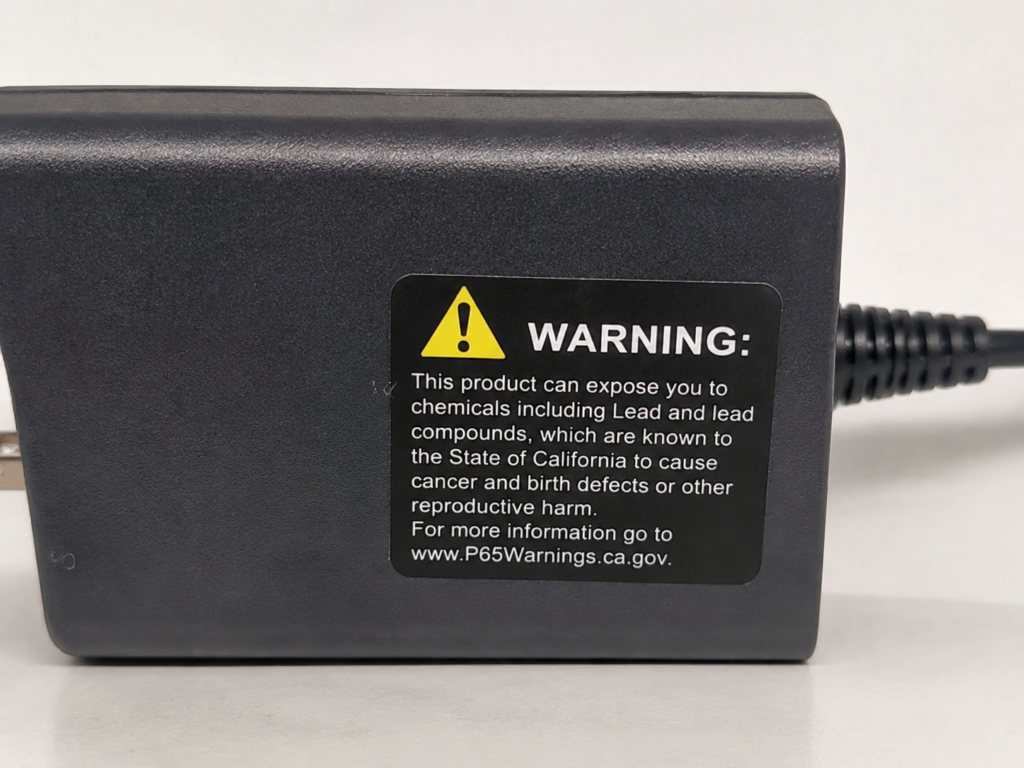
Consumers or cross-border sellers who frequently deal with electronic products in the California, U.S. market have mostly seen the “WARNING” label with a black exclamation mark on a yellow background, which is commonly known as the “California Proposition 65” mark. Many people mistakenly think it means the product is toxic or unqualified. In fact, it is a unique consumer right-to-know rule in California, and electronic products are a high-incidence controlled category, with many detailed requirements that are easy to fall foul of. This article explains from basic concepts, control logic, compliance methods to common misconceptions one by one, suitable for ordinary consumers and entry-level operators for reference.
1. Basic Understanding: The Relationship Between California Proposition 65 and Electronic Products
The official full name of California Proposition 65 is the Safe Drinking Water and Toxic Enforcement Act of 1986 (Proposition 65), a state-level regulation passed by California’s statewide referendum in 1986. It is neither a U.S. federal requirement nor a product quality certification. Its core logic is to let California consumers know before purchasing whether the product will expose them to carcinogenic or reproductive toxic chemicals, leaving the choice to consumers; at the same time, it prohibits enterprises from discharging controlled substances on the list into California’s drinking water sources. The compliance focus of electronic enterprises is usually the consumer warning obligation.
Electronic products are a high-incidence controlled category under California Proposition 65, mainly for three reasons: First, complex materials — controlled substances are prone to appear in solder, plastic shells, wires, batteries, and metal plating; second, frequent contact — most consumer electronics are hand-held or used close to the body, and there are even habits such as biting wires, resulting in higher exposure risks; third, high incidence of lawsuits — consumer electronics and accessories are key targets of private enforcement, especially small accessories have low testing costs and large sales volumes, making them easy to be sued.
Scope of Application and Boundaries
The obligors of California Proposition 65 are business entities that operate in California, provide products to California consumers and may cause chemical exposure, covering all consumer electronic products sold, distributed, or given away in California (including cross-border direct mail and online orders sold to California). Common mobile phones, computers, earphones, power banks, data cables, smart watches and accessories are all within the scope of control.
There are two common exemption/non-trigger scenarios: First, small business entities with fewer than 10 employees that meet the legal definition can apply the small business exemption and do not need to bear the warning obligation themselves. Here is a special reminder for entry-level sellers: this exemption only applies to the warning obligation of the business entity itself, and cannot be equated with a product safety endorsement; if the product enters the California market through other entities such as platforms, importers, and brand owners, other responsible entities in the chain may still bear the warning obligation, and the enterprise still needs to comply with other California Proposition 65 related requirements such as drinking water source discharge. Second, individual non-commercial occasional second-hand resale (such as personal transfer of used mobile phones for personal use) is not a business activity and does not bear compliance obligations, but commercial second-hand sellers still need to abide by the rules. It should be noted that electronic equipment for purely industrial use is not automatically exempt. If it is only sold to industrial customers and does not cause exposure to ordinary consumers, it usually does not trigger the consumer warning obligation, but it still needs to comply with the relevant requirements for drinking water source discharge.
Four Core Cognitive Corrections
Regarding common misconceptions about California Proposition 65, first clarify four core judgments:
- It is not a ban on the use of hazardous substances: Even if the exposure level of chemical substances in the product exceeds the standard, as long as the notification obligation is fulfilled as required, it can still be sold legally. It is not that products with any controlled substances are banned from sale.
- It does not only apply to local California products: As long as they enter the California market, regardless of whether they are produced in other U.S. states or overseas, they must comply with the rules.
- It does not only apply to big-brand/high-priced products: Low-priced small accessories are more likely to be sued because of frequent contact and low testing costs. The applicability of the regulation has nothing to do with product price or volume.
- Having FCC/UL certification does not mean compliance: FCC (Federal Communications Commission, responsible for technical compliance of electronic equipment) and UL (electrical safety certification carried out by third-party institutions) target electromagnetic compatibility and electrical safety respectively, which are completely unrelated to the chemical substance right-to-know requirements of California Proposition 65 and cannot replace each other.
2. Core Logic: The Core of Control is Human Exposure Rather Than Product Content
The most special control logic of California Proposition 65 is that it does not take the total content of hazardous substances in the product as the judgment standard, but takes the dose that consumers actually contact and absorb during normal use — that is, “human exposure” — as the core. For example, for fully sealed true wireless earphones, if the lead in the internal solder joints cannot be contacted under normal use and reasonably foreseeable wear, the warning obligation is usually not triggered. However, if the product can be disassembled by itself, or the internal substances are easily exposed after damage, the risk still needs to be assessed.
The threshold for judging whether a warning needs to be posted is the “Safe Harbor Level”, formulated by the California Office of Environmental Health Hazard Assessment (OEHHA, the California state agency responsible for maintaining the California Proposition 65 list and warning rules). It is divided into two categories, with different calculation assumptions and applicable scenarios:
- No Significant Risk Level (NSRL, for carcinogenic substances): A dose threshold based on lifetime daily exposure with a cancer risk of no more than one in 100,000.
- Maximum Allowable Dose Level (MADL, for reproductive toxic substances): A safe dose threshold based on lifetime daily exposure that does not produce observable reproductive harm.
It should be noted that the safe harbor levels of different substances vary greatly, and some controlled substances do not have publicly available safe harbor values for the time being. The specific values shall be subject to the latest official release of OEHHA, and there is no need to memorize them by rote.
When judging the exposure level, it is necessary to combine the actual contact scenarios: common exposure routes include skin contact, hand-to-mouth contact (such as eating directly after touching a data cable), and inhalation of dust/smoke (such as powder produced after old equipment is broken). The premise of judgment includes not only normal use, but also reasonably foreseeable misuse. For example, if infants and young children put small Bluetooth earphones into their mouths, merchants cannot ignore this scenario on the grounds that “they will not bite during normal use”. Children, pregnant women, and users who use electronic products for a long time hand-held or close to the body are high-risk groups, and more caution is required during assessment.
Regarding the boundary between “accessible” and “internally enclosed”, the judgment standard is: shells, wires, buttons, plugs, labels, etc. that users can touch during normal use are all accessible parts; solder joints, battery cells, and circuit boards that are completely sealed in non-detachable shells usually have lower exposure risks. However, if the product supports self-disassembly (such as a remote control with replaceable batteries), or internal substances can be accessed after normal use wear/damage, it cannot be considered completely enclosed.
3. High-Risk Substances in Electronic Products and Key Inspection Points
The control list of California Proposition 65 is dynamically updated by OEHHA and may be adjusted multiple times within a year. Currently, there are about 900 substances on the list, of which about 10 are frequently involved in the electronic product field. There is no need to memorize all of them, and focus can be placed on four types of high-incidence substances:
- Lead (Pb): Commonly found in solder, electronic component pins, battery electrodes, metal plating, and glass/ceramic parts.
- Phthalates (plasticizers): Commonly found in soft plastic shells, charging cable sheaths, earphone rubber sleeves, and button soft rubber. Hard plastics usually do not need to add plasticizers and have lower risks.
- Cadmium (Cd): Commonly found in rechargeable batteries, switch contacts, plastic stabilizers, and electroplating layers.
- Hexavalent Chromium (Cr VI): Commonly found in metal anti-corrosion coatings and electroplating layers.
In addition, there are several types of substances to pay attention to: Bisphenol A (BPA) may be present in some plastic shells, thermal labels, and coatings; flame retardants may be present in plastic shells and insulating materials around PCBs, depending on the specific formula; per- and polyfluoroalkyl substances (PFAS) may be present in waterproof and oil-proof electronic coatings and some protective films; mercury (Hg) is mostly found in old-fashioned switches and sensors, and is less used in modern electronic products.
When investigating risks, you can sort them from high to low contact frequency to avoid omissions:
- Long-term skin-contact parts: Smart watch straps, earphone rubber sleeves, and wearable device shells have the highest exposure risk;
- High-frequency holding parts: Mobile phone cases, game controllers, mice, keyboards, and remote controls have long daily contact time;
- High-frequency plug-in parts: Charging cables, data cables, adapter plugs, and interface metal parts are contacted every time charging is performed;
- Small parts easily accessible to children: Small electronic accessories, wires, buttons, and battery covers are easily put into the mouth by children;
- Packaging auxiliary materials: Plastic bags, stickers, protective films, and thermal labels are parts that users will contact and are easily overlooked.
After a new substance is added to the control list, the warning obligation usually does not take effect immediately. A common practice is to set a transition period of about 12 months for enterprises to adjust; however, the specific effective date and transition requirements shall be subject to the official announcement of OEHHA. There is no need to excessively follow up on list changes, just focus on high-incidence substances in electronic products.
4. Compliance Requirements: Two Paths and Warning Rules
There are two types of compliance paths for California Proposition 65, and enterprises can choose according to their own situation:
Path 1: Exposure is below the safe harbor level, no warning needs to be posted
If the exposure level of hazardous substances in the accessible parts of the product is lower than the corresponding safe harbor value, or the hazardous substances are completely sealed inside and there is no possibility of exposure under normal use, no warning needs to be posted. However, compliance certificates must be kept for future reference, including supplier material declarations, third-party test reports, exposure assessment reports, etc. For example, for fully sealed true wireless earphones with built-in batteries, if the internal heavy metals cannot be accessed under normal use, this path can be applied.
It should be noted that supplier material declarations are used to trace the formula components of accessible parts, migration/leaching tests are used to verify the actual release level of substances, and exposure assessments are used to judge whether the warning threshold is reached. The three have different functions and cannot replace each other.
Path 2: Display warnings as required (the most commonly used low-cost compliance method)
If it is impossible to prove that the exposure level is below the safe harbor, the most worry-free way is to post a warning as required, and the cost is much lower than the cost of testing and litigation.
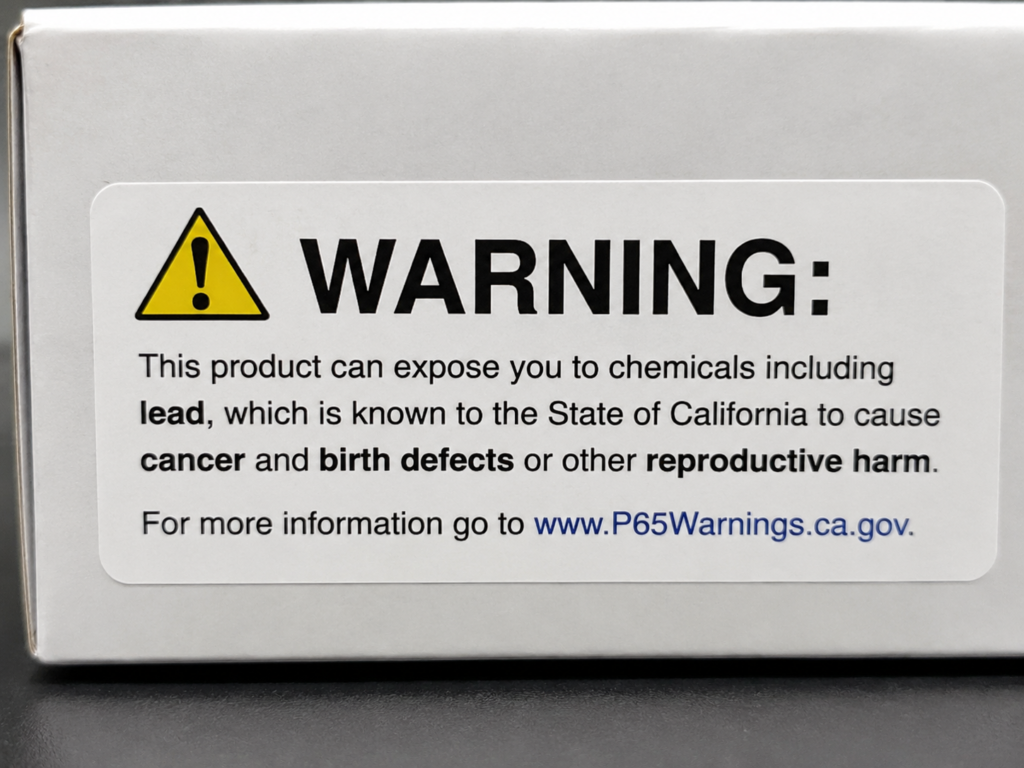
Warnings are divided into two categories: long-form and short-form. Long-form warnings are applicable to scenarios where there is sufficient space on the product/packaging, and must include core elements such as a yellow triangle exclamation mark icon + the English word “WARNING”, clear risk type (carcinogenic/reproductive harm or both), at least one relevant controlled chemical substance, and the link to the official California warning website; the chemical substances listed must correspond to the actual exposure risk and warning type. For example, substances only involving reproductive toxicity should not be arbitrarily marked as carcinogenic risk; if there are both carcinogenic and reproductive harm risks, the relevant descriptions of both types of risks should be covered in accordance with the applicable format. Short-form warnings are applicable to scenarios where the product/packaging space is extremely small. The specific format and content requirements shall be subject to the current effective rules of OEHHA. Enterprises must check the latest requirements before using them, and shall not simplify them on their own.
Warning placement requirements vary for different sales scenarios:
- Offline retail: Can be placed on the product itself, packaging, or prominent positions on shelves. For very small products, hang tags can be used;
- Online e-commerce: Warnings or clear warning entry links must be displayed in a prominent position on the product detail page, and must also be visible during the checkout process before consumers complete their purchase, to ensure that consumers can easily obtain the information before placing an order. They must not be hidden in non-prominent areas such as collapsed sections, user agreements, after-sales terms, FAQs, or the bottom of the page. The specific requirements must comply with the current rules of OEHHA for online channels;
- Electronic accessories that require installation (such as desktop graphics cards, hard drives): Warning content can be added to the installation instructions, but this cannot replace the pre-purchase notification obligation.
Responsibility Division and Document Preservation
Regarding the division of compliance responsibilities: the warning obligation is mainly borne by the product manufacturer, brand owner, importer, packager and other entities; if a retailer can prove that it has obtained compliant warning materials from the upstream supplier and has not modified the warning content itself, the corresponding exemption rules can apply. The specific division of responsibilities shall be subject to the original text of the regulation. Ordinary consumers do not need to bear compliance responsibilities.
No matter which path is chosen, compliance documents must be properly preserved: supplier declarations, test reports, exposure assessment records, and warning label samples must all be kept on file. It is recommended that the retention period be no less than the product life cycle plus a reasonable limitation period. In the event of litigation or settlement, complete evidence can greatly reduce risks and costs. If the supply chain, materials, or processes change and may affect the chemical composition or exposure path of accessible parts, a new assessment must be carried out, and the original report cannot be directly used.
5. Practical Judgment: Quick Operation Methods for Ordinary Users and Small Merchants
When ordinary consumers purchase electronic products, they can make quick judgments through a three-step method:
Step 1: Look for warning marks. Marks on the product itself, packaging, and online detail pages are all valid;
Step 2: A warning does not mean toxic. It may be that the exposure exceeds the safe harbor threshold, or it may be a preventive warning taken by the enterprise for risk prevention. It is not that you will get sick if you touch it once. Just pay attention to usage habits in daily life;
Step 3: No warning does not mean completely harmless. It may be that the merchant did not post it in violation of regulations, or the exposure level does meet the standard. There is no need to worry too much.
Entry-level small merchants and sellers targeting the California market can quickly judge compliance through a four-step process:
Step 1: Confirm whether the product enters the California market. Online shipping to California addresses, offline sales in California, and supply to California distributors all count;
Step 2: Sort out all user-accessible parts, and do not miss easily overlooked parts such as shells, wires, buttons, packaging, and labels;
Step 3: Check supply chain materials, ask suppliers for substance declarations of accessible parts, and confirm whether they involve substances on the control list;
Step 4: Judge the exposure risk. First identify the actual controlled substances and corresponding hazard types. If it is impossible to prove that the exposure level is below the safe harbor, give priority to posting warnings in accordance with the rules, which has the lowest cost. Do not take chances.
For multi-variant and multi-category products, there are several other precautions: variants of different materials and colors need to confirm risks separately, and cannot share the same compliance declaration. For example, black soft rubber mobile phone cases and white hard shell mobile phone cases have different materials and different risks; for set products, all component parts must be inspected, not just the main product. For example, data cables and storage bags given away with earphones must all be included in the assessment; after changes in the supply chain, materials, or processes, if they may affect exposure risks, a reassessment is required.
When encountering the following scenarios, it is recommended to seek the help of professional compliance personnel: products are targeted at sensitive groups such as children and pregnant women; receiving a 60-day violation notice of California Proposition 65; planning to enter large retail channels or mainstream e-commerce platforms; products contain multiple controlled substances and have complex exposure scenarios.
6. Risk Avoidance: Enforcement Rules and High-Incidence Misconceptions
The enforcement mechanism of California Proposition 65 is quite special: in addition to the California Attorney General and district attorneys, eligible private individuals or environmental organizations can also sue violating merchants, commonly known as the “private prosecutor” system. The plaintiff usually first purchases the product for testing, and sends a 60-day violation notice after confirming the violation. After receiving the notice, the enterprise can handle it through rectification, settlement, etc. Whether it enters the formal litigation stage depends on multiple factors such as the plaintiff’s qualifications, the compliance of the notice, and the rectification situation. Screenshots of e-commerce pages, product labels, and test reports may all become evidence in disputes.
The consequences of violations should be viewed rationally: the upper limit of statutory civil fines is $2,500 per violation per day, which is the statutory maximum. The specific penalty amount is determined by the court according to the circumstances of the violation, duration, subjective fault, etc. It is not that violations will be punished at the upper limit. In practice, most cases end in settlement, and the settlement amount varies greatly due to product sales volume, involved substances, duration of violation, etc., and there is no unified standard. Violations generally do not constitute criminal liability, nor will they automatically lead to product recalls. Common handling requirements include rectifying labels, replacing materials, and issuing notices to consumers.
Four types of high-incidence violation scenarios for electronic products need to be avoided with focus:
- Soft plastic accessories such as charging cables, earphone sleeves, and mobile phone cases cannot prove that phthalate-related exposure levels are below the safe harbor, and do not provide warnings as required. They are categories with a high frequency of being sued;
- Battery-powered products such as power banks and Bluetooth speakers cannot prove that the relevant exposure levels of lead, cadmium and other substances are below the safe harbor, and do not provide warnings as required;
- The detail pages of electronically sold products do not have compliant warnings, or the warnings are hidden in non-prominent areas;
- Small accessories such as data cables and buttons are often ignored by merchants for compliance due to low unit price and small size, which are high-frequency pitfalls.
Six of the most common cognitive misconceptions need to be distinguished:
- A product with a California Proposition 65 warning is a low-quality product: Wrong. Products of many mainstream consumer electronics brands also post this warning, which is a normal compliance notification behavior and has no direct relationship with product quality.
- Products containing listed substances must be labeled: Wrong. If the substance is completely sealed inside and inaccessible to users, or the exposure level is below the safe harbor level, no posting is required.
- Posting a warning means everything is fine: Wrong. If the content, position, and format of the warning do not meet the requirements, it is also a violation and may still be sued.
- Small products/low unit price do not need to be managed: Wrong. The applicability of the regulation has nothing to do with product size and price. On the contrary, small accessories are key targets of private enforcement due to low testing costs and large sales volumes.
- Having a test report means compliance: Wrong. The total content test of the whole product can be used as a preliminary screening method, but usually cannot directly prove whether the consumer exposure level meets the standard. Migration/leaching tests or exposure assessments need to be carried out for accessible parts; if the supply chain or materials change and affect the exposure risk, the old report cannot be directly used.
- If RoHS is passed, California Proposition 65 does not need to be considered: Wrong. RoHS (EU Restriction of Hazardous Substances Directive for electrical and electronic equipment) restricts the content of hazardous substances in electronic products, while California Proposition 65 focuses on human exposure. The assessment logic is completely different. Even if it meets the RoHS content requirements, if long-term contact causes the exposure to exceed the safe harbor, a warning still needs to be posted.
Entry-level risk avoidance methods for two groups of people:
- Consumers: Do not bite the shells and wires of electronic products. Wash hands before meals after touching electronic products. Avoid infants and young children playing with small electronic accessories to prevent them from putting them in their mouths.
- Small merchants: Give priority to suppliers that can provide California Proposition 65 compliance declarations. When unsure of the risk, post warnings in accordance with the rules. Do not take chances — the cost of labels is far lower than the settlement amount.
7. Easy-to-Confuse Distinctions: Differences Between California Proposition 65 and Other Electronic Regulations
Many people easily confuse California Proposition 65 with other common electronic regulations and certifications. The core differences are as follows:
| Common Regulation/Certification | Core Difference from California Proposition 65 |
|---|---|
| EU RoHS Directive | RoHS is an EU directive that restricts the content of hazardous substances in electrical and electronic equipment. Currently, it controls 10 types of restricted substances. In principle, products exceeding the standard cannot be placed on the EU market, with specific exemption scenarios; California Proposition 65 takes human exposure as the core of judgment. In the scenario of consumer product warnings, if exposure exceeds the safe harbor, the compliance focus is usually to provide clear and reasonable warnings; however, other applicable regulations must still be met at the same time, and the drinking water source discharge ban cannot be replaced by labeling, and there are more substances on the control list |
| U.S. FCC Certification | FCC is the technical compliance requirement formulated by the Federal Communications Commission for electromagnetic compatibility, radio frequency radiation, etc. of electronic equipment. The specific rules depend on the type of equipment; California Proposition 65 manages the right to know about chemical substances, which belongs to consumer rights protection. The two are completely unrelated and cannot replace each other |
| EU REACH Regulation | REACH (Registration, Evaluation, Authorization and Restriction of Chemicals) is a chemical management regulation covering all categories, with an extremely wide scope; California Proposition 65 is a consumer warning regulation only applicable to the California market, with different applicable regions, control logic, and requirements |
| UL/ETL Safety Certification | UL/ETL are electrical safety certifications carried out by third-party institutions to verify whether products have risks such as electric leakage and fire; California Proposition 65 is not a safety certification, but only a notification requirement for chemical substance exposure |
8. Summary: 5 Judgments You Can Make After Learning
After reading this article, you don’t need to memorize all the regulatory details by rote, and you can quickly make the following 5 practical judgments:
First, you can clarify that the essence of California Proposition 65 is a “consumer right-to-know requirement”, which is neither a sales ban nor a product quality certification — posting a warning is just fulfilling the notification obligation, does not mean the product is low-quality, and not posting it does not mean it is completely harmless.
Second, you can quickly judge whether an electronic product is within the scope of control: as long as it is consumer electronics and accessories sold, distributed, or given away to the California market (including cross-border direct mail and online orders sent to California), it falls under the control category; purely industrial equipment and individual non-commercial second-hand resale usually do not trigger the consumer warning obligation. Small enterprises with fewer than 10 employees can apply for entity-level exemption, but need to pay attention to the responsibilities of other entities in the chain.
Third, you can initially judge whether a warning needs to be posted through the logic of “accessible parts + whether exposure exceeds the safe harbor”: first find the parts that users can touch during normal use, then check whether the substance exposure of these parts is below the safe harbor. Substances completely sealed inside usually do not trigger the warning obligation.
Fourth, you can clearly distinguish the differences between California Proposition 65 and common electronic regulations/certifications such as RoHS, FCC, REACH, UL/ETL, and will not be misled by wrong statements such as “if RoHS is passed, California Proposition 65 does not need to be considered” and “having FCC certification means compliance”.
Fifth, you can identify the highest-incidence violation risks of electronic products and take corresponding risk-avoidance actions: consumers only need to avoid biting electronic accessories, wash hands after contact, and do not let infants and young children play with small electronic parts; small merchants can reduce risks by asking for supplier compliance declarations, sorting out accessible parts, and posting warnings when unsure, and seek professional help when encountering complex scenarios.