
When dealing with product compliance for the UK GB market, many people, upon first hearing of “UKCA self-declaration”, tend to go to two extremes: either they think it is a gray channel where “you can go on the market just by writing a random declaration”, or they think only third-party certification is reliable and self-declaration will definitely not pass supervision. In fact, UKCA self-declaration is a compliance path explicitly recognized by UK law. When statutory conditions are met, it has exactly the same market access effect as third-party certification. Its core principle is “whoever produces is responsible” — the manufacturer must complete the conformity assessment on its own and retain complete and traceable compliance evidence, rather than completing compliance solely with a single declaration. The following will systematically sort out the method for judging the scope of application, requirements for necessary documents, practical steps of the whole process, as well as rules for reusing CE documents and common compliance risks, to help you master the core logic and implementation methods of this set of rules.
1. First Understand the Basics: What Exactly is UKCA Self-Declaration
In plain terms, the essence of UKCA self-declaration is a compliance path where the manufacturer completes the product conformity assessment on its own and promises that the product meets the requirements of relevant UK regulations, without prior review by a third-party body officially designated by the UK. Its official term is “Self-declaration”, also known as “Module A: Internal production control” — you don’t need to remember this module name; just know that it is a path of “being responsible for yourself and providing evidence by yourself”.
Applicable Market Boundaries
Next, we must first clarify the applicable regions. Many people confuse “the UK” with the “scope of UKCA application”. The core applicable areas of the UKCA mark are England, Scotland and Wales. These three regions together are called Great Britain, which is what we often refer to as GB (the UK mainland).
The rules for Northern Ireland are different: UKCA cannot be used alone in the Northern Ireland market. If your product follows the self-declaration path, or has undergone third-party assessment completed by an EU notified body, only the CE mark is required in Northern Ireland; only products that have undergone third-party assessment completed by a UK Approved Body (UKAB for short, a third-party assessment body officially authorized by the UK) need to bear the UKNI mark to enter Northern Ireland. For products with special arrangements such as medical devices and construction products, separate verification must be carried out in accordance with corresponding industry rules and the latest government guidelines.
If you sell your products to the EU, GB and Northern Ireland at the same time, you must judge the compliance path separately, and you cannot use one set of documents for all regions.
Clarification of Core Concepts
Here we also need to clarify several easily confused concepts to avoid errors in subsequent judgments:
First, the core difference between self-declaration and UKCA third-party certification is whether there is UKAB involvement. Self-declaration is done entirely by yourself, while third-party certification requires UKAB to carry out assessment and issue certificates.
Second, it is necessary to clarify the relationship between self-declaration and “UKCA certificate”. Many people ask “can you get a UKCA certificate through self-declaration”. The answer is that under the self-declaration path, there is usually no UKCA certification certificate issued after prior review by UKAB; the core documents are technical documentation and UK DoC; only when regulations require third-party conformity assessment may there be conformity assessment documents such as type examination and quality system approval issued by a designated body. The core of self-declaration is a complete set of compliance evidence chain, not a single certificate issued by a third-party body.
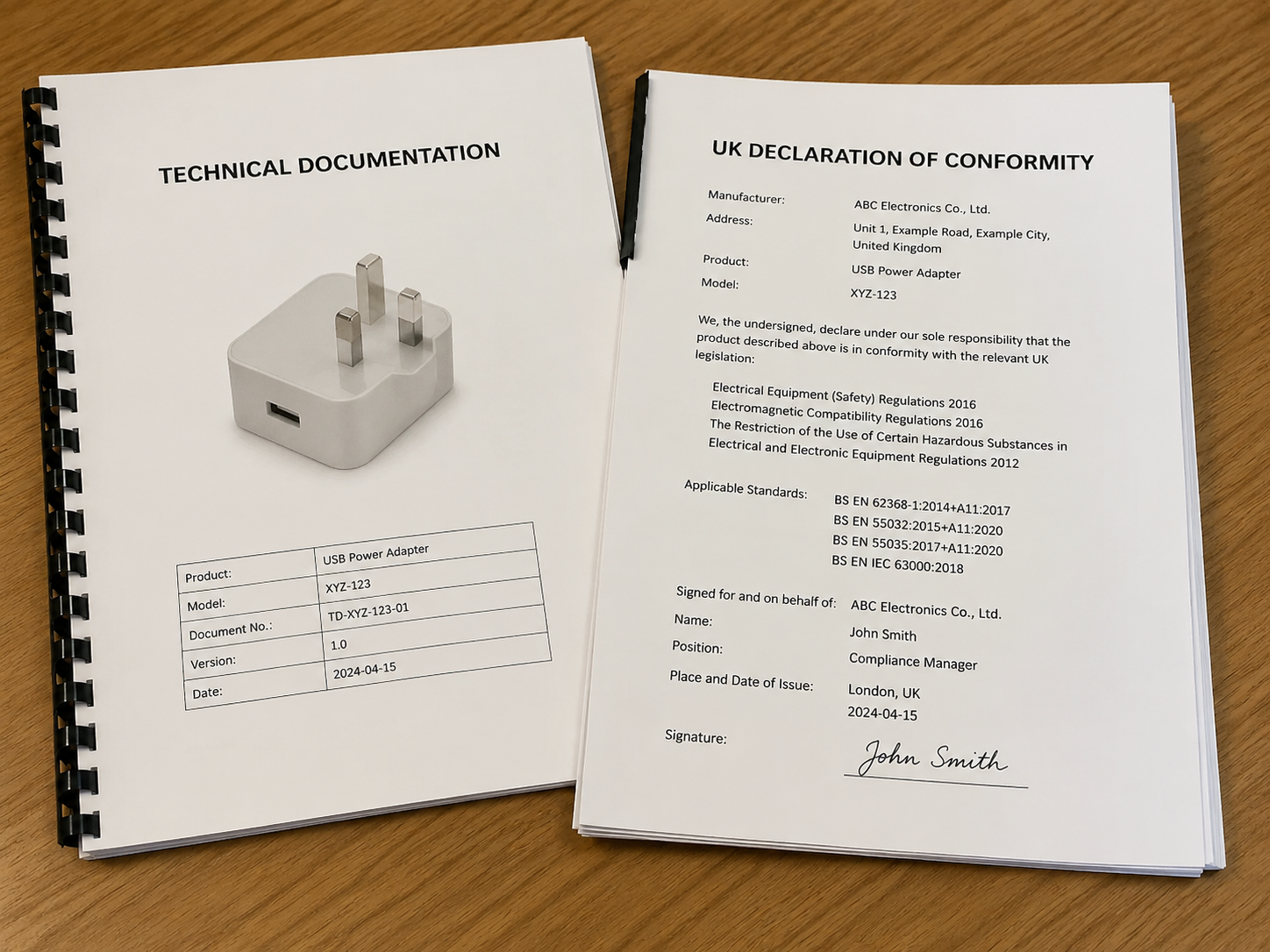
Third, we should briefly mention the background of Brexit: after the UK left the EU, not all products bearing the CE mark can directly enter the GB market. Whether they are recognized and how long they are recognized must be verified in accordance with the regulations of the corresponding products. UKCA is one of the official compliance paths for the GB market, and it is two parallel systems with CE.
2. Core Judgment: Whether Your Product Can Use UKCA Self-Declaration
The core of judging whether self-declaration is applicable is a four-step logic, equivalent to a decision tree. Each step must meet the conditions before proceeding to the next:
Step 1: First confirm that your product and sales destination are within the scope of application of the UKCA general rules;
Step 2: Find out all UK product regulations that your product needs to comply with — note that a product may be subject to multiple regulations at the same time. For example, a Bluetooth electric toothbrush must comply with electrical safety regulations, electromagnetic compatibility regulations, and may also comply with RoHS regulations;
Step 3: Check each applicable regulation to see if it allows the manufacturer to complete the conformity assessment on its own (that is, the Module A / internal production control path we mentioned earlier);
Step 4: Confirm that your product does not trigger the statutory situation where “UKAB must be involved”.
Here we need to correct a common misconception: many people think that “only low-risk products and products with UK designated standards can use self-declaration”, but this is not the case. Low risk and having designated standards are only clues for quick judgment, not necessary prerequisites. Even if there is no corresponding UK designated standard, as long as you can provide other sufficient technical evidence to prove that the product meets the basic safety requirements of the regulations, you can still use self-declaration.
Preliminary Screening of Product Scope
Let’s first break down the product scope of the first step to help you quickly screen:
Generally speaking, all finished products, supporting parts, accessories and set products sold to the GB market fall within the scope of application of the UKCA general rules.
However, there are several special situations where the general rules cannot be directly applied and separate verification is required: for example, second-hand products, modified products, custom products, samples for exhibition or R&D, products imported for personal use, and parts sold separately. All these need to be checked for special provisions in the corresponding regulations.
There are also several types of products that are governed by special systems and do not apply to the general UKCA self-declaration logic, such as automobiles, pharmaceuticals, medical devices, cosmetics, food contact materials, construction products, etc. For these, you should directly check the rules with the regulatory authorities of the corresponding industry, and do not apply the general process.
Reference for Compliance Paths of Common Categories
To give you an intuitive reference, we have compiled a comparison of compliance paths for several common types of products, but it must be noted that these are only general references. The final result must be based on the currently effective regulations, the actual configuration and intended use of your product, and cannot be directly copied.
| Product Category | Can Self-Declaration Be Used (General Reference) | Remarks |
| Electrical Safety (LVD) / Electromagnetic Compatibility (EMC) | Yes for most ordinary electronic and electrical products | Need to verify specific applicable regulations and standards |
| Toys | Yes if fully compliant with UK designated toy standards | If standards are not fully covered or special risks are involved, UKAB involvement may be required |
| Personal Protective Equipment (PPE) | Only for Category I (low risk, such as ordinary work gloves) | Category II/III medium and high risk products require UKAB involvement |
| Machinery | Yes for ordinary machinery (not on the high-risk list) | Machinery included in the high-risk list requires UKAB assessment |
| Pressure Equipment | Yes for low pressure/volume categories | High categories require UKAB involvement, specific judgment based on regulatory classification |
| Explosion-proof Products | Only for extremely low-risk scenarios | Most require UKAB involvement |
Roles and Qualification Requirements of Economic Operators
After clarifying the product scope, it is also necessary to clarify who is qualified to make self-declaration and what responsibilities different roles should bear. The core principle here is: the legal obligations of all roles must be confirmed in accordance with the specific regulations applicable to your product, there is no general requirement that ‘there must be a UK Responsible Person (UK RP)’.
Specifically:
Manufacturers, whether based in the UK or overseas, are the ultimate responsible persons for product compliance and can initiate self-declaration;
UK-based importers usually need to perform the verification obligations required by regulations, such as checking whether product labels are correct and whether compliance documents are complete, and must also cooperate with supervision and cannot sell non-compliant products;
An authorized representative can only be designated by the manufacturer to perform part of the compliance duties on the premise that the corresponding regulations allow it, and it is not required for all products;
UK RP is a statutory role in specific regulations such as medical devices and cosmetics. It is not required at all for general consumer goods. Don’t be misled into spending unnecessary money;
If an importer or distributor wants to make a self-declaration on behalf of the manufacturer, they must obtain written authorization from the manufacturer, and even if they do so, the ultimate compliance responsibility still lies with the manufacturer and cannot be shirked.
3. Necessary Documents and Markings: What to Prepare for Self-Declaration
After confirming that self-declaration is applicable, what many people care most about is “what to prepare to be considered compliant”. The core of self-declaration is not the declaration itself, but a complete set of evidence that can prove product compliance, as well as markings that meet the requirements. All requirements in this chapter are general references. All details including document language, retention period, signing form, marking specifications, etc., must be subject to the UK special regulations applicable to the product, and will not be repeatedly prompted below.
Let’s first clarify the general division of responsibilities of each role: the manufacturer is the leading party, responsible for the entire conformity assessment process, issuing a full set of compliance documents and bearing the ultimate responsibility; UK importers need to verify the integrity of product markings and compliance documents, and must not sell products that they know are non-compliant; authorized representatives or UK RPs perform document custody and supervision docking duties in accordance with the requirements of corresponding regulations; distributors must not modify products or replace compliance documents without authorization, and must report violations to the regulatory authorities if found.
Technical Documentation Requirements
Technical documentation is a collection of all compliance evidence and is also the core material for supervision and verification. It is not a simple pile of test reports, but must fully prove “why the product meets the regulatory requirements” with clear logic.
General content includes detailed product description, design drawings/circuit diagrams, test records, risk assessment report, label draft, and production consistency control description. When organizing, it is recommended to arrange according to the logic of “product description → applicable regulations → evidence standards/evidence → compliance conclusion”, to avoid the accumulation of irrelevant materials affecting verification efficiency.
General verification points: the document language is mainly English, and some regulations allow other languages; the retention period is usually 10 years after the last batch of products is put on the market, and special products are implemented in accordance with corresponding regulations; it is not mandatory to store them in the GB territory, but they must be provided in a timely manner when required by supervision; test reports can come from internal laboratories or ordinary third-party institutions, and do not need to be issued by UKAB, but must be authentic and traceable.
UK Declaration of Conformity (UK DoC) Requirements
The UK DoC is an official compliance commitment document signed by the manufacturer and is also one of the core identifiers of the self-declaration path.
Its general content includes manufacturer/authorized entity information, product model/batch, applicable regulations and standards, authorized signatory information, and signing date. When signing, note that: most regulations recognize electronic signatures; it can be issued for a single product, or cover products of the same series with consistent design and risk; it can be in paper or electronic form, and must be retrievable at any time.
Special attention should be paid: all information on the UK DoC must be completely consistent with the actual product and technical documentation. False labeling will constitute an illegal declaration and require corresponding legal responsibility.
Product Marking and Instruction Manual Requirements
In addition to documents, product markings and instruction manuals are also necessary components of compliance. The general requirement for the UKCA mark is that it is clear, permanently affixed, and not easy to wear.
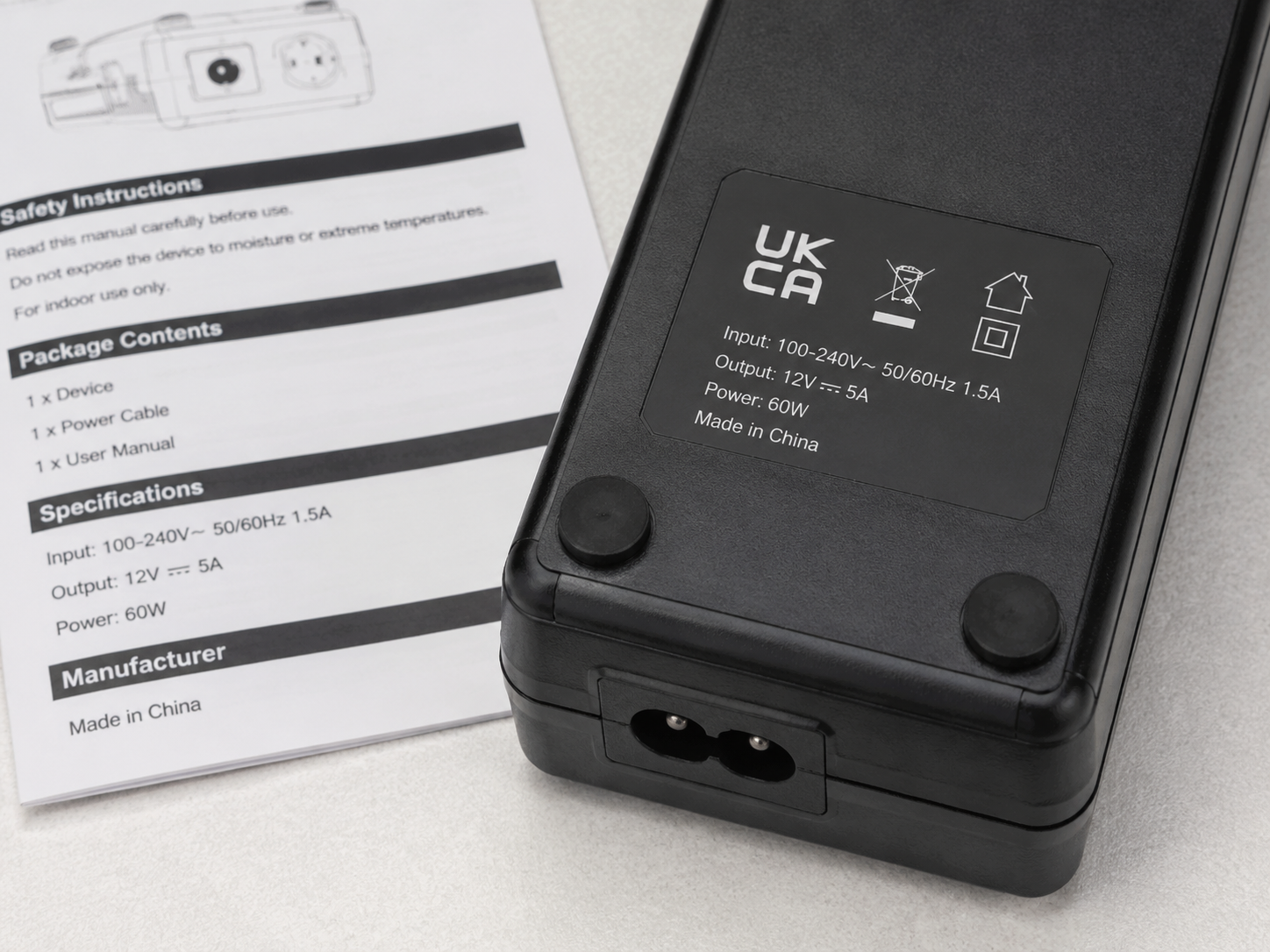
General verification points: the minimum size is usually 5mm, with exceptions for very small products or special regulations; the affixing position is preferably on the product body, and some regulations allow it to be affixed to packaging or accompanying documents; it must not be mixed with other compliance marks to cause misleading, and multiple marks must be clearly distinguished and not blocked by each other.
The instruction manual must provide a language version that meets regulatory requirements, clearly mark safety warnings and use restrictions, and the product model contained therein must be completely consistent with the actual product and the UK DoC.
Quick Verification Checklist for Documents and Markings
You can quickly check the general requirements according to the following items:
1. Technical documentation: complete content, compliant retention period, available in a timely manner, language meets requirements
2. UK DoC: valid signature, accurate coverage of model range
3. UKCA mark: size, position, durability meet requirements
4. Entity information: contact information of manufacturer and importer is marked as required
4. Practical Steps: Do UKCA Self-Declaration from Scratch
After clarifying what to prepare, let’s talk about the specific practical process. There are five steps in total, each with clear inputs, tasks to do and output documents. You can follow them step by step.
Step 1: Compliance Qualification Verification
The first step is the process of judging whether self-declaration is applicable as we mentioned earlier.
The input information you need to prepare is: detailed product information, sales destination, intended use of the product.
Tasks to do include: first confirm that the sales destination is GB; check whether the product belongs to a category under special circumstances or special system governance; then find all applicable UK product regulations and make a list.
The output of this step is the .
There is a key judgment point here: as long as any regulation in the list does not allow self-declaration, you cannot take the self-declaration path and must switch to third-party certification.
Step 2: Confirm Applicable Standards and Basic Requirements
The inputs are the list of applicable regulations from the first step and your product technical data.
The task to do is: find the UK designated standards under each applicable regulation, compare your existing product data with the standard requirements one by one, and sort out the risk points not covered by the standards.
The outputs of this step are the , , and .
It should be noted that if there is no corresponding UK designated standard, you must formulate a supplementary technical evidence plan to prove that the product meets the basic requirements of the regulations in other ways, and you cannot skip this step just because there is no standard.
Step 3: Complete Conformity Assessment
This is the most core step, and also where many people cut corners.
The inputs are standard requirements, list of standard deviations, and product samples.
Tasks to do include: checking whether the product’s design, materials, and performance meet the requirements against the basic requirements of standards or regulations; completing a full risk assessment and controlling all identified risks; carrying out necessary tests, and rectifying non-conformities until all are compliant; also establishing a production consistency control mechanism to ensure that mass-produced products are the same as the tested samples, and that samples cannot be qualified while bulk goods are unqualified.
The outputs of this step are the , , , and .
Key judgment point: only after all risks are controllable and all tests are passed can you proceed to the next step. Do not proceed with problems.
Step 4: Organize Documents and Sign the UK DoC
The inputs are all the previous assessment and test data, as well as the manufacturer’s information.
The task to do is: organize the full set of technical documents according to the logic we mentioned earlier; check whether the models and versions on the documents, products, and labels are completely consistent; finally, the authorized person in charge of the manufacturer signs the UK DoC.
The outputs of this step are the full set of compliance technical documents and the officially signed .
Before signing, be sure to check again from beginning to end, especially key information such as model numbers and standard numbers. Writing them wrong means all efforts are in vain, and may also constitute a false declaration.
Step 5: Labeling and Post-Market Maintenance
Many people think that once the product is on the market, it’s done. In fact, post-market maintenance is also very important.
The inputs are compliance documents, products, packaging, and instruction manuals.
Tasks to do include: affixing the UKCA mark in accordance with regulatory requirements; checking whether the information on the packaging and instruction manuals is consistent with the product; also establishing a mechanism for re-evaluation triggered by changes, that is, when the product is modified in the future, it is necessary to judge whether a new compliance assessment is required.
The outputs of this step are the and .
Post-market requirements are: keep all compliance documents for the period specified by regulations; if the product’s design or materials change, or the applicable standards and regulations are updated, the compliance must be re-evaluated in a timely manner, and it cannot be done once and for all.
5. Can CE Documents Be Reused? Differences Between UK and EU Compliance and Pitfall Avoidance
Many sellers who have already done CE compliance will ask: can I directly use CE documents for UKCA? The answer is: those that meet the conditions can be reused, but you cannot just change the header and use them directly; you must first verify. Let’s first talk about the general principle of CE recognition in the GB market, and then talk about how to reuse.
General Principle of CE Recognition in the GB Market
First of all, we must confirm a core rule: regarding the recognition of the CE mark in the GB market, there is no general conclusion of ‘all recognized’ or ‘all not recognized’, and it must be verified item by item in accordance with specific product regulations.
When verifying, there are five main dimensions to look at:
First, the scope of regulations: whether the regulation corresponding to your product still recognizes the CE mark;
Second, the version of applicable requirements: whether the version of EU regulations or standards you adopt is recognized by the UK;
Third, the validity of CE assessment: whether the CE conformity assessment you have completed meets the UK requirements;
Fourth, certification bodies and modules: if the CE path involves an EU notified body (NB) or other third-party assessment, it should be verified whether the assessment results, body qualifications and assessment modules are recognized by the corresponding UK regulations or transitional arrangements; EU NB, UKAB or CE certificates cannot be simply equated with each other.
Fifth, industry transition rules: for special industries such as medical devices and construction products, there are special transitional arrangements, which need to be checked separately.
If your product meets all the conditions for CE recognition, you can directly use CE to enter the GB market, and you don’t need to do additional UKCA self-declaration at all, which can save a lot of trouble.
Core Differences Between UKCA and CE Self-Declaration
To figure out whether CE documents can be reused, we must first know the core differences between UKCA and CE self-declaration, which are mainly three points:
First, the legal framework and applicable regions: UKCA is based on UK statutory documents and only applies to the GB region; CE is based on EU regulations and applies to the EU and other regions that recognize CE.
Second, the standard system: most UK designated standards (called BS EN) have the same content as EU EN standards, but you must confirm the officially designated version of the UK. Some standards may have UK-specific requirements, and you cannot directly default that they are exactly the same.
Third, third-party body requirements: UKCA recognizes UK Approved Bodies (UKAB), and CE recognizes EU Notified Bodies (NB). When third-party assessment is involved, it is necessary to distinguish between the qualification of EU Notified Bodies (NB) and the qualification of UK Approved Bodies (UKAB); whether the GB market accepts existing CE assessment results depends on the corresponding UK regulations and transitional arrangements, and it cannot be defaulted that documents issued by UKAB are equivalent to EU CE notified body certificates.
So if you sell to both the UK and the EU at the same time, you can completely reuse the common evidence of both sides, and you don’t need to do two sets of full processes completely independently, which can save a lot of cost and time.
Judgment Method for CE Document Reuse
So how to specifically judge whether CE documents can be reused? The core premise is that the regulations, standards, and product configuration corresponding to your CE documents are completely consistent with the UK requirements.
Before reuse, four items must be compared:
First, the applicable regulatory texts: whether the basic requirements of the corresponding UK and EU regulations are consistent, and whether there are UK-specific requirements;
Second, the standards and release dates: whether the EN standards used for your CE have been listed as designated standards by the UK, and whether the versions match;
Third, product configuration and intended use: whether the product models and uses covered by the CE assessment are exactly the same as the products you sell to GB. If you modify the configuration of the products for GB, they definitely cannot be used directly;
Fourth, the modules and bodies of third-party assessment: if your CE involves third-party assessment, whether the qualification of the body and the assessment modules are recognized by the UK.
There is one document that must be issued separately, and that is the UK DoC. You cannot just change the header of the CE DoC to UKCA and use it. You must sign the UK DoC separately and clearly mark the applicable UK regulations and standards, otherwise it will be invalid.
Rules for Using Dual Markings (UKCA + CE)
Finally, let’s talk about the issue of dual markings, that is, whether the UKCA and CE marks can be affixed at the same time.
The answer is yes, but conditions must be met: the two marks respectively meet their respective regulatory requirements, are clearly distinguished, do not block each other, and cannot be confusing.
What is absolutely forbidden: using the CE mark to replace the UKCA compliance requirements, or vice versa using UKCA to replace CE; you also cannot make a common mark to mislead the regulator.
In addition, it should be reminded that dual markings are only suitable for products sold to both the UK and the EU at the same time. If you only sell to the GB market, there is no need to affix CE at all, which is unnecessary.
6. Pitfall Avoidance Guide: Common Misconceptions and Compliance Risks
After talking about the practical process, we will sort out the common cognitive misconceptions in practice, market supervision rules, and compliance judgment methods after product changes, to help you avoid unnecessary compliance risks.
High-frequency Cognitive Misconceptions and Truths
There are six common cognitive misconceptions in practice. Avoiding them can help you reduce the vast majority of primary compliance errors:
1. Misconception: Self-declaration = no testing needed / write a declaration randomly
Truth: A declaration without real technical documentation support is completely invalid, and the manufacturer must bear full compliance responsibility. Only after completing a full conformity assessment and retaining a traceable evidence chain can self-declaration have legal effect.
2. Misconception: Self-declaration can only be done if there are UK designated standards
Truth: Designated standards are common evidence for presumption of conformity, not a necessary prerequisite. When there is no corresponding designated standard, as long as other sufficient technical evidence can be provided to prove that the product meets the basic safety requirements of the regulations, the self-declaration path can still be adopted.
3. Misconception: Overseas manufacturers must have a UK RP to enter GB
Truth: UK RP is a statutory role in specific regulations such as medical devices and cosmetics. It is not required for general consumer goods, and UK importers can perform corresponding obligations in accordance with regulatory requirements.
4. Misconception: Affixing the UKCA mark equals compliance
Truth: Labeling is only one part of the compliance requirements. Incomplete technical documents, inconsistent information, and unfulfilled role obligations are all violations. Only when the whole process meets the regulatory requirements can it be considered fully compliant.
5. Misconception: UKCA applies to the entire UK
Truth: UKCA cannot be used alone in the Northern Ireland market. For products with self-declaration or assessed by EU notified bodies, only the CE mark is required in Northern Ireland; only products that have undergone third-party assessment completed by UKAB need to bear the UKNI mark, and special categories also need to be verified separately in accordance with industry rules.
6. Misconception: Changing the header of CE documents means UKCA compliance
Truth: It is necessary to first verify whether the regulatory requirements, standard versions, and product configurations match the UK rules. Directly applying CE documents is invalid compliance, and once inspected, corresponding responsibilities must be borne.
Market Supervision and Corrective Measures
Many people ask: is UK supervision strict? What happens if you are caught?
The main regulatory bodies in the UK are Trading Standards, as well as regulatory agencies for corresponding industries, such as MHRA for medical devices, HSE for chemicals, etc.
Regulatory authorities have great powers: they can require you to provide compliance documents at any time, inspect products at any time, and if necessary, order you to stop supply, rectify, withdraw products, or even recall them.
As for the response period and penalty intensity, there is no general fixed standard. The response period and rectification requirements are subject to the formal law enforcement notice of the regulatory authority; the penalty intensity depends on the specific product regulations, violation circumstances, and risk level. Minor ones are rectification within a time limit, and serious ones may involve high fines or even criminal liability.
The core basis for responding to supervision is your complete and traceable technical documentation. As long as the documents are complete and authentic, you can explain clearly even if you are inspected. If there are no documents, nothing you say will help.
Compliance Judgment Method After Product Changes
There is another risk that is easily overlooked, that is, compliance issues after product changes. Many people think that once a self-declaration is done, they don’t need to worry about product modifications in the future, which is wrong.
For these changes, re-evaluation or even re-declaration is required: changes in product design, core materials, core functions, or changes in applicable standards and regulations may affect compliance and must be re-evaluated.
For these changes, re-declaration is not required: for example, packaging adjustments, minor appearance changes that do not involve safety. These do not affect safety and compliance, as long as the change records are kept properly.
It is recommended that you make an internal . Every time there is a product change, judge item by item against the requirements of applicable regulations whether re-evaluation is needed, to avoid missed judgments.
7. Quick Tools and Summary
Finally, we have compiled several quick-to-use tools and answers to common questions for your convenience at any time.
3-step Quick Judgment of Whether Self-Declaration Is Applicable
If you don’t want to go through the complete four-level judgment, you can first use this simplified version to quickly screen, but the final result must be based on the complete judgment:
Step 1: Confirm that the sales destination is GB, and the product does not belong to a category that requires special system governance;
Step 2: Identify all applicable UK product regulations, and check that each regulation allows self-assessment (Module A);
Step 3: Confirm that the product does not trigger the situation where UKAB must be involved, and you can issue authentic and compliant technical documentation.
It should be noted that if a product involves multiple regulations, all regulations must meet the conditions for self-declaration before it can be used; if even one does not, it cannot be used.
Self-Declaration Compliance Self-Checklist
After completing the whole process, you can do a final check from the following four dimensions to avoid missing items:
1. Entities and roles: The responsibilities of manufacturers, importers/authorized representatives have been clarified in accordance with applicable regulations, and the statutory UK RP requirements have been implemented for specific categories
2. Compliance documents: Technical documents are complete and traceable, UK DoC information is completely consistent with the product and the signature is valid
3. Product markings: UKCA mark and instruction manual information meet the requirements of corresponding regulations
4. Post-market management: Documents are retained for the statutory period, and a change-triggered re-evaluation mechanism has been established
High-frequency Frequently Asked Questions
Q: Does UKCA self-declaration require an official application? Is there an official certificate?
A: No application is required, and there is no official certificate. The manufacturer completes the assessment and issues documents on its own, and bears full compliance responsibility.
Q: Can products without corresponding UK designated standards be marketed in GB?
A: Yes, as long as sufficient technical evidence can be provided to prove compliance with the basic safety requirements of the regulations.
Q: Can CE test reports be directly used for UKCA self-declaration?
A: It is necessary to compare regulations, standard versions, product configurations, and body qualifications. If they meet the requirements, they can be reused.
Q: Can the UKCA mark be used in the Northern Ireland market?
A: It cannot be used alone; self-declared products only need CE in Northern Ireland, and only those involving UKAB third-party assessment need to bear the UKNI mark. Special categories are verified in accordance with industry rules.
Q: Can the UKCA and CE marks be affixed at the same time?
A: Yes, they need to meet their respective regulatory requirements, be clearly distinguished and not misleading, and are only applicable to products sold to both the UK and the EU at the same time.
Q: Must overseas cross-border sellers configure a UK RP?
A: It is not required for general consumer goods, and UK importers can perform corresponding statutory obligations; it is mandatory for specific categories such as medical devices and cosmetics.
Authoritative Query Channels
When you are unsure about the rules, you can verify through the following official authoritative channels:
1. UK government official website (GOV.UK) UKCA special page and designated standards pages under each product regulation: you can query the latest regulations, scope of application, transition policies, and the officially recognized list of designated standards, which is the core authoritative source for verifying compliance requirements;
2. British Standards Institution (BSI) database: you can query the text, validity and version status of BS EN standards to assist in checking standard details;
3. UK Product Safety Database and product safety notification channels: can assist in viewing dynamic supervision content such as regulatory risk notifications and product recall information, but cannot replace regulations and designated standard lists as compliance basis;
4. Official websites of industry regulatory agencies (such as MHRA, HSE): query special rules for special industries such as medical devices and chemicals.
Final Summary
After mastering these contents, you can independently judge the following core issues: whether the product falls within the scope of application of UKCA self-declaration in the GB market; how to identify applicable regulations and judge whether UKAB involvement is required; which existing CE documents can be reused and what materials need to be supplemented; the complete process and necessary documents of UKCA self-declaration; as well as common violation risks and basic pitfall avoidance methods.
Adopting self-declaration can reduce the third-party pre-assessment link, but it does not reduce the manufacturer’s obligations for testing, risk assessment, document retention and post-market maintenance. The compliance responsibility is always borne by the manufacturer. If complete evidence is not retained in accordance with the rules or false declarations are made, you may face regulatory penalties such as rectification, recall, and fines.