
Whether you are an ordinary consumer buying charging accessories in Malaysia, or a cross-border seller operating in the Malaysian market, you have most likely heard of the term “SIRIM certification”. Some say it is Malaysia’s equivalent of 3C certification, some say all electronic products need to apply for it, and others say CE certification can replace it — in fact, none of these statements are entirely correct. Today, we will start with charging products, and clearly explain SIRIM-related certifications, applicable scopes, application procedures, and common pitfalls all at once. After reading this, you will be able to initially judge by yourself whether a product needs to go through Malaysia’s electrical product compliance procedures, as well as verify the authenticity of certificates to avoid wasting money.
SIRIM Certification Basics
First, we need to distinguish several easily confused concepts.
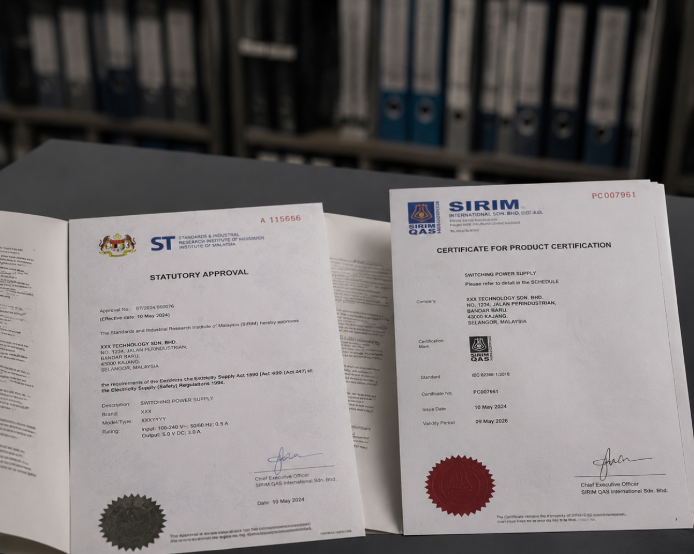
For electrical equipment regulated by the Energy Commission of Malaysia (Suruhanjaya Tenaga, abbreviated as ST), it is usually required to apply for a Certificate of Approval (CoA) in accordance with ST’s requirements, and use the ST-SIRIM label as specified. ST is responsible for supervision, approval, and law enforcement; relevant testing can be completed by ST-recognized laboratories, and SIRIM QAS is one of the testing or certification bodies, but not all certificates for regulated electrical products are issued by SIRIM.
At the same time, SIRIM QAS also provides voluntary product certification services. It belongs to another set of product certification arrangements, cannot be referred to interchangeably with the CoA issued by ST, and SIRIM voluntary product certification cannot replace the ST approval required for regulated electrical equipment.
These systems mainly focus on electrical safety and regulatory compliance, such as electric shock protection, overheating protection, fire prevention, and whether the product meets applicable technical requirements. They are not comprehensive quality ratings for charging speed, durability, appearance, or overall user experience. For charging products, whether a CoA, ST-SIRIM label, or other documents are required ultimately depends on the product category, applicable standards, and ST’s latest list.
Many people do not know that the “certification” commonly seen in the actual market may correspond to different documents, with different legal effects:
| Comparison Item | ST Mandatory Regulation and CoA | SIRIM Voluntary Product Certification |
| Whether it is mandatory to apply | Products included in ST’s regulated equipment scope must be applied for as required | Non-mandatory products can be applied for according to commercial needs |
| Main function | Meets the import, sales, and use requirements of regulated electrical equipment | Used for product certification, market communication, or customer requirements |
| Responsible body | CoA is reviewed, approved, and issued by ST | Implemented by the corresponding SIRIM QAS product certification scheme |
| Supporting mark | Use ST-SIRIM label in accordance with ST’s current regulations | Use the corresponding mark according to the specific SIRIM certification scheme |
| Consequences of no certificate | May face import obstruction, seizure, removal from shelves, recall, or penalties | Whether it affects sales depends on customers, platforms, and specific commercial requirements |
In short: ST’s CoA is the statutory approval for regulated electrical equipment; SIRIM voluntary product certification is another type of product certification service. The two may be linked in terms of testing or technical documentation, but they cannot be regarded as the same certificate.
Relationship with Other Regulatory Bodies
In addition to SIRIM and ST, there is another body in Malaysia that is easily confused with electrical safety certification: MCMC, the Malaysian Communications and Multimedia Commission.
ST is mainly responsible for the supervision and approval of regulated electrical equipment. SIRIM QAS or other recognized bodies may undertake technical work such as testing and certification, depending on the application type and product category.
MCMC is involved in the regulation of communications equipment and radio equipment. For example, if a charger also has Bluetooth, Wi-Fi, or other radio frequency communication functions, in addition to electrical safety requirements, it should also be confirmed whether additional compliance is required according to MCMC’s communications equipment certification or registration rules, and the procedures should be handled through designated channels. Whether it applies should be judged based on the equipment’s communication functions, frequency bands, power, and purpose. SIRIM-related safety documents cannot replace applicable communications equipment compliance.
The following types of documents should also be distinguished:
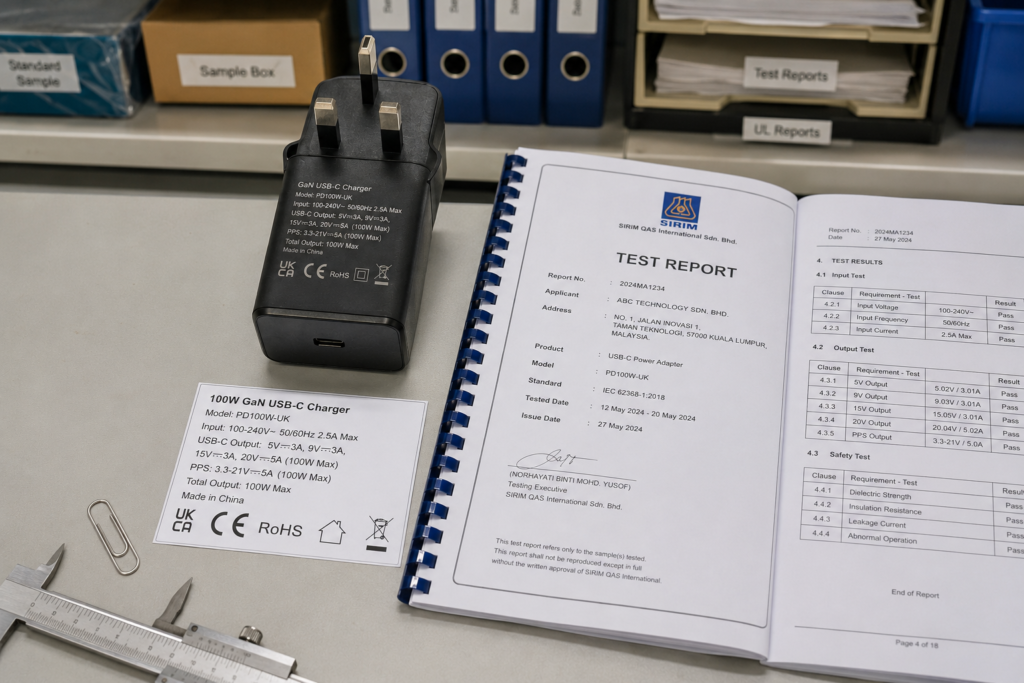
• Test Report: A technical document issued by a laboratory after testing a sample, stating the results of the sample under specific test conditions.
• ST CoA: An approval document for regulated electrical equipment reviewed, approved, and issued by ST.
• SIRIM Product Certification Certificate: A product certification document issued in accordance with the specific SIRIM QAS certification scheme.
• Declaration of Conformity: A document in which the manufacturer or supplier self-declares that the product meets certain requirements.
Their issuing bodies, applicable scopes, and legal effects are different, and they cannot replace each other.
Practical Functions of Certification
For ordinary consumers, charging products that meet applicable regulatory requirements have usually undergone corresponding compliance reviews or tests in terms of electric shock protection, overheating, and fire prevention. But this does not mean that the product will absolutely not be damaged, nor does it mean that it is necessarily better in terms of charging speed, lifespan, etc.
For sellers, the functions are more direct:
First, if regulated electrical equipment does not obtain approval or is correctly marked as required, it may encounter problems during import, and may also face seizure, recall, removal from shelves, penalties, or other law enforcement measures. The specific consequences depend on applicable laws, law enforcement decisions, and the actual situation of the product, and cannot be simply understood as a fixed multiple of fines.
Second, e-commerce platforms may require sellers to provide ST CoA, ST-SIRIM labels, or other compliance materials based on product category, brand, local regulations, or platform policies. The requirements of platforms such as Shopee, Lazada, and TikTok Shop may vary, and will also change with product categories and policies. It cannot be generalized that all charging products must obtain SIRIM voluntary certification before they can be listed.
Third, compliance materials help reduce the handling risk when products are complained about, recalled, or removed from shelves, but certification itself cannot replace product quality control and after-sales responsibility.
Core Cognitive Misconceptions for Beginners
People who are new to SIRIM are most likely to fall into two cognitive pitfalls. Let’s clarify them in advance here so you don’t waste your effort.
First pitfall: “All electronic products need SIRIM certification” — wrong. Whether ST approval is required depends on whether the product is a regulated electrical device published by ST, as well as the specific product definition and applicable requirements. Many low-voltage products that are not directly connected to the mains may not be within ST’s mandatory scope, but other regulations, customer requirements, or platform rules should still be checked.
Second pitfall: “I have CE/FCC certification, which can replace Malaysia’s requirements” — wrong. CE and FCC correspond to the requirements of jurisdictions such as the European Union and the United States respectively, and cannot directly replace Malaysia’s ST CoA or other applicable documents.
CB test reports can sometimes be submitted as technical documentation or testing basis, but they will not be automatically converted into SIRIM certification or ST CoA, nor are they the only materials that may be accepted. Whether duplicate testing can be reduced and how much cost can be reduced depends on applicable standards, report version, qualification of the issuing laboratory, report completeness, and the review of ST or relevant certification bodies, which must be confirmed on a case-by-case basis.
Quick Judgment of Applicable Scope for Charging Products
After understanding the basic concepts, the question everyone is most concerned about must be: Does the charging product I have need to apply for ST approval or other certifications?
You can first use the following 3-step method for preliminary screening. However, the first two steps can only help you narrow down the scope, and the final result shall still be subject to the latest list of regulated electrical equipment, product categories, and technical materials published by ST.
3-Step Mandatory Certification Judgment Method
Step 1: First check whether the product is directly connected to Malaysia’s 230V/50Hz mains power. Direct mains connection is an important screening condition, but you cannot conclude that a CoA is necessarily required based on this alone. You also need to continue to check the equipment category, rated parameters, purpose, and whether it is a regulated product in ST’s list.
Step 2: Check the actual function and sales form of the product. Is it an independent external power supply, plug, socket converter, power strip, or a module installed inside other equipment? Does the product belong to consumer, industrial, or other special purposes? These factors may affect applicable standards and approval requirements.
Step 3: Check the latest list of regulated electrical equipment and application guidelines on ST’s official website. This is an important basis for the final judgment. The list, equipment definitions, and application requirements may be updated, and judgments cannot be made solely based on supplier experience or conclusions of old projects.
Mandatory Certification Product Scope
Among charging products, the following products may involve ST regulated equipment requirements, but it cannot be assumed that all of them apply to the same certification solely based on the product name:
1. Wall-plug chargers or power adapters;
2. Independent external power supplies with Malaysian plugs;
3. Power strips, sockets, or converters with USB charging ports;
4. Individually sold Malaysian standard plugs, sockets, or related accessories.
These products should be compared with ST’s latest list and applicable standards respectively to confirm their equipment category, whether a CoA is required, test report requirements, and whether the ST-SIRIM label needs to be used. Plugs, sockets, converters, and power adapters may be subject to different technical requirements, and cannot be directly classified into the same category just because they all “have a plug” or “have a USB port”.
Voluntary Certification Product Scope
The following products do not necessarily fall within ST’s mandatory regulation scope, but cannot be uniformly classified into a certain SIRIM voluntary certification category solely based on “not directly connected to mains power”:
1. USB charging cables without mains plugs;
2. Car chargers plugged into car cigarette lighters or vehicle power ports;
3. Wireless chargers powered by USB or other low-voltage power supplies.
If the product is not in ST’s mandatory list, it usually does not have to obtain a CoA due to ST rules. However, sellers may still apply for corresponding voluntary product certification or prepare other compliance materials according to the requirements of customers, brand owners, purchasers, or e-commerce platforms. Whether it is necessary to apply should be checked separately against the product category, target channel, and latest platform policies.
Wireless charging itself is not equal to wireless communication. Only when the product also has Bluetooth, Wi-Fi, or other radio frequency communication functions is it necessary to further judge whether MCMC’s communication equipment certification or registration requirements apply.
Certification Exemption Situations
Some products or import scenarios may have special exemptions, simplified procedures, or usage restrictions, but cannot be generalized as automatic exemptions. The following situations need to be confirmed based on ST’s specific clauses, import purposes, and approval documents:
1. Charging modules or charging interfaces built into terminal equipment;
2. Industrial high-power charging equipment or special-purpose power supplies;
3. Personal use items, exhibition samples, or test samples;
4. Inventory that is only transshipped through Malaysia;
5. Matching power supplies or after-sales accessories that are not sold separately and provided with the complete machine.
Built-in modules do not mean that the complete machine necessarily covers all independent regulatory requirements; industrial equipment also does not automatically exclude ST regulation. Goods for personal use, exhibition, and transshipment usually may also involve import purpose, quantity, declaration, and document conditions, and cannot be directly used for commercial sales.
Judgment of Confusing Boundaries
In actual judgment, ambiguous situations are often encountered. Remembering these principles can reduce misjudgment.
First, pure cables vs. active function cables. Ordinary passive charging cables usually do not belong to external power supplies directly connected to the mains, but products with conversion circuits, identification chips, active protection functions, or other electronic modules should be re-judged based on their actual structure and function, and cannot be called “charging cables” just by their appearance.
Second, sold separately vs. sold with the complete machine. When the same charger is sold separately, it may need to be reviewed according to the independent equipment category; if it is sold with the complete machine in the packaging of a mobile phone or laptop, the independent equipment requirements cannot be automatically exempted just because it is “sold with the packaging”. It should be confirmed according to ST’s specific classification and approval scope for complete machines and matching power supplies, to check whether the adapter is clearly included in the relevant documents.
Third, charging products with wireless communication functions. Smart chargers, smart power strips, etc. with Bluetooth, Wi-Fi, or other radio frequency functions should, in addition to electrical safety requirements, also confirm whether additional compliance is required according to MCMC’s communication equipment rules. SIRIM safety-related documents cannot replace applicable communication equipment certification or registration.
Fourth, whether different models of the same series can share documents. Whether series models can share certificates or test data should be confirmed on a case-by-case basis according to the specific certification scheme and the series rules of the certification body. The certification body may also review key components, PCB, circuits, output specifications, housing, plug, manufacturer, trademark, and model differences. As long as there are changes in power, input/output, key components, circuits, plugs, or structure, a change assessment is usually required first, and it cannot be self-determined that sharing is allowed.
Core Requirements for SIRIM Certification of Charging Products
After confirming that you need to go through relevant compliance procedures, first clarify the core requirements to avoid getting stuck after preparing for a long time. Specific test items and document requirements depend on the product category, applicable standards, ST requirements, and certification scheme, and all items cannot be regarded as unified mandatory requirements for each type of charging product.
Core Safety Requirements
The overall goal is centered around “no injury, no fire”, and common concerns include:
1. Electrical Safety: Including electric shock protection, insulation, withstand voltage, abnormal operation, overheating, and fire risk, etc.;
2. Plug and Socket Requirements: If the product uses Malaysian plugs, sockets, or converters, the dimensions, structure, fuses, and markings should be confirmed in accordance with the corresponding Malaysian standards and ST requirements;
3. Interface and Protection Functions: USB-A, USB-C, or other interfaces may need to be checked for insulation, overcurrent, overvoltage, short circuit, and abnormal load protection according to specific product standards;
4. Electromagnetic Compatibility (EMC): Some products need to be evaluated for whether they will cause excessive interference to other equipment and whether they can work normally under specified environments;
5. Energy Efficiency Requirements: Some external power supplies may involve standby power consumption or conversion efficiency requirements. Whether to test and what limits to use should be confirmed according to the corresponding product standards and applicable regulations.
IEC 62368-1 is only a safety standard that may be adopted by some information technology, audio-visual equipment, and related power supplies, and is not a unified standard for all chargers, adapters, plugs, power strips, and wireless charging products. Different products may also apply MS IEC 62368-1, MS IEC 61558 series, IEC 60335 series, plug and socket standards, or other special standards, and the final result shall be subject to the technical requirements confirmed by ST’s list and the certification body.
Mandatory Labeling Requirements
Labels seem simple, but in fact many people stumble here:
• Regulated equipment that has obtained ST approval shall be affixed with or marked with the ST-SIRIM label in accordance with ST’s current regulations, and the label format, number or QR code, and placement position shall be checked;
• The product body or nameplate usually needs to provide information such as model, input and output parameters, manufacturer, importer, or responsible subject, and the specific content shall be subject to applicable standards and approval requirements;
• The marking requirements for plugs, sockets, converters, and external power supplies may be different, and should be confirmed in accordance with corresponding standards and ST requirements respectively;
• The mark of SIRIM voluntary product certification must also be used in accordance with the official mark specifications of the corresponding certification scheme, and marks of different schemes cannot be mixed.
Do not judge whether a product is compliant solely based on the “black triangle plus unique certificate number” or “circular SIRIM mark”. Different ST-SIRIM labels, SIRIM QAS certification schemes, and product categories may have different marking rules.
Common Reasons for Getting Stuck
Common problems during the application process for charging products include:
First, the structure and marking of plugs, sockets, or converters do not meet applicable Malaysian standards;
Second, the housing temperature rise of the charger is too high when operating at full load, posing risks of scalding, overheating, or fire;
Third, the insulation design between the primary and secondary is insufficient, which may pose an electric shock risk;
Fourth, the model, input and output parameters, manufacturer, or importer information on the label is incomplete, or the label is inconsistent with the application documents;
Fifth, there are differences between the sample, technical materials, and the final mass-produced product, such as replacing key components, plug suppliers, PCB, or housing structure without first conducting a change assessment.
Impact of USB-C Unification Policy
The unified USB-C charging interface is a policy that has been implemented in some jurisdictions such as the European Union, and it cannot be concluded that Malaysia will mandate the use of USB-C for all portable electronic devices starting from 2025.
Whether Malaysia will introduce similar requirements shall be subject to the formal regulations, announcements, and list of regulated equipment issued by the Malaysian competent authority. At present, it cannot be judged solely based on the USB-C interface that chargers and charging cables will be automatically included in ST’s mandatory certification scope. USB-C products should still be judged for compliance based on their own category, function, and applicable standards.
Full SIRIM Certification Process (for Charging Products)
After clarifying the requirements, let’s go through the main process from preparation to obtaining documents, and then to subsequent maintenance. Since ST CoA, SIRIM QAS product certification, and laboratory testing are different links, the actual sequence will vary depending on the product and application type.
Pre-Certification Preparation (1-2 Months in Advance)
It is recommended to start preparation work in advance, don’t rush to handle it when it’s time to list. The preparation work is divided into two parts: product materials, and materials of the applicant entity and institution.
For product materials:
• First confirm which category the product belongs to: ST regulated equipment, non-mandatory product, or special product that requires further consultation; organize the product parameter sheet, circuit diagram, appearance drawing, nameplate drawing, and list of key components;
• Prepare test samples. The number of samples is determined by the laboratory and applicable standards, and “conventional 3-5 units” cannot be regarded as a unified requirement for all chargers. Samples must represent the final mass-produced version;
• Confirm in advance whether plugs, sockets, or converters meet applicable Malaysian standards, and prepare relevant supplier materials;
• If you already have CB reports, other test reports, or certification documents, you should first confirm whether their standard version, qualification of the issuing laboratory, and content meet the review requirements of ST or relevant certification bodies.
For institutions and applicant entities:
• Select an ST-recognized laboratory, or confirm the application path and qualification requirements with corresponding certification bodies such as SIRIM QAS;
• Import of regulated electrical equipment usually requires relevant applications to be handled by Malaysian registered importers, manufacturers, sellers, or authorized entities that meet ST requirements, and prepare materials of local responsible entities. Specific application qualifications shall be confirmed according to ST application guidelines and product categories;
• Prioritize institutions with experience in charging products, as they are more familiar with the classification and document requirements of different power supply, plug, and interface products.
Sample Testing (Core Time-Consuming Item)
After preparation, enter the sample testing stage. The basic process is usually to submit samples and technical materials to a recognized laboratory, which conducts relevant tests in accordance with applicable standards, and issues a test report after completion.
Here are several key precautions:
First, if you already have a CB test report, it does not mean you can directly “convert the certificate”. A compliant CB report may be submitted as technical documentation or testing basis, but whether it is accepted, whether duplicate testing is reduced, and what additional items need to be done shall be confirmed by ST or relevant certification bodies on a case-by-case basis according to product category, standard version, laboratory qualification, and report completeness.
Second, if the test fails, supplementary testing or re-testing is required after rectification. Minor problems may involve adjustments to materials, markings, or structure; if they are core issues such as plugs, insulation, circuits, or temperature rise, the rectification time may increase significantly.
Third, there is no unified standard for the testing cycle applicable to all chargers. The actual time will be affected by factors such as product category, applicable standards, number of samples, laboratory scheduling, report review, rectification, and whether factory inspection is required.
Fourth, test samples should be consistent with the final mass-produced products. Before replacing key components, plug suppliers, PCB, housing, or circuit design, you should first apply for a change assessment from ST, SIRIM, or relevant laboratories. You cannot provide specially adjusted samples to pass the test and then mass-produce with different versions.
Review and Certification Issuance
After passing the test, follow-up procedures shall be handled separately according to the application type:
• If you are applying for ST CoA for regulated electrical equipment, you should submit the application, technical documents, test materials, and applicant entity information in accordance with ST’s system and application guidelines, and ST will conduct review and approval;
• If you are applying for SIRIM QAS product certification, you should submit the application and materials in accordance with the corresponding SIRIM certification scheme;
• If you only conduct laboratory testing, what you finally get may just be a test report, which is not equivalent to ST CoA or SIRIM product certification certificate.
Test reports, ST CoA, SIRIM product certification certificates, and declarations of conformity are different documents and cannot replace each other. The form of certificates or approval documents, whether they are electronic, and their specific legal effects shall be subject to the current rules and document content of the issuing body.
After getting the documents, the first thing to do is to check whether the product model, parameters, plug type, manufacturer, importer, or other responsible entity information is correct, and confirm that the products covered by the documents are consistent with the actual sales version.
Certificate Maintenance and Change
Getting the documents is not the end of the story; subsequent maintenance and changes are also required.
First is the validity period and renewal. The validity period and renewal requirements of ST CoA shall be subject to the specific CoA and ST’s current regulations, and cannot be uniformly written as three years. Whether factory inspection, market sampling, or supervision testing is conducted also depends on the product category and specific certification scheme. The validity period and supervision requirements of SIRIM QAS product certification shall be implemented in accordance with the corresponding SIRIM scheme, and cannot be confused with ST CoA rules.
Then are the product change rules:
• If the product’s power, input/output, key components, PCB, circuit, plug, or structure changes, you should apply for assessment from ST, SIRIM, and relevant laboratories before the change;
• The certification body may require supplementary testing, model expansion, re-application, or re-issuance of certificates;
• Even if it is just a change in appearance, trademark, manufacturer information, or model name, it may affect the label, structure, or certification scope, and written confirmation from the certification body should be obtained;
• Do not self-judge that “it’s just a small change so no need to report”, and the change assessment results and approval documents should be retained.
Cycle and Cost Reference
How long the entire process takes and how much it costs depends on the application type and product situation, and a set of fixed numbers cannot be applied to all chargers.
Actual costs and cycles may be affected by the following factors:
• Whether the product is subject to ST CoA or SIRIM QAS voluntary product certification;
• Applicable standards and test items that need to be completed;
• Whether there is already an acceptable CB report or other technical materials;
• Number of samples, laboratory scheduling, and report review time;
• Whether supplementary testing, rectification, factory inspection, or market sampling is required;
• Product power, number of ports, wireless communication functions, and structural complexity;
• Fees for the applicant entity, labels, agents, and subsequent maintenance.
CB reports may reduce some duplicate testing, but a fixed 30%-50% savings ratio should not be preset, nor can it guarantee a report in one week or a certificate in two or three weeks. Specific quotations and timelines should be confirmed directly with recognized laboratories, ST, or SIRIM QAS.
If it is the same series of products, do not self-assume that test data or certificates can be shared. Whether series certification, model expansion, or shared materials are possible shall be evaluated by the specific certification scheme and certification body based on key components, circuits, output specifications, housing, plug, manufacturer, and model differences.
Common Misconceptions and Pitfall Avoidance Guide
After finishing the process, let’s sort out the common pitfalls, which are divided into cognitive, process, and market supervision categories.
Cognitive Misconceptions (Don’t Waste Money)
1. “Voluntary certification is unnecessary” — this cannot be generalized. Whether to apply for SIRIM voluntary product certification for non-ST mandatory products depends on the requirements of customers, brand owners, purchasers, and sales channels. Whether e-commerce platforms require it should also be checked against the latest policies platform by platform and product category by product category, and it cannot be generalized that all charging cables and car chargers must obtain SIRIM voluntary certification.
2. “One certificate can cover all models” — wrong. Whether series models can share certificates or test data should be confirmed on a case-by-case basis according to the certification scheme and the series rules of the certification body. When changes involve power, output, key components, circuits, PCB, plugs, structure, manufacturer, trademark, or model, a change assessment is usually required.
3. “All chargers below 5W are exempt” — wrong. 5W cannot be used as a unified exemption threshold, and everything shall still be subject to ST’s latest list of regulated equipment, product definitions, and specific requirements.
4. “Just buy a certificate, no need for testing” — wrong. Formal documents shall be reviewed, approved, and issued by the corresponding bodies in accordance with regulations. The authenticity, scope, and status of certificates, CoAs, labels, or test reports need to be verified through official channels designated by the issuing body. Using false documents may lead to import obstruction, product removal from shelves, recall, or other legal and commercial consequences.
Process Pitfalls (Don’t Delay Launch)
1. The agent you find has no qualification, and you get fake documents. You should first confirm whether the laboratory, certification body, and application channel meet the requirements of ST or the corresponding SIRIM scheme, and then verify through the official system of the issuing body after getting the documents.
2. Thinking that overseas companies can definitely apply directly, or definitely cannot apply. The actual requirements depend on whether the product is imported or locally manufactured, the application type, and ST’s current registration rules. Import of regulated equipment usually requires a qualified Malaysian registered responsible entity, and specific qualifications should be verified in advance.
3. Stock up first and then do certification. This arrangement is not recommended. Failure to pass the test, change in product classification, or non-compliant labels may result in the inventory being unable to be sold as originally planned. Classification confirmation and necessary compliance assessments should be completed before mass production and large-scale import.
4. Samples are different from bulk goods. Providing special samples to pass the test, and then replacing components or reducing costs during mass production may cause the documents to no longer cover the actual product, and trigger risks of random inspection, recall, removal from shelves, or penalties.
Market Supervision Pitfalls (Don’t Get Penalized)
1. “No certification is needed for online sales” — wrong. Online sales do not automatically exclude ST’s statutory requirements. Products within the regulated scope still need to obtain approval and be correctly marked as required; platforms may also require additional compliance materials. Specific platform measures shall be subject to platform rules.
2. No need to worry about changing packaging or brand — wrong. If the product brand, manufacturer, importer, model, or nameplate information changes, it should be confirmed whether the documents cover the new sales method and responsible entity. Inconsistency between the nameplate and the approval documents may cause customs clearance, listing, or market supervision problems.
3. You can sell as long as there is a SIRIM mark — wrong. The mark only indicates a certain document or certification arrangement, and cannot replace all other regulations. Products with Bluetooth, Wi-Fi, or other radio frequency communication functions also need to confirm whether communication equipment certification or registration is required according to MCMC rules.
Practical Skills: Certificate Verification and Compliance Self-Check
Whether you are a consumer buying a charger, or a seller purchasing goods or clearing customs, learning to verify certificates by yourself and conduct compliance self-checks is a very practical skill.
Official Certificate Query Methods
Different documents may use different query systems. When verifying, you should use the official channels designated by the issuing body and input according to the fields supported by the system:
• ST CoA number;
• Number or serial number on the ST-SIRIM label;
• SIRIM QAS certificate number;
• Identification information specified in other official documents.
QR codes have reference value only when they are indeed provided in official documents and lead to the official verification page after scanning. It is not guaranteed that all certificates can be queried by product model, nor can authenticity be judged solely by a QR code.
SIRIM Mark Identification
Do not rely solely on the mark graphic to judge compliance. ST-SIRIM labels, SIRIM QAS product certification marks, and marks of other schemes may have different formats, numbers, serial numbers, QR codes, and usage positions.
The following situations are worthy of vigilance:
• The number, serial number, or product model is inconsistent with the document;
• Blurred font, deformed mark, or abnormal label printing quality;
• The manufacturer, importer, plug type, or rated parameters on the document are inconsistent with the actual product;
• No corresponding record can be found in official query channels;
• The document has expired, been suspended, or revoked;
• The agent only provides pictures, and does not provide verifiable formal documents and applicant entity information.
The mark style and category shall be subject to the official specifications of the corresponding certification scheme. Do not use online pictures such as “black triangle” or “circular SIRIM” as unified judgment standards.
Key Points for Certificate Verification
After getting the documents, you should at least check the following content:
First, check the issuing body, number, validity period, and current status of the document to confirm that it is not an expired, suspended, or revoked document.
Second, check the information of the certificate holder, manufacturer, importer, or responsible entity to confirm that it is consistent with the information provided by the seller or supplier.
Third, check the product model, input and output parameters, plug type, number of ports, and product photos to confirm that the version covered by the document is the one you actually want to import or sell.
Fourth, confirm the document type. A test report is not equivalent to ST CoA, and a SIRIM voluntary product certification certificate is also not automatically equivalent to ST approval.
Fifth, if the product has Bluetooth, Wi-Fi, or other radio frequency functions, you also need to confirm MCMC-related requirements separately, and cannot only look at electrical safety documents.
Pre-Import Compliance Self-Check List
If you are a seller, before importing to Malaysia, you can do a self-check according to this list to avoid customs clearance problems:
1. Confirm whether the product is within the scope of ST regulated electrical equipment;
2. Check the applicable equipment category, standards, and CoA requirements;
3. Check the authenticity and effective scope of the documents, as well as whether the documents match the actual product;
4. Confirm that plugs, sockets, or converters meet applicable Malaysian standards;
5. Confirm that product labels, ST-SIRIM labels, or SIRIM certification marks meet the requirements of the corresponding scheme;
6. Prepare test reports, CoA, authorization documents, importer materials, and other potentially required documents;
7. If the product has Bluetooth, Wi-Fi, or other wireless functions, confirm whether MCMC communication equipment compliance is required;
8. Set reminders for certificate renewal, label update, and product change;
9. Before product revision, component replacement, plug replacement, manufacturer replacement, or brand replacement, obtain written confirmation from ST or the certification body first.
Conclusion
By now, you should have a relatively comprehensive understanding of SIRIM-related certifications. To sum up, after reading this article, you can at least do 3 things independently:
First, you can use the 3-step method of “mains connection status — product category — ST’s latest list” to initially judge whether a charging product may require ST CoA, and know that the final result shall be subject to the official list and specific technical materials.
Second, you can clarify the differences between ST CoA, ST-SIRIM label, SIRIM QAS product certification, and laboratory test report, and will not confuse different documents.
Third, you can avoid common certification pitfalls, know how to verify the authenticity of documents, product models, and label scopes, and also know that charging products with wireless communication functions may require additional confirmation of MCMC requirements.
Malaysia is an important market for charging products in Southeast Asia. Facing chargers, power adapters, plugs, power strips, charging cables, and wireless charging devices, the safest approach is not to apply conventional wisdom such as “direct mains connection means mandatory” or “low-voltage products are definitely exempt”, but to check against the latest rules of ST and SIRIM QAS item by item. When in doubt, you should confirm with ST, recognized laboratories, or relevant certification bodies before stocking, importing, and revising products.