
Overseas sellers of charging products, cross-border e-commerce practitioners, or people who often ship electronic accessories have most likely encountered this problem: Can power banks and wireless chargers with batteries be shipped by sea? Will they be detained, fined, or even returned? The rules for sea transport of lithium batteries seem fragmented and professional, with UN numbers, SP188, and different versions of the IMDG Code, which confuses many people who are new to it.
This article starts with the most basic question of “whether your product is subject to control”, and breaks down the compliance requirements for sea transport of lithium batteries step by step. Beginners can quickly determine which path their goods should take after reading, and experienced readers can also find tips to avoid pitfalls and prevent violations due to unfamiliarity with the rules.
First, Figure Out: Does Your Product Need to Be Controlled as a Lithium Battery?
Many people make a mistake at the first step: they think any electronic accessory is counted as a lithium battery product, or they ship chargers directly as general cargo. In fact, the core judgment criterion is “whether there is a built-in lithium battery/lithium metal energy storage element”, which is not necessarily related to the product’s appearance.
Two Types of Products Not Subject to Lithium Battery Rules
The first type is products with no built-in energy storage elements at all, which can be transported directly as general cargo. For example, common ordinary wall chargers, power adapters, pure charging cables, and adapters. These products themselves have no lithium batteries, supercapacitors, or other energy storage components, and only play the role of power conversion or transmission.
A special reminder here: you must never judge only by appearance. You must check the product’s specification sheet or bill of materials (BOM), or even disassemble the physical product to confirm. For example, some products that look exactly like ordinary chargers actually have a small-capacity built-in lithium battery that can be used as an emergency power bank. This kind of product falls within the scope of lithium battery control, and false declaration as general cargo will result in heavy fines.
The second type is products with built-in non-lithium energy storage elements. Lithium battery rules cannot be applied to them, and the corresponding dangerous goods classification must be checked separately. For example, charging accessories using supercapacitors, sodium batteries, or nickel-metal hydride batteries. Although these products also have energy storage functions, their chemical type is not lithium, so the control requirements are completely different, and lithium battery rules cannot be directly copied.
Three Types of Controlled Charging-Related Products
As long as a charging product has a built-in lithium-ion or lithium metal battery, it falls within the scope of sea transport control. There are three common types:
The first type is standalone energy storage products, that is, products that are themselves batteries, such as power banks, spare lithium battery packs, outdoor energy storage power supplies, and some fast charging heads with built-in lithium-ion batteries.
The second type is charging devices with built-in batteries, such as wireless chargers with lithium-ion batteries, smart charging bases, and USB-C hubs with batteries. The main function of these products is charging, but they have built-in batteries to realize functions such as standby and fast charging buffering.
The third type is charging accessories with auxiliary batteries, such as smart charging heads with lithium metal/lithium-ion button batteries, and charging cables with micro-battery indicator lights. The battery capacity of these products is very small, only used to realize auxiliary functions such as indicator lights and timing, but they still fall within the scope of control.
Three Core Boundary Judgment Logics
When you first come into contact with the rules, as long as you remember the three core boundaries, you can avoid most confusion:
First, pure batteries and devices with batteries have different applicable UN numbers and different requirements, so they cannot be lumped together;
Second, small-capacity auxiliary batteries and large-capacity energy storage batteries can apply simplified rules if they meet the conditions, but not all small batteries can be simplified;
Third, the rule systems for sea transport, air transport, and land transport are completely independent. You cannot directly apply air transport requirements to sea transport, and vice versa.
Who Makes the Rules for Sea Transport of Lithium Batteries?
Many people ask: Why is sea transport of lithium batteries so strictly controlled? In fact, there are two core reasons: First, lithium batteries themselves are risky. In the event of short circuit, extrusion, or damage, thermal runaway and fire are very likely to occur, and lithium battery fires are difficult to extinguish. Second, the sea transport scenario is special: the cargo hold is closed, and the voyage lasts from more than ten days to dozens of days. In the event of a fire, there is no way to rescue in time, and the collateral damage is very high, which may even endanger the safety of the entire ship.
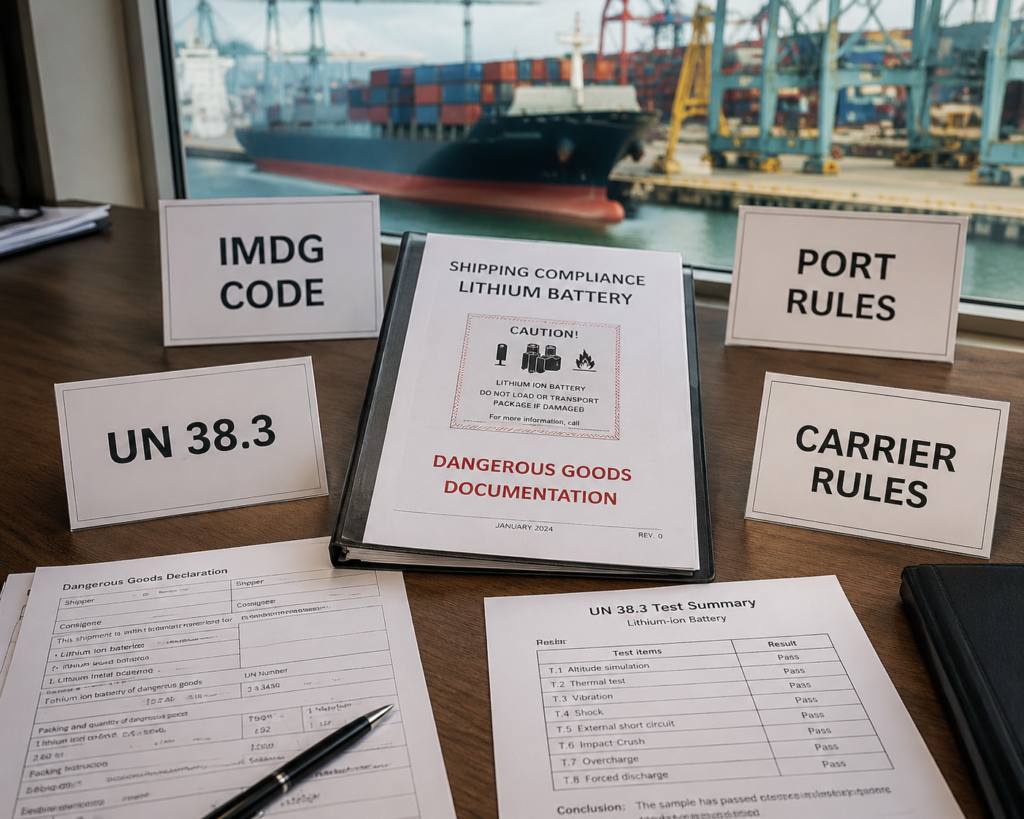
Four Types of Rules and Requirements to Check
Sea transport of lithium batteries is not determined by a single document. Different rules solve different problems, and it cannot be simply summarized as “the strictest one shall prevail in the end”.
- IMDG Code: That is, the International Maritime Dangerous Goods Code formulated by the International Maritime Organization, which is the main mandatory rule for dangerous goods transported by sea. Lithium batteries are classified as Class 9 dangerous goods; except for exceptions such as SP188, they shall also use the corresponding Class 9A labels and meet other marking and packaging requirements in accordance with the current IMDG provisions for lithium batteries.
- UN38.3 Test Requirements: UN38.3 comes from Section 38.3 of the United Nations Manual of Tests and Criteria, and transport rules such as IMDG will reference the requirements for lithium battery design type tests in it. It is not a set of independent sea transport regulations parallel to IMDG. Prototypes, low-volume production, or other special circumstances may be transported in accordance with corresponding special provisions and with the approval of the competent authority. Therefore, the absence of completed conventional UN38.3 does not mean that transport is absolutely prohibited under all circumstances.
- Rules of National/Port Competent Authorities: Local mandatory regulations of the exporting country, importing country, and transit port, such as Port State Control (PSC) inspections. These rules have legal effect locally, and compliance with IMDG does not necessarily mean compliance with all local implementation requirements.
- Carrier Rules of Shipping Companies/Freight Forwarders: Shipping companies can put forward stricter requirements on the basis of the IMDG Code. For example, some shipping companies do not accept lithium batteries exceeding a certain capacity, or require additional certification documents. Whether the goods can be transported and what materials are required shall be subject to the implementation rules of relevant ports and countries and the confirmation requirements of the booking shipping company.
How to Confirm the Applicable Version in 2025?
The IMDG Code is updated every two years. Many people are confused about which version to use in 2025. In fact, just remember two versions:
- The mandatory baseline is IMDG Code 41-22, which came into mandatory effect on January 1, 2024;
- The latest IMDG Code 42-24 may be voluntarily applied in advance from January 1, 2025, and will be mandatorily applied from January 1, 2026.
In actual shipment, you still need to verify the national implementation rules and port requirements of the loading port, transit port, and destination port, as well as the version accepted by the booking shipping company. You cannot judge only based on the year or the information of your own country.
How to Quickly Retrieve the IMDG Code?
You don’t need to memorize the entire IMDG Code. Just follow this five-step path to find the requirements for the corresponding product:
Step 1: First determine the UN number, that is, the chemical type and transport status of the corresponding battery;
Step 2: Check the hazard class and the corresponding special provisions, such as SP188 and SP230 which are often mentioned;
Step 3: Find the corresponding packing instructions, such as P903, P908, P909. Different packing instructions correspond to different packaging requirements;
Step 4: Check the requirements for marking, labeling, and transport documents;
Step 5: Confirm the requirements for stowage, segregation, and container loading.
A special reminder here: you must never judge the requirements based solely on the product name. You must check the current version of the IMDG Code item by item according to this path to avoid errors due to vague product names.
Core Classification: How to Determine Which UN Number Corresponds to Your Goods?
The UN number is the core of the classification of lithium batteries for sea transport. Many rules are centered on the UN number. First, figure out the logic of the UN number, and the subsequent requirements will be easy to understand.
Four Basic Premises for Classification
Before judging the UN number, you must first clarify four basic pieces of information. Without any one of them, accurate classification is impossible:
- Battery Chemical Type: Whether it is lithium-ion or lithium metal, the control requirements for the two are completely different. Rechargeable energy storage products such as power banks are mostly lithium-ion batteries, but you cannot judge lithium metal batteries solely by “whether they are rechargeable” — for example, some rechargeable lithium metal batteries cannot be subject to lithium-ion rules, and everything shall be based on the manufacturer’s technical data. If it is a non-lithium energy storage product, this classification system does not apply, and you need to check separately.
- Transport Status: Whether the battery is transported alone, placed in the same package as the equipment, or already installed inside the equipment. Different transport statuses correspond to different UN numbers.
- Battery Condition: Whether it is brand new and intact, or repaired, second-hand, or damaged, swollen, recalled. The worse the battery condition, the stricter the requirements.
- Energy/Lithium Content: This is the core indicator that determines whether simplified rules can be applied. For lithium-ion batteries, look at the energy value (Wh), and for lithium metal batteries, look at the lithium content (grams).
Four Core UN Numbers (Charging Product Scenarios)
The UN number is a unique identification number assigned by the United Nations to each type of dangerous goods, equivalent to the “global ID card” of dangerous goods. Ports and shipping companies use it to quickly identify risks. Note that the UN number only represents the category, and does not directly represent the level of risk.
There are four common UN numbers for charging products:
- UN3480: Lithium-ion batteries transported alone, such as separately shipped power banks and spare lithium battery packs;
- UN3481: Lithium-ion batteries contained in equipment or packed with equipment, such as wireless chargers with built-in lithium batteries and smart charging bases;
- UN3090: Lithium metal/lithium alloy batteries transported alone, such as separately shipped lithium metal button batteries for charging heads;
- UN3091: Lithium metal/lithium alloy batteries contained in equipment or packed with equipment, such as smart charging heads with lithium metal button batteries.
The final classification shall be based on the manufacturer’s data, actual transport status, and the current IMDG version, and you cannot guess randomly.
How to Calculate the Core Indicator?
Many people are used to using mAh (milliampere-hour) to judge the size of a battery, but the core indicator for sea transport control is the energy value Wh (watt-hour), and the two cannot be directly equated.
- Lithium-ion batteries: Judged by the energy value Wh. The conversion formula is:
Wh = nominal voltage (V) × capacity (Ah), where 1Ah = 1000mAh. For example, a power bank with a nominal voltage of 3.7V and 10000mAh is converted to 3.7V × 10Ah = 37Wh. The parameters must be based on the nominal/rated parameters on the battery nameplate or specification sheet, and you cannot estimate by yourself. - Lithium metal batteries: Judged by the grams of lithium content. The parameters shall be based on the lithium content marked on the manufacturer’s technical data, and do not disassemble and measure by yourself.
How to Judge the SP188 Simplified Rules?
SP188 is Special Provision No. 188 in the IMDG Code, which specifically provides partial simplification for small-capacity lithium batteries. If all conditions are met, you can skip part of the complete dangerous goods declaration process, which can save a lot of trouble. But note: this is not a general rule. All of the following five conditions must be met at the same time, none is dispensable:
- Parameter Threshold: Lithium-ion cells ≤ 20Wh, lithium-ion battery packs ≤ 100Wh; lithium metal cell lithium content ≤ 1g, battery pack ≤ 2g;
- Test Requirements: Both cells and batteries have completed the applicable UN38.3 tests;
- Protection Requirements: Protection against short circuit and accidental activation is provided;
- Packaging Requirements: Use strong packaging and meet the performance requirements of 1.2-meter drop;
- Weight and Packaging Conditions: Check the total gross weight limits and related exception conditions for batteries packed alone, packed with equipment, and contained in equipment respectively according to the original text of SP188. You cannot simply summarize “≤30kg” as only applicable to batteries transported alone.
There is also a special case of marking exemption: only when all conditions such as the battery is contained in the equipment, the number of relevant cells or batteries meets the regulations, and the number of relevant packages per shipment does not exceed the specified upper limit are met at the same time, the lithium battery mark may be exempted. You cannot conclude only based on no more than 4 cells or 2 batteries per shipment. The specific requirements shall be checked word by word against the current SP188.
Quick Reference for Common Transport Paths
To make it easier for everyone to quickly find the corresponding situation, we have sorted out the common transport paths of charging products into a table:
| Transport Path | Common Applicable Scenarios | Core Features |
|---|---|---|
| Complete dangerous goods declaration | Products that do not meet SP188 conditions, such as power banks over 100Wh shipped separately, outdoor energy storage power supplies | Usually need to submit dangerous goods declaration in accordance with IMDG, use the corresponding Class 9A label, the process is the most complicated |
| SP188 simplified transport | Power banks with single pack ≤100Wh, wireless chargers/charging bases with built-in small-capacity batteries (need to meet all SP188 conditions) | Simplified declaration may be applicable, but marking, packaging and other requirements still need to be confirmed in accordance with current rules and carrier requirements |
| Simplification for ultra-low capacity auxiliary batteries | Smart charging heads with ultra-small capacity lithium metal button batteries, charging cables with micro-battery indicator lights (need to meet the corresponding simplification conditions) | More lenient requirements, marking can be exempted in some scenarios |
| General cargo transport | Ordinary chargers, power adapters, pure charging cables, adapters without built-in energy storage elements | No lithium battery-related compliance requirements, treated as general cargo |
What Compliance Actions Are Required for Different Transport Paths?
No matter which path you take, there are corresponding compliance requirements. We will explain them step by step from general requirements to special requirements for different paths.
Basic Battery Access and Document Requirements
As long as the goods contain lithium batteries, you should first confirm whether the actual battery design type has completed the applicable UN38.3 test, and confirm that the test object matches the actual goods. For prototypes, low-volume production, batteries in special conditions, etc., you cannot simply apply the path for ordinary qualified products, and you should check the applicable special provisions and the approval requirements of the competent authority.
The UN38.3 test summary shall be provided by the manufacturer or subsequent distributor as required, and shall be available for inspection by the competent authority, carrier or other relevant parties. It should not be generally stated that it must be submitted with each shipment. The qualification of the testing institution, the report format, and whether a complete test report needs to be submitted shall also be verified in accordance with applicable regulations and carrier requirements.
In addition, please note:
- The battery appearance should be intact, without swelling, leakage, or damage; recalled and waste batteries cannot directly apply the transport rules for new batteries;
- State of Charge (SOC, that is, the remaining power of the battery) shall be checked against the current IMDG version and the carrier’s requirements, and you cannot directly apply the 30% power requirement for air transport;
- A complete UN38.3 test report is usually a document that may be required by the carrier during risk review, not a statutory document that must be submitted with the goods as a unified regulation.
Packaging Compliance Requirements
The core principle of packaging is: match the corresponding packing instruction according to the UN number, battery condition, and special provisions. You cannot use the same packaging for all products.
First, let’s explain the applicable boundaries of the three most common packing instructions:
- P903: Applicable to conventional intact lithium-ion/lithium metal batteries, it is the most commonly used packing instruction for qualified products;
- P908: Applicable to lithium batteries that are damaged or defective, with stricter packaging and cushioning requirements;
- P909: Applicable to waste or recycled lithium batteries transported under the corresponding waste battery entries that are not in a damaged/defective state, and must also comply with relevant regulations on cross-border waste transport. If waste or recycled batteries are also in a damaged/defective state, they may need to be packaged in accordance with P908, P911, or other packaging approved by the competent authority.
Packaging requirements vary for different situations:
- Lithium batteries transported alone (UN3480/UN3090, corresponding to P903): Terminal insulation must be done, such as putting on insulating caps and pasting insulating tape to prevent short circuits;
- Charging equipment with batteries (UN3481/UN3091, corresponding to P903): The battery must be fixed inside the equipment and cannot shake during transport to avoid friction and damage;
- Goods applicable to SP188 simplification: Still need to meet basic protection, packaging strength and drop requirements, and cannot be placed loosely or in soft packaging;
- General prohibition: Old packaging that is damaged, damp, or deformed must never be used.
Recalled batteries are not automatically regarded as damaged/defective batteries. It shall be judged whether SP376, P908, P911 or other provisions apply according to the actual condition and the reason for the recall.
Marking, Labeling and Container Placard Requirements
Many people are confused about the difference between various marks and labels. First, let’s clarify the three core concepts:
- Lithium Battery Mark: A special transport mark printed with a lithium battery pattern and the corresponding UN number, there is no mandatory requirement for a 24-hour emergency contact number;
- Class 9A Hazard Label: A special hazard label applicable to lithium batteries. It cannot be generally equated with ordinary Class 9 labels. The specific requirements shall be implemented in accordance with the relevant UN entries and label provisions of the current IMDG;
- Container (CTU) Placard: A dangerous goods mark that needs to be posted on the outside of the container when transporting by full container load.
Requirements vary for different paths:
- Path 1: Complete dangerous goods declaration (non-SP188): Usually, Class 9A hazard labels need to be used in accordance with the relevant UN entries; whether the lithium battery mark is also applicable shall be checked in combination with the corresponding UN entry and packing instruction. If it is a full container load, container placards must also be posted as required. When posting, pay attention to clarity and not easy to fall off, paste it in a conspicuous position of the package, and cannot be blocked by other things.
- Path 2: Applicable to SP188 simplified provisions: Whether it is necessary to post the lithium battery mark and whether the Class 9A label is exempted shall be subject to the applicable version of SP188 and relevant UN entries. Only when all the conditions for marking exemption in SP188 are met can the corresponding mark be exempted.
- Additional requirements of shipping companies: Some shipping companies may put forward additional marking requirements for goods transported in a simplified manner, so be sure to confirm in advance.
Common mistakes include: using air transport labels, label sizes not meeting requirements, wrong UN numbers, mistaking ordinary Class 9 labels for Class 9A labels, and posting positions being blocked. These problems may lead to cargo detention.
Transport Document Requirements
Transport documents are divided into two categories: one is the dangerous goods declaration materials required by IMDG or relevant regulations, and the other is the materials used for customs, trade or carrier review. Don’t confuse them.
Statutory Transport Documents
- Path 1 (Controlled goods not applicable to SP188): Usually, a Dangerous Goods Declaration (DGD for short) needs to be submitted in accordance with IMDG requirements. At least these fields of the DGD shall be checked: UN number, proper shipping name, hazard class, number and type of packages, net weight and gross weight, and shipper’s certification signature. Commercial invoices are mainly used for customs, trade and carrier internal review. Whether to submit and the specific content shall be implemented in accordance with relevant requirements, and they are not dangerous goods transport documents uniformly stipulated by IMDG for all transport.
- Path 2 (SP188 simplification): SP188 may exempt part of the complete dangerous goods declaration requirements, but whether simplified declaration is accepted, whether DGD is exempted, and whether a lithium battery declaration or other documents are required shall be confirmed with the applicable provisions of the current IMDG, port requirements and carrier regulations, and no globally unified absolute conclusion can be made.
- General requirements: The parameters on all documents must be completely consistent with the actual goods, and the battery attribute must never be concealed.
The shipper must provide true and complete classification and declaration information. The parties actually responsible for packaging, stuffing, declaration review or carriage shall respectively bear their responsibilities under the IMDG Code and the contract, and it cannot be simply summarized as “the shipper is fully responsible, and the freight forwarder only reviews the format”.
Carrier Review Materials
These materials may be required by the carrier for risk review, and should not be generally understood as must be submitted with each shipment:
- UN38.3 test summary, which shall be provided by the manufacturer or subsequent distributor as required and available for inspection by relevant parties;
- Complete UN38.3 test report, provided if required by the carrier;
- SDS (Safety Data Sheet), focusing on the physical properties in Section 9 and transport information in Section 14;
- Auxiliary materials such as product specification sheets, packaging photos, and battery appearance photos.
Container Stuffing and Stowage Requirements
This part is divided into two parts: one is controllable by the shipper/stuffer, and the other is the responsibility of the carrier and the ship:
- Controllable requirements for shippers/stuffers: Before stuffing, check that all packages are intact, no damage or leakage, and marks and labels are clearly facing outward; when loading, the weight shall be evenly distributed, and the goods shall be reinforced with straps and cushions to prevent displacement, extrusion, and collapse during transport; the stuffing information must be completely consistent with the DGD and declaration content, and no more or less loading is allowed.
- Responsibility of carrier/ship: The stowage and segregation requirements of the ship shall be implemented by the carrier and the ship in accordance with the IMDG Code and the approved stowage plan. Whether the freight forwarder assumes the responsibility of classification, packaging, declaration review or stuffing depends on its actual role and contract arrangement, and cannot be generally regarded as only responsible for document format review. The shipper can confirm the stowage plan with the freight forwarder in advance to avoid being rolled off due to non-compliance with segregation requirements.
How to Judge Special Scenarios? Don’t Step into the Pit of Gray Areas
In actual transport, there will be many special situations that cannot be directly applied to conventional rules. Here we explain the judgment logic of common special scenarios clearly.
Two Important Reminders for SP188
First, SP188 must meet all five conditions at the same time, none is dispensable, and if one is missing, simplified transport cannot be used;
Second, simplification does not mean that you don’t need to care about anything at all. You still need to declare truthfully, do basic protection well, and paste labels as required. Violations will still result in return and fines.
How to Handle Mixed Loading of Multiple UN Numbers?
Many people ask: There are several kinds of products with batteries in one shipment, corresponding to different UN numbers. Can they be merged into one UN number of the highest level for declaration? The answer is no.
The rules clearly require that one shipment or one container can contain lithium batteries of multiple UN numbers, but they cannot be directly merged into one UN number according to the “highest level”. The correct approach is: first confirm whether goods with different UN numbers can be packed in the same container, whether there are packaging and segregation restrictions, then classify, package, and mark them separately, and declare them item by item in the DGD. If lithium batteries of different chemical types (lithium-ion and lithium metal) are mixed, additional segregation requirements must be checked.
Classification and Transport Requirements for Abnormal Batteries
Not all batteries are intact new products, and the applicable rules for batteries in different conditions are completely different:
- Intact qualified products: Transported in accordance with conventional rules such as UN numbers and SP188, that is, the general path we mentioned earlier;
- Damaged/defective batteries (such as swelling, leakage, deformation, etc.): If they meet the definition of damaged/defective batteries in SP376, they shall be implemented in accordance with SP376 and applicable P908, P911 or alternative packaging approved by the competent authority, with much stricter requirements than qualified products;
- Waste/recycled lithium batteries: If they are not in a damaged/defective state, check the P909 packing instruction according to the corresponding waste battery entry, and must also comply with cross-border waste transport regulations; if they are also in a damaged/defective state, P909 cannot be directly applied;
- Prototype/low-volume production batteries (parameters not yet finalized, no conventional UN38.3): They can only be transported with the approval of the competent authority and acceptance by the carrier, and cannot be shipped as qualified products casually.
Recalled batteries are not automatically equal to damaged/defective batteries, and must be classified according to the actual condition and the reason for the recall.
Judgment Logic of Common Special Scenarios
- Small-batch samples: They will not automatically apply simplified or limited quantity rules. They still need to be judged according to the battery’s parameters, condition, packaging, and quantity. You cannot say “this is a sample so I don’t need to care”;
- Set products: The UN numbers and transport status of each battery and other dangerous goods in the set shall be identified one by one, and the restrictions on same-package, mixed loading, packaging and segregation shall be checked; “highest control level” cannot be used to replace classification, nor can multiple UN numbers be merged into one UN number;
- Repaired/second-hand charging products: If the battery condition is unknown, SP188 simplification cannot be applied. The battery condition must be evaluated first, and then matched with the corresponding transport path;
- Large-capacity energy storage products: When SP188 is not met, usually return to the complete IMDG requirements of the corresponding UN entry, but the specific packaging, labeling, document and stowage requirements must still be determined according to UN3480/3481, UN3090/3091, special conditions, other special provisions and the approval of the competent authority;
- Lithium batteries for personal use/through freight channels: When shipped through commercial sea freight channels, they cannot be automatically exempted only on the grounds of personal use or samples. Passenger luggage, crew belongings, postal and other non-freight scenarios may apply different rules, which shall be checked according to the actual transport mode and the provisions of the competent authority.
Absolutely Prohibited Acts
There are several situations that must never be touched, and touching them is a serious violation:
- All lithium batteries that meet the definition of dangerous goods must not conceal the battery attribute and falsely declare as general cargo;
- Damaged/defective/waste/prototype lithium batteries that have not obtained the approval of the competent authority and acceptance by the carrier cannot be transported as conventional qualified products;
- Batteries without conventional UN38.3 are not absolutely untransportable, but they must go through the corresponding special approval path, and false declaration as qualified products is strictly prohibited.
Practical Implementation: Quick Judgment and Preparation of Freight Forwarder Materials
After talking about so many rules, some people may still feel confused. Here we have sorted out a 6-step quick judgment method, as well as the materials needed to find a freight forwarder. Just follow the instructions.
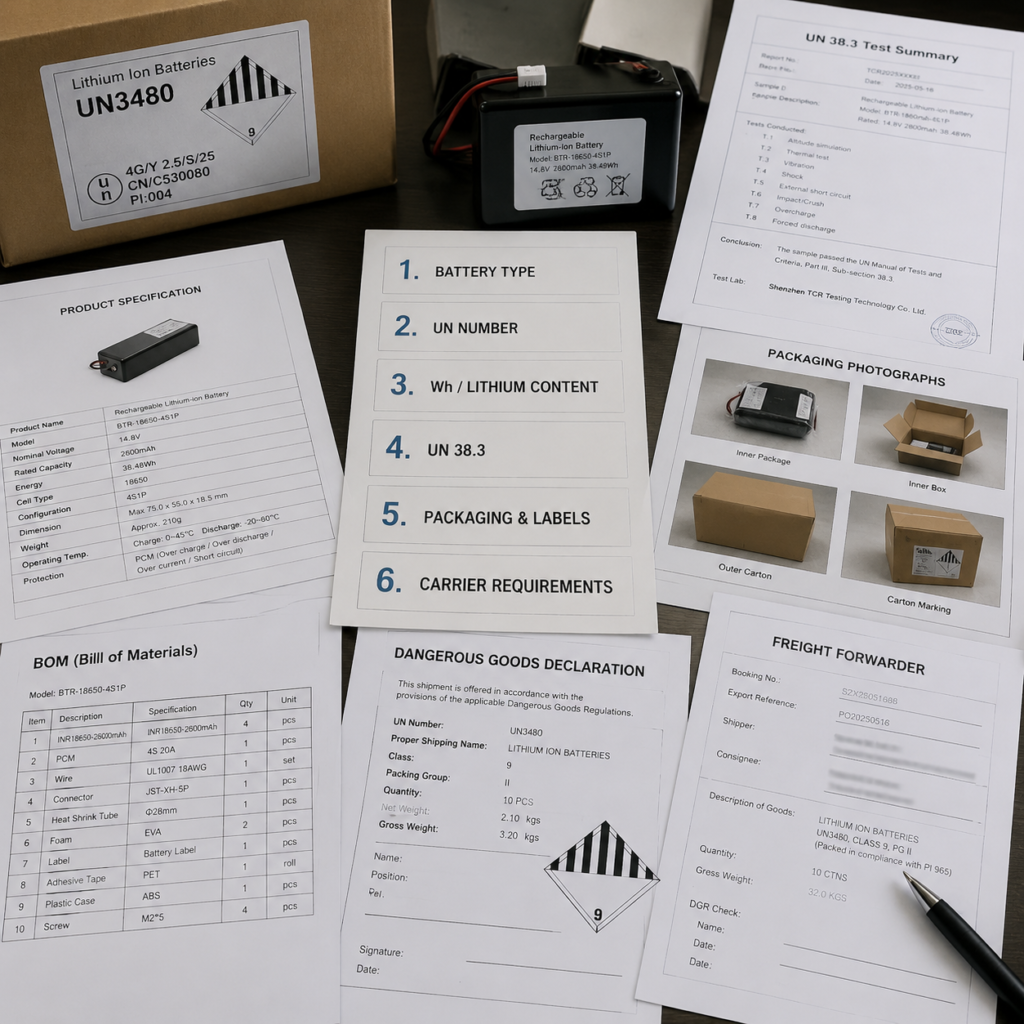
6-Step Quick Judgment of Compliance Path
Step 1: First verify whether there are lithium-ion/lithium metal cells or batteries in the product, check the BOM, specification sheet or physical product. If not, treat it as general cargo;
Step 2: Confirm the chemical type of the battery, transport status (alone/same container/contained in equipment), and battery condition (new/damaged/second-hand, etc.);
Step 3: Calculate the energy value (Wh) or check the lithium content to initially judge whether it can meet the simplified conditions of SP188;
Step 4: Check whether the actual battery design type has completed the applicable UN38.3 test, and confirm whether the corresponding test summary can be obtained;
Step 5: Against the corresponding transport path, self-check whether the packaging, marking and labeling, and documents meet the requirements;
Step 6: Consult the freight forwarder or shipping company in advance to confirm the additional requirements of the transit port and destination port — note that booking confirmation does not equal final port release, so be sure to leave buffer time in advance.
List of Required Materials to Submit to the Freight Forwarder
When booking space with a freight forwarder, preparing these materials in advance can save a lot of back-and-forth communication time:
- Basic product information: product name, battery type, initially judged UN number, energy value or lithium content, quantity, packaging method;
- Battery qualification documents: UN38.3 test summary of the corresponding design type, and supplement the complete test report if required by the carrier;
- Other documents: Commercial invoice truthfully marked with lithium batteries, and packaging qualification certificate (if required).
When Is It Recommended to Find a Professional Dangerous Goods Freight Forwarder?
If you encounter the following situations, it is recommended to find a professional dangerous goods freight forwarder directly, don’t try it yourself, it is easy to step into pitfalls:
- Involving UN3480 (lithium-ion batteries transported alone) and not applicable to SP188 simplification;
- Batteries with special conditions, such as damaged, defective, prototype, recalled, waste, recycled batteries;
- Mixed loading of multiple UN numbers, requiring complete dangerous goods declaration (DGD);
- The rules of shipping companies or ports are unclear, or additional certificates are required;
- For large shipment quantities, additional checks on the quantity limit per package and the shipping company’s receiving limit are required — quantity is an important factor in the carrier’s risk review, and it is not that as long as SP188 is met, unlimited quantity will be accepted.
Clarification of Common Misconceptions: Don’t Be Tricked by These Wrong Statements
Misconception 1: The smaller the capacity (mAh), the looser the sea transport requirements
Correction: The core indicator of sea transport control is the energy value (Wh), not mAh. For the same 10000mAh battery, if the nominal voltage is 3.7V, it is 37Wh. If the nominal voltage is 12V, it is 120Wh, which has exceeded the 100Wh threshold of SP188. Usually, it cannot be simplified according to SP188, so you must convert it according to the nominal voltage before judging.
Misconception 2: With a UN38.3 report, you can ship by sea
Correction: UN38.3 is only part of the basic basis for the design type transport test requirements, equivalent to an “admission ticket”. Whether it can be shipped depends on whether the battery’s parameters, condition, packaging, documents and corresponding transport path meet the requirements. It is not that everything is fine with the report.
Misconception 3: With CE/FCC/CCC and other product certifications, you can ship by sea
Correction: These product certifications are market access requirements, which control “whether it can be sold”, while sea transport rules are transport access, which control “whether it can be transported”. The two are completely unrelated and cannot replace each other. No matter how many product certifications you have, if the transport is not compliant, you will still be detained.
Misconception 4: All charging products with built-in batteries can be shipped as general cargo
Correction: Only small-capacity batteries that meet SP188 or other applicable simplification conditions can apply the corresponding simplified rules; when SP188 is not met, usually the complete IMDG requirements of the corresponding UN entry shall be returned. The specific situation still needs to be judged according to the UN number, transport status, battery condition and carrier requirements, and cannot be directly shipped as general cargo.
Misconception 5: Sea transport requirements are the same as air transport
Correction: The rule systems for sea transport and air transport are completely independent, with different packaging, labeling, and limited quantity requirements. They must never be mixed. For example, the SOC requirements and packaging requirements for air transport are very different from those for sea transport, and direct application will definitely lead to errors.
Misconception 6: Personal use/small-batch samples can be exempted from all compliance requirements
Correction: When shipped through commercial sea freight channels, they cannot be automatically exempted only on the grounds of personal use or samples, and the requirements still need to be checked according to the actual goods and transport mode. However, passenger luggage, crew belongings, postal and other non-freight scenarios may apply different rules, which cannot be generalized.
Misconception 7: If you comply with the SP188 simplified rules, you don’t need to do anything
Correction: The simplification of SP188 only exempts part of the complete dangerous goods declaration process. You still need to meet all conditions, as well as the corresponding packaging, declaration, and marking requirements. If you violate the rules, you will still be returned and fined, and even affect subsequent shipments.
Conclusion
After reading this article, you should have mastered the core capabilities of lithium battery sea transport compliance: you can quickly verify whether charging products fall within the scope of lithium battery sea transport control, you can judge the corresponding UN number and applicable transport path according to the battery type, transport status, and energy value, you can find the corresponding requirements according to the retrieval path of the IMDG Code, you will not judge blindly only by the product name, you can self-check the basic compliance of packaging, marking and labeling, and documents against the corresponding path, and you can also identify common compliance misconceptions to reduce the risk of cargo detention, fines, and returns.
At the same time, you can also judge when you can prepare materials for shipment by yourself, and when you need to find a professional dangerous goods freight forwarder. Finally, a reminder: the commonly used mandatory IMDG version in 2025 is the 41-22 version, and the 42-24 version can be voluntarily applied in advance, but the specific requirements must be verified in combination with the implementation rules of shipping companies, ports and relevant countries. Don’t memorize by rote. After all, sea transport rules are dynamically updated, and verification in advance is always the safest approach.