
If you have ever bought chargers or fast chargers in Canada, or run a cross-border business of charging accessories, you must be familiar with the two marks CSA and cUL. Many people cannot distinguish their effectiveness differences, which products must have them, and which do not — ordinary consumers may buy white-label products with safety hazards, while new merchants may face risks of goods detention, product delisting, or even fines. This article will clearly break down the scope of application and judgment logic of CSA/cUL certification in combination with common forms of charging products.
Basic Knowledge: First Understand What These Two Certifications Are
Let’s clarify the basic concepts first to avoid confusion. CSA is a safety certification mark issued by the CSA Group (Canadian Standards Association), equivalent to a “safety qualification certificate” issued by a local institution; cUL is a mark issued by the US UL institution after evaluation in accordance with Canadian safety standards, and UL’s corresponding certification capability is accredited by the Standards Council of Canada (SCC, the official Canadian authority responsible for certification and accreditation). The core functions of the two are completely consistent: both are to prevent electric shock, overheating, and fire risks of electrical products, only related to safety, and have nothing to do with charging speed or protocol compatibility.
Many people ask: which has higher effectiveness, CSA or cUL? The answer is: As long as the certification body is within the accreditation scope of the SCC, and the product model, certification category, applicable Canadian standards, manufacturing factory, and mark usage method are all consistent with the certificate, the safety access effectiveness of the two is completely equivalent. Electrical safety regulations in Canadian provinces generally require that electrical products sold commercially must be evaluated as qualified by SCC-accredited institutions in accordance with applicable standards, and a compliant and valid CSA or cUL mark can be used as proof of meeting the requirements. It is particularly important to remind that these two certifications only assess electrical safety and do not involve functional indicators such as fast charging power and protocol compatibility — do not assume a charger is a fast charger just because it has a CSA mark; it only means that the charger is not prone to safety problems such as fire and electric shock.
Understanding the basic definitions will help you grasp the practical value of the scope of application: for ordinary consumers, looking at the mark allows you to quickly judge whether a product meets basic safety requirements and avoid unprotected white-label products; for new merchants, judging in advance whether a product requires certification can avoid losses from goods detention and delisting, and avoid wasting money on unnecessary certifications. Here is a core logic for everyone first, and the following content is expanded around this logic: Charging products sold connected to Canadian mains electricity basically require safety certification, and most low-voltage passive accessories can be exempted.
Geographical Scope of Application: Where Are These Marks Recognized
Core Applicable Area: Entire Territory of Canada
Under the premise that the certificate is valid, the product model is within the certification coverage, the certification body has the corresponding SCC accreditation qualification, and the mark is used in compliance, all provinces and territories in Canada recognize the safety certification effectiveness of CSA and cUL marks.
Electrical safety in each province/territory is enforced by different competent authorities (such as provincial safety bureaus, consumer protection departments, electrical regulatory agencies), and specific access requirements, installation or on-site use rules may vary slightly, but Canadian standard certifications issued by SCC-accredited institutions are generally accepted. If in doubt, you can check the requirements of local competent authorities before importing, selling, or installing and using in specific places.
Extended Application: Conditions for Dual Compliance in the US and Canada
Many merchants operating in the US and Canadian markets are concerned about the “dual compliance” issue. The core is not the name of the mark, but whether the certification covers the safety standards of both countries at the same time:
• CSA or cUL marks only marked as applicable to Canada (no US-related标识): can only prove that the product meets Canadian safety standards, and cannot be used as a basis for safety certification in the US market; if you want to sell in the US market, you need to obtain additional certification and marks that meet US standards;
• CSA marks with US market coverage identifiers such as US and C-US, or UL’s cULus mark: meet the safety standards of both the United States and Canada, and can be used as a basis for safety certification in both regions; whether they can be sold legally also needs to meet other requirements such as wireless/EMC, energy efficiency, labeling, import and platform rules;
• Only ordinary US UL marks (no c prefix): only meet US standards, do not meet Canadian requirements, and cannot be used as a basis for safety compliance in the Canadian market.
For quick memory, a comparison table is compiled:
| Certification Mark Type | Applicable Region for Safety Certification | Core Description |
| Canada-only CSA Mark | Entire territory of Canada | Issued by Canadian local institutions in accordance with Canadian standards |
| Canada-only cUL Mark | Entire territory of Canada | Tested by UL per Canadian standards, with corresponding qualifications accredited by SCC |
| CSA/cUL Mark with Dual US-Canada Coverage | United States + Canada (safety dimension only) | Meets safety standards of both countries, can be used as a basis for safety certification in both regions |
| Standard UL Mark (no c prefix) | United States only | Not recognized by Canada as a basis for safety certification |
As for other countries and regions such as the European Union and Asia-Pacific, they do not recognize CSA/cUL certification. Exports to these regions need to meet the certification requirements of the corresponding regions, such as CE in the European Union and PSE in Japan, which cannot be mixed.
Mandatory Applicable Charging Products: These Must Be Focused On
For most people, the most concerned question is: which charging products require CSA/cUL certification? We have sorted them by product type, all related to daily charging, and you can compare them by yourself after reading.
Charging Power Supplies Directly Connected to Mains Electricity (Usually Subject to Mandatory Certification in Consumer Retail Scenarios)
For example, commonly used wall-mounted PD fast chargers, multi-port GaN (gallium nitride) chargers, power adapters for laptops and monitors, the power supply part of docking stations with charging functions, as well as desktop, vertical, and magnetic wireless charging bases connected to household sockets, all fall into this category. The core standard for judgment is very simple: the product needs to be connected to Canadian 120V household mains electricity and perform alternating current (AC) to direct current (DC) conversion — that is, convert the high-voltage electricity in the socket into low-voltage electricity that can be used by mobile phones and computers. Because such products are directly exposed to high voltage and have high risks, they basically fall within the scope of mandatory certification in ordinary consumer retail scenarios, and special scenarios such as industrial and experimental use have separate rules.
Charging Accessories with Active Circuits/Batteries (Must Be Evaluated per Corresponding Standards, Cannot Be Directly Exempted)
Although most of these products are not directly connected to mains electricity, because they have active circuits or lithium batteries, their safety risks are higher than pure passive accessories, so they cannot be directly exempted as low-voltage passive parts, and need to be specifically judged in combination with product form, rated parameters and corresponding standards:
• USB charging cables with E-Marker chips, indicator lights or control chips: no longer apply to the exemption logic of ordinary passive cables. When sold separately, the certification requirements need to be checked according to active cables or corresponding product categories; if sold as accessories in a set, they need to be included in the scope of complete device evaluation;
• Power banks, magnetic charging accessories with batteries, and battery cases: belong to active consumer electronic products with energy storage, need to meet corresponding battery safety, information technology equipment or consumer electronic safety standards, and cannot be exempted as passive parts;
• Charging power strips with USB ports and wall-mounted USB charging sockets: because they involve mains-side connections, they fall within the scope of mandatory certification;
• Active car chargers (DC-DC conversion products that convert cigarette lighter power to USB): although they are not directly connected to 120V mains electricity, they have their own voltage conversion circuits, and need to check the requirements according to corresponding low-voltage electronic and auto parts safety standards, and cannot be directly exempted as passive low-voltage parts. Specific rules can be verified in combination with sales channels and product categories.
Mains-Side Plugs and Interfaces (Mandatory)
For example, the mains input plug of a charger needs to adopt a NEMA configuration suitable for Canada, and meet the corresponding CSA plug, socket, cord/connector safety standards and certification requirements; the high-voltage side interfaces of charging equipment, such as the AC input port of a power adapter, the mains jack of a power strip, as well as wires and conversion parts carrying mains electricity, all need to meet the corresponding safety and certification requirements.
Complete Devices with Built-in Charging Power Supplies (Require Complete Device Evaluation)
For example, all-in-one multi-port charging stations, charging cabinets with built-in power supplies, and complete charging devices sold with matching power supplies, such as wireless charger sets with adapters. Here is a common pitfall to pay special attention to: even if the power module used in the complete device itself has CSA/cUL certification, it does not mean that the complete device is compliant — the structure, heat dissipation, and wiring of the complete device may bring new safety risks, so a separate complete device-level certification evaluation must be carried out.
If you can’t remember so many categories, just remember three entry-level quick judgment tips:
1. Charging products directly connected to Canadian 120V mains electricity basically require safety certification;
2. Active charging accessories with chips or batteries cannot be directly exempted and need further verification;
3. Products with an input voltage marked 100-240V AC on the nameplate are most likely mains-type products and require certification.
Exemption/Non-Applicable Scenarios: These Products Do Not Require Mandatory Certification
After talking about the ones that must be focused on, let’s talk about which scenarios do not require mandatory CSA/cUL certification, to avoid everyone wasting money.
Low-Voltage Side Passive Charging Accessories (Mostly Exempted)
For example, ordinary passive USB charging cables without any electronic components, and simple low-voltage adapters without circuits or chips (such as passive USB-A to USB-C adapters) all fall into this category. It is particularly important to remind here: exemption only means that mandatory CSA/cUL certification is not required, and does not mean that basic safety requirements can be ignored — if equipment damage is caused by cable quality problems, corresponding responsibilities still need to be borne.
Products for Non-Commercial Use
For example, a small number of self-use charging products brought back from abroad by individuals, personal gifts in non-commercial scenarios, and personal second-hand resale (applicable in some provinces) do not require mandatory certification. But as long as the product enters the commercial circulation link, such as bulk sales of second-hand products or opening a store to sell goods, it must meet the certification requirements.
Low-Voltage Charging Products Below Mandatory Thresholds
Here we need to debunk a common rumor: There is no universal “low-power exemption value”. It is not that certification is not required for products below 5W or 10W. Specifically which low-voltage products can be exempted needs to be judged in combination with corresponding standards, product categories and local competent authority requirements, and cannot be guessed based on power level.
Other Non-Applicable Scenarios
Industrial-specific, customized non-mass-produced experimental charging equipment is usually not directly judged according to the rules of consumer retail charging products, and may be subject to industrial equipment safety standards, on-site approval or installation acceptance requirements; if it is an industrial charging product connected to Canadian mains electricity and supplied commercially, specific requirements still need to be confirmed with the certification body or local competent authority.
Purely mechanical charging peripherals (such as charging cable storage racks, phone stands and other completely non-electrical products) do not require CSA/cUL certification.
Semi-Proficient: Practical Methods for Quick Judgment
If you need a more accurate judgment, such as when selecting products as a merchant, or encountering borderline products you are unsure about, you can use the following methods, which will basically not go wrong.
Four-Step Judgment Method (Check in Order)
Step 1: First look at the sales scenario: is it sold commercially in Canada? If it is for personal use or not for sale, you don’t need to read further;
Step 2: Look at the power supply method: is it an active product connected to mains electricity, with chips/batteries, or a pure passive low-voltage accessory? The former mostly requires certification, while the latter is mostly exempted;
Step 3: Look at the product form: is it a separately sold finished product, a component, or an accessory in a set? Those sold separately are judged as independent products, and those sold in sets need to be included in the complete device for evaluation together;
Step 4: Check official requirements: if you are still unsure after the first three steps, you can first confirm the qualification of the certification body, then consult the provincial electrical safety competent authority or a formal certification body to confirm whether the product category is within the mandatory scope.
Key Points for Identifying Certification Marks and Nameplates
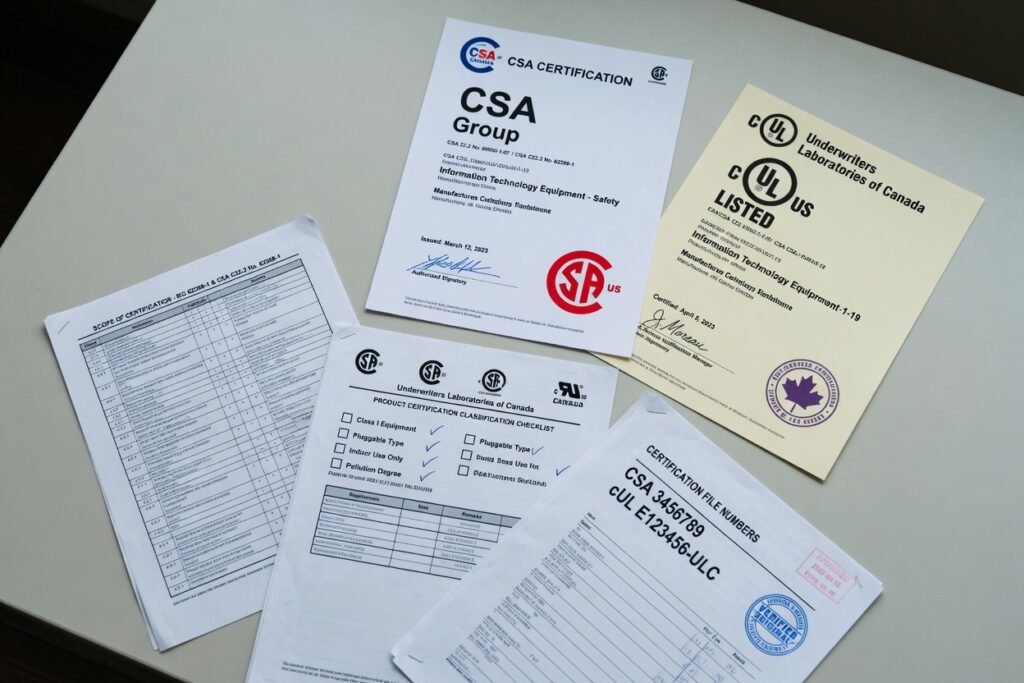
When judging, you also need to know how to read certification marks and product nameplates to avoid buying products with fake certifications or non-compliant products. A compliant CSA or cUL mark should be able to trace the corresponding certification record in the official database of the certification body through the file number and control number on the mark, combined with product model, manufacturer/applicant information.
Turn to the back of the charger or adapter, and you will see a nameplate printed with parameters. The model, input and output parameters, manufacturer/manufacturing factory information on it must be consistent with the scope covered by the certification. Otherwise, even if the mark style is correct, this product is not within the valid certification scope. Special attention: if a product claims to be sellable in Canada but only has a standard UL mark without the c prefix, it cannot be used as a basis for Canadian safety compliance, and further verification is required.
Official Scope and Practical Authenticity Query
If you are unsure about the authenticity of the certification, be sure to query through official channels, and don’t just look at the certificate photo given by the merchant. The correct query steps are:
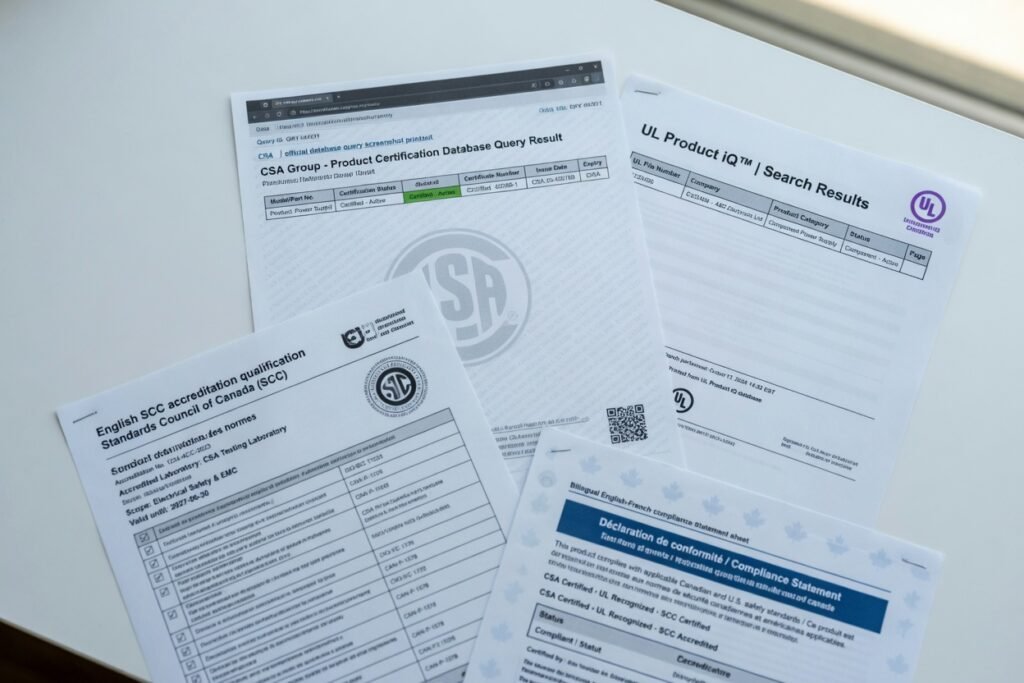
1. First confirm the qualification of the certification body and the mandatory attribute of the product: first go to the SCC official website to check whether the certification issuing body (such as CSA Group, UL) has Canadian accreditation qualifications for the corresponding product category, and confirm the legality of the certification body; as for whether the product falls within the mandatory safety certification scope of Canada or the corresponding province, it needs to be further judged in combination with the requirements of the provincial electrical safety competent authority, applicable product standards and the product category rules of the certification body, and the content of the SCC website cannot be used as the sole basis for the mandatory catalog.
2. Then go to the official database of the certification body (such as CSA Group’s Product Listing, UL’s Product iQ), enter the certification file number and model on the product, and check the certification coverage information item by item: including applicable region, certification status and validity period, covered Canadian/US standards, product category, applicant/manufacturer, manufacturing factory;
3. When checking the certification status and validity, confirm whether the applicable standards, versions, certification status and transition period requirements listed in the certificate are still accepted by the certification body; do not judge validity/invalidity solely based on the certificate date or standard version. Everything shall be subject to the real-time results of the official database, and paper certificates or photoshopped marks are not valid.
Boundary Scenarios Prone to Misjudgment (Exclusive to Charging Products)
There are several boundary scenarios that are most likely to be misjudged, so be sure to remember them clearly:
• Component certification vs. complete device certification: CSA/cUL certification for components is only applicable for use as internal parts when factories assemble complete devices, and cannot replace complete device-level certification. For example, if you purchase a certified power module and install it in a self-designed multi-port charging station for sale, you cannot use the power module’s certification as the certification of the complete device. The complete device must be evaluated separately.
• Separate sales vs. set sales: If a charging cable is sold separately, it is judged as an independent product whether it needs certification; if it is sold together in a set, such as a fast charging cable included in a wireless charger set, it must be included in the evaluation scope of the complete device, and you cannot just use any random cable.
• Low-voltage USB input products vs. mains products: Devices powered only by low-voltage USB, such as small magnetic wireless chargers plugged into power banks, have relatively lower risks, but if the product has a built-in lithium battery or has high power, it still needs to meet corresponding safety standards and cannot be directly exempted.
• Samples/repair parts vs. retail products: Internal test samples of factories and non-sale repair parts are subject to relatively loose supervision, but if they are repair parts sold to consumers, such as separately sold replacement chargers and replacement power cords, they still need to meet certification requirements.
Judgment Cases for Common Charging Products
To give everyone a better idea, let’s take a few common examples:
• 20W USB-C wall charger, 65W GaN multi-port charger: directly connected to mains electricity for AC-DC conversion, falls within the scope of mandatory certification in consumer retail scenarios, and must have compliant CSA/cUL certification;
• Passive USB-A to Micro USB cable: no chip, no circuit, only low-voltage transmission, and can be exempted from mandatory certification in most cases;
• 100W USB-C fast charging cable with E-Marker: has an active chip, does not apply to the exemption rule for passive cables, and the requirements need to be confirmed in combination with sales form (separate sale/set accessory), rated parameters and corresponding standards;
• Wireless charger set with adapter: needs to be evaluated for certification as a complete device, and cannot rely solely on the separate certification of the adapter.
Semi-Proficient: Scope Differences from Other Certifications
Many people confuse CSA/cUL with other certifications, thinking that having one is enough. In fact, different certifications cover completely different dimensions and cannot replace each other.
Differences from US UL Certification
For the geographical effectiveness differences between CSA/cUL and US UL marks, please refer to the mark comparison table above. Here we only emphasize the core boundary: standard UL marks without the c prefix only meet US safety standards and cannot be used as a basis for safety compliance in the Canadian market; dual US-Canada coverage certification only means that the safety standards meet the requirements of both regions, and does not automatically cover other compliance dimensions.
Differences from Wireless/EMC Certifications
CSA/cUL only manages electrical safety, that is, preventing electric shock, fire, and overheating; while Canada’s ISED (Innovation, Science and Economic Development Canada) is responsible for regulating requirements such as radio frequency and electromagnetic compatibility. Charging products with wireless transmission functions and electromagnetic radiation (such as wireless charging bases) need to check ISED’s RF/EMC or ICES related requirements in addition to safety certification. Whether specific certification, declaration or exemption is required depends on the product’s working method, frequency band, transmission characteristics and product category, and cannot be generalized. Similarly, the US FCC certification is the US electromagnetic compatibility requirement and cannot replace Canadian safety certification at all.
Differences from Energy Efficiency Certifications
CSA/cUL only focuses on safety and does not assess energy consumption at all; Canada has special energy efficiency regulations, mainly targeting regulated product categories such as external power supplies. It is necessary to check standby power consumption, average conversion efficiency, labeling and declaration rules in accordance with regulatory requirements. The specific scope of application needs to be judged in combination with product category, rated parameters and exemption conditions. That is to say, even if a product has passed CSA/cUL safety certification, it does not mean that it automatically meets energy efficiency requirements, and merchants need to separately confirm the corresponding standards.
Differences from USB-IF Certification
CSA/cUL focuses on electrical and structural safety, while USB-IF certification manages USB protocol compatibility, fast charging functions, and labeling specifications, such as whether the USB-C mark can be used and whether PD fast charging can be labeled. The two are completely unrelated and cannot replace each other. Many USB-C fast charging products may need both certifications.
Differences from EU CE Certification
CE is the compliance mark of the European Union, which is completely inapplicable to Canada, and CE certification cannot replace CSA/cUL.
Common Misconceptions and Pitfall Avoidance Tips
Finally, we have sorted out several of the most common cognitive misconceptions, as well as pitfall avoidance tips for ordinary users and new merchants, to help you avoid most pitfalls.
Common Cognitive Misconceptions (Exclusive to Charging Products)
1. Misconception 1: Having CE/FCC is enough to enter Canada: Wrong. Compliance marks from other regions, or certifications from other dimensions (such as electromagnetic compatibility), cannot replace Canadian safety certification. Commercial sales in Canada must hold valid safety certification issued by SCC-accredited institutions.
2. Misconception 2: All charging cables require certification: Incorrect. Passive low-voltage USB cables without chips or circuits can mostly be exempted and do not require additional mandatory certification.
3. Misconception 3: CSA has higher effectiveness than cUL: Wrong. Both are compliant safety certifications accredited by the SCC, with equivalent effectiveness throughout Canada, and there is no difference in level.
4. Misconception 4: One certification is valid for life: Incorrect. Safety certification is not a once-and-for-all matter. The certification holder needs to continuously accept follow-up inspections and factory inspections by the certification body to ensure that mass-produced products are consistent with the certified samples; if the product is redesigned, key components are replaced, the structure is changed, the manufacturing factory is replaced, or the model is expanded, it is usually necessary to report to the certification body or re-evaluate, otherwise the certification may become invalid.
5. Misconception 5: Low power means no certification is required: Incorrect. As long as it is a product connected to mains electricity and sold commercially, certification is usually required. There is no universal low-power exemption value. Don’t believe the rumor that “certification is not required for products below 10W”.
Pitfall Avoidance Tips for Ordinary Users
• When buying chargers and power adapters connected to mains electricity, prioritize those with compliant CSA/cUL marks;
• Do not buy white-label fast chargers without any safety marks, especially high-power GaN chargers, which are prone to overheating and fire risks;
• If you are unsure about the authenticity of the certification, you can directly go to the official database of CSA or UL and enter the file number and model on the product to query;
• For charging products used in humid environments such as outdoors and bathrooms, you also need to additionally confirm the protection level, as safety certification alone is not enough.
Compliance Pitfall Avoidance Tips for New Merchants
• Products without compliant certification may, in mild cases, be detained by customs or delisted from platforms, and in severe cases, incur fines. Never take chances;
• Never buy fake certifications. The official websites of CSA and UL can directly query the authenticity of certifications. Fake certifications will be exposed as soon as they are checked, and the penalties will be heavier;
• If you are unsure about the product category, consult a formal certification body or official channel in advance, and do not judge based on experience;
• If the product is sold in a set, be sure to confirm that the complete device and all accessories meet the requirements. You cannot only certify the main unit and ignore the accessories.
Overall, CSA and cUL are the two most common types of safety certification marks in the Canadian market, with the core function of ensuring the electrical safety of charging products, and their effectiveness is completely equivalent under the premise of compliance and validity. Whether it is consumers choosing safe charging products, or new merchants planning their presence in the Canadian market, as long as they grasp the logic of “first check the sales scenario, then check the power supply and structure, and consult official channels when in doubt”, they can avoid the vast majority of safety and compliance risks.