
Many overseas manufacturers of charging products often encounter the following situations when entering the Chinese market for the first time: their products have clearly obtained 3C certification, but are rejected when listing on e-commerce platforms, requiring supplementary SRRC certificates; or they have produced fast chargers with WiFi, thinking that like wired models, they only need to pass safety certification, but are detained by customs during import. In fact, the core of these problems is that they do not understand China’s mandatory access requirement for products with wireless transmission functions — SRRC radio frequency type approval.
First, Understand: What Exactly is SRRC
The official name of SRRC is “Radio Transmission Equipment Type Approval”, which you can understand as a **wireless signal pass** issued by China for products with wireless transmission functions. The core purpose of this national approval is to prevent various products from occupying radio frequencies indiscriminately and interfering with legal frequency-using scenarios such as communications, broadcasting, and aviation. Like 3C, it is a mandatory access requirement: products that have not obtained SRRC approval and do not meet exemption conditions cannot be sold in the Chinese market, cannot be imported, and cannot be listed on formal e-commerce platforms.
For charging products, not all products with the word “wireless” need SRRC, nor do only high-power products need it. You can use the **three-step judgment method** specifically for charging products for quick self-check:
Step 1: First confirm whether the product has the function of **actively transmitting radio waves**. If it is a purely receiving or purely wired product, such as an ordinary PD wired charger with no wireless transmission module at all, the SRRC requirement is directly excluded.
Step 2: Check whether the product is included in the . Even if it has active transmission function, if it is not in the officially released approval catalogue, type approval is not required.
Step 3: Check whether it meets the exemption conditions. Although some products have transmission functions, if their frequency, power, and field strength are within the officially prescribed exemption limits, they also do not need to apply for type approval.
It should be noted that meeting the exemption conditions does not mean being completely free from radio regulation. Products still need to meet the requirements of frequency range, power/field strength, duty cycle and use conditions for the corresponding equipment categories, shall not cause harmful interference to legal radio services, and shall not unauthorizedly increase power, open unapproved frequency bands or channels through software or hardware.
For easy correspondence, we have sorted out the judgment results of several common charging products:
| Product Type | SRRC Required | Core Certifications Required |
| Pure PD wired charger | No | 3C |
| WiFi smart socket-type fast charger | Yes | 3C + SRRC |
| Home charging pile with Bluetooth App | Yes | 3C + SRRC |
| 4G version shared power bank | Yes | 3C + SRRC + Network Access License |
| Magnetic wireless charger (power transmission type) | Judged according to regulations | SRRC not required if meeting exemption conditions |
It should be specially noted here that products with power transmission as the core, such as magnetic wireless chargers, are not conventional communication RF devices, and the rules of Bluetooth and WiFi cannot be directly applied. They must be judged in accordance with China’s special wireless charging management regulations, and SRRC is not required if they meet the exemption conditions.
Don’t Confuse: SRRC, 3C and Network Access License Are Not the Same Thing
Many people confuse SRRC with 3C and Network Access License. In fact, the three have completely different regulatory directions and cannot replace each other:
Compared with 3C certification, 3C mainly manages electrical safety and basic electromagnetic compatibility of products in the corresponding catalogue, such as electric shock protection, temperature rise, insulation, conducted/radiated harassment, etc.; while SRRC manages the compliance of radio spectrum, that is, whether the product’s wireless signal occupies frequency indiscriminately and whether it will interfere with other legal frequency-using devices. When a charging product is in the 3C certification catalogue, and its wireless transmission function is included in the SRRC type approval catalogue and does not meet the exemption conditions, it must meet both requirements at the same time.
Compared with the Network Access License, the Network Access License is only for devices connected to public communication networks. For example, a shared power bank with a 4G module needs a Network Access License because it needs to access the operator’s cellular network; while ordinary Bluetooth and WiFi charging accessories use short-range communication and do not access the public network, so they do not need a Network Access License.
Simply put: how many types of functions corresponding to compliance requirements a product has, how many types of certifications must be superimposed accordingly, and none can replace the other.
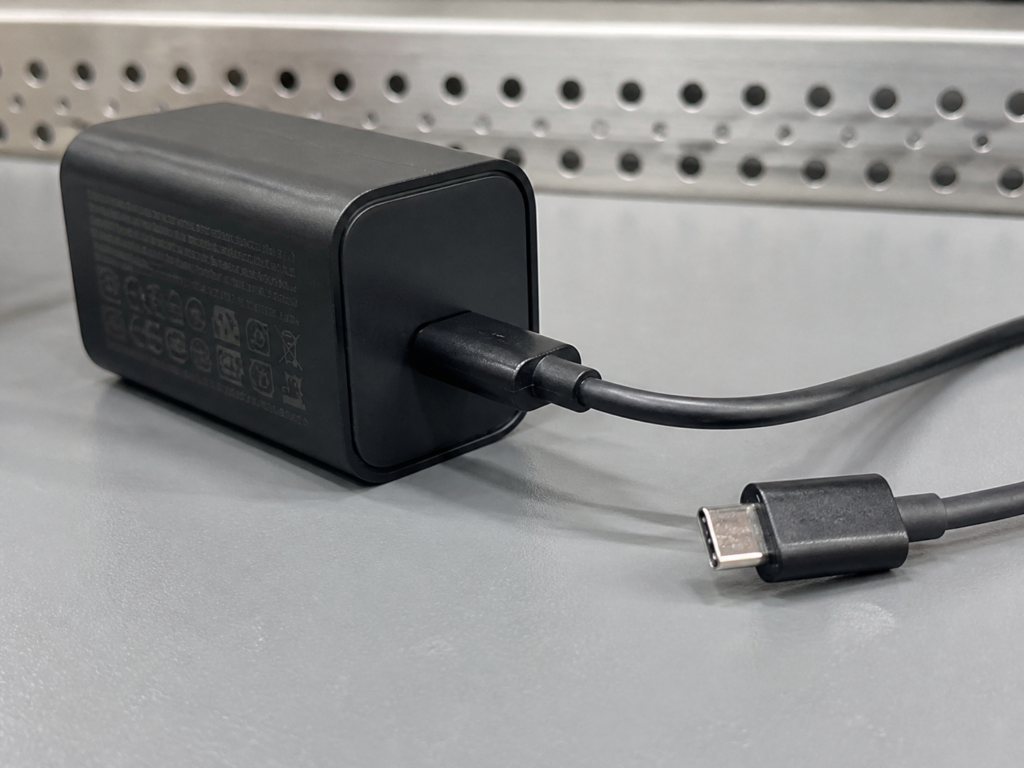
After a product passes SRRC approval, it will receive a unique identification number — **CMIIT ID**, which is equivalent to the product’s “radio ID card”. According to regulations, the CMIIT ID is preferentially marked on the product body; if the product is too small in size or the material is not suitable for printing (such as mini fast chargers, ultra-thin wireless chargers), it can also be marked on the manual, packaging, or displayed with electronic labels. When checking, note that the product model, applicant, and equipment category corresponding to the ID must be completely consistent with the actual product, otherwise it may be a misappropriated certificate.
What Exactly Does SRRC Test? Plain Language Explanation of Core Indicators for Charging Products
After figuring out whether SRRC is needed, you may be curious: what exactly does the test measure? Which indicators that fail to meet the standards will lead to rejection? We break down the core test indicators of charging products in plain language to help you understand the qualification logic:
Working Frequency and Frequency Tolerance
The core requirement of this indicator is very simple: the radio frequency actually transmitted by the product must fall within the frequency band officially allowed by China; and regardless of temperature changes, voltage fluctuations or load changes, the frequency deviation must not exceed the allowable range.
Common compliant frequency bands for charging products include the familiar 2400-2483.5MHz (i.e., 2.4G frequency band), as well as the 5G WiFi frequency band officially approved by China — the specific frequency bands, channels, and indoor/outdoor use restrictions shall be checked in accordance with China’s current radio management requirements and test submission standards; overseas SKUs need to confirm that the firmware region code, channel list, and automatic channel selection logic will not enable channels that are not open in China. In addition, wireless charging products cannot directly apply the frequency bands of the overseas Qi standard, and must be checked in accordance with China’s special wireless charging regulations.
There are three common non-conforming scenarios: overseas version products use 5G channels that are not open in China; poor quality crystal oscillators cause frequency deviation; frequency drifts out of the allowable range when working at high power.
Transmission Power and Duty Cycle
The core requirement is: the maximum transmission power of the product during normal operation must not exceed the officially prescribed limit; if it is a micro-power device, it must also meet the limits of duty cycle (i.e., the ratio of transmission time to total time) and single transmission duration, and cannot occupy the frequency all the time.
The special feature of charging products is that the test will not only test a certain state: the transmission power under different fast charging gears, different charging loads, and different transmission distances must all meet the standards. Common non-conforming situations include: manufacturers unauthorizedly increase the transmission power to improve the charging speed of wireless chargers, or the WiFi transmission power of smart chargers exceeds the standard.
Occupied Bandwidth
You can think of radio frequency as a multi-lane highway, and the signal of each device can only use its own lane, not the adjacent lane. Occupied bandwidth measures the “lane width occupied” by the signal, which must not exceed the specified value, otherwise it will occupy adjacent channel resources and interfere with other devices.
Different wireless technologies have different bandwidth requirements. For example, different modes of Bluetooth BLE and WiFi have different bandwidth limits. A common non-conforming situation in charging products is that the RF circuit design of the fast charger is defective, and the signal is too wide to interfere with adjacent devices such as Bluetooth headsets and wireless mice.
Spurious Emission
In addition to the main signal required for normal operation, the product may also leak some useless signals from antennas, power cords, wireless charging coils, etc. These are called spurious emissions, and their intensity must not exceed the standard.
The spurious emissions of charging products mainly come from three sources: electromagnetic interference of the fast charging switching power supply, magnetic leakage of the wireless charging coil, and unreasonable circuit wiring. If spurious emissions exceed the standard, it will interfere with home routers and Bluetooth headsets in mild cases, and even touch the red line of public communication frequency bands in severe cases.
Emission in Standby/Low Power Mode
Many people think that RF testing is only required when working at full load. In fact, radio signals must not be transmitted illegally in non-full-load states such as standby, sleep, and no-load.
For charging products, the test scenarios include: the emission situation when the smart charger is in standby and output is turned off, and when no receiving device is placed on the wireless charger. A common non-conforming situation is that cheap smart chargers continue to transmit WiFi during standby, and both power and spurious emissions exceed the standard.
Out-of-Band Emission and Spectrum Mask
This indicator is easy to confuse with occupied bandwidth. In fact, the two measure different things: occupied bandwidth measures the width of the main signal itself, while out-of-band emission measures the strength of the signal that “spills over” from the edge of the main signal. It is required that these spilled signals must comply with the officially prescribed “spectrum mask” and must not cross the boundary to interfere with adjacent frequency bands.
A common problem in charging products is that the interference of the fast charging circuit causes the out-of-band spillover of the WiFi signal, which exceeds the limit of the spectrum mask.
EIRP (Equivalent Isotropically Radiated Power)
Many people think that as long as the transmission power of the module itself meets the standard, it is compliant. In fact, what really determines compliance is EIRP — you can understand it as “the total power actually radiated by the device into space”. In plain language, under the measurement caliber of dBm/dBi, EIRP ≈ module transmission power + antenna gain; but the actual whole-machine evaluation also needs to consider factors such as feeder loss, matching loss, housing shielding, antenna installation position, etc., and the final result is subject to the laboratory radiation test result.
For charging products, different built-in antenna gains, metal housing shielding, and even the layout of the USB-C port will change the EIRP value, so only testing the conducted power of the module is not valid, and the radiation performance of the whole machine must be tested.
Receiver Spurious Emission and Blocking
This indicator is not tested for all products, and is only applicable when the product has a receiving function and the corresponding equipment standard requires assessment. Its core requirement is: when the product receives signals, it must not leak useless spurious signals by itself; at the same time, when there is strong signal interference from the outside, it cannot stop working directly.
Among charging products, smart chargers with WiFi/Bluetooth reception and charging accessories with NFC read-write function usually involve this assessment; if it is a wireless charging product with only transmission function or pure power transmission, it is generally not assessed according to receiver items.
Different Charging Products Have Different Test Focuses
The above are general core indicators, but different types of charging products have different test focuses. You can focus on them according to your own products:
Wireless Charging Equipment (Power Transmission Type)
Such products are not included in the scope of SRRC type approval by default, and must be comprehensively judged in combination with China’s special wireless charging regulations and the micro-power equipment catalogue. Approval is only required when the frequency, power, and field strength limits of the exemption are exceeded.
If testing is required, the core assessment items include: working frequency band, rated transmission power, spurious emission, as well as parameter stability under different loads and coil offset conditions — after all, users cannot place the wireless charger perfectly straight every time, and the performance under offset conditions must also meet the standards.
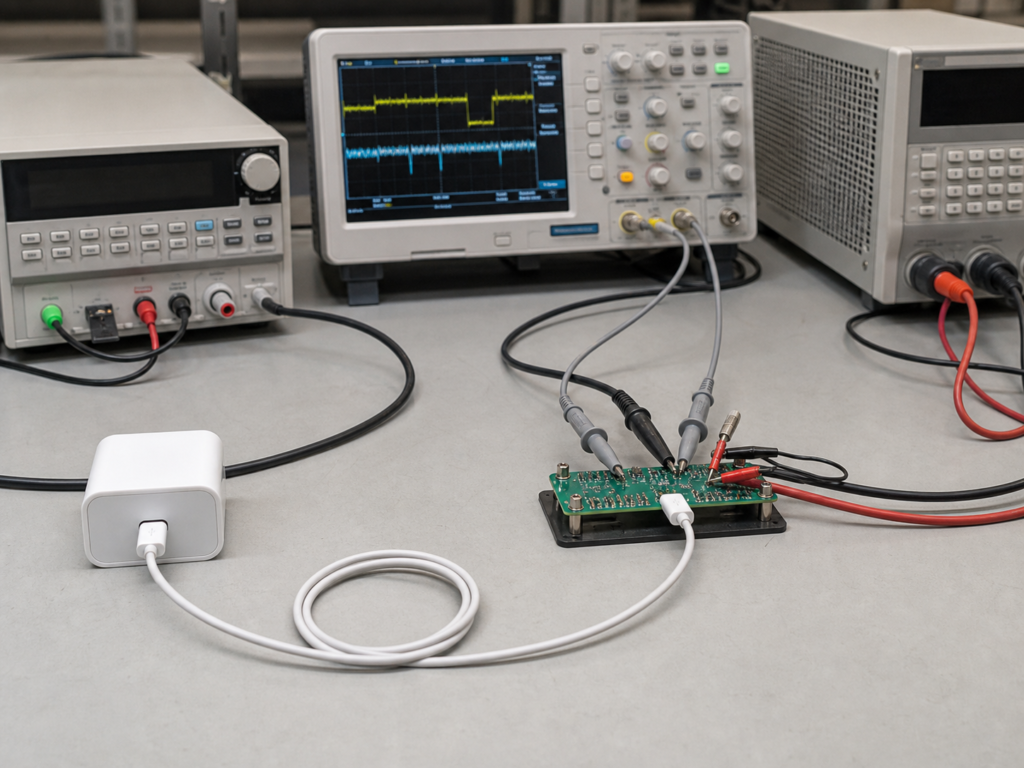
There are also prerequisites for enjoying exemption: it must meet the officially prescribed equipment category, frequency range, power/field strength limits, and must not cause harmful interference, and parameters must not be changed without authorization.
Charging Accessories with Bluetooth/WiFi Short-Range Communication
These are fast chargers, charging docks, charging piles, etc. with Bluetooth and WiFi, which belong to communication RF functions and are the most common charging products that require SRRC.
The core assessment items are frequency tolerance, EIRP, occupied bandwidth, spurious emission, spectrum mask, and standby emission of the corresponding frequency band. In addition to conventional tests, special scenarios must also be covered: such as network configuration/pairing mode (where the transmission power is often higher), continuous working mode, different fast charging loads, and multiple RF working at the same time (such as Bluetooth and WiFi turned on together).
Special reminder: The available channels of 5G WiFi in China are different from those overseas, and overseas version products need to confirm channel compliance in accordance with the aforementioned frequency requirements.
Charging Accessories with NFC Function
Many people have misunderstandings about the SRRC judgment of NFC. Some think that NFC must be exempted because of its short transmission distance, while others think that SRRC must be done as long as it has NFC. In fact, both are wrong. Not all NFC charging accessories require SRRC, which must be comprehensively judged in combination with equipment attributes, transmission characteristics, and the current approval catalogue.
Generally speaking, only charging accessories with NFC read-write function and whose transmission power exceeds the exemption limit need to apply for SRRC. If testing is required, the core assessment indicators are frequency, power, bandwidth, and spurious emission in the 13.56MHz frequency band.
Whole-Machine Test Rules for Multi-RF/Certified Modules
If the product has multiple RF functions (such as both WiFi and Bluetooth), each RF function must be tested separately, and it is also necessary to assess whether mutual interference will cause spurious emissions to exceed the standard when multiple modules are turned on at the same time.
In addition, special attention should be paid: even if the RF module used itself has an SRRC certificate, it does not mean that the whole machine is automatically compliant. If the antenna position is changed, a metal housing is added, or the power supply method is changed, these will affect the RF performance, and re-testing is required. Only when the module has no changes and the whole machine integration is within the allowable use range of the module can the module certificate be directly cited.
What Factors Affect SRRC Test Results?
Many manufacturers encounter the situation of “the module is obviously good, why can’t the whole machine pass the test” when submitting for testing. In fact, they ignore some key variables that affect the test results:
The first is **sample hardware status**, which is the basis of testing. The RF module, antenna, wireless charging coil, and power circuit of the submitted sample must be completely consistent with the mass-produced ones. Specially optimized “golden samples” — that is, samples whose parameters are specially adjusted to pass the test and then changed back during mass production — cannot be used, and will be directly unqualified once discovered. The product structure will also affect the transmission characteristics: antenna position, metal housing, shielding materials, and even the layout of the USB-C port will change the RF performance. When submitting for testing, all accessories must be brought: the original power adapter, standard test load, and wireless charging products must also be equipped with a standard receiving board to simulate real usage scenarios. If the antenna is replaced without authorization, the wireless charging coil is modified, or the PCB layout is changed later, the original test result will be directly invalid, and a new application must be made.
The second is **test environment requirements**. SRRC testing must be carried out in a shielded room or anechoic chamber, in order to isolate other wireless signals in the environment and avoid affecting the accuracy of test results. The temperature, humidity, and power supply voltage during testing must meet the product’s nominal normal working conditions, and testing cannot be carried out in an overly ideal environment, otherwise when mass-produced products reach users, they will become unqualified as the environment changes. The test margin of different laboratories may vary slightly, but the pass/fail conclusion should be consistent.
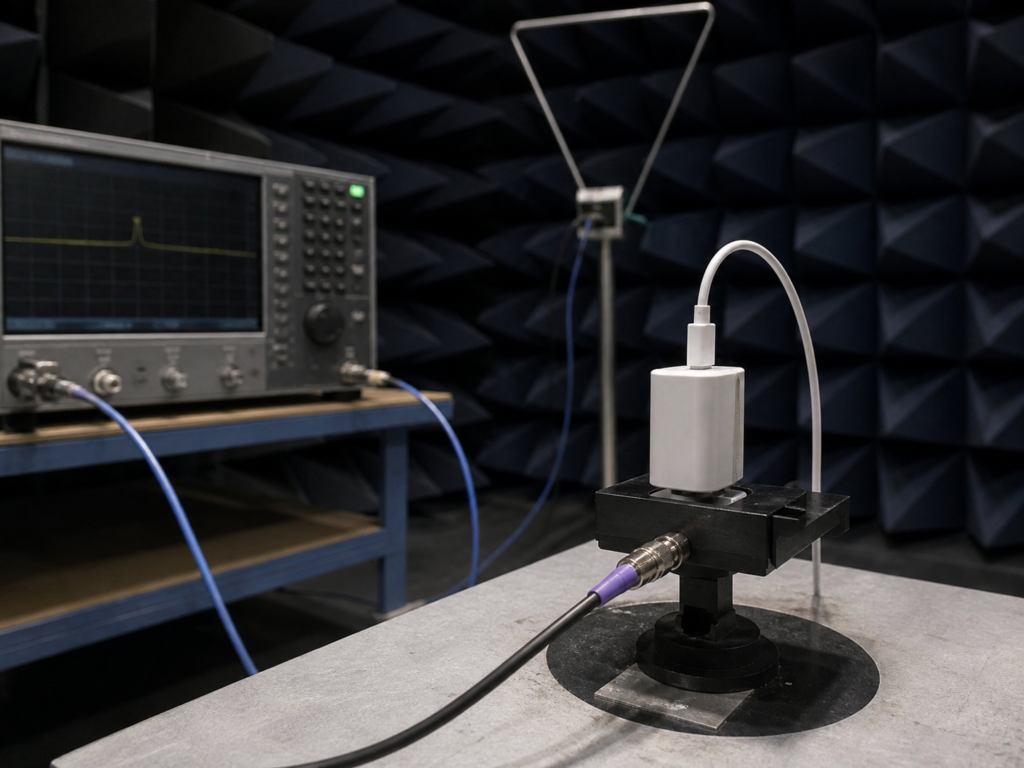
The last is **test mode and power supply conditions**. During testing, the optimal state of the product will not be the only test; on the contrary, the highest power, the most edge channels, and the working modes that are most likely to exceed the standard will be specially tested to ensure compliance even in the worst case. For charging products, the test scenarios that must be covered include: different fast charging gears, no-load/full-load, standby/sleep, and multiple RF working at the same time. In addition, different power supply methods will also affect RF performance: the noise levels of AC power supply, battery power supply, and different voltage gears of USB-C PD are all different, and these situations will also be covered during testing.
How to Check SRRC Compliance? Tips to Identify Misappropriated and Fake Certificates
Whether you are purchasing charging products or verifying your own certificates, you can check SRRC compliance through official channels, and also identify misappropriated and fake certificates:
Querying CMIIT ID only takes three steps: Step 1: First find the CMIIT ID on the product body, nameplate, packaging or manual. If there is no mark at all, the compliance risk is very high; Step 2: Log in to the official query platform of the Radio Administration Bureau of the Ministry of Industry and Information Technology of China, and enter the CMIIT ID; Step 3: Check whether the certificate information is consistent with the actual product.
To avoid the pitfall of misappropriated certificates, remember the **four comparisons**:
1. The CMIIT ID number is consistent with the one marked on the product;
2. The applicant/manufacturer indicated on the certificate is consistent with that indicated on the product;
3. The equipment model is consistent with the actual product model and sales SKU;
4. The approved frequency/standard is consistent with the wireless function claimed by the product.
Only when all four are consistent can it be a truly compliant certificate.
If you get the test report, you don’t need to understand all of it. You can quickly judge by grasping three key points: first, check whether the product model, wireless function, and frequency band in the report are consistent with the actual product, otherwise no matter how good the report looks, it is useless; then check whether the core test indicators are all within the limits. If the margin is particularly small (passing just at the limit), it is easy to be unqualified during mass production due to process fluctuations; finally, check whether the report covers all working modes and usage scenarios. If only a single mode is tested, the reference value of the report is very low.
There are also several quick identification tips for misappropriated/fake certificates: if there is no CMIIT ID or the ID is blurry, the compliance risk is extremely high; if it cannot be found on the official platform, it is highly suspected of non-compliance, of course, the situation that the certificate has just been obtained and has not been entered into the system should also be excluded; if it does not meet the four comparison requirements, it can basically be determined as a misappropriated certificate or non-compliant.
The Most Common SRRC Misconceptions and Pitfalls
Regarding SRRC, there are several particularly common cognitive misconceptions and high-frequency pitfall scenarios. Understanding them in advance can save you a lot of money and time:
5 Core Cognitive Misconceptions
1. **Having 3C means no SRRC is needed**: Wrong. The two have different regulatory directions and cannot replace each other; charging products with RF transmission functions that should obtain type approval according to law, if they are also in the 3C certification catalogue, need to meet both requirements at the same time.
2. **Low power means no SRRC is needed**: Wrong. The core depends on whether there is an active transmission function, whether it is included in the approval catalogue, and also combined with whether it meets exemption conditions such as micro-power and wireless charging. Low power does not automatically mean exemption.
3. **FCC/CE can replace SRRC**: Wrong. Each country has different frequency band planning and radio management rules; products that are legally included in China’s and do not meet exemption conditions need to apply for SRRC in accordance with China’s requirements when entering the Chinese market for sale.
4. **If the RF module has SRRC, the whole machine does not need it**: Wrong. Changes in the whole machine structure, antenna, power supply, etc. may affect RF performance. Those exceeding the allowable use range of the module certificate need to be re-tested. For specific rules, see the aforementioned whole-machine requirements for multi-RF modules.
5. **All wireless chargers need/do not need SRRC**: Wrong. There is no one-size-fits-all conclusion, and comprehensive judgment must be made in combination with China’s special wireless charging management rules and exemption requirements.
4 High-Frequency Pitfall Scenarios
The first is the **overseas version 5GHz WiFi channel pitfall**: equipped with 5G channels that are not open in China, which directly fails to meet the frequency requirements.
The second is the **module certificate citation boundary pitfall**: unauthorized modification of antenna/housing/power supply, exceeding the allowable use range of the module certificate, resulting in non-compliance of the whole machine.
The third is the **mass production change pitfall**: after obtaining the certificate, the RF components such as crystal oscillators, antennas, and wireless charging coils are unauthorizedly replaced during mass production for cost reasons, which are inconsistent with the declared samples, and the original certificate becomes invalid.
The fourth is the **platform listing pitfall**: the model on the certificate is inconsistent with the sales SKU, even if the product itself is compliant, it cannot pass the review of e-commerce platforms.
How to Maintain the Certificate? Pre-Test Self-Check List
Obtaining the SRRC certificate is not a once-and-for-all matter, and attention must be paid to maintenance; doing a good self-check before submitting for testing can also greatly improve the pass rate:
According to official regulations, the validity period of the SRRC approval certificate is 5 years, and it needs to be renewed or re-applied as required after expiration. If it is a change in product appearance or non-RF components, such as housing color and charging interface material, which do not affect RF performance, there is no need to re-apply. But if it is the following types of changes, it is necessary to re-apply or re-test: replacement of RF components (antenna, module, wireless charging coil); adjustment of working frequency band, power or addition of new RF functions; opening of new frequency bands, new channels, new power gears after software upgrade; model expansion involving changes in RF parameters.
Domestic mainstream e-commerce platforms usually require RF-enabled charging products that legally require SRRC to submit CMIIT ID or approval certificate. The specific material requirements may vary with categories and platform rules. The review requirements of platforms may be more detailed than regulations, but the core basis is still SRRC-related regulations. Consistency of certificate model, product title, and nameplate information is the common review focus of all platforms, and inconsistency is likely to lead to rejection.
Finally, here is a **pre-test self-check list** for you. Following it can greatly improve the pass rate:
1. Sample status: completely consistent with mass-produced products, no special optimization of RF components, structure, and power supply, no special test prototypes;
2. Test preparation: able to trigger maximum transmission mode, edge channels, and all working modes (including standby, multiple RF turned on at the same time), to avoid delay due to inability to adjust during testing;
3. Accessories and materials: bring the original adapter, standard test load, antenna drawings, manual and nameplate. If a certified module is used, also bring the module certificate and difference description;
4. Pre-verification: confirm in advance that the frequency bands and channels used by the product are officially open in China, and the wireless charger meets the special management requirements. Don’t find that the basic conditions are not met until you arrive at the laboratory.
After mastering the content of this article, you can independently complete five practical SRRC-related operations: quickly determine whether charging products need to apply for SRRC through the three-step method, understand the qualification logic of core RF test indicators, query compliance through the official CMIIT ID channel and identify the risk of misappropriated certificates with the “four comparisons”, avoid common cognitive misconceptions and high-frequency pitfall scenarios, accurately judge whether product changes require re-application for SRRC and complete the basic pre-test self-check.