
Many overseas sellers of charging products, when first entering the Chinese mainland market, are often confused by “SRRC certification”: they already have FCC and CE wireless certifications, why do they need to apply for another one? Do ordinary wired chargers need it? Why are wireless charging pads also under regulation?
This article starts from the actual scenarios of charging products, and clearly explains the definition, judgment method, application process, and common pitfalls of SRRC certification at one go. Even beginners who have never been exposed to China’s access rules can understand and make judgments.
First, Understand: What is SRRC for Charging Products
The full name of SRRC is **Radio Transmitting Equipment Type Approval**, which is China’s mandatory access requirement for wireless transmitting equipment. You can understand it as the “Chinese wireless ID card” for wireless products. Its core role is to regulate the wireless signal transmission of various types of equipment, to avoid harmful interference to other legal radio services or surrounding electronic equipment caused by various wireless functions such as wireless charging transmission, Bluetooth, WiFi, 2.4G, etc.
Products that pass the certification will receive a unique **CMIIT ID**, which is publicly queryable, equivalent to the product’s wireless compliance certification.
For charging products, the applicable boundary of SRRC is very clear: ordinary wired charging products (such as chargers that only have AC-DC conversion and pure wired output) do not need to apply at all; as long as the charging product has the function of **actively transmitting radio signals**, it falls within the scope of regulation. Whether it is import customs clearance, e-commerce platform listing, or market supervision and spot check, this certificate will be verified. Violations may face penalties such as cargo detention, fines, confiscation of products, and removal of product links.
Many people confuse SRRC with other certifications. Here we clarify the boundaries using charging product scenarios:
• **Difference from CCC**: SRRC regulates “whether wireless transmission will interfere with other equipment or services”, while CCC regulates “whether the product itself is safe, whether it will leak electricity, and whether electromagnetic compatibility is qualified”. If the product also falls into the CCC certification catalog, it usually needs to meet both CCC and SRRC requirements; SRRC cannot replace CCC, and CCC cannot replace SRRC either.
• **Difference from overseas wireless certifications**: China does not recognize overseas wireless certifications such as FCC and CE. Even if the product is sold compliantly in Europe and the United States, it must apply for SRRC separately to enter the Chinese market, and cannot be directly replaced.
• **Difference from Network Access License (CTA/NAL)**: Network access license is for devices with cellular mobile communication functions. For example, if a charging device has a built-in cellular communication module such as 4G/5G/NB-IoT and accesses the public mobile communication network as a telecommunication terminal, it is necessary to further judge whether it involves CTA/NAL in combination with the catalog of telecommunication equipment network access licenses; ordinary charging products with Bluetooth, WiFi, and wireless charging functions usually do not fall within the scope of network access license regulation.
Quick Judgment: Does Your Charging Product Need SRRC
The core standard for judgment is very simple: **whether the product actively transmits radio signals** — those that only receive signals do not count, and those with wired transmission do not count either. For example, protocol communication of wired fast charging such as PD and QC, and wired data transmission of USB-C, are all transmitted through cables, which do not belong to wireless transmission, so no application is required.
Of course, the premise of this judgment is: the product is planned to be produced, imported, sold or used in Chinese mainland. If it is only sold in overseas markets, there is no need to consider SRRC at all.
For easy comparison, here is a comparison table of common charging products:
| Charging products that require SRRC | Charging products that do not require SRRC |
| Wireless charging transmitter types: Qi wireless charging pads, car wireless chargers, charging bases | Ordinary wired chargers, power adapters (wired output only) |
| Smart control types: smart chargers, adapters, charging plugs with Bluetooth/WiFi/2.4G/Zigbee | Ordinary charging cables, USB/USB-C adapters/extension cables (no wireless function) |
| Multi-function types: USB-C charging docks, expansion docks with wireless data transmission/NFC | Charging products that only support wired fast charging protocols |
| Remote control types: charging power strips, charging stands with RF remote control | Products that only serve as wireless charging receivers (such as built-in charging coils in mobile phones) |
Boundary Cases and Self-Inspection Methods
A boundary misunderstanding that is most easy to fall into should be specially mentioned here: **the transmitter end of Qi wireless charging must apply for SRRC**. Many people think that wireless charging only transmits energy and does not count as “radio signal transmission”, but under China’s regulatory rules, transmitting equipment for wireless energy transmission also falls within the scope of regulation, so transmitter ends such as wireless charging pads and car wireless chargers all need to apply for the certificate; while the wireless charging receiving coils in mobile phones and earphones do not need to apply separately because they only receive energy and do not actively transmit.
Compliant exemption scenarios include: temporarily entering test samples, scientific research prototypes or display and verification equipment, which are only for testing, scientific research or display purposes, and shall not enter sales channels or be used for long-term commercial use; if it involves actual power-on transmission, import customs clearance or temporary use, it is also necessary to confirm whether temporary procedures are required in accordance with the requirements of the customs and radio management departments. But as long as the product enters the market for sale, it must apply for SRRC certification.
If you are not sure, there are three simple self-inspection methods: first, check the product specification to see if there are wireless function marks such as RF, Bluetooth, WiFi; second, check the bill of materials (BOM) of the product to see if there are components such as wireless chips and antennas; third, find a formal agent with experience in charging product SRRC to do a pre-evaluation, usually you can get an accurate conclusion in 1-2 days, which is much more reliable than guessing by yourself.
Pre-Application Preparation: Exclusive Notes for Overseas Users + Charging Products
Since SRRC is China’s local access certification, there are many special requirements for overseas users to apply. Preparing in advance can save a lot of detours.
First is the requirement for the applicant entity, which is the point that overseas users are most likely to get wrong: **overseas enterprises cannot directly apply for SRRC**, and must entrust a legal person enterprise within Chinese territory as an agent or responsible unit to submit the application. If it is an OEM/ODM model, it must be clarified in the contract in advance whether the certificate holder is the brand party or the foundry, to avoid subsequent ownership disputes. In addition, all application materials need to have a Chinese version. If it is in Chinese-English comparison, the Chinese content shall prevail. When translating, it is necessary to ensure the accuracy of parameters and function descriptions, to avoid corrections due to translation errors. It is recommended to prioritize formal agents with experience in handling SRRC for charging products — charging products have their own unique problems, and inexperienced agents may not know how to solve them when encountering problems.
Sample and Material Preparation
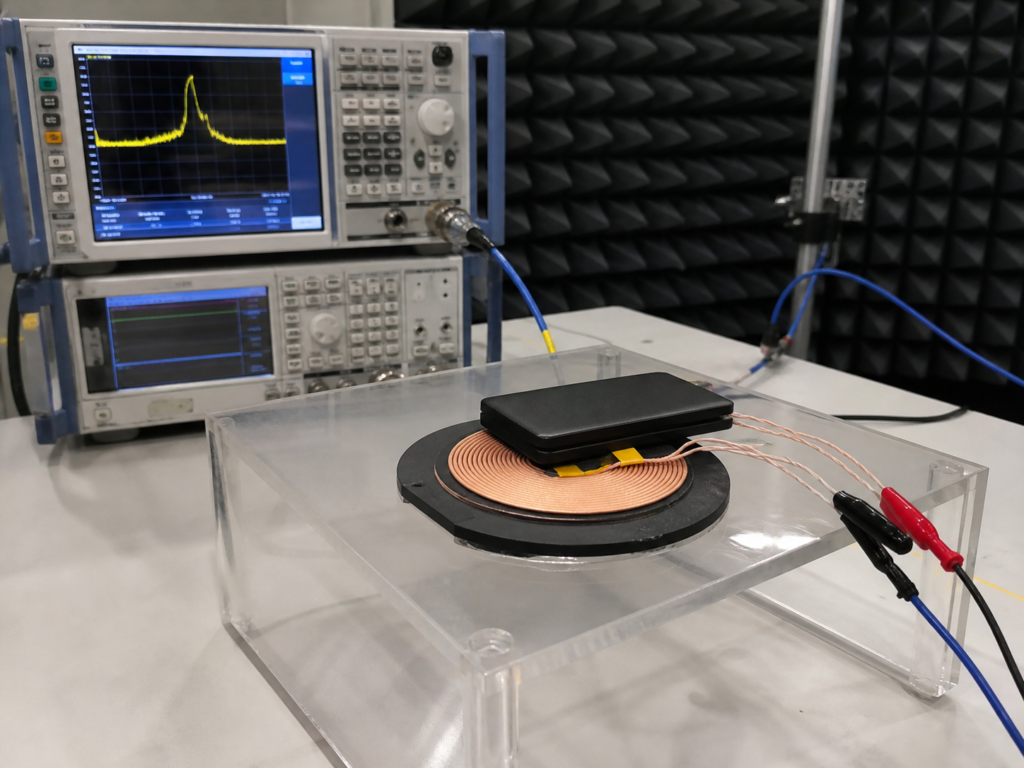
For samples, 2-3 units of **final mass-produced finalized version** machines need to be prepared, not engineering machines that are still being debugged. There are two special requirements for charging products here: if it is a wireless charging product, it should be equipped with a standard test load (a device that simulates the receiving end of a mobile phone, to facilitate the stable operation of the wireless charger during testing); if it is a charging product with smart control, it should be equipped with the corresponding control tool or APP, otherwise the wireless function cannot be turned on during testing, which will delay the schedule.
In terms of materials, basic materials include application form, qualification documents of the applicant and the agent, power of attorney, product manual, nameplate draft, appearance and structure photos; technical materials need to provide circuit function block diagram (the position of the radio frequency part should be clearly marked), wireless module specification, radio frequency parameter table, and the specification of the wired charging part — after all, it is a charging product, the regulator also needs to confirm the basic information of the wired part.
Key Points for Pre-Self-Inspection
Doing these self-inspections well can greatly reduce the probability of subsequent corrections and rectifications:
1. Confirm that the wireless operating frequency is within the public frequency band allowed by China. For example, the 2.4G ISM frequency band used by Bluetooth is compliant. If a frequency band not opened by China is used, it will directly fail.
2. Confirm that the indicators related to wireless transmission meet China’s limit requirements. Many overseas version products have not been adapted to China for their radio frequency parameters, and it is easy to exceed the standard if sent for testing directly.
3. Confirm that all parameters on the materials are completely consistent with the actual situation of the sample. For example, if the material says the transmission power is 1W, but the actual measured sample is 1.2W, it will definitely be rejected.
4. If the product uses a wireless module that has obtained SRRC certification, don’t think that the whole machine does not need to be tested — be sure to confirm that the applicable conditions of the module’s certificate match the whole machine. For example, if the module was originally equipped with a ceramic antenna, but you replace it with a PCB antenna, or adjust the transmission parameters of the module, then the module’s certificate cannot be directly used, and the whole machine still needs to undergo a complete test.
Full Process of Formal SRRC Application (with Key Checkpoints)
After the preparation work is done, you can go through the formal process. The whole process is divided into four steps, each with clear checkpoints. Keeping an eye on these nodes can avoid delays.
Step 1: Pre-Evaluation and Model Confirmation
Before formally submitting the application, first find an agent or testing institution to do a pre-evaluation to confirm whether the product is within the acceptance scope and clarify the specific type of wireless function.
Here is a money-saving and time-saving tip: **series model application**. If the wireless parts of several products are exactly the same, only the appearance, color, plug specification, and wired charging parameters are different, they can be combined into one series application, only costing one share of money and time. For example, the same wireless charger has two versions with national standard pins and European standard pins, and the wireless transmission part is completely unchanged, so they can be applied for in combination.
The checkpoint of this step is: the pre-evaluation conclusion will be issued in 1-2 working days. There is no need to blindly prepare materials, first confirm whether it can be handled and how to handle it most cost-effectively.
Step 2: Online Application and Material Preliminary Review
After the pre-evaluation is passed, the agent will submit the online application through the Ministry of Industry and Information Technology’s type approval application system.
The preliminary review mainly checks three aspects: whether the materials are complete, whether the applicant entity’s qualification is qualified, and whether the product is within the acceptance scope. Special attention should be paid to charging products: the specific type of wireless function must be clearly marked in the application materials, such as “wireless charging transmission” or “Bluetooth control”, don’t just write “wireless function” generally, it is easy to be rejected for correction.
The checkpoint of this step is: an acceptance notice or correction notice will be issued within 5 working days after submission. If correction is required, it must be completed within the required time limit, otherwise the whole process will be slowed down.
Step 3: Sample Submission for Testing and RF Testing
After the application is accepted, the samples should be sent to an **officially recognized testing institution** for radio frequency testing — be sure to find a qualified institution. Reports issued by unqualified institutions are invalid, don’t look for small institutions for cheap.
The conventional test cycle is 2-4 weeks, and charging products with a single wireless function will be faster. For example, those with only Qi wireless transmission function are much faster than multi-function expansion docks with Bluetooth + WiFi. If the test fails, a rectification notice will be received, and the product can be re-submitted for testing after adjustment.
The checkpoint of this step is: before sending the samples, be sure to confirm that the samples can stably enter the wireless transmission state. For example, for a smart charger with Bluetooth, make sure that it can normally connect to the APP and turn on the Bluetooth function. Don’t wait until you send it to the laboratory to find that the sample cannot be connected, wasting the waiting schedule.
Step 4: Technical Review and Certificate Issuance
After the test is passed, the testing institution will submit the report to the regulatory department for technical review, which mainly checks three contents: whether the test report is qualified, whether the materials and samples are consistent, and whether the scope covered by the model is reasonable.
The review of charging products is basically written review, and on-site verification is rarely required, so there is no need to worry too much about factory inspection.
After the review is passed, an electronic certificate will be issued, which has the same effect as a paper certificate, and the certificate will be accompanied by a unique CMIIT ID.
The checkpoint of this step is: after getting the certificate, check immediately whether the product model and wireless parameters on it are consistent with what you applied for, to avoid information errors and problems when using it later.
Core Test Items and Common Unqualified Reasons for Charging Products
Many people think that radio frequency testing is very mysterious, but in fact, the core is to test four indicators. There are also several unique unqualified reasons for charging products, and understanding them in advance can avoid pitfalls.
| Core Test Item | Popular Explanation | Impact of Unqualified |
| Operating frequency deviation | The frequency of the transmitted wireless signal must be within the range allowed by the state, and cannot deviate too much | Deviating from the allowed frequency band, interfering with other legal radio services |
| Transmission power | Indicators such as transmission power, equivalent radiated power or field strength shall meet the limits of the corresponding equipment category and frequency band, and be consistent with the declared parameters in the application materials | Exceeding the limit of power or field strength will interfere with other legal radio services, and inconsistency with declared parameters will not meet the type approval requirements |
| Occupied bandwidth | The frequency band width occupied by the signal cannot exceed the standard, and cannot occupy others’ “frequency band parking spaces” | Crowding out adjacent frequency bands, causing other equipment to fail to work normally |
| Spurious emission | Except for the normal operating frequency, no extra wireless signals can leak out | Extra signals may cause harmful interference to legal radio services in adjacent frequency bands or other electronic equipment |
Common Unqualified Reasons for Charging Products
1. Poor antenna design or matching leads to excessive spurious emission, which is a common problem in products of many small and medium-sized factories.
2. **Power supply noise coupled to the RF path** — this is a unique problem for charging products. Because charging products themselves have high-power power supply circuits, if isolation is not done well during design, power supply noise will run into the wireless circuit, leading to excessive spurious emission. This is a situation rarely encountered in ordinary consumer electronics such as Bluetooth headsets.
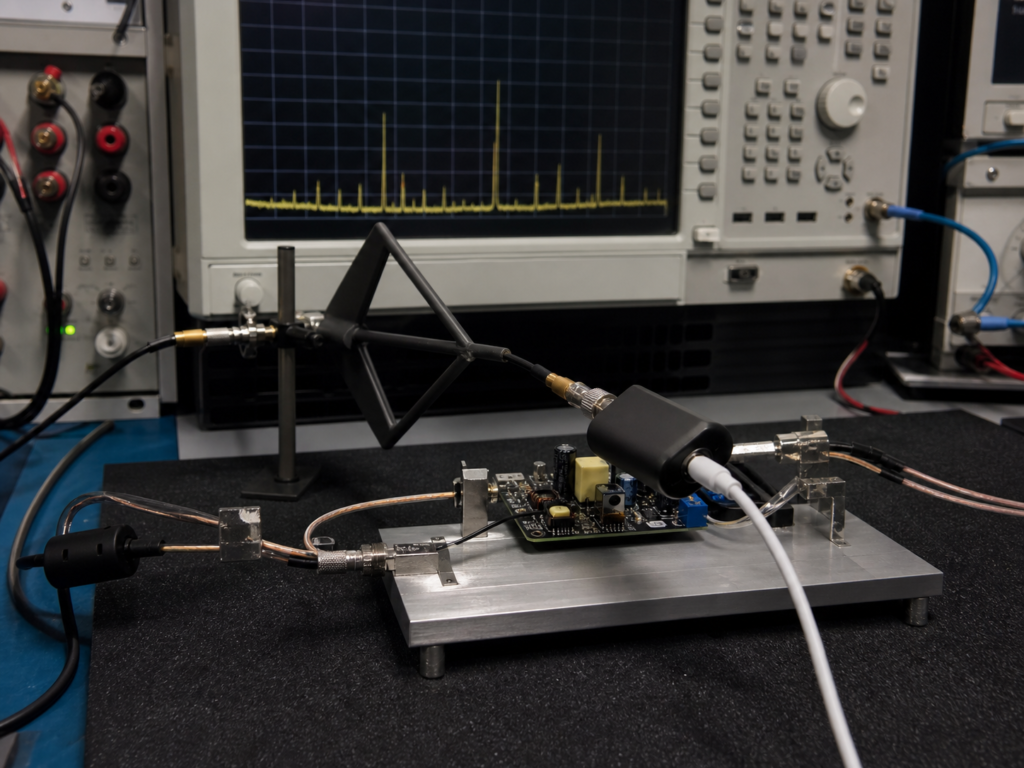
3. RF-related indicators do not meet China’s national standard limits, which is common in overseas version products that have not been adapted to the Chinese market — overseas version wireless charging products may not be configured with operating frequency band, field strength, spurious emission control or power management strategies in accordance with China’s requirements, and direct testing may not meet the limit requirements.
4. The software version of the sample is inconsistent with the mass-produced version, and the RF parameters are changed. For example, the engineering machine sent for testing adjusts the RF parameters to compliant values, but the mass-produced version’s software raises the parameters again, or the region code is set to Europe and America, which will lead to unqualified testing.
To reduce the test failure rate, there are two practical methods: first, do a pre-test (also called baseline test) before formal submission for testing, find problems in advance, and send them to the official laboratory after rectification, which is more cost-effective and time-saving than rectifying after failing the direct test; second, lock all wireless parameters before testing, such as setting the region code to China, fixing the transmission power and channel, and do not change them casually, to avoid unqualified results due to parameter changes during testing.
Application Cycle and Cost Reference (for Charging Products)
The cycle and cost that everyone is most concerned about actually have no fixed figures, and are affected by many factors. Here is a reference range for charging products.
Cycle Range and Influencing Factors
If it is a basic model (charging product with a single wireless function, such as only Qi wireless charging, or only a Bluetooth-controlled charger), under the premise of complete materials and no need for rectification, it takes about 4-6 weeks to get the certificate.
If it is a complex model (multiple wireless functions, such as a USB-C expansion dock with Bluetooth + WiFi + wireless charging), the cycle will be longer, about 6-10 weeks.
There are many factors affecting the cycle: the more times materials are corrected, the longer the cycle; the more times test rectification is done, the longer the cycle; if it catches up with the peak application period (such as the end of the year), the laboratory schedule is full, and it will also slow down; some projects can compress time by booking laboratory schedules in advance, expedited testing or parallel preparation of materials, but whether it can be shortened by 1-2 weeks depends on the testing institution’s schedule, product complexity and whether rectification is required, and usually incurs additional costs.
Cost Composition and Reference Range
The market cost of SRRC application is mainly composed of several parts: administrative approval and certificate cost are usually not the main cost; testing and pre-test fees are charged by the undertaking officially recognized testing institutions or third-party institutions according to the project; in addition, additional expenses such as agency fees, rectification and retesting fees may also be incurred. The following is a reference to the market application cost of charging products, which is not equivalent to the official fixed fee, and the specific amount shall be subject to the quotation of the actual cooperative institution.
For reference price, the basic model (single wireless function) is about several thousand RMB; the complex model (multiple wireless functions) is about 10,000-30,000 RMB.
The specific cost is affected by these factors: the more wireless functions, the higher the cost; the higher the test complexity, the higher the cost; expedited service requires extra money; different agents charge different fees; if rectification is required, such as modifying the antenna or circuit, additional rectification costs will be paid.
Certificate Use and Maintenance
Getting the certificate is not the end of the story. You also need to know how to use and maintain it, otherwise it is easy to violate the rules.
Basic Certificate Information and Query
The core information on the SRRC certificate includes: applicant unit, product model, wireless function parameters, CMIIT ID. The validity period of the certificate is 5 years, calculated from the date of issuance.
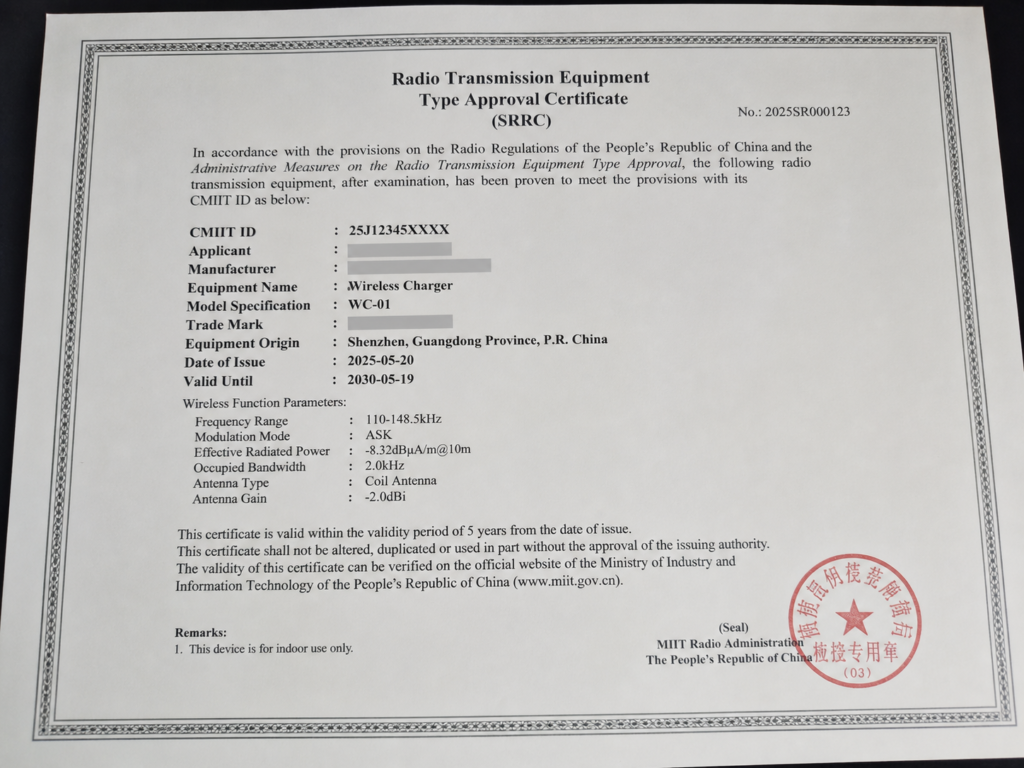
If you want to check the authenticity of the certificate, you can directly enter the certificate number or product model in the Ministry of Industry and Information Technology’s type approval public announcement system to query. If the corresponding information cannot be queried in the Ministry of Industry and Information Technology’s type approval public announcement system, you should first check whether the certificate number, CMIIT ID, product model and applicant unit are accurate; if it still cannot be verified after excluding input errors, system announcement delays and other situations, it should be regarded as a high-risk certificate and should not be directly used for customs clearance, listing or sales.
Certificate Use Rules
The certificate can only be used on the marked models and specifications, and cannot be applied beyond the scope — for example, using the certificate of model A wireless charger for model B is a violation.
The CMIIT ID should be preferentially marked on the product body, nameplate or label in accordance with the type approval requirements; if it cannot be marked on the body due to product size or structure limitations, it should be reflected in the manual, packaging and other materials as required. Whether it needs to be displayed on the e-commerce page also needs to be determined in combination with the rules of the corresponding platform and the listing review requirements.
Change, Renewal and Re-application
If only the product name and the name of the applicant unit have changed, and the wireless part has not changed at all, you can apply for certificate change without re-testing.
If the certificate is about to expire, you need to apply for renewal within 6 months before the expiration of the validity period. Renewal may require re-testing, not direct renewal.
If the product’s wireless module, antenna, transmission power, or RF parameters in the software have changed, you must re-apply for SRRC and cannot continue to use the original certificate — for example, replacing the original Bluetooth module with another model, or adjusting the RF parameters to improve performance, all require re-applying for the certificate.
Common Pitfalls and Pitfall Avoidance Guide for Overseas Users Applying for SRRC
Finally, we have sorted out several types of pitfalls that overseas users are most likely to fall into. Avoiding them in advance can save a lot of money and time.
Cognitive Misconceptions
• Misconception 1: All charging products need to apply for SRRC. Correct answer: Only charging products with active wireless transmission function need to apply. Ordinary wired chargers, charging cables and other products without wireless transmission function do not need to apply.
• Misconception 2: Overseas certifications such as FCC and CE can replace SRRC. Correct answer: China does not recognize overseas wireless certifications. You must apply for China’s type approval separately. Customs clearance, listing and spot checks are all subject to China’s official certificates.
• Misconception 3: If the wireless module has SRRC, the whole machine does not need to apply. Correct answer: The certification of the module does not mean that the whole machine is automatically compliant. Changes in antenna, structure, and RF parameters will affect the final performance. The whole machine still needs to complete the approval as required. Only some scenarios can simplify the test, and it cannot be directly exempted.
• Misconception 4: Only one of SRRC and CCC is needed. Correct answer: The two have completely different regulatory directions. If the product also falls into the CCC catalog, it needs to meet the two requirements respectively, and they cannot replace each other.
Application Pitfalls (Costly and Time-Consuming)
• Pitfall: Overseas version products that have not been adapted to the Chinese market are directly sent for testing, and the probability of failure is very high. Pitfall avoidance: Before sending for testing, adjust the region code, operating frequency band, channel, and RF-related parameters to China’s compliance range in advance, and confirm that the relevant indicators meet the requirements.
• Pitfall: The samples sent for testing are engineering machines, which are inconsistent with the mass-produced version. Even if the test is passed, you will be punished if the subsequent spot check finds inconsistency. Pitfall avoidance: The final mass-produced finalized version must be used for testing, to ensure that the information of materials, samples, and nameplates is completely consistent.
• Pitfall: Finding an agent that lacks experience in charging product services, it is difficult to solve unique problems in a timely manner, which is easy to slow down the progress. Pitfall avoidance: Before choosing an agent, check its SRRC handling cases and formal qualifications for charging products.
• Pitfall: Credulously believing in the publicity of “guaranteed pass”, “test-free”, “certificate issued in 3 days”. These are all scams. Formal SRRC certificates must be queryable in the Ministry of Industry and Information Technology system. RF testing is a necessary link, which cannot be exempted, and issuing certificates in 3 days is even more inconsistent with the actual process.
Use Pitfalls (High Violation Risk)
• Pitfall: Randomly changing the core wireless parameters after getting the certificate, such as adjusting the RF transmission parameters of the wireless charger, replacing the wireless module or antenna, are all violations, and you will be punished if found. Pitfall avoidance: As long as the core wireless parameters change, you need to re-apply for SRRC.
• Pitfall: Selling in Chinese mainland after the certificate expires. Many people easily forget the validity period of the certificate, and only remember to renew it when it expires, which affects sales. Pitfall avoidance: Start preparing the renewal application 6 months in advance, don’t wait until it expires to be anxious.
• Pitfall: Models with different wireless parts share one certificate. For example, two wireless chargers use different wireless modules but use the same certificate, which is beyond the scope of use and is a violation. Pitfall avoidance: Only models with exactly the same wireless parts can apply for a shared certificate as a series, and those that are different must apply separately.
To sum up, mastering these four points can help you calmly handle the SRRC application for charging products: first, you can quickly judge whether the product needs to be applied; second, you are clear about the core application steps and preparation materials; third, you understand the key factors affecting the cycle and cost; fourth, you can avoid common pitfalls for overseas users. With good preliminary preparation, you can efficiently complete the wireless compliance access to the Chinese market.