
Practitioners dealing with electronic and electrical products for the US market often encounter two types of compliance requirements: ETL and FCC. Many beginners easily confuse their positioning: since both are related to market access, is it enough to do only one? Which one is mandatory? Why do some products bear both marks, while others only bear one?
ETL and FCC correspond to safety certification and electromagnetic/wireless compliance respectively. They have completely different regulatory scopes, mandatory attributes, and compliance logics, neither including nor replacing the other. This article sorts out the two from the dimensions of basic concepts, regulatory positioning, applicable boundaries, common misconceptions, practical judgment, and application verification, to help readers clarify their relationship.
Beginner’s Basics: Distinguish the Core Responsibilities of the Two in 1 Minute
The most core distinction logic is: ETL governs personal and property safety risks related to product electricity use and structure, while FCC governs electromagnetic interference and public spectrum order.
Let’s start with ETL: you can understand it as a qualified electrical safety certificate issued by an authoritative third party, proving that the product will not have safety risks such as electric shock, short-circuit fire, overheating melting, or structural loosening causing injury under normal use scenarios.
Many people mistakenly believe that ETL is a certificate issued by the US government. In fact, the ETL mark is launched by Intertek, and Intertek is a “Nationally Recognized Testing Laboratory” (NRTL for short) recognized by the U.S. Occupational Safety and Health Administration (OSHA). NRTL is an officially endorsed list of institutions with safety testing qualifications in the US. Only safety marks issued by institutions on the list are generally recognized by the US market. Common safety marks such as ETL, UL, and CSA all belong to certifications under the NRTL system.
Now let’s talk about FCC: FCC is the abbreviation for the Federal Communications Commission of the United States. The electromagnetic compliance rules it formulates are federal-level mandatory requirements, governing the electromagnetic wave emission issues of electronic, electrical, and wireless equipment falling under the jurisdiction of FCC rules — the core is to prevent equipment from emitting signals abnormally and interfering with public communication resources such as WiFi, broadcasting, and mobile communications.
The core rule of the FCC is Part 15, which divides regulated products into two categories:
One category is “unintentional radiators”, which refers to products that do not need to emit wireless signals themselves, but will produce a small amount of electromagnetic wave leakage when working due to equipped digital circuits, such as ordinary USB chargers, touch-controlled desk lamps without wireless functions, and power banks without wireless functions. The common compliance path for such products is SDoC (Supplier’s Declaration of Conformity): enterprises do not need to submit materials to the FCC for filing, they only need to complete testing according to standards, keep test reports and declaration documents, and provide them when inspected.
The other category is “intentional radiators”, which refers to products that rely on emitting wireless signals to achieve core functions, such as Bluetooth speakers, WiFi sockets, and wireless earphones. The compliance requirements for such products are stricter, and usually require applying for an FCC ID: that is, an FCC-recognized institution reviews the test materials, and issues a unique filing number after passing, which the public can query on the FCC official website, equivalent to an officially recognized wireless compliance voucher.
The specific compliance path needs to be confirmed according to equipment category, technical parameters, and corresponding clauses of 47 CFR; ordinary consumer digital devices usually follow SDoC, and devices with wireless transmission functions usually require Certification and obtain an FCC ID.
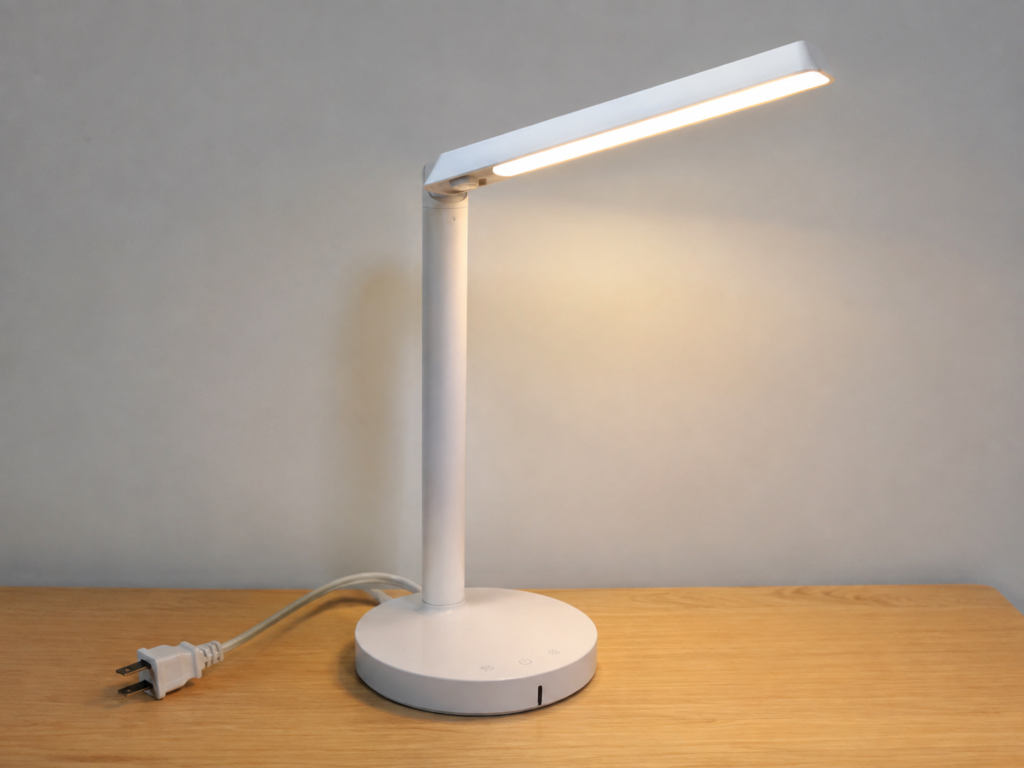
Take a common smart desk lamp as an example: what ETL governs is whether the desk lamp will short-circuit and catch fire when plugged in, and whether the lamp holder will leak electricity and hurt people; what FCC governs is whether the desk lamp will leak electromagnetic waves and interfere with surrounding WiFi signals when working.
Regulatory Position: The Actual Effectiveness of the Two in the US Market
FCC: Federally Mandatory, Enforced Jointly by Multiple Entities
FCC rules are formulated by the Federal Communications Commission of the United States in accordance with the Communications Act, belong to the federal legal level, and are clear mandatory requirements. Law enforcement entities include the FCC itself, U.S. Customs, e-commerce platforms, etc. Violations may face consequences such as cargo detention, recall, platform removal, and fines; the amount of fines depends on the type of violation, duration, number of involved products, and FCC enforcement discretion.
Compliance responsibilities are divided according to supply chain roles: the SDoC path requires designating a U.S. responsible party (Responsible Party) to bear compliance responsibilities; manufacturers, importers, and distributors bear corresponding obligations according to their roles in the supply chain.
Not all products need to meet FCC requirements: FCC Part 15 rules mainly govern categories such as digital devices that generate radio frequency energy and intentional radiators. Pure mechanical products, passive devices without digital circuits and wireless transmission functions (such as ordinary resistors, capacitors, and metal brackets) usually do not fall under the jurisdiction of Part 15; the specific situation still needs to be confirmed by combining the actual functions of the product and checking the corresponding FCC rules and clauses.
ETL: Third-Party Voluntary Certification, De Facto Mandatory in Most Scenarios
ETL is not a government certificate; in essence, it is a third-party safety certification mark under the NRTL system, and is a voluntary certification at the federal legal level. However, products connected to mains power, used in workplaces/building installations/public areas, entering large retail channels, or requiring insurance review are usually required to provide the NRTL mark; specific requirements are subject to category standards, local Authority Having Jurisdiction (AHJ) rules, platform policies, and customer contracts, which is scenario-based de facto mandatory.
Mandatory requirements for the NRTL mark mainly come from four types of scenarios:
First, OSHA workplace rules: OSHA usually requires electrical equipment used in workplaces to meet applicable safety requirements and be recognized, and NRTL listed/labeled is the most common and easily accepted proof method. Specific requirements depend on equipment category and applicable standards.
Second, local Authority Having Jurisdiction (AHJ) requirements: for building supporting products such as wall sockets, lamps, and fire-fighting equipment, passing building acceptance usually requires the NRTL mark.
Third, large retail and e-commerce platforms: channels such as Amazon, Walmart, and The Home Depot often require the NRTL mark for most electronic and electrical product categories before they can be listed, subject to the category rules of the corresponding platform.
Fourth, insurance and risk assessment requirements: insurance companies or underwriters may require products to have the NRTL mark in underwriting, claim settlement, or risk assessment; if the accident is related to electrical safety defects and the product lacks the safety certification required by the corresponding scenario, it may increase the risk of claim rejection or accountability, subject to policy terms and accident investigation results.
Under the premise that the institution’s OSHA-recognized scope covers the corresponding product category and applicable standards, and is accepted by the local AHJ, sales channel, or customer contract, ETL and certifications from other NRTL institutions such as UL and CSA usually have the same recognition status, and there is no legal difference in effectiveness level. If in doubt about the institution’s qualifications, you can directly check the NRTL list on the OSHA official website.
ETL certification is not once and for all. After obtaining the certificate, you need to accept regular factory follow-up inspections by the issuing agency to ensure that mass-produced products are consistent with the submitted samples; if changes in structure or key components are not reported, the certificate may be revoked.
Exception scenarios: in scenarios such as personal second-hand trading, small-batch custom non-public sales, etc., if no relevant party puts forward requirements, the ETL mark may not be needed.
Basis of Overlap: Jointly Cover Mainstream Electronic and Electrical Products
Products with power supply functions, equipped with electronic/wireless modules, and publicly sold in the US are highly likely to be regulated by both, and compliance requirements need to be evaluated separately.
Core Relationship: Complementary and Independent, Applicable Boundaries Change with Conditions
To intuitively present the differences between the two, the following compares the core dimensions based on the same electronic and electrical product publicly sold in the US:
| Comparison Dimension | ETL (Safety Certification) | FCC (Electromagnetic Compliance) |
|---|---|---|
| Regulatory Purpose | Prevent personal/property losses such as electric shock, fire, and structural injury | Prevent electromagnetic interference and maintain public spectrum and communication order |
| Applicable Rules | US safety standards such as UL/CSA/ANSI | 47 CFR federal communications regulations (core is FCC Part 15) |
| Compliance Logic | Certificate issued after testing and audit by a third-party NRTL body, with regular factory inspections | Government sets rules, enterprises self-certify (SDoC) or file official records (FCC ID) |
| Mandatory Attribute | Scenario-based mandatory (depends on sales channel and usage scenario) | Legally mandatory (products within the regulatory scope must comply) |
| Test Content | Safety items such as insulation, flame retardancy, temperature rise, and mechanical structure | Electromagnetic items such as radiated/conducted emissions and radio frequency power |
Beyond the basic boundaries, the applicable rules for four types of special scenarios need to be judged separately:
First type: pure low-voltage battery-powered products without mains input. The NRTL requirement for such products is usually lower than that of mains-connected products; but if they contain lithium batteries, charging circuits, matching adapters, or are for children/medical/industrial use, or the channel clearly requires safety certification, the corresponding safety standards still need to be evaluated. FCC compliance is still judged based on whether the product has digital circuits/wireless transmission functions and whether it falls under the regulatory scope, regardless of the supply voltage.
Second type: purely mechanical, purely passive devices. For example, purely mechanical power strips without USB interfaces or indicator lights, or passive components such as ordinary resistors and capacitors, are usually exempt from FCC because they have no digital circuits and do not generate electromagnetic wave emissions. However, ETL requirements still need to be judged according to usage scenarios and channels: if it is a mains-connected product that needs to enter retail channels or be used in workplaces, safety certification requirements still need to be evaluated.
Third type: small-batch custom, non-publicly sold products. For example, for internal use equipment customized for US enterprises, if the customer does not put forward ETL requirements, there is no need to apply — after all, ETL is scenario-based mandatory, and regulatory and channel requirements are relatively loose for non-public sales. But FCC is a federal legal requirement, as long as the product is used in the US and falls under the regulatory scope, regardless of the sales scale, it must meet compliance requirements.
Fourth type: finished product modification using certified modules. It needs to be judged separately according to module type: FCC module certification only covers the radio frequency compliance of the module itself, and only under the premise of meeting authorization conditions, antenna specifications, installation methods, and label requirements can the FCC test burden of the finished product be reduced; certified key components under the ETL system (such as power modules) can only be used as supporting materials for finished product safety assessment, and cannot replace safety tests such as structure, temperature rise, insulation, and flame retardancy of the finished product. Both types of module certification can reduce part of the test cost, but cannot directly replace the finished product compliance assessment.
The two marks can be marked on the product, packaging, or manual at the same time, but each must comply with the marking specifications: the corresponding control number must be marked next to the ETL mark, FCC certified products must be marked with the FCC ID number, and SDoC products must be marked with the specified declaration language, and they cannot be mixed arbitrarily.
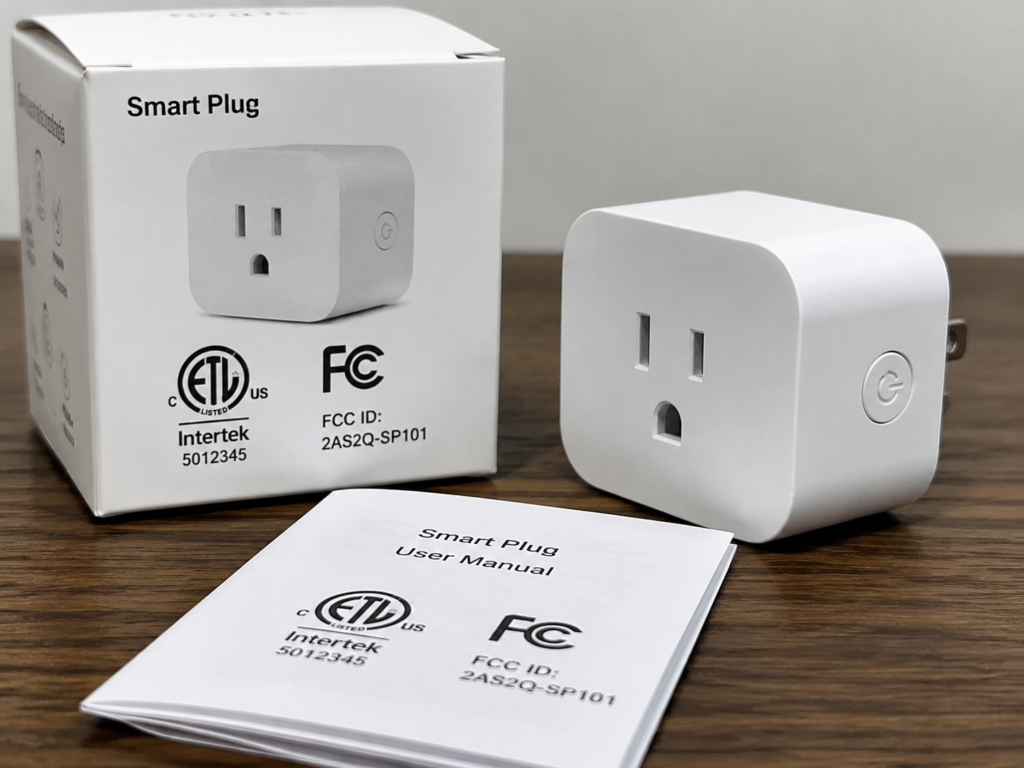
It needs to be clarified that NRTL institutions such as Intertek can provide FCC testing services, but these are separate value-added services and are not inherent content of ETL safety certification; without separately applying for FCC testing items, the ETL certificate does not include any electromagnetic compliance content.
Common Misconceptions to Avoid: 4 Types of Mistakes Beginners Often Make
Practitioners new to US compliance are prone to four types of cognitive misconceptions, which require special attention:
Misconception 1: Believing the two include each other and can replace each other
There are three common sub-misconceptions under this category:
Sub-misconception 1: ETL certification default includes FCC compliance. Ordinary ETL only tests safety items and does not involve electromagnetic compatibility content at all. FCC testing needs to be handled separately. Judgment method: check whether there is a separate FCC ID number or SDoC declaration document; if there is no corresponding material, FCC compliance is not completed.
Sub-misconception 2: FCC compliance represents product safety qualification. FCC only governs electromagnetic compatibility and radio frequency related requirements, and does not involve electric shock, fire, structural safety and other content; even if the product’s electromagnetic indicators are qualified, there may still be safety hazards. To judge the safety compliance of a product, you need to check whether there is an NRTL (such as ETL, UL) mark.
Sub-misconception 3: UL is the only official safety certification in the US, and ETL has insufficient effectiveness. Both UL and ETL are NRTL institutions recognized by OSHA. Under the premise that the institution’s recognition scope covers the corresponding product category and applicable standards, and is accepted by the local AHJ, sales channel, or customer contract, the two usually have the same recognition status, and there is no legal difference in effectiveness level. If in doubt, you can check the NRTL list on the OSHA official website for verification.
Misconception 2: Using certified modules means the finished product does not need certification
Module certification only covers the module itself. Any change in the finished product’s antenna, housing, power supply method, etc., may affect compliance. Judgment method: check the “finished product applicable conditions” in the module certification report, such as whether it is required to use a specified model of antenna and specified housing material. If the product design does not meet the applicable conditions, re-testing and evaluation must be carried out.
Misconception 3: CE mark can directly replace ETL or FCC
CE is the EU market access mark, formulated in accordance with EU directives and standards, which is completely different from the US regulatory system and cannot directly replace ETL or FCC compliance. Data from some test items (such as some electromagnetic compatibility tests) can be reused, but need to be re-audited according to US standards, and you cannot directly enter the US market with a CE certificate.
Misconception 4: Small-volume, low-power products only need one type of compliance
The regulatory scope of compliance is determined by product functions and applicable clauses, and has no direct relationship with volume and power. For example, a Bluetooth module the size of a fingernail, although small in size and low in power, is an intentional radiator and must apply for an FCC ID; if it is matched with a mains power supply device, the device also needs to evaluate ETL requirements. When judging, you need to check according to three dimensions: power supply type, whether it has digital/wireless functions, and sales/usage scenarios, and cannot judge based on subjective experience.
Practical Judgment: 3 Steps to Quickly Determine Product Compliance Requirements
You can quickly judge the compliance requirements of a product through a three-step method:
Step 1: Check FCC first (legally mandatory with higher priority)
First, judge whether the product falls under the jurisdiction of FCC Part 15 and related clauses: as long as it is equipped with digital circuits and wireless transmission functions, it is basically within the regulatory scope. Exempt products only include pure mechanical products, passive devices without digital circuits and wireless transmission functions, etc. The specific situation can be checked against FCC official rules and exemption clauses.
After confirming that it falls under the regulatory scope, then match the compliance path: intentional radiators with wireless transmission functions usually need to apply for an FCC ID; ordinary digital products without wireless functions usually follow the SDoC self-declaration. The specific path needs to be confirmed according to product category, technical parameters, and corresponding regulatory clauses.
Step 2: Then check ETL (scenario-based mandatory depends on 4 dimensions)
ETL requirements need to be comprehensively judged in combination with four dimensions:
First, power supply method: products directly connected to mains power or with hazardous voltage and high energy sources have a higher probability of NRTL requirements; low-voltage powered products also need to be comprehensively judged in combination with battery type, charging design, heating condition, installation environment, and channel requirements. Note: Voltage thresholds are only for introductory reference in common safety scenarios and cannot replace the formal judgment of specific product standards.
Second, usage scenario: if the product is used in workplaces, building supporting facilities (such as wall lamps, sockets), or public areas, it is usually required to have the NRTL mark.
Third, sales channel: if sold through large platforms such as Amazon, Walmart, The Home Depot or offline chain channels, most categories often require the NRTL mark.
Fourth, customer type: most B2B industrial customers will mandatorily require the NRTL mark; for B2C scenarios, you can first verify the category rules of the corresponding platform.
As long as one of the above four dimensions clearly requires the NRTL mark, you need to apply for ETL or other equivalent NRTL certification.
Step 3: Check special categories and official inquiry channels
The compliance requirements for some special categories are more than just ETL and FCC: for example, lamps need to superimpose energy efficiency requirements of DOE (Department of Energy) and CEC (California Energy Commission), children’s products need to meet CPSC safety requirements, medical devices need to pass FDA review, and industrial equipment also needs to check OSHA’s industry-specific requirements.
If in doubt about compliance requirements, the safest way is to check the official list of the corresponding institution, or consult a laboratory with formal qualifications.
The following are common judgments for typical consumer products, which need to be confirmed according to the actual product design and sales scenario:
| Product Type | Compliance Requirements | Judgment Reason |
|---|---|---|
| WiFi-enabled smart plug | ETL + FCC ID | Mains connection poses safety risks, requiring NRTL safety certification assessment; with wireless transmission function, requires FCC ID |
| US-standard power adapter | ETL + FCC SDoC (typical situation) | Mains connection requires NRTL safety certification assessment; if its switching power supply/electronic circuit falls under FCC EMC requirements for unintentional radiators, it is usually necessary to prepare SDoC or corresponding compliance documents |
| Battery-powered Bluetooth transmitter | Only FCC ID (typical situation) | Low-voltage battery with no mains connection, relatively low NRTL requirement; with wireless transmission function, requires FCC ID |
| WiFi module development board / Bluetooth development board | Usually only requires FCC ID (or check according to module authorization conditions) | Low-voltage power supply, low ETL requirement when there is no mains terminal safety risk; with wireless transmission function, must meet FCC requirements. If sold as an end product with a housing/power supply/charging system, ETL and finished product FCC compliance need to be re-evaluated |
| Purely mechanical power strip | Only ETL (typical situation) | Mains connection requires safety certification assessment; no digital/wireless function, usually exempt from FCC |
| Non-electric hand tools / simple metal brackets | Neither is required | No power supply, no electronic/wireless function, both are within the exemption scope |
Application and Verification: Process Optimization and Authenticity Check
Optimal Sequence and Efficiency Optimization for Simultaneous Application
If the product has not been finalized, it is recommended to complete the ETL safety test first, and then start the FCC test. Because safety tests often find structural problems (such as insufficient insulation distance, unqualified flame retardancy), which require structural adjustment; if the FCC test is completed first, structural changes may lead to changes in electromagnetic wave emission characteristics, requiring re-testing, increasing time and cost.
If the product is completely finalized, you can choose a laboratory with both NRTL qualification and FCC recognition qualification to submit tests in parallel; under the premise of complete prototype materials and few rectifications, the parallel process can usually save about 20%-30% of the overall cycle compared with the serial process. The actual duration still depends on the laboratory’s scheduling, the number of rectifications for test failures, and the number of wireless systems.
The core of cost optimization is to select certified key components: for example, try to select models with corresponding certifications for power modules and wireless modules, which can reduce some finished product test items and lower costs.
List of Required Compliance Documents
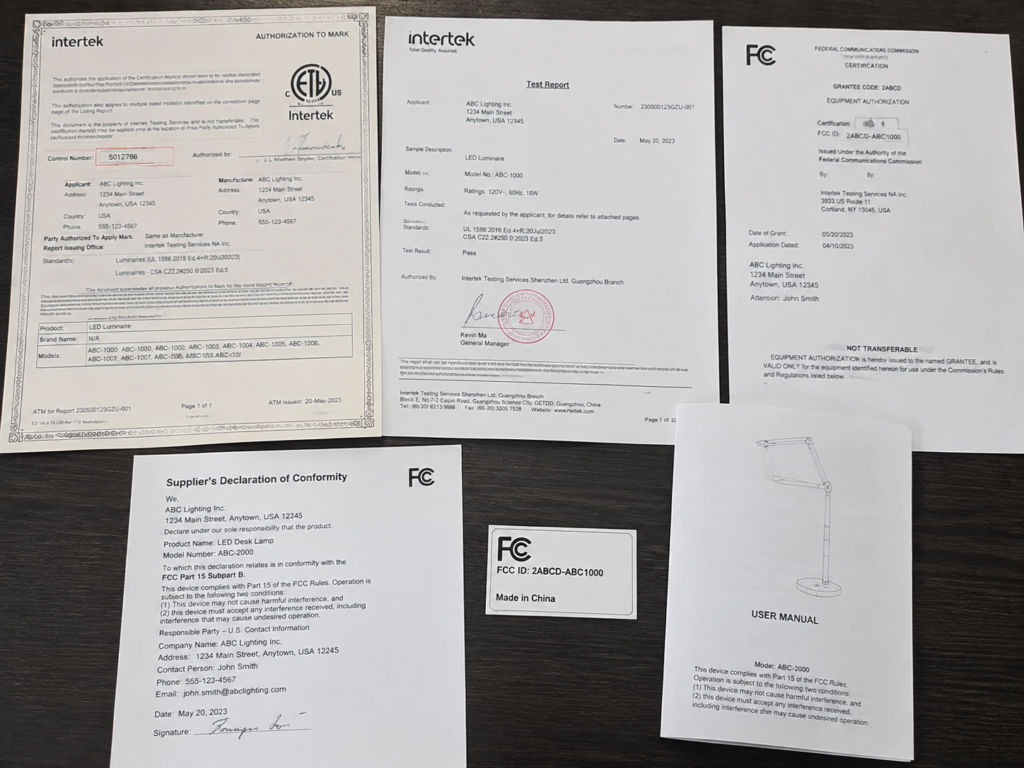
FCC compliance documents are distinguished by path:
- SDoC path: Need to prepare SDoC declaration document, complete test report, U.S. responsible party (Responsible Party) information, and compliance statements on product labels and manuals.
- Certification (FCC ID) path: Need to prepare FCC authorization record (Grant), test report, FCC ID label, user manual and label materials, and applicant-related information.
ETL compliance documents: Need to prepare ETL certification certificate, control number, list of covered models, factory follow-up inspection records, as well as list of key components and production factory information (if applicable). Products must be marked with the ETL mark and corresponding control number according to the rules.
Compliance Costs and Pitfall Reminders
There is no official unified pricing for certification, and prices vary greatly depending on the laboratory and product complexity. The following are only for preliminary budget communication reference and cannot be used as a formal quotation basis:
For ordinary digital products of FCC SDoC category, the cost is about several thousand to over ten thousand RMB; FCC ID requires wireless radio frequency testing, which is more complex and the cost is correspondingly higher; ETL cost is priced according to product power and structural complexity, and is usually higher than the FCC SDoC cost of the same product.
Pitfall reminder: Do not轻信 low-price service providers that claim “flat-rate guaranteed pass”. You need to confirm three core issues: Does the test adopt US officially recognized standards? Can the certificate be queried in the official database? Does the fee include subsequent factory follow-up inspections? Many low-price non-compliant certifications either use informal standards, cannot be queried in the official database, or do not include the factory inspection link, which will be directly invalidated when inspected, causing greater losses instead.
Authenticity Verification Methods
Whether it is a certification applied for by yourself or a certificate provided by a supplier, it is recommended to verify the authenticity through official channels:
FCC verification: For products with an FCC ID, you can directly log in to the FCC official ID database, enter the ID number to check whether the model, applicant, and frequency band are consistent; those with inconsistent information or stolen others’ IDs are invalid. For products following the SDoC path, you need to check whether there is a complete test report, SDoC declaration, and U.S. Responsible Party information. If any of the three is missing, it does not meet the compliance requirements.
ETL verification: You can log in to the Intertek ETL official database, enter the certificate number or product model, and check whether the certificate validity period, covered models, manufacturer, and control number are consistent; those that are expired, have mismatched models, or mismatched manufacturers are invalid.
Summary After Learning
After sorting out the relationship between ETL and FCC, you can master three core judgment abilities:
First, you can clearly distinguish the differences in regulatory scope and mandatory attributes between ETL and FCC, will not confuse the positioning of safety certification and electromagnetic compliance, and will not believe the statement that “one certification covers two types of requirements”.
Second, you can quickly judge whether it is necessary to carry out two types of compliance at the same time according to product functions, sales scenarios, and channel requirements, without repeated consultation and confirmation.
Third, you can independently verify the compliance authenticity of FCC and ETL through official databases, and avoid common certification scams and cognitive misconceptions.
The compliance requirements of the US market seem complicated, but as long as you clarify the regulatory scope and underlying logic of each requirement, you can proceed in an orderly manner. When you are unable to confirm, you should refer to official databases, platform rules, and the opinions of qualified laboratories.