
For products sold in the North American market, whether home appliances, lighting fixtures, or small electronic components, you have most likely seen the ETL mark. It is a product safety certification trademark held by Intertek (Tianxiang Group), and belongs to the NRTL (Nationally Recognized Testing Laboratory, i.e., officially recognized third-party safety certification bodies) system accredited by the U.S. OSHA (Occupational Safety and Health Administration). Its core function is to prove that the product meets corresponding safety standards, and it does not represent quality grade or performance superiority. Along with UL and CSA, it is a common third-party safety compliance path in the North American market; whether it is applicable specifically needs to be judged based on product category, applicable standards, and certificate scope.
As a registered trademark, the use of the ETL mark is not an optional suggestion, but a licensing obligation that the certificate holder must fulfill. Compliant use of the ETL mark is an important credential for products to enter North American retail and e-commerce channels, pass local safety inspections, and gain recognition from insurance companies. It also avoids consumer misleading caused by counterfeit marks and inconsistent information. Many people think it is a randomly printed safety logo that can be obtained by asking a factory for an image, only to end up with products removed from e-commerce platforms, detained by customs, or even receiving regulatory fines.
Before diving into specific rules, let’s first clarify 4 basic boundaries to avoid common misconceptions from the start:
- Having a test report does not mean you are allowed to use the ETL mark; formal certification authorization must be obtained.
- A supplier’s verbal promise does not mean the product is within the certification scope; official verifiable information shall prevail.
- Certification of one model does not mean the entire series, modified versions, or private-label versions can be labeled.
- ETL is not a U.S. federal mandatory certification, but it may be required by retail channels, local safety inspections, or insurance scenarios.
The following explains mark types, style specifications, prerequisites for use, scenario-based rules, compliance self-inspection, and violation handling one by one, covering entry-level operations and intermediate risk assessment.
Common ETL Mark Types and Applicable Scenarios
ETL marks are not a single type; they are divided into different categories based on the certification object, nature, and coverage area, each with clear boundaries for use and cannot be mixed up.
Classified by Certification Nature and Object
- ETL Listed: The most common safety certification for end products, targeting complete products for end users (such as home appliances, lighting fixtures, consumer power supplies), certifying that the entire finished product meets the corresponding safety standards.
- ETL Recognized: Component/assembly certification, only for a specific part inside the product (such as power modules, switches, circuit boards); marks for this type of certification cannot be directly affixed to end products.
- ETL Verified: Performance certification, targeting specific performance claims of the product (such as energy-saving effects, service life, etc.), independent of safety certification. It cannot be used to prove product safety compliance, and the specific coverage is subject to the corresponding certificate.
- ETL Classified: Certification for specific risk scenarios, only certifying that the product meets a certain type of special safety requirements (such as industrial explosion protection, specific environmental protection, etc.). Its applicable scope is narrower than Listed, and the specific scope is subject to the items indicated on the certificate.
- ETL Sanitized: Hygiene scenario-related certification, targeting properties such as sanitation, disinfection, and antibacterial performance of products, mostly used for food-contact and medical-related products. Specific rules are subject to certificate requirements.
The certification scopes of the above types of marks are completely different, and they must never be substituted for one another — for example, you cannot use a Recognized component certification to label a finished product with a Listed mark, nor can you use a Verified performance certification to promote product safety. The specific usage rules for these special marks are all subject to the annotations on the corresponding certificates.
Classified by Coverage Area
- ETLus: Certification mark covering only the U.S. market.
- cETL: Certification mark covering only the Canadian market.
- cETLus: Certification mark covering both the U.S. and Canadian markets.
Which regional mark can be used is entirely subject to the certificate annotations and the official Marking Guide (official mark guidelines); regional prefixes cannot be added or modified without authorization.
Style Specifications: Standard Form and Printing Requirements for ETL Marks
The style of the ETL mark has clear official standards, and any unauthorized modification may constitute a violation. The following explains from four aspects: core elements, size and proportion, color and durability, and source files and taboos.
Unmodifiable Core Components
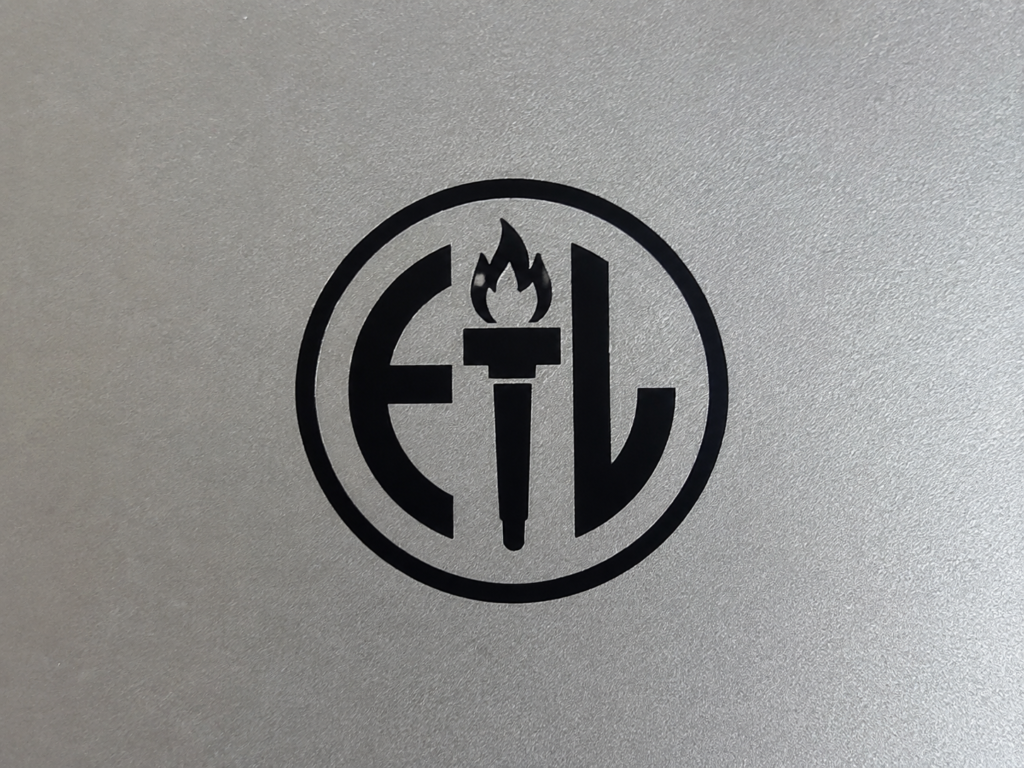
The basic graphic of the ETL mark is a fixed combination of a torch and the letters ETL, and neither the pattern shape nor the font of the letters may be altered. The category label on the mark (such as Listed, Recognized, etc.) must completely match the actual certification type, and cannot be arbitrarily changed or omitted. Regional marks (such as ETLus, cETL, cETLus, etc.) must be consistent with the market scope covered by the certificate, and regional prefixes cannot be added without authorization. As for whether the Control Number (the unique traceability code for each certification project, which can be used to verify authenticity) and safety standard number must be marked, this must be strictly implemented in accordance with the certificate annex, the officially provided mark template, and the Marking Guide; fields cannot be added or deleted without authorization.
Size, Proportion, and Clarity Requirements
The mark must use the vector template officially provided by Intertek, scaled proportionally; stretching, tilting, or deformation is prohibited, otherwise it will be deemed non-compliant. For conventional products, the minimum size of the mark shall not be less than 6mm (approximately 1/4 inch), ensuring all characters are clearly visible to the naked eye. For extremely small products that cannot meet the minimum size requirement, exceptions must be applied for or confirmed in accordance with official rules; the mark cannot be reduced in size without authorization. In addition, the mark must remain identifiable after normal wear and tear during use.
Color and Durability Requirements
The ETL mark has no mandatory fixed color, as long as it has sufficient contrast with the background and is clearly identifiable. It is important to note that white text on a red background is a typical feature of the UL mark, not a requirement for ETL, so do not confuse the two. In terms of durability, the mark must match the service life of the product, and must not easily fall off or fade during normal transportation, installation, and use. There are no mandatory restrictions on the production method; screen printing, laser engraving, molding, self-adhesive labels, etc., are all acceptable as long as they meet the durability requirements.
Mark Source Files and Surrounding Taboos
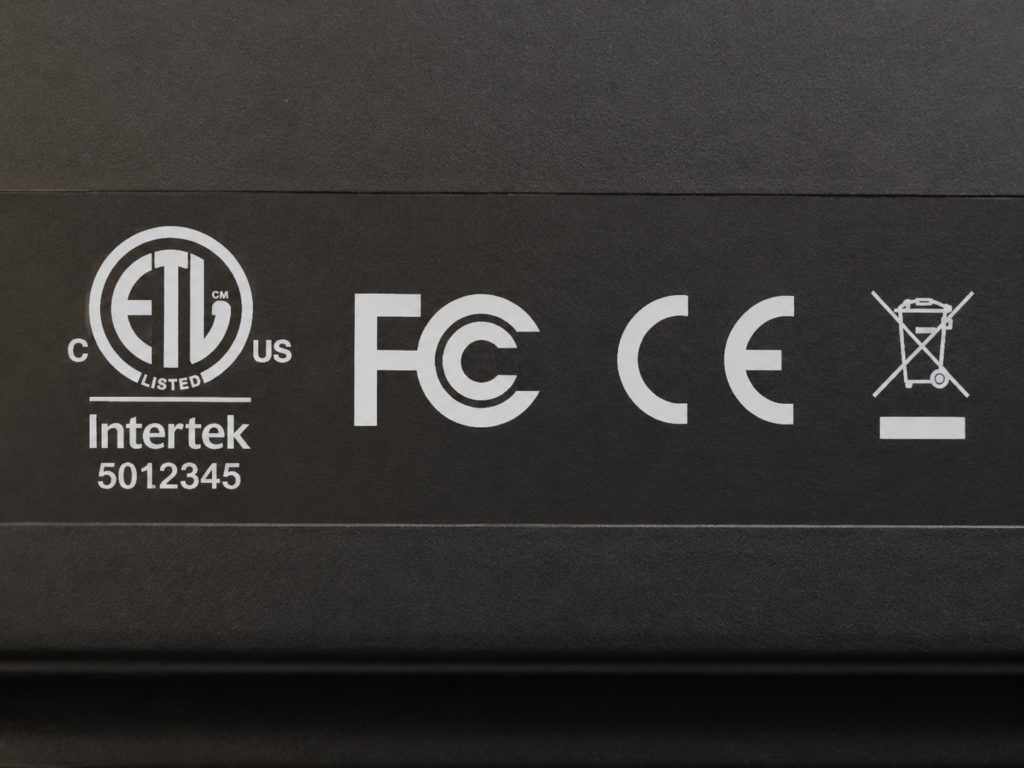
The source file of the mark must be a vector file officially provided by Intertek; use of screenshots, self-redrawn marks, or marks copied from competing products is prohibited. Misleading text such as “government certified” or “ETL approved” shall not be added around the mark, to avoid leading consumers to mistakenly believe it is directly endorsed by official authorities. If a product has multiple certification marks that need to be displayed side by side, the independence of each mark must be maintained; they cannot be overlaid, deformed, or merged into a single mark.
Prerequisites for Use: Necessary Conditions for Legal Use of ETL Marks
To use the ETL mark legally, having a certificate is not enough; multiple conditions must be met simultaneously. Here is the priority order of basis for practical judgment — if information from different channels differs, judging in this order can minimize errors:
Formal certificate/authorization letter > Certification directory verifiable on Intertek’s official website > Official Marking Guide > Applicable safety standards > Historical mark samples
A formal certificate is an authorization document issued directly by Intertek to the certificate holder, with the highest validity; the official website directory is publicly verifiable filing information, with the second highest validity; the marking guide is a general rule, with the third highest validity; safety standards are basic requirements; and historical mark samples may be expired and can only be used as reference. If there is inconsistency between the certificate, official website directory, Marking Guide, or historical mark samples, the formal authorization document and Intertek’s verifiable public information shall prevail. It is recommended to confirm with the certificate holder or Intertek official before printing the mark, and do not make judgments based solely on a single document.
Specifically, legal use must meet all of the following conditions simultaneously:
First, the certification qualification must be authentic and valid. A formal ETL certification certificate issued by Intertek must be held, and the validity of the certification shall be comprehensively judged based on the current status of the certificate, factory supervision results, and whether there are unrectified violation records; it should not be summarized by a fixed number of years. If the certificate is suspended or revoked, or there are unrectified violation records, the mark shall not continue to be used. Pre-assessment documents, test reports, and verbal promises are not considered valid qualifications.
Second, the product must completely match the certification information. The model, specifications, and electrical parameters must be completely consistent with those listed on the certificate, and there must be no unreported changes to core components or structural design. Derivative models, custom products, and modified products that are not registered in the certificate cannot be directly labeled, even if they are similar in appearance. If certification information (such as control number, applicable standard number) is updated, the mark must be replaced synchronously.
Third, the user entity must have legal authorization. The certificate holder listed on the certificate (usually the manufacturer or brand owner) may directly use the mark; distributors, OEM/ODM factories (i.e., the cooperation model where a brand owner entrusts a factory to produce products) must hold a complete written authorization chain issued by the certificate holder, and must not fraudulently use or borrow the ETL certification qualifications of other manufacturers.
Fourth, the production site must be within the scope of supervision. Products must be produced in factories registered on the certificate and subject to regular inspections by Intertek — this regular inspection is called Factory Follow-up Service (FUS, i.e., a supervision mechanism where the certification body conducts regular random inspections of factories to ensure mass-produced products are consistent with the originally tested samples and continuously meet certification requirements). If the factory is changed, production is outsourced without updating certification information, or there are unrectified abnormalities in factory random inspections, the mark shall not be used.
Scenario-Based Rules: ETL Mark Usage Requirements in Different Scenarios
Compliance of the mark itself is only the foundation; different usage scenarios have corresponding specific requirements.
Usage Rules for the Product Itself
The mark shall be affixed to a conspicuous position that consumers can see without disassembling the casing, such as the product nameplate or the bottom of the device. For embedded products or extremely small products that really cannot be labeled externally, the mark can be placed inside, but the position of the mark must be clearly indicated in the instruction manual for inspection convenience. The mark can be produced in various ways such as nameplates, self-adhesive labels, screen printing, laser engraving, molding, etc., but must remain clearly readable under normal transportation, installation, and use conditions, not easily fall off or fade, and its durability must match the service life of the product. In addition, the mark must not obscure mandatory information such as product rated parameters and safety warnings.
Usage Rules for Packaging and Instruction Manuals
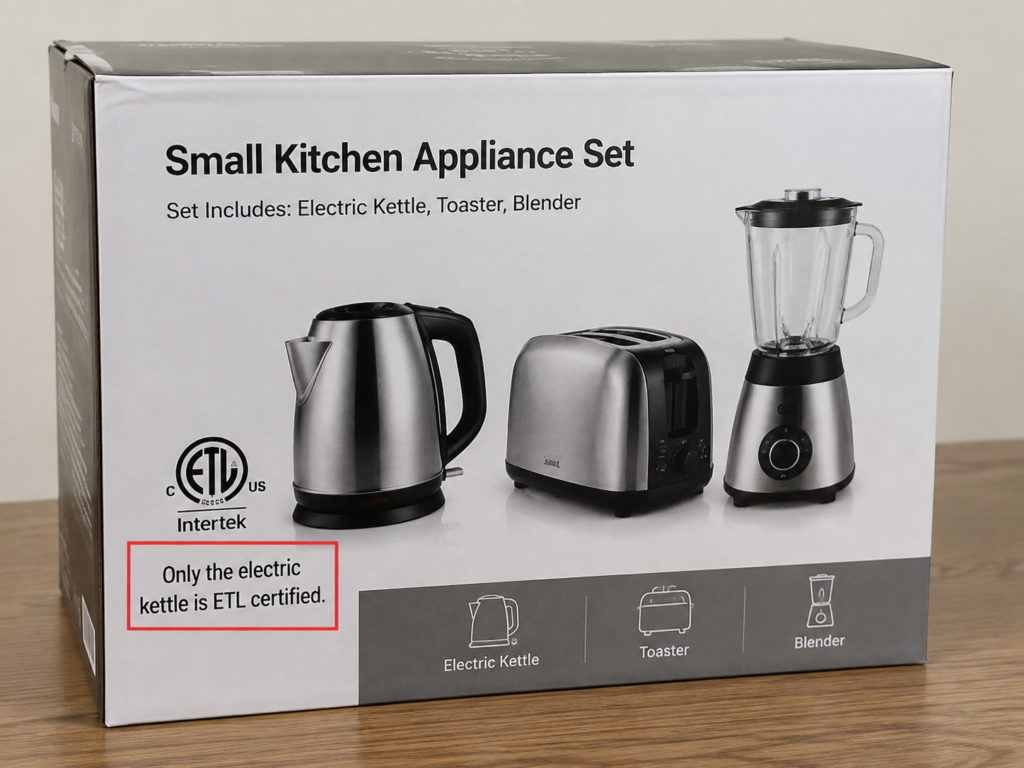
The ETL mark may only be printed on the packaging and instruction manuals of the corresponding certified models. If multiple models are mixed in the same package, the specific certified models must be clearly marked separately. For set products, the specific components covered by the certification must be clearly marked, and it shall not be implied that the entire set has obtained ETL certification — for example, if only the electric kettle in a set of small kitchen appliances is certified, the ETL mark cannot be directly printed on the outer packaging of the set; it must be clearly marked that “Only the electric kettle is ETL certified”.
The statements about certification in the instruction manual must be completely consistent with the certificate, and the certification scope shall not be exaggerated. For multilingual packaging or different language versions of instruction manuals, the meaning of certification statements must be consistent, and consumers shall not be misled through language differences.
Usage Rules for E-Commerce Pages and Promotional Materials
The ETL mark may only be displayed for specific certified models actually sold on the page. When the same link contains multiple models, it shall not be uniformly claimed as “full series ETL certified”, but must correspond to specific models.
The certification statement for the same model must be completely consistent in main images, detail pages, SKU titles, live broadcast oral statements, and advertising materials. Contradictory situations such as “the title indicates ETL certification, but only accessories are actually certified” are prohibited.
It is forbidden to use the ETL mark to promote non-safety performance — such as “ETL certified energy-saving effect” or “ETL certified ultra-long service life”, because conventional ETL Listed is a safety certification and does not cover performance indicators such as energy saving and service life.
Misleading expressions such as “ETL approved” shall not be used, to avoid leading consumers to mistakenly believe it is directly approved by the government or official authorities. The correct expressions are “ETL listed” or “ETL certified”.
If the certification expires or the product is discontinued, the ETL mark in all promotional channels must be immediately removed and taken down, and shall not continue to be used.
Usage Rules for Special Scenarios
Component products may only be labeled on the component itself, and shall not be labeled on the assembled finished product — for example, a power module with Recognized certification cannot be directly labeled on the finished luminaire that uses this module.
For complete system products, only when the entire system has passed ETL certification can the system finished product be labeled; the entire system shall not be labeled just because a certain component in the system is certified.
Exhibition and display samples must be certified versions; non-certified prototypes shall not bear the ETL mark, even if they are only for display purposes.
If a modified product has its casing, core components (such as power supply, plug, control board) replaced, or its functions adjusted, the certification qualification must be reconfirmed, and the old mark shall not be directly used.
Pitfall Avoidance Guide: Common Misconceptions, Violation Red Lines, and High-Risk Judgment
After understanding the basic rules, it is necessary to focus on common cognitive misconceptions and violation red lines, and at the same time master the judgment logic for high-risk scenarios.
3 Most Common Cognitive Misconceptions
First misconception: Believing that ETL is a U.S. government mandatory certification. In fact, it is a third-party voluntary certification, required only by some retail channels, local regulators, and insurance scenarios; not all products in the U.S. market must have it.
Second misconception: Believing that the ETL mark must have white text on a red background. ETL has no mandatory color requirement; white text on a red background is a typical feature of UL, so do not confuse the two.
Third misconception: Believing that having an ETL certificate number means you can use the mark arbitrarily. In fact, conditions such as product matching, authorized entity, and production site within supervision scope must be met simultaneously; merely holding a certificate number does not mean you have the right to use the mark.
Absolutely Prohibited Violation Red Lines
The following acts are serious violations, and those who commit them may face severe penalties:
Qualification-related: Labeling without certification, continuing to use after certification expires, using beyond the certification scope (e.g., the certificate only covers 5V power supplies, but labeling a 65W fast charger), misappropriating others’ control numbers to impersonate own certification.
Mark-related: Tampering with the shape, proportion, or characters of the mark, intentionally obscuring the control number or standard number, imitating the style of other certifications to mislead consumers.
Promotion-related: Using component certification to promote finished product certification, using single-market certification to impersonate dual-market certification, exaggerating the certification coverage scope.
Other-related: Using the ETL trademark alone on non-certification-related materials (such as gifts, T-shirts, employee ID badges), violating trademark usage regulations.
Judgment Logic for High-Risk Scenarios
In daily operations, there are several types of scenarios that are particularly prone to violations, which are high-risk situations requiring key verification, and are also core judgment abilities to be mastered at the intermediate level:
First, OEM scenarios: It is necessary to confirm both that the private label model is within the certification scope and that a complete written authorization chain is held; neither is dispensable.
Second, product modification scenarios: If core components (power supply, plug, control board, etc.) or electrical functions are changed, the certification scope must be re-verified, and the old mark shall not be used for granted.
Third, set/system scenarios: Certification of a single component does not mean the entire product is certified; it is necessary to verify whether there is overall certification qualification.
Fourth, cross-market scenarios: Sales in the U.S. require the corresponding ETLus mark, and sales in Canada require the corresponding cETL mark; the market coverage scope shall not be expanded without authorization.
Self-Inspection Methods: Compliance Verification That Ordinary People Can Do
Whether ordinary buyers, purchasers, sellers, or manufacturers, all can complete compliance verification using simple methods.
Quick Verification Method for Ordinary Consumers/Buyers
If you want to confirm whether the ETL mark of the purchased product is authentic and compliant, it can be done in three steps:
First step: Check the style. Whether it is the standard torch + ETL pattern, whether there is deformation or stretching; products that require a control number must not lack it.
Second step: Check the match. Whether the model and parameters corresponding to the mark are consistent with the purchased product, and whether there is misattribution.
Third step: Verify authenticity. Go to the ETL certification directory on Intertek’s official website, enter the control number or product model, and you can check the validity and coverage scope of the certificate.
Compliance Self-Inspection Checklist for Sellers/Manufacturers
Sellers or manufacturers can conduct self-inspection from four dimensions to ensure compliant use of the mark:
First, check qualifications: Confirm that the certificate status is valid, there are no suspension or revocation records, and the factory follow-up inspection results are normal.
Second, check products: Confirm that the specifications and core components of the models on sale are completely consistent with the certificate information, and there are no unreported changes.
Third, check style: Confirm that the proportion, size, and constituent elements of the mark meet official requirements, and there are no unauthorized modifications.
Fourth, check scenarios: Confirm that all usage scenarios such as the product itself, packaging, instruction manuals, e-commerce pages, and promotional materials comply with the rules, and there are no out-of-scope or misleading statements.
Confusion Distinction: Differences Between ETL and Other Common Certification Marks
Many people confuse ETL with other certification marks. The following summarizes the common differences.
Differences Between ETL, UL, and CSA
Similarities among the three: All belong to the OSHA-accredited NRTL system, are common third-party safety compliance paths in the North American market, and their core function is to prove that products meet safety requirements.
Differences: The issuing bodies are different (ETL is from Intertek, UL is from Underwriters Laboratories, CSA is from the Canadian Standards Association), the mark styles are different, and some channels may specify the mark of a certain certification body; ultimately, it is subject to the requirements of customers, platforms, or local regulations.
Special note: Certification marks from different bodies shall not be used interchangeably; holding UL certification does not allow affixing the ETL mark, and vice versa.
Differences Between ETL, CE, and FCC
Compared with CE: CE is a European Union compliance declaration, covering multiple aspects such as safety and electromagnetic compatibility, while ETL is a North American third-party safety certification; CE cannot replace ETL in the North American market.
Compared with FCC: FCC is a U.S. electromagnetic compatibility/wireless certification, which regulates whether products interfere with other devices and whether wireless functions are compliant, while ETL is a safety certification, which regulates whether products have safety risks such as electric shock and fire. Products with wireless functions usually need to meet both FCC and ETL requirements, and the two cannot replace each other.
Core Principles for Side-by-Side Use of Multiple Marks
If a product has multiple certifications and the marks need to be displayed side by side, two core principles must be followed: First, each mark only corresponds to its own certification scope, and cross-implying is prohibited — for example, ETL and FCC cannot be combined and expressed as “ETL-FCC certification”, to avoid leading people to mistakenly believe that one certification covers both types of requirements; Second, they must be displayed separately in accordance with the requirements of each certification body, and shall not be merged or deformed.
Violation Response and Long-Term Compliance Recommendations
If a violation occurs accidentally, it must be handled in accordance with the standardized process, and the risk of violations can also be reduced through simple daily management.
Common Triggers and Consequences of Violations
Common triggers for ETL violations include: Intertek’s factory follow-up random inspections, compliance verifications by customs or channels, and reports from consumers or competitors.
Once a violation is confirmed, common consequences include: certification being suspended or even revoked, products being detained by customs or removed from platforms, facing consumer claims or regulatory penalties, and also damaging brand reputation, which is not worth the loss.
Handling Steps for Suspected/Confirmed Violations
If a possible violation is found, or a violation notice has been received, handle it according to the following steps:
First, immediately stop using all suspicious ETL marks, isolate the involved inventory and packaging materials, and take down relevant promotional content to avoid the problem from expanding.
Second, investigate the cause of the problem: Verify information such as the formal certificate, Intertek’s official website directory, product model, production factory, and control number to clarify the type of problem — whether it is qualification non-compliance, incorrect mark style, or out-of-scope promotion.
Next, carry out targeted rectification: If it is a qualification-related problem (such as no certification, exceeding certification scope, expired certification), it is necessary to re-apply for certification, handle scope expansion, or apply to restore the certificate status; if it is a problem of mismatched model or production site, it is necessary to complete supplementary filing, replace compliant marks, or isolate non-compliant inventory; if it is a problem of mark style or promotion scenario, it is necessary to replace printed materials and modify page content, then submit to the certificate holder or Intertek for compliance confirmation.
Finally, after Intertek or the certificate holder confirms that the rectification is compliant and passes the review, resume using the mark; do not resume use without authorization.
Practical Recommendations for Long-Term Compliance
Doing the following well in daily operations can greatly reduce the risk of violations:
First, assign dedicated personnel to manage certification certificates and mark usage permissions, conduct compliance checks before new product launches, packaging changes, or product modifications, and proceed only after confirming there are no issues.
Second, if certificates, service agreements, or partner requirements involve matters such as renewal and annual maintenance, they should be verified and handled 3-6 months in advance to avoid gaps in certification status.
Third, all mark approval documents, certificate records, and authorization documents must be properly stored, at least until after the expiration of the certificate validity period, for easy verification.
The usage rules of the ETL mark may seem trivial, but the core logic is very clear: Only products covered by certification, produced by legally authorized entities, and manufactured in supervised compliant production sites can be used in corresponding scenarios in accordance with the officially specified style. Mastering this core logic, combined with the type distinctions, style requirements, scenario rules, and self-inspection methods sorted out in this article, you can independently judge most compliance issues and avoid the vast majority of common risks.