
Many friends who do cross-border business of charging products will panic when they get an unqualified certification report for the first time: Is this batch of goods completely useless? Do we need to re-open the mold? Will the products be removed from the platform? In fact, unqualified does not mean total loss. Most problems have corresponding rectification solutions. The key is not to modify blindly or in vain. Today, starting from the most basic pre-judgment, we will explain the entire rectification process step by step. Even beginners who have just entered the industry can follow the whole process.
Pre-judgment First: Avoid Vain Rectification
Many people start disassembling samples and modifying parts as soon as they get the report. As a result, after half a month of tossing, they find that the laboratory used the wrong standard, or the test sample is not the model to be sold at all, which is a complete waste of effort. The first step of rectification is not to modify the product, but to first figure out “whether to modify” and “according to what requirements to modify”.
Sort Out Product Information First
The charging products we often refer to mainly include chargers, power adapters, USB (including Type-C) cables, and interface connectors. Compliance requirements for different categories vary greatly. You need to first sort out the core information of the product: input and output voltage, rated power, whether it has wireless function, plug form, and whether the product is only for charging or has data/power functions.
After sorting out, you can quickly classify: external power supplies (chargers, power adapters) need to meet safety and energy efficiency requirements; passive cables (ordinary charging cables) mainly depend on interface and material compliance; electronic products with power supply (such as docking stations with charging function) need to determine applicable safety, EMC, material and other regulatory requirements in combination with specific functions.
Determine Compliance Requirements According to the Target Market
After sorting out the product information, sort out the rules corresponding to the country or region of sale in three steps:
Step 1: Confirm the country or region of sale, and list the corresponding mandatory regulations. For example, the EU corresponds to CE-related regulations, and the US corresponds to FCC and market access requirements. Mandatory requirements are usually the prerequisite for placing products on the market, selling or using them; customs, market supervision authorities and platforms may require compliance evidence during import, customs clearance, sales or random inspection.
Step 2: Match the product category to determine the applicable standards and conformity assessment paths. Even for chargers, different markets may adopt different methods such as manufacturer’s self-conformity assessment, third-party testing, certification or factory inspection. It cannot be judged only by the product name.
Step 3: Distinguish three types of requirements:
• **Mandatory requirements**: If not met, the product may not be legally placed on the market, sold or used;
• **Platform, retailer or importer requirements**: For example, some sales channels require NRTL certification or designated laboratory reports;
• **Voluntary certification**: Mainly used for product selling points, procurement access or customer trust.
During rectification, priority should be given to ensuring mandatory regulatory requirements, and then handling channel and voluntary certification requirements.
First Understand Several Easily Confused Terms
Many people fall into pitfalls because they don’t understand the terms. Here are the most commonly used ones explained clearly first:
• **Test report**: An “exam transcript” issued by a third-party laboratory, which proves the test results of the sample, but is not equivalent to certification, nor can it alone represent the compliance qualification of all markets;
• **Declaration of Conformity (DOC)**: A “self-guarantee letter” issued by the manufacturer itself, declaring that the product meets applicable requirements. Some markets and products allow this method without third-party certification;
• **Third-party certification**: A certificate of conformity issued by a qualified certification body. Some certifications include factory audits and require subsequent continuous supervision;
• **Factory audit report**: A document proving the factory’s production quality management system or production consistency status. It is a different matter from the product test report and cannot replace each other.
First Judge Whether the Report Itself Has Problems
If you get the report and find that the laboratory used the wrong standard, or the test sample does not match the sales model, first file a technical appeal with the laboratory, certification body or customer to confirm whether the report is applicable, and do not directly rectify the product.
In addition, it should be noted that different product categories have different compliance obligations, and rectification plans of other models cannot be directly copied. For example, the creepage distance rectification method for a 65W charger cannot be directly applied to a 20W charger. The specific requirements still need to be judged according to the working voltage, insulation category, structure and applicable standards.
Basic Cognition: What is Unqualified and How Big is the Impact
After figuring out whether to rectify, let’s talk about the definition of unqualified and what impact it will have on cross-border business.
Definition of Unqualified and Core Goal of Rectification
The so-called unqualified certification testing means that the charging products submitted for testing or randomly inspected do not meet the requirements of the target market regulations or certification schemes, and cannot obtain or maintain the corresponding compliance qualifications.
Here we must correct the most common misunderstanding of beginners: **The core goal of rectification is to make mass-produced products continuously compliant, not just to pass the test samples**. Many people take the chance that “as long as the sample passes, the bulk goods can be made casually”, and as a result, they are found in market random inspections, and the punishment is much more serious than the first unqualified.
In addition, it should be clarified that unqualified does not mean that all products are scrapped. Minor labeling and document problems may be sold normally after rework, and do not need to be all destroyed. However, whether rework is allowed, whether sales can continue, or whether channels need to be notified still depends on specific regulations and risk assessment.
4 Types of Unqualified Scenarios and Severity
According to common scenarios, they can be divided into four categories:
1. **Sample test failure**: The product has not yet been launched, and the first test fails. Usually, there is no market disposal risk yet, but it is still necessary to confirm whether the failure is due to design, materials, assembly or test configuration;
2. **Document review failure**: It may be just missing documents or labels, or it may reflect problems in the judgment of conformity declaration, technical documents, product identification information or applicable regulations. It cannot be uniformly considered that modifying documents is enough;
3. **Factory audit unqualified**: There are loopholes in the production process, such as no incoming material inspection and incomplete production records. The scope of impact depends on the non-conformities, certification scope, production lines and shared product situations. It may affect some models or expand to the entire certification scope;
4. **Market random inspection unqualified**: The product has been launched and sold, and is found unqualified by customs, market supervision authorities or other channels. It may lead to goods detention, removal from shelves, fines, rectification notices, and in serious cases, may involve recall.
For document review, factory audit and single sample failure, the scope of impact should be judged in combination with non-conformities, certification scope, batch traceability, and design and material sharing relationships. Before the cause investigation and risk assessment are completed, it should not be preset that “only modify documents”, “affect the entire series” or “only handle a single batch”.
Core Terms Commonly Used in Cross-border Business (with English)
Doing cross-border business often requires communication with foreign institutions and suppliers. It is best to remember these terms:
• **Non-conformity**: Specific items that fail the test. For example, “insufficient creepage distance” is a non-conformity;
• **Correction / Corrective Action**: Correction refers to dealing with immediate non-conforming products, such as tearing off wrong labels and re-pasting; corrective action refers to eliminating the root cause of the problem and preventing recurrence, such as optimizing the label version management process;
• **Electromagnetic Compatibility (EMC)**: The ability of a product to not interfere with other devices when working and to resist normal external interference. For example, a charger will not cause abnormalities in adjacent devices;
• **Creepage distance**: The shortest distance between high and low voltage circuits along the insulation surface, which is an important indicator in electrical safety. Insufficient distance may increase the risk of electric leakage, sparking and insulation failure;
• **BOM (Bill of Materials)**: A list of all parts and components of a product, from transformers to resistors, which is an important basis for compliance traceability;
• **E-Marker chip**: A chip used in some USB Type-C cable assemblies to declare the current capability, data capability, etc. of the cable. Not all USB-C cables have built-in E-Marker, depending on the cable type and rated capability.
Impact of Unqualified on Cross-border Procurement
Unqualified may bring the following direct losses: inability to affix or continue to use compliance marks, requirements for supplementary compliance evidence in customs or regulatory links, removal from platforms, warehouse entry bans, etc. Indirect losses include return bad reviews, fines, recall costs, store account restrictions, and in serious cases, may affect subsequent sales qualifications.
Here is a practical rule: the closer the non-conformity is to the core of safety, such as electric shock, overheating, and fire, the larger the scope of impact usually is, and the stricter the disposal; if it is only labeling and document problems, the risk may be lower, but it still cannot be assumed that no notification or corrective action is needed without assessment.
First Response: Do These Things First When You Get the Report
Many people’s first reaction when they get the report is “quickly modify and retest”, which is actually wrong. Doing the following steps first can avoid a lot of unnecessary losses.
First Audit the Validity of the Report and Samples
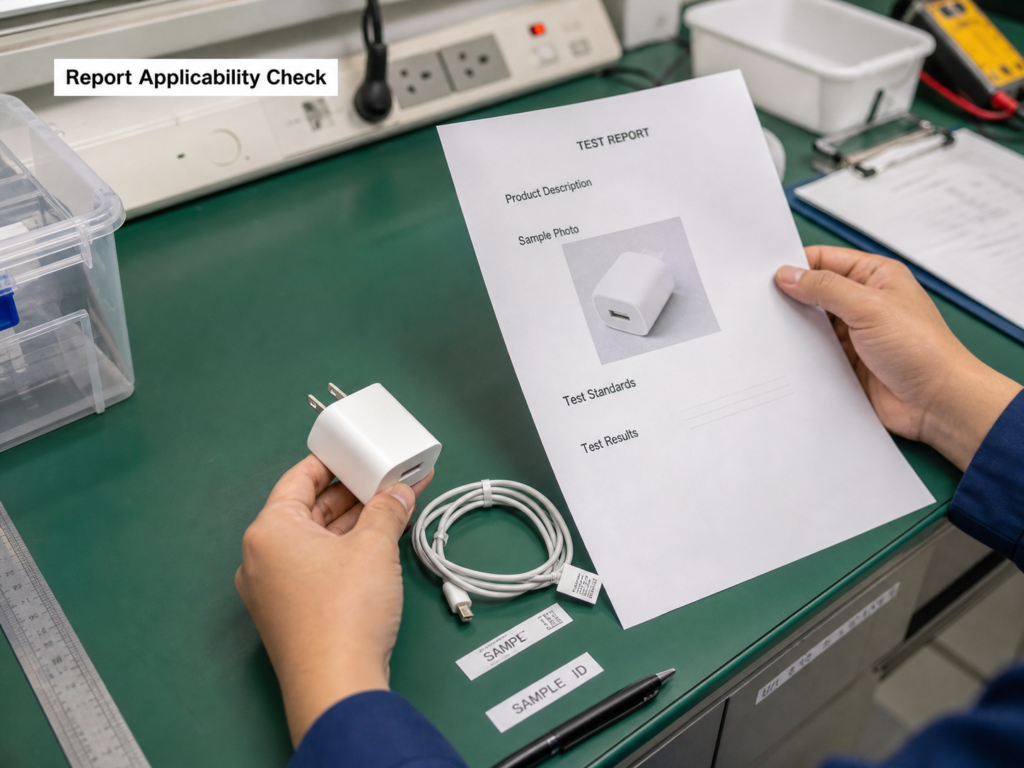
First confirm whether the report itself is applicable. If the report uses wrong standards or wrong samples, you cannot directly formulate a rectification plan based on it. Four points need to be checked:
1. **Laboratory qualification and capability**: It should be confirmed that the laboratory has corresponding testing capabilities, and preferably has ISO/IEC 17025 accreditation scope related to the test items. For specific conformity assessment procedures that require the participation of a notified body, the qualification of the body should also be confirmed. Most CE self-conformity assessments do not require the testing laboratory to obtain so-called “EU recognition”;
2. **Standards and methods**: Whether the applicable standard version is correct, and whether the test method meets the requirements of regulations or certification schemes. For example, if the standard has been updated but the laboratory still uses the old version for testing, it is necessary to confirm whether the version is still accepted by the target market;
3. **Sample configuration**: Whether the model, hardware version, firmware, supporting cables and loads of the test sample are consistent with the mass-produced or declared version. If the laboratory uses special samples, the reference significance of the results for bulk goods will be affected;
4. **Report status**: Whether it is an officially issued version, and whether there are abnormal records or remarks. Pre-test reports can be used to find problems, but cannot be simply regarded as formal certification conclusions.
Understand the Key Information of Non-conformities
After confirming that the report is valid, first extract the core information of the non-conformities for subsequent analysis:
• **Mandatory verification information**: Name of the non-conformity, corresponding regulatory clauses, gap between measured value and limit value;
• **Must-see information**: Test environmental conditions, including temperature, humidity, load status and test configuration;
• **Must-distinguish**: Whether it is a hardware or performance problem, or a document or labeling problem. The rectification cost and cycle of the two types of problems are very different.
For example, the creepage distance limit must be determined according to applicable standards, combined with working voltage, insulation category, pollution degree, material group, altitude and circuit location. The report should list the clauses, tables and calculation conditions used, and the limit cannot be directly judged only by the product’s rated power, pollution degree or material group.
First Do Immediate Loss Stoppage
After confirming that the non-conformity is real and valid, stop losses immediately to prevent more unqualified goods from flowing out:
1. Suspend the shipment of products of the same model, same batch and same key materials, and do not take the chance of “sell first and then talk”;
2. Isolate pending inspection inventory, work-in-progress, returned goods and test retention samples to avoid mixing with qualified products;
3. Lock the current product version: hardware, cables, plugs, packaging, labels and firmware shall not be changed at will, otherwise the root cause of the problem cannot be located later;
4. It is forbidden to randomly replace components and send samples without assessment. For example, if you hear that the creepage distance is insufficient, you randomly add an insulating sheet without evaluating heat dissipation and other safety indicators, which is easy to cause new problems after modification.
Judge the Scope of Impact and Determine the Rectification Level
According to the distribution of non-conformities, judge the scope of rectification needed:
• **Single sample failure**: It may be an occasional assembly defect, or insufficient design margin, key material batch problems or test configuration problems. The cause should be investigated first, and then decide whether to only handle this batch;
• **Multiple failures in the same batch**: It is necessary to check incoming materials, processes and inspection loopholes to confirm whether it is a batch problem;
• **Same problem in multiple models**: It may involve shared design, materials or suppliers. The scope of rectification needs to be expanded to check all models with shared resources;
• **Already mass-produced and shipped**: It is necessary to trace the inventory of all channels, goods in transit and sold products, and evaluate whether measures such as stopping sales, notification, rework or recall are needed.
Reference for Rectification Cost and Cycle
The rectification cost and cycle of charging products have a rough range. It is recommended to reserve a 20%—50% buffer, as there are often unexpected situations in actual operation:
| Rectification Type | Reference Cycle (including buffer) | Main Cost Components |
| Document/labeling | 1—2 weeks | Design fee, label/manual printing fee |
| Material replacement | 2—4 weeks | Material price difference, old material loss, proofing fee |
| Structure/design | 4—8 weeks (plus 2—4 weeks for mold modification) | Engineering design fee, mold fee, material price difference |
| Market-launched disposal | Determined according to scope and regulatory requirements | Rework fee, recall cost, fine, platform loss |
The cost is mainly composed of engineering design fee, proofing fee, material price difference and old material loss. If the mold is modified, the mold fee needs to be added.
High-frequency Non-conformities and Rectification Plans (by Risk Priority)
The following are the most common non-conformities of charging products, sorted from high to low risk. You can find the rectification direction according to your own situation.
Electrical Safety Category (Highest Risk)
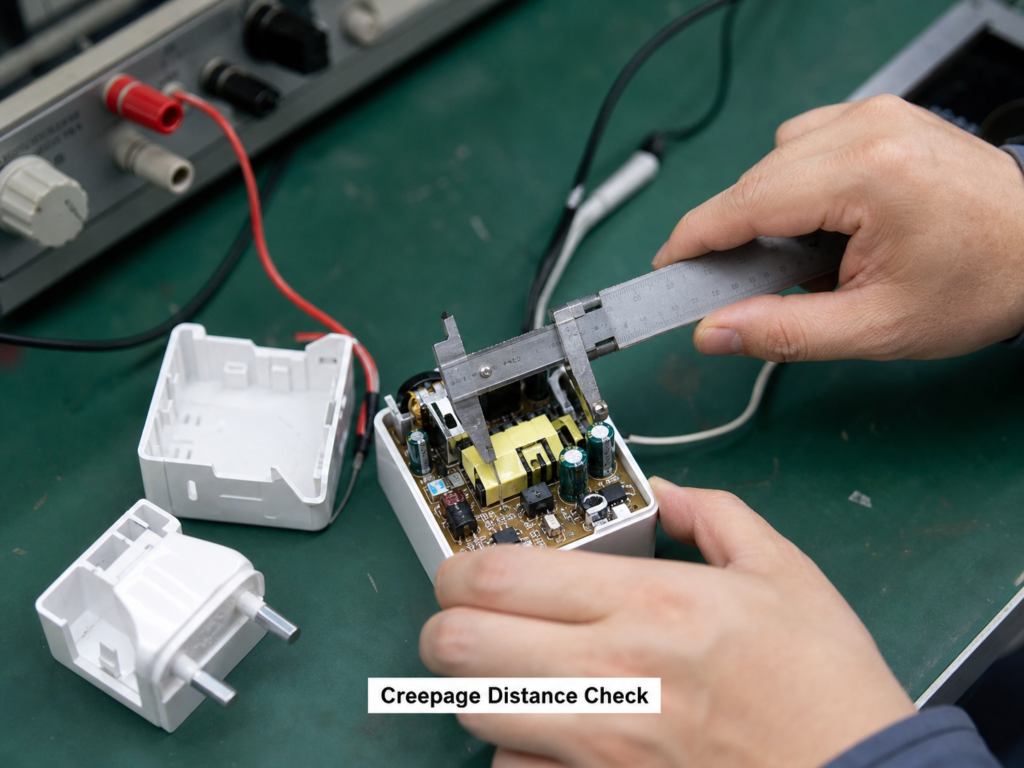
Electrical safety problems directly involve electric shock, overheating and fire, and must be rectified first, without any ambiguity.
1. **Insufficient creepage/electrical clearance**: The root cause may be insufficient PCB layout spacing, insufficient insulation structure design or too thin insulation layer. Rectification can be achieved by adjusting PCB layout, optimizing insulation structure, increasing insulation layer thickness or using auxiliary insulation materials;
2. **Unqualified withstand voltage/insulation resistance**: The root cause may be insufficient insulation material grade, or internal hidden dangers such as short circuit, burrs, assembly deviation. Rectification requires replacing qualified insulation materials and checking internal short circuit risk points;
3. **Excessive full-load temperature rise**: The root cause is insufficient heat dissipation, unreasonable component selection or low efficiency. The rectification direction is to optimize the heat dissipation structure, replace high-efficiency components, and adopt derating design to make components work below the rated capacity;
4. **Short circuit/overload protection failure**: The root cause is missing protection circuit, wrong fuse selection or inaccurate protection threshold. Rectification requires improving the protection circuit, selecting appropriate fuses and reconfirming the protection threshold;
5. **Excessive leakage current/contact current**: The root cause may be too large Y capacitance capacity or improper grounding design. Rectification requires replacing qualified Y capacitors and optimizing grounding design.
Boundary reminder: Safety rectification must verify mass production consistency, and temporary measures to cope with testing are prohibited. For example, adding an insulating sheet during testing and removing it during mass production will have very high risks once found.
Electromagnetic Compatibility (EMC) Category (Easily Overlooked Access Requirement)
EMC is the ability of a product to not interfere with other devices and resist normal external interference. Although it does not necessarily directly involve personal safety, it is an important access requirement in many markets and product categories.
Common non-conformities include:
1. **Excessive conducted/radiated emission**: The root cause may be large power supply ripple, insufficient filter design or insufficient shielding. Rectification can be achieved by optimizing filtering, adjusting PCB layout, improving grounding or adding appropriate shielding measures;
2. **Electrostatic Discharge (ESD) failure**: The root cause may be poor grounding or lack of protection at the interface. Rectification requires optimizing the grounding design and adding appropriate ESD protection components at the interface;
3. **Surge/electrical fast transient burst failure**: The root cause may be insufficient anti-interference circuit. Rectification requires adding appropriate surge protection components, optimizing the filter circuit, and conducting anti-interference test verification after modification.
Note: Changes to cables, connectors and supporting chargers may affect EMC results. After rectification, reconfirmation should be carried out according to applicable standards and original test configurations.
Chemical Environmental Protection and Flame Retardant Category (Easy to Fall into Pitfalls Due to Material Changes)
Such problems are often caused by supplier material changes, material source changes or incomplete supply chain documents. Common non-conformities include:
1. **Excessive RoHS hazardous substances**: The root cause is that materials contain restricted substances, or suppliers change materials without assessment;
2. **REACH SVHC information obligations not met or restricted substances non-compliant**: When the candidate list SVHC in an article exceeds 0.1% (by weight), it usually triggers the supply chain information transmission obligation; if the specific substance is also subject to REACH restriction or authorization requirements, it should be further judged according to the corresponding clauses;
3. **Unqualified flame retardancy of shell/insulation materials**: The root cause is that the flame retardant grade of the material does not meet the requirements. Rectification requires replacing engineering plastics or insulation materials that meet the corresponding flame retardant grade.
High-incidence parts of such problems include PVC/TPE cable jackets, plug plastics, printing inks, solders and metal coatings. You can focus on these positions when checking materials.
USB-C/Charging Performance Category (High Incidence in Cables and Connectors)
This is a common pitfall for cable sellers. Many people think that “as long as it can charge, it’s fine”. In fact, different combinations of USB-C cables and devices may have different current, data and protocol requirements.
1. **Unqualified USB-C interface resistance**: The root cause may be too thin connector plating or poor crimping. Rectification requires replacing compliant connectors and optimizing the crimping process;
2. **Excessive voltage drop of charging cable**: The root cause may be too thin conductor diameter or non-compliant material. Rectification requires replacing copper cores of appropriate specifications, optimizing conductor materials, and conducting voltage drop test verification after modification;
3. **Wrong E-Marker chip parameters**: The root cause may be wrong chip firmware programming or wrong selection. Rectification requires replacing the compatible chip and re-programming the correct firmware;
4. **PD protocol handshake failure**: The root cause may be protocol incompatibility or wrong interface pin definition. Rectification requires adjusting firmware or optimizing pin design.
Misunderstanding clarification: Being able to charge a single mobile phone does not mean compatibility with all USB-C devices. When connecting to laptops, tablets or other devices, problems may occur in power, data transmission or protocol negotiation. Products should be designed and verified according to their declared capabilities and applicable standards.
Energy Efficiency and Standby Power Consumption Category (Only for Chargers/Power Adapters)
Such requirements are mainly for external power supplies. Passive cables usually do not involve external power supply energy efficiency requirements. Common problems include excessive standby power consumption, insufficient load efficiency, and inconsistency between nameplate parameters and actual output.
There are two rectification directions: either optimize the power management design to improve efficiency and reduce standby power consumption; if the actual output capacity needs to be adjusted, the nominal parameters, promotional content, labels and manuals should be modified simultaneously, and false labeling cannot continue.
Note: Do not deliberately reduce the nominal power to muddle through. The parameters must be consistent with the actual performance, and a full energy efficiency test verification is required after modification.
Document and Labeling Category (Fastest Rectification, Lowest Cost)
Many beginners fail for the first time because of this, and it is also the simplest to modify. Common problems include: labels lack necessary product identification information, incomplete manufacturer or importer information, manuals lack warning statements required by the target market, or promotional parameters are inconsistent with actual capabilities.
Several typical scenarios:
• **EU**: Product identification information, manufacturer or importer information, rated parameters and safety information should be checked according to applicable regulations and product standards. The CE mark itself does not require rated parameters to be immediately adjacent to the CE mark; the WEEE crossed-out wheeled bin logo applies to electrical and electronic equipment included in the WEEE scope, but it should first be checked whether the product belongs to this scope and whether there is a statutory exemption;
• **USB-C cables**: USB-IF certification or trademark rules, retailer rules and specific labeling requirements of the target market should be distinguished. It should not be generally claimed that the EU has a universal statutory power labeling obligation for all independent USB-C cables;
• **US**: FCC ID, SDoC compliance information, labels and user manual statements should be checked according to the FCC authorization method applicable to the device and specific Part 15 clauses. Do not generally require a unified warning statement next to the FCC logo;
• **General problems**: False fast charging power labeling, missing safety warnings in manuals, inconsistency between manufacturer information and actual responsible subject.
The rectification method is to modify labels and manuals according to the requirements of the corresponding market. It is recommended to submit them to the laboratory, certification body or customer for pre-review in advance, and confirm that they are correct before printing to avoid repeated errors. If sold to multiple countries, corresponding languages need to be prepared, and local responsible party information should be marked.
Root Cause Analysis: Finding the Right Root Cause Avoids Vain Rectification
Many people’s rectification is “treating the head when the head hurts, treating the foot when the foot hurts”. For example, if the creepage distance is insufficient, they add an insulating sheet, but do not think about why the spacing was not left enough during design. As a result, the same problem occurs again when changing the model next time. Truly effective rectification is to find the root cause and solve it from the root.
Find the Root Cause with a Four-layer Problem Chain
You can dig step by step along these four layers:
1. **First layer: Clarify the failure phenomenon** — which test fails, under what state it fails, and how big the gap between the measured value and the limit is;
2. **Second layer: Find the direct cause** — which component, which material or which process causes the problem;
3. **Third layer: Find management reasons** — why design, incoming material or outgoing inspection did not find it, whether it is wrong understanding of standards, out-of-control version management, or supplier changes not assessed;
4. **Fourth layer: Check diffusion risk** — whether it affects other models, batches and markets, for example, whether all chargers using the same PCB or transformer have this problem.
5 Common Root Causes
Most problems fall into these five categories:
1. **Design reasons**: Insufficient safety margin, insufficient internal space, wrong understanding of standards;
2. **Material reasons**: Alternative materials not assessed, suppliers secretly change materials, batch quality fluctuations;
3. **Process reasons**: Poor welding, insulation layer damage, insufficient crimping, missed inspection;
4. **Document reasons**: Wrong label version, inconsistency between test samples and mass-produced samples, wrong document application;
5. **Standard misjudgment**: Designed according to old standards, or applying the requirements of market A to market B.
How to Judge Whether a Supplier’s Rectification Plan is Reliable
If the supplier is responsible for rectification, don’t just listen to them say “it has been modified”, but check according to these standards:
1. The affected batches, inventory quantity, specific reasons and control measures taken must be clearly stated;
2. Specifications, version numbers and compliance certificates of new materials or new components must be provided and checked one by one;
3. Vague and unverifiable answers such as “has improved” and “strengthened inspection” are not accepted. Specific actions and evidence must be provided;
4. For key material changes, it is necessary to confirm whether they affect the coverage of the original compliance qualifications. For example, if the transformer is replaced, whether the original test report or certification still covers the modified product.
4 Common Invalid Rectifications, Don’t Step on Them
1. Only modify the test samples, not handle the bulk goods and shipped products. If found in market random inspections, the punishment will be much heavier;
2. Repeatedly sending samples to try luck without finding the root cause, wasting time and money;
3. Using “special samples” to cope with testing, while cutting corners on mass-produced versions, is a serious compliance risk;
4. Only modify the failed items, ignoring associated risks — for example, adding an insulating sheet to solve the creepage distance problem, but leading to poor heat dissipation and excessive temperature rise, solving one problem but causing another new problem.
Full Process of Implementation Rectification: From Plan to Mass Production Closed Loop
After finding the root cause, it is necessary to implement the rectification, not just stay on paper.
First Formulate a Reliable Rectification Plan
A qualified rectification plan must include: list of non-conformities, root cause, rectification measures, responsible person, completion time and retest arrangement.
Rectification priorities are sorted by risk level: first deal with personal safety and fire-related problems, then deal with mandatory regulatory requirements, and finally deal with document and labeling problems; if there are no safety or regulatory risks, you can also modify documents first, because it is the fastest and can resume relevant sales or audit processes as soon as possible.
Rectification should follow three principles: minimal modification, try not to change the appearance and function; controllable cost; compliance first. In addition, it must be checked whether the rectification will cause new compliance problems, such as whether adding an insulating sheet will lead to excessive temperature rise, and whether replacing filter components will affect the safety distance.
How to Judge Whether a Change Requires Retesting
Any change to documents, labels, key components, structure or radio frequency should be recorded and a compliance impact assessment should be conducted. Whether testing is required in the end, how large the test scope is, whether engineering assessment or supplementary testing can be used, and whether the certificate needs to be changed should be jointly determined by applicable regulations, certification schemes, nature of change, risk analysis, and requirements of the laboratory or issuing body.
You can first grasp the following principles:
• For document or label changes, technical documents should still be updated and modification records kept, while confirming whether they affect the conformity declaration or certification documents;
• For non-key material changes, such as shell color or packaging, they should be implemented after confirming that they do not affect compliance, and individual items should be supplemented if necessary;
• For key safety or performance component changes, such as transformers, fuses, Y capacitors, USB-C interfaces or E-Marker chips, a compliance impact assessment should be conducted, and the test scope should be confirmed with the laboratory or certification body;
• Core design changes, such as changes in power supply topology, PCB layout, structure or rated output parameters, may require supplementary testing, partial retesting, full retesting or re-evaluation;
• Changes to the radio frequency circuit of wireless products may affect radio frequency, EMC or device authorization. It should be confirmed according to FCC, RED or other applicable systems whether supplementary testing, certification change or re-application is required.
The original report is still the test record of the original sample and original configuration, but should not be automatically regarded as covering the modified product.
Sample Rectification and Internal Pre-verification
For hardware rectification, first test 1—2 prototype samples, do not directly modify the bulk goods mold, otherwise if the modification fails, the mold fee will be wasted. If conditions permit, internal pre-inspection can be done, such as testing insulation with a withstand voltage tester, testing cables with a voltage drop tester, and first passing the core items to reduce the retest failure rate.
Document rectification can be sent to the laboratory, certification body or customer for pre-review in advance, and formally submitted after confirmation. It must be noted here that trial production samples should be consistent with the materials, processes and firmware of the planned mass production, otherwise the test is in vain, and problems will still occur during mass production.
Precautions for Submitting Retest
Before sending samples, confirm clearly with the laboratory or certification body:
• Whether the retest scope is only the failed items, or related items need to be added;
• Sample quantity, sample configuration and whether spare samples are needed;
• Whether destructive samples or samples of different configurations are needed;
• Charging standards, test cycle and document requirements.
The sample quantity, configuration, and whether spare or destructive samples are needed should be confirmed in writing by the applicable standards and the laboratory or certification body before the retest, and should not be preset as 1—2.
The submitted rectification report should clearly state four cores: problem description, root cause, rectification measures and internal verification results, with a comparison description before and after rectification attached.
Misunderstanding reminder: Do not default to “only retest the failed items”. Structural or key component changes may require extended testing of related items. For example, if the PCB layout is changed, it may be necessary not only to confirm the creepage distance, but also to evaluate withstand voltage, temperature rise and EMC.
After Passing the Retest, Do a Good Job in Mass Production Consistency Closed Loop

Passing the retest is not the end of rectification. Many people ignore it after the test, and the same problem occurs again two months later. You also need to do these things:
1. **Document update**: Simultaneously modify BOM, drawings, labels, manuals and conformity declarations, and lock the latest version;
2. **Change control**: All rectification-related changes shall be issued with a formal Engineering Change Notice (ECN), clarifying the change content and implementation time. It is forbidden for the production end to privately change back to the original process or materials;
3. **Key component management**: Keep specifications and compliance certificates for newly replaced key materials, and lock suppliers and models;
4. **Production control**: Check rectification points for the first piece, inspect key processes during production, and randomly inspect core compliance items by batch to ensure that mass-produced products are consistent with test samples;
5. **Old material cleaning**: Unqualified old materials, old labels and old packaging shall either be destroyed or reworked to avoid mixing with new materials and flowing into the market;
6. **Batch traceability**: Establish the corresponding relationship between batches, BOM and test records, so that the cause and impact scope can be quickly located when problems occur later.
Differences in Rectification Requirements of Major Global Markets
Friends who do cross-border business often encounter the situation that one product is sold in multiple markets. The rectification requirements of different markets are different and cannot be generalized.
EU Conformity Assessment and CE Mark Rectification
• **Applicability judgment**: Judge applicable regulations respectively according to product types, such as external power supplies, cables or products with power supply;
• **Conformity assessment path**: Many charging products can be subject to conformity assessment by the manufacturer itself, issue EU DOC and affix CE mark. Only some categories or specific procedures require the intervention of a Notified Body (NB);
• **Rectification characteristics**: Document problems require supplementing or modifying technical documents and keeping rectification records; hardware problems should update test evidence and technical documents, and re-evaluate if necessary;
• **Note**: RoHS, WEEE, ecodesign and universal charger requirements are all independent regulatory obligations and are not part of the CE mark itself. Affixing CE does not mean that all relevant obligations have been met;
• **Special points for charging products**: For universal charger requirements, it should first be judged whether the product belongs to the radio equipment category listed in the Radio Equipment Directive (RED) and the specific applicable date. For independent USB-C cables, USB-IF certification or trademark rules, retailer rules and specific labeling requirements of the target market should be distinguished, and should not be generally referred to as the EU’s general statutory power labeling requirements.
US Market Compliance Rectification (Divided into Two Categories)
US compliance requirements can be divided into FCC-related requirements and safety access requirements, which many people confuse.
FCC RF/EMC Compliance Rectification
It should be judged according to specific FCC rules whether the device is an intentional radiator, unintentional radiator or digital device that requires authorization, or whether a clear exemption applies. Do not use “pure analog charger” as a legal classification that directly excludes FCC applicability.
The current FCC equipment authorization procedures mainly include:
• **SDoC (Supplier’s Declaration of Conformity)**;
• **Certification**.
Do not continue to list “self-verification” as an independent current authorization path alongside SDoC and Certification. The specific applicable method still depends on the device category and FCC rules.
During rectification, test, label, user manual and compliance information requirements should be confirmed according to applicable FCC Part 15 clauses or other specific rules.
Note: FCC is not responsible for product safety requirements and cannot replace safety compliance assessment.
Safety Access and NRTL/Retailer Requirements
NRTL is a **Nationally Recognized Testing Laboratory** accredited by OSHA of the United States within its accreditation scope, not a general term for “nationally accredited laboratory”.
Whether NRTL certification or listing is required in the US should be confirmed in combination with the following factors:
• Product category;
• Requirements of the sales state and local competent authorities;
• Policies of specific platforms, retailers, importers and insurers;
• Safety standards used and laboratory accreditation scope.
UL is one of the well-known NRTL bodies, but not the only choice. When structural or safety components are changed, communicate with the issuing NRTL in advance to confirm whether supplementary testing, re-audit or listing change is required.
Key Points of Rectification in Other Major Markets
• **UK (Great Britain)**: It should be confirmed according to product regulations whether CE can be used currently or UKCA must be used. Many product regulations currently continue to recognize the CE mark. Existing CE test reports can be used as one of the evidences of UK technical documents on the premise of meeting the requirements of UK applicable regulations, standards and responsible subjects, but cannot be mechanically copied;
• **Japan PSE**: Distinguish between specified and non-specified electrical appliances according to Japan’s Electrical Appliance and Material Safety Law. The core is electrical safety and corresponding labeling and conformity procedures. EMC and radio requirements should be judged separately according to product functions and applicable systems, such as the Radio Law, VCCI or customer requirements;
• **Korea KC**: The applicability of safety, EMC and radio regulations, as well as the KC conformity assessment method corresponding to the product, should be confirmed respectively. The qualification of testing institutions, whether overseas test results are acceptable, and whether factory inspection is required should be confirmed according to product categories, certification schemes and rules of competent authorities.
Multi-market Rectification Coordination Skills
If the product is sold in multiple markets, rectification costs can be reduced through shared design and overlapping test items, but the mark or report of one market cannot automatically replace the requirements of other markets.
It is recommended to establish a multi-market compliance matrix and confirm market by market:
1. Applicable regulations and standards;
2. Administrative procedures, certificate or conformity declaration requirements;
3. Plug, voltage and frequency requirements;
4. Energy efficiency, material and environmental protection requirements;
5. Label, language and manual requirements;
6. Local responsible subject or authorized representative requirements;
7. Whether factory inspection, registration or continuous supervision is required.
CE or “strictest standard” shall not be presumed to automatically cover other markets. Even if there is overlap in technical test items, it may still be necessary to supplement national standards, energy efficiency procedures, registration, language, responsible subject, certificate or factory inspection.
Pitfall Avoidance and Pre-risk Control: Reduce Rectification Probability from the Source
After all, rectification is a remedy after the event. The best way is to do a good job in risk control from the beginning to reduce the possibility of unqualified.
High-frequency Rectification Misunderstandings, Don’t Step on Them
1. Only modify test samples and secretly replace key components of bulk goods, resulting in heavier penalties for market random inspections;
2. Find unqualified institutions for rectification, copy reports, and forge certificates, which are not recognized by the target market at all;
3. Still use old documents after the standard version is updated, and still unqualified after rectification;
4. Do not update documents and BOM after modification, and the same problem occurs again when materials are changed later.
Cost and Time Control Skills
1. Prioritize solving high-risk items, then deal with low-risk items to avoid repeated rectification;
2. For hardware rectification, first do prototype verification, and then modify the bulk goods mold after meeting the standards;
3. Find a laboratory with corresponding market testing capabilities and accreditation scope for pre-testing to reduce the cost of repeated sample submission;
4. For products with large batches, regional rectification can be considered to balance cost and compliance requirements, but it must comply with local regulations.
Pre-risk Control at the Procurement End to Reduce Rectification Probability from the Source
1. **Contract agreement**: The procurement contract clearly defines the rectification responsibility, cost and cycle for non-compliance, distinguishes the responsible parties for design, production and document problems, and avoids suppliers shifting blame;
2. **Supplier selection**: Prioritize factories that have compliance experience in the target market for similar products and can provide complete BOM and key component compliance certificates;
3. **Incoming material inspection**: Check incoming key materials such as plugs, cables, PCBs, chips, etc., to confirm that they are consistent with the certified samples. You cannot accept whatever the supplier sends;
4. **Change management**: Evaluate the compliance impact before changing key materials, structures or labels, follow the rule of “first evaluate → then change → then verify”, and cannot change at will.
Doing these pre-work well can significantly reduce the probability of unqualified and repeated rectification from the source, but the actual effect will vary depending on the product, supply chain, market and maturity of the quality system.
Graded Disposal of Unqualified Products Already on the Market
If the product has been launched and found unqualified, don’t panic, first grade it and then dispose of it.
First Do Risk Grading
• **High risk**: There are safety hazards such as electric shock, fire, overheating, or regulatory authorities require measures such as recall;
• **Medium risk**: No direct safety hazards, but not in compliance with mandatory regulations, may be removed from shelves, detained or restricted from sale;
• **Low risk**: Mainly labeling or document defects, no safety and performance problems found yet.
Corresponding Disposal Actions
• **High risk**: Immediately stop supply and conduct risk assessment, notify importers, distributors and relevant channels, and decide on warning, return and exchange, recall, rework or destruction according to target market regulations and requirements of competent authorities;
• **Medium risk**: Suspend sales, reconfirm after rectification, rework inventory, and notify relevant parties to replace compliance labels or documents according to regulations and channel requirements;
• **Low risk**: Rectify labels or documents for products in transit and in inventory, and confirm whether channel notification, consumer correction or other corrective measures are needed. It should not be preset that recall is definitely not required.
Whether to recall, whether to destroy, and whether it can be solved by correcting labels, supplementing information or rework, all depend on risk assessment, sold quantity, product traceability, requirements of competent authorities and target market regulations.
Conditions for resuming sales include: the product passes testing or evaluation after rectification, complies with target market regulations, meets the requirements of platforms or regulatory authorities, and relevant documents have been updated.
The retention period must be determined separately according to the target market and applicable regulations. For example, EU regulations such as the Low Voltage Directive (LVD), Electromagnetic Compatibility Directive (EMC), Radio Equipment Directive (RED) and RoHS usually require manufacturers to keep relevant EU conformity declarations and technical documents for 10 years after the product is placed on the market. Rectification, testing, notification and disposal records should also be kept in accordance with applicable regulations, requirements of certification bodies and product traceability needs.
Practical Toolkit (Can Be Directly Applied)
These tools can help you avoid a lot of detours, just apply them directly:
1. **Report and problem sorting tools**
• Unqualified report interpretation form: check report validity, sort out non-conformities, correspond to regulatory requirements, and record preliminary judgments;
• Rectification CAPA form: record problems, root causes, correction/corrective actions, responsible persons, completion time and verification results, and keep the complete rectification process.
2. **Compliance and change management tools**
• Compliance certification matrix: record models, markets, applicable regulations and standards, document versions, certificate or report status, change re-evaluation requirements;
• Material change assessment form: assess the impact of key material changes on compliance, and judge whether retesting or document updating is required;
• Sample consistency confirmation form: check whether the materials, structure, firmware and labels of the submitted samples are consistent with the mass-produced bulk goods, to ensure that what is tested is what is sold.
3. **Implementation and release tools**
• Retest submission list: sort out the samples, documents and rectification instructions required for retest, and check them before sending samples to avoid omissions;
• Mass production release list: before the first batch of mass production, check whether all rectification points are implemented, whether documents are updated, and whether materials are locked, and release after confirmation.
Final Summary
Unqualified certification testing is not the end of the world. The key is to rectify in the correct way: from the initial pre-judgment to avoid vain rectification, to finding the root cause, implementing rectification, mass production closed loop, and then pre-risk control to reduce risks from the source. Doing every step well can not only solve the immediate problems, but also avoid stepping on the same pitfalls in the future.
Remember, the core of rectification is not to cope with testing, but to make the product truly meet the requirements of the target market, so that your cross-border business can last for a long time.