
For friends in the charging product overseas business, when first entering the U.S. and Australia-New Zealand markets, you will most likely be confused by the two marks UL and RCM: one is a common safety mark on U.S. chargers, the other is a compliance mark on Australian products. Are they the same thing? Are they mandatory? Do ordinary charging cables need them? How to check whether the certification provided by the supplier is real or fake?
This article focuses on common charging products such as USB chargers, Type-C charging cables, and power adapters, and thoroughly explains the core differences, scope of application, self-check methods, and pitfall avoidance points of UL and RCM. From beginner to independent judgment, you no longer need to look for scattered information everywhere.
First, Understand the Basics: What Exactly Are UL and RCM?
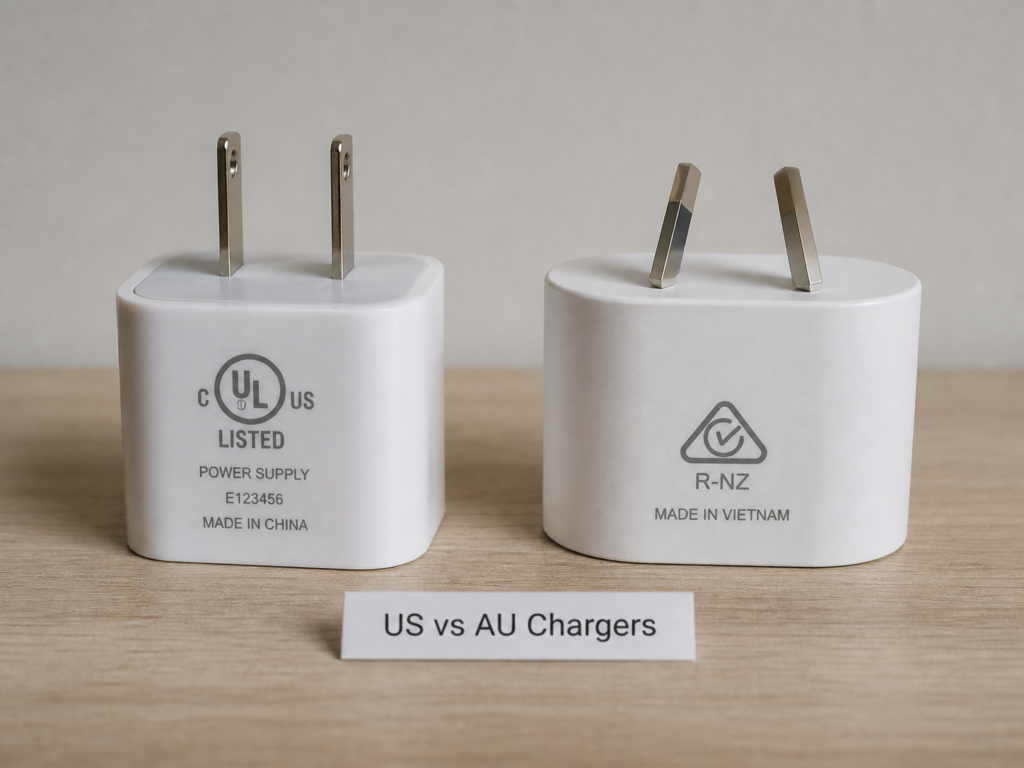
Many people easily confuse the nature of the two certifications. We first clarify their core identities, then define the boundaries of this comparison to avoid deviations in subsequent understanding.
Core Identity of UL Safety Certification
Many people think UL is an official mandatory certification in the United States, but it is not. UL is a safety certification issued by UL Solutions, and UL Solutions is one of the Nationally Recognized Testing Laboratories (NRTLs for short) recognized by the U.S. Occupational Safety and Health Administration (OSHA). Simply put, UL is a third-party organization qualified to issue safety certifications recognized by the U.S. market. It has equivalent legal effect to other OSHA-recognized NRTL organizations such as ETL, and there is no hierarchy between them.
UL’s safety certifications are mainly divided into two categories: one is for complete products, such as full chargers and power adapters, and the common scheme includes UL Listed (listing certification); the other is for components, modules or assemblies that are installed in end products under controlled conditions, called UL Recognized (recognition certification). The rated values and usage conditions of Recognized objects must comply with the certification documents, and they usually cannot replace the end-product certification required for final products. The specific type of service to choose mainly depends on the product type, certification scheme, installation scenario, and the requirements of the purchaser or platform.
RCM Compliance Mark System
RCM is the most easily misunderstood: many people think it is a unified certification certificate for Australia and New Zealand, but in fact it is a commonly used compliance mark system in Australia and New Zealand, not a single certificate. The RCM is used to indicate that a product has completed corresponding compliance with applicable Australian or New Zealand electrical safety, EMC, radio and other requirements, but it is not a blanket proof of all regulations. Energy efficiency requirements such as GEMS need to be judged and handled separately, and the RCM mark alone cannot prove that a product meets energy efficiency requirements.
Different regions have corresponding different regulatory rules:
- Australia: Electrical safety is governed by requirements such as the EESS (Electrical Equipment Safety System). Suppliers need to fulfill corresponding declaration of conformity, registration or other supplier obligations according to the equipment risk level, and confirm the local responsible supplier. Electromagnetic compatibility (EMC) and radio functions are governed by the relevant rules of the ACMA (Australian Communications and Media Authority), and supplier registration and declaration of conformity must be completed as required. Energy efficiency is managed by the GEMS (Greenhouse and Energy Minimum Standards) scheme, and whether it is required depends on the product type and power. Whether the RCM needs to be used should be confirmed in combination with applicable regulations and product categories.
- New Zealand: It does not use Australia’s EESS registration system, and applies its own local electrical safety, EMC, radio and energy efficiency regulations. RCM is a commonly used compliance mark, but not the only one. Whether and how to mark it depends on the product category and local regulatory requirements. Local suppliers or importers usually bear important obligations such as local supply, conformity documents and traceability, but manufacturers, brand owners and other relevant responsible parties may still bear corresponding legal liabilities, which need to be confirmed in accordance with specific regulations.
First Clarify the Boundaries of the Comparison
To avoid misalignment, this comparison follows a unified standard:
- Compared products: Charging products such as USB chargers, Type-C charging cables, power adapters, and related connectors, excluding other industries;
- Comparison benchmark: UL specifically refers to the NRTL safety certification issued by UL in the United States, excluding the Canadian version cUL;
- Comparison premise: For commercial sales scenarios, personal use and small-volume overseas shopping are not within the scope of discussion;
- Boundary reminder: Specific requirements will vary with product category, power, presence of wireless functions, sales form, and target region, and the latest official requirements shall prevail in the end.
Quick Judgment: Does Your Product Need Certification?
You don’t have to start by flipping through thick regulations. First check the scope of application, then quickly screen with 5 variables, and you can get a pretty good idea.
Applicable Requirements for the U.S. Market
U.S. certification requirements are tiered, and not all products are mandatory:
- Statutory level: Whether NRTL certification is mandatory in the United States requires separate verification of applicable federal workplace requirements, state and local electrical codes, and the requirements of the local Authority Having Jurisdiction (AHJ for short). OSHA’s NRTL requirements mainly apply to workplace equipment and specific standards within its scope, and the adoption and enforcement scope of state and local codes and AHJs also vary. Many consumer electronic products do not have a unified federal NRTL mandatory requirement;
- Platform level: Mainstream e-commerce platforms and large retailers generally require NRTL certification for mains-input charging products, and some platforms specifically require the UL mark. This is a commercial requirement, not federal law, but you must comply if you want to sell on the platform;
- Commercial level: If a customer specifies UL or other NRTL certification, it is also a commercial requirement, not a statutory mandate.
Products with high certification demand are mainly chargers with AC mains plugs, power adapters, and charging devices with active circuits; components such as connectors, cable flame-retardant jackets, and power modules generally obtain UL Recognized component recognition. Pure passive low-voltage USB cables (no chip, no AC input, no power conversion) do not have a unified federal mandatory safety certification requirement, unless the platform has special regulations.
RCM Coverage in the Australian Market
Australia’s requirements are clearer: products within the mandatory scope of relevant regulations must be compliant before they can be placed on the market, but not all products with AC input can be directly classified into the same registration path:
- Chargers with AC mains input, power adapters, and charging products with active circuits should first confirm the equipment level according to the EESS scope of application and AS/NZS 4417.2;
- Electrical equipment within the EESS scope must fulfill corresponding declaration of conformity, registration or other supplier obligations according to Level 1, Level 2 or Level 3 respectively. Level 3 equipment usually requires EESS product registration, and it cannot be generally stated that all AC chargers must undergo EESS registration;
- If the product has wireless charging, Bluetooth, or Wi-Fi functions, it must additionally meet the EMC and radio requirements of the ACMA;
- Energy efficiency requirements are judged according to the product scope, power, and registration rules of the GEMS scheme, and those within the scope need to separately handle corresponding energy efficiency registration or declaration.
Same as in the United States, pure passive low-voltage USB cables are usually not within the mandatory scope.
RCM Coverage in the New Zealand Market
New Zealand’s rules are similar to Australia’s, but the system is independent:
- It applies its own national electrical safety, EMC, radio and energy efficiency regulations, and does not need to go through Australia’s EESS registration;
- For chargers and power adapters with mains input, it is usually necessary to focus on verifying the product categories in New Zealand’s electrical safety regulations, and separately judge EMC, radio and energy efficiency requirements; it cannot be directly concluded that all products apply the same mandatory path solely based on AC input;
- RCM is a commonly used compliance mark, but not the only one. Specific labeling requirements are confirmed according to product categories and local regulations, and other compliance declarations can also be used;
- Local importers or suppliers usually bear the main obligations such as local supply, conformity documents and traceability, but manufacturers, brand owners and other responsible parties may still bear corresponding legal liabilities, which must be confirmed in accordance with specific regulations.
Pure passive low-voltage USB cables are also usually not within the mandatory scope.
5-Variable Quick Judgment Method for Charging Products
You don’t need to memorize complex regulations. Go through 5 variables with your product to make a quick judgment:
- Does it have an AC mains plug/high-voltage input? If yes, there is a high probability that you need to focus on verifying the safety compliance requirements of both regions;
- Does it have active functions? Such as fast charging chips, wireless charging, power conversion — if yes, corresponding test items will be added;
- Is the sales form sold separately or as a set accessory? If sold as a set, it shall be evaluated according to the requirements of the complete product, and cannot be judged only by the accessory itself;
- Is the sales channel platform, offline, or individual? Platform and offline requirements are usually higher than basic regulations;
- What is the target state/region for sales? Specific requirements may vary in different regions of the United States, Australia and New Zealand.
Of course, product power, output type, whether it contains a battery, and energy efficiency rules will further adjust the requirements, but these 5 variables can help you quickly eliminate 80% of your doubts.
Core Differences: Understand the Difference Between the Two from 6 Dimensions
Now that we have clarified the scope of application, we will break down the substantive differences between the two from 6 core dimensions for your reference when making decisions.
1. Mandatory Degree and Legal Status
- U.S. NRTL (including UL): The federal government does not set a unified NRTL mandatory requirement for all consumer electronic products. Whether NRTL certification is mandatory depends on applicable federal workplace requirements, state and local electrical codes, AHJ requirements, and the specific use of the product; requirements from platforms and retailers are commercial “de facto mandatory”. Where applicable requirements permit, you can usually choose any OSHA-recognized NRTL organization, and UL is not necessarily required.
- Australia RCM-related: Products within the scope of relevant regulations must complete corresponding compliance requirements before they can be placed on the market, and violations may result in removal from shelves or even fines. Different compliance modules correspond to different regulatory authorities, and EESS also requires fulfillment of declaration, registration or other supplier obligations according to equipment level.
- New Zealand RCM-related: Whether mandatory compliance is required is judged according to local regulations. RCM is a commonly used mark but not the only compliance mark.
For charging products, mainstream U.S. e-commerce platforms basically require NRTL certification for mains-input charging products, and the specific requirements shall be subject to the latest platform policies. The degree of mandatory requirement is not fixed; it will change as sales channels, product risk levels, and target regional rules change.
2. Compliance Content Coverage
- United States: Safety, EMC, wireless, and energy efficiency are mutually independent compliance modules and cannot replace each other. Safety is usually resolved through NRTL certification, and UL is just one of the optional organizations; FCC compliance needs to be determined according to equipment category and FCC Part 15, Part 18 and other rules. Unintentional radiation devices can usually use SDoC or certification, and intentional radiation devices usually require certification and obtain an FCC ID, but specific equipment categories and authorization exceptions still need to be verified. Whether a charger requires FCC SDoC also requires confirmation of whether it is a regulated digital device and the applicable Part 15 requirements. In terms of energy efficiency, products such as external power supplies must meet the energy efficiency requirements of the DOE (U.S. Department of Energy) and state-level requirements such as those in California, depending on the product definition.
- Australia and New Zealand RCM: Multiple sets of regulations are matched according to product functions, and one certificate does not cover everything. Basic mains charging products need to judge electrical safety and EMC requirements according to product category; those with wireless functions need to add radio requirements; those within the energy efficiency scope need to add corresponding energy efficiency requirements, and finally confirm whether to use the RCM mark according to applicable regulations. Energy efficiency requirements such as GEMS are judged separately, and the RCM mark alone cannot prove that they have been met.
Simply put, when a product has wireless functions and meets the definition of an energy efficiency product, the number of compliance items that need to be completed will increase.
3. Core Differences in Testing Requirements
The core testing basis for both is general safety standards (such as UL/IEC/AS/NZS 62368-1) and corresponding EMC standards. The differences mainly come from two local requirements:
- Different plug specifications: The United States uses Type A/B plugs, and Australia and New Zealand use Type I plugs;
- Different grid parameters: The United States is 120V/60Hz, and Australia and New Zealand are 230V/50Hz.
Most test data cannot be directly mutually recognized. You can apply to laboratories and target certification bodies that have the relevant accreditation scope to evaluate the acceptability of existing data, but whether it can be used depends on the standards used and national differences, sample and structural consistency, laboratory accreditation scope, rules of the NRTL or local certification body, and the acceptance of the regulatory authority.
For wide-voltage products of 100-240V, safety tests may have a high degree of overlap, but it cannot be promised in advance that most tests can be shared. Item-by-item confirmation is still required, and rectification costs will also be affected by local plugs, voltage and testing requirements.
4. Responsible Entities and Compliance Processes
- UL/NRTL compliance process: Sample submission for testing → initial factory audit → certification issuance → regular factory follow-up inspections, with inspection frequency determined according to product risk level. The responsibility is mainly on the manufacturer or brand owner, and the certification body will regularly inspect the factory to ensure that mass-produced products are consistent with the submitted samples.
- Australia RCM process: Proceed by module. For electrical safety, first confirm whether the product is within the EESS scope and its Level 1, Level 2 or Level 3 rating, then complete the declaration of conformity, product registration or other supplier obligations according to the level, and confirm the local responsible supplier; for EMC/wireless, product testing is required, then complete supplier registration and issue a declaration of conformity according to ACMA requirements; for energy efficiency, complete registration or declaration according to GEMS rules.
- New Zealand compliance process: After product testing or evaluation, local importers or suppliers bear the main obligations such as local supply, documentation and traceability, and manufacturers, brand owners and other responsible parties may still bear corresponding legal liabilities; a full set of technical documents and declarations of conformity need to be kept, and there is no need to go through Australia’s EESS registration system.
Generally speaking, the higher the product risk level, the stricter the registration and documentation requirements.
5. Cost Composition and Cycle Influencing Factors
The cost composition of the two is different, and there is no unified conclusion on “which is more expensive”. The actual cost depends on many factors such as the organization, product, factory, rectification situation, and local service quotation:
- The cost of UL/NRTL is mainly testing fee + initial factory audit fee + regular follow-up service fee;
- The cost of RCM corresponding compliance is mainly testing fee + registration fee (if any) + local responsible supplier service fee (if needed).
In terms of cycle, for conventional samples without rectification, the overall time for both is similar, which is specifically affected by laboratory scheduling and product complexity. If the sample requires multiple rectifications, expedited processing, high product power or complex functions, both the cycle and cost will increase significantly.
6. Mark Use and Regulatory Spot Checks
- UL mark: The style and labeling content shall be subject to the specific UL authorization scheme. You cannot just print a UL mark casually; different certification types (Listed/Recognized) have different mark styles.
- RCM mark: The labeling position and supplier code requirements for different regulatory modules in Australia are different; New Zealand’s labeling requirements are confirmed according to product categories and local regulations, and the compliance documents of local suppliers need to be verified.
Regulatory methods are also different: in the United States, it is mainly state-level/AHJ law enforcement + platform spot checks + commercial procurement verification; in Australia and New Zealand, various regulatory authorities conduct spot checks according to their respective responsibilities, and the responsibility mainly falls on local suppliers or importers, but manufacturers, brand owners and other relevant responsible parties may also bear corresponding obligations. Generally speaking, products with mains input, high energy density, multi-port fast charging, and wireless transmission will receive higher regulatory attention.
For your quick comparison, I have organized the core differences into the following table:
| Comparison Dimension | U.S. UL (NRTL Safety Certification) | Australia and New Zealand RCM Compliance Mark System |
|---|---|---|
| Core Nature | Third-party safety certification, one of the OSHA-recognized NRTL organizations, mainly covering the electrical safety module | A mark system used to indicate the compliance status with applicable regulations, with coverage depending on the electrical safety, EMC, radio and other regulations applicable to the product; energy efficiency requirements such as GEMS are judged separately |
| Mandatory Logic | There is no unified federal NRTL mandatory requirement covering all consumer electronic products; specifics depend on federal workplace requirements, state and local codes, AHJ, platform and customer requirements | Mandatory in Australia according to applicable regulations, judged in New Zealand according to local regulations, RCM is a commonly used mark |
| Core Responsibility | Mainly the manufacturer/brand owner, the certification body conducts regular factory inspections | Local importers/suppliers usually bear important obligations such as local supply, documentation and traceability, and other responsible parties may still bear corresponding responsibilities |
| Core Testing Differences | Adapted to U.S.-standard Type A/B plugs and 120V/60Hz grid parameters | Adapted to Australian-standard Type I plugs and 230V/50Hz grid parameters |
| Data Mutual Recognition | Most items are not directly mutually recognized; whether existing data can be used needs to be evaluated by the laboratory and target certification body | Same as above |
| Subsequent Obligations | Need to pass regular factory follow-up inspections by the certification body | Need to separately maintain applicable EESS, ACMA, GEMS or New Zealand related documents, registration and responsible entity requirements |
Charging Product Comparison: How Much Do Requirements Differ for Different Products?
Talking only about rules may feel a bit abstract. Let’s take three of the most common charging products for specific comparison, and you can apply them directly after reading.
USB Chargers/Power Adapters
This is a category that is strictly regulated in both regions and most requires specific verification:
- UL/NRTL requirements: Mains-input chargers should usually obtain applicable NRTL end-product safety certification; if UL Solutions is selected, the specific mark and certification scheme may be UL Listed, etc., but equivalent certifications from other OSHA-recognized NRTLs may also meet the corresponding requirements;
- Australia RCM requirements: First confirm whether the product is within the EESS scope and its equipment level, then fulfill the corresponding declaration of conformity, registration or other supplier obligations according to Level 1, Level 2 or Level 3, and complete the applicable EMC requirements at the same time. It cannot be generally stated that all products must undergo EESS product registration;
- New Zealand requirements: Products with mains input need to focus on verifying the product categories in local electrical safety regulations, and separately judge EMC, radio and energy efficiency requirements. Local suppliers or importers bear important obligations such as local supply, documentation and traceability.
Whether in the United States or Australia and New Zealand, multi-port, fast-charging, and GaN high-power products will have additional test items; energy efficiency requirements must be judged according to the rules of the corresponding region.
USB/Type-C Charging Cables (Divided into Three Categories by Function)
The requirements for charging cables are the most easily confused. Not all cables require certification, and they must be classified by function:
- Pure passive low-voltage cable: No chip, no AC input, no power conversion, such as ordinary USB-A to C charging cables. There are usually no mandatory safety certification requirements in both regions, unless the platform has special regulations. If sold as a set with a charger, compliance evaluation must be carried out together with the complete product, and the cable’s certification alone cannot replace the complete product compliance.
- USB-C cable with E-Marker: With a power/protocol identification chip, but no power conversion function, such as a 100W PD fast charging cable. This does not automatically trigger mandatory safety certification. Whether testing or recognition is required depends on rated voltage, current, structure, sales form, applicable standards and channel requirements. Generally, it is also evaluated along with the complete product certification. If sold separately, the corresponding service is selected according to platform or customer requirements.
- Active cables/docks with power conversion/rectification/signal expansion: For example, docks with HDMI output, charging cables with step-down circuits — these are active electrical devices that need to be included in the scope of safety, EMC and other compliance in both regions.
Charging Products with Wireless/Expansion Functions
Such as wireless charging pads, charging docks with Bluetooth, etc.:
- UL/NRTL requirements: Whether safety certification is required and the specific scheme shall be confirmed according to applicable specifications, installation and sales requirements; wireless functions are evaluated according to FCC equipment categories and applicable rules, and not all wireless products require an FCC ID;
- Australia and New Zealand RCM requirements: Wireless energy transmission and wireless communication functions correspond to local radio/EMC rules respectively, and are included in relevant compliance evaluation and marking requirements.
Generally speaking, the more functions, the higher the test items and compliance costs; the specific path must be determined according to the transmission mechanism and functions, and there is no default single compliance path.
Authenticity Self-Check: 4 Steps to Verify Whether Certification is Valid
Are the certification documents provided by the supplier real or fake? Have they expired? You don’t need to find a third party; you can conduct a preliminary screening using the four-item cross-verification method by yourself.
Core Logic of Self-Check: Four-Item Cross Verification
- The mark style and labeling information comply with official specifications;
- There are corresponding certification certificates, registration documents or declarations of conformity;
- The information available in the official database matches the product (if the information is public);
- The key components and structure of the product are consistent with the descriptions in the compliance documents.
The four-item verification can only improve the reliability of preliminary judgment, and cannot alone guarantee that the product meets all regulations, standard versions, factory production consistency, energy efficiency and radio requirements, nor can it guarantee that the documents have currently valid authorization. In the end, it is still necessary to verify applicable regulations, product grades, certification or registration scope, production changes, validity period and responsible entities, and confirm with the certification body or regulatory authority if necessary.
Key Points for UL/NRTL Certification Self-Check
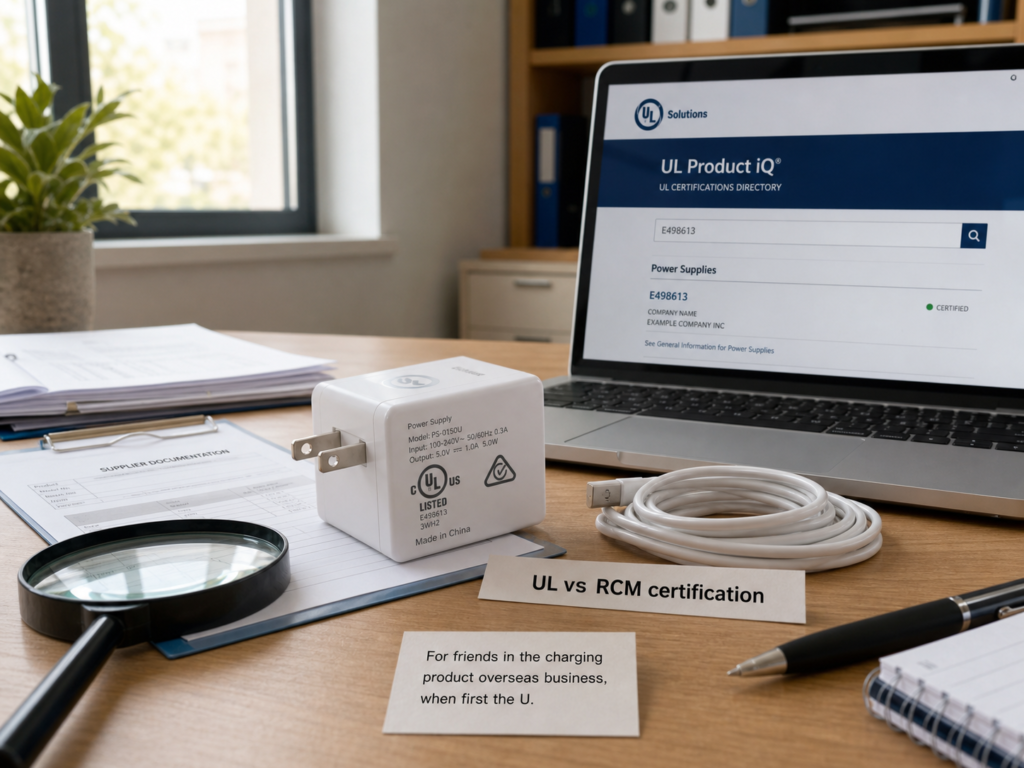
The core of UL certification self-check is to prioritize checking the certificate and service status, because the form and labeling of the UL mark are subject to the specific authorization scheme, and there may not be the traditional file number everyone is familiar with.
The self-check steps are simple: find the UL mark and labeling information on the product → log in to the UL Product database to query the corresponding information.
Note: Failure to find the record does not mean it is counterfeit. It may be due to different mark schemes, incorrect product information, or unupdated certification status. You can first verify clearly, then contact the certification body or authorized party for confirmation.
Key Points for RCM Compliance Self-Check
RCM self-check is divided into two cases: Australia and New Zealand:
- Australia: Find the RCM mark and labeling information → check the corresponding database according to product type. For electrical safety, verify information such as EESS equipment level, product registration or declaration of conformity; for EMC/wireless, check ACMA registration information; if the product is within the GEMS scope, also verify the corresponding energy efficiency registration or declaration separately.
- New Zealand: Find the RCM mark (if any) → ask the local supplier or importer to provide a full set of compliance documents → verify whether the responsible entity, test report, and declaration of conformity are consistent.
Similarly, failure to find the record does not mean it is counterfeit, because some compliance information is not publicly available. You need to contact the responsible supplier for confirmation, and the latest official data shall prevail in the end.
Common Judgment Standards for Compliance Invalidation
Even if the certification is real, it will become invalid in the following situations:
- The product model, key components, structure, or appearance has been changed without re-reporting;
- The applicable standard version is updated, exceeding the transition period stipulated by regulations or the certification body;
- The UL/NRTL certification fails to pass regular factory follow-up inspections, or the certification is suspended or revoked;
- The valid status of EESS equipment registration or declaration, ACMA supplier registration, GEMS registration and applicable New Zealand documents shall be verified separately. The expiration of a certain registration or invalidation of responsible supplier information may affect the compliance of the corresponding module, but it should not be collectively referred to as “RCM registration expiration”.
A reminder here: standard revisions will not immediately invalidate old compliance. Be sure to check the official transition period requirements, and don’t panic as soon as you see a standard update.
Pitfall Avoidance Guide: Misconceptions 90% of People Have Fallen For
I have sorted out 11 of the most common misconceptions. Avoiding these can save you a lot of detours.
High-Frequency Misconceptions
- Misconception: UL is a U.S. federal statutory mandatory certification → Correction: The United States does not have a unified federal NRTL mandatory requirement covering all consumer electronic products. Whether NRTL is required depends on applicable federal workplace requirements, state and local codes, AHJ, platform and customer requirements.
- Misconception: RCM is a unified single certification certificate for Australia and New Zealand → Correction: RCM is a mark system used to indicate the compliance status with applicable regulations, corresponding to multiple sets of regulations in Australia and New Zealand respectively. One certificate cannot prove that all regulations and energy efficiency requirements have been met.
- Misconception: All charging cables require certification → Correction: Pure passive low-voltage USB cables are usually not within the mandatory scope, and only active cables need to be judged by function.
- Misconception: A product printed with the UL/RCM mark is truly compliant → Correction: Four-item cross-verification of mark, documents, database, and product structure must be carried out; these can only be used as preliminary screening, and cannot replace a complete verification of regulations, product grades, registration scope, production changes and responsible entities.
- Misconception: USB-IF and fast charging protocol marks are equivalent to safety compliance → Correction: Interface compatibility, protocol certification and electrical safety compliance are completely independent matters and cannot replace each other.
Advanced Misconceptions
- Misconception: UL reports can be directly converted to RCM → Correction: You can apply to laboratories and target certification bodies that have the relevant accreditation scope to evaluate the acceptability of existing data. Only when standards, samples, structures, test conditions and accreditation scope all meet the requirements can part of the data be adopted. It cannot be promised in advance that most tests can be shared.
- Misconception: RCM is the Australian version of UL → Correction: RCM is a regulatory compliance mark system, with coverage depending on applicable safety, EMC, radio and other regulations. UL is a third-party safety certification under the NRTL system, and their natures are completely different.
- Misconception: UL Recognized is equivalent to UL certification for complete products → Correction: Recognized is usually for components, modules or assemblies installed in end products under controlled conditions. Complete products need to obtain corresponding NRTL end-product safety certification according to applicable requirements, and component certification cannot replace end-product certification.
- Misconception: Compliance is valid for life after passing → Correction: Product changes, standard updates (with transition periods), failed factory inspections, expiration of relevant registrations or invalidation of responsible entity information will all affect the corresponding compliance status.
- Misconception: Having a test report is equivalent to having compliance qualification → Correction: The test report only represents that the submitted sample has passed the test, and does not mean that all mass-produced products are compliant. It is also necessary to verify the corresponding certification, registration, factory inspection, responsible entity and other regulatory requirements.
- Misconception: Cables with E-Marker definitely require mandatory certification → Correction: E-Marker is just a protocol identification chip and does not automatically trigger mandatory certification. Whether it is required depends on the overall function and channel requirements.
Practical Implementation: How to Make a Compliance Plan for Your Products
After covering all the knowledge points, we will finally talk about how to make a compliance plan for your products step by step, and then practice with 5 real cases. You can apply it directly after reading.
Three-Step Decision-Making Method
Step 1: Clarify Product Attributes and Target Market
First sort out the basic information:
- Product information: Type (charger/cable/adapter), function (whether there is wireless/fast charging/power conversion), power, input and output specifications;
- Target market: U.S. only, Australia only, New Zealand only, or dual/multi-market synchronization;
- Sales channels: E-commerce platforms, offline retail, commercial procurement (whether there is a designated organization requirement).
Step 2: Match Corresponding Compliance Modules
- U.S. market only: Judge whether NRTL safety certification (UL or other OSHA-recognized organizations) is required according to the product and use, then judge the FCC compliance path according to FCC equipment categories and applicable rules, and verify applicable energy efficiency requirements;
- Australian market only: Match electrical safety + EMC + wireless (if applicable) + GEMS energy efficiency (if applicable) according to product functions. For the electrical safety part, first confirm the EESS scope of application and equipment level, then handle declaration, registration or other supplier obligations according to the level, and confirm the local responsible supplier;
- New Zealand market only: Match electrical safety + EMC + wireless (if applicable) + energy efficiency (if applicable) according to product functions. Local suppliers are responsible for important obligations such as local supply, documentation and traceability, and at the same time confirm the corresponding responsibilities of manufacturers, brand owners and other responsible parties.
Note that there is no “only designated certification”, and you must choose the compliance path according to the specific requirements of the product and region.
Step 3: Select Compliance Path and Cost-Reduction Plan
- Multi-market synchronization: You can apply to laboratories and target certification bodies that have the relevant accreditation scope to evaluate the acceptability of existing data. Only when standards, samples, structures, test conditions and accreditation scope all meet the requirements can part of the data be adopted. It cannot be promised in advance that most tests can be shared;
- OEM/white-label products: Be sure to confirm whether the original compliance documents cover your own brand and model. If not covered, they cannot be used directly;
- Accessories sold separately: Pure passive cables usually do not require mandatory compliance, but the specific requirements of the platform must be verified;
- Product revision/material change: After replacing key components, housings, or plugs, the validity of compliance must be re-evaluated, and old certifications cannot be directly used;
- Response to commercial requirements: If a customer or platform specifically requires UL, first distinguish whether it is a commercial requirement or a statutory requirement, and select the certification body as needed, without blindly choosing the most expensive one.
After learning these, you should be able to independently make these judgments: distinguish the core nature differences between UL and RCM; quickly judge whether charging products require corresponding compliance using 5 core variables; match compliance modules according to target market and product type, and identify factors affecting cycle and cost; self-check the authenticity and validity of compliance through four-item cross-verification, and avoid common misconceptions; initially plan compliance paths for single/multiple markets, and find cost-reduction points and risk points.
5 Real Case Exercises
Let’s practice with 5 of the most common charging products to see if you can make the right judgment.
Case 1: 100-240V Wide-Voltage GaN 65W USB-C Charger (sold in both markets, no wireless function)
- Product profile: Mains input, wide voltage, multi-port fast charging, no wireless communication function
- U.S. path: Judge whether NRTL end-product safety certification is required according to product category and sales scenario; FCC compliance shall be determined according to equipment category and applicable rules, and unintentional radiation devices can usually use SDoC or certification; at the same time, verify DOE/applicable state energy efficiency requirements
- Australia and New Zealand path: For Australia, first confirm the equipment level according to the EESS scope of application and AS/NZS 4417.2, then fulfill the declaration of conformity, registration or other supplier obligations according to the level, and complete applicable EMC tests; GEMS energy efficiency is judged according to rules. For New Zealand, it is necessary to verify local electrical safety product categories, and separately judge EMC, radio and energy efficiency requirements, with local suppliers or importers bearing the main local obligations
- Data sharing: Wide-voltage products may have evaluable existing basic safety data, but whether they can be used depends on the laboratory’s accreditation scope, standards, samples, structure, test conditions and the acceptance of the target certification body. It cannot be promised in advance that most data can be shared
- Most common misjudgment: Defaulting that UL can be directly converted to RCM, ignoring local voltage, plug, EMC, energy efficiency, EESS equipment level and registration requirements
Case 2: Pure Passive USB-C to C Charging Cable (sold separately / sold as a set with charger)
- Product profile: No chip, no AC input, low voltage, pure charging/data transmission
- U.S. path: Usually no mandatory safety certification requirement when sold separately (except for special platform requirements); when sold as a set, evaluated together with the complete charger
- Australia and New Zealand path: Usually not within the mandatory scope when sold separately; when sold as a set, compliant along with the complete product
- Data sharing: No sharing required when there are no mandatory testing requirements
- Most common misjudgment: Thinking that pure passive cables sold separately must have UL/RCM, or that a separate certification for the cable in a set can replace the complete product compliance
Case 3: 100W USB-C Fast Charging Cable with E-Marker (sold separately in both regions)
- Product profile: With E-Marker protocol chip, high power, low voltage, no power conversion function
- U.S. path: Does not automatically trigger mandatory certification; needs to be judged according to rated parameters, sales form, applicable standards, and channel requirements
- Australia and New Zealand path: Does not automatically trigger mandatory registration; needs to be judged according to product function, voltage, and channel requirements
- Data sharing: If testing is required, you can apply to the laboratory and target certification body to evaluate whether basic mechanical/electrical performance data can be adopted. It cannot be guaranteed in advance that data can be shared
- Most common misjudgment: Thinking that having an E-Marker definitely requires UL/RCM mandatory certification
Case 4: 15W Wireless Charging Pad (only near-field wireless energy transmission, no Bluetooth/Wi-Fi or other communication functions)
- Product profile: Mains input, wireless charging, no intentional communication transmission function
- U.S. path: Wireless charging pads shall judge Part 18 or other FCC requirements and authorization methods based on operating frequency, transmission mechanism and FCC equipment classification; you cannot conclude that an FCC ID is required just because it has wireless functions. Whether NRTL safety certification is required also needs to be confirmed according to applicable specifications, installation and sales requirements
- Australia and New Zealand path: Electrical safety, EMC and radio requirements need to be judged according to product category and applicable rules; wireless energy transmission may involve corresponding radio or EMC rules. Australia also needs to confirm declaration, registration or other supplier obligations according to the EESS scope of application and equipment level; New Zealand’s relevant responsible parties fulfill obligations according to local regulations
- Data sharing: Whether basic safety test data can be used needs to be evaluated item by item in combination with standards, samples, structure, test conditions, laboratory accreditation scope and the acceptance of the target organization
- Most common misjudgment: Defaulting that all wireless charging products require an FCC ID, or thinking that all wireless charging pads apply exactly the same NRTL path
Case 5: Same Series Charger (U.S.-standard Type A/B plug version vs Australian-standard Type I plug version)
- Product profile: Consistent internal circuit, only different plug/input voltage markings, same power
- U.S. path: The U.S.-standard plug version confirms the NRTL certification path according to product category, applicable specifications and 120V/60Hz grid parameters
- Australia and New Zealand path: The Australian-standard plug version confirms electrical safety and EMC requirements at 230V/50Hz according to product category; Australia also needs to confirm declaration, registration or other supplier obligations according to the EESS scope of application and equipment level; New Zealand needs to confirm electrical safety, EMC and other applicable requirements according to local regulations, with relevant responsible parties fulfilling obligations
- Data sharing: When the internal circuits are consistent, some safety test data may have evaluation value, but plug and voltage adaptation tests and other local requirements need to be confirmed separately. Whether existing data can be used depends on the acceptance of the laboratory and target certification body
- Most common misjudgment: Thinking that different plug versions of the same circuit can share the same compliance document
Final Summary
Generally speaking, UL and RCM are compliance requirements under two completely different systems. Neither is the “overseas version” of the other, and there is no universal “one-size-fits-all” rule. UL is a third-party safety certification under the U.S. NRTL system, mainly covering electrical safety; RCM is a commonly used mark system in Australia and New Zealand to indicate compliance status with applicable regulations, with coverage depending on the electrical safety, EMC, radio and other regulations applicable to the product, while energy efficiency requirements such as GEMS need to be judged and handled separately.
For charging products going global, as long as you grasp the logic of “product functions determine requirements, target market determines rules, sales channels raise standards”, and use the quick judgment method and self-check method we talked about, you can avoid 90% of the pitfalls. If you encounter complex products that you are not sure about, it is best to confirm with a laboratory with corresponding qualifications or a local compliance service provider, and do not make decisions based solely on experience.