
Anyone who sells cross-border charging products has most likely heard of similar frustrating experiences: you order a batch of 65W chargers from a supplier, who guarantees that they have full CE and FCC certification, only for the goods to be detained when they arrive at a European port. Upon inspection, the certificates turn out to be Photoshopped. You not only have to pay return shipping fees and fines, but also miss the peak sales season, resulting in losses of tens of thousands.
False certification is one of the most common pitfalls in cross-border procurement, especially for products like chargers and USB-C cables, where the barrier to fraud is low and there are many tricks. New sellers can fall victim easily if they are not careful. This guide starts with the most basic definitions, moves on to quick identification, in-depth verification, then full-process prevention and emergency handling, to help you go from beginner to semi-proficient and avoid the vast majority of false certification pitfalls.
Beginner Basics: First Understand What False Certification Is
Definition of False Certification and Core Judgment Criteria
Many people think that “a piece of paper with a red stamp is a real certification”, but this is not the case. The essence of false certification is: a product has not completed assessment in accordance with the compliance path applicable to the target market, but compliance documents, certification documents or marks are created or used through forgery, misappropriation, or exaggeration to deceive regulators, platforms, and consumers.
To determine whether a compliance document is truly valid, you cannot only look at whether it has a third-party organization’s stamp. First, confirm the compliance path applicable to this type of product in the target market, which may include the manufacturer’s declaration of conformity, third-party certification, conformity assessment with the participation of a notified body, or registration with the competent authority; then verify the responsible entity, product scope, test basis, applicable standards, and document authenticity in the document.
For example, regulations applicable to some chargers in the EU allow manufacturers to complete the required conformity assessment on their own and sign an EU Declaration of Conformity (EU DoC), which does not mean that a so-called “CE certificate” must be issued by a notified body. US FCC rules also distinguish between different equipment authorization paths; some devices can use the Supplier’s Declaration of Conformity (SDoC), and not all products must apply for an FCC ID.
Note an easily confusing boundary here: if a certification or compliance document has expired, or the scope covered by the document is insufficient – for example, using documentation for an 18W product to support a 65W product – although this does not necessarily directly prove that the supplier deliberately committed fraud, there is already a compliance problem, and the document cannot be directly used for the current product. Whether it is ultimately invalid must be judged in combination with the specific system, product changes, and target market requirements.
3 Types of Easily Confused Compliance Documents: Stop Mixing Them Up
Many beginners are scammed because they treat “test reports” and “self-declarations” as the same thing. These three types of documents all look like “proof of compliance”, but their actual functions are different:
| Document Type | Issuing Party | Core Function | Can It Be Used as a Basis for Market Compliance? |
| Third-party certification or conformity assessment document | Certification body, or relevant bodies such as notified bodies participate when required by regulations | Proves that the product has completed third-party assessment or certification in accordance with a specific system and scope | May be voluntary certification, or the result of conformity assessment required by specific regulations; cannot be generalized |
| Test report | Laboratory | Proves that the submitted sample completed the specified tests under specific conditions, and records the test results | Usually technical evidence, and may not alone replace declarations, registrations, or other compliance documents required by regulations |
| Declaration of Conformity (DoC/SDoC) | Manufacturer, importer, or responsible entity specified by regulations | The responsible entity promises that the product complies with applicable regulations and assumes corresponding responsibilities | When required by applicable regulations, it may be a compliance document required for placing products on the market, but it is not equivalent to third-party certification |
In simple terms, third-party certification means “assessment completed by a relevant body in accordance with a certain certification system”; a test report means “a certain sample has completed certain tests”; a declaration of conformity means “the responsible entity formally promises that the product complies with applicable regulations”. Test reports are often an important technical basis for DoCs or other compliance documents, but they cannot be automatically equated with market access permits; conversely, DoCs cannot be packaged as third-party certification.
Why Is False Certification Particularly Common for Charging Products?
Charging products are a hard-hit area for false certification, mainly for four reasons: First, requirements vary greatly across cross-border markets. The EU usually requires completion of CE compliance procedures in accordance with applicable regulations, the US involves FCC equipment authorization, and Japan has systems such as PSE. Beginners are easily confused, and fraudsters can easily take advantage of this. Second, product iteration is fast: from 20W to 100W, from single-port to multi-port, suppliers may be unwilling to re-evaluate each design variant. Third, the supply chain is fragmented, with many small factories and traders, and many sellers do not even know whether the documents they receive are real. Fourth, document names, marks, and responsible entities differ across markets, leaving room for exaggerated publicity and certificate misappropriation.
The cost and cycle of genuine compliance vary depending on product structure, applicable regulations, test items, laboratory, existing test data, conformity assessment path, and whether third-party participation is required. You cannot use a fixed amount to judge whether a supplier has completed compliance assessment, nor can you directly refer to a certain test quote as the “fixed cost of CE certification”.
The harm of false certification is far more than just “goods detention”: during customs clearance, goods may be detained, returned, or fined, and in serious cases, destruction fees must be paid; on platforms, products may be removed from shelves, deposits withheld, or even stores closed; if a product catches fire or causes electric shock because it has not passed safety tests, the seller must also bear huge compensation, not to mention ruined brand reputation, and may also face further scrutiny from market regulators or customs.
4 Common Forms of False Certification
Only by understanding the tricks of fraud can you see through them at a glance. False certification on the market can basically be divided into four categories, and fraud involving charging products is particularly concentrated in these types:
Complete Forgery: Purely Fake Certificates and Marks
This is the most low-level form of fraud, entirely made up. For example, a whole set of certificates and reports are Photoshopped, and a non-existent certification body is fabricated – such as a name like “EU International Certification Center” that sounds formal but does not actually exist. The shape and proportion of the certification mark on the product are completely wrong, or irrelevant certifications for toys or textiles are marked on chargers to deceive people. Others directly tamper with the date, model, test conclusion, signature and seal, or even the QR code on the certificate, which when scanned leads to a webpage made by the supplier themselves, not the official query page.
Taking the CE mark as an example, you can check its proportion, readability, and minimum size in accordance with EU official graphic specifications. Blurred printing, abnormal proportions, or illegibility of the mark can all be used as warning signals. However, abnormal color or simple appearance abnormalities cannot directly prove that the document or product is fraudulent; the final judgment must still be made in combination with the manufacturer’s DoC, technical documents, applicable regulations, and official verification results.
Genuine Certificate Mismatch: The Certificate Is Real, but It Has Nothing to Do with Your Goods
This is the most common trick, and it is also highly concealed. The certificate is indeed real, but it does not match the product you are purchasing at all. There are four common types of mismatches:
• **Entity mismatch**: Misappropriating a certificate from another factory or brand. For example, if you source goods from Trading Company B, the certificate holder they provide is Factory A. You must verify the manufacturer, importer, brand owner, and production location corresponding to the certificate, as well as whether the document is allowed to be used by the current responsible entity;
• **Parameter mismatch**: Using certification for a low-power model to cover a high-power product. For example, using documentation for an 18W charger to support a 65W product, or using documentation for a 3A cable to promote a 5A fast charging cable;
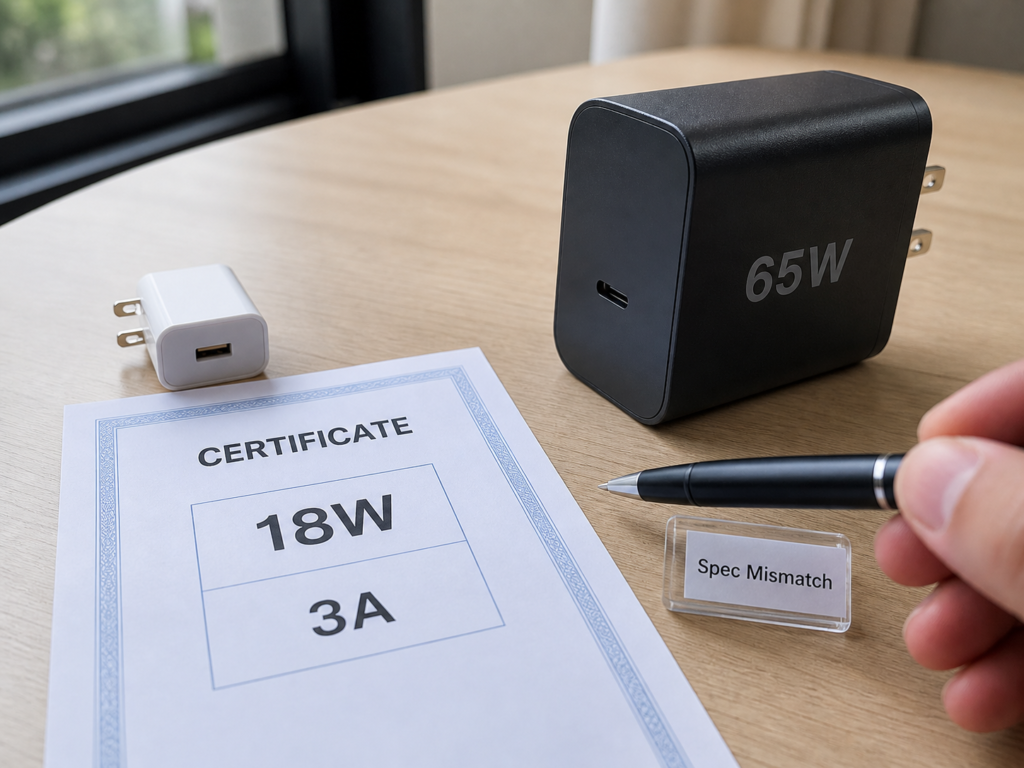
• **Scope mismatch**: The certificate does not clearly cover the model, structure, accessories, or production location of the product you are purchasing. If the production factory is inconsistent with that in the document, further verification is also required;
• **Component mismatch**: Using certification for internal parts to impersonate whole-machine or whole-cable certification. For example, using the UL certification of the transformer inside a charger to claim that the entire charger has UL certification, or using the certification of a USB connector to claim that the entire cable has certification. Qualified parts do not equal a qualified whole product.
Unauthorized Qualification: The Issuing Body Is Not Qualified to Issue Certificates at All
This type of problem lies with the issuing body or the nature of the document. When judging, you cannot simply assume that “all CE certifications must be issued by a notified body”. First, confirm whether applicable regulations require the participation of a Notified Body (NB for short).
For the EU Low Voltage Directive (LVD) and Electromagnetic Compatibility Directive (EMC) applicable to many chargers, regulations allow manufacturers to complete self-assessment in accordance with the prescribed conformity assessment procedures, and prepare technical documents, test evidence, and an EU Declaration of Conformity. If specific regulations or product categories do require the participation of a notified body, you should verify the body’s NB number, as well as its scope of regulations, products, and conformity assessment in the EU NANDO database. An NB that only has a scope related to medical devices cannot complete the corresponding conformity assessment for power adapters based on that.
There are also bodies that only complete part of the test items – for example, only testing safety, not electromagnetic compatibility (EMC) – but issue a full compliance certificate. More commonly, factory management system certificates (such as ISO9001) are used to replace product safety certification. ISO9001 governs factory management processes, which is a completely different matter from whether a specific product complies with safety regulations.
Concept Confusion: Packaging Non-Certification as Official Certification
This type is a word game, and it does not necessarily involve forgery of the entire set of documents, but it may still be invalid in terms of compliance. For example, a declaration of conformity issued by the enterprise itself (such as CE DoC, FCC SDoC) is packaged as “authoritative third-party certification”, when in fact self-declaration and third-party certification are different compliance paths; or “product meets a certain standard” is promoted as “has obtained mandatory certification of a certain country”.
You should also be wary of old standards, expired documents, or transition policies being used out of context. After a standard is updated, there may be transition periods, coexistence periods, or arrangements for existing products to continue to apply. You cannot simply say that old standards will immediately become invalid; but you also cannot treat old documents as currently valid basis without verification.
For the UK market in particular, the relationship between CE and UKCA must be judged in combination with product category, applicable UK regulations, and current policies. The UK government currently continues to recognize the CE mark for many regulated products, and specific arrangements may vary by product category and transition policy. Therefore, a certificate stating UKCA and the product bearing the CE mark, or both marks appearing at the same time, cannot alone prove that the documents are contradictory; they must be verified in accordance with the specific regulations of the target market.
Beginner-Level Quick Identification: 4 Steps to Filter Out 80% of False Certifications
Beginners do not need to know too much professional knowledge. Just follow these 4 steps to filter out many low-level frauds, and the operation is very simple.
Step 1: Check for Low-Level Loopholes in Marks and Certificates
First look at the most obvious problems, where fake certificates almost always give themselves away:
• **Mark appearance**: Check the shape, proportion, readability, and size against official specifications. For example, the CE mark has specified geometric proportions and minimum size requirements. If the mark on a charger is skewed, blurry, or has obviously abnormal proportions, it can be first classified as high risk; but abnormal appearance can only be used as a warning, and fraud cannot be determined solely by color or printing effect;
• **Basic certificate information**: Check whether the document nature, responsible entity, product model, test basis, issuing body, and signing information are complete. The validity period must also be judged in combination with the specific system, and you cannot directly assume there is a problem just because the document does not have a unified expiration date;
• **Number and marking contradictions**: Check whether the number can be verified through the corresponding official or institutional channels, and whether the document type matches the product mark. For example, an FCC ID should be queryable in the relevant FCC database; if both CE and UKCA appear, or only one of them appears, this must also be judged in combination with the target region, product category, and current policy, and cannot be directly said to be contradictory.
Step 2: Verify the Match Between Product Parameters and Certification
Compare the parameters on the document with the product you want to purchase one by one, no mistakes allowed:
• If it is a charger or power adapter, verify the rated voltage, current, power, number of ports, plug specification, and output mode. For example, if the document describes a US-standard single-port 18W product, and you are buying a EU-standard dual-port 65W product, the supplier needs to prove the coverage scope of the document;
• If it is a USB-C or charging cable, verify the rated current, transmission rate, length, structure, and whether it has an E-Marker chip. For example, if you want a 5A, 10Gbps PD cable, and the document says it is a 3A, 480Mbps ordinary cable, it cannot be directly regarded as the same product;
• If purchasing multiple models at once, you cannot only look at whether they are listed one by one on the certificate. You should verify the model range, series definition, representative models, and allowed variants clearly listed in the document, and confirm with the certification body whether models not listed one by one fall within the coverage scope.
Step 3: Check for Contradictions in the Supplier’s Statements
When communicating with the supplier, ask a few more details to see if there are loopholes in their answers:
• Claims “full certification is complete” but refuses to provide the document number, query channel, or DoC for the corresponding market;
• Promises “guaranteed certification pass” and “guaranteed customs clearance”, but refuses to bear responsibility for returns, fines, and compensation caused by fraud, only saying “we have never had problems”;
• Claims “one certificate is valid globally” but cannot explain the specific compliance paths for different markets;
• Claims “one test is permanently valid”, or says all products must be retested immediately after a standard is updated. Document validity rules vary by system. You should verify the valid status, revocation status, applicable standards, and transition period of the specific certificate or authorization, and judge whether re-assessment is required based on change control requirements for the product or key components;
• Uses the claim that “the same model from the same factory has certification”, but cannot provide evidence that the manufacturer, production location, model, key components, and controlled production conditions of this supply are consistent with the assessed product.
Step 4: Use Price and Delivery Cycle for Auxiliary Judgment
Price and delivery cycle can be used as warning signals, but cannot be used as the sole basis for judgment. The cost and cycle of genuine compliance depend on product structure, test items, existing reports, conformity assessment path, laboratory, and target market. For some products, compliance documents can be completed using existing test data, series assessment, or manufacturer’s self-declaration, and the cycle may be significantly shorter than a full test.
Therefore, if a supplier’s quote is obviously abnormally low, or they claim to be able to obtain multi-country documents within a few days, this only indicates that further verification is needed, and it cannot be directly concluded that they are fake. Cross-confirmation should be carried out through the issuing body or regulatory database, test records, applicable regulations, and actual product sampling.
Semi-Proficient In-Depth Verification: Official Channels + Logical Judgment
If you have passed the previous 4 steps but are still not reassured, or if it is a large order or high-risk product, you can conduct in-depth verification to further confirm the authenticity and applicability of the documents.
Verification of Core Certificate Fields and Validity Judgment
First verify all core fields of the document: responsible entity, manufacturer and production factory, product model parameters, applicable regulations and standard versions, issuance date, valid status, test scope, and change instructions.
To judge whether a document is still applicable, you can remember 4 principles: the document issuer or relevant conformity assessment path meets the system requirements, the status of applicable standards and regulations is clear, the document covers the purchased product, and it has not been revoked, suspended, or exceeded its applicable scope.
Common risk situations include: changes in key product parameters or core components, changes in manufacturer or production location, updates to regulations or standards, suspension or revocation of certificates or authorizations, or the document has exceeded its specified valid status. However, changes in company name or address, or standard updates, do not necessarily automatically invalidate the document. These changes should be checked against the change control requirements of the issuing body and applicable regulations to confirm whether the document needs to be revised, re-assessed, or retested.
Official Free Query Channels for Mainstream Certifications
Query methods vary across different markets, product categories, and compliance paths. You cannot assume that each system has a unified database covering all products. Common practices include:
• **United States**: FCC IDs can be queried through the official FCC database; for third-party certification marks such as UL and ETL, you should check their certificates, models, and factory scope on the official website of the corresponding certification body. For products using FCC SDoC, you should focus on checking the responsible supplier, test basis, and conformity documents, rather than looking for a non-existent FCC ID;
• **European Union**: If specific regulations require the participation of a notified body, you can query on the official website of the issuing NB, and verify the NB number and its scope of regulations, products, and conformity assessment in the NANDO database. For products that allow manufacturer self-assessment, you should require the EU Declaration of Conformity, technical documents, and test evidence, and verify the responsible entity and product scope;
• **Asia-Pacific and other regions**: The query methods for Japan PSE, South Korea KC, Australia-New Zealand RCM, and UK UKCA depend on the specific product system and registration type. You should query public records of relevant competent authorities, registration systems, and accredited certification bodies; when there is no unified database, require the supplier to provide DoC, test reports, registration information, and responsible entity materials, and conduct cross-verification with relevant bodies;
• **Ecosystem certification**: Programs such as USB-IF and Apple MFi should be verified through the official channels of the corresponding association or program operator. They may involve compatibility, ecosystem access, or brand authorization, and should not be automatically equated with government-mandated market access certification.
Tips for Identifying Common Certification Borderline Practices
Some documents are not necessarily completely forged, but are borderline practices, and also require caution in terms of compliance:
• **Abuse of series certification**: The rules for series, family series, or model coverage are not unified. You should verify the model range, series definition, representative models, and allowed variants clearly listed in the certificate or report. Unlisted models cannot be automatically regarded as covered, but you also cannot directly judge non-compliance just because they are not listed one by one; you should confirm with the certification body;
• **Exaggerated self-declaration**: Referring to FCC SDoC as FCC ID certification, or referring to ordinary CE self-declaration as CE certification issued by an NB. The two have different responsible entities, document requirements, and compliance paths;
• **Passing old certificates off as new**: Using standards, documents, or test conclusions that are no longer applicable to the current product or market. During verification, check regulatory updates, transition periods, and whether the specific product can still use this basis;
• **Sample replacing mass-produced goods**: Differences between the submitted sample and the mass-produced product do not necessarily automatically invalidate the certification. The key depends on whether the difference affects conformity and whether it exceeds the change control requirements of the certification body. You should verify whether the mass-produced product falls within the structure, length, material, rated value, and variant ranges specified by the test sample and document.
Key Points for High-Risk Inspection of Segmented Products
Different charging products have different high-risk points, and targeted inspections can be carried out:
• **Chargers and power adapters**: Focus on verifying the test conditions for simultaneous multi-port output, fast charging protocol coverage, rated input and output parameters, as well as the structure and applicable scope of different plug versions. US-standard, EU-standard, and UK-standard plugs have different structures, and documents cannot be directly interchanged just because the circuits are similar;
• **USB-C and charging cables**: Focus on verifying whether the document covers the entire cable, or only covers connectors, terminals, or a certain component; also check whether the E-Marker chip, conductor structure, wire diameter, length, and rated value are consistent with the test sample. There is no fixed conversion rule applicable to all products between cable length, conductor cross-sectional area, and rated current; the specific test configuration and certification scope shall prevail;
• **Charging products with wireless functions**: For example, wireless chargers, you need to verify the regulations and test requirements corresponding to the wireless function. Wired and wireless parts may apply different compliance paths, and wired test data cannot automatically replace the relevant requirements for wireless functions.
Full-Process Prevention: Implementation Methods from Supplier Selection to Listing
Identifying false certification is only the first step. More importantly, prevention should be done well throughout the entire process from procurement to listing to block risks in advance.
Pre-Procurement: Clarify Requirements and Screen Reliable Suppliers
First, you must understand the requirements of the target market, distinguish between mandatory regulations, third-party voluntary certification, platform requirements, and ecosystem compatibility requirements, and implement them into specific product categories, responsible entities, and regulation versions. Do not use vague expressions like “must have European certification”.
In the procurement requirements, you should clearly require the supplier to explain the applicable EU regulations and harmonized standards, and provide a signed EU Declaration of Conformity, technical or test evidence, as well as NB information when regulations do require third-party participation. Do not generally write “CE-LVD/EMC/RoHS certification” as a unified certificate that must be issued by an NB, because the compliance paths for LVD, EMC, and RoHS are not exactly the same, and many chargers can have the prescribed self-conformity assessment completed by the manufacturer.
Before cooperation, ask the supplier to provide the document number, query channel, and responsible entity information. Verify the authenticity before discussing price and delivery time. Do not wait until the goods are produced to find that there are problems with the materials. Merchant levels, “power merchant” badges, or similar compliance marks on platforms can at most be used as initial screening information for suppliers, and cannot replace independent verification of specific products, manufacturers, DoCs, test data, and mass production consistency.
Mid-Procurement: Contract Constraints and Sample Verification
When signing the contract, be sure to add a **certification authenticity clause**, which clearly stipulates: if the documents are fraudulent, the product exceeds the compliance scope or does not meet the requirements of the target market, resulting in losses such as returns, fines, platform penalties, and customer compensation, the supplier shall bear corresponding responsibilities; it should also be stipulated that if the supplier replaces key materials, modifies product design, changes the manufacturer or production factory, it must notify in advance, and complete change assessment or re-provide valid documents in accordance with applicable regulations and certification body rules, otherwise it will be considered a breach of contract.
Be sure to request certified samples, and compare the parameters, nameplate marks, and structure of the samples with the descriptions on the certificate one by one to ensure that the samples fall within the scope clearly covered by the document. If series products are involved, you should confirm the series definition, representative models, and allowed variants, rather than just looking at whether the product appearance is the same.
For large orders, you can entrust a third-party organization to conduct sampling testing of key items, such as safety and EMC. Spending a small amount of money can save a lot. All compliance documents, communication records, sample photos, and change confirmations should be kept well, which can be used as a basis for accountability and rectification if problems arise later.
Post-Procurement: Bulk Goods Sampling Inspection and Standardized Customs Clearance
When bulk goods arrive, be sure to conduct sampling inspection. For example, take a few boxes to verify whether the product nameplate, certification mark, model, parameters, manufacturer, and production location are consistent with the documents. Do not find out something is wrong after receiving all the goods. The batch itself does not necessarily require a separate certificate, but mass-produced products must be consistent with the assessed design and controlled production requirements.

During customs clearance, use genuine documents that you have verified yourself, and do not directly use unverified materials from the supplier. For high-risk batches, such as suppliers cooperating for the first time, orders with high value, or products with design changes, the sampling ratio should be increased, focusing on verifying the match between parameters and compliance scope.
After Listing: Monitor Valid Status and Standardize File Management
Before uploading documents to the platform, verify their current valid status and product match again. Use high-definition documents with complete numbers and signing information, and do not use blurry screenshots. Documents of different systems may have different validity rules, so specific revocation, suspension, renewal, and change requirements should be recorded.
Establish a reminder mechanism, and contact the supplier in advance to confirm regulatory changes, document updates, and product changes. The specific advance time should be arranged according to market requirements and document rules. Regularly review the document status, and pay attention to regulatory updates, market regulatory notices, and recall announcements in the target market.
Establish independent compliance files for different markets, recording document versions, verification time, product models, manufacturers, production locations, change records, and query results, for easy subsequent search and update.
Pitfall Avoidance and Remediation: Common Misconceptions and Emergency Handling
6 Cognitive Misconceptions Beginners Are Most Likely to Fall For
Many people fall into the false certification pit not because they cannot identify it, but because their cognition is wrong first:
1. **Having a certificate means real certification**: Documents may be forged, misappropriated, or used beyond their scope. You must verify the document nature, issuer or responsible entity, applicability, and product match;
2. **All certificates issued by third-party bodies are valid**: If a regulation clearly requires the participation of a notified body, you must verify the NB number and scope; if the regulation allows manufacturer self-assessment, you should verify the manufacturer’s DoC, technical documents, and test evidence. You cannot use “whether there is an NB number” as the sole criterion for CE validity;
3. **Certification is the supplier’s responsibility, and procurement does not need to worry about it**: Customs clearance, platform penalties, and product safety responsibilities often fall on importers, brand owners, or sellers. The supplier can at worst block you and run away, so you must control it yourself;
4. **Charging cables and data cables do not need compliance documents at all**: Whether cables require mandatory compliance documents should be judged item by item according to the target market, specific cable category, rated value, and sales method, which may involve safety, EMC, environmental protection, labeling, or registration requirements. If USB-IF certification is a compatibility or ecosystem requirement, it should also be distinguished from government regulatory requirements;
5. **If others can sell the same model, so can I**: Focus on verifying the manufacturer, production location, model, key components, and change control scope. The batch itself does not necessarily require a separate certificate, but mass-produced products must be consistent with the assessed design and controlled production requirements;
6. **It’s okay to ship first and make up the certificate later**: Selling without a certificate or with incomplete documents may face removal from shelves, fines, returns, or recalls. Liability for safety accidents will not automatically disappear just because documents are supplemented afterwards.
In Case of False Certification: 5-Step Emergency Handling
If you do find problems with certification or compliance documents, don’t panic. Follow these 5 steps to minimize losses as much as possible:
1. **Suspend and isolate**: Immediately suspend the use of problematic documents for customs clearance, listing, and sales, isolate inventory and in-transit goods, to prevent problematic goods from flowing into the market and expanding losses;
2. **Recheck and characterize**: Re-verify through official channels or the document issuer to determine whether it is a document error, insufficient scope, unreported change, or deliberate forgery. Different problems have different handling methods;
3. **Contact the supplier**: Feedback the problem to the supplier, and require them to provide genuine and valid documents or solutions within a time limit, such as return, refund, re-assessment, or compensation;
4. **Handle in accordance with the law**: Immediately stop sales and circulation and preserve evidence. In accordance with the regulations of the target market, contact the importer, platform, customs or competent authority, as well as professional compliance or legal counsel, and implement notification, recall, return, or destruction procedures as required. Do not simply interpret proactive explanation of the situation as inevitable lenient treatment, nor make unnecessary responsibility commitments before clarifying the facts and responsibilities;
5. **Pursue responsibility and file for record**: Pursue the supplier’s responsibility in accordance with the contract, include them in the risk list, and increase the verification level for subsequent cooperation, such as batch sampling, requiring a deposit, or re-auditing the manufacturer and production location.
Practical Checklists and Capability Summary
3 Practical Checklists for Beginners
For daily use, 3 sets of beginner-level checklists are organized, just follow them directly:
• **When receiving supplier documents**: Confirm document nature → check issuer or responsible entity → check number and public record queryability → check product parameters and applicable scope → check valid status;
• **Before listing or shipping**: Check that product marks are consistent with compliance documents → check that publicity does not exaggerate certification → check that model, manufacturer, production location, and key parameters correspond;
• **During initial supplier screening**: Ask about document query channels → ask about applicable regulations and coverage scope → ask about rules for material replacement, factory replacement, and design changes → ask about responsibility for fraud and compliance invalidation.
Capabilities You Can Master After Learning
After reading this guide, you should be able to master these core capabilities: use the 4-step quick method to investigate traces of false certification in charging products; select appropriate official or institutional verification channels according to the target market and product category; distinguish between manufacturer’s declarations of conformity, test reports, third-party certification, and conformity assessment with notified body participation; implement false certification prevention measures throughout the procurement process; identify common certification borderline practices and handle problems step by step; adjust inspection priorities for different products such as chargers and USB-C cables.
Overall, false certification may seem to have many tricks and deep waters, but as long as you don’t covet small bargains and don’t find it troublesome, verifying the document nature, applicable scope, and product consistency step by step from supplier selection to listing, you can avoid the vast majority of pitfalls. After all, the loss from a single goods detention, recall, or store removal is usually much more than the time and money you spend on verifying compliance materials.