
Many small and medium-sized sellers who export charging cables and chargers for the first time often have questions like: I’m only sending a few dozen pieces for trial sales, do I still need to comply with regulations? The supplier gave me a bunch of certificates, so am I all set? Why was my product removed from the platform even after it cleared customs? These questions essentially stem from a lack of understanding of global market compliance rules—and charging products, because they are electrical and involve interface standards, are exactly the category where compliance pitfalls occur frequently.
Entry-Level Understanding: Basic Boundaries and Core Concepts of Compliance
Before we officially start, let’s clarify the boundaries of this guide to avoid wasting your time: it is suitable for small and medium-sized sellers, foreign traders, and small factories that export charging products for the first time or in small batches. The covered products include charging cables, USB/USB-C data cables, chargers, power adapters, and interface connectors; it does not involve products with special regulations such as medical devices, automotive electronics, and toys, nor is it used for large enterprises to build a complete compliance system. 70% of the content is basic knowledge that beginners must understand, and 30% is advanced methods to help you control costs and avoid pitfalls. None of the content can replace professional legal or certification services, and you should still consult a professional institution for complex problems.
Plain Language Definition of Global Market Regulations
Many people think that “compliance” is just getting a few certificates, but it’s not that complicated: global market regulations, to put it bluntly, are the local mandatory rules that your products must comply with to be sold commercially legally in a certain country or region, plus additional requirements from e-commerce platforms and industry associations.
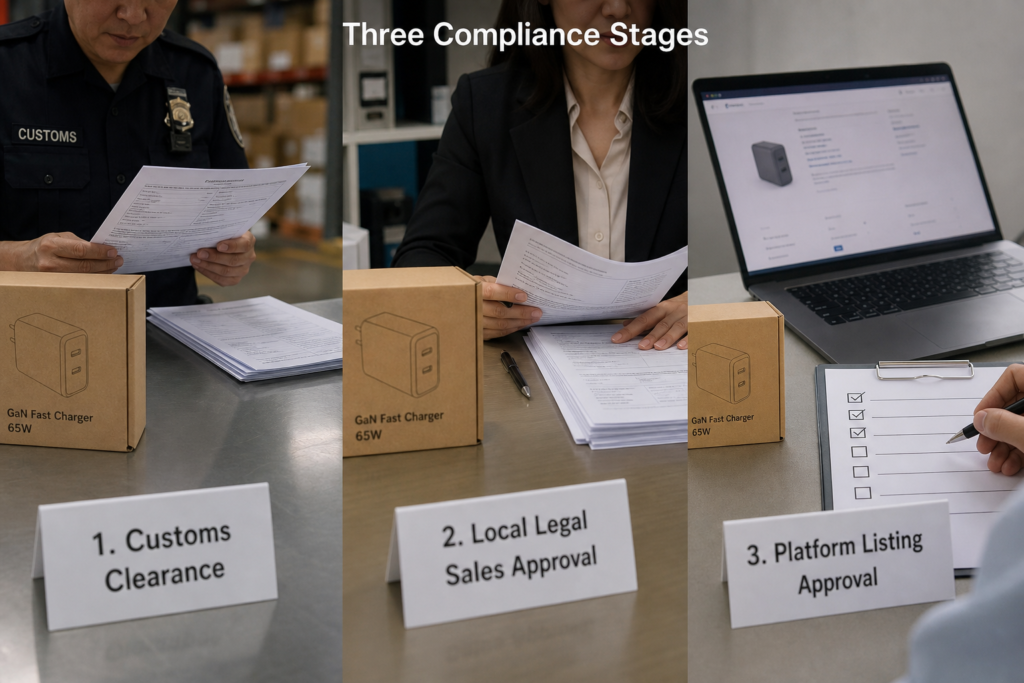
There is a very important distinction here that 90% of beginners have fallen for: **Customs clearance ≠ Legal sales ≠ Eligible for platform listing**. Customs only checks the documents required for customs clearance. Passing customs does not mean you can sell locally legally; even if you can sell in local physical stores, it does not mean you can list on mainstream e-commerce platforms—the requirements of the three links may be completely different. Don’t think that everything is fine after passing one level.
From the perspective of regulatory direction, charging products most often encounter six types of requirements: electrical safety, electromagnetic compatibility, environmental protection, energy efficiency, labeling, and intellectual property. We will break them down one by one later.
Plain Language Distinction of Core Concepts (Avoid Confusion)
People who are new to compliance are often confused by a bunch of terms: regulations, standards, test reports, certification certificates, DoC, marks… In fact, it’s very simple to distinguish them in plain language:
• **Regulations/Standards**: Regulations are mandatory requirements set by the government, such as “chargers sold in the EU must be safe”; standards are technical specifications used to prove that the technical requirements of regulations are met, telling you how to evaluate whether a product reaches the corresponding safety level. For example, the use of relevant harmonized standards usually gives rise to a presumption of conformity, but all conformity assessments required by applicable regulations still need to be completed, and it cannot be simply understood as “passing a standard test automatically meets all regulations.”
• **Test Reports/Certification Certificates**: A test report is the result of a single test conducted by a laboratory on the sample you submitted, mainly reflecting the test performance of the sample in relevant items; a certification certificate is a conformity proof issued by a certification body in accordance with a specific certification scheme. Whether certification includes factory audit, system audit or continuous supervision depends on the specific certification scheme, and cannot be generalized.
• **Declaration of Conformity (DoC)**: It is a document issued by the enterprise itself, promising that the product complies with relevant regulations, and must be based on applicable conformity assessment and technical documents. Test reports are common evidence, but not all products or all regulations mandate independent third-party test reports. It is not a randomly written guarantee; writing it randomly will instead increase liability.
• **Certification Marks/Compliance Documents**: Marks are symbols printed on products and packaging (such as CE, PSE), but they can only be used when required by applicable regulations, or when the product has indeed completed the corresponding authorization, certification and meets the conditions for using the mark. A mark is not an independent compliance certificate; it should be supported by corresponding reports, certificates or technical documents. Printing marks randomly is a violation and will result in heavier penalties.
Common Division of Compliance Responsibilities
After understanding the concepts, you also need to know who is responsible for compliance, so that you don’t find out you can’t shift the blame when something goes wrong:
• **Manufacturer/Brand Owner**: Is the first responsible party for compliance, responsible for product design, production, and compliance declarations. You can’t say “the supplier said they have certificates so I don’t care”. If something goes wrong, the regulator and the platform will first look for the brand owner.
• **Importer/Local Responsible Person**: Manufacturers, importers, authorized representatives and fulfillment service providers each assume the obligations stipulated by applicable regulations. For example, when selling certain products subject to relevant market surveillance regulations in the EU, it is necessary to confirm whether there is a required EU economic operator, and keep documents and cooperate with supervision in accordance with regulations; the specific obligations of the EU responsible person also depend on applicable regulations, and cannot be generally understood as bearing “joint and several liability” for all problems.
• **E-commerce Platform**: Equivalent to a “goalkeeper”, it will review settlement qualifications and conduct irregular spot checks on compliance. Once a violation is found, it can directly remove listings, deduct points, even close stores and freeze funds. The platform will not bear responsibility for sellers.
• **Freight Forwarder/Logistics Provider**: Usually only handles transportation, customs declaration or customs clearance procedures, and does not replace the manufacturer to assume product conformity responsibility; but under specific laws, customs agency relationships or contracts, freight forwarders, carriers or customs declaration agents may still bear corresponding customs agency, transportation or contractual obligations. Don’t believe the saying that “guaranteed customs clearance equals compliance”. If the goods are detained, you still have to bear the loss yourself.
3 Most Common Cognitive Misconceptions for Beginners
New sellers are most likely to fall into these three cognitive pitfalls. Avoiding them in advance can save you tens of thousands:
1. **Small batch/trial sales do not need compliance**: Wrong. Small batches, trial sales or low value usually do not automatically exempt from product regulatory obligations; whether there are exemptions for samples, exhibits, R&D, professional use or specific product scopes must be confirmed item by item according to the target market and specific regulations. Even if you only send 10 pieces, you cannot judge that requirements are exempted solely based on quantity.
2. **I am not responsible if the supplier has certificates**: Wrong. Even if the certificate is real, it must match the product model and target market. For example, the US UL report given by the supplier is useless for selling in the EU. Moreover, the brand owner is the first responsible party, and the supplier’s certificate cannot exempt you from liability.
3. **Affixing a certification mark counts as compliance**: Wrong. The mark is the result after the compliance assessment is completed, not a “pass”. A mark without support of real reports, certificates or technical documents is false publicity, and will result in heavier penalties instead.
Real Consequences of Non-Compliance
Some people may think “it’s fine if I don’t get caught”, but charging products are a key regulatory focus, and the cost of non-compliance is often much higher than the cost of compliance:
• **Customs Side**: Goods detention, return, destruction, and you have to bear additional storage and logistics costs. You lose money before the goods are sold.
• **Platform Side**: Listing removal, store point deduction, account suspension, fund freezing, all early operation investment goes to waste.
• **Market Side**: Consumer or competitor complaints, fines, product recalls, and in serious cases, you may be permanently banned from entering the market.
• **Special Risk**: California Prop 65 in the US is not simply “a warning must be provided if the product concentration exceeds the threshold”. If the product exposes consumers or occupational personnel to chemicals listed under California Prop 65, and the exposure exceeds the applicable safe harbor level, or it cannot be proven that the situation does not require a warning, a compliance warning may be required. Violations may lead to enforcement, private litigation and settlement costs, the amount of which depends on the specific chemical, exposure route and case facts.
Core Regulatory Dimensions: 6 Types of High-Frequency Requirements That Charging Product Sellers Must Understand
The regulatory logic of countries around the world is similar, with 6 core types of requirements, only differing in strictness. These are the compliance foundation for all markets.
Electrical Safety Requirements (Anti-Electric Shock/Fire, Most Frequent)
The core goal is simple: the product must not harm users during normal use, even in the event of a single fault (such as a short circuit).
Different products have different inspection focuses: for chargers and adapters, the focus is on insulation performance, over-temperature protection, and power authenticity. It cannot be labeled 65W but actually only 30W; for charging cables, the focus is on wire diameter, rated current, voltage, temperature rise, insulation and sheath material, etc., to avoid abnormal heating or mechanical and electrical failure during use.
The applicable boundaries also differ: chargers and adapters are directly connected to the mains, and usually need to be evaluated in accordance with the safety standards for power supplies or information and communication technology equipment applicable to the target market; ordinary cables should select applicable standards according to their structure, rating, whether they contain chips, and target market requirements, and cannot judge whether the requirements are stricter solely based on current magnitude.
IEC/EN/UL 62368-1 only applies to equipment within its product scope, and is not a unified mandatory safety standard for all charging products in the world. Chargers and external power supplies may apply this standard or its regional versions, but ordinary passive charging cables are not generally subject to IEC 62368-1. The actual situation shall be subject to the target market and product classification.
Electromagnetic Compatibility (EMC) Requirements (Do Not Interfere with Other Devices)
Electromagnetic compatibility is often called EMC in the industry. To put it bluntly, there are two requirements: the product must not interfere with surrounding electronic devices when working (for example, it cannot cause the router to lag when charging a mobile phone), and at the same time it can withstand basic daily interference and will not stop working as soon as it is interfered with.
Among charging products, the switching power supply of chargers is most prone to excessive radiation and conduction interference; fast charging cables with chips and wireless chargers also require additional evaluation due to electronic components. Ordinary charging cables with pure passive transmission (no chips) usually do not have independent mandatory EMC requirements, but may still be subject to interface, electrical safety, material or other applicable rules.
In addition to EMC, wireless charging products should also be evaluated for their radio spectrum, radio frequency exposure and communication function requirements. Whether radio equipment certification or additional RF testing is required must be confirmed according to the target market, operating frequency, transmission power and specific technical parameters, and it cannot be generally asserted that all wireless chargers require radio equipment certification.
Environmental and Chemical Substance Requirements
The core goal is to restrict harmful substances in products and standardize the recycling of electronic waste.
There are two most common types for charging products: one is RoHS, which restricts the content of controlled harmful substances in products; the other is California Prop 65 in the US, which requires evaluating whether a warning is needed based on listed chemicals, exposure routes and safe harbor levels.
Taking EU RoHS as an example, 10 substances are currently restricted: lead, mercury, cadmium, hexavalent chromium, PBB, PBDE, and four phthalates: DEHP, BBP, DBP, DIBP. The RoHS systems and restricted lists of different countries or regions may be different, and you cannot directly apply the list of one region to the global market.
There is a very easy pitfall here: the RoHS limit is calculated by **homogeneous material** (the smallest unit that can be split), not the average of the whole machine. For example, the lead content of the PVC sheath of the wire must not exceed the standard when tested separately, not that the average of the entire wire after being shredded meets the standard.
RoHS and Prop 65 are two different systems. Lead or restricted phthalates in PVC sheaths may cause non-compliance with RoHS homogeneous material limits; but whether it triggers a Prop 65 warning requires separate evaluation of the exposure, use and safe harbor level of the listed substances. A violation of RoHS for a certain substance does not automatically prove a violation of Prop 65.
In addition, EU REACH has supply chain information obligations for substances of very high concern (SVHC) on the candidate list. If an article contains SVHC on the candidate list with a concentration exceeding 0.1%, usually at least the information transmission obligation under Article 33 of REACH must be fulfilled; whether it is also necessary to submit a notification under Article 7(2) to ECHA requires further verification of annual import volume, use and other exemption conditions, and you cannot directly assume that it is not involved just because the batch is small.
Energy Efficiency Requirements (Exclusive High-Frequency for Chargers/Adapters)
Energy efficiency requirements basically only apply to chargers and power adapters, and there are no relevant requirements for pure cables. The core goal is to reduce standby/no-load power consumption and improve energy utilization efficiency.
Focus on two indicators: no-load power consumption (power consumption when plugged in but not connected to a device), conversion efficiency (the ratio of mains power to charging power). Products of different power levels have different requirements.
Common corresponding regulations include the US DOE Level VI energy efficiency and the EU ErP Ecodesign Regulation. Some markets also require energy labels to be affixed. Whether it is specifically applicable shall be confirmed in combination with product type, output power and target market rules.
Labeling and Instruction Manual Requirements
The core requirement is to label key information in the local language to protect consumers’ right to know.
The content that must be labeled depends on the target market and product regulations. Usually, attention should be paid to: rated input and output parameters, product model, manufacturer or importer information, necessary safety warnings, and traceability information required by regulations. Only when required by applicable regulations, or when the product has indeed completed the corresponding authorization, certification and meets the use conditions, can the corresponding compliance mark be affixed.
Common pitfalls include: compliance mark size, position or use conditions do not meet requirements, lack of local language warnings, and false parameter labeling. There are also some special labels, such as the EU WEEE recycling mark (crossed-out trash can); if the product contains a battery, you also need to confirm the battery label according to applicable rules. You cannot directly take the mark requirements of one market as the general requirements of all countries.
Interface and Protocol Compliance (Exclusive for USB-C Products)
This category is not a government mandatory requirement, but it is generally required by mainstream e-commerce platforms. Sellers of USB-C products must pay attention.
The trademark and protocol specifications of the USB interface are managed by the USB-IF Association. If you use the official USB logo on the product, packaging, or detail page, or advertise support for USB PD/fast charging functions, you must comply with the association’s specifications, otherwise you may be complained and removed from the shelf.
Common pitfalls: printing the USB logo without authorization, falsely labeling PD power. In addition, compatibility issues with fast charging protocols (such as QC, PD) may cause safety risks (such as damaging the device being charged). It is recommended to conduct corresponding compatibility and performance tests according to the actual functions of the product.
Quick Check of Access Requirements for Core Global Markets (Exclusive for Charging Products)
Different markets have their own characteristics of access rules. I have sorted out the requirements of several core markets where charging products are most often exported for your quick comparison:
| Target Market | Core Access Mark | Core Mandatory Requirements for Charging Products | Common Pitfalls |
| EU/EEA | CE mark (whether self-declaration by the enterprise is allowed depends on applicable regulations and assessment procedures) | The applicability of LVD, EMC, RoHS and ErP shall be judged item by item according to product scope, input voltage, function and specific ecodesign measures; the unified USB-C charging requirement applies to relevant portable radio equipment listed within the scope of RED from December 28, 2024, and applies to laptop computers from April 28, 2026 | Failure to retain technical files (TCF), non-compliant use or size of CE mark |
| United States | No unified mandatory safety mark; some equipment is subject to FCC SDoC or FCC Certification | FCC Part 15 (electromagnetic compatibility), DOE Level VI energy efficiency; California Prop 65; mainstream platforms may require safety documents recognized by NRTLs such as UL and ETL | Confusing the responsibilities of FCC and UL, thinking that FCC is in charge of product safety |
| United Kingdom | UKCA or CE when conditions are met, depending on product category and latest regulations | The regulatory foundation is similar to the EU but updated independently; Northern Ireland still uses CE in accordance with relevant Northern Ireland market rules, and CE+UKNI may be used when a notified body is involved | Failure to check the current CE recognition conditions for specific product categories in the GB market, or incorrect use of UKCA/CE marks |
| Japan | PSE mark (diamond/circle, judged by specific product classification) | Products such as AC adapters that meet the regulations may be classified as specified electrical appliances and require diamond PSE, and other applicable electrical appliances may use circular PSE; ordinary USB cables need to first confirm whether they are subject to PSE regulation; VCCI is generally a voluntary EMC mark | Failure to check the specific PSE classification, documents and procedures, or mistaking platform requirements for unified mandatory requirements |
| Southeast Asia (Thailand/Malaysia/Vietnam) | Each country adopts different certification or registration requirements according to product classification | Thailand, Malaysia and Vietnam shall be confirmed respectively according to product classification, rated parameters and requirements of local competent authorities; CB reports can reduce repeated testing in some countries and projects, but cannot be automatically converted into national certifications, and local applications, difference assessments and labeling procedures still need to be completed | Mistaking that all ASEAN countries have exactly the same compliance requirements, or thinking that CB reports can directly replace local certifications |
Quick Judgment Logic for Other Markets (Semi-Proficient)
If you want to enter other markets such as South Korea, Australia and New Zealand, Canada, Saudi Arabia, etc., you don’t need to memorize them by rote. You can quickly judge according to the three-step logic:
1. **Look at product attributes**: Electrical products require safety requirements, products with wireless functions require evaluation of spectrum, radio frequency exposure and communication-related requirements, and external power supplies require additional energy efficiency requirements.
2. **Check CB mutual recognition**: Confirm whether the target market accepts CB reports (IEC mutual recognition system). If accepted, repeated testing may be reduced, but usually local application, difference assessment, registration or labeling procedures are still required.
3. **Confirm local requirements**: Whether a local representative, local registration or local language label is required.
Certification references for common markets: South Korea KC, Australia and New Zealand RCM, Canada ISED/CSA, Saudi Arabia SASO. You can check the specific requirements when actually entering.
Entry-Level Practical Operation: 5-Step Process to Build Compliance from Scratch
After talking about so many requirements, some people may feel overwhelmed: for the first time, where should I start? Follow these 5 steps, and you can get the basic compliance right.
Step 1: Sort Out Products and Sales Scenarios
First, figure out your own situation, don’t just go to a certification agency and ask “how much does a certification cost”—the requirements for different products vary a lot.
First, list the product details clearly: is it a charging cable or a charger? What is the power? What interface? Does it have a chip/wireless function? What is the specific model? For example, a charger with wireless charging has more spectrum, radio frequency exposure or communication evaluations than an ordinary charger, and the cost difference is quite large.
Then confirm the sales channel: is it an e-commerce platform, an independent website, or offline wholesale? You should know that platform requirements may be stricter than local regulations. For example, there is no unified mandatory safety certification mark at the US federal level, but some platforms or categories may require safety documents such as UL and ETL.
Then confirm the target market: prioritize 1-2 markets with the highest sales volume. Don’t spread to the whole world at the beginning, the compliance cost will be very high. Expand after the business is established.
**Checkpoint**: For products sold in sets (such as charger + charging cable), each component must be judged separately and meet applicable requirements, and only the whole machine certification is not enough.
Step 2: Quickly Confirm the Specific Requirements of the Target Market
Figure out the real requirements of the target market. Don’t do what others say, verify it yourself.
The most reliable are official channels: for example, the EU EUR-Lex official website and the US FCC official website have special product compliance guides, and you can understand the core requirements with translation tools.
If you find the official content too complicated, you can consult a regular certification service provider, but be sure to ask the other party to provide clear regulatory basis, not just say “you have to do this”.
You can also refer to the detail pages and packaging certification labels of top sellers in the same category, but you can only refer to them and not copy them—their product models and configurations may be different from yours.
**Checkpoint**: Distinguish between mandatory regulations and voluntary/platform requirements. Prioritize meeting mandatory items, and then do voluntary items according to budget and channel needs.
Step 3: Prepare Samples and Testing & Certification
There are several key points in the process of sending samples for testing and certification that can help you avoid detours:
First, **the sample must be exactly the same as the mass-produced goods**. Don’t use good materials and sufficient wire diameter for testing, but cut corners on mass-produced goods. In that case, the report you get cannot prove that the mass-produced goods are compliant, and you will still be held responsible if found out.
Then, confirm the specific regulations and conformity assessment modules first, then choose a laboratory. When doing the EU market, only for projects that require the participation of a third-party notified body (NB) as required by regulations, you need to select the corresponding EU notified body (NB); for projects that allow manufacturer self-declaration, you can use a laboratory with corresponding capabilities, or the manufacturer can complete applicable tests and technical assessments. You cannot conclude that a laboratory’s report is invalid just because it is not an NB.
Also, choose the right certification path: for projects that can be self-declared (such as CE, FCC SDoC), technical documents, test records and declarations should be prepared in accordance with applicable regulations, and there is no need to additionally purchase so-called “certificates”. For products using the FCC SDoC path, a Supplier’s Declaration of Conformity signed by the responsible party and test records should be prepared; only equipment subject to the FCC Certification path needs to prepare the FCC Grant of Certification.
**Checkpoint**: After getting the report, certificate or declaration, be sure to check whether the product model, parameters, and appearance are consistent with the actually sold product. Even a difference of one letter may require re-evaluation.
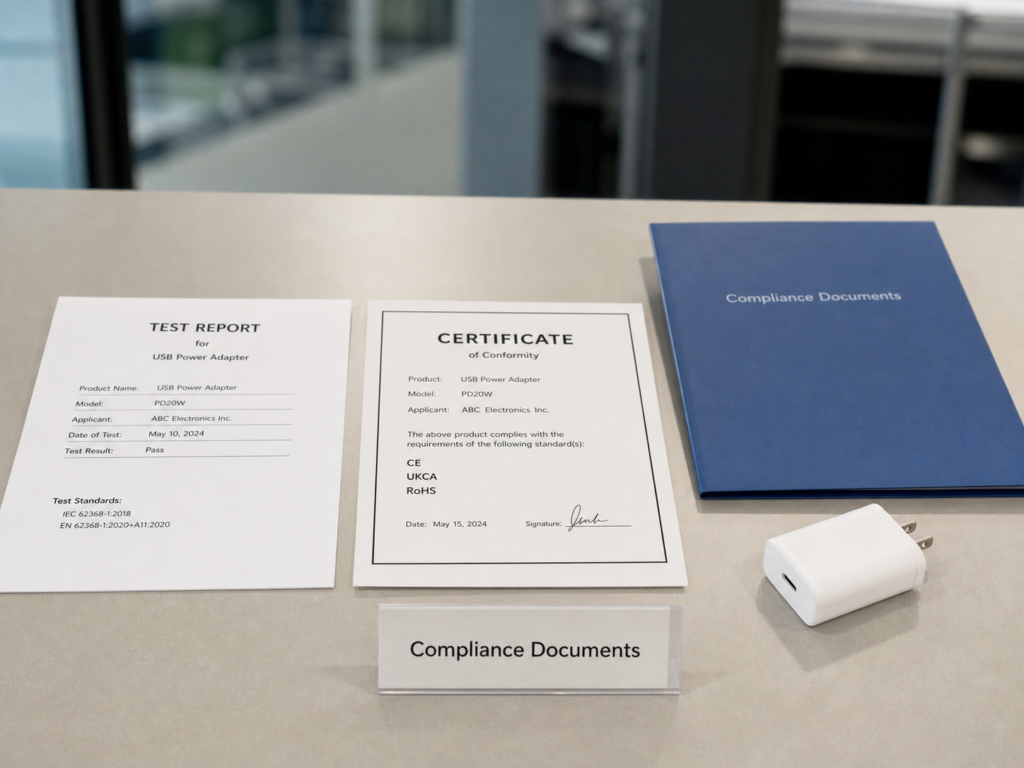
Step 4: Organize the Necessary Compliance Document Package
Organize all compliance documents into a unified document package. Don’t put them here and there, it will be troublesome if you can’t find them during spot checks.
Documents are mainly divided into four categories:
1. **Test Report Category**: Third-party test reports for safety, EMC, RoHS, energy efficiency, etc. It is necessary to confirm that the institution’s capabilities and report scope match the target market requirements.
2. **Certification/Declaration Category**: Declaration of Conformity (DoC), Supplier’s Declaration of Conformity, FCC Grant of Certification when applicable, PSE documents, etc.
3. **Labeling Document Category**: Product labels, packaging, local language instruction manuals, warning label design drafts.
4. **Supply Chain Document Category**: Raw material compliance reports from upstream suppliers, such as wire RoHS reports and plastic flame retardant reports.
**Storage Requirements**: For applicable EU product regulations, technical files and DoC are usually kept for at least 10 years from the date the product is placed on the market. The storage period, responsible party and starting point for other markets must be confirmed according to specific regulations, and cannot be generalized as several years after sales stop. It is recommended to create separate folders by market, and store both electronic and paper copies for easy access at any time.
Step 5: Final Check Before Launch
Do a final round of checks before listing and shipping. Don’t do all the previous work well but fail on small details in the end:
• **Product Side**: Check that the size, position, and durability of compliance marks (cannot be wiped off easily), and parameter labeling are true and not falsely labeled.
• **Sales Side**: The power, functions, and certifications advertised on the detail page and packaging are completely consistent with the actual product.
• **Channel Side**: Upload the compliance documents required by the platform in advance, and list only after passing the review. Don’t list first and then make up.
**Checkpoint**: All components of the set product meet the requirements, and the packaging model is completely consistent with the certificate.
Semi-Proficient Advanced: Cost Control and Supply Chain Compliance
After you get the basic compliance right, you may wonder: can I spend less money? How to ensure that the supplier’s goods are always compliant? This part of advanced content helps you control costs and manage the supply chain well.
Compliance Cost Estimation Method for Charging Products
Compliance costs are mainly composed of three parts: testing fee + certificate fee + annual review fee, among which the annual review fee is only required for some certifications, not all.
Whether ordinary USB-C cables require CE depends on whether they fall within the scope of a certain CE regulation; RoHS also needs to be judged in combination with whether the product is electrical and electronic equipment, the applicable market and supply chain evidence. Therefore, the cost cannot be summarized by a fixed range. The cost should be estimated based on the target market, regulatory scope, cable structure, number of models, test items and laboratory quotations. Chargers usually have higher fees because there are more test items, depending on product complexity and laboratory qualifications.
There are two legal ways to save money: one is **series evaluation for products of the same series**, but whether series products can share tests or reports must be evaluated in writing by the laboratory based on the consistency of design, key components, materials, wire length, interface and rated parameters; the other is **using CB reports as application materials for some markets**, but CB reports cannot be automatically converted into national certifications, and still need to meet local requirements.

Pitfall reminder: Don’t be greedy for cheap and choose small laboratories without qualifications. Invalid reports are a waste of money, and the loss of detained goods is even greater.
Method for Judging the Authenticity of Supplier Compliance Documents
Many sellers have received fake supplier certificates. Here are three tricks to quickly verify:
1. **Check Filing**: Formal certification or regulatory documents usually have corresponding query entrances. For example, equipment subject to the FCC Certification path can query FCC Grant information; PSE-related documents should be verified according to the Japanese competent authority and specific product classification. Don’t treat all documents as “certificates” that can be queried in the same official database.
2. **Verify Consistency**: Even if the certificate is real, you must compare whether the product model, appearance, and parameters on the report, certificate or declaration are consistent with the actually purchased product—for example, the supplier gives a UL report for model A, but delivers model B goods, then the report is invalid for you.
3. **Identify Fake Features**: Those without the official seal of the testing institution, no official filing, and obvious inconsistency between product information and the report are most likely fake. However, whether it is valid should still be comprehensively judged in combination with the issuing institution, document type and applicable regulations.
If you are still not sure, you can ask the supplier to provide photos of the test sample corresponding to the report to check whether it is consistent with the mass-produced goods.
Contract Constraints for Supply Chain Compliance
It’s not enough to just check documents. You also need to write compliance requirements into the procurement contract and constrain suppliers with rules:
• Clearly specify the documents that the supplier needs to provide: test reports, certificates, raw material compliance declarations (such as RoHS), all must be written clearly, so that you don’t get them when you need them.
• Agree on change notification: Changes to key components (capacitors, chips, wires, transformers) require advance notice and re-evaluation of compliance. Materials cannot be secretly changed to reduce costs.
• Clarify the division of responsibilities: Agree on the proportion of losses caused by non-compliance, such as goods detention, fines, and recalls, that shall be borne by the supplier. The clearer the writing, the better, to avoid disputes when something goes wrong.
Pitfall reminder: Don’t purchase products that only label “international certification” but cannot provide specific reports, certificates or other verifiable documents. They are basically pitfalls.
Mass Production Consistency Control (Avoid Certification Invalidity)
Many people have done certification, but the mass-produced goods are different from the test samples, which means it’s all for nothing and the certification is directly invalid.
Key control points: core components (power IC, transformer, wire material, flame-retardant plastic) cannot be replaced at will. These are key components that affect safety, EMC and environmental protection.
Regular spot checks: For each batch of mass-produced goods, check whether the product labels, parameters, and key components are consistent with the certified samples. Don’t wait until something goes wrong to find out that the supplier has changed materials.
Change management: When product design, production factory, or key components change, it is necessary to evaluate whether re-testing is required. For example, if the power IC of the charger is changed, the EMC may not meet the standard. Don’t take it for granted that there is no problem.
The most common pitfall is that suppliers secretly replace inferior wires or chips to reduce costs, resulting in the original report not covering the actual product. The final responsibility is still borne by the brand owner, so you must keep an eye on the consistency of mass-produced goods.
High-Frequency Compliance Pitfalls and Risk Response
Even if you follow the steps, you may encounter some common pitfalls or unexpected problems. Here are the most frequent pitfalls and response logic for charging products, to help you avoid pitfalls in advance and stay calm when things happen.
3 Most Common Pitfalls for USB-C/Charging Cables
1. **Labeling Pitfall**: Using the official USB logo without USB-IF authorization and advertising USB PD functions, resulting in complaints and removal by the association—the USB logo is a registered trademark and cannot be used casually.
2. **Safety Pitfall**: Cables should meet their nominal current, voltage, temperature rise, insulation, durability and applicable interface specifications. For USB-C cables that exceed basic current capacity or require rated current identification, E-marker and related protocol requirements should also be evaluated. Overcurrent protection is usually implemented jointly by the power supply, device or system, and is not a unified mandatory configuration for all passive cables.
3. **Environmental Pitfall**: Lead or restricted phthalates in PVC sheaths may cause non-compliance with RoHS homogeneous material limits; whether it triggers a California Prop 65 warning requires separate evaluation of the exposure, use and safe harbor level of listed substances.
3 Most Common Pitfalls for Chargers/Power Adapters
1. **False Power Labeling**: The actual output power is lower than the labeled value, which does not meet the output requirements of safety standards and also constitutes false publicity.
2. **Insufficient Insulation**: The insulation distance between primary and secondary sides is insufficient, which is prone to electric leakage, and is a key rejection item in safety tests.
3. **Excessive Electromagnetic Interference**: Interfering with other electronic devices during operation, failing FCC or CE related EMC tests, which is the most common unqualified item for chargers.
Additional Compliance Requirements of Cross-Border E-Commerce Platforms
In addition to regulatory requirements, e-commerce platform rules are often stricter: for example, Amazon and other platforms may require UL, ETL or other designated safety compliance documents for specific charger, power supply or electrical categories; EU sites may also require CE-related documents and EU economic operator information. The specific documents, formats and applicable products will change with the site, category, product type and time, and must be subject to the current platform policies and review notifications.
Mainstream platforms have special compliance review entrances. You can upload corresponding documents by product category. You can find specific requirements directly in the seller backend by searching “compliance” or corresponding category requirements, no need to ask around.
Common pitfall: The certification advertised on the detail page is inconsistent with the actually uploaded documents, which is judged as a violation by the platform. Therefore, the publicity must be realistic.
Response Logic for Common Compliance Risks
Don’t panic when encountering compliance problems, just handle them according to this logic:
• **Platform Removal/Goods Detention**: First ask for the specific reason for the violation, and supplement materials or make rectifications accordingly. Don’t blindly add certifications, maybe it’s just a label problem.
• **Regulatory Updates**: Pay attention to regulatory revisions in the target market 6-12 months in advance (such as the EU USB-C new regulation), adjust products in advance, don’t wait until it takes effect to rush.
• **Multi-Market Sales**: Prioritize certifications or test foundations with strong versatility (such as CB), and then apply for target market certifications as needed to reduce repeated investment, but don’t treat CB reports as automatic passes.
• **Spot Check Response**: Proactively provide complete compliance documents and cooperate with supervision. Don’t conceal or forge, otherwise the penalty will be heavier.
Pre-Launch Self-Check List and Capability Summary
Self-Check List for Compliance of Charging Products Going Overseas
You can check one by one against the following items. If all are checked, the basic compliance requirements are basically met:
• **Product Side**: Model, parameters, and functions are clear, and key components are consistent with the certified sample.
• **Market Side**: All mandatory regulations of the target market are met, and documents required by the platform are prepared.
• **Document Side**: Test reports, certification certificates, declarations, labels and instruction manuals are complete and matched.
• **Supply Chain Side**: Supplier compliance responsibilities are clarified, and a change notification mechanism is established.
• **Sales Side**: The detail page publicity is consistent with the actual product, and there is no false certification or parameter publicity.
Things You Can Complete Independently After Learning This Guide
After reading this content, you already have basic compliance capabilities and can independently complete these things:
1. Quickly sort out the core compliance requirements of your own charging products corresponding to the target market, no longer need to ask around “what certification do I need”.
2. Complete basic compliance preparation according to the 5-step process, reducing common cognitive errors; the final conformity of specific markets still needs to be confirmed item by item according to products and regulations.
3. Initially estimate compliance costs, judge the authenticity of supplier documents, and control supply chain compliance risks.
4. Formulate a basic compliance schedule and budget to respond to basic spot checks by platforms or customs.
Scenarios Where You Need to Find a Professional Institution
Of course, not all problems can be solved by yourself. It is recommended to directly find a professional certification agency or lawyer in these situations:
• Products with wireless functions, high power, new structures, and high risks;
• The target market requires local certification, local testing or local representative;
• Unable to compile technical documents or conduct risk assessments;
• Encountering major compliance disputes, recalls or lawsuits.
In fact, compliance is not as difficult as you think, nor is it some “extra cost”. It is the basic threshold for doing cross-border business. You don’t have to pursue perfection at the beginning. Start with core markets and core products, advance step by step, and manage the supply chain well, then you can reduce most common risks. When the business grows, gradually expand the market and improve the compliance system. Steady progress is the long-term survival way for small and medium-sized sellers.