
Most sellers of cross-border charging products have encountered compliance pitfalls: either they assume certification only costs a few thousand yuan in testing fees, only to discover they missed local representative and environmental recycling fees when customs detains their goods; or they opt for cheap, unqualified laboratories, and the certificates they obtain are not recognized by platforms, delaying the peak sales season. In reality, certification compliance costs are full-cycle expenditures, with corresponding fees at every stage from product design to post-launch maintenance. A single miscalculation can eat up the entire profit of a product.
In this article, we take USB/USB-C charging cables, data cables, chargers, power adapters, wireless chargers, and interface connectors as the default applicable products, and thoroughly explain the composition of certification costs, influencing factors, requirements of each market, budgeting steps, and pitfall avoidance methods. This will help you progress from beginner to independently creating a reliable compliance cost budget, and avoid common issues such as missing items, fake certificates, and overspending.
First, let’s state the cost benchmark: the cost logic referenced below uses RMB as the reference currency, and defaults to the scenario of 1-2 sets of samples, passing testing in one attempt, and selecting a laboratory or certification body that meets the requirements of target regulations. Actual costs will vary depending on the product, market, and service provider.
2. Five Categories of Certification Costs: Don’t Miss Hidden Expenditures
Many people go over budget because they only calculate explicit testing fees, missing hidden and follow-up expenditures. We divide compliance costs into 5 categories; if you go through this list, you will basically not miss any items.
1. One-time Fixed Costs: Explicit Expenditures for First-time Compliance
These are the fixed fees you must pay when conducting compliance for a product for the first time, mainly including 5 items:
• **Laboratory testing fees**: For example, safety testing (to ensure no electric shock or fire), electromagnetic compatibility (EMC) testing, radio frequency testing (for products with applicable wireless transmission functions), energy efficiency testing, material compliance testing (such as RoHS, REACH), etc. Testing items vary for different products, and costs differ greatly.
• **Certificate/registration fees**: Application fees, registration fees, and certificate issuance fees charged by authorities or certification bodies, such as FCC equipment authorization, Japan PSE-related certificate or inspection fees.
• **Sample and logistics fees**: Testing requires providing prototypes, and usually 1-2 spare samples need to be prepared, plus international shipping fees to the laboratory, all of which must be included.
• **Agency/consulting service fees**: If you are unfamiliar with compliance, hiring an agent to help organize documents, answer inquiries, and communicate with authorities or laboratories requires paying service fees. For beginners, this fee saves a great deal of trouble.
• **Technical document preparation fees**: For example, drafting declarations of conformity, organizing test reports, and setting up technical files. If you cannot complete these yourself, you need to engage a professional organization for assistance.
2. Recurring Fixed Costs: Fees Paid Annually
Many beginners completely overlook this part when making their first budget, and are caught off guard when renewal fees come due the second year. These fees are fixed annually and unrelated to sales volume:
• **Annual audit/factory supervision fees**: For certifications or inspections such as UL and some diamond PSE projects, whether annual factory inspection, supervision, or review is required must be confirmed according to the specific certification system and product category; if on-site audits are involved, auditor travel expenses must also be calculated to ensure mass-produced products are consistent with submitted samples.
• **Annual local representative fees**: For example, EU authorized representatives (EU reps), Japanese importers, or other local compliance services. Whether these are legal requirements must be judged according to the target country and specific product regulations. When relevant services are required, annual service fees usually incur.
• **Qualification maintenance fees**: Annual maintenance fees for certificates, or notification fees when standards are updated. For example, when regulations are revised, your certificate needs to be updated, which may incur fees.
3. Sales Volume-Variable Costs: Must Be Calculated According to Local Systems
These fees may vary with sales scale, product weight, packaging materials, declaration cycle, or producer responsibility systems, but there is no unified global billing method, and the formula of “charged by sales volume or weight” cannot be simply applied:
• **Environmental recycling fees**: For example, EU WEEE (e-waste recycling) fees should be calculated according to the target country, product category, producer identity, and rules of local recycling organizations.
• **Packaging EPR fees**: Packaging producer responsibility systems vary by country, and may involve conditions such as packaging materials, weight, placement volume, turnover, declaration cycle, and responsible entities. They should be confirmed according to the specific national system.
• **Market spot check response fees**: Authorities conduct irregular spot checks on products on the market, and may require test reports, documents, or re-testing. This fee is a probabilistic risk cost that can be estimated according to the enterprise’s internal risk model, and is not a unified statutory fee item charged by sales volume.
• **Recall reserve**: If a product has compliance problems and needs to be recalled, large costs will be incurred. An internal enterprise reserve can be established based on product risk, historical data, and estimated sales volume. It belongs to the risk budget and is not a unified regulatory fee charged by sales volume.
4. Compliance Incremental Costs: Extra Production/Modification Costs for Compliance
This type of cost is easily counted as ordinary production cost, but in fact it is incurred due to compliance requirements, and must be included in the compliance budget:
• **BOM replacement costs**: For example, if originally used components do not meet safety requirements, or materials do not meet RoHS environmental protection requirements, they must be replaced with more expensive compliant components, resulting in increased material costs.
• **Structural modification costs**: For example, to meet safety isolation distances, PCB wiring needs to be adjusted, or the shell structure needs to be modified and new molds opened. These are all modification costs.
• **Localization modification costs**: For example, labels and manuals need to be translated into local languages, and packaging needs to meet local compliance requirements. These are all revision costs.
• **Rework and scrap costs**: If a batch of products has already been produced and found to be non-compliant, there will be losses from rework and modification, or direct scrapping.
5. Risk Reserve: For Uncontrollable Additional Expenditures
There are always unexpected situations in the compliance process, so a risk reserve must be set aside to avoid sudden overspending:
• **Rectification and retest reserve**: If the first test fails, the product needs to be modified and retested. This fund must be reserved in advance, especially for products with complex structures or that are being developed for the first time, a larger reserve is needed.
• **Expedited fee reserve**: If you are rushing to meet the launch time and need expedited testing or certification issuance, you must pay expedited fees. Reserve this money in advance to be prepared.
• **Regulatory change reserve**: If regulations are about to be revised, or there are rumors of policy adjustments, fees for supplementary testing or certificate replacement must be reserved.
4. Compliance Paths and Budget Frameworks for Each Market
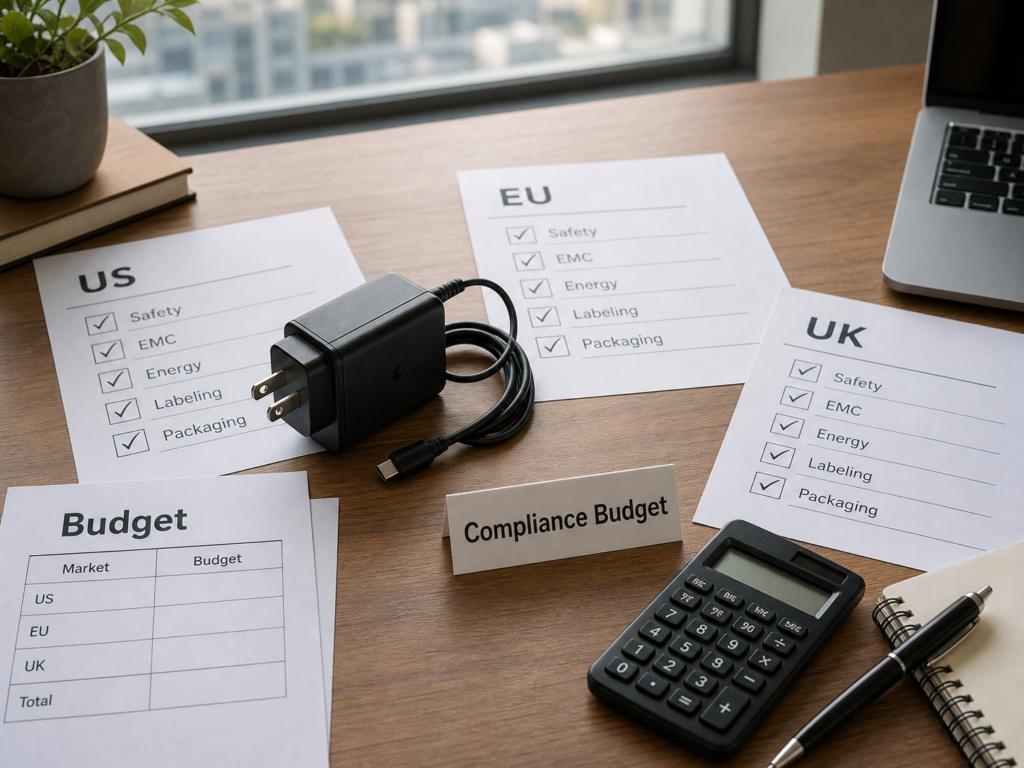
Next, we will cover the compliance requirements of several mainstream cross-border markets to help you quickly build a budget framework. First, let’s state the prerequisites for use:
The benchmark sample for the following content is a basic 20W USB-C wall charger or ordinary passive USB-C data cable, without wireless or complex functions; requirements in emerging markets such as Southeast Asia, Latin America, and the Middle East vary greatly, requiring separate quotations, and price ranges from Europe and the United States cannot be directly applied; it is recommended that you inquire with at least 2 service providers with corresponding accreditation qualifications for the target market before making a decision.
US Market
Applicable products include chargers, power adapters, wireless chargers, charging cables with chips, etc.
Core regulations mainly include FCC Part 15, electrical safety rules that may be required by the state where the product is sold or the sales channel, and energy efficiency requirements of the DOE and California CEC. FCC Part 15 includes requirements for both unintentional radiators and intentional radiators, but the specific applicable path must be judged based on product functions.
In terms of mandatory requirements, products within the FCC’s regulatory scope must meet corresponding federal requirements; whether NRTL safety certification is required usually depends on the state, local authority having jurisdiction (AHJ), channel, and product sales requirements, and not all products are subject to the same unified federal mandatory requirement. The energy efficiency requirements, declaration methods, and applicable scopes of the DOE and CEC are also not completely identical, and should be checked separately. Responsible entities mainly involve importers, sellers, or other responsible parties stipulated by regulations within the United States.
Core testing and registration items are divided into several scenarios:
• For non-wireless chargers or charging cables with chips, evaluate FCC Part 15 unintentional radiator requirements based on the actual circuit and functions, and prepare test records and compliance documents according to applicable rules. Unintentional radiators usually use the Supplier’s Declaration of Conformity (SDoC) or other applicable equipment authorization paths.
• Products with wireless communication transmission functions such as Wi-Fi and Bluetooth usually need to apply for equipment authorization and obtain an FCC ID according to intentional radiator rules.
• Products that only perform near-field wireless power transmission such as Qi and do not have wireless communication transmitters cannot be directly determined to require an FCC ID solely based on the “wireless charging” function; Part 15 requirements should be evaluated based on the specific circuit and transmission characteristics.
• If safety certification is required, the certificate should be issued by an NRTL laboratory (such as UL, ETL) that is recognized by OSHA and covers corresponding product standards and factory supervision scope. Whether factory audit is included must be confirmed according to the specific certification scheme.
• External power supply products should confirm whether they are within the regulatory scope of DOE federal rules and California CEC, and fulfill obligations such as testing, certification or reporting, and database declaration according to applicable rules respectively. It cannot be generalized that all products need to complete the same “DOE/CEC registration”.
Labels and documents to be prepared include: FCC marking or SDoC-related information where applicable, NRTL marking (if obtained), energy efficiency marking or other energy efficiency information (if applicable), declaration of conformity, test records, and technical files. The FCC mark is not universally mandatory for all devices using the SDoC path, and should be confirmed according to applicable regulations.
Recurring costs are mainly NRTL annual factory audit fees, certificate maintenance fees (if any), and fees related to energy efficiency or platform maintenance.
Verification points: First confirm whether your product belongs to the category of digital devices or wireless devices regulated by the FCC; confirm whether it includes a wireless communication transmitter under FCC jurisdiction; confirm whether your sales channel and the state where you sell require NRTL safety certification; confirm whether the product is within the scope of DOE or CEC external power supply energy efficiency regulation.
Canadian Market
Applicable products are basically the same as those in the US.
Core regulations include: ISED wireless certification rules, ICES EMC requirements, electrical safety certification requirements of each province or territory, and NRCan energy efficiency requirements.
In terms of mandatory requirements, ISED wireless equipment and ICES-applicable EMC requirements are federal-level requirements; electrical safety regulation is mainly implemented by provinces and territories, and many electrical products must have a provincially recognized certification mark before being sold or connected to the power grid, which cannot be simply summarized as mainly a channel requirement. Responsible entities must be confirmed in combination with federal regulations, provincial rules, and import and sales arrangements.
Core testing and registration items:
• Digital non-wireless products must meet applicable ICES EMC requirements according to product category, and prepare test records and compliance documents.
• Products with wireless transmission functions need to be processed according to ISED wireless equipment certification rules, and confirm whether they are listed on the Radio Equipment List (REL); it should not be simply referred to as a unified “registration”.
• For electrical safety certification, first confirm the specific requirements according to the sales province and product category, then select a certification body and mark with the corresponding accreditation scope.
• External power supplies only need to fulfill corresponding energy efficiency testing, reporting, marking, and importer obligations when they fall within the applicable scope of Canada’s Energy Efficiency Regulations. It cannot be generalized that all external power supplies need to complete a unified energy efficiency registration.
Labels and documents include: applicable ISED/ICES marking or compliance information, safety marking (if any), energy efficiency marking (if any), technical files, declaration of conformity.
Recurring costs are annual factory audit fees for safety certification, certificate maintenance fees (if any), and maintenance fees for relevant provinces or projects.
Verification points: First confirm the product classification: whether it is a digital device, wireless device, or passive accessory, as different categories correspond to different requirements; second, confirm electrical safety certification and accreditation mark requirements according to the sales province and product category; third, confirm whether wireless products need to be listed on the REL; finally, confirm whether the product is within the scope of NRCan energy efficiency regulation.
EU Market
Applicable products include chargers, power adapters, wireless chargers, charging cables, etc.
There are many core regulations, which must be matched according to the applicable conditions of the product:
• **CE-LVD Safety + EMC Electromagnetic Compatibility**: Applicable to products with electrical functions. Passive charging cables are generally evaluated together with matching products and do not need to be completed separately.
• **RoHS Restriction of Hazardous Substances**: Applicable to products and accessories within the scope of electrical and electronic products, restricting the use of hazardous substances such as lead and mercury.
• **REACH Chemical Compliance**: Obligations must be judged separately for substances, mixtures, and articles in the product, with a focus on SVHC information communication, restricted substances, and importer and supplier responsibilities. REACH applicability cannot be directly equated with mandatory testing.
• **WEEE E-waste Recycling**: Applicable to products within the scope of electrical and electronic equipment. Registration, declaration, thresholds, and fees are specifically stipulated by member state systems. Whether passive cables are included and how they are classified must also be judged in combination with product categories.
• **Packaging EPR**: Packaging producer responsibility is specifically implemented by member state systems. Registration, declaration, and payment obligations should be verified based on the country of placement, producer identity, packaging volume, turnover, and applicable thresholds. It cannot be generalized that all products sold with packaging are registered and paid for in the same way.
• **Ecodesign/Energy Efficiency**: Applicable to chargers and power adapters that meet conditions such as the definition of external power supplies. Completing applicable ecodesign requirements and retaining technical documents does not mean there is a universal EU-wide Ecodesign registration.
• **RED Radio Equipment Directive**: Only products with applicable radio transmission functions are evaluated under RED. Whether wireless power transmission products such as Qi fall within the relevant scope must be judged separately based on specific frequency, transmission method, and product design.
• **Common Charger Regulation**: Must be checked against Directive (EU) 2022/2380 and its applicable radio equipment categories, interfaces, sales methods, and implementation dates. It cannot be judged that all chargers are applicable solely based on the “with USB-C interface” item.
The CE mark only indicates that the product complies with applicable EU harmonized regulations, and does not include WEEE or packaging EPR obligations. The responsible entity must determine the EU economic operator according to specific product regulations. The EU authorized representative (EU rep) is not a unified mandatory requirement for all products; in many cases, the EU importer can assume corresponding legal responsibilities.
Core testing and registration items: First, complete conformity assessment, technical document organization, and necessary declaration of conformity for applicable LVD, EMC, RoHS, and external power supply Ecodesign requirements respectively; in terms of material compliance, require the supply chain to provide corresponding RoHS/REACH information, and conduct targeted testing when necessary; in terms of producer responsibility, confirm WEEE recycling registration, packaging EPR registration, declaration, and payment obligations according to member state systems; wireless products also need to evaluate RED requirements based on specific wireless transmission functions.
Required labels and documents include: CE marking, WEEE marking where applicable, packaging recycling marking, energy efficiency marking (if any), declaration of conformity, technical files, and EU economic operator information required by regulations.
Recurring costs include: EU rep annual fees when truly needed, WEEE/packaging EPR annual declaration fees, certificate or standard update and maintenance fees.
Verification points: Confirm the CE directives and regulatory scope corresponding to the product, do not overcount or miss test items – for example, passive cables usually do not need separate LVD; confirm whether the product belongs to special regulatory categories such as external power supplies and wireless devices; the CE mark can be used in member state markets covered by the corresponding EU harmonized regulations, but each country has different requirements for WEEE, packaging EPR, and language labels, which must be complied with separately.
UK Market
Applicable products are basically the same as those in the EU.
Core regulations include UKCA conformity assessment rules, UK RoHS, packaging EPR, and wireless equipment-related rules. At the same time, attention should be paid to the CE recognition policies and transition periods announced by the UK government for specific products.
Products within the regulatory scope need to meet corresponding regulatory requirements, but UKCA is not currently the only or universally mandatory mark for all related products. For many products, the UK still recognizes the CE mark under eligible conditions. The specific period, applicable regulations, and whether self-declaration is allowed must be checked against the rules currently announced by the UK government.
Responsible entities must determine the obligations of manufacturers, importers, authorized representatives, and other UK responsible persons according to specific regulations, and it cannot be generalized that all products must hire a separate UK rep. Packaging EPR must also be judged based on the producer definition, turnover, packaging tonnage, and the situation of placing packaging within the UK.
Core testing and registration items: Non-wireless products must complete conformity assessments for safety, EMC, RoHS, etc. according to applicable UK rules; wireless products must additionally evaluate wireless equipment-related requirements; in terms of producer responsibility, check registration, data declaration, and payment obligations according to the UK packaging EPR system.
Labels and documents include: applicable UKCA or CE marking, responsible entity information, declaration of conformity, technical files, and other label information required by regulations.
Recurring costs include: UK rep or other responsible entity service fees when truly needed, packaging EPR annual fees, certificate maintenance fees.
Verification points: First confirm product classification and applicable rules; second, note that the CE mark’s recognition policy and transition date in the UK must be checked against the information currently announced by UK authorities. Do not assume that UKCA is the only mark, nor that CE is valid long-term.
Japanese Market
Applicable products include chargers, power adapters, wireless chargers, charging cables, etc.
Core regulations include: PSE Electrical Appliance and Material Safety Law, Giteki (MIC) wireless certification rules, recycling/packaging requirements.
In terms of mandatory requirements, PSE requirements depend on the DENAN list, product structure, input/output parameters, and specific classification. Not all products listed in the catalog adopt the same “certification” path. Wireless products only need to go through relevant procedures such as Giteki when they fall within the scope specified by Japanese radio regulations.
Responsible entities usually involve importers, sellers, or other declaring entities stipulated by regulations within Japan. It is necessary to confirm the legal responsibilities of the Japanese importer or declaring entity, and the commercial service provider “Japan rep” cannot be generalized as a mandatory entity for all products.
Core testing and registration items: PSE safety requirements are divided into different categories such as circular PSE (other electrical appliances) and diamond PSE (specified electrical appliances). The category should first be determined based on the DENAN list, product structure, and parameters, then specific obligations such as self-inspection, third-party conformity inspection, notification, and factory inspection should be judged; not all PSE projects can be simply referred to as the same type of certification. Products with wireless functions also need to confirm whether they fall within the scope of specified wireless equipment, then evaluate Giteki requirements.
Labels and documents include: applicable PSE marking (circular or diamond), Giteki marking (if any), technical files, information on the Japanese importer or other legal entities.
Recurring costs include: Japanese importer or compliance service fees, certificate maintenance fees, fees related to factory inspection or third-party conformity inspection. Specific factory audit and inspection fees must be confirmed according to PSE category and applicable inspection system, and it cannot be generalized that only diamond PSE requires factory audit.
Verification points: Be sure to first confirm the PSE classification of the product, whether it is specified electrical appliances or other electrical appliances, as the two categories have different compliance, inspection, and declaration obligations; confirm the legal responsibilities of the local Japanese importer or declaring entity, and cannot only use overseas entities to handle all obligations; confirm whether the product has wireless functions and whether it falls within the applicable scope of Giteki.
Australian and New Zealand Markets
Applicable products include chargers, power adapters, wireless chargers, charging cables, etc.
Core regulations include: Australia’s EESS Electrical Safety System, RCM compliance mark rules, ACMA wireless and EMC compliance rules; New Zealand should be checked separately against RSM (Radio Spectrum Management) and related EMC and radio rules.
Products within the regulatory scope need to meet corresponding requirements, but EESS registration is not the same registration that all charging cables, chargers, or wireless chargers automatically need. In terms of responsible entities, Australia must confirm the responsible supplier according to EESS and specific supply chain arrangements; New Zealand should confirm suppliers, importers, and other responsible entities according to RSM rules, and cannot be generally replaced by Australian responsibility arrangements.
Core testing and registration items:
• For Australia, first determine whether the product is EESS-regulated electrical equipment, and complete requirements such as supplier registration, compliance documents, and RCM marking according to the equipment class.
• Wireless communication devices are implemented according to mechanisms such as ACMA applicable standards, technical documents, and supplier declaration of conformity. It cannot be generalized that all wireless products require ACMA wireless registration or unified qualification certification.
• New Zealand needs to separately check radio and EMC requirements, supplier or importer responsibilities, and marking according to RSM rules, and cannot directly apply Australian ACMA or EESS conclusions.
Labels and documents include: RCM marking where applicable, information on the responsible supplier or other responsible entities, technical files, and supplier declaration of conformity.
Recurring costs include: responsible supplier annual fees, applicable registration or maintenance fees, certificate maintenance fees.
Verification points: Confirm whether the product falls within the scope of EESS-regulated electrical products, as different categories correspond to different registration and compliance requirements; New Zealand’s rules must be verified separately, do not directly use Australian conclusions; confirm whether the product has wireless communication functions, and evaluate Australian ACMA and New Zealand RSM requirements respectively.
6. Step-by-Step Method for Certification Cost Budgeting
Now that we’ve covered the composition and requirements of each market, let’s look at how to specifically create a budget. There are six steps in total, and following them will produce a reliable budget table.

Step 1: Clarify 3 Core Prerequisites
Before calculating costs, first set the three prerequisites, otherwise all budgets are just guesswork:
• **Target market**: Which countries/regions are the first to launch? Are there any expansion plans later? Is the sales channel an e-commerce platform or offline supermarkets?
• **Product parameters**: What type of product is it? What is the power? What interface? Does it have wireless function? How many models are there? What is the situation of core components?
• **Sales plan**: How long is the sales cycle? What is the estimated total sales volume? What is the launch timeline?
Step 2: Sort Out the Compliance Requirement List for the Target Market
After setting the prerequisites, you can sort out the compliance requirements of each target market. Free inquiry channels include regulatory agencies of various countries, regulatory databases, and compliance lists published by formal testing institutions. Note that the validity of the information must be confirmed according to the verification methods mentioned earlier.
To avoid missing items, you can divide the requirements into four categories: **mandatory access, environmental recycling, channel requirements, voluntary value-added**. Going through them according to this classification will basically result in no omissions.
The most common missing items for charging products include: local responsible entity, packaging EPR, label language requirements, and material compliance declarations. These should be checked with emphasis.
Step 3: Determine Mergeable Product Series and Certification Paths
If you have multiple product models, first see which ones can be merged for series certification, which can save a lot of money.
The conditions for merging are: shared circuit board, key components, and shell structure, with only differences in model name, color, and low power. But these conditions can only be used as preliminary screening; whether they can finally be covered by series or family certification must be confirmed by specific regulations, certification rules, and the certification body.
Situations that cannot be simply merged include obvious differences such as different power levels, different plugs, different circuit boards, and with or without wireless. They are not absolutely unmergeable under all systems, but all need to be evaluated item by item.
The operation method is: select representative models and confirm the coverage scope with the certification body in advance. You cannot assume that the “highest power” model can cover all models. If it is a multi-market layout, you also need to evaluate whether CB reports and certificates can be used as basic materials for certification in each target country, as well as whether there are national differences, additional testing, or local certification issuance requirements, to reduce the cost of repeated testing.
Step 4: Service Provider Inquiry and Quotation Verification
After sorting out the requirements, you can find service providers for inquiries. When making inquiries, prepare an information package: product specification sheet, BOM list, model list, target market, sales channel, estimated cycle. The more complete the information provided, the more accurate the quotation.
After receiving the quotation, be sure to check several key items: whether the standard version is the latest, which test items are included, how many samples are needed, what language the report is in, what the rules for rectification and retesting are, whether there are factory audit requirements, and who the registration entity is. All these must be clearly stated to avoid hidden charges later.
The most important thing is to verify the qualification of the service provider. Confirm whether the laboratory has the specific accreditation qualifications, testing scope, and valid status required by the target regulations, such as FCC-recognized laboratories, and NRTLs recognized by OSHA and covering corresponding product standards. The CNAS or A2LA marks can be used as part of the qualification information, but these two marks alone cannot be used to judge that the report will definitely be accepted by the FCC, customs, platforms, or other regulatory agencies. You also need to confirm the report format and acceptance conditions with the target platform or regulatory agency.
It is recommended to inquire and compare with at least 2 qualified service providers, do not decide after only asking one.
Step 5: Calculate Total Costs by Item
After receiving the quotation, you can calculate the total cost by item.
**Total compliance cost = one-time fixed cost + recurring fixed cost (converted according to the planning cycle) + variable fees such as producer responsibility calculated according to local systems + compliance incremental cost + risk reserve**
If you want to calculate the compliance cost per unit product, divide the total compliance cost within the planning cycle by the estimated total sales volume within the cycle.
When calculating, pay attention to distinguishing between **cash flow budget** and **accounting amortization**: the cash flow budget is calculated according to payment nodes, such as how much to prepay before testing, how much to pay before certification issuance, and annual fees paid yearly; accounting amortization allocates costs to each product according to the validity period or sales volume, used for pricing.
For a complete budget table, the core fields can be divided into two dimensions: by cost attribute, there are one-time fees, annual fixed fees, producer responsibility fees calculated according to local systems, and rectification and retest reserve; by correlation dimension, there are per-model fees, per-market fees, sample logistics fees, translation and labeling fees, internal engineering labor costs, and platform audit fees; there should also be management fields, such as risk reserve, payment nodes, responsible person, and review date.
Step 6: Buffer Reserve and Feasibility Judgment
After calculating the basic cost, you also need to reserve a buffer, that is, a risk reserve, to deal with uncontrollable situations.
There is no universal fixed ratio for the buffer, it must be adjusted according to the complexity and risk level of the product: low-risk scenarios (such as passive charging cables, key components all have mature compliance reports) can have a smaller reserve; high-risk scenarios (such as high-power/multi-port/wireless products, first entry into a new market, regulations nearing revision) need to be calculated separately.

After reserving the buffer, you also need to make a feasibility judgment on market entry: if the ratio of unit compliance cost to gross profit is too high, do not expand to too many markets at the beginning. First do verification in 1-2 core markets, reduce initial launch models, and expand after it works.
In addition, you must do a good job in cash flow planning and arrange funds according to payment nodes. For example, prepay a portion before testing, pay the balance before certification issuance, and pay annual fees yearly. Don’t let funds run out at the critical moment, delaying the certification cycle.
7. Budget Optimization and Pitfall Avoidance Guide
Finally, let’s talk about how to reasonably optimize costs and how to avoid common pitfalls, to help you spend less unnecessary money.
Cost Optimization Methods for Multi-Market Layout
If you want to enter multiple countries, you can use these methods to save money:
First, **Evaluate CB certification conversion**. If you want to enter 3 or more countries, you can prioritize evaluating the CB path, but you must check in advance whether the target country accepts the relevant CB reports and certificates, whether there are national differences, additional testing, local certification or marking requirements. You cannot treat the CB certificate as a global automatic access certificate.
Second, **Prioritize regional certification coverage**. For example, CE can be used in EU markets covered by the corresponding EU harmonized regulations, but producer responsibility and market requirements such as WEEE, packaging EPR, and language labels in each country still need to be checked separately. It cannot be assumed that CE already covers all obligations.
Third, **Phased investment**. Do not expand new products to a dozen markets at the beginning. First do verification in 1-2 core markets, then expand after it works, to reduce early-stage risks and investment.
Upfront Cost Control in Early Product Stages
Many compliance costs are actually determined at the design stage. Controlling them well in the early stage saves much more money than later rectification:
First, **Use certified key components**. For core components such as power ICs, plugs, and wireless modules, prioritize choosing those with compliance reports, which will greatly reduce the risk of later rectification.
Second, **Do compliance pre-review before design freeze**. When the product design is not yet finalized, find a compliance agency to do a basic pre-review, and make changes in advance to avoid batch rework after mass production.
Third, **Do pre-testing before formal testing**. Do an internal pre-test first, and send it to the laboratory only after there are no problems, which can reduce retesting fees.
Certificate and Model Verification Methods
Many people use suppliers’ certificates, only to find they are useless at all. When verifying certificates, focus on these items: certificate holder, manufacturer, model list, key components, input/output parameters, report version, issuing agency qualification, authorization chain.
Common misuse situations include: supplier certificates cannot be used directly; you must check whether the certificate holder is you, or whether you have been authorized, and whether the models cover your product, otherwise the certificate is invalid. You also need to confirm that the certification body or laboratory has the specific accreditation scope required by the target regulations, rather than just looking at general qualification marks such as CNAS and A2LA.
Another very important point: mass-produced products must be completely consistent with the submitted samples. If you change the circuit board or replace components, the certificate may become invalid.
Common Budget Pitfalls and Identification
• **Low-price fake certificate trap**: Unqualified laboratories offer particularly low prices, and the reports or certificates they issue are fake, not recognized by customs or platforms, resulting in even greater losses. Be sure to find service providers with corresponding qualifications for the target regulations.
• **Quotation missing item trap**: Some service providers offer particularly low prices, but they do not include fees such as annual audit, retesting, local representative, and translation. Later, they make you pay for each item one by one, and the total ends up being more expensive. When making inquiries, be sure to ask clearly about all items and have them written into the quotation.
• **Lifetime validity misconception**: Certification is not valid for life. Regulations will be updated, products will be changed, all of which require additional fees, and even re-certification.
• **Model coverage misconception**: If the power, circuit, or key components change, supplementary testing is required, otherwise the certificate may no longer cover them. Don’t think that after certifying one model, all models in the same series can use it.
Compliance Change Management and Impact Matrix
After modifying a product, do you need to spend money on re-certification? Many people are unsure. The principle for handling changes is: as long as you plan to modify the product, no matter what you change, first consult a compliance agency or laboratory to confirm whether supplementary testing is needed and how much it will cost, then decide whether to make the change.
To facilitate your quick judgment, we have compiled an impact matrix of common changes:
| Change Type | Typical Compliance Impact | Cost Impact Level |
| Only model/brand/packaging change | Generally no need for supplementary testing, only need to update technical documents and labels (need to confirm certification entity requirements) | Low |
| Input plug/shell material change | Need to evaluate safety/EMC impact, may require single-item supplementary testing | Medium-Low |
| PCB layout/key components (power IC, optocoupler, etc.) change | High probability of needing supplementary safety/EMC testing, re-certification required in severe cases | Medium-High |
| Power parameter change | Need to re-evaluate safety/energy efficiency, usually requires supplementary testing, re-certification required if exceeding the original scope | Medium-High |
| Wireless module/antenna/firmware change | Need to re-evaluate radio frequency compliance, high probability of supplementary testing or re-registration | High |
| Production factory change | Evaluate whether factory audit or re-certification is required according to certification rules | Medium |
| Product adds new functions | Need to add corresponding test items, re-apply for certification if necessary | High |
Balanced Decision-Making Between Cost and Cycle
Many people struggle with whether to expedite, but it’s actually very simple: if you’re rushing for the peak sales season and the loss from late launch is more than the expedited fee, then choose expedited; if time is sufficient, there’s no need to spend extra money.
How to avoid unnecessary expediting? Plan 2-4 weeks in advance, reserve sufficient time for testing and rectification, don’t wait until the last minute. Overall, the shorter the cycle, the higher the cost. You need to weigh it against the launch pace and the loss from late launch.
Cost Tracking Methods for Budget Execution
Making a budget is not the end of the story; you also need to track it during execution to avoid overspending:
Before testing starts, be sure to confirm that the submitted samples are consistent with the mass-produced version. Don’t let inconsistent samples cause test failure, leading to extra retesting fees.
During the rectification stage, record the reason for every additional fee clearly, distinguish between full retesting and single-item supplementary testing, to avoid being overcharged.
After the product is launched, set up reminders for certificate expiration and annual fee payment. Don’t let missed annual fee payments or missed maintenance cause the compliance status to become invalid, requiring re-doing and wasting money.
Summary
This concludes the content on cost budgeting for electronic product certification regulations. After reading this article, you should be able to judge which compliance items are needed for charging products according to the “product-market-channel” logic, instead of blindly applying other people’s lists; you can break down 5 types of compliance costs, identify common missing items and incremental costs, and make an accurate certification fee budget; you can create an executable cross-border compliance cost budget table according to the 6-step process and calculate the compliance cost per unit product; you can distinguish the compliance cost differences of different types of USB-C charging cables, without overcounting or missing; you can judge when to use methods such as CB certification conversion and series certification to optimize costs; you can judge the compliance cost of product adjustments through the change impact matrix and control expenses in advance; you can also verify the authenticity of quotations and certificates, avoiding common pitfalls such as fake certificates, hidden charges, and certificate misuse.
Compliance costs are not unnecessary expenses, but necessary investments for products to be sold legally and avoid greater losses. Only by calculating this cost clearly can your products be sold more stably and profits be more guaranteed.