
Most friends who run cross-border charger businesses have stumbled on compliance pitfalls: either they rush to get certifications last minute before shipment, spending tens of thousands of yuan on board modifications and still missing the peak season; or they think passing US UL certification means they can sell globally, only to have goods detained in the EU due to lack of a local responsible person, and entire batches returned in Japan due to incorrect plug dimensions. Many people treat compliance as a troublesome matter of “paying for certificates before shipment”. In fact, as long as you plan ahead, you can reduce costs from repeated testing, post-stage board modifications, and repeated certifications—though the actual savings depend on the product, market, and certification path—and also avoid major losses from cargo detention, listing removal, and fines.
This article explains thoroughly the core logic of multi-market charger compliance, requirements of major global markets, impacts of product design, layout strategies, phased steps, and pitfall avoidance methods, from introductory concepts to practical implementation. It is suitable for small and medium-sized sellers new to cross-border business, as well as brands looking to optimize their compliance systems.
2. 7 Categories of General Global Compliance Requirements: Unavoidable No Matter Which Market You Enter
Charger regulations in countries around the world seem varied, but in fact they are a combination of 7 categories of requirements. As long as you understand what each category regulates and what impact it has on your products, you will not be confused when looking at the requirements of specific markets.
1. Electrical Safety Requirements
This is the most basic requirement for all markets, with three core points: electric shock protection, fire protection, and overheating protection.
There are many factors affecting the stringency of safety requirements: for example, input voltage range (wide-voltage products must meet safety requirements for both 100V and 240V, which is stricter than single-voltage products), output power (the higher the power, the higher the risk of overheating and fire, and the stricter the requirements), plug structure (whether there is grounding, whether pin dimensions are compliant), and shell flame retardant grade (whether the shell can self-extinguish within a specified time after catching fire).
2. Electromagnetic Compatibility (EMC) Requirements
Electromagnetic compatibility sounds professional, and usually involves electromagnetic emission control; some markets or product categories also require immunity. That is to say, chargers must not generate electromagnetic interference exceeding limits when operating, and under applicable target market rules, must also be able to withstand a certain degree of external electromagnetic interference. Specific test items cannot be generalized, and should be confirmed according to the target market and applicable standards.
For example, ordinary wired chargers may need to be evaluated for conducted emissions and radiated emissions; products with wireless functions, higher power, or more complex circuits may have more applicable test items. High-power fast chargers, GaN (gallium nitride) chargers, and multi-port chargers usually require more careful evaluation, because power density, circuit switching frequency, or port combinations may increase design and testing difficulty.
3. Energy Efficiency and Ecodesign Requirements
Simply put, it means electricity cannot be wasted: for example, when a charger is plugged into the wall and not in use (no-load), power consumption must not exceed the specified value; the energy conversion efficiency during charging must meet standards, and too much electricity cannot be wasted as heat. Some markets also require energy efficiency labels to be affixed, so consumers can see at a glance whether the product is energy-saving.
There is a common misconception here: you cannot judge whether a product needs energy efficiency certification solely by power. Taking the EU as an example, ecodesign requirements apply to external power supplies that fall within the regulatory definition and are not exempted; whether they apply should be judged based on the definitions, exemption clauses, and market placement time of Commission Regulation (EU) 2019/1782, and cannot be generalized solely by “external power supply” or 5W power.
4. Chemical Substance Restriction Requirements
This category of requirements mainly includes controls on hazardous substances and chemical information under different regulations. For example, RoHS restricts the concentration of specified substances in homogeneous materials in electrical and electronic equipment; the REACH SVHC candidate list may trigger obligations such as article information transfer and SCIP, depending on substance concentration, product type, and supply chain role.
This does not mean that all SVHCs are uniformly prohibited, nor can it be simply understood that the same set of rules naturally covers all materials of products and packaging. Components such as circuit boards, solder, plastic shells, charging cables, and interface connectors need to be judged separately according to applicable RoHS, REACH, and other market rules. Packaging and printing ink on packaging should also be separately confirmed according to applicable REACH, packaging, and member state rules.
5. Radio Emission Requirements
This category of requirements mainly applies to chargers with wireless functions, such as smart chargers with Bluetooth or Wi-Fi (those that can be remotely controlled and display power). Ordinary wired chargers usually do not involve radio emission requirements.
The core requirement is to comply with the radio spectrum management rules of the target country, and not to occupy unapproved frequency bands to avoid interfering with other wireless devices. Products with wireless functions may also require additional radio testing, certification, or registration, and cannot directly use all compliance documents of ordinary wired chargers.
6. Labeling and Technical Documentation Requirements
That is, parameters and responsible party information must be clearly marked on products, packaging, and manuals as required, and corresponding test reports, certification certificates, or other technical documents must be provided as support.
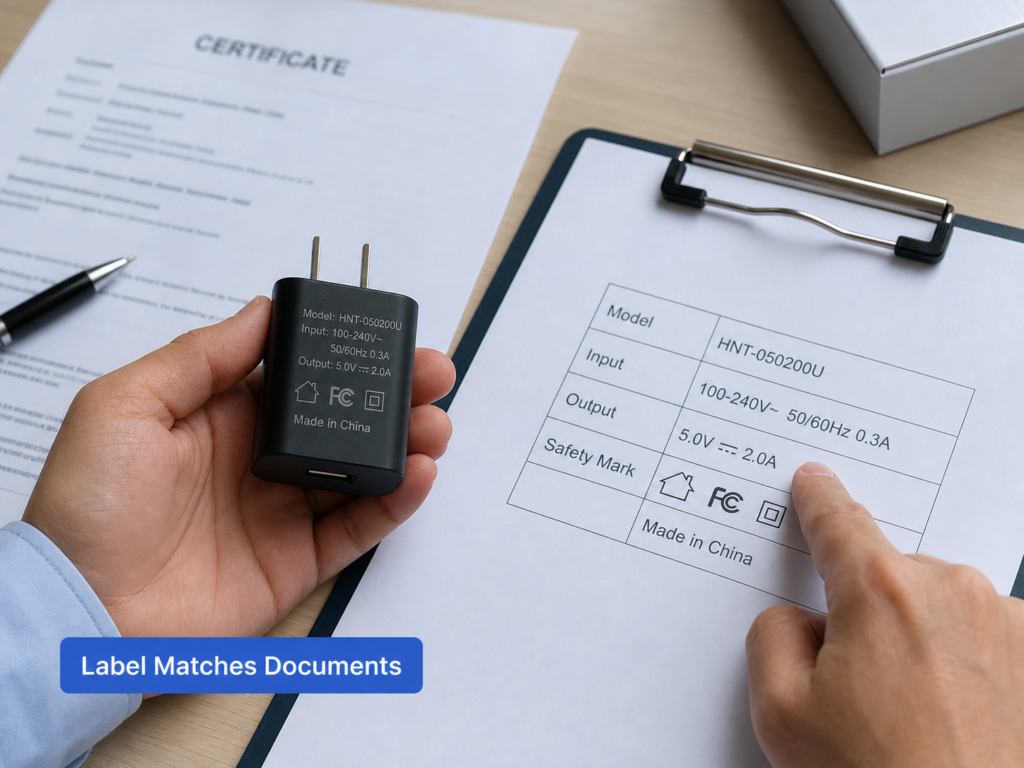
The most core principle is: **all parameters on the label must be completely consistent with the actual product and certification documents**. For example, if your certification is for 20W output but the packaging marks 65W, or the certified model is A but the actual sold model is B, both may be non-compliant, even if the product itself has no quality issues.
7. Extended Producer Responsibility (EPR)
This is a requirement that has become increasingly strict in recent years. In plain terms, it means “whoever places the product on the market bears the corresponding recycling and environmental protection responsibilities” — for the chargers you sell that become e-waste after breaking, as well as product packaging waste, producers, importers, or other responsible entities may need to bear obligations such as registration, declaration, fee payment, and recycling treatment.
Note a boundary: if your charger has no built-in battery and no battery is included, it usually does not involve special rules for battery recycling, but the recycling responsibility for e-waste and packaging still needs to be confirmed according to the target market’s system.
4. Your Product Design Directly Determines Compliance Costs
Many sellers do not know that product designs such as structure, power, and interfaces determine the difficulty and cost of compliance from the very beginning. We have sorted out the impacts of several common product attributes, which you can optimize in advance during the design stage.
1. Plug and Structural Design
The plug is the most intuitive difference and also the foundation of compliance:
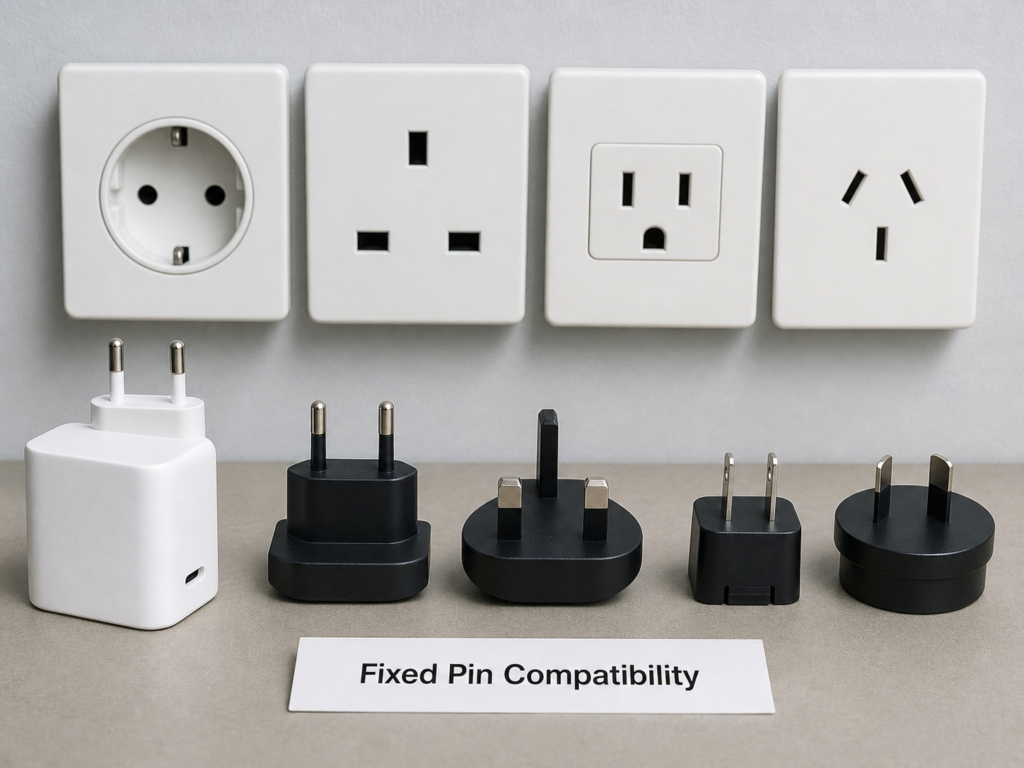
• **Chargers with fixed pins**: Pin dimensions must fully comply with the plug standards of the target country. A charger with fixed pins is usually only compatible with 1-2 regions. For example, US-standard pin chargers can be sold in the US and Canada; Japanese pin dimensions are close to US standards but have slight differences, which strictly speaking require separate confirmation.
• **Chargers with replaceable plugs**: Many sellers think replaceable plugs can be swapped at will, but that is not the case — replaceable plugs must be within the range of series variants recognized by the certification body, and must also meet safety requirements such as mechanical locking (cannot fall out when pulled), creepage distance, temperature rise, and grounding. Otherwise, even if you change the plug, it may not be compliant.
• **Desktop adapters with detachable AC cables**: In addition to the adapter itself, the detachable AC power cable must also separately meet the compliance requirements of the target market, and you cannot just use any random cable.
2. Power and Port Design
Power and number of ports directly affect the stringency and cost of testing:
• The stringency of safety and energy efficiency is comprehensively judged based on input and output parameters, circuit topology, number of ports, and target market standards. It is not that higher power necessarily means higher cost, but **high-power, high-power-density products** (such as 65W small-volume GaN chargers) may have more test items for temperature rise, insulation, and EMC, with stricter requirements, so the cost is naturally higher.
• **Multi-port chargers** should mark rated output parameters in accordance with applicable safety and labeling rules. To avoid consumer misunderstanding, it is recommended to clearly state the single-port capacity, total output limit, and power distribution when multiple ports are used simultaneously. Specific mandatory labeling content should be confirmed according to target market rules, and “must mark dynamic distribution rules” cannot be regarded as a universal legal requirement for all markets. For example, if you sell a 65W dual-port charger, with a maximum of 65W per single port and 45W + 20W when both ports are used together, you should try to mark this information clearly to avoid false publicity and consumer misunderstanding.
3. Interfaces and Fast Charging Protocols
Requirements for interfaces and protocols have changed rapidly in recent years, so special attention should be paid:
• **Physical interfaces**: Some markets have mandatory interface requirements for specific categories of radio equipment themselves, such as the EU’s USB-C requirement, but you must pay attention to the applicable scope. Not all chargers require it, so do not blindly modify the design.
• **Fast charging protocols**: The compliance requirement is that supported power levels (such as 5V3A, 9V2A, 12V1.5A) must be clearly marked, and marketing terms such as “fast charge” or “super fast charge” cannot be used instead of parameter declarations.
• There is a common misconception here: **USB-C is not equivalent to PD fast charging**. Having a C port does not mean meeting PD protocol requirements. PD is a set of charging protocols that requires separate testing and verification. Many sellers think that having a C port equals supporting PD, and end up being complained about false publicity by consumers.
4. Special Technologies and Functions
• **GaN (gallium nitride) chargers**: Many people think GaN is a separate regulatory category with special certification, but that is not the case — GaN is just a material for power devices. Chargers are still subject to the rules for ordinary external power supplies. Requirements are mainly related to power, functions, and applicable regulations, and using GaN does not automatically place them in an independent regulatory category.
• **Chargers with wireless functions (Bluetooth/Wi-Fi)**: They need to additionally comply with the radio emission regulations of the target country, and cannot share all certifications of ordinary wired chargers. This is equivalent to adding a whole set of testing requirements, and the cost will be much higher.
5. Included Cables and Bundled Sales
• **Included cables**: If you include USB-A/C charging cables or detachable AC cables when selling chargers, these cables also need to be evaluated for safety, chemical, and other applicable requirements according to target market rules. You cannot just use cheap random cables, otherwise, if inspected, it may affect the compliance of the entire product.
• **Bundled sales**: If chargers are sold bundled with terminal products such as mobile phones, tablets, or laptops, they need to meet the supporting compliance requirements of the terminal products, and the division of responsibilities must also be clarified in the manual.
• Note: Compatibility of fast charging protocols is usually not a separate mandatory regulatory category, but if you make false publicity (for example, marking support for PD3.1 but actually not supporting it), you will violate advertising and anti-unfair competition rules under market supervision, and will still be fined.
6. Phased Implementation: Full-Process Layout from Design to Market Launch
Multi-market compliance layout is not a one-time matter, but is promoted in four stages. The earlier you get involved, the lower the cost.
Phase 1: Product Planning Period (Pre-layout, Lowest Cost)
This stage is when the product has not yet been molded or prototyped, with the lowest cost and best effect. You must attach importance to it:
1. First, make a complete list of all target markets, sorted by the weighted score mentioned earlier.
2. Extract the common requirements of all markets (safety, EMC, energy efficiency, chemical) and directly integrate them into product design. For example, use shell materials that meet the flame retardant requirements of all markets, and set the creepage distance of the circuit board according to the strictest requirements.
3. Prioritize solutions compatible with multiple markets, such as replaceable plug designs and USB-C universal interfaces, so that you don’t need major modifications when expanding to new markets later.
4. **Checkpoint**: The design draft must cover the basic mandatory requirements of all core markets, and reserve a certain amount of adjustment space. For example, if you add new markets later, you won’t need to re-mold or modify the board.
Phase 2: Certification and Testing Period (Batch Operation, Improve Efficiency and Reduce Costs)
After product prototyping, it enters the certification and testing stage. In this stage, try to operate in batches to reduce repeated testing:
1. **Do CB certification first**: CB is a basic safety test report under the IECEE system, which can be used as the technical basis for safety assessment in multiple countries and regions. CB reports and CB certificates must be processed through NCBs and their CBTLs within the IECEE CB Scheme. ISO/IEC 17025 accreditation can be used as a reference for laboratory capability, but cannot replace the IECEE qualification of NCB or CBTL. When applying for safety certifications in various countries later, it may still be necessary to supplement local national difference tests or complete other local procedures.
2. CB reports can be used as supporting evidence for EU LVD technical documents, and can also be used for local safety assessment applications in some countries or regions; whether they are accepted and what tests or documents need to be supplemented should be confirmed according to local systems and certification body requirements. CE is not a third-party certification that can be applied for or converted; manufacturers still need to complete the conformity assessment of applicable regulations, prepare technical documents, and sign the EU Declaration of Conformity.
3. Simultaneously carry out shareable EMC and energy efficiency tests. For example, the basic items of EMC testing may overlap in many markets, but whether they can be directly reused still depends on the target market’s standards, product categories, and document requirements.
4. Cycle and cost reminder: The cycle and cost of certification are affected by many factors, such as the number of samples, rectification rounds, institution scheduling, and whether there are factory inspection requirements. Be sure to confirm with the certification body in advance, and don’t wait until the peak season to do it, otherwise you will have to wait one or two months for scheduling.
5. **Checkpoint**: The holder, covered models, and parameters of certification or conformity documents must be consistent with the products you actually ship. For example, if your certified model is A but the shipped model is B, or the certification is for 20W but the actual sold product is 65W, both may cause the documents to fail to cover the product.
Phase 3: Market Launch Preparation Period (Supplement Local Exclusive Requirements)
After certification is completed, before market launch, you need to supplement the exclusive requirements of each market:
1. Replace the corresponding plugs and packaging according to the target market.
2. Affix local mandatory labels, energy efficiency labels, and warning texts in local languages. Note that the position, size, and language of the labels must meet local requirements, and cannot be affixed randomly.
3. Implement local economic operators or responsible entities according to the actual legal role and target market system. You cannot simply apply the terms “EU representative” or “Japan representative” to all countries. For example, non-EU manufacturers in the EU should ensure that there is an economic operator within the EU as required by regulations; for Japanese PSE products, qualified Japanese manufacturers or importers should fulfill obligations such as notification. At the same time, complete necessary platform or government registrations, such as WEEE registration, EPR registration, RCM supplier registration, etc.
4. **Checkpoint**: Packaging and labels meet the target country’s language and posting position requirements, and the information of the responsible entity is true, valid, and traceable. For example, when the EU requires economic operator information, it should be ensured that the entity is indeed located within the EU and can perform corresponding duties.
Phase 4: Post-Market Maintenance and Change Control
Many people think that once certification is done, it’s a once-and-for-all matter. In fact, post-market maintenance is more important, otherwise previous investments may be wasted:
1. **Regulatory tracking**: Pay attention to regulatory updates in core markets 6-12 months in advance to reserve adjustment time. For example, the EU’s USB-C requirement was announced several years in advance, so you don’t need to wait until the deadline to make changes.
2. **Product change management**: Clarify which changes require compliance assessment in advance. For example, if core components (power IC, transformer, optocoupler, etc.), PCB board, circuit design, shell, or cables are changed, you must first assess whether they are still within the scope of the original certification, and cannot sell after random changes.
3. **Certification maintenance**: Check item by item whether third-party certificates, registrations, and filings have expiration, supervision, or update requirements. For non-fixed-term systems such as CE Declaration of Conformity and FCC SDoC, continuously ensure that products, technical documents, labels, and conformity status are consistent with current regulations and mass-produced products.
4. **Evidence chain management**: Establish a correspondence table of “BOM (Bill of Materials) – key components – test reports – certification certificates – production batches” to ensure full traceability. When customs or platforms inspect, you can immediately produce evidence to prove product compliance.

5. **Checkpoint**: All modification contents do not exceed the scope of the original certification or conformity documents, third-party certificates, registrations, and filings all meet their respective maintenance requirements, and the evidence chain is complete.
Special Scenario Handling
• If platform requirements conflict with legal requirements, implement the principle of “applying the higher standard rather than the lower one”. For example, if the platform requires UL certification but it is not mandatory at the federal level, prepare according to the platform requirements, and keep all compliance evidence to avoid subsequent disputes.
• In case of product recall or safety accident, submit a report within the specified time limit according to the target market’s regulatory requirements, and cooperate with the investigation of regulatory authorities. Do not delay reporting, otherwise the fine will be heavier.
7. Cost Reduction, Efficiency Improvement, and Common Risk Pitfall Avoidance
Compliance costs can be saved, but not blindly. We have sorted out 3 practical cost reduction ideas and 4 types of common risk pitfall avoidance methods.
3 Practical Cost Reduction Ideas
1. **CB mutual recognition and reuse**: This is a commonly used cost reduction method. First, do a CB report, then apply for safety assessment according to each market’s system to reduce possible repeated testing. CB reports should be processed through NCBs and their CBTLs within the IECEE CB Scheme; ISO/IEC 17025 accreditation cannot replace CBTL qualification.
2. **Product serialization**: If your charger has multiple power models, such as 20W, 30W, 45W, as long as the circuit design and shell structure are similar, you can evaluate whether they can be processed as a series. Whether certificates or reports can be shared, what tests need to be supplemented, the number of samples, and whether re-issuance of certificates or change of filing is required depend on the specific national system, certification body rules, standard version, as well as differences in power, circuit, key components, and structure. You cannot default that each model only needs to report the difference part.
3. **Universal platform + replaceable plugs**: Within the range of variants recognized by the certification body, the same charger main body with different plugs and labels may reduce repeated assessments. However, whether certificates or reports can be shared, what tests need to be supplemented, and whether filing changes are required should be evaluated and confirmed by the applicable market’s certification system, certificate holder, and certification body based on actual differences. “Variant filing” cannot be regarded as a cross-market universal procedure.
4 Types of Common Risks and Pitfall Avoidance Methods
1. **Certification itself risks**
Common problems: certificate model mismatch, borrowing others’ certificates, expired certificates, missing mandatory modules such as EMC/energy efficiency, and the certification holder not being oneself.
Pitfall avoidance method: After getting the certificate, be sure to check carefully: Is the holder you or your authorized company? Are the covered models and parameters consistent with the products you sell? Do third-party certificates, registrations, or filings still meet their respective validity and maintenance requirements? Do they cover all applicable regulatory modules? For example, EU CE needs to cover applicable LVD, EMC, RoHS, ecodesign and other requirements, and cannot only have safety documents.
2. **Labeling and packaging risks**
Common problems: labels only affixed to packaging, not on the product itself; no local language; energy efficiency labels do not meet requirements; label parameters are inconsistent with the actual product.
Pitfall avoidance method: According to the target market’s requirements, check the labels on products, packaging, and manuals one by one, including language, position, size, and content, to ensure consistency with certification documents. Do not randomly modify parameters on packaging.
3. **Supply chain risks**
Common problems: suppliers provide expired certifications, borrow other customers’ certifications, and secretly replace core components during mass production without notification.
Pitfall avoidance method: When signing contracts with suppliers, clarify compliance responsibilities, require suppliers to provide true and valid certification documents, and regularly spot-check materials from mass production batches to ensure consistency with the BOM during certification or conformity assessment. The actual responsibilities, change control, and quality obligations of ODMs should also be clearly agreed in the contract.
4. **Regulatory update risks**
Common updates: mandatory interface requirements (such as EU USB-C), energy efficiency standard upgrades, stricter environmental protection requirements (such as new restricted substances in RoHS).
Pitfall avoidance method: Pay attention to regulatory developments in core markets in advance. You can subscribe to official regulatory update notifications, or find a reliable compliance service provider for regular reminders. Prepare 6-12 months in advance, and don’t wait until the deadline to rush to make changes.
8. Layout Effect Self-Check List
After completing the layout, you can use this list to self-check to ensure nothing is missed.
Basic Entry-Level Self-Check (Mandatory Items, Cannot Launch Market If Not Met)
• **Product body**: Has mandatory certification or compliance labels required by the target market; plug meets target country standards; interface meets mandatory requirements for corresponding product categories. The EU’s common USB-C charger rule mainly targets radio equipment with wired charging function in the listed categories themselves: the first batch of categories such as mobile phones, tablets, and headphones applies from December 28, 2024, and laptops apply from April 28, 2026.
• **Certification documents**: All mandatory compliance documents are prepared and remain applicable; third-party certificates, registrations, or filings are maintained according to their respective requirements; for non-fixed-term systems such as CE Declaration of Conformity and FCC SDoC, products, technical documents, labels, and mass production status are consistent with current requirements; covered models and parameters are completely consistent with actual products; relevant entities have the right to use the certificate or document.
• **Packaging and manuals**: Have warning texts and user instructions in local languages; all applicable mandatory energy efficiency labels are affixed; information of local economic operators or other responsible entities is marked as required (if needed).
Advanced Risk Self-Check (Semi-Proficient Items, Avoid Long-Term Risks)
• **Regulatory updates**: There have been no relevant regulatory updates in the target market in the past year, or the product already meets the latest requirements.
• **Supply chain**: Core components have not been replaced in mass production batches, or replaced components have completed compliance assessment and do not affect the effective coverage of certification or conformity documents.
• **Evidence chain**: BOM, key component data, test reports, certification certificates, and production batches correspond one by one, with full traceability.
• **Platform requirements**: Have met the additional compliance requirements of the sales platform (such as UL certification required by the platform, platform compliance audit requirements).
Final Summary
Multi-market compliance layout for chargers is essentially not a passive response of “paying for certificates”, but an active strategy integrated from the product design stage — it can not only help you reduce costs from post-stage board modifications, retesting, and repeated certifications, but also avoid major risks such as customs cargo detention, platform listing removal, fines, and recalls.
Small and medium-sized sellers who are just starting out can start with selective compliance in core markets, and then gradually expand after sales increase; brands with a certain scale can use universal platforms, serialization, and appropriate regional versions to minimize the compliance cost of a single product. No matter which strategy you choose, remember the core principles: **plan ahead, assign responsibilities by role, and keep evidence records** — this will reduce major compliance risks.