
Most practitioners operating in the EU electronics market are familiar with the RoHS Directive, but many enterprises first encounter the regulatory requirements of REACH Annex XVII when their goods are detained by customs or their listings are taken down by cross-border platforms: why do products that have completed RoHS compliance still trigger chemical compliance risks? In fact, RoHS only covers a small part of the EU’s chemical regulatory scope. The Restricted Substances List under the REACH Regulation (i.e., Annex XVII) is the market access red line with a broader scope of application and stricter requirements. From the perspective of the electronics supply chain, this article systematically sorts out the core rules of Annex XVII, high-risk substances in the industry, practical judgment methods, and common misconceptions, to help beginner practitioners quickly grasp the key points of compliance.
1. First Things First for Beginners: What Is REACH Annex XVII and How Does It Relate to the Electronics Industry?
REACH is the EU’s overarching regulation on the registration, evaluation, authorization, and restriction of chemicals, equivalent to the access rule system for the EU chemical market. Annex XVII is the detailed list of prohibited and restricted substances in this set of rules. Its core logic is to directly specify whether specific chemical substances can enter the EU market, the permitted use scenarios, and the maximum concentration/release thresholds. The regulated objects cover three categories: individual chemical substances, mixtures such as glues/coatings, and finished products and components such as mobile phones/cables (referred to as “articles” in the regulation) — as long as the product contains substances listed in the list, it must meet the corresponding requirements.
Many practitioners easily confuse Annex XVII with other compliance concepts when they first encounter it. The following are the core differences between the three most easily confused concepts:
| Compliance Requirement | Core Function | Number of Regulated Substances | Scope of Application |
|---|---|---|---|
| REACH Annex XVII | Directly restricts the use and placing on the market of substances (a hard threshold for market access) | Hundreds (continuously updated dynamically) | All chemicals, mixtures, and finished products (including electronic packaging, non-electrical contact parts, process chemicals, etc.) |
| REACH SVHC Candidate List | Requires fulfillment of notification/communication obligations, with phased implementation of controls | Dynamically updated; the exact number is subject to the latest list published by ECHA | All articles; if the concentration exceeds 0.1%, corresponding obligations must be fulfilled to customers or ECHA |
| RoHS Directive | Restricts specific hazardous substances in electrical and electronic equipment | 10 types | Applies to regulated homogeneous materials in electrical and electronic equipment, typically covering the equipment itself, cables, spare parts, etc.; however, the number of regulated substances and product boundaries are far narrower than those of REACH Annex XVII, and it generally does not cover sales packaging, most non-electronic accessories, or process chemicals |
Simply put, SVHC are “suspicious harmful substances of high concern” — after use, notification or communication obligations must be fulfilled, but their use is not directly prohibited. Annex XVII is a “hard restriction”: products exceeding the limit cannot be placed on the EU market. The same substance may be included in both lists, with corresponding different obligations that cannot replace each other. The familiar RoHS only targets 10 substances in the electrical and electronic field, with a scope far smaller than Annex XVII. Therefore, RoHS compliance is by no means equivalent to Annex XVII compliance.
A third easily confused认知 is “restriction ≠ complete ban”. Many people think that a substance cannot be used at all when it is listed in Annex XVII. In fact, the vast majority of restricted substances have concentration or release thresholds; as long as they are below the threshold, they can be circulated normally. Only a very small number of substances (such as asbestos) fall into the category of almost complete prohibition.
Why the Electronics Supply Chain Should Pay Close Attention
The electronics industry is a high-incidence area for Annex XVII violations, mainly due to three practical reasons:
First, the product material system is complex. From plastic housings, adhesives, coatings to metal platings, batteries, and PCB boards, a single component may involve dozens of chemical additives, making it very easy to cross the red line of restricted substances.
Second, the supply chain has multiple levels and is difficult to trace. For example, a smart watch brand’s wristband supplier purchases raw materials from upstream plastic pellet factories. If the pellet factory adjusts the pigment formula without authorization, leading to excessive cadmium, downstream enterprises may not discover the problem until the goods are detained by customs.
Third, the cost of violations is high. It may lead to customs detention of goods, administrative fines, and full-batch recalls. Cross-border e-commerce operators may also face economic losses such as platform listing removals and account freezes.
Applicable Boundaries: Which Electronics-Related Products Need to Comply
Many people mistakenly believe that only powered finished products need to comply. In fact, the judgment logic has nothing to do with whether the product is powered. As long as it meets the conditions of “entering the EU market” and “containing restricted substances”, it must comply with the requirements.
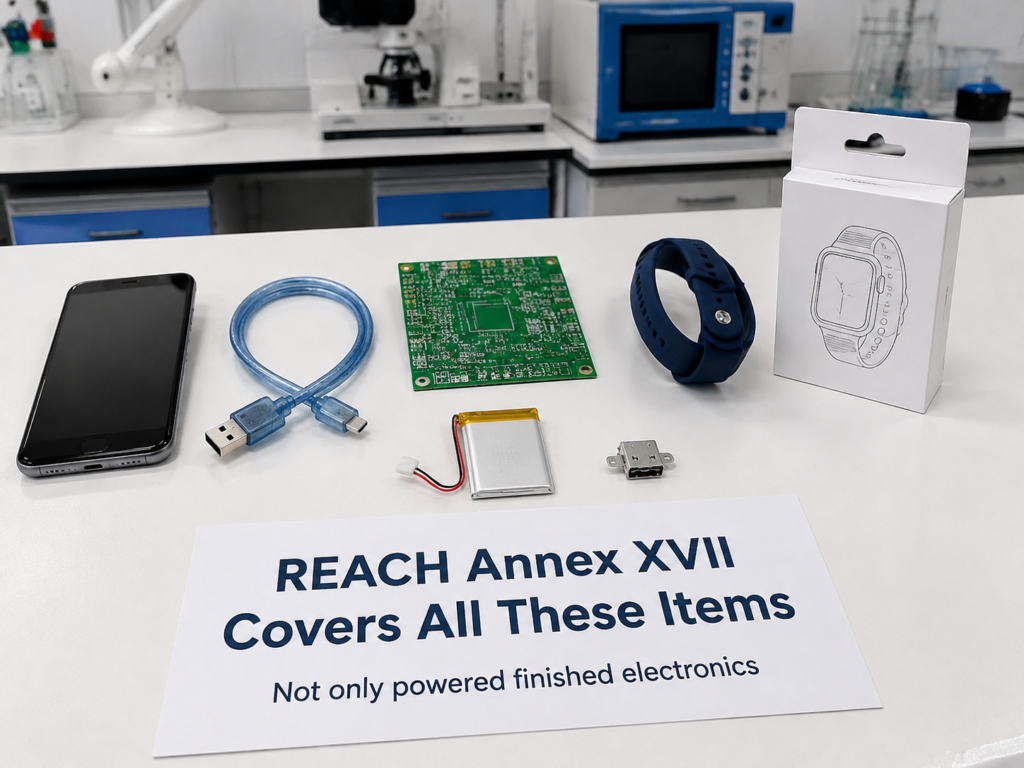
The specific scope of coverage includes: electronic finished products, components, raw materials entering the EU, as well as sales packaging, repair parts, consumer electronics and wearable devices sent via cross-border e-commerce direct mail — for example, when selling mobile phones, if the printing ink on the paper box packaging contains restricted substances, it will also trigger a violation.
Of course, there are some exemption scenarios, such as military electronics, second-hand electronics, specific medical devices, and small-batch samples for research and development. However, it should be noted that all exemptions must be confirmed against the specific entries of Annex XVII. You cannot default that a certain type of product is necessarily exempt. Most exemptions only apply to products with specific uses and specific quantities, and those that do not meet the conditions still need to comply.
2. Frequently Restricted Substances in the Electronics Industry and Corresponding High-Risk Components
There are many types of restricted substances involved in the electronics industry. The following are the 6 most common high-risk substances, which can be quickly checked in combination with products. For core information, please refer to the quick reference table at the end of this section.
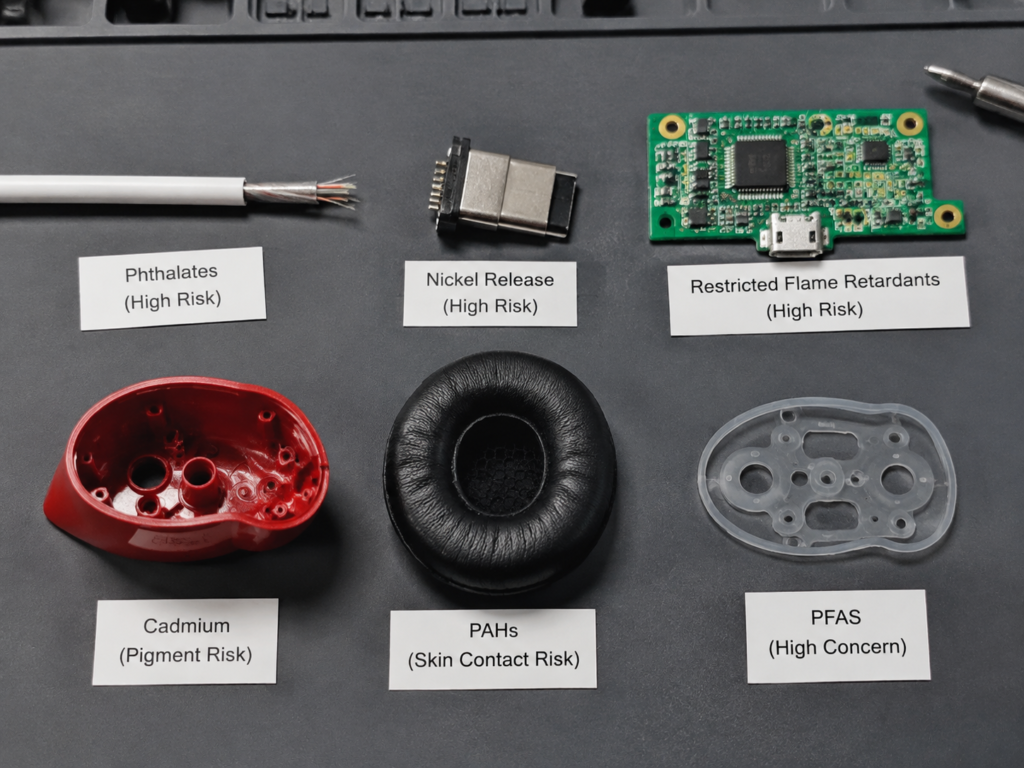
Phthalates (Plasticizers)
Phthalates are the most widely used plastic plasticizers, whose main function is to adjust the elasticity and flexibility of soft plastics and rubber, and they are one of the most commonly encountered restricted substance categories in the electronics industry. Their restriction rules must be checked against the specific entries of Annex XVII. Usually, the total amount or single concentration of relevant phthalates in plasticized homogeneous materials of 0.1% is used as the core judgment threshold. Products clearly classified as children’s products, such as toys and childcare articles, have stricter applicable conditions. It should be noted that you cannot directly apply stricter limits solely based on “children may come into contact”; you should first confirm whether the product falls into the applicable scenarios defined in the entry. Relatively speaking, components made of hard plastics and non-PVC materials have lower risk.
Heavy Metals (Lead, Cadmium, Nickel)
Heavy metals are the most well-known restricted substance category to the public, but the sources of heavy metals in the electronics industry are far more than just solder:
- Lead: High-risk sources include electronic ceramics, housing paint, plastic stabilizers, and some solders. Lead has no universal limit; requirements vary for different uses and products, and need to be queried against specific entries.
- Cadmium: The regulation of cadmium involves multiple regulatory systems: under REACH Annex XVII, cadmium is strictly restricted in uses such as some plastics, coatings, brazing fillers, and metal platings. Common limits can be as low as 0.01% of homogeneous materials, but the specific value needs to be confirmed in combination with the material type and use. Cadmium in batteries also requires separate checking of the special requirements of the EU Battery Regulation, and cannot be judged solely by the rules of Annex XVII. Due to its extremely low limit, cadmium is a high-risk substance that the electronics supply chain needs to focus on.
- Nickel: Many people mistakenly believe that the regulation of nickel targets total content. In fact, the restriction of nickel in Annex XVII is nickel release, that is, the amount of nickel released per unit area per week when in contact with the skin, which has no direct correlation with the total nickel content of the metal itself. High-risk components are metal parts that are in long-term contact with the skin, such as charging ports, headphone pins, and metal contact parts of wearable devices.
Restricted Flame Retardants (Brominated/Chlorinated Paraffin Types)
Flame retardants are almost essential additives in the electronics industry, used to improve the flame retardant performance of materials and reduce the risk of fire. Therefore, they are widely used in components with fire protection requirements such as PCB boards, plastic housings, and cable insulation layers.
Currently, restricted flame retardants in Annex XVII include pentabromodiphenyl ether, short-chain chlorinated paraffins, etc. In most scenarios, the concentration limit for homogeneous materials is 0.1%. Special attention should be paid: “halogen-free flame retardant” does not equal compliance with Annex XVII requirements — halogen-free only means it does not contain halogen elements such as bromine and chlorine, but it may contain other flame retardants listed in the restriction list. The specific chemical name must be verified, and compliance cannot be judged solely based on “halogen-free” publicity.
Per- and Polyfluoroalkyl Substances (PFAS)
PFAS is a general term for a class of per- and polyfluoroalkyl substances. Due to their water and oil repellent and high temperature resistant properties, their application in the electronics industry has gradually increased in recent years, and they are also a core hotspot of EU chemical regulation.
PFOS, PFOA and related substances are already strictly regulated in the EU, but some requirements are mainly implemented through systems such as the POPs Regulation. When judging the PFAS compliance risk of electronic materials, it is necessary to simultaneously check REACH Annex XVII, the POPs Regulation, and the full-category PFAS restriction proposal being promoted by ECHA. Currently, the package restriction of all PFAS is still in the proposal review stage and has not officially taken effect. However, due to its extremely wide coverage and great impact on the electronics industry, it is recommended to pay attention in advance and prepare alternative solutions.
Polycyclic Aromatic Hydrocarbons (PAHs)
Unlike the aforementioned actively added additives, polycyclic aromatic hydrocarbons are harmful impurities generated during the processing of plastics and rubber, which are not actively added by enterprises, but still fall within the scope of regulation.
Annex XVII mainly sets content limits for specific PAHs for rubber/plastic parts that are in direct, long-term or repeated short-term contact with the skin or oral cavity. If the product also involves categories such as toys and children’s products, it may be necessary to separately verify the migration test requirements in other regulations or standards.
Other Restricted Substances to Note
In addition to the above five categories, there are two types of substances that need to be focused on: first, asbestos, which is basically in the category of complete prohibition, with only a very small number of legacy products as exceptions; second, hexavalent chromium, which is commonly found in metal platings and plastic pigments, and has clear concentration limits.
| Restricted Substance Category | Common High-Risk Electronic Components | Core Restriction Logic | Precautions |
|---|---|---|---|
| Phthalates | PVC cables, soft plastic housings, wristbands, headphone cushions | Must be checked against specific entries; the common limit for plasticized homogeneous materials is 0.1% | For children’s products, applicable rules must be confirmed separately; hard plastics and non-PVC materials have lower risk |
| Lead | Electronic ceramics, housing paint, some solders | Limits vary by use, no universal value | Entries must be queried in combination with specific materials and uses |
| Cadmium | Plastic pigments, electroplated coatings, brazing fillers, batteries | Under Annex XVII, limits for some uses are as low as 0.01%; batteries require separate checking of EU Battery Regulation | Extremely low limit, classified as a high-risk substance |
| Nickel | Charging ports, metal contact parts, wearable metal components | Restricts nickel release (per unit area/week) | Unrelated to total nickel content; release testing is required |
| Restricted flame retardants | PCB boards, plastic housings, cable insulation layers | In most scenarios, homogeneous material concentration ≤0.1% | “Halogen-free” does not equal compliance; specific chemical names must be verified |
| PFAS | Waterproof coatings, semiconductor packaging, battery separators | PFOS/PFOA are already strictly regulated under multiple regulations; the full-category PFAS restriction is yet to take effect | A regulatory hotspot in recent years; it is recommended to prepare alternatives in advance |
| PAHs | Tool handles, rubber grips, rubber housings | Content limits for specific PAHs in accessible rubber/plastic parts | Are processing impurities, not intentionally added |
| Asbestos, hexavalent chromium | Legacy insulation parts, metal coatings, plastic pigments | Asbestos is almost completely banned; hexavalent chromium has clear concentration limits | Legacy materials and coated components must be prioritized for inspection |
3. Practical Tools: How to Read the Official Entries of REACH Annex XVII
After understanding high-risk substances, you can query the latest regulatory requirements through official channels to avoid using outdated information. The official free query channel is the REACH Annex XVII section on the official website of the European Chemicals Agency (ECHA). All updates are published as soon as possible, authoritative and real-time. It is not recommended to query through third-party informal channels, so as not to obtain outdated versions.
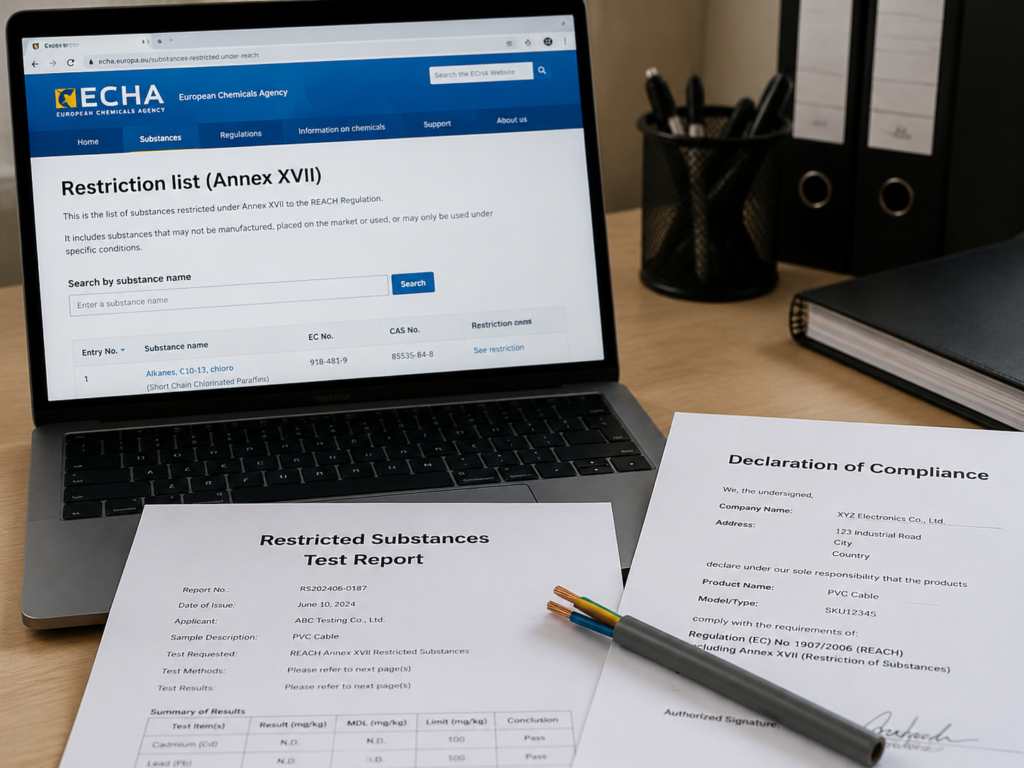
After opening the official list, each restriction entry contains 6 core pieces of information. Sorting them in order allows you to quickly understand:
- Substance name/substance group name: Accompanied by CAS number and EC number — these two are the unique identification numbers of chemical substances, equivalent to “ID numbers”, and will not be confused due to different trade names.
- Entry number: That is, which article of Annex XVII, for quick location and reference.
- Applicable objects: Clearly specifies whether the restriction applies to pure chemical substances, mixtures such as glues/coatings, or specific articles/uses. For example, some restrictions only apply to children’s products, and ordinary consumer electronics do not need to comply, which requires careful verification.
- Limit requirements: Clearly specifies whether it is a concentration limit, release limit, or migration limit, as well as the specific value.
- Effective date and transition period: Some restrictions are not implemented immediately, and a buffer period of several months to several years will be set. After seeing a new proposal, you must first confirm the effective time, and there is no need to panic excessively.
- Exception/exemption conditions: Clearly specifies which industries, products, and uses are not subject to this restriction. For example, some industrial components are exempt but consumer products are not. This part needs to be focused on verification.
3 Common Calculation Bases for Limits (Don’t Get the Denominator Wrong)
After understanding the entries, the most error-prone part is the calculation basis of the limit (i.e., the “denominator” of the limit). Incorrect basis will cause the test report to be completely invalid. There are three common types of basis:
- Homogeneous material limit: The most common type, calculated based on the smallest disassembly unit of the same material. For example, the PVC outer sheath of a data cable is tested separately, and the internal copper wire is tested separately. Note: The test result of mixing and grinding the entire product does not meet the regulatory requirements and is an invalid test.
- Mixture limit: For products that are themselves mixed of multiple substances, such as glues, coatings, and inks, calculated based on the total weight of the mixture.
- Release limit: For example, nickel release is calculated based on the release amount per unit area and per unit time, which is unrelated to the total content of the substance, and cannot be replaced by total content testing.
3 Common Pitfalls to Avoid When Checking the List
When querying the list, there are three high-frequency misconceptions to note:
First, do not query only by trade name. For example, a supplier calls a plasticizer “environmental soft oil”. Searching the trade name directly cannot match the corresponding entry. You must obtain the chemical name or CAS number and EC number to query accurately.
Second, pay attention to the coverage of substance groups. Many entries restrict an entire group of substances. For example, “phthalates” may include dozens of specific chemical substances. You cannot judge full compliance by querying only one or two of them.
Third, the limit of the same substance may vary under different uses and product types. For example, the requirements for phthalates in ordinary consumer electronics and children’s toys are different. You must verify in combination with the use and sales scenario of your own product, and cannot arbitrarily apply a general limit.
4. Compliance Responsibilities of Each Link in the Supply Chain: Who Does What
The compliance responsibility of Annex XVII covers the entire supply chain, and the obligations of different links have their own focuses, not only borne by brand owners.
Upstream Raw Material/Component Suppliers
The core responsibility is to provide true hazardous substance compliance information for the supplied materials, and must not conceal or falsify. Materials to be provided include the compliance declaration (DoC) and material composition sheet. When requested by the customer, corresponding test reports must also be provided. The bottom-line requirement is: electronic materials that do not meet the limit requirements must not be supplied to the EU market.
Midstream Contract Manufacturers/Assembly Plants
The core responsibility is to verify the compliance of incoming materials, and must not put materials into production while knowing they are non-compliant. Specific actions include: establishing a control list of high-risk materials, requesting compliance certificates for incoming high-risk materials, and conducting spot checks when necessary. If the finished product is unqualified due to the use of non-compliant materials, corresponding joint and several liability shall be borne.
Downstream Brand Owners/EU Importers/Cross-Border Sellers
This link is the ultimate bearer of legal liability — no matter what promises upstream suppliers make, as long as there is a compliance problem with the product in the EU market, the regulator will first hold the EU importer or brand owner accountable.
For most electrical and electronic products entering the EU market, information on EU-based economic operators such as importers, authorized representatives, or fulfillment service providers is a general requirement for market supervision. Cross-border sellers need to confirm whether it is necessary to designate an EU responsible person in combination with specific regulations applicable to the product, such as CE, RoHS, battery, and radio equipment regulations. The compliance responsibility of REACH Annex XVII always rests with the relevant operators who place the product on the EU market, who bear the ultimate verification obligation.
The core work to be completed by downstream entities includes: finished product compliance assessment, preservation of compliance documents, and cooperation with regulatory spot checks. At present, mainstream cross-border e-commerce platforms will verify relevant compliance certificates. Non-compliant products will be directly removed from the shelves, and in severe cases, accounts will be frozen.
2 Key Notes on Responsibility Coordination
Regarding the division of responsibilities, there are two key points to clarify:
First, non-EU suppliers do not directly bear EU legal liability. That is to say, EU importers cannot relax their verification solely based on the “compliance” promises of domestic suppliers. Once a problem occurs, EU regulators will hold the domestic importer accountable, not the overseas supplier.
Second, it is recommended to clarify three types of clauses in the supply chain contract: first, the supplier must truthfully disclose the substance composition; second, formula/process changes must be notified in advance; third, the rules for dividing compliance responsibilities, to avoid shifting blame to each other after problems occur.
5. 6-Step Practical Process for Annex XVII Compliance Assessment of Electrical and Electronic Equipment
For the compliance judgment of specific products, you can systematically proceed according to the following 6 steps to ensure accurate conclusions:
Step 1: Confirm Whether the Product Falls Within the Regulatory Scope
First complete three checks: first, whether the product needs to enter the EU market (including cross-border e-commerce direct mail); second, whether there are corresponding exemption scenarios — must be confirmed against specific entries, and cannot be defaulted as exempt; third, whether附属 items such as sales packaging and repair parts are included in the verification scope to avoid omissions. After confirming that the product falls within the regulatory scope, proceed with the subsequent steps.
Step 2: Disassemble the Product and Identify High-Risk Components
Disassemble the product into the smallest homogeneous material units, then screen out high-risk components for key verification. High-risk components mainly include: PVC cables, soft plastic/rubber parts, coatings/paints, metal contact parts, PCBs, batteries, and grip parts.
Pure metal, glass, and additive-free ceramic components, on the premise of no coating, no paint, no plating, no pigment/glaze, and supported by supplier compliance documents, can be used as lower-priority inspection objects. If there are surface treatments, coloring processes, long-term skin contact scenarios, or unknown compositions, they still need to be included in the key verification scope.
Step 3: Match with Annex XVII Restriction Entries
Match the screened high-risk components with Annex XVII entries one by one. The matching logic is: first screen by substance/material category. For example, soft plastic parts are优先 checked for phthalates and PAHs, and metal contact parts are优先 checked for nickel release and hexavalent chromium. Then verify the specific limits according to use (whether accessible, whether it is a children’s product) and product type. If you encounter composite materials with unknown composition, directly ask the supplier to provide composition information, without guessing by yourself.
Step 4: Verify Exemption and Exception Conditions
After matching the corresponding entry, first check the exception and exemption conditions in the entry: does this restriction cover the use and sales scenario of your own product? Are there industry, product, or time-level exemptions? If you meet the exemption conditions, you need to keep the corresponding supporting materials, clarify the valid period of the exemption, and ensure that you can provide the basis during regulatory spot checks.
Step 5: Determine Whether Additional Testing Is Required
Not all products require third-party testing, which can be judged according to the actual situation:
- Scenarios requiring testing: New suppliers cannot provide compliance certificates, material formula/process has changed, high-risk children’s electronics or wearable devices.
- Scenarios not requiring testing: Complete supply chain compliance documents are available, and the material belongs to the low-risk category.
If testing is required, samples must be taken according to homogeneous materials, and the test type must correspond to the regulatory basis. For example, nickel release cannot be tested for total content, and release testing must be carried out.
Step 6: Draw a Compliance Conclusion
Based on the aforementioned verification results, draw a clear compliance conclusion:
- Compliant: Organize all compliance evidence and file them by batch.
- Insufficient information: Listed as pending confirmation, and cannot be directly judged as qualified.
- Non-compliant: Immediately stop using the material and launch an alternative solution or rectification process.
- Conditionally compliant: Clarify the applicable market, use, and valid period to avoid out-of-scope use.
6. How to Judge Compliance Evidence: Are Supplier Declarations/Test Reports Valid?
The core basis for compliance judgment is the compliance declaration and test report provided by the supplier. However, many practitioners do not know how to judge the validity of documents, and only accept them when they see the word “qualified”, which ultimately leads to risks.
Key Audit Points for Valid Supplier Compliance Declarations
The following 5 pieces of information can be used as the minimum audit elements for a supplier’s compliance declaration. Missing any one should be listed as a compliance risk, and the supplier should be required to supplement and improve before acceptance:
- Clearly covered product/component models and material scope — must not generally claim that “all products comply with REACH”.
- List of involved restricted substances and compliance status — need to list the specific compliant entries and corresponding restricted substances, and cannot only write “comply with REACH requirements”.
- Applicable REACH Annex XVII version/query date — the list is continuously updated, and there must be a clear time node.
- Limit basis and applicable use description — for example, “homogeneous material concentration 0.1%, applicable to consumer electronics accessible to the general public”.
- Declaring entity, date, contact person, and liability commitment — must have a seal or authorized person’s signature, and can be traced to the specific responsible person.
Common characteristics of invalid declarations include: only writing “comply with REACH” without specifying specific entries, general declarations without specific material/model scope, oral promises without seal/signature, declarations that have expired or correspond to old versions of regulations. Such declarations cannot be used as the basis for compliance.
Correct Way to Read Test Reports
After getting the test report, you cannot only look at the final “qualified” conclusion. You need to focus on verifying the following content:
First, whether the test sample is consistent with the actual mass-produced material (material, process, supplier) — test reports of other models or other batches provided by the supplier, even if the material category is the same, cannot represent that the currently purchased material is qualified.
Second, whether the test type corresponds to the regulatory requirements — for example, for the restriction of nickel release, a report of total nickel content cannot be used instead. A report with mismatched test items has no reference value.
Third, whether the limit of detection is lower than the regulatory limit — for example, the limit for cadmium is 0.01%; if the report’s limit of detection is 0.05%, even if it is marked “not detected”, the report is invalid, because its detection capability cannot cover the limit requirement.
Fourth, whether the test unit and calculation basis are consistent with the regulatory requirements — for example, whether sampling is carried out according to homogeneous materials, and whether there is mixed sample testing.
Fifth, whether the test date is earlier than the change time of the material formula, process, or supplier — as long as the formula, process, or supplier changes, the original test report automatically becomes invalid.
4 Scenarios Where You Cannot Rely Solely on Test Reports
In the following four scenarios, even if there is a test report, additional verification is required, and it cannot be directly accepted:
- The regulation restricts the use, not simply the substance content — for example, some substances are only allowed for industrial products and cannot be used for consumer electronics, even if the content meets the standard, it is still a violation.
- The test sample cannot represent materials of all colors, batches, or structures — for example, a test pass for red plastic does not mean that black plastic is qualified, because the pigment formula may be different.
- After the supplier changes the formula, the original test report automatically becomes invalid, and test data needs to be provided again.
- What is restricted is a substance group, but the report only covers some of the substances — for example, phthalates include dozens of substances, and the report only tests 5 of them, which cannot prove full compliance.
7. 7 Industry-Specific Compliance Misconceptions and Pitfall Avoidance Guides for the Electronics Industry
There are 7 common types of compliance misconceptions in the electronics industry, which even experienced practitioners may fall into, so special attention is required:
Misconception 1: RoHS Compliance = REACH Annex XVII Compliance
Truth: The two are independent compliance requirements, with non-overlapping regulatory scopes and numbers of substances. RoHS compliance cannot replace Annex XVII compliance; for specific differences, refer to the earlier concept comparison.
Pitfall avoidance: RoHS and Annex XVII must be verified separately; the same compliance document cannot be used to meet both requirements.
Misconception 2: Restricted Substances = Cannot Be Present at All
Truth: The vast majority of restricted substances have concentration or release thresholds; products below the threshold can be circulated normally. Only a very small number of substances (such as asbestos) are almost completely banned. It is particularly important to note that the calculation basis for limits is homogeneous materials, not the total weight of the entire product, to avoid misjudgment due to incorrect understanding of the basis.
Pitfall avoidance: First check the specific limits and calculation basis; do not discard a material immediately upon seeing the word “restricted”.
Misconception 3: Only Finished Products Need to Comply, Components Do Not
Truth: Non-compliant raw materials or components will directly lead to non-compliant finished products, and all links in the supply chain must bear corresponding responsibilities. If problems are only discovered after the finished product is assembled, rework costs are extremely high, and may even lead to the entire batch being scrapped.
Pitfall avoidance: Implement control from the material selection stage; verify component compliance before assembling finished products, and control risks at the front end.
Misconception 4: The Annex XVII List Is Fixed and Unchanging
Truth: The EU revises Annex XVII every year, adding new restricted substances or tightening existing limits. Recent adjustments include expanding the regulatory scope of phthalates, advancing full-category regulation of PFAS substances, and tightening limits for multiple flame retardants and heavy metals.
Pitfall avoidance: Follow ECHA regulatory updates every six months; after seeing relevant proposals, evaluate alternatives for high-risk materials in advance, and do not wait until they officially take effect to start responding.
Misconception 5: Only Metal Parts Contain Heavy Metals
Truth: Pigments and stabilizers in plastics, as well as additives in adhesives, may contain heavy metals such as lead and cadmium, and in some scenarios the content is not low.
Pitfall avoidance: Do not directly determine whether heavy metals are present based solely on material category; compliance certificates or test results shall prevail.
Misconception 6: “Nickel-Free” = Nickel Release Compliance
Truth: The restriction requirement for nickel is release amount, which has no direct correlation with total nickel content — even if a material contains nickel, as long as the coating is stable enough and the release amount is below the limit, it is compliant. Conversely, even if a product claims to be “nickel-free”, if the coating process is poor and impurities are present, the release amount may still exceed the limit.
Pitfall avoidance: Nickel release test reports must be verified for metal contact parts; compliance cannot be determined solely based on total nickel content or “nickel-free” claims.
Misconception 7: Having a “REACH Certificate” Equals Full Compliance
Truth: There is no universal “compliance certificate” for REACH that applies to all products. All compliance assessments are for specific substances, specific products, and specific uses; a single certificate cannot cover all scenarios.
Pitfall avoidance: After receiving a so-called “REACH certificate”, first verify the scope of substances, products, and uses it covers, and confirm a match before accepting it as valid.
8. Long-Term Compliance: Regulatory Follow-Up and Basic Management Checklist
Compliance is not a one-time job. Due to continuous regulatory updates and constant changes in products and supply chains, it is necessary to establish a long-term dynamic management mechanism. Without daily high-frequency follow-up, you can also ensure that compliance does not fall behind.
High-Impact Regulatory Items That Have Taken Effect and Are Pending Implementation
You can focus on high-impact regulatory items related to the electronics industry and prepare responses in advance:
- Revisions that have taken effect: Expanded regulatory scope of phthalates, upgraded regulation of short-chain chlorinated paraffins, and restrictions on PFOS and PFOA substances implemented through the POPs Regulation and REACH supporting measures. These requirements are now officially implemented, and products must be ensured to comply with the corresponding rules.
- Pending proposals: Full-category PFAS restriction, new brominated flame retardant regulation, tightening of heavy metal exemptions, etc. If officially implemented, they will have a great impact on细分 fields such as consumer electronics, semiconductors, batteries, and wearable devices. It is recommended to pay attention in advance.
Practical Channels for Following Regulatory Changes
To follow regulations, you do not need to browse the ECHA official website every day. You can efficiently obtain information through the following channels:
The most authoritative channel is the REACH section on the ECHA official website, where all official updates are published as soon as possible and are available for free.
If you find it inefficient to sort out the official website content by yourself, you can also follow the update notifications of electronics industry associations and compliance service providers. Such institutions will screen out content related to the electronics industry, so practitioners do not need to search from hundreds of entries by themselves.
The recommended follow-up rhythm is: centrally sort out regulatory updates every six months. If there are proposals related to your own products, evaluate the feasibility of alternatives for high-risk materials in advance, so that you can make a smooth transition when they officially take effect.
Basic Compliance Management Checklist for Electronics Enterprises
Electronics enterprises do not need to build a complex compliance system at the beginning. By doing the following four things well first, you can cover more than 80% of compliance risks:
- Product side: Establish a material BOM list, mark the material, use, whether it is high-risk, and whether it is in contact with the skin/used for children’s scenarios for each component, to facilitate quick troubleshooting.
- Supplier side: Require all suppliers to provide compliance declarations with clear scope, and reject general declarations; stipulate in the contract the obligation of advance notification for formula, process, and supplier changes.
- Change management: As long as there is any change in materials, suppliers, or formulas, re-evaluate compliance. Do not take it for granted that “changing the color will not be a problem”. Many violations are caused by small changes.
- Record management: Compliance information related to REACH obligations should generally be kept for at least 10 years from the date of the last manufacture, import, supply, or use of the relevant substances, mixtures, or articles. Enterprises can internally file supplier declarations, test reports, and compliance assessment records by product batch, to ensure that they can be traced to the corresponding materials and production batches during regulatory spot checks.
9. Core Compliance Competency Checklist
After mastering the aforementioned methods, you can build the following 7 core compliance competencies, covering the full-process needs of REACH Annex XVII compliance in the electronics industry:
- Able to quickly judge whether electronics-related products fall within the regulatory scope of REACH Annex XVII, clarify the verification requirements for exemption scenarios, and avoid misjudging the applicable boundaries.
- Able to accurately locate high-risk components such as PVC cables, soft plastic parts, coatings, and metal contact parts by disassembling the product BOM, improving verification efficiency.
- Able to understand the official entry structure of Annex XVII, proficiently query the latest regulatory requirements through the ECHA official website by CAS number and entry number, without relying on outdated third-party information.
- Able to complete product compliance judgment according to the 6-step process, accurately distinguish the four types of conclusions: compliant, conditionally compliant, insufficient information, and non-compliant, to avoid arbitrary judgment.
- Able to audit the validity of supplier compliance declarations and test reports, and confirm that the covered models, materials, uses, and limit bases match their own products.
- Able to avoid the 7 common types of compliance misconceptions in the electronics industry, and reduce the risk of violations in front-end material selection and supply chain management.
- Able to establish a regular regulatory follow-up and material change review mechanism to achieve long-term dynamic compliance, without passively responding to regulatory changes.
The compliance management of REACH Annex XVII seems to involve a large number of substances and complex entries, but its core logic always revolves around “identifying high-risk materials – matching corresponding regulatory requirements – verifying supply chain compliance evidence”. Shifting compliance control to the front end of material selection and supply chain management, rather than waiting until the finished product clears customs or undergoes a platform spot check to take remedial measures, is the core idea for the electronics supply chain to reduce compliance costs and avoid violation risks.