
Practitioners engaged in exporting electronic products to the EU have most likely heard of REACH, but many people’s first reaction is: Isn’t that a regulation for chemical products? What does REACH have to do with the headphones, power banks, and smart watches I sell? It is not until downstream customers demand Substances of Very High Concern (SVHC) declarations, or even products cannot enter the EU market due to compliance issues, that they come to understand: the information communication obligation under REACH is an important rule covering the entire supply chain from raw materials to end products. Electronic products, due to their long supply chains and diverse materials, instead fall into a high-risk category.
Basic Understanding: Core Definitions and Relevance to Electronic Products
What are REACH Information Communication Obligations?
Simply put, these are statutory rules requiring relevant entities in the supply chain to communicate information on chemical risks in products. The core legal basis is Article 33 (for SVHCs in articles) and the relevant provisions of Article 31 on Safety Data Sheets (SDS) for hazardous chemicals of the EU Regulation on Registration, Evaluation, Authorization and Restriction of Chemicals (abbreviated as REACH).
Its core purpose is not to prohibit the use of certain types of substances, but to enable all links in the supply chain to be aware of the situation of hazardous chemicals in products, and to ensure safety throughout the entire process of use, disassembly, and recycling.
There are two core daily scenarios: first, routine information communication between upstream and downstream of the supply chain; second, when consumers make inquiries to merchants within the EU, the merchants must provide a free reply within 45 days.
Why is the Electronic Product Supply Chain a High-Risk Scenario?
Compared with ordinary fast-moving consumer goods, electronic products have higher supply chain compliance difficulties, mainly for the following reasons:
First, there are many supply chain tiers. From plastic pellets, components, assembly plants to brand owners and importers, there are often four or five tiers or even more. The longer the information communication chain, the more likely omissions or distortions will occur.
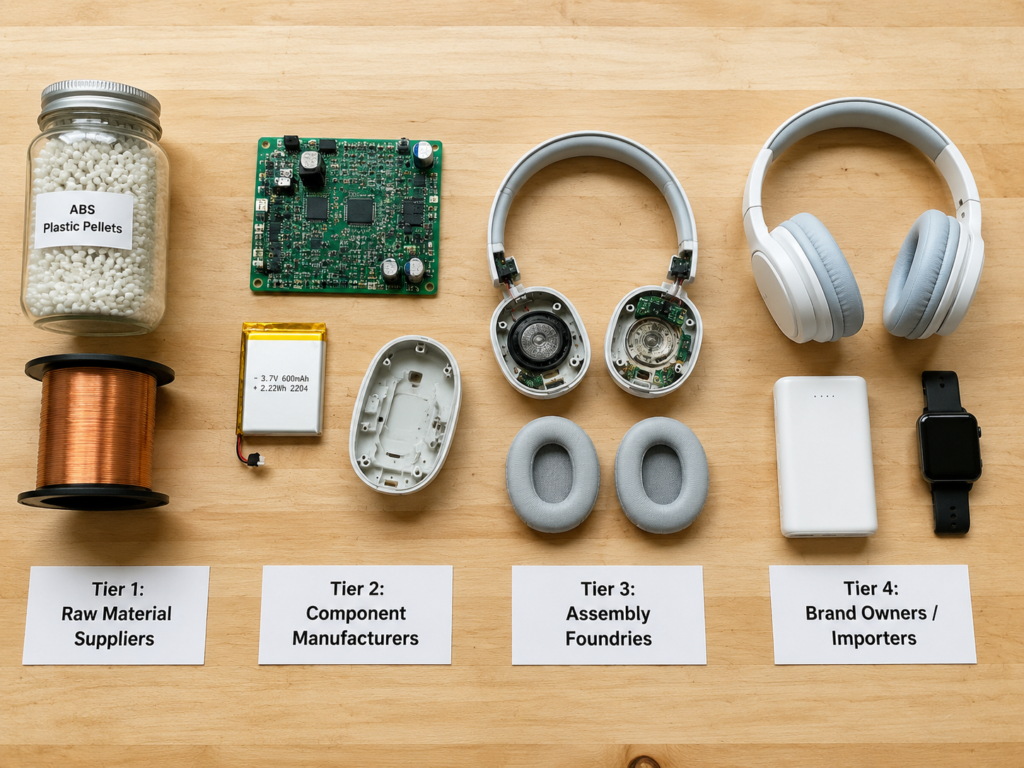
Second, the types of materials are diverse. Plastics, solders, batteries, adhesives, cleaning agents, etc., all belong to high-risk material categories, with a higher probability of triggering compliance requirements.
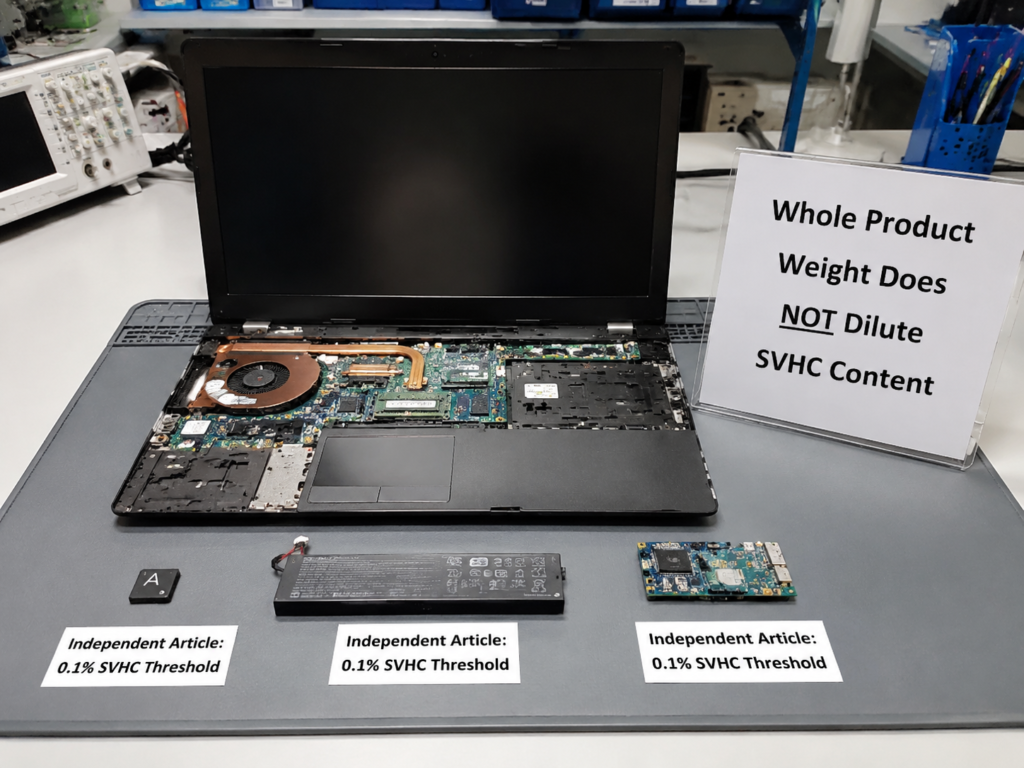
Third, the product structure is complex. The SVHC threshold must be calculated based on components with independent attributes (see the rules later), and cannot be diluted by the weight of the whole product, so higher precision is required for compliance judgment.
Fourth, regulations are dynamically adjusted. The SVHC Candidate List is usually updated twice a year, but the specific situation shall be subject to the latest current version and effective date on the ECHA official website; after new substances are added to the list, materials that were compliant last year may no longer meet the requirements this year, and compliance conclusions are not static.
If relevant obligations are not fulfilled, one may face rectification requirements, administrative penalties, market access restrictions from competent authorities of EU member states, or commercial losses due to rejection by downstream customers; specific law enforcement measures depend on the facts of the violation and the regulatory rules of the member state.
6 Basic Misconceptions to Clarify for Beginners
Many people fall into these pitfalls when they first come into contact with REACH. Clarifying them in advance can save a lot of detours:
- Only merchants that sell directly to the EU are responsible? Wrong. Entities such as article suppliers, importers, and distributors within the EU have direct statutory obligations; non-EU enterprises are usually not the direct targets of REACH enforcement, but if their supplies enter the EU, they still need to provide data support to importers/brand owners.
- REACH only regulates chemicals, not electronic products? Wrong. The parts and materials of electronic products all fall within the regulatory scope of REACH. As long as an article contains high-risk substances that meet the requirements, the relevant obligated entities must fulfill the information communication obligation.
- Having CE/RoHS certification automatically complies with REACH? Wrong. The regulatory logic and scope of the two types of regulations are completely different. RoHS targets specific restricted substances in electrical and electronic products, while REACH covers far more substances and is not limited to the electronics industry.
- Containing SVHC will lead to a sales ban? Wrong. The information communication obligation is not the same as a prohibition obligation. SVHCs are only “of very high concern” and require disclosure of their presence; only substances that are subsequently added to the restriction list or authorization list will be prohibited or restricted from use.
- A single declaration from the supplier is permanently valid? Wrong. The SVHC Candidate List is usually updated twice a year. When material compositions or suppliers change, compliance information also needs to be updated again. There is no such thing as a one-time solution.
- There is a unified “REACH certification certificate”? Wrong. REACH is a continuous compliance obligation, and there is no unified certificate covering all requirements. Most of the common “REACH certifications” on the market are test reports for a specific material, and cannot be equated with a full compliance certificate.
Obligated Entities: Division of Responsibilities for Each Role in the Supply Chain
Division of Obligations for Each Link in the Electronics Industry
REACH responsibilities are implemented tier by tier according to the supply chain link and the location of the entity, and the obligation boundaries of different roles are clearly distinguished:
- Upstream material/component suppliers (plastic pellet, PCB, chip, battery factories, etc.): If they are suppliers of substances/mixtures/articles within the EU, they need to fulfill the direct information communication obligations corresponding to their category; if they are non-EU suppliers, they have no direct EU statutory obligations, but need to provide complete material chemical information to downstream parties (especially EU importers) to assist downstream parties in fulfilling their compliance obligations.
- Mid-stream assembly foundries (EMS factories, etc.): If they are article suppliers within the EU, they need to fulfill information communication obligations for the finished/semi-finished products they supply; non-EU foundries have no direct EU statutory obligations, but need to summarize upstream component information and provide it to downstream importers as a basis for product compliance. If the communicated information is untrue, they may need to bear corresponding responsibilities in accordance with the supply chain contract. It is recommended to conduct necessary verification of upstream information on high-risk materials rather than directly forwarding it.
- Market supply entities within the EU: Importers are the key entities that introduce articles into the EU market, and need to ensure that imported products meet REACH-related requirements, including communicating necessary information to downstream parties and responding to consumer inquiries; domestic article manufacturers/brand owners, if they produce and place products on the market by themselves, need to bear the information communication obligations for the corresponding articles; distributors need to ensure that the products they sell meet compliance requirements, and when receiving consumer inquiries, they must reply in accordance with regulations or coordinate with upstream parties to provide information. EU regulatory authorities usually prioritize contacting domestic market supply entities to conduct investigations.
- Non-EU suppliers: They have no direct REACH statutory obligations, but need to provide complete compliance data to EU importers to ensure that downstream parties can smoothly fulfill compliance requirements for the EU market.
Core Judgment Logic for Different Types of Obligations
The information communication obligations under REACH are not unified rules, and need to be judged separately in combination with the type of obligation, one’s own role, and product attributes. There are three core common scenarios:
- Article SVHC information communication (Article 33): All of the following must be met simultaneously — ① One is an article supplier/importer/distributor within the EU, or a non-EU supply chain enterprise that needs to provide compliance support to downstream parties; ② The supplied article contains substances on the SVHC Candidate List, and the mass proportion reaches the statutory trigger threshold; ③ The article is placed on the EU market (including situations of provision to third parties such as sale, gifting, and exhibition participation).
- Safety Data Sheet (SDS) communication (Article 31): All of the following must be met simultaneously — ① One is a substance/mixture supplier within the EU, or a non-EU supplier that needs to provide compliance support to downstream parties; ② The supplied substance/mixture meets the trigger conditions specified in Article 31 of REACH; ③ The substance/mixture is supplied to the EU market.
- Restricted substance compliance certificate (Annex 17): REACH does not uniformly require the communication of restricted substance compliance declarations, but downstream customers or regulators may require relevant certificates; it is necessary to first judge whether the product meets the restriction requirements according to the specific entries of Annex 17, and then provide corresponding materials according to demand.
It should be noted that whether samples for internal R&D are exempted depends on whether they are supplied to third parties and whether they fall under the exceptions to the scope of REACH application. “Small quantity” alone cannot be used as a basis for exemption; exemptions for products in special fields must comply with relevant EU and member state regulations, and cannot be determined independently.
2 Common Pitfalls in Entity Responsibilities
These two are the most common mistakes in the industry, and must be avoided in advance:
First pitfall: No need to communicate if no downstream inquiry is received. SDS for hazardous chemicals that meet the trigger conditions must be proactively communicated along with the goods, without requiring downstream requests; for article SVHC information, article suppliers within the EU shall provide relevant information sufficient to ensure safe use to downstream recipients when supplying articles; if consumers make inquiries, a free reply must be provided within 45 days.
Second pitfall: Foundries only need to forward upstream information and are not responsible. If a foundry directly supplies articles to the EU market, it is responsible for the compliance of the information it communicates; even for non-EU foundries, if downstream losses are caused by forwarding untrue information, they may also face contractual liability. It is recommended to conduct necessary verification of upstream information on high-risk materials.
Boundaries of Regulated Objects: How to Distinguish Substances/Mixtures/Articles, and How to Calculate for Electronic Products
To figure out what you need to communicate, you first need to understand which category of REACH regulation your product falls into — the regulatory logic of different categories is completely different, especially the boundaries of threshold calculation, where many people fall into pitfalls.
Plain-Language Distinction of the Three Types of Regulated Objects
REACH divides regulated objects into three categories, and the core of judgment is function source and supply form, rather than simply looking at the shape:
- Substance: A single chemical component, whose own function is determined by its chemical properties, such as pure copper metal and single-component chemical additives.
- Mixture: Composed of two or more substances mixed according to a formula, whose function mainly comes from the chemical action of each component, and has no fixed use form, such as solder paste and electronic glue.
- Article: Obtains a specific shape, surface or design during the production process, whose function is mainly determined by these morphological attributes rather than chemical composition, such as plastic shells, circuit boards, and complete machines.
Examples of Common Classifications of Electronic Products
It is easy to understand by matching common materials in electronic products to the categories:
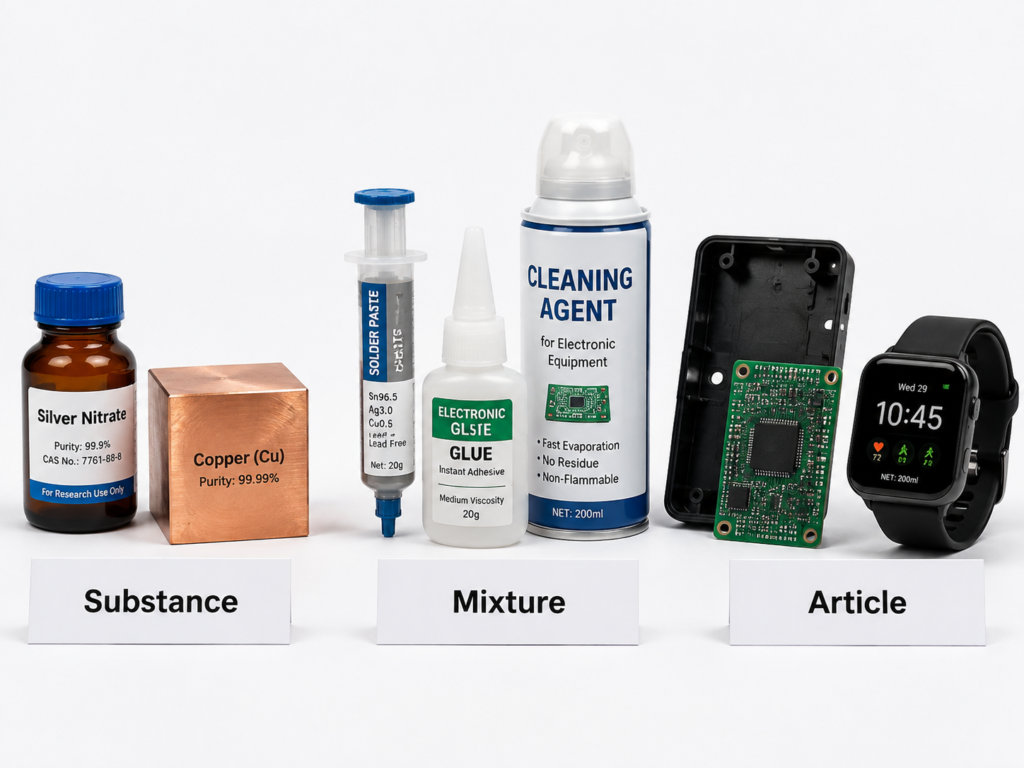
- Substances: high-purity metal raw materials, single-component chemical additives.
- Mixtures: solder paste, flux, adhesives, coatings, cleaning agents, electrolytes.
- Articles: plastic shells, metal structural parts, circuit boards, wiring harnesses, battery cases, complete machines.
There is another detail that is easy to miss: product packaging, labels, and protective films, as long as they are placed on the EU market together with the product, also need to be judged for compliance separately, and cannot be defaulted as not counted. Specific classification needs to be judged in combination with the actual function source to avoid mechanical application.
Core Judgment Rules for Article Boundaries
This rule directly determines the calculation base of the SVHC threshold, and is the core of electronic product compliance:
The threshold is calculated in units of separable components with independent article attributes, and the SVHC content of a single independent component cannot be diluted by the total weight of the whole product. For example, the keyboard keys of a laptop are independently produced, have a fixed shape and function, and count as an independent article. If the SVHC in the keys exceeds the statutory threshold, even if the entire computer weighs 1 kilogram, the content cannot be “diluted” below the compliance line by the weight of the whole machine.
For complex electronic products such as mobile phones and computers, the tier to which they need to be disassembled must be judged based on factors such as the supply form of the components, whether they maintain independent functions, and whether they are separable. There is no need to mechanically disassemble down to every screw and every tiny part — this is not an exemption based on the size of the part, but depends on whether the component still maintains independent article attributes in the complex article; as long as it maintains independent article attributes, even if the weight is very small, its SVHC content cannot be diluted by the weight of the whole machine. For details, please refer to the article judgment guidelines issued by ECHA and relevant EU court precedents.
It should also be noted that “not intentionally added” is not equal to compliance. If SVHCs are introduced by impurities or recycled materials, as long as the content exceeds the threshold, the information communication obligation still needs to be fulfilled, and there is no automatic exemption due to unintentional addition.
Core Communication Content: 3 Types of Key Information to be Communicated for Electronic Products
With the regulated objects clarified, the next most core point is: what exactly needs to be communicated? The common communication content in the electronic product supply chain is divided into three categories, each with different trigger conditions and requirements.
Category 1: Communication Requirements for Substances of Very High Concern (SVHC) (Article 33)
What is SVHC?
The full name of SVHC is the “Candidate List of Substances of Very High Concern”, which includes high-risk substances identified by the EU, including carcinogenic, mutagenic, reprotoxic (CMR) substances, persistent, bioaccumulative and toxic (PBT) / very persistent and very bioaccumulative (vPvB) substances, and other substances with an equivalent level of concern.
The SVHC Candidate List is maintained and published by ECHA. Candidate substances can be proposed by member states or ECHA according to procedures and confirmed through relevant EU procedures; the list is usually updated twice a year, and all compliance judgments must be based on the latest current version and effective date published on the ECHA official website.
Trigger Conditions and Content to be Communicated
Trigger conditions: When the mass proportion of substances on the SVHC Candidate List in an independent article reaches or exceeds 0.1% w/w, the information communication obligation stipulated in Article 33 is triggered; this approach is also a common management method in enterprise practice, which can avoid compliance risks caused by boundary value judgment errors and detection uncertainties. The threshold is calculated in units of independent articles, and the specific rules are detailed in the previous “Article Boundary Judgment” section.
Content to be communicated:
- Statutory minimum requirement: Provide information sufficient to ensure the safe use of the article, at minimum clarifying the name of the SVHC substance (unique identifiers such as CAS number and EC number can be attached to avoid confusion due to duplicate names).
- Supplementary information recommended in practice: To meet downstream traceability, compliance declaration and safety management needs, it is recommended to also provide information such as the component/location where the substance is present, content range, and precautions for safe use/disassembly/disposal.
In response to consumer inquiries, SVHC information related to the safe use of the article must be provided free of charge within 45 days.
Common Trigger Scenarios in the Electronics Industry
Common categories of substances in electronic products that may trigger the SVHC communication obligation include: certain phthalates and short-chain chlorinated paraffins in plastic shells and wires, specific flame retardants in PCBs, certain cobalt compounds in batteries, etc. Whether the obligation is actually triggered needs to be checked against the specific substances on the current SVHC Candidate List, the concentration in the corresponding article, and the result of article boundary judgment, and cannot be generalized.
Category 2: Safety Data Sheet (SDS) Communication Requirements (Article 31)
What is SDS?
SDS is the “safe use instruction manual” for hazardous chemicals, which details information such as material storage requirements, operation precautions, emergency treatment methods, and waste disposal rules. It is a standard document used in conjunction with the EU Classification, Labelling and Packaging Regulation (abbreviated as CLP Regulation).
Trigger Conditions and Content to be Communicated
Trigger conditions: According to Article 31 of REACH, SDS must be provided when supplying the following substances or mixtures:
- Substances or mixtures classified as hazardous chemicals according to the EU CLP Regulation;
- Mixtures that are not classified as hazardous as a whole, but contain hazardous ingredients, PBT/vPvB substances, SVHCs, or substances with EU statutory occupational exposure limits that reach the specified concentrations, and meet other trigger conditions stipulated in REACH; specific concentration thresholds must be checked against Article 31 of REACH and CLP classification results;
- It may also be necessary to provide SDS when downstream users or distributors make requests in accordance with the law.
Content to be communicated:
- SDS documents in compliance with EU standard format;
- If the supplied substance has completed REACH registration and the registration dossier includes exposure scenarios, the exposure scenarios must be communicated as part of the extended SDS to explain the conditions for safe use.
Language requirements: SDS must be provided in the corresponding official language version in accordance with the statutory requirements of the EU member state where the supply takes place; when supplying cross-border to multiple member states, the language requirements of each destination country must be checked one by one, and English cannot be defaulted as universally applicable.
Common Trigger Scenarios in the Electronics Industry
In the electronics industry, suppliers of chemical auxiliary materials such as solder paste, electronic glue, cleaning agents, and coatings must proactively provide the corresponding SDS to downstream customers such as assembly plants when supplying goods, if the supplied materials meet the SDS trigger conditions.
Category 3: REACH Restricted Substance Compliance Certificate (Annex 17)
What are REACH Restricted Substances?
Annex 17 of REACH lists restricted substances, that is, substances whose use is prohibited or strictly restricted in specific products and specific scenarios, with a higher regulatory intensity than the SVHC Candidate List — the core requirement of SVHC is “information disclosure”, while the core requirement of restricted substances is “they cannot be placed on the market if they do not meet the restriction rules”.
Each restriction in Annex 17 has a clear scope of application, including the corresponding substance, product category, concentration limit, implementation date, and exemption conditions, which must be checked item by item and cannot be applied generally.
Common Demands for Compliance Certificates
REACH does not uniformly stipulate that the supply chain must communicate restricted substance compliance declarations, but in actual business, downstream customers and EU regulatory authorities may require relevant certification materials to confirm that products meet the restriction requirements of Annex 17.
Common certification materials include: compliance declarations for specific restriction entries, third-party test reports, etc. It should be noted that the certification materials must correspond to the specific restriction entries in Annex 17, rather than generally claiming to “meet REACH restriction requirements”.
Common Relevant Restriction Entries in the Electronics Industry
Restriction entries in Annex 17 that are more commonly involved in the electronic product supply chain include: cadmium content restrictions in certain plastic products, restrictions on specific phthalates in toys and children’s products, and lead content restrictions within specific uses or specific product ranges, etc.
Special attention should be paid: the routine restrictions on substances such as lead, mercury, and cadmium in electrical and electronic products mainly fall under the regulatory scope of the EU RoHS Regulation, but if they involve lead restriction entries separately listed in Annex 17 of REACH, they still need to be checked separately according to the scope of application, limit values, and exemption conditions of the corresponding entries; lead exemptions in RoHS cannot be automatically equated with compliance with Annex 17 of REACH. The two have different legal bases and scopes of application, and need to be judged separately.
Basic Distinction of Easily Confused Relevant Requirements
In addition to the above three types of core information communication requirements, there are two other compliance obligations that are often confused. It is only necessary to first clarify that they do not belong to the same category as information communication obligations:
- Article 7(2) Notification: This is an official notification obligation that article manufacturers or importers within the EU must fulfill to ECHA. The trigger condition is “the concentration of SVHC in the article exceeds 0.1% w/w, and the total amount of the substance placed on the EU market per year exceeds 1 ton”. It does not belong to routine information communication between upstream and downstream of the supply chain. If it can be proven that the substance will not be exposed to humans or the environment under normal use and reasonably foreseeable use conditions, an exemption from notification can be applied for in accordance with regulations, but the information communication obligation is not affected by this exemption.
- SCIP Database: This is a declaration requirement under the EU Waste Framework, mainly used to improve the safety of waste treatment. The declaring entities are manufacturers, importers, distributors, etc. that supply articles containing SVHC (concentration exceeding 0.1% w/w) to the EU market. Its data can reuse SVHC-related information, but the obligated entities, declaration purposes, and information communication obligations are all different.
Basic Practice: Full Process of Supply Chain Information Communication
Knowing what to communicate, the next step is how to communicate specifically, when to communicate, and what records to keep. If these practical details are not done properly, problems will still arise.
Common Communication Forms in the Electronics Industry
Common information communication forms in the electronics industry are divided into the following categories. Different forms correspond to different obligation scenarios and cannot replace each other:
- Material Compliance Declaration (MCD): A written statement issued by the supplier, listing the chemical control status of the material. It is the most commonly used form of SVHC and restricted substance compliance information communication in the supply chain, and is a general certification document in practice, with no unified statutory format.
- Safety Data Sheet (SDS): A standard explanatory document for substances or mixtures that meet the trigger conditions, with statutory format requirements, and is the core carrier of hazardous chemical information communication.
- Product SVHC Information Form: A summary table listing the SVHC content of each independent article by component, mostly used for SVHC information communication of finished and semi-finished products, facilitating downstream summary declaration.
- CLP Packaging Label: A risk warning label on the outer packaging of hazardous chemicals, which is a requirement of the EU CLP Regulation, used to directly communicate the hazard classification information of materials, and cannot replace article SVHC information or SDS.
- Industry Data Systems: Standardized substance information exchange tools such as IMDS and BOMcheck, mostly used for supply chain data management of large brand customers, with more standardized information formats and strong reusability.
Requirements for Communication Timing, Updates, and Record Keeping
For different types of information, the communication timing and update requirements are different:
- Proactive communication requirements:
- SDS that meets the trigger conditions must be proactively provided simultaneously when supplying goods, without requiring downstream requests;
- For article SVHC information, article suppliers within the EU shall provide relevant information sufficient to ensure safe use to downstream recipients when supplying articles.
- On-demand communication requirements:
- When consumers make SVHC-related inquiries to suppliers/distributors within the EU, a free reply must be provided within 45 days;
- When downstream supply chain enterprises make reasonable information requests, relevant parties should also cooperate and provide them in a timely manner to ensure full-chain compliance.
- Update trigger conditions:
Information is not permanently valid after one communication. When situations such as material composition changes, supplier replacements, REACH regulation updates (such as new substances added to the SVHC Candidate List, revisions to Annex 17 entries) occur, the updated information must be re-communicated in a timely manner. - Record keeping requirements:
According to Article 36 of REACH, all materials related to the fulfillment of obligations, including compliance declarations, SDS, test reports, supply chain communication records, etc., must be kept for at least 10 years after the last manufacture, import or supply of the relevant products, and cannot rely solely on oral commitments.
Typical Communication Path of the Electronic Product Supply Chain (Example)
Taking the supply chain of ordinary consumer electronic products as an example, the typical path of information communication is as follows (the specific documents to be communicated need to be judged in combination with actual trigger conditions):
- Plastic pellet supplier → shell processing factory: If the plastic pellets meet the SDS trigger conditions, SDS must be provided simultaneously; at the same time, information on the substance composition of the plastic pellets must be provided for the shell processing factory to evaluate the SVHC content of the finished shell.
- Shell processing factory → complete machine assembly plant: Plastic shells are articles. If the SVHC content is assessed to reach the trigger threshold, SVHC compliance information for the shell must be provided to downstream parties; if the threshold is not reached, a corresponding declaration can be provided according to downstream demand.
- Complete machine assembly plant → EU importer/brand owner: Summarize the compliance information of all components to form a finished product SVHC information summary table and relevant compliance certification documents, for importers to fulfill EU market access obligations.
- EU distributor → consumer: After receiving consumer inquiries about SVHC in products, information related to safe use must be provided free of charge within 45 days.
Advanced Judgment: Decision Logic for Complex Scenarios
After understanding the basic operations, many people become unsure when encountering some vague and complex scenarios. The following judgment logic will help you quickly respond to common disputed situations.
Decision Logic for Quickly Judging “Whether to Fulfill the Obligation”
When encountering uncertain scenarios, you can judge according to the logic of “first classify the obligation type, then verify the trigger conditions”:
Step 1: Clarify your own role and link — whether you are a supplier/importer/distributor within the EU, or a non-EU supply chain enterprise, and determine whether you are a direct obligated entity or need to provide collaborative support.
Step 2: Clarify the corresponding obligation type — whether it is article SVHC information communication, SDS communication, or a demand for restricted substance compliance certificate. Different obligations have different judgment rules.
Step 3: Verify product attributes and trigger thresholds — for example, for articles, first determine the independent article boundary according to the previous rules, then verify whether the SVHC concentration meets the statutory trigger standard; for chemical materials, verify whether they meet the SDS trigger conditions.
Step 4: Confirm whether there are statutory exceptions — for example, whether it falls under the exemption scenarios of REACH’s scope of application (requires clear legal basis and cannot be determined independently).
Boundary Judgment of High-Frequency Disputed Scenarios in the Electronics Industry
These are the most frequently asked vague scenarios in the industry, and the judgment boundary must be based on regulatory requirements:
- Exhibition/test samples: Only samples that are used for R&D within the enterprise and are not provided to third parties may not trigger “placing on the market” related obligations; samples given to customers for free, used for exhibition participation or public testing all belong to provision to third parties, and corresponding obligations must be fulfilled. Whether exemption applies requires clear legal basis and cannot be determined solely on the grounds of “small sample quantity”.
- SVHC introduced by recycled materials: As long as the SVHC content in an article exceeds the 0.1% w/w threshold, regardless of whether it is intentionally added, including situations such as introduction by recycled materials and impurities generated during the production process, the information communication obligation must be fulfilled. Recycled materials are not a reason for exemption.
- Whole machine test pass ≠ compliance: If only the whole machine is tested for SVHC, it is easy for high-concentration SVHC in small components to be diluted due to the large weight of the whole machine, resulting in a wrong pass conclusion. Separate evaluation must be carried out according to the independent article judgment rules before comprehensive judgment.
- Trade secret protection: You cannot refuse to provide safety information required by law on the grounds of trade secrets, but you can disclose in layers by signing a confidentiality agreement — only provide the necessary safety information required by regulations, and do not disclose confidential content such as core formulas.
Comparison of Communication Requirements for Different Electronic Materials
Different types of electronic materials have different common information communication demands, but they are not fixed combinations. They need to be judged in combination with material attributes, regulatory trigger conditions, and downstream customer requirements. The following classifications can be referred to:
- Chemical auxiliary materials (solder paste, glue, cleaning agents, etc.): Common communication contents include SDS that meets trigger conditions, restricted substance compliance certificates, and SVHC information; among them, SDS must meet the trigger requirements of Article 31 of REACH, and SVHC information must be judged in combination with the attribute of the material as a substance/mixture/article.
- Electronic components (chips, PCBs, resistors, etc.): Common communication contents include SVHC compliance information and restricted substance compliance certificates; components belong to the article category, the SVHC threshold must be judged according to independent article rules, and restriction requirements must be checked against the specific entries of Annex 17.
- Structural parts (plastic shells, metal parts, wires, etc.): Common communication contents include SVHC compliance information and necessary safe use tips; the SVHC threshold must be calculated according to independent article rules, and safety tips are used to meet downstream safe use needs.
- Finished complete machines: Common communication contents include whole machine compliance declarations and summary of SVHC information for all components; compliance information of all upstream components must be summarized for downstream importers and distributors to fulfill their obligations.
Common Risks and Countermeasures
When doing supply chain compliance, these risks are the most common. Preparing countermeasures in advance can help avoid pitfalls:
- Risk 1: Untrue information provided by upstream leads to downstream compliance risks. Countermeasure idea: Implement tiered management of suppliers. For high-risk materials (such as plastics, batteries, solders, etc.), require upstream parties to provide traceable certification materials. If necessary, the authenticity of the information can be verified through sampling tests to avoid losses caused by false upstream declarations.
- Risk 2: Upstream refuses to provide necessary compliance information. Countermeasure idea: As the entity that introduces products into the EU market, EU importers are responsible for product compliance. Therefore, it is necessary to establish a supplier audit mechanism in advance and clarify compliance requirements before cooperation; if the upstream cannot provide necessary information, the risk can be assessed through third-party testing, or suppliers that meet the requirements can be replaced. Non-EU suppliers that cannot provide necessary compliance data may face commercial risks such as order loss or rejection of goods by importers.
- Risk 3: Information is not updated in a timely manner, leading to invalid compliance conclusions. Countermeasure idea: Establish a synchronization mechanism for material changes and regulatory updates, designate a dedicated person to regularly track regulatory developments such as the SVHC list and Annex 17 revisions issued by ECHA, and update compliance information in a timely manner when material compositions change, to avoid violations caused by information lag.
- Risk 4: Incomplete compliance documents affect products entering the EU market. Countermeasure idea: Before product import, the responsible entity within the EU shall sort out a full set of compliance documents in advance, check whether they meet the regulatory requirements of the corresponding member state, and avoid products being investigated by regulatory authorities or rejected by customers due to missing documents.
Clear Distinction of Easily Confused Compliance Requirements
Many people confuse REACH information communication with several other compliance requirements. The core differences can be distinguished in one sentence: Article 33 is the information disclosure obligation between upstream and downstream of the supply chain and consumers; Article 7(2) is the official notification obligation submitted by EU article manufacturers and importers to ECHA, with an additional requirement that the total annual placement of the corresponding substance exceeds 1 ton, and notification exemption can be applied for due to no exposure risk, but it does not affect the Article 33 information communication obligation; SCIP is a database declaration requirement under the EU Waste Framework, mainly serving waste treatment safety; RoHS is a rule restricting the use of specific hazardous substances in electrical and electronic products, with a completely different regulatory scope and logic from REACH information communication.
Practical Tools: Self-Inspection and Information Qualification Judgment Methods
Finally, we have sorted out several practical tools and judgment criteria for daily self-inspection and verification of upstream information.
REACH Information Communication Self-Inspection Checklist for Electronic Product Suppliers
You can conduct self-inspection against the following items to confirm whether the work related to REACH information communication is in place:
- □ The SVHC and restricted substance compliance status of all materials/products supplied to the EU market has been sorted out
- □ Corresponding compliance declarations/documents have been provided to downstream parties according to material types and regulatory trigger conditions
- □ Compliance-related materials and communication records have been kept for at least 10 years (meeting the requirements of Article 36 of REACH)
- □ An information synchronization update mechanism for regulatory updates and material changes has been established
- □ If directly facing EU consumers, an internal process for free reply to consumer inquiries within 45 days has been established
3 Criteria for Quickly Judging Whether Upstream Information is Qualified
After obtaining the compliance information provided by the upstream, you can judge whether it is valid from three dimensions to avoid getting invalid documents:
First, the information content is specific and clear. It must list the corresponding substance name, applicable product/material scope, and necessary information sufficient to support compliance judgment (such as SVHC concentration range, corresponding components, etc.), and cannot only generally write “meets REACH requirements”.
Second, the source is traceable. There must be verifiable supplier identity identifiers (such as the supplier’s full name, contact information, signature of authorized contact person or official seal and other commonly used enterprise confirmation methods), and mark the applicable product model and corresponding regulation version (such as the update date of the SVHC Candidate List) to ensure traceability when problems occur.
Third, there is a reasonable supporting basis. It is best to provide supporting materials such as corresponding test reports and material composition traceability records, rather than unfounded verbal declarations; it should be noted that the test report must correspond to the correct test object and test standard, and cannot be misapplied.
Beginner’s Pitfall Avoidance: 3 Types of Invalid Tools Not to Use
Beginners who are new to compliance can easily misuse the following types of invalid tools, and it is recommended to avoid them directly:
First, outdated SVHC list templates downloaded randomly from the internet. The SVHC Candidate List is usually updated twice a year and must be based on the latest version on the official EU ECHA website. Old templates found online may omit newly added substances, leading to wrong judgments.
Second, general-purpose SDS documents. SDS must correspond to the composition and supplier information of the actually supplied substance or mixture, and must be updated in a timely manner with material changes; general-purpose templates cannot match the hazard classification and safety requirements of specific materials and have no compliance validity.
Third, unofficial regulatory interpretations. Core compliance requirements must be based on the guidelines and regulatory texts officially issued by the EU ECHA. Unofficial personal interpretations may have deviations and cannot be used as a basis for compliance judgment.
Summary
Overall, REACH information communication is a basic requirement for supply chain compliance of electronic products exported to the EU, and its core is to ensure the right to know chemical risks at all links through full-chain information disclosure. Practitioners can implement it according to fixed steps: first confirm their own role and whether the product is placed on the EU market, then distinguish whether the material is a substance, mixture or article, and judge the trigger conditions against the rules of SVHC, SDS, and Annex 17 restrictions respectively. When communicating, it is necessary to clarify the specific substance, corresponding component, applicable regulation version, and safe use precautions, and keep traceable records for at least 10 years; whenever regulations are updated or materials change, the compliance status must be rechecked. This is a continuous obligation that requires long-term maintenance, not a one-time job.