
Many people working in the EU electronic product market have run into pitfalls with REACH: either goods are detained as soon as they arrive at the port due to excessive phthalates, or e-commerce platform listings are suddenly required to provide REACH certificates, leaving people scrambling to supplement materials with no guarantee of passing. A more common problem is that many people simply cannot figure out whether they are “importers” in the sense of REACH and whether they need to bear responsibilities — either they waste money on a bunch of unnecessary tests, or they only find out they are the primary responsible party when problems actually arise. From the perspective of the electronic product supply chain, this article sorts out the main responsibilities and practical steps for importers under the REACH Regulation, covering identity judgment, core supervision logic, specific responsibilities, implementation methods and common misconceptions, which can be used as a reference for self-check before import.
1. First Things First: Do You Need to Bear REACH Importer Responsibilities?
Let’s first provide a basic refresher for those new to this: REACH is a general EU chemical safety regulation applicable to all products entering the European Economic Area (EEA, i.e. the 27 EU member states plus Norway, Iceland and Liechtenstein). It does not only apply to electronic products, nor only to chemicals. Its core logic is simple: whoever first brings a product into the EEA market and places it in the circulation chain bears primary responsibility for the chemical safety of the product. The European Chemicals Agency (ECHA) is responsible for EU-level coordination work such as list formulation, guideline issuance, database operation and maintenance, and management of some notification systems; specific enforcement spot checks, penalties and market supervision are usually carried out by the competent authorities, customs and market supervision departments of each member state.
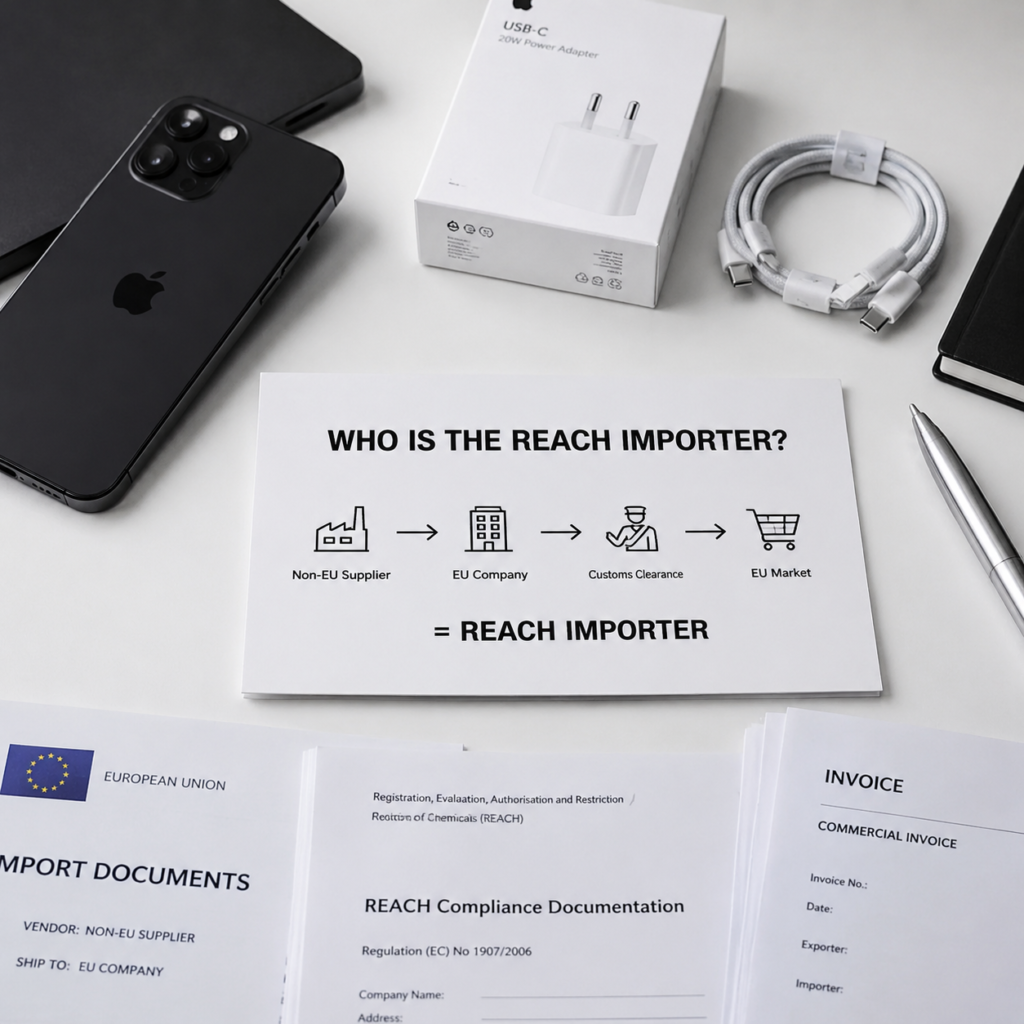
So what kind of entity counts as an “importer” under REACH? There are two core conditions: first, it must be a legal or natural person within the EEA; second, it completes customs clearance in its own name and places the product on the EEA market for the first time. For specific determination, three core references are used: who is the import entity on the customs declaration documents, who owns the goods at the time of customs clearance, and who the commercial invoice is issued to. If the customs declaration entity, contract buyer, ownership of the goods and invoice issuer are inconsistent, a comprehensive judgment shall be made in combination with the import declaration documents, international trade terms, point of transfer of goods ownership, and who first places the product on the EEA market, and the basis for the judgment shall be kept on file.
In the electronic product supply chain, the most common importer scenarios are as follows: EU local electronic brands purchasing finished products or components from overseas, EU traders/wholesalers importing electronic products for resale, EEA-registered sellers using EU FBA or overseas warehouses, and manufacturers importing electronic chemical consumables such as soldering flux and cleaning agents. When non-EEA registered sellers stock up for FBA/overseas warehouses, they usually need to clarify who acts as the import registration entity within the EEA to bear legal responsibility, and cannot only follow the operation procedures of the platform or freight forwarder.
Many people confuse the responsibilities of other supply chain roles with those of importers. Here is a clear clarification of the boundaries once and for all:
- Non-EU exporters or factories: do not directly bear the REACH responsibilities of importers, and only need to cooperate with importers to provide compliance documents;
- EU-based distributors: only need to verify upstream compliance documents and pass on relevant information, with a lower priority of responsibility than importers; if problems arise, importers are held accountable first;
- Freight forwarders or customs brokers: only handle customs clearance procedures as entrusted, and do not automatically assume primary REACH responsibilities;
- Cross-border e-commerce direct shipping: if consumers clear customs by themselves for personal use, consumers are the importers. However, at present, most platforms require sellers to provide REACH compliance certificates even for direct shipping, so it cannot be taken lightly;
- Only Representative (OR for short): is an EU-based agent designated by a non-EU manufacturer, who can undertake part of REACH obligations such as registration and notification. However, importers cannot relax requirements just because the manufacturer says “we have an OR”. They must verify the coverage of the OR: including the types of substances covered, annual tonnage level, applicable uses, and whether you as the importer are included in the coverage list, otherwise the OR cannot replace you in performing corresponding obligations.
It should be noted that REACH exemptions are usually determined based on substances, uses, regulatory scenarios or the connection with special regulations, rather than exempting entire categories of “electronic product types”. The following are several types of scenarios that may be inapplicable or partially exempt. Specific verification of regulatory provisions shall be conducted in combination with substances, uses and import status:
- Military electronic equipment: member states may set relevant exemptions based on national defense needs;
- Goods in customs transit or temporary storage: goods under customs supervision that are not officially placed on the EEA market are usually not treated as imported and placed on the market;
- E-waste: usually subject to the EU waste regulatory system, but recycled materials or products re-placed on the market after repair still need to be re-assessed for REACH compliance;
- Special medical electronic equipment: some substances or uses may be subject to special requirements due to the connection rules of EU special regulations such as medical device regulations.
If you are unsure, you can directly check the ECHA official website or consult the competent authorities of the member states for confirmation.
If you are still unsure whether you are an importer, ask yourself 5 questions for a quick judgment:
- Is your supplier outside the EEA?
- Is this batch of goods entering the EEA market for the first time?
- Do you clear customs in your own name, or hold the ownership of the goods?
- Are you the import entity on the customs declaration documents?
- Is there a valid OR coverage certificate that can replace you in bearing relevant obligations?
If the answer to the first four is “yes” and the fifth is “no”, then you are basically an importer in the sense of REACH and shall bear corresponding responsibilities.
2. Must-Know Basics: Core Logic of REACH Supervision for Electronic Products
After clarifying your identity, let’s first explain the underlying logic of what REACH regulates and how it regulates, otherwise it will be easy to get more confused when reading the responsibility list later.
REACH divides regulated objects into three categories, which are easy to understand in the electronic product industry:
The first category is substances, which are single chemical substances, such as lead in solder or a certain type of flame retardant. They are the most basic regulatory unit;
The second category is mixtures, which are preparations mixed of multiple substances. For example, soldering flux, circuit board cleaning agents and screen printing ink commonly used in electronic factories are all mixed of multiple chemical substances;
The third category is articles, which are products whose main function is determined by their shape and design. For example, common mobile phones, circuit boards, plastic shells and data cables all belong to articles.
There are often cases of blurred boundaries in electronic products. Just remember several judgment criteria: cured adhesive layers and plastic coatings sprayed on the shell are part of the article and are regulated as articles; uncured adhesives and soldering paste are regulated as mixtures; special products such as batteries and ink cartridges shall be judged in combination with the supply status and main functions. For example, consumer-grade batteries sold separately are articles, while the electrolyte inside is a mixture. It should also be noted that the same batch of goods may contain three types of objects at the same time. For example, if you import a batch of circuit board kits with soldering paste, the circuit board is an article, the soldering paste is a mixture, and the lead in it is a substance, which require separate compliance assessment.
REACH’s regulation of chemical substances is divided into three levels according to the degree of strictness and regulatory logic, which many people tend to confuse:
The first level is Substances of Very High Concern (SVHC for short): these are substances identified by the EU as having extremely high risks to human health or the environment, and there are currently more than 200 of them. The focus of regulation of such substances is information transfer, not direct prohibition of use, and the list is updated twice a year (usually in January and July);
The second level is restricted substances (corresponding to Annex XVII of the REACH Regulation): these are highly hazardous substances whose use is explicitly prohibited or strictly restricted. As long as the concentration exceeds the specified threshold and meets the applicable scenarios, the product cannot be imported into the EEA, which is a red line;
The third level is substances subject to authorization (corresponding to Annex XIV of the REACH Regulation): authorization and restriction are not simply a relationship of “level of hazard” — the restrictions in Annex XVII focus on setting prohibition/restriction conditions for specific substances, uses or product categories; the authorization in Annex XIV focuses on setting authorization thresholds for continued use of some SVHCs after the “sunset date”. After the sunset date, unless official EU authorization is obtained, they cannot continue to be placed on the market in corresponding scenarios.
For electronic products, the components that are most prone to problems are actually concentrated: plastic shells, PVC cables, batteries, solder, circuit board coatings, rubber keys, ink labels, adhesives, and flame retardant materials. These parts either use a large number of polymer materials that are likely to contain harmful additives, or contain heavy metals themselves. When conducting compliance work, you can focus on these parts without blindly inspecting the entire product.
3. Consequences of Non-Compliance: Common Penalties in the Electronic Product Industry
Some people may ask: what will happen if I am not compliant? EU member states enforce REACH in accordance with their own enforcement rules, and common consequences include the following categories:
- Customs detention and return of goods: If the product has excessive restricted substances or cannot provide required compliance documents, it may be detained, returned or even destroyed by customs, and the importer shall bear costs such as storage, testing and round-trip logistics. According to the public notifications of the EU Safety Gate, customs spot checks and platform compliance inspections, excessive phthalates in PVC soft plastic parts of consumer electronics, excessive lead in metal solder joints/contact parts, etc. are common risk types. The specific handling result shall be subject to the enforcement decision of the competent authority of the member state.
- Fines and economic losses: The amount of penalties and whether criminal liability is involved are determined by the laws of each member state, and may be calculated comprehensively based on the proportion of goods value, fixed amount or the circumstances of the violation: in practice, fines in some member states may reach 1%-20% of the goods value, and in serious cases may be as high as tens of thousands to hundreds of thousands of euros, or even involve criminal liability. In addition, if the goods have been sold to downstream customers, the importer shall also bear joint and several losses such as returns and claims.
- E-commerce platform penalties: At present, EU sites of mainstream platforms such as Amazon and AliExpress usually require REACH compliance certificates for selling electronic products. If they cannot be provided, listings may be removed, or even accounts may be frozen.
- Product recall and brand loss: If products already placed on the market are found to have compliance problems, the competent authority may require a recall. For example, some wearable electronic devices containing excessive lead and phthalates have been included in the EU Safety Gate recall notifications. In addition to direct recall costs, brand reputation will also be affected in the long term.
- Market access restrictions: Those who violate regulations repeatedly or have serious circumstances may be prohibited from placing products on the market, required to stop sales, or notified in the EU Safety Gate public early warning system, affecting subsequent market expansion.
4. Core Responsibility List: Basic Mandatory Obligations + Triggered Obligations
Next is what everyone is most concerned about: as an importer, what exactly do you need to do? We divide them into two categories: one is basic mandatory responsibilities, which must be fulfilled as long as you import electronic products into the EEA, regardless of the import volume or goods value; the other is triggered responsibilities, which only need to be performed when specific conditions are met, and if the upstream manufacturer or OR has completed the corresponding obligations and covered your products and import volume (see the OR coverage explanation in Chapter 1 for specific verification methods), you do not need to repeat them.
Basic Mandatory Responsibilities (No Exemption by Quantity or Goods Value)
Let’s first talk about the basic mandatory ones, there are four in total, without any exemption by quantity or goods value:
The first is the collection and verification of chemical information in the supply chain. To put it simply, you have to ask upstream suppliers for compliance documents, and confirm that the documents are really useful, not just a random piece of paper.
The documents to be requested include: SVHC compliance statement indicating the version of the SVHC list, test reports for restricted substances, and material composition list; if the imported goods are mixtures (such as soldering flux, cleaning agents), an additional Safety Data Sheet (SDS for short, a document detailing chemical hazards and safe use methods) in the language of the importing country is also required.
When verifying, focus on three dimensions. Only documents that meet all conditions are valid:
① Product matching: The report shall correspond to the specific product model, material and batch, and the test shall target the unit corresponding to the regulatory requirements (the test result of the average concentration of the whole machine cannot replace the compliance judgment at the component article level);
② Institution qualification: The testing institution issuing the report shall have ISO/IEC 17025 accreditation, and the accreditation scope shall cover the corresponding REACH test items;
③ Regulatory validity: The report shall cover the currently applicable version of the SVHC list and the latest requirements of REACH Annex XVII, and the test method shall comply with the specifications; if customers, platforms or enterprise internal control have set a validity period for the report, retesting or updating shall be carried out as required.
Here we need to make it clear which documents are invalid, so don’t collect a bunch of useless ones: a one-page statement that only says “compliant with REACH”, RoHS or WEEE reports (those are other regulations, not interchangeable with REACH), general statements without indicating the product model and issuance date, and reports that only test the average concentration of the whole machine, none of these can be used as compliance certificates.
The second is the obligation of restricted substance compliance. This is a red line: you must ensure that the concentration of restricted substances in imported products meets the requirements of REACH Annex XVII. As long as the concentration exceeds the limit and does not meet the exemption conditions, the product must never be imported. The most common restricted substances in electronic products are lead, cadmium, mercury, hexavalent chromium, polybrominated biphenyls, phthalates, and short-chain chlorinated paraffins. It should be noted that some restricted substances have concentration thresholds or exceptions for product categories, and the specific details shall be checked against the latest version of the Annex XVII list issued by ECHA.
The third is the SVHC information obligation. Let’s first clarify a term: the official judgment criterion for the 0.1% SVHC threshold in complex products under the REACH Regulation is “article as such” (i.e. the smallest component unit in a complex product with an independent shape or function, such as a plastic shell, circuit board, cable), rather than the total weight of the whole machine; in practice, to improve screening efficiency, more conservative testing can be carried out first according to homogeneous materials (the smallest uniform material unit that cannot be further divided), but the final judgment of information obligation, SCIP notification and SVHC notification obligation shall return to the article as such criterion, and the homogeneous material judgment rules of RoHS shall not be directly applied.
As long as the SVHC content of any single component article in the product exceeds 0.1% (by weight), you must fulfill the information obligation: if you sell to downstream distributors or industrial customers, you must proactively inform them of relevant information; if you sell to ordinary consumers, you do not need to proactively inform them, but as long as consumers take the initiative to ask, you must reply free of charge within 45 days. The content of the information shall at least include the name of the SVHC, content range, and safe use precautions.
The fourth is the requirements for retention of compliance documents, traceability and labeling under relevant product regulations. The core requirement of the REACH Regulation for importers is to establish a complete compliance file to ensure that documents such as supply chain chemical information, statements, reports, notification records, and coverage certificates are traceable, and shall be kept for at least 10 years. Regulatory authorities may access them at any time, and failure to provide them will be deemed a violation.
In addition, electronic products are usually also subject to general EU regulations such as product safety, CE certification and market supervision. The name, address and contact information of the responsible entity within the EEA shall be indicated on the product, packaging or accompanying documents. Relevant requirements shall be checked together during import, and the specific details shall be confirmed in combination with the corresponding product regulations.
Triggered Responsibilities (Only to Be Fulfilled When Conditions Are Met)
Next are the triggered responsibilities, there are six in total, which only need to be performed when the corresponding conditions are met:
The first is the SVHC notification obligation (corresponding to Article 7 of the REACH Regulation). Many people confuse it with the information obligation mentioned just now, but they are actually completely different. SVHC notification requires three conditions to be met at the same time: first, the SVHC content in a single component article exceeds 0.1%; second, as an importer, the total annual import volume of this SVHC in all your products exceeds 1 ton; third, the upstream manufacturer or OR has not made a notification for this substance, or the scope of the notification does not cover you. The notification is submitted to ECHA and must be completed within 6 months after the substance is included in the SVHC list. To put it simply: information obligation only requires exceeding 0.1%, while notification requires the additional condition of “annual import exceeding 1 ton”.
The second is the SCIP database notification obligation. Let’s explain it in plain language: SCIP is a waste management database established by the EU for articles containing SVHCs, with the purpose of letting waste treatment institutions know what hazardous substances are in products to facilitate classified treatment. The trigger condition is very simple: as long as the SVHC content in the articles you place on the EEA market exceeds 0.1%, you need to notify. The notification entity is usually an EU importer or manufacturer. If the upstream has made a valid notification, you can directly reference it without notifying yourself. The basic data that usually needs to be prepared before notification includes: article hierarchy, SVHC name and CAS/EC number, concentration range, material category, product category, and safe use information. It should be noted that SCIP notification is not the same as SVHC notification, nor is it the same as information to consumers. These three are completely independent obligations, please do not confuse them.
The third is the registration obligation for intentionally released substances. This does not need to be considered for most ordinary electronic products, and only needs to be considered when your electronic products actively release chemical substances, such as smart speakers with aromatherapy function, mosquito repellent night lights, etc. If the total annual import volume of the released substances exceeds 1 ton and is not within the exemption scope, you need to apply for registration with ECHA. Ordinary products such as mobile phones, computers and headphones that do not actively release chemical substances do not need to consider this item at all.
The fourth is the obligations related to substances subject to authorization. First of all, it needs to be clarified that the authorization system of REACH Annex XIV mainly regulates the production, use and placing on the market for use of substances/mixtures within the EU; imported finished articles containing substances listed in Annex XIV generally do not directly require importers to apply for authorization, but they still need to comply with other REACH obligations such as SVHC information transfer, SCIP notification, and restricted substances.
For the electronic product supply chain, common trigger scenarios for authorization obligations include: importing separate chemical substances or mixtures (such as authorized substances in soldering flux and cleaning agents), or producing and using chemicals containing authorized substances within the EEA. If such scenarios are involved, it is necessary to check one by one whether the substance is included in Annex XIV, whether the specific use is within the authorization scope, whether the sunset date has passed, whether there is a legal exemption, and whether the upstream manufacturer/OR has obtained valid authorization and covers your import volume and use.
Special attention should be paid: “a substance being included in the SVHC list” does not equal “prohibited from use”. Only after it enters the authorization list and the sunset date has passed, will its use and placing on the market in corresponding scenarios be prohibited. Do not judge that the product cannot be sold as soon as you see that the SVHC exceeds the limit. Common authorized substances in electronic products include some flame retardants and phthalates.
The fifth is the registration obligation for mixtures/separate substances. If you import a separate chemical substance, or a certain substance in a mixture, with a total annual import volume exceeding 1 ton, and the upstream has not registered, or the OR’s coverage does not include you, then you need to do the registration yourself. In the electronic product industry, the most common scenario is importing electronic chemical consumables such as soldering flux, cleaning agents and coatings.
The sixth is the additional responsibility for import for own use. If you import electronic equipment for production use in your own factory, in addition to the previous compliance requirements, you must also comply with the relevant requirements on occupational health in REACH; if you sell to industrial customers, you must also provide them with complete safe use information.
5. Practical Implementation: 5 Steps for REACH Compliance of Electronic Products
After talking about responsibilities, many people may still not know where to start. We have sorted out a 5-step process for REACH compliance of electronic products, just follow it.
Step 1: Sort out products and risk classification, focus on key points first to reduce costs.
Don’t start by disassembling and testing all products. First, split the products by hierarchy: whole machine → module → component → material. Also distinguish the product body, packaging, accompanying consumables and spare parts, don’t miss these. Then mark the high-risk components mentioned above and focus on them. In addition, you need to count the total annual import volume of the same substance — note that it is the sum of the same substance in all your products, not calculated per single product.
Step 2: Request compliance documents from suppliers.
Prioritize requesting SVHC statements indicating the latest version of the SVHC list and test reports for restricted substances; if it is a mixture, also request an SDS. If suppliers cannot provide the documents, either require them to supplement, or negotiate to send samples for testing together.
To avoid subsequent disputes, be sure to clearly write REACH compliance requirements into the procurement contract. It is recommended to include the following clauses: types of REACH documents that suppliers need to provide; guarantee that the documents are true and valid and correspond to specific product models and batches; notification time limit when the SVHC list is updated or materials/formulas are changed; compensation liability for goods detention, recall and fines caused by false or non-compliant documents; sharing method of testing and retesting costs.
Step 3: Self-verify compliance status.
The core standard for verification must be remembered: the 0.1% SVHC threshold is calculated according to the single component article criterion explained above, rather than the total weight of the entire product; while there is no unified 0.1% threshold for restricted substances, you need to check the substance scope, concentration limits, applicable product categories and exemption conditions of the corresponding entries in REACH Annex XVII one by one, and cannot directly apply the judgment rules of SVHC.
How to quickly judge a component article? Generally speaking, the smallest unit with an independent shape or function can be regarded as a component article. For example, the PVC cable, plastic shell and rubber key of a headset each count as a unit. In practice, you can first split into homogeneous materials for conservative screening — if the content of the homogeneous material does not exceed 0.1%, the corresponding component article must be compliant; if the homogeneous material exceeds the limit, then calculate based on the overall proportion of the component article.
Then check the validity of the documents: whether the report corresponds to your product model, whether the issuance date is recent enough and covers the currently applicable regulatory requirements, whether the testing institution has ISO/IEC 17025 accreditation and the accreditation scope covers the corresponding REACH test items; if the platform, customer or competent authority has other designated accreditation requirements, implement according to their requirements. If you are unsure, you can find a third-party institution to do a quick screening test, which is low cost and reassuring.
Step 4: Fulfill corresponding compliance responsibilities.
After verification, handle according to the situation:
- If all items meet the standards: keep all documents well and import normally;
- If SVHC exceeds 0.1% but the total annual import volume is less than 1 ton: fulfill the information obligation to downstream/consumers, and then complete the SCIP notification;
- If SVHC exceeds 0.1% and the total annual import volume exceeds 1 ton: first confirm whether there is valid notification coverage from the upstream. If not, first submit the SVHC notification to ECHA, then fulfill the information obligation and SCIP notification;
- If restricted substances exceed the limit: never import, quickly replace materials or suppliers, this is a red line;
- If it involves authorization or registration requirements: apply in advance, or confirm whether the upstream authorization/registration covers you, don’t wait until it’s time to import to worry.
Step 5: Regularly update compliance files.
REACH requirements are not static, so compliance files should also be updated regularly: ECHA updates the SVHC list twice a year, and after each update, you must check whether your products are still compliant; if the product changes materials, changes suppliers, or modifies the formula, be sure to re-request and verify the documents; count the annual import volume of the same substance once a year to see if there are changes in triggered obligations; spare parts and after-sales replacement parts should also be included in the review scope simultaneously, don’t miss them.
6. Pitfall Avoidance Guide: 9 Common Misconceptions in the Electronic Product Industry
In the process of REACH compliance, many people will step into unnecessary pitfalls, which may cost money in mild cases, or lead to goods detention in severe cases. We have sorted out the 9 most common misconceptions in the electronic product industry. After reading them, they can help you avoid most common compliance risks and avoid detours.
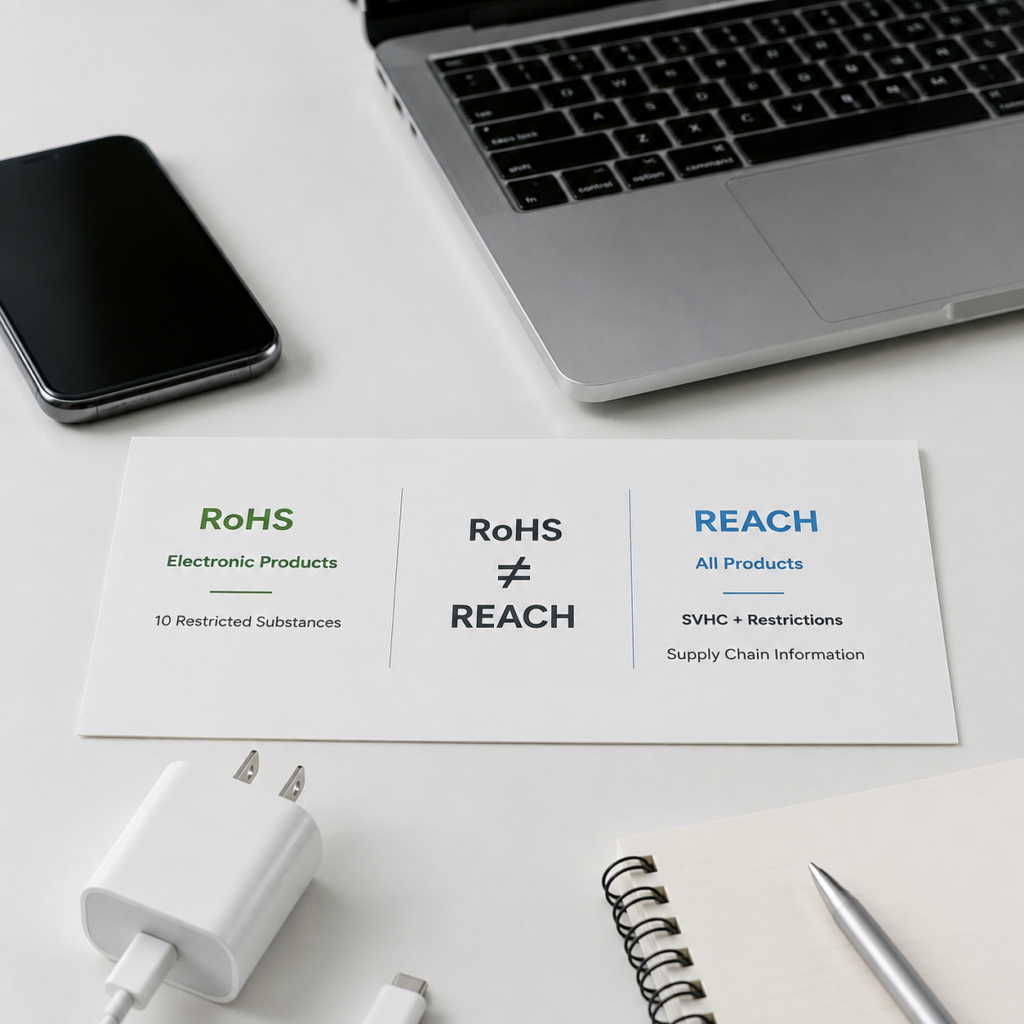
Misconception 1: RoHS Compliance = REACH Compliance
- Wrong logic: believing that both regulate hazardous substances, so passing one is enough.
- Correction: RoHS only regulates 10 hazardous substances for electrical and electronic products, while REACH covers all products entering the EEA. There are more than 200 SVHCs alone, plus dozens of restricted substances, and the regulatory scope is much larger than that of RoHS.
- Example: The 10 substances restricted by RoHS include 4 phthalates: DEHP, BBP, DBP, DIBP; while REACH’s SVHC list and Annex XVII restriction list cover more phthalate substances. Even if you pass RoHS compliance, you may still exceed REACH limits.
Misconception 2: SVHC 0.1% Is Calculated Based on the Weight of the Entire Product
- Wrong logic: calculating the proportion of SVHC by the total weight of the whole machine, thinking that low content means no problem.
- Correction: REACH requires the 0.1% threshold to be calculated based on a single component article (the difference between the official criterion and homogeneous material screening has been explained above), rather than the total weight of the whole machine. Do not directly apply the homogeneous material judgment rules of RoHS.
- Example: A pair of headphones weighs 100 grams, and the PVC cable as a component article weighs 2 grams. If the lead content in the cable is 1%, it seems compliant at 0.02% calculated by the whole machine, but it reaches 1% calculated by the PVC cable as a component article, far exceeding the 0.1% threshold, and relevant obligations still need to be fulfilled.
Misconception 3: No Need to Verify by Yourself If the Supplier Says It Is Compliant
- Wrong logic: shifting responsibility to upstream suppliers, thinking verbal promises are enough.
- Correction: Importers are the primary responsible parties for REACH. If problems arise, regulators will hold importers accountable first. Verbal promises from suppliers have no legal effect.
- Practical suggestion: Written compliance documents and test reports must be requested, and the responsibilities of both parties must be clarified through the procurement contract.
Misconception 4: Small-Batch, Low-Value Imports Do Not Need Compliance
- Wrong logic: thinking that with small quantity and low value, regulators will not check.
- Correction: REACH has no exemption by quantity or goods value. Even if you only import one headset, you must fulfill the information obligation as long as the SVHC exceeds the limit; if restricted substances exceed the limit, the goods will still be detained. Only obligations such as SVHC notification and substance registration have a threshold of 1 ton/year. Information obligation, restricted substance compliance, etc. must be done regardless of the quantity.
Misconception 5: Cross-Border E-Commerce Sellers Using FBA Do Not Need to Bear Responsibility Themselves
- Wrong logic: believing that freight forwarders help with customs clearance and platforms are responsible for sales, so they don’t need to bear REACH responsibilities.
- Correction: In FBA/overseas warehouse stocking scenarios, the legal importer shall be determined in combination with the import registration entity within the EEA, customs clearance name, ownership of goods and arrangements for first placing on the market. This EEA-based entity usually bears importer responsibilities. Although non-EEA sellers themselves do not directly become importers in the sense of the REACH Regulation, they still need to provide REACH compliance documents to platforms, customers or service providers, and ensure that the Only Representative (OR) or importer service covers corresponding obligations. They cannot default that the platform or freight forwarder automatically bears responsibility.
- Practical suggestion: If the freight forwarder provides “importer” services, be sure to confirm in advance whether the service includes primary REACH responsibilities. At the same time, verify the responsible entity and relevant coverage certificates according to the method in Chapter 1 to avoid a responsibility vacuum.
Misconception 6: Having a Test Report Equals Full Compliance
- Wrong logic: thinking that having a REACH test report means everything is fine.
- Correction: A test report can only prove the substance content of the tested sample, and cannot automatically prove that you have completed obligations such as registration, authorization and information transfer. The test report is only part of the compliance documents, and other obligations need to be checked one by one by yourself.
Misconception 7: EU REACH Compliance Can Cover the UK Market
- Wrong logic: believing that the UK still applies EU REACH after Brexit.
- Correction: After Brexit, the UK has established an independent UK REACH system. EU REACH documents cannot be directly applied to the UK market. Only Northern Ireland still applies EU REACH due to the Windsor Framework.
- Practical suggestion: If you sell to both the EU and UK markets, be sure to confirm the import entity, registration and information transfer obligations separately.
Misconception 8: Compliance Statements Can Be Permanently Valid
- Wrong logic: thinking that a compliance statement from a supplier can be used forever once obtained.
- Correction: The SVHC list is updated every year, restriction requirements are also adjusted, and product materials and formulas may also change. There is no permanently valid statement.
- Practical suggestion: The compliance statement must be bound to the product model, version, issuance date and applicable SVHC list version, and shall be reviewed at least once a year.
Misconception 9: Ignoring Packaging, Accessories and Spare Parts
- Wrong logic: only checking the product body, thinking that packaging, accessories and spare parts are not important.
- Correction: Packaging materials themselves belong to articles and may also involve SVHC obligations; complimentary chemical consumables (such as cleaning agents, soldering paste) belong to mixtures and require SDS; spare parts and after-sales replacement modules also need to be included in compliance assessment.
- Practical suggestion: when sorting out products, be sure to include packaging, accessories and spare parts to avoid missing judgments.
7. Advanced Decision-Making: Quick Self-Check and Cost Optimization
At this point, everyone should have a basic concept of their own responsibilities. Finally, let’s talk about something practical: how to quickly self-check what you need to do, and how to reduce costs while ensuring compliance.
First, here is a quick self-check list. Follow the questions down, and you will immediately know which obligations you need to fulfill:
| Question No. | Question Content | Answer | Corresponding Conclusion/Next Step |
|---|---|---|---|
| Q1 | Are you an electronic product import entity within the EEA (customs clearance/holding ownership of goods/first placing on the market)? | No | Do not bear importer REACH responsibilities |
| Q2 | Are all products within the REACH exemption/inapplicable scope? | Yes | Keep the basis for exemption judgment; uncovered parts still need to be further assessed |
| Q3 | Does the concentration of restricted substances in the product not meet the requirements of Annex XVII? | Yes | Must not be imported, need to replace materials or suppliers |
| Q4 | Does the SVHC content in a single component article of the product exceed 0.1% (by weight)? | No | No need to fulfill SVHC information obligation, notification obligation and SCIP notification obligation |
| Q5 | Does the total annual import volume of the excessive SVHC exceed 1 ton? | No | Only need to fulfill SVHC information obligation + SCIP notification |
| Yes | Proceed to Q6 to judge the upstream notification coverage | ||
| Q6 | Has the SVHC been effectively notified and covered by the upstream manufacturer or Only Representative (OR)? | Yes | Keep the coverage certificate, fulfill information obligation + SCIP notification |
| No | Need to notify ECHA + information obligation + SCIP notification | ||
| Q7 | Does the product involve intentionally released substances, substances subject to authorization, or registration of imported separate substances/mixtures? | Yes | Assess relevant special obligations accordingly |
Let’s talk about when you need to find a third-party compliance agency for help: when suppliers have no compliance documents at all and testing is needed; when you are unsure of product composition and need screening; when you need to go through official procedures such as SVHC notification, SCIP notification, authorization application, and substance registration. When choosing an institution, prioritize those with ISO/IEC 17025 accreditation and whose accreditation scope covers the corresponding REACH service items; if the platform, customer or member state competent authority has other designated requirements, implement according to their requirements. Don’t be greedy for cheap and choose institutions that do not meet the requirements, otherwise the documents will be invalid and you will waste money.
Finally, here are some ideas for optimizing compliance costs, so you don’t have to spend money wrongly:
First, prioritize reusing valid test reports that suppliers already have. As long as the report is for the corresponding material, within the validity period and qualified, you don’t need to repeat the test yourself;
Second, test high-risk components first. As long as high-risk components are okay, low-risk ones basically don’t need to be tested. Don’t start with full product testing;
Third, clarify the supplier’s responsibility for providing documents through the procurement contract, and reasonably share compliance costs. Suppliers know more about their own material composition and have higher cooperation efficiency;
Fourth, the same substance is counted collectively across all products. If the annual total does not reach 1 ton, there is no need for notification or registration, which can save a lot of money;
Fifth, prioritize verifying and reusing the valid coverage of the upstream Only Representative (OR) to avoid duplicate investment in registration and notification costs.
If you have many products and don’t have time to check them one by one, you can do it by priority: first check products containing PVC, rubber, coatings, adhesives and flame retardant materials, then check imported chemical consumables such as soldering flux and cleaning agents, then whole machines and modules with incomplete supplier documents and complex sources, and finally other low-risk products. This way you can control the high-risk parts as quickly as possible and reduce the probability of problems.
8. What You Can Do After Learning
Generally speaking, the REACH responsibilities of electronic product importers are both complex and simple: first figure out whether you are the responsible entity, then distinguish which are mandatory basic obligations and which are triggered obligations that only need to be performed when conditions are met, then implement according to the process and avoid common misconceptions, then you can effectively reduce compliance risks.
After reading this content, you should be able to complete the following 5 things:
- Accurately judge whether you are an electronic product importer under the REACH Regulation and the corresponding scope of responsibilities;
- Clearly distinguish basic mandatory responsibilities and triggered responsibilities, to avoid missing obligations or over-investing unnecessary costs;
- Complete the REACH compliance self-check and implementation of electronic products according to the 5-step process;
- Identify 9 common REACH misconceptions in the industry, and avoid most unnecessary compliance risks;
- Optimize compliance costs in combination with your own business situation, and judge whether you need to seek support from a third-party compliance agency.