
Whether you live in Singapore and buy chargers or power adapters, or run a digital accessories business for the Singapore market, you have most likely heard of the term “PSB certification”. However, many people have either vague understanding or many misconceptions about it: for example, thinking that CE certification is enough to sell products directly, that all charging cables require certification, or that the higher the energy efficiency rating, the faster the charging speed. Today, we will start from the most basic concepts and guide you step by step to understand Singapore’s PSB-related safety and energy efficiency requirements, from beginner-level comprehension to semi-proficient ability to judge compliance on your own.
Beginner Basics: Core Concepts and Scope of Application
The “PSB certification” that many people refer to is actually not the official formal name. Let us first clarify the most easily confused concepts:
Relationship Between PSB and Safety Mark
The commonly spoken term “PSB certification” actually refers to Singapore’s mandatory Safety Mark system. “PSB certification” is a common name inherited from the era of the former Singapore Productivity and Standards Board (PSB). The relevant functions of PSB were transferred to SPRING Singapore in 1996; SPRING Singapore merged with International Enterprise Singapore in 2018 to form the current Enterprise Singapore. Institutions such as “TÜV SÜD PSB” that people often hear about are officially authorized third-party Conformity Assessment Bodies (CABs for short, i.e., third parties qualified to conduct certification audits on behalf of the authority), not the competent authority itself.
The entire Safety Mark compliance process consists of three completely independent links: testing → assessment → registration. Completing testing does not equal having certification; official registration and obtaining a registration number are required for it to be valid. This is the first pitfall many people fall into.
Responsibilities of Core Stakeholders
There are four core roles in the entire regulatory system, with clear division of labor. Do not confuse them:
• Enterprise Singapore: Responsible for formulating rules, accepting registration applications, authorizing third-party bodies, and conducting market supervision; it is the final competent authority.
• Locally registered supplier: That is, a locally registered company in Singapore. Overseas brands cannot directly apply for certification, and must entrust a local importer or agent as the responsible entity to submit applications, keep technical documents, and bear the main responsibility for compliance.
• Conformity Assessment Body (CAB): Responsible for reviewing test materials and issuing compliance assessment opinions; it is the intermediate link connecting testing and official registration.
• Testing laboratory: Tests products according to standards and issues test reports, and is only responsible for the tested samples.
Regulatory Framework of the Safety Mark
The core legal basis of the Safety Mark is the (CPSR for short). The core purpose of regulation is to prevent safety risks such as electric shock and fire of electrical appliances. If you sell non-compliant controlled products, the consequences include product removal from shelves, confiscation, and recall, and the responsible party may also be fined, which is not a trivial matter.
Safety and Energy Efficiency Are Two Independent Systems
Many people confuse safety certification and energy efficiency requirements. In fact, they are two completely independent systems that cannot replace each other, and the same product may need to meet both:
• Safety Mark (safety): Under the responsibility of Enterprise Singapore, it manages safety risks such as electric shock and fire. Products included in the controlled list must be mandatorily registered.
• Energy efficiency requirements: Under the responsibility of the National Environment Agency (NEA for short) of Singapore, it manages whether products consume electricity. It is divided into two categories: one is Minimum Energy Performance Standards (MEPS for short), which means energy consumption cannot be higher than the red line, otherwise sale is prohibited. It is a mandatory requirement but not all categories require labeling; the other is Mandatory Energy Labelling Scheme (MELS for short), which requires the common energy efficiency rating label, and only categories designated by the NEA require it.
In addition, if a product contains Wi-Fi, Bluetooth, cellular communication, or other radio frequency or telecommunications functions regulated by the IMDA, or falls under the categories of wireless power transmission equipment applicable to the IMDA, it shall be separately verified in accordance with the IMDA’s current equipment registration, technical standards, and exemption rules; the wireless charging function itself cannot be directly generalized as definitely requiring IMDA registration.
Which Charging Products Are Covered
Among charging-related products, wall-plug USB chargers (including fast chargers and GaN chargers) and external AC/DC power adapters (such as power supplies for laptops and monitors) usually need to be further checked against the Safety Mark controlled product categories.
Wireless charging devices with mains input, USB power strips, or extension sockets shall also be determined item by item according to the actual structure and Enterprise Singapore’s controlled product categories; they may involve categories such as AC adaptor, battery charger, multi-way adaptor, or extension socket, and conclusions cannot be drawn solely based on “having mains input”.
As for boundary products such as charging cables, car chargers, and power banks, they cannot be generalized. The specific judgment logic will be explained later.
Quick Determination: Does Your Charging Product Require a Safety Mark?
Many people judge by intuition: “Anything that plugs into the mains requires certification.” In fact, this is wrong — “direct connection to the mains” is only a risk reminder, not a statutory judgment standard. The authority has a clear three-step determination method, and following it in order will lead to a conclusion.
Three-Step Statutory Decision Tree
The first step is to confirm whether the product is for commercial supply in the Singapore market: situations such as personal use, transshipment, and samples may be subject to specific exclusion, exemption, or approval arrangements, but they must be verified case by case in accordance with the definitions and conditions specified in the CPSR and the competent authority. Samples used for commercial display, distribution, sale, or subsequent commercial supply cannot be automatically regarded as exempt; as long as they are for sale, whether offline or e-commerce, they are considered commercial supply and need further determination.
The second step is to compare with Enterprise Singapore’s controlled goods list, split the product into different components and judge each separately, instead of treating the whole set as one product.
The third step is to correspond different components to different competent authorities according to their attributes: for mains-related parts, check the Safety Mark of Enterprise Singapore; for low-voltage parts, check whether they are regulated; for modules containing radio frequency or telecommunications functions regulated by the IMDA, check according to IMDA requirements.
Compliance Determination for Common Charging Products
To facilitate understanding, we split common charging products by components, and clarify the usual situations and easily overlooked boundaries:
1. Wall-plug USB chargers (single/multi-port, PD, GaN): Usually require a Safety Mark. The boundary to note is: the rated parameters and plug type of the product must be within the registration scope. If it is a model with replaceable plugs, confirm that all optional plug models are covered by the registration, and you cannot sell the full set with only one plug registered.
2. External AC/DC power adapters: Usually require a Safety Mark. The boundary is: if the adapter is sold separately, it must have its own independent registration; if it is sold as a random accessory with a complete machine such as a laptop or monitor, check whether the registration of the complete machine covers this adapter.
3. Charging docks/desktop USB power strips with mains input: Shall be determined according to the actual product structure and controlled product categories, and cannot be directly identified as a certain type of Safety Mark product just because it has mains input. If the product also has ordinary mains socket functions, it may also involve requirements for corresponding categories such as sockets, extension sockets, or converters, which need to be checked according to the actual category.
4. Wireless charger set (with external adapter): The adapter shall be judged separately, and the charging dock shall also be checked according to the actual structure and controlled categories. The whole set cannot be directly regarded as the same Safety Mark object. Whether the adapter requires independent registration and whether it has been covered by the complete machine registration shall be confirmed according to the product supply form and official registration scope.
5. Car chargers: Ordinary car chargers without mains input do not require mandatory Safety Mark. The boundary is: if it is a 2-in-1 product with mains conversion function (for example, it can be plugged into both a car and a wall), it shall be re-judged as a mains product.
6. Individually sold USB charging cables/adapters: Passive low-voltage cables (i.e., ordinary cables without chips that only transmit electricity) generally do not require mandatory certification. The boundary is: if the cable is a matching accessory supplied with the charger, it will be included in the registration coverage of the complete machine and does not need its own separate Safety Mark.
7. Power bank + adapter set: The adapter is judged separately, and the power bank itself shall be checked against Enterprise Singapore’s latest controlled goods list. The boundary is: all-in-one power banks with mains plugs (i.e., power banks that can be directly plugged into the wall for charging) shall be separately judged as mains products, and cannot be regarded as ordinary power banks.
If you are unsure, the safest way is to check Enterprise Singapore’s latest controlled goods list, or consult an officially recognized Conformity Assessment Body (CAB), and do not judge based on your own experience.
Core Safety Requirements of the Safety Mark (Charging Products)
Many people think that certification is just “going through the process”. In fact, the core of the Safety Mark is to control the safety risks of products in various scenarios. We will explain the core requirements for charging products in plain language.
Standard Application Principles
First of all, note: you cannot determine which standard applies to a product solely by the standard name or number. The specific standard shall be subject to official requirements, CAB opinions, and the actual product structure. At present, the most commonly used reference standard for charging power products is SS IEC 62368-1 (safety standard for audio/video/ICT equipment and power supplies), but this is not the only standard, and the specific one shall still be subject to official requirements.
5 Core Categories of Safety Risks Under Control
The Safety Mark manages safety under normal use, abnormal conditions, and even specified fault scenarios, with 5 core categories of risks:
1. Electric shock protection: The output terminals, high-low voltage isolation, and user-accessible parts of the product shall meet the electric shock protection requirements specified in applicable standards, and meet the test limits under normal, abnormal, and specified fault conditions.
2. Insulation and isolation: There shall be reliable isolation between the high-voltage mains side and the low-voltage USB side, and the insulation, clearance, and related protection measures shall meet the requirements of applicable standards.
3. Temperature rise safety: The temperature of parts that users can touch shall meet the applicable limits to avoid the risk of scalding or igniting surrounding items.
4. Fire resistance performance: The requirements for key non-metallic materials, protection components, and isolation parts depend on the product structure and applicable standards, and the risk of fire and flame spread shall be controlled under specified conditions. Compliance does not mean an absolute guarantee against any failure or fire scenario.
5. Mechanical strength: After tests such as plugging and unplugging, dropping, and bending specified in applicable standards, plugs, cables, and enclosures shall remain compliant with safety requirements, for example, to avoid damage to pins or cracking of the enclosure that exposes internal dangerous parts.
Fault Safety Assessment Requirements
The core principle of fault assessment is: Safety standards usually do not stipulate a unique implementation solution, but they simultaneously specify requirements for structure, key components, insulation and clearance, marking, instructions, and testing. The product must overall meet applicable standards and registration requirements, rather than only passing several test items.
Common assessment and test contents include:
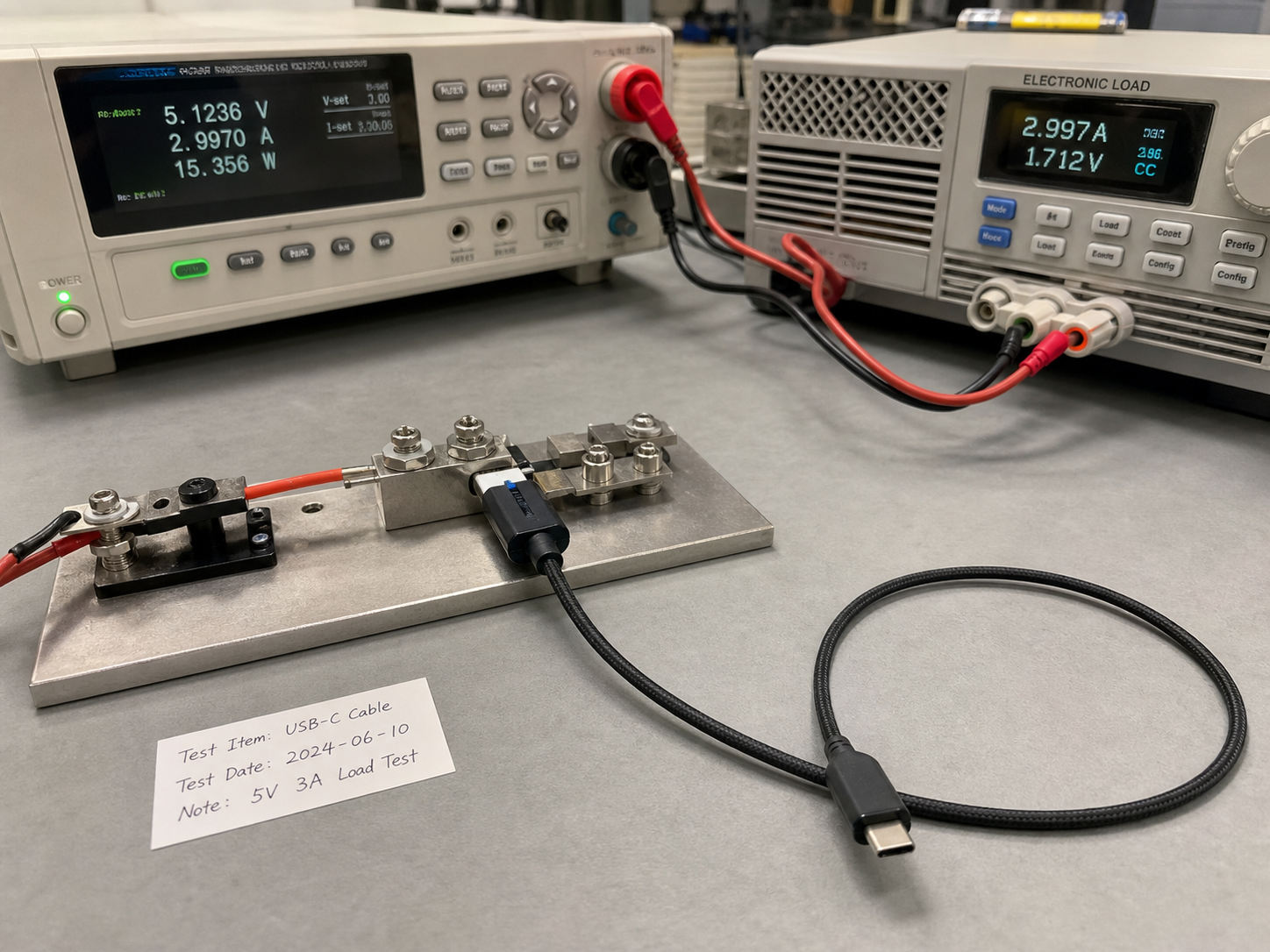
• Short circuit and overload tests: Under applicable short circuit or overload conditions, the product shall meet the specified safety requirements;
• Insulation and electrical clearance: The air clearance, creepage distance, insulation structure, etc. between the high-voltage and low-voltage sides shall comply with the standards;
• Key safety components and protection measures: Related components such as fuses and transformers, as well as protection designs, need to meet requirements under specified abnormal or fault conditions;
• Material flame retardancy: Applicable non-metallic parts shall meet corresponding material and fire protection requirements;
• Mechanical strength of plug and cable: Pin size, strain relief at the root of the cable (i.e., the connection between the cable and the plug is not easily broken), etc. shall meet requirements.
These test items will be adjusted according to the product structure, power, and applicable standards, and not all products are tested with exactly the same content.
Special Requirements for Fast Charging/Multi-Port/GaN Chargers
Now fast charging, multi-port, and GaN chargers are very common. There are several special points to note for the compliance of such products:
• Power declaration: You can mark the maximum power of a single port, the upper limit of combined output, or paste a power distribution table. It is not required that all ports can reach the single-port peak at the same time. For example, a 65W dual-port charger has 65W when used with a single port, and 45W + 20W when used with two ports together. As long as it is clearly marked, it is fine.
• Core of compliance: Product labels, instructions, promotional content, and actual output capacity must be consistent, and consumers must not be misled. For example, if the page marks 100W but the actual power is only 65W, it is non-compliant.
• Technology does not equal safety: Fast charging protocols (PD/PPS/QC, etc.) and GaN semiconductor technology do not mean automatic compliance with safety requirements. You cannot use “GaN is safer” as a basis for compliance. Whether it is safe depends on whether it has passed certification.
• Stricter control for high power: Higher output power may increase the difficulty of thermal design and temperature rise assessment, but the temperature rise test conditions and limits shall be determined according to applicable standards, product structure, and rated conditions; the Safety Mark has no general 65W temperature rise dividing line.
How to Tell if a Test Report Is Valid
Many sellers do not know how to judge whether a test report can be used after getting it. There are three core points to check:
1. Coverage: The report must cover the complete model, plug specification, and rated power parameters of the product. For example, if you sell a UK-plug 65W charger but the report is for a US-plug 30W charger, this report is completely useless.
2. Validity: If the standard is revised, registration conditions change, or the product is modified, the CAB or registered supplier shall judge whether supplementary testing or re-registration is required. The report is not always valid.
3. Common invalid scenarios: Products of the same series with different power and different plugs share a report that does not cover these models. For example, a series has 30W, 65W, and 100W models, but only the 30W model is tested and the whole series is claimed to be compliant. This is the most common invalid situation.
Energy Efficiency Requirements: First Determine If It Is Regulated, Then Discuss Compliance
After talking about safety, let’s talk about energy efficiency requirements that people easily confuse. First of all, remember: not all charging products have energy efficiency requirements. You must first determine whether it is a regulated external power supply (EPS for short), and cannot draw a conclusion directly.
Two Core Systems of Singapore’s Energy Efficiency
Singapore’s energy efficiency system is divided into two categories, with completely different rules:
• MEPS (Minimum Energy Performance Standards): It is a mandatory requirement. Products that fail to meet the energy consumption limit cannot be sold, but not all regulated products require labeling.
• MELS (Mandatory Energy Labelling Scheme): It requires an energy efficiency rating label, and only categories designated by the NEA require it. Not all products regulated by MEPS require MELS labeling.
The core rule is: whether to affix an energy efficiency label must be subject to the NEA’s latest controlled list, and you cannot guess based on the product name. For example, you cannot say “all chargers need energy efficiency labels”.
Determination of Energy Efficiency Applicability for Charging Products
To judge whether a charging product needs to meet energy efficiency requirements, you must first check four core fields:
1. Input power type: whether it is mains input;
2. Output parameters: output voltage, power, single output or multi-output;
3. Supply form: sold separately or sold as a matching set;
4. Whether it is a type explicitly exempted by regulations.
After checking these, you also need to confirm several core parameters on the NEA official website: the effective date of requirements and applicable test standards, the no-load power consumption and average conversion efficiency limits for each power segment, the requirements for compliance registration or declaration, and the exemption conditions and scope of application. All these shall be subject to the latest official requirements, and do not calculate based on your own experience.
Compliance Pitfalls to Avoid in Energy Efficiency Promotion
Regarding energy efficiency promotion, there are several common pitfalls that cannot be stepped into:
• You cannot casually mark “energy-saving” or “high-efficiency” without verifiable test basis; you cannot say it casually;
• You cannot mix overseas energy efficiency labels, for example, claiming US Energy Star or EU ERP as Singapore’s mandatory requirements;
• You cannot confuse technology and energy efficiency: fast charging, GaN, and PD protocols do not equal passing energy efficiency certification. GaN materials may help improve energy efficiency, but they must pass testing and meet the standards to be counted.
Practical Process: Compliance Application and Maintenance
If you are a seller and need to certify your products, this section explains the key points of the whole process from application to subsequent maintenance.
Prerequisites Before Application
Before formal application, first confirm two prerequisites:
1. Product determination: Safety and energy efficiency shall be confirmed separately according to the requirements of the competent authority to see if the product is a regulated product. Do not only do safety and forget energy efficiency, or vice versa.
2. Responsible entity: There must be a locally registered supplier in Singapore as the responsible entity. Overseas brands can entrust a local importer or agent, and cannot directly apply to the authority on their own.
Core Steps for Safety Mark Application
1. Prepare documents: You need to prepare product specifications, circuit diagrams, label drafts, English user manuals, list of key safety components, and other documents.
2. Consistency of documentation: The model, rated parameters, plug version, key components, manufacturing factory, label, user manual, and test report information in all documents must be completely consistent. If any item does not match, it will be rejected.
3. Testing and assessment: Find an officially recognized CAB for testing, or submit an existing test report to the CAB for review. Note: Reports from overseas ILAC laboratories are not automatically accepted, and must be reviewed and confirmed by the CAB to meet the requirements.
4. Registration and number acquisition: After passing the assessment, complete registration with Enterprise Singapore and obtain the Safety Mark registration number. When verifying, the registration number must be compared together with the brand, complete model, product category, and valid registration status displayed in the official database, and cannot be judged solely by the number itself.
5. Affixing the mark: Affix the Safety Mark logo and registration number clearly and durably on the product or packaging in accordance with official requirements. The position and size must meet the requirements, and you cannot casually paste a small sticker that scrapes off easily.
Core Steps for Energy Efficiency Compliance (If Applicable)
If the product falls within the scope of energy efficiency regulation, the process is:
1. In accordance with the test report acceptance conditions announced by the NEA for this regulated product, entrust a laboratory with the corresponding accreditation scope for testing, and confirm that the report, test method, accreditation body, and validity period meet the NEA’s current registration requirements;
2. Submit the test report and complete the compliance declaration or registration;
3. Only products covered by MELS need to affix energy efficiency labels. Charging products usually do not need to be labeled, and the specific situation shall be subject to the NEA list.
Notes on Compliance Maintenance
Getting the registration certificate is not the end of the story. You also need to do a good job in compliance maintenance afterwards:
• Validity period and renewal: The validity period of registration and the renewal window shall be subject to the rules of the competent authority. You should apply for renewal before expiration, and do not continue selling after expiration.
• Retention of technical documents: All test reports, registration certificates, sales records, and change records shall be properly kept by the locally registered supplier. The retention period shall be in accordance with official requirements, and they shall be ready for spot checks at any time.
• Product changes require reassessment: Any change that affects safety, energy efficiency, or registration coverage, such as changing power, replacing plugs, replacing key safety components, changing manufacturing factories, or modifying internal structure, must first be evaluated by the CAB to confirm whether supplementary testing or re-registration is required. You cannot continue selling after modifying it on your own.
• Spot checks and incident response: Cooperate with the competent authority’s spot checks and accident investigations, and provide technical documents in a timely manner; if the product is judged to be unqualified, rectify, recall, or remove it from shelves as required.
Quick Checklist Before Listing/Import
To facilitate quick verification of basic compliance, we have compiled a checklist. Going through it before listing or importing can avoid most low-level mistakes:
| Check Item | Requirement | Remarks |
| Verification of regulated status | Verify whether the product is on the competent authority’s controlled goods list for safety and energy efficiency respectively | Do not only check safety and miss energy efficiency |
| Registration certificate | Have a valid Safety Mark registration certificate and corresponding test report | The report must cover all parameters of the product |
| Mark and registration number | The product/packaging has a clear Safety Mark logo and registration number | The mark must not be blurred or tampered with; the number must be consistent with the registration data |
| Nameplate parameters | Input/output, power, and model are completely consistent with the registration data | Including model suffixes must be consistent; the rated input value shall cover Singapore’s 230V, 50Hz power supply conditions |
| Mains plug | The equipped plug/socket category meets applicable Singapore standards and registration scope | Three-pin plugs can only be used for initial screening; the actual applicable category and registration coverage shall prevail |
| User manual | Equipped with an English user manual | Singapore officially requires English instructions |
| Energy efficiency requirements | If within the regulated scope, the compliance declaration/registration has been completed | Charging products usually do not need energy efficiency labels |
Compliance Verification Methods (Must-Read for Users)
Whether you are a consumer buying a charger or a seller verifying the qualifications of a supplier, you can use the following methods to judge whether the product is truly compliant.
3 Items for Initial Appearance Screening (For Preliminary Judgment Only)
First look at the appearance. Products with these three characteristics are not necessarily compliant, but those without them are most likely problematic. This is only initial screening and cannot be used as the final basis:
1. The product has a clear Safety Mark logo and registration number;
2. The category of the mains plug seems to meet the common use requirements in Singapore. For example, a three-pin plug can only be used for limited initial screening and does not mean it must meet applicable standards or registration scope;
3. The nameplate parameters are complete: there are brand, complete model, rated input parameters, and output parameters. The rated input value shall cover Singapore’s 230V, 50Hz power supply conditions, and can be marked as a standard-compliant range value, such as 220–240V, 50/60Hz, and does not have to be literally marked as “230V/50Hz”. “Three-no” products with nothing marked are definitely non-compliant.
Four-Step Official Verification Method (Most Accurate)
To confirm whether a product is really registered, the most reliable way is to check the official database, following four steps:
Step 1: Record 4 key pieces of information: brand, complete model (including all suffixes, such as -65W, -UK, etc. must be recorded completely), Safety Mark registration number, rated input and output parameters.
Step 2: Log in to Enterprise Singapore’s Safety Mark registration database.
Step 3: Check whether the brand, complete model or registered variants, registration number, rated parameter range, plug version, and official registration status are consistent with the physical product.
Step 4: If there are unexplainable differences in model, rated value, or registration scope, confirm with the registered supplier, CAB, or competent authority.
Common Counterfeiting Pitfalls on E-Commerce Platforms
Certification fraud on e-commerce platforms is very common. You must pay attention to these pitfalls:
• Only mentioning “PSB certification” or “Singapore certification” without showing the Safety Mark logo and registration number is most likely uncertified, using rhetoric to fool people;
• Using the registration certificate of a low-power model to impersonate a high-power model, for example, selling a 65W charger with a 30W certificate, because the appearance is similar, many people do not pay attention to the model;
• Claiming overseas certifications such as CE, UKCA, and FCC as Safety Mark, confusing concepts, and saying “having CE meets Singapore’s requirements”, which is completely wrong;
• The product page has a Safety Mark logo, but the physical product does not have it, or the logo is blurred or tampered with, for example, it is Photoshopped, or the registration number of another product is pasted.
Pitfall Avoidance Checklist for Ordinary Users
If you are an ordinary consumer, remembering these points can help you avoid most dangerous non-compliant products:
• Do not buy “three-no” mains chargers without brand, model, or parameters. They are cheap but may have fire risks;
• After receiving the goods, check whether the model on the product page is completely consistent with the model on the physical nameplate, including the suffix;
• If the charger is loose when plugged in, abnormally hot, has peculiar smell, or the enclosure is cracked, stop using it immediately, do not make do with it;
• For cross-border direct mail and second-hand charging products, confirm that they meet Singapore’s mains requirements and compliance requirements, do not just buy them from other countries and use them.
Advanced Pitfall Avoidance: Common Misconceptions
Finally, we have compiled several types of misconceptions that people are most likely to fall into, to help you avoid 90% of compliance pitfalls.
Misconceptions About Certification
• Misconception: CE/FCC certification allows direct sales in Singapore
Correct: The Safety Mark is an independent mandatory requirement. Overseas certifications can only be used as a reference. They must be reviewed by a CAB and complete official registration before sale, and cannot be directly used universally.
• Misconception: Having a test report from a PSB laboratory means having a Safety Mark
Correct: A test report is only technical documentation. Compliance is only achieved after completing official registration and obtaining a registration number. Only testing without registration equals no certification.
• Misconception: Small-batch/individual sellers selling controlled goods can be exempted
Correct: As long as controlled goods are for commercial supply, there is no general exemption rule. Situations such as personal use, transshipment, and samples may be subject to specific exclusion, exemption, or approval arrangements, but they must be verified in accordance with the specific definitions and conditions of the CPSR and the competent authority; samples used for commercial display, distribution, sale, or subsequent commercial supply cannot be automatically regarded as exempt.
Misconceptions About Product Determination
• Misconception: Chargers with the same appearance can share a registration number
Correct: The same appearance does not mean the internal circuit, power, or key components are the same, nor does it mean that registration can be shared. Only models or variants clearly covered by testing, CAB assessment, and official registration can use the corresponding Safety Mark registration; for new models, power, plugs, or key component changes, you should first confirm whether they can be included in the existing registration, or whether supplementary testing, change, or new registration is required.
• Misconception: If the charging cable does not have a Safety Mark, the whole set is non-compliant
Correct: Individually sold passive charging cables usually do not belong to mandatory regulated products and do not need their own Safety Mark; matching cables supplied with the product have been included in the registration coverage of the complete machine and are compliant.
• Misconception: If the complete machine has certification, the matching/built-in adapter does not need/needs separate certification
Correct: It shall be judged according to the supply form and regulated category: adapters sold separately must be registered separately; for adapters sold randomly with the product, confirm whether the complete machine registration covers it, and it cannot be generalized.
Misconceptions About Energy Efficiency
• Misconception: It is illegal for a charger not to have an energy efficiency label
Correct: Only products covered by MELS need to affix energy efficiency labels. Products only regulated by MEPS do not need to be labeled. Whether to label shall be subject to the NEA’s latest list, and you cannot say it is illegal just because you see no label.
• Misconception: Fast charging/GaN chargers must have high energy efficiency
Correct: Fast charging is a power level, and GaN is a component technology. The level of energy efficiency shall be based on actual test data, and it is not that using GaN will definitely meet energy efficiency standards.
• Misconception: The higher the energy efficiency rating, the faster the charging speed
Correct: Energy efficiency represents the degree of power saving, and has nothing to do with charging speed; charging speed is determined by power and fast charging protocols. A 20W charger with first-level energy efficiency is definitely slower than a 65W charger with fifth-level energy efficiency.
Final Summary
After reading this article, you should be able to independently complete these judgments:
• Can distinguish between the colloquial “PSB certification” and the statutory Safety Mark, and know that testing, assessment, and registration are three independent links;
• Can use the three-step decision tree to judge whether a charging product requires a Safety Mark;
• Can distinguish that safety and energy efficiency are two independent systems, and know that the energy efficiency of charging products requires first determining whether it is a regulated external power supply;
• Can identify the Safety Mark logo and verify registration information in the official database using the four-step method;
• Can identify common compliance misconceptions and avoid counterfeiting pitfalls on e-commerce platforms;
• Can use the listing checklist to check the basic compliance of products;
• Know that product changes require first assessing whether re-registration is needed.
Finally, we remind everyone: regulations and requirements may be updated, and actual compliance must be subject to the latest requirements of the competent authority. You can check the latest information at these official portals:
• Official website of Enterprise Singapore: Safety Mark registration database, controlled goods list;
• Official website of the National Environment Agency (NEA) of Singapore: MEPS/MELS controlled product list, energy efficiency requirements;
• Official website of the Infocomm Media Development Authority (IMDA) of Singapore: If the product contains regulated radio frequency, telecommunications, or applicable wireless power transmission functions, you can check according to current equipment registration, technical standards, and exemption rules.