
If you have ever bought chargers, charging cables, or outdoor power banks, you have most likely seen the “IPXX” marking on the packaging or product enclosure — for example, IP20, IPX4, IP67. Many people think that the larger the number, the safer and better the product is, and even regard it as a “comprehensive safety certification” for charging products, but this is actually a big misunderstanding.
For charging products with high voltage and high current, dust and water resistance is directly related to usage safety: dust ingress may clog contacts and cause poor contact, while water ingress is even more likely to cause short circuits, electric leakage, or even fire. But what exactly does the IP rating test? What capabilities do different numbers represent? Is the rated rating valid for life? Today, from the perspective of charging users, we will thoroughly explain the test rules, judgment logic, and practical usage of IP protection ratings, so that you can go from beginner to being able to judge and avoid pitfalls on your own.
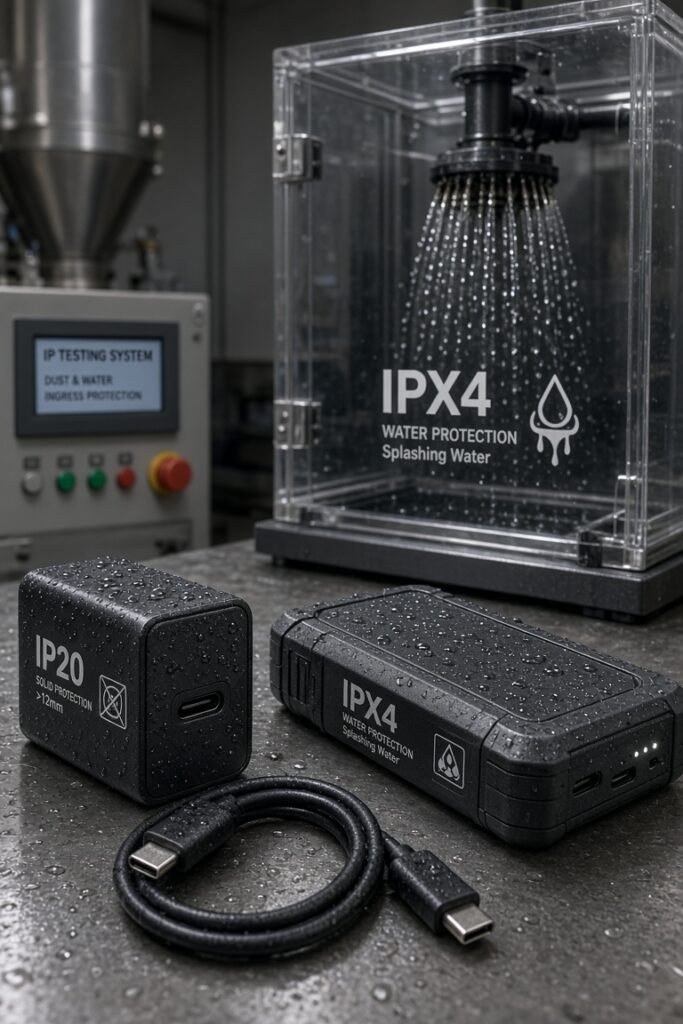
Entry-Level Basics: Common Knowledge That Charging Users Must Understand
What is IP Protection Rating?
IP protection rating is a set of widely adopted global product enclosure protection classification standards, specifically used to evaluate the ability of a product’s enclosure to block external solids (such as fingers, dust) and liquids from entering. Chargers, power adapters, charging cables, USB/USB-C ports, plugs, and device charging ports we come into contact with daily can all be measured for dust and water resistance using IP ratings. Its core function is to avoid short circuits, electric leakage, charging failures, or product damage caused by dust and water ingress.
Why is the IP Rating of Charging Products Particularly Important?
Unlike ordinary plastic enclosure products, charging products have high voltage and high current inside. Once dust or water enters and comes into contact with live parts, the light consequence is failure to charge and product burnout, and the serious consequence is safety accidents such as electric shock and fire.
Charging products usually have several natural weak points in protection: the contact gaps of the USB-C female port, the seams of the enclosure splicing, the connection position between the prongs and the enclosure, and the frequently bent parts at both ends of the charging cable. These places are the most prone to dust and water ingress.
However, it is not the case that the tighter the seal, the better: a high-seal design will affect product heat dissipation, increase production costs, and the sealing rubber ring at the interface will wear out as the number of plugging and unplugging increases, which instead reduces the service life of the interface.
The 3 Most Common Cognitive Misconceptions
The first misconception is regarding the IP rating as a complete charging safety certification. In fact, the IP rating only tests the dust and water resistance of the enclosure, and does not involve other safety items such as insulation, lightning protection, electromagnetic compatibility, and overheat protection at all. A high IP rating does not equal absolute safety.
The second misconception is thinking that the higher the IP rating, the better the product works. The IP rating should match the usage scenario. If you only use the charger on an indoor desk, buying a high-protection IP67 model is not only expensive, but also may affect charging stability due to the overly tight seal and poor heat dissipation.
The third misconception is thinking that the IP rating marked on the product is valid for life. The IP rating test is for specific product designs, sample states, and specified configurations. After the product undergoes aging, repair, disassembly, or damage, the actual protection may no longer be equivalent to the original test state; if your charger’s enclosure is cracked from a fall, or the dust plug of a port with a dust plug is lost, the protection capability may decrease or even fail completely.
How to Read the IP Code? Quick Reference for Common Ratings
Basic Rules of the Code
The standard IP code consists of “IP + two digits”. The first digit represents dust resistance (solid protection) capability, and the second represents water resistance (liquid protection) capability. The order is fixed and cannot be reversed.
If a certain item is not tested or the manufacturer does not declare it, “X” will be used instead. For example, IPX4 means only water resistance was tested, and the dust resistance item was not tested — note here that X is not equal to level 0, it just means no clear rating is given, and does not mean there is no dust resistance capability at all.
Some IP codes are followed by additional letters or supplementary letters. A, B, C, D may indicate protection against access to hazardous parts, and H, M, S, W, etc. may also indicate equipment category, test state, or environmental conditions. When encountering additional letters, they should be interpreted in combination with product instructions and test conditions, and cannot be ignored uniformly.
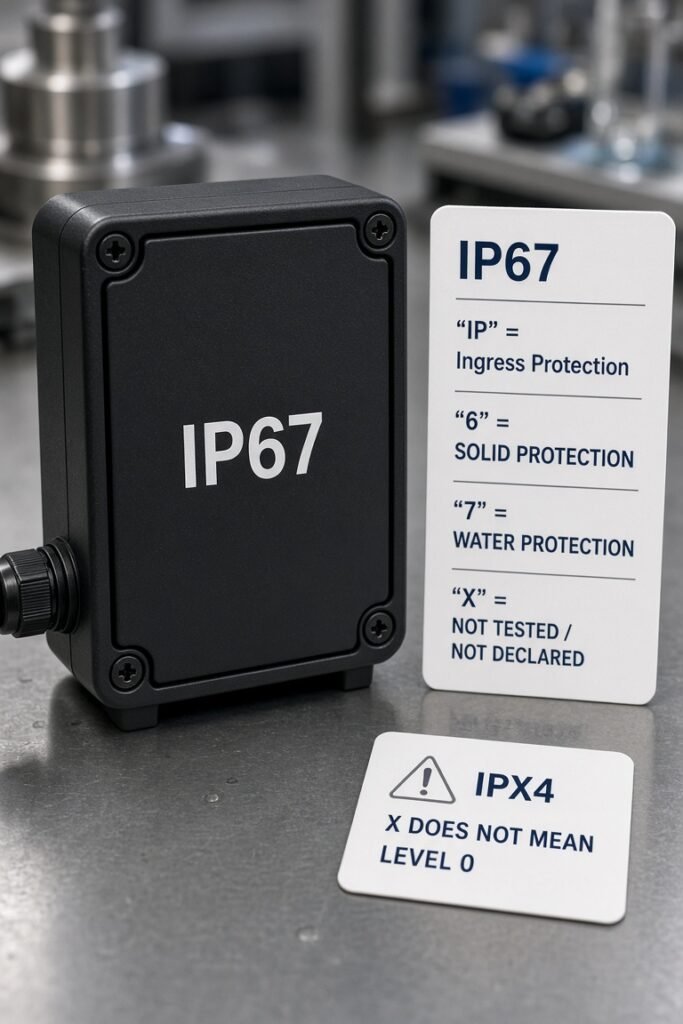
Corresponding Scenarios for Common IP Ratings of Charging Products
For everyone’s quick correspondence, we have compiled several common IP ratings in charging products and the protection capabilities they represent. Special attention should be paid: these ratings can only be used as examples of protection capabilities, and cannot be used to presume that a certain type of charger, charging cable, or wireless charging product usually has this rating, nor can they replace the model marking and user manual of specific products.
| IP Rating | Core Protection Capability | Possible Product Examples | Protection Capability Description |
|---|---|---|---|
| IP20 | Prevents fingers from touching internal hazardous parts, no water resistance | Some ordinary desktop chargers, wall-mounted power adapters | Suitable for indoor dry environments explicitly allowed by the product |
| IPX4/IP44 | Resists splashing water from any direction; IP44 additionally prevents entry of 1mm diameter thin wires | Chargers or charging cables specifically marked with this rating | Only indicates that the corresponding splashing water test has been passed, and cannot be directly presumed to be suitable for energized use in bathrooms or kitchens |
| IP54 | Limited dust resistance plus splash water resistance | Vehicle-mounted or outdoor charging products specifically marked with this rating | Only indicates dust and splash water resistance under specified conditions |
| IP65 | Complete dust resistance plus water jet resistance | Outdoor charging equipment specifically marked with this rating | Only indicates that the specified dust-tight and water jet tests have been passed |
| IP67 | Complete dust resistance plus temporary immersion | Outdoor power banks and other products specifically marked with this rating | Only indicates short-term immersion protection capability under specified conditions |
In bathrooms, kitchens, seaside, and rainy environments, it is not possible to judge whether safe charging is possible solely based on the IP rating. It is also necessary to consider whether the product is allowed to be used when energized, the position of the plug and socket, the connection state, as well as salt spray, corrosion, ultraviolet rays, and other outdoor conditions. In particular, chargers must not be connected or used in damp, water-accumulated, or immersed states.
Two Basic Principles for Reading Codes
When reading the IP code, there are two principles that must be remembered: First, you cannot add the two digits to compare the level, you must look at the two dimensions of dust resistance and water resistance separately — for example, IP65 and IP57, one has better dust resistance and the other has better water resistance, so you cannot say which has stronger overall protection solely based on the sum of the digits.
Second, ratings of different test types cannot be directly compared across categories. For example, IPX7 for immersion testing and IPX6 for water spray testing have completely different test logics, so you cannot say that IPX7 is necessarily better in water resistance than IPX6.
First Digit: Test and Judgment of Dust Protection
Grading Logic of Dust Resistance Ratings
The first digit ranges from 0 to 6, but these digits are not a simple continuous upgrade of “the same type of dust resistance capability” from weak to strong. Digits 0 to 4 mainly indicate protection against solid foreign object ingress and access to hazardous parts, digit 5 indicates dust protection, and digit 6 indicates dust-tight. The test objects and judgment methods corresponding to different digits are not the same.
Common protection markings for charging products are between IP2X and IP6X, where X means the water resistance item is untested or undeclared. Products with level 0 (no protection at all) basically do not appear in the charging category.
Test Methods and Qualification Standards for Common Dust Resistance Ratings
IP2X means that solid foreign objects with a diameter of 12.5 mm must not fully enter the enclosure, and the jointed test finger must not touch hazardous parts. It is not a unified basic requirement that all charging products must meet, but a specific enclosure protection rating. Whether an ordinary indoor desktop charger meets this rating shall be subject to the actual product marking or test data.
IP4X requires that solid foreign objects with a diameter of 1.0 mm must not enter the enclosure. If protection against access to hazardous parts is also to be declared, it shall be judged separately according to the access test tool specified in the standard, and cannot be simply summarized as “thin wires cannot touch internal live parts”. Whether the product meets IP4X shall also be subject to the test results of the complete enclosure.
IP5X is a limited dust resistance rating. During the test, the product is placed in a dust chamber and tested with test dust such as talcum powder. After the test, a small amount of dust may enter the product, but as long as this dust does not affect the safety and specified normal operation of the product, it is considered qualified. Whether vehicle-mounted or camping charging products meet this rating cannot be presumed based on the usage scenario, and the specific product marking must be checked.
IP6X is a dust-tight rating, meaning that under specified test conditions, no visible dust can enter. During the test, a dust chamber is used, and the sealing effect of the enclosure is tested through specified test conditions. Whether IP6X is met must be subject to the standard test results of the complete product.
Key Factors Affecting Dust Resistance Capability
The dust resistance capability of charging products is mainly affected by three factors: The first is heat dissipation holes. Exposed heat dissipation holes will increase the difficulty of dust-proof design, but whether IP5X or IP6X is met depends on the aperture, labyrinth structure, filter screen, air duct, sealing design, and the test results of the complete enclosure, and cannot be judged solely based on the presence of heat dissipation holes.
The second is interface sealing. Many USB-C ports with dust plugs can only reach the rated dust resistance rating when the plug is tightly inserted. If the plug is lost, deformed, or not tightly sealed, the protection may fail.
The third is enclosure seams. The precision, structure, and sealing method of the seams will all affect dust resistance capability. The larger the gap or the worse the seal, the higher the risk of dust ingress usually is.
Second Digit: Test and Judgment of Water Protection
Grading Logic of Water Resistance Ratings
According to IEC 60529, the second characteristic digit is 0 to 8, and IPX9 additionally indicates high-temperature and high-pressure water jet protection. IPX9K mainly belongs to road vehicle-related standards such as ISO 20653, and cannot be directly mixed with IPX9 of IEC 60529.
The test scenarios corresponding to these ratings gradually upgrade from dripping water, splashing water to water spray and immersion; IPX9 and related IPX9K tests also involve high-temperature water jets. Common water resistance markings for charging products are roughly between IPX3 and IPX7, and higher ratings are relatively rare in civilian charging products.
Test Methods and Qualification Standards for Common Water Resistance Ratings
IPX3 and IPX4 are common dripping and splashing water resistance ratings: IPX3 is water spray from a 60-degree range above the product, and IPX4 is splashing water on the product from any direction. The specific test time and assembly state shall be implemented in accordance with applicable standards and test plans.
After the test, the water entering the enclosure must not reach a level that impedes the specified normal operation or compromises safety. Whether energization, functional inspection, and specific judgment are required shall also be implemented in accordance with product standards and test plans, and cannot be simply understood as “no water can be inside at all” or only depend on whether the charging function is normal.
IPX5 and IPX6 are water jet test ratings: IPX5 uses water jets under specified conditions to spray the product from all directions, and the water jet conditions of IPX6 are more stringent. After the test, water ingress must not impede the specified normal operation or compromise safety; if charging function, insulation, and other electrical safety items need to be verified, they shall be tested separately in accordance with corresponding product standards. Whether it is suitable for vehicle-mounted, camping, or rainy day use cannot be presumed solely based on these ratings.
IPX7 is a temporary immersion rating. During the test, the product is completely immersed in water of a specified depth, taken out after a specified time, and observed whether water ingress reaches a level that affects the specified normal operation or compromises safety. Common IPX7 test conditions are about 1 meter water depth and 30 minutes, but in practice, it shall still be subject to product markings, instruction documents, and applicable test plans.
IPX8 is for continuous immersion conditions. Its specific immersion depth, duration, and other conditions are determined by applicable standards and agreements between the manufacturer and the user, and according to IEC 60529, it shall be more severe than IPX7. The specific conditions shall be specified in the product marking or instruction documents, and it is not allowed to only write IPX8 without explaining the conditions.
IPX9 in IEC 60529 indicates high-temperature and high-pressure water jet protection. IPX9K is mainly found in road vehicle-related standards such as ISO 20653, and the specific test conditions and scope of application shall be subject to the corresponding standards.
3 Things That Are Most Easily Misunderstood About Water Resistance Tests
Many people’s misunderstandings about water resistance ratings arise here, so be sure to pay attention:
First, IPX7 (immersion test) does not automatically cover IPX5/6 (water spray test). The water ingress logic of the two is completely different: static water immersion mainly examines immersion protection under a specified water depth, while the water spray test also applies water jet impact. Some products are suitable for static water resistance, but not necessarily for stronger water spray. Therefore, when buying, you should see clearly which items have been specifically tested, and cannot default to IPX7 being necessarily better in water resistance than IPX6.
Second, the medium, temperature, pressure, and flow rate of the specific water test shall be subject to applicable standards. Conventional IP water tests cannot be used to infer that the product can protect against seawater, detergents, beverages, steam, or other chemical media; IPX9 and related IPX9K tests also involve high-temperature water jets. Seawater may cause corrosion, and detergents and beverages may also damage sealing materials or internal circuits. “Water resistance” cannot be understood as “resistance to all liquids”.
Third, when used in combination, the IP rating of each component cannot be directly used to take the lowest value to derive the rating of the whole machine. The IP rating shall be tested for the complete enclosure or specified assembly state. The actual protection of the combination of chargers, cables, connectors, and equipment shall be subject to whether the manufacturer has made an IP statement and test for the complete combination and specific plug-in state. When there is no combination test or clear explanation, the component rating should not be extrapolated to the whole machine rating.
General Judgment Rules and Result Boundaries of IP Tests
Basic Premises of the Test
IP tests shall use samples that can represent mass-produced products, and shall be carried out in accordance with the assembly, sealing, and state specified in the standards and test plans. For example, if a product is rated IP65 with a dust plug, the test usually requires the dust plug to be installed and correctly tightened as specified; if the product is required to be used in a specific direction or assembly state, the test shall also be based on relevant requirements.
After the product undergoes aging, repair, disassembly, or damage, the actual protection may no longer be equivalent to the original test state. Whether it can continue to be used shall be judged in combination with the manufacturer’s maintenance requirements and the actual condition of the product, and re-evaluated if necessary, rather than relying solely on the original IP marking as a guarantee.
IEC 60529 is a widely adopted international standard for enclosure protection ratings, and many regions adopt or equivalently adopt its content, but specific regulations, product standards, certification procedures, and additional requirements may differ. The CE mark itself is not equivalent to an IP test report; the US UL system may also adopt IEC 60529, UL’s own standards, or product-specific standards, so it cannot be said that all regions and certification requirements around the world are completely consistent.
Core Logic of Qualification Judgment
For solid protection, that is, the test corresponding to the first digit, the standard will specify solid foreign object test tools and hazardous part access test tools according to the corresponding rating, and judge according to the corresponding requirements. For example, different ratings may focus on whether foreign objects can enter the enclosure, or whether the test tool can touch hazardous parts, respectively. All ratings cannot be simplified to the same judgment of “the probe cannot touch live parts”.
For dust and liquid protection, the core is that the intruding dust or water must not reach a level that impedes the specified normal operation or compromises safety. Not all ratings require that no dust or water enters at all.
IP tests mainly judge whether solid foreign objects and water ingress reach the corresponding rating. Items such as leakage current, withstand voltage, insulation, overheating, and short circuits shall be verified separately in accordance with applicable product safety standards, and cannot be replaced solely by IP test conclusions.
Applicable Boundaries of Test Results
The test results of IP ratings are not omnipotent, and have clear applicable boundaries:
First, it only covers the protection capability under standard test conditions. For example, IPX7 corresponds to a temporary immersion test with a specified depth and time, and it cannot be used to guarantee that the product is still safe in deeper water, long-term immersion, or other liquids.
Second, it is only valid for the specific product model and configuration tested. Products of different models, even if they look similar, may have different protection ratings; if the same product has different configurations, for example, some with dust plugs and some without, or the port is in different connection states, the results may also be different.
Third, when detachable accessories, such as dust plugs and waterproof covers, are missing or damaged, the protection rating will decrease. After the product has cracks, deformation, disassembly and repair, or aging of seals, it cannot be assumed that the original protection capability is still maintained.
Exclusive IP Protection Boundaries for Charging Products
The general rules of IP ratings are for all product enclosures, but charging products have their own special structures, so there are several exclusive protection boundaries that need attention.
Protection Boundaries of Chargers/Power Adapters
The IP test of chargers and power adapters is for the complete enclosure under the specified configuration, including all parts that may allow water and dust ingress, such as enclosure seams, heat dissipation holes, prong areas, and cable lead-out ends.
It should be particularly noted that the protection rating when the port is empty is not equal to the rating after the charging cable is inserted. The IP rating of some products is tested in the empty port state. After inserting the charging cable, the gap between the port and the charging cable may allow water and dust ingress, and the protection rating may change. When buying, you should see clearly whether the test state rated by the manufacturer is empty port, plugged with cable, or the state after connecting the device.
In addition, for ports with detachable dust plugs, they only meet the rated rating when the plug is tightly inserted as required. If the plug is not inserted normally or is damaged, the port protection is not guaranteed.
Protection Boundaries of USB/USB-C Ports and Charging Cables
For the protection of USB/USB-C ports and charging cables, three different states must be distinguished: the first is the rating of the port itself, such as when the female port is empty; the second is the rating after inserting the charging cable; the third is the rating of the whole machine after connecting the device. The protection ratings of these three states may be completely different and cannot be confused.
The weak points of charging cable protection are the connections between the ports at both ends and the cable body, as well as the stress areas that are frequently bent — the sealing structures or protective layers in these places are prone to cracking due to pulling and bending, leading to a decrease in protection capability.
After repeated bending, pulling, and plugging/unplugging, the sealing structure of the charging cable and port will gradually wear out, and the protection rating may also decrease. Therefore, charging cables that have been used for a long time and have cracks or deformation can no longer be used according to the high water resistance rating of new products.
Protection Boundaries of Charging Bases and Contacts
For charging bases with exposed contacts, such as wireless charging bases and magnetic charging bases, their IP ratings are usually tested for the specified product state and assembly configuration. Exposed contacts may corrode or short circuit after accumulating water, and such risks cannot be ruled out solely by the enclosure IP rating.
Some charging bases have drainage structures, such as drainage holes on the base to let accumulated water flow out, but this drainage structure does not automatically increase the rated IP rating. The IP rating depends on the enclosure protection capability under specified test conditions, and drainage capability belongs to another structural design.
How to Read IP Markings and Test Reports to Avoid Pitfalls
Pitfall-Avoiding Reading of Product Markings
When looking at the IP marking on the product, there are several pitfalls to avoid:
First, the order of the two digits is fixed. The first digit is solid protection, and the second is water protection. You cannot read them in reverse. For example, IP54 means solid protection level 5 and water protection level 4, not the other way around.
Second, be wary of vague publicity. Many manufacturers will say “daily water resistance”, “military-grade water resistance”, “splash-proof”, these statements cannot replace the unified IP code, nor can they alone explain which tests the product has passed. When judging protection capability, you should check the specific IP code, product instructions, and usage restrictions.
Finally, do not treat “X” as protection level 0. X only means that this item is not tested or the manufacturer has not declared it, and does not mean there is no protection capability at all — for example, some products marked IPX5 may actually have dust resistance up to IP4X, but the manufacturer has not tested or declared it.
Validity Judgment of Third-Party Test Reports
If the product provides an IP test report, the reference value of the report should be judged from three aspects:
First, it is necessary to verify whether the issuing agency of the report has the ISO/IEC 17025 accreditation scope related to IEC 60529 and this type of product, and confirm the specific product model and configuration corresponding to the report. Uncertified reports issued by internal laboratories or third-party institutions cannot be automatically deemed invalid, but their probative force and scope of application need further verification.
Second, the test state in the report must be consistent with your actual usage state. For example, if the report tests the protection in the wall-plugged state, but you actually use it flat; or if the report is tested with a dust plug, but you do not plug it when using, the report results cannot be directly extrapolated.
Third, it is necessary to confirm the test method, sample configuration, test results, and report purpose used in the report. Mutual recognition arrangements such as ILAC-MRA help to confirm laboratory accreditation results, but they do not mean that the report will be automatically accepted in all countries, all regulations, and all product scenarios.
Correct Comparison Method for Different IP Ratings
When comparing the IP ratings of different products, you should compare the dust resistance digit and water resistance digit separately, not just look at the sum of the digits, nor just look at the second water resistance digit.
For example, IP65 and IP57: IP65 means it has passed the IP6 dust resistance and IPX5 water jet tests, and IP57 means it has passed the IP5 dust resistance and IPX7 temporary immersion tests. They respectively indicate different protection capabilities, and you cannot simply say which is “more water-resistant overall”.
IP57 and IP65 also cannot be directly presumed to be suitable for seaside or all waterside environments. For seaside use, it is also necessary to confirm salt spray resistance and corrosion resistance requirements; for rainy days, it is necessary to confirm the manufacturer’s clear instructions on outdoor rainfall, connection state, and energized use. IP tests do not cover all conditions such as salt spray corrosion, wind-driven rain, or long-term outdoor exposure.
In addition, a higher rating only means that the requirements of the corresponding test item are more stringent, and does not mean it is applicable to all scenarios. For example, for indoor chargers, the heat dissipation design of IP20 may be more suitable than high-seal products, and you should not only pursue larger digits.
Practical Guide for Purchase, Use and Maintenance
Rating Recommendations for Different Usage Scenarios
When choosing an IP rating, you don’t need to pursue the higher the better, just match your own usage scenario. However, the following content can only be used as a reference for understanding protection capabilities, and cannot replace the manufacturer’s instructions:
If it is only used on an indoor dry desk, the protection capability represented by IP20 may be sufficient, and heat dissipation is usually easier to handle. Specifically, you should still abide by the product instructions.
If it is placed in places prone to water splashes such as bathrooms and kitchens, you cannot assume that it can be safely used when energized just because the product is marked with IPX4 or IP44. Chargers and sockets should be kept away from water sources, accumulated water, and damp areas, and comply with local requirements for electrical installation in damp places.
If it is for vehicle-mounted or short-distance camping use, IP54 or above only means that the corresponding product has passed the specified dust and splash water tests. Whether it is suitable for in-vehicle, outdoor, and energized use depends on the product’s instructions on conditions such as temperature, rain, and connection state.
If it is used at the seaside or outdoors on rainy days, IP65 only means that the complete product has passed the specified dust-tight and water jet tests, and cannot guarantee resistance to seawater, salt spray, wind-driven rain, or long-term outdoor exposure. For use at the seaside and on rainy days, you should also confirm the manufacturer’s instructions for outdoor use, corrosion resistance, and energized use.
If it is a scenario where accidental falling into water is possible, IPX7 only means that the product has been tested accordingly under the marked temporary immersion conditions. After falling into water, do not energize or charge in water. You should first disconnect the power supply, take it out, and handle it according to the manufacturer’s requirements. Do not understand IPX7 as being able to work underwater, nor extrapolate it to liquids such as seawater and sewage.
3 Pitfall-Avoiding Points When Purchasing
First, do not blindly pursue high IP ratings. High-protection chargers often require more complex sealing and heat dissipation designs, and may be more expensive; when used in indoor dry environments, there is no need to choose high-protection products just for larger digits.
Second, pay attention to the impact of detachable accessories on the protection rating. Many products are rated with high IP, but they only work when dust plugs and waterproof covers are installed. If you usually do not install them, or the accessories are deformed or damaged, you cannot use them according to the rated rating.
Third, prioritize products that clearly mark the specific IP rating, and reject products that only have vague publicity such as “daily water resistance” and “splash-proof”. At the same time, you should also check the test state, usage restrictions, and applicable environment, not just look at the two digits on the packaging.
Daily Self-Inspection and Tips for Extending Protection Life
If you want to keep the protection capability of charging products longer, you can pay attention to these points:
You can conduct regular self-inspections: check if there are cracks or deformation in the enclosure and ports, and whether the dust plugs and waterproof covers can still be completely tightened. If there is damage, do not take them to damp or dusty places for use.
If water accidentally enters, do not immediately energize for testing. You should immediately cut off the power and stop using it, and do not energize for testing by yourself; after wiping the outside dry, send it for inspection or replace it according to the manufacturer’s requirements. Use can only be resumed after the manufacturer explicitly allows it and it is confirmed that the interior is completely dry and free of damage. Waiting for a fixed 24 hours does not guarantee that the interior is completely dry, especially for chargers with mains input, residual moisture, corrosion, or insulation damage may pose risks.
If you need to clean the port, first disconnect all power supplies and confirm that the port is dry, and use a suitable non-conductive cleaning method that will not damage the port according to the manufacturer’s instructions. Do not scrub the port in a damp or energized state, and do not use sharp metal tools to clean precision ports such as USB-C, so as not to bend the contacts, push foreign objects deeper, or cause short circuit risks.
In daily use, try to avoid dropping, bumping, or squeezing the product, and do not place it in a high-temperature and high-humidity environment for a long time, such as in the bathroom all year round, otherwise the seals will accelerate aging and the protection capability will decline faster.
Learning Summary
At this point, the knowledge about IP protection ratings is almost covered. As long as you remember three things, you can easily handle daily purchase and use:
First, you can understand the meaning of the IP marking, look at the two dimensions of solid protection and water protection separately, accurately judge the product’s protection capability under specified test conditions, and will not be fooled by vague publicity.
Second, you can choose the appropriate IP rating according to your own usage scenario, neither spending wasted money on high protection that you don’t need, nor using it incorrectly by mistaking the IP rating for a complete safety certification. For bathrooms, seaside, rainy days, and falling into water scenarios, you should also check the manufacturer’s instructions and local electrical safety requirements at the same time.
Third, you can self-inspect whether the protection state of the product is valid, and know how to correctly use and maintain high-protection charging products. The IP rating is not a permit for underwater work, nor a lifetime durability guarantee; once water ingress, cracks, deformation, or disassembly and repair occur, you should stop using it and handle it according to the manufacturer’s requirements.