
When buying chargers, power banks, USB-C cables, or in-car charging devices, you have most likely seen markings such as “IP67” or “IPX4 water resistance” printed on the packaging. Some merchants claim products “can be used in rain”, but poor contact occurs after just a light drizzle; some products are labeled with high dust protection, but their interfaces are full of dust after half a year of use. The core of these problems is often that people do not understand the real rules of the IP code — it is not a marketing concept fabricated by manufacturers, but a unified international standard formulated by the International Electrotechnical Commission, namely IEC 60529.
This article will start with the most basic reading method, combine various charging products you encounter in daily life, and explain the meaning, applicable boundaries, common misconceptions, and purchase judgment methods of IP ratings clearly. It will help you go from “unable to understand the marking” to “able to accurately judge the authenticity of publicity and choose products suitable for you”.
Basic Cognition of IP Code
First, clarify several core definitions to avoid going astray at the beginning.
IEC 60529 is an enclosure protection standard issued by the International Electrotechnical Commission, which provides unified ingress protection classification and test methods for electrical equipment enclosures within the applicable scope. Whether a specific product adopts this standard and how to mark it shall also be combined with the corresponding product standards and manufacturer’s declaration. IEC 60529 is adopted by many product standards and markets, but whether IP testing or marking is mandatory depends on applicable regulations, product standards, market requirements, and manufacturer’s declaration.
The IP code (full name: Ingress Protection) is the symbol used in this standard to indicate protection capability — simply put, two digits are used to measure the ability of the enclosure to block the ingress of solids (such as dust, fingers, tools) and liquids (such as water) respectively. The first characteristic digit also involves protection against human contact with hazardous live parts; it does not mean all internal components are protected.
For the charging products we commonly use, the significance of IP ratings is very practical: for products such as chargers, power adapters, charging cables, USB/USB-C interfaces, plugs, and power banks, once dust or water enters, the consequences range from interface corrosion and poor contact to short circuits, electric shock, and even fire. The IP rating is used to quantify the protection capability of the enclosure against these risks.
However, the basic boundaries of IP ratings must be clearly defined first to avoid misunderstandings later:
First, IP is only a special indicator for enclosure protection, not equal to the overall product quality rating, nor a complete electrical safety certification. It only tests “whether the enclosure blocks things from entering”. As for whether charging will cause overcharge, fire, or drop resistance, these are governed by other standards.
Second, the IP rating only applies to the external enclosure declared by the product, and does not involve the protection capability of internal circuit boards or components themselves.
Third, it does not cover other protection capabilities such as drop resistance, high and low temperature resistance, corrosion resistance, and UV resistance. Do not think that products with high IP ratings are “invulnerable”.
Fourth, whether IP rating testing or marking is required is not the same for all charging products, but depends on applicable regulations, product standards, market requirements, and manufacturer’s declaration. Most ordinary indoor charging products do not undergo high protection testing, after all, the cost will increase and it is not needed indoors.
Structure and Reading Rules of IP Code
Many people think that the larger the number after IP, the stronger the overall protection, but this is not true — the structure of the IP code is fixed, and the two digits are responsible for their respective aspects and cannot be confused.
Basic Format and Core Rules
The basic structure of the IP code is: IP + first digit (dust/solid protection) + second digit (water protection).
The two digits are evaluated completely independently: high water resistance does not mean high dust resistance. For example, an IPX7 product may not be dustproof at all; conversely, high dust resistance does not mean high water resistance. For example, an IP6X product may break when exposed to water.
There is also a very easy pitfall to step into: water immersion protection ratings (IPX7/8) do not automatically cover water jet protection ratings (IPX5/6). Simply put, products that can be immersed in water may not be able to withstand high-pressure water jets; products that can pass the specified water jet test may not be immersible in water.
Some products are marked with combined ratings, such as IP65/IP67, which means it has passed both IP65 and IP67 independent tests, corresponding to jet water protection and immersion water protection scenarios respectively, not “a higher rating than IP67”.
Meaning of the Special Mark “X”
You may have seen markings with X such as IPX4 or IP5X. Many people mistakenly think X means “0 protection” or “the highest level of protection”, but neither is correct.
X means: the corresponding item has not been tested in accordance with the standard, or the manufacturer has not declared the rating for this item — it is neither 0 nor the highest, just “not tested/not declared”. For example, IPX4 means only water resistance has been tested, and the dust protection item has not been done; IP5X means only dust resistance has been tested, and the water protection item has not been done.
When purchasing, if you care about a certain type of protection (such as dust resistance in dusty environments), be sure to confirm that the corresponding position is a clear number, not X, otherwise its dust resistance capability may be completely unguaranteed.
Additional and Supplementary Letters: Ordinary Users Do Not Need to Care
In addition to the first two digits, the complete IP code may also have additional letters and supplementary letters after it, but for consumer-grade charging products, these two types of markings almost never appear:
- Additional letters (A/B/C/D): used to supplement the specific objects of contact protection, such as protection against the back of the hand, fingers, or metal wires. Consumer-grade products generally do not be marked separately.
- Supplementary letters (H/M/S/W): correspond to special test conditions, such as high-voltage equipment, moving state, still water state, outdoor weather conditions, etc., which are basically not used for ordinary charging products.
Most consumer-grade products mainly focus on the two characteristic digits, but if additional letters or supplementary letters appear in the code, they should also be read in combination with the product description and cannot be directly ignored.
Complete Structure and Omission Rules
The complete IP code structure is: IP + first digit + second digit + additional letter + supplementary letter. For convenience, untested items are replaced with X, and letters that do not require supplementary explanation are directly omitted.
Most of the IP markings of charging products we see daily are simplified, such as IP20 (ordinary indoor chargers), IPX4 (outdoor chargers with splash protection), IP5X (dustproof adapters for garage use), IP23S (products with special supplementary conditions, relatively rare).
First Digit: Dust/Solid Protection Rating (0-6)
The first digit of the IP code represents the protection capability of the enclosure against solid foreign objects, with 7 levels from 0 to 6, which can be roughly divided into three categories: basic contact protection, tool/wire protection, and real dust protection.
For your quick comparison, here is a concise rating table:
| First Digit | Core Protection Capability | Common Applicable Scenarios |
|---|---|---|
| 0 | No solid protection; persons/objects can directly contact internal components | Exposed components with no protection requirements (rarely used in charging products) |
| 1 | Protects against large-area contact of the back of the hand with internal live parts | Rarely marked separately for charging products |
| 2 | Protects against finger insertion to contact internal live parts | Whether this rating is met or declared shall be subject to product marking and technical documentation |
| 3 | Prevents entry of thick tools and metal wires with diameter ≥2.5mm | Basic outdoor charging products |
| 4 | Prevents entry of thin tools and metal wires with diameter ≥1mm | Mid-range outdoor charging products |
| 5 | Dust-protected: dust ingress does not affect safety and function; very small amount of dust ingress is allowed | Specific environments need to be judged in combination with actual conditions |
| 6 | Dust-tight: no dust ingress under standard tests | Specific environments need to be judged in combination with actual conditions |
Levels 0-2: Only Contact Protection, No Dust Resistance at All
The core function of the first three levels is to prevent the human body or large objects from touching internal hazardous live parts, and they cannot block dust at all.
IP0X means no protection at all, hands can directly touch internal parts, and charging products basically do not use it; IP1X can only block large-area contact such as the back of the hand, which has little practical significance, and charging products are rarely marked separately; IP2X can prevent fingers from inserting and contacting hazardous live parts.
However, whether ordinary indoor chargers meet or declare IP2X must be subject to product marking and technical documentation, and cannot be presumed by default. IP2X also does not block dust at all, so it cannot be understood as a dust protection rating.
Levels 3-4: Tool/Wire Protection, Still Not Dustproof
The protection objects of level 3 and level 4 are tools and metal wires, such as screwdrivers, copper wires and other small solids, but they still cannot block finer dust.
IP3X can block thick tools and metal wires with a diameter of 2.5 mm or more; IP4X can block thin tools and metal wires with a diameter of 1 mm or more. These two levels are mostly used for basic outdoor charging products, mainly to prevent small branches and metal debris outdoors from falling in and touching live parts, but they still have no way to deal with dust.
Levels 5-6: Real Dust Protection Capability
Only when reaching level 5 and level 6 can it be regarded as having actual dust protection capability:
IP5X is “dust-protected”. During the test, the product will be placed in a dust chamber, and the amount of dust ingress will be checked after the test — as long as the incoming dust does not affect the safety and normal function of the product, it is considered up to standard, and a very small amount of dust is allowed to enter.
IP6X is “dust-tight”, which requires no dust to enter the interior of the enclosure under standard tests, with a higher protection level. However, it should be noted that dust-tight does not mean complete air isolation, only that dust cannot enter, and dust ingress cannot be judged by the naked eye, but must rely on standard tests.
Whether IP5X or IP6X can meet the requirements of specific environments such as balconies, garages, and construction sites still needs to be judged in combination with dust type, concentration, usage time, interface status, and the manufacturer’s environmental instructions. The IP rating does not directly specify that a certain environment must be applicable, nor does it cover actual conditions such as dust properties, mechanical wear, and interface exposure.
Even with the highest IP6X, after long-term use in high-dust environments, dust may accumulate on the interface surface, so it is necessary to clean the charging interface regularly to avoid poor contact.
Second Digit: Water/Liquid Protection Rating (0-9)
The second digit is the water resistance capability that people are most concerned about, with 10 levels from 0 to 9, and it is also the part with the most misconceptions. Again, here is a comparison reference table for you first:
| Second Digit | Core Protection Capability | Common Applicable Scenarios |
|---|---|---|
| 0 | No water protection at all | Pure indoor dry environments |
| 1 | Protects against vertically falling water drops | Rarely marked for charging products |
| 2 | Protects against vertically falling water drops when tilted 15° | Rarely marked for charging products |
| 3 | Protects against water spray within 60° range | Rarely marked for charging products |
| 4 | Protects against splashing water from any direction | Specific scenarios shall comply with product instructions |
| 5 | Protects against water jets specified by the standard | Cannot be presumed to be flushable with a shower head or high-pressure cleaner |
| 6 | Protects against stronger water jets specified by the standard | Cannot be presumed to withstand any high-pressure cleaning |
| 7 | Temporary immersion (tested according to standard-specified water temperature, immersion position and time) | Occasional falling into water, specific subject to product declaration |
| 8 | Continuous immersion (specific conditions subject to applicable standards or product declaration) | Long-term water contact, deep immersion scenarios |
| 9 | Protects against high-temperature high-pressure water jet cleaning | Industrial high-temperature cleaning scenarios (rare for consumer-grade) |
Levels 0-4: From Dripping to Splashing
Among the first five levels, levels 0 to 3 are of little significance to charging products and are basically not marked separately:
IPX0 means completely non-waterproof, and it may break when exposed to water; IPX1 can only prevent vertically falling water, such as ceiling dripping, which is almost useless; IPX2 can prevent vertical dripping when the product is tilted 15 degrees, and there are also few scenarios; IPX3 can prevent water spray within 60 degrees, such as obliquely sprinkled water, and charging products are also rarely marked.
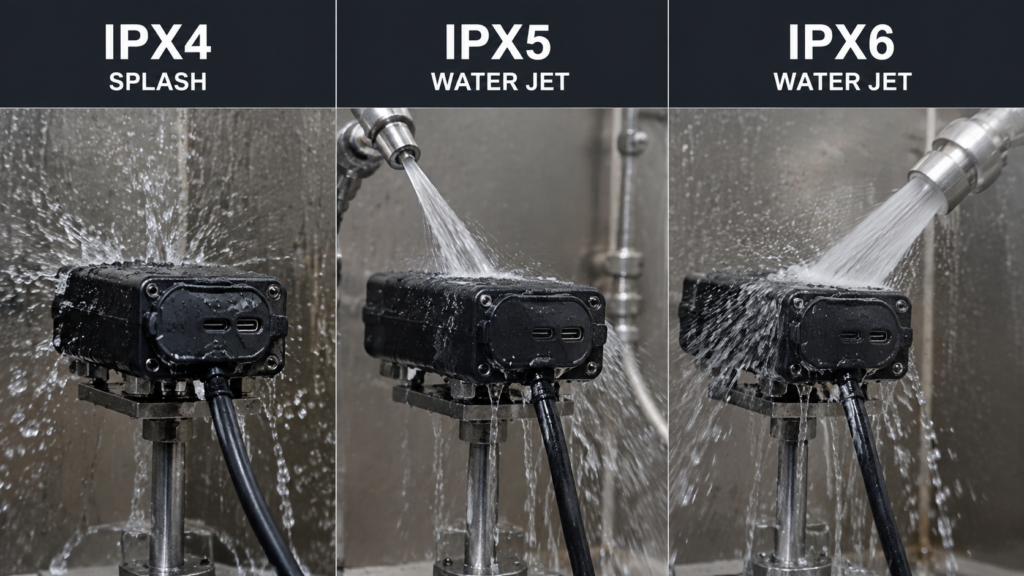
The really commonly used one is IPX4: it means that the product has splash protection from any direction under specified conditions. Whether it can be used in humid scenarios such as kitchens and bathrooms must also comply with the product instructions, and confirm whether the product is allowed to be used in energized state. IPX4 does not mean it can be rinsed or immersed, nor does it cover condensation, chemical liquids, or other complex environments.
Levels 5-6: Water Jet Protection (Jet Protection ≠ Immersible)
IPX5 and IPX6 correspond to standard-specified water jet tests respectively, which use specified nozzles, flow rates, distances and durations. It cannot be presumed that the product can be rinsed freely with a shower head or high-pressure cleaner, and actual use shall be subject to the product instructions.
Here are two very important reminders:
First, the test uses controlled water flow in the laboratory, which is different from natural rain. Natural rain has wind, angle changes, and impurities, so it cannot be simply considered that “IPX5 can be used in rain”. Use in rainy days should also be judged in combination with other declarations of the product, the size of the rain, and the use state.
Second, IPX5/6 and IPX7/8 are completely independent and do not cover each other. For example, an IPX7 product that can be immersed in water may not be able to withstand the specified water jet; a product that can pass the IPX6 water jet test may have water ingress when immersed in water.
Levels 7-8: Immersion Protection
IPX7 and IPX8 are immersion-type ratings, that is, the product can be immersed in water under specified conditions.
IPX7 is temporary immersion. The typical test is 30 minutes of immersion under specified water temperature and immersion position conditions; for common small enclosures, the reference condition is that the highest point of the enclosure is 1 meter below the water surface, but the specific implementation shall follow the size and test clauses of IEC 60529. After the test, it is also necessary to check whether there is harmful water ingress and whether the product meets the corresponding judgment requirements, so it cannot be simply understood as “any product can be completely put into 1 meter deep water”.
IPX8 requires testing under continuous immersion conditions that are more severe than IPX7, as specified by the applicable product standard or agreed between the manufacturer and the user. The specific depth, duration and other conditions shall be specified in the product documentation. The IPX8 test conditions of different products may vary greatly, so they cannot be directly compared horizontally. Be sure to check the specific depth, duration and other restrictions marked on the product.
IPX9 and IPX9K: Do Not Confuse the Standards
You may occasionally see markings of IPX9 or IPX9K. These two are not the same thing and should be clearly distinguished:
IPX9 is a water protection rating in the IEC 60529 standard, which can protect against high-temperature high-pressure water jet cleaning. It is basically used for industrial equipment, and is very rare for consumer-grade charging products.
IPX9K comes from ISO 20653 and is mainly used for road vehicle equipment. Its test method is different from that of IPX9 in IEC 60529; it cannot be simply asserted which is more stringent, nor can they replace each other. The two belong to different standard systems. When you see IPX9K, you should confirm that the product is based on ISO 20653, not IEC 60529.
Applicable Boundaries of IP Ratings for Each Component of Charging Products
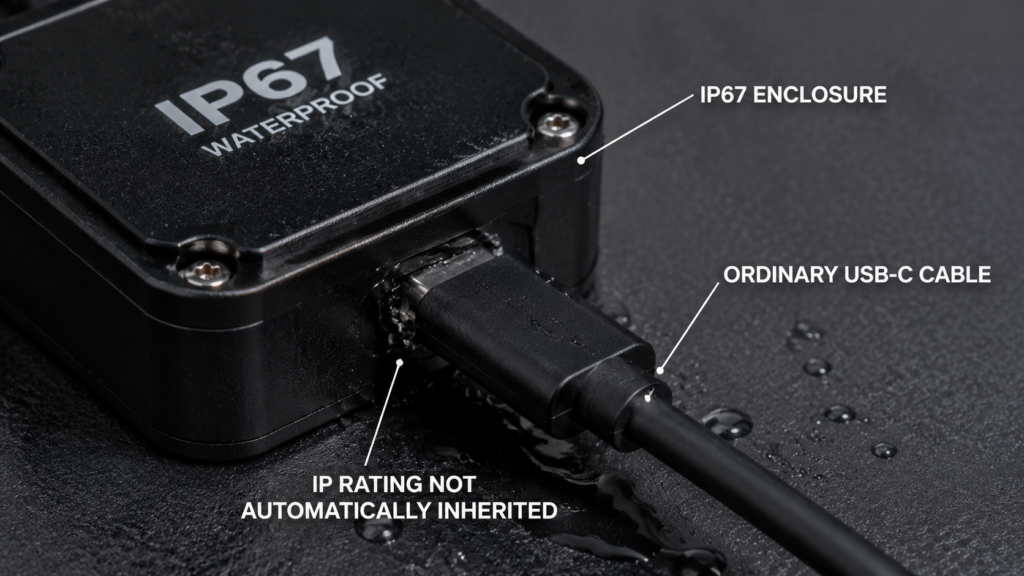
Many people buy charging products with high IP ratings but they still break down. It is very likely that they do not understand: the IP rating only corresponds to the declared specific configuration and state, not that the entire product can reach this rating no matter how it is used. In particular, charging products are composed of multiple components, and the IP ratings of each component cannot be applied to each other.
Core Principle: No Universal Default Values, Only Declarations Apply
First of all, remember a core rule: there is no universal default scope for IP ratings, and everything shall be subject to the declaration in the product manual or official test report.
When checking, focus on these points: the specific model of the product, which part is tested, whether the sealing plug is covered during the test, whether the interface is plugged with a cable or empty, what the installation direction of the product is, and whether the product is energized during the test.
The IP codes of each component cannot be automatically inherited. After connecting an ordinary USB-C cable, the sealing state of the interface combination will change; unless the manufacturer has tested and declared this complete combination, the entire combination cannot continue to be claimed as IP67, nor can a new IP rating be determined based on this.
Boundaries of Chargers/Power Adapters
When we usually say that a certain charger has a certain IP rating, it mostly refers to its main body enclosure, including the fixed pins and the output interface after being sealed, but does not include the external charging cable.
High-protection chargers generally have sealing gaskets and tight joint designs, but note that heat dissipation performance cannot be inferred solely from the IP rating — some high-protection products have fewer heat dissipation holes for sealing purposes, and their heat dissipation may be inferior to ordinary models, especially for high-power chargers. When purchasing, you should consider the heat dissipation design together.
In addition, the premise of meeting the IP rating is: the enclosure is intact without cracks, the sealing plug is covered, and it has not been disassembled without permission. If it has been disassembled or the enclosure is cracked due to dropping, the protection capability may fail.
Boundaries of USB/USB-C Interfaces
The IP rating of a USB or USB-C interface is tested according to the specified state, either with the matching sealing plug covered, or mated with the matching waterproof charging cable.
If you use an ordinary non-waterproof charging cable, the mating gap between the interface and the cable is not sealed, and the protection rating will be significantly reduced, or even completely lost. Unless the manufacturer explicitly declares that this complete combination has been tested, the original IP rating of the charger or interface cannot continue to be used.
If the interface itself is exposed without a sealing cover, the actual protection capability will be much lower than the nominal rating, and problems such as contact corrosion and short circuit are prone to occur over time.
Boundaries of Charging Cables and Plugs
Many people think that a waterproof charging cable is “waterproof all over”, but it is not: a waterproof charging cable can only guarantee the sealing of the cable body and the outer layer of the connector, does not cover the mating gap of the interface — that is, the connection points between the cable and the charger, and between the cable and the phone, are not included in the cable’s IP rating.
Ordinary charging cables cannot be considered to have a high overall IP rating after being plugged in just because the charger or power bank has a high IP rating. Unless the complete charger, cable and mating state have been tested and obtained corresponding declarations, the ratings of each component cannot be combined for use.
The most prone places for protection failure of charging cables are the strain relief of the connector, the connection position between the cable and the connector, and the gap of the metal pins of the plug. If these places are cracked or worn, the protection may be affected.
Core Logic and Validity Boundaries of IEC 60529 Testing
To judge whether IP publicity is reliable, you must first understand the test logic of this standard and know its boundaries, so as not to be fooled by the exaggerated publicity of merchants.
No Universal Default Values for Test Conditions
Many people default to “IPX7 is 1 meter for 30 minutes” or “all tests are energized”, but this is not true — IEC 60529 specifies the corresponding test methods and judgment framework, and it is impossible to judge whether the test is energized solely based on the IP code. Specific requirements shall be found in the applicable product standards, test reports, and the manufacturer’s declaration on the use state.
When checking the test conditions, focus on these items: the state of the sample (new or used), installation method (placed horizontally or vertically), state of sealing components (whether the sealing plug is covered, whether the matching cable is plugged), standard-specified water test conditions (including water temperature, flow rate, pressure, distance, duration and sample state), and whether the product is energized during the test.
Salt water, alcohol, cleaning agents, etc., are not standard test media directly covered by the IP code; they involve additional issues of chemical compatibility, corrosion, or material resistance.
In addition, after the test, it is also necessary to verify whether the safety performance and function of the product are normal. It is not that “no water ingress” means up to standard. For some ratings, a small amount of water ingress does not necessarily directly mean unqualified. The key depends on whether it constitutes a harmful effect and whether it meets the judgment requirements of the standard.
Core Judgment Logic of Tests at All Levels
The judgment standards of different levels are different. Do not apply the same set of logic to all:
- Dust protection levels 0-4: The judgment criterion is “test objects of corresponding size cannot contact internal hazardous live parts”, not that they cannot enter at all. As long as hazardous live parts cannot be touched, the corresponding rating requirements may be met.
- Dust protection levels 5-6: IP5X passes if the amount of dust ingress does not affect safety and function; IP6X means no dust ingress under standard test conditions.
- All water protection levels: The focus of water protection rating judgment is “no harmful ingress of water”, not simply requiring “no water ingress at all”. Whether it constitutes a harmful effect shall be judged in combination with the judgment requirements specified in the standard and the structure and function of the product.
Validity Boundaries of Test Results
The IP test result is not “valid for life” nor “universal for the entire series”. Its validity has clear boundaries:
First, it is only responsible for the samples, configurations, and conditions tested at that time, and is not permanently valid — after a period of use, enclosure wear and sealing gasket aging will reduce the protection capability.
Second, it is a single-condition test. For example, it only tests immersion under normal temperature water conditions, and does not test immersion after high temperature or drop, so the results of a single test cannot be applied to complex real scenarios.
Third, it only applies to the specific model declared, and cannot be extrapolated to other models in the same series — for example, the Pro version charger of a certain brand is IP67, which does not mean the standard version is also.
Core Boundaries Between IP Rating and Charging Safety
This is the most easily confused point: the IP rating is only the rating of enclosure protection, and must never be equated with the overall electrical safety of the product.
First of all, IEC 60529 is a special standard for enclosure protection, not a complete machine safety standard. IEC 62368-1 applies to the safety of audio/video, information and communication technology equipment within its scope; chargers, power supplies, batteries, and USB-C interfaces may also be subject to other specialized product safety, energy efficiency, electromagnetic compatibility, and battery/charging system standards. No matter how high the IP rating is, it cannot be judged solely by this item that the product has passed all relevant safety requirements.
Specifically, the IP rating does not cover these core electrical safety performances at all: insulation, withstand voltage, leakage current, temperature rise, overcharge/overdischarge, short circuit protection, as well as USB-C power negotiation, cable current-carrying capacity, electromagnetic compatibility, and energy efficiency. These have nothing to do with IP and must be guaranteed by other standards.
In addition to electrical safety, the IP rating also does not cover material and environmental tolerance:
- Chemical liquids: IP tests use standard-specified water test conditions. Whether liquids such as seawater, sweat, beverages, alcohol, and cleaning agents will corrode the enclosure or cause short circuits is not covered by the IP rating and requires additional verification.
- Mechanical and environmental performance: drop and shock resistance, high and low temperature resistance, UV resistance, corrosion resistance, etc., are also not within the scope of IP.
Finally, the most critical misconception should be emphasized: having an IP rating does not mean it is safe to touch water while energized. It is impossible to judge whether the test is energized solely based on the IP code; you should check the applicable product standards, test reports, and the manufacturer’s declaration on the use state. When there is no clear declaration of energized use, the IP rating should not be extended to a permit for water contact with power on. Even for high-protection products, the risk of water ingress during charging is very high, so never take risks.
Practical Guide to IP Ratings for Charging Products
After talking about so many rules, finally let’s get down to actual use, teaching you how to choose, how to distinguish authenticity, and how to maintain.
Purchase Decision Logic: Do Not Blindly Pursue High Ratings
Products with high IP ratings have higher costs and may sacrifice other performances such as heat dissipation and feel. There is no need to blindly pursue the highest rating, just choose according to your own needs. You can follow these four steps:
Step 1: First judge your own use scenario: is it a pure indoor dry environment, or will there be daily splashes, or a dusty garage/balcony, or outdoor rain, or possible immersion.
Step 2: Confirm your own use state: will you often use it while energized? Will the interface be plugged with a cable for a long time? Will you plug and unplug frequently?
Step 3: Check the product’s IP rating, corresponding configuration state, and whether the test complies with the IEC 60529 standard — don’t just listen to the merchant saying “waterproof”, look at the specific IP code and test basis.
Step 4: Comprehensively choose based on the product’s rated power, heat dissipation design, and brand reputation, don’t just look at the IP rating.
Publicity Authenticity Verification Checklist
Now many merchants falsely mark IP ratings. You can use these items to check the authenticity of publicity:
- It shall be checked whether the product clearly declares the specific IP code, applicable standard, product model and configuration. Merely stating “daily water resistance” or “splash resistant” does not allow you to judge its corresponding standard rating.
- The configuration state corresponding to the rating shall be clear, such as “IP67 when the sealing plug is covered” or “IPX7 when mated with the matching waterproof cable”. Only marking the IP rating without explaining the state makes it impossible to judge whether the rating applies to your actual usage.
- High-grade products usually need to achieve protection through corresponding structural design, but IP protection can adopt various structures. It is impossible to judge false marking solely by whether there is a gasket, whether the joint is obvious, or the appearance workmanship. The manufacturer’s declaration on the specific model, configuration and test evidence shall be checked.
- If it is an IPX8 rating, the specific immersion depth, duration and relevant conditions shall be marked, otherwise it is impossible to judge its actual water resistance capability.
- When necessary, you can request the manufacturer for test reports or compliance declarations corresponding to the model, configuration and test conditions; product compliance cannot be judged solely by whether the report is disclosed.
Real Scenario Judgment Cases
Let’s practice with several common scenarios to help you consolidate these rules:
- Can a power bank with IPX7 be used while charging in the rain? It cannot be directly determined. First, IPX7 is an immersion rating and does not cover rain jet; second, it is impossible to judge whether the test is energized solely based on the IP code. Using while charging is an energized state, and you must check whether the product has a clear declaration of energized use, otherwise do not try.
- After connecting an IP67 charger to an ordinary USB-C cable, is the whole still IP67? This cannot be claimed. Ordinary USB-C cables have not been subject to waterproof declaration for the corresponding combined state, and the gap after mating may change the sealing state of the interface. Unless the manufacturer has tested and declared this complete combination, the entire combination cannot continue to be claimed as IP67, nor can a new IP rating be determined based on this.
- Can an IP54 charger be rinsed with a faucet? Rinsing cannot be allowed based on this. IP54 only declares splash protection under specified conditions, and the flow rate, pressure, distance and direction of faucet water flow are not uniform. Unless otherwise specified by the manufacturer, do not rinse with continuous water flow.
Daily Maintenance and Failure Judgment
The IP rating is not once and for all. If daily maintenance is not done well, the protection capability will soon fail:
- Daily maintenance: When the interface is not in use, cover the sealing plug; avoid dropping, bumping, or squeezing the enclosure, otherwise it will cause joint cracking and sealing gasket falling off; before cleaning sealed parts, check the manufacturer’s regulations. When material compatibility is not confirmed, avoid using alcohol, solvents, or cleaning agents, and prioritize methods permitted by the instruction manual.
- Treatment after water ingress: Once water enters, immediately power off and stop using, do not plug or unplug with power on, do not turn on, do not disassemble by yourself, repair according to the product after-sales requirements, and use it after confirming there is no problem.
- Failure signals: If the following situations occur, it means that the protection capability may have been affected, and do not use it in humid or dusty environments: cracks in the enclosure, larger joints, falling off or deformation of the sealing gasket, and the interface cover cannot be closed reliably. A decrease in the insertion/extraction damping of the interface, making it loose, mainly reflects the mechanical retention or wear of the connector. The connector and sealing state should be checked at the same time, and IP failure cannot be judged solely based on this. If charging is intermittent, abnormally hot, or has poor contact, you should also stop using it and check.
Learning Summary
So far, the core content of the IEC 60529 enclosure protection rating has been finished. Let’s briefly sort out the key points:
First, understand the structure of the IP code: the two digits are responsible for dust protection and water protection respectively, independent of each other, and X means untested or undeclared; if additional and supplementary letters appear, they should also be read in combination with the product description.
Second, distinguish the differences and applicable boundaries of dust protection levels 0-6 and water protection levels 0-9. Especially in water protection ratings, jet and immersion do not cover each other, and IPX8 cannot be compared horizontally.
Third, make it clear that the IP rating of each component of the charging product only corresponds to the specific state declared, and cannot be inherited from each other. After connecting different cables or changing the sealing configuration, the original rating cannot continue to be used unless the complete combination has been tested and declared.
Fourth, distinguish the boundary between IP rating and overall electrical safety. IP is only enclosure protection, cannot replace electrical safety certification, and even less means it is safe to touch water with power on.
Fifth, when purchasing, combine your own use scenarios and use states, do not blindly pursue high ratings, and at the same time check the product model, configuration, applicable standards and test evidence to judge whether the publicity is true.
Sixth, pay attention to daily maintenance, know what changes in the enclosure and sealing components require stopping use for inspection, and handle correctly after water ingress.
The IP rating is not an esoteric concept, but it is not a gimmick used by manufacturers for marketing — understand its rules, and you can choose charging products that are really suitable for you and avoid many unnecessary risks.