
Merchants selling in the EU market have more or less encountered problems with packaging labeling: either goods are detained during customs clearance due to a missing label on the packaging, or they are complained about by consumers and fined for printing the words “eco-friendly packaging”, and some people cannot figure out how many types of labels need to be printed to be compliant.
EU packaging labeling may seem scattered, but it actually has a clear hierarchical logic. When assessing compliance, you can check against four layers: “EU common framework – target country rules – packaging scenario – printing and archiving”. This article starts with basic definitions, covers differences in national rules, methods for judging different packaging types, practical implementation, and self-check pitfalls to help you go from beginner to being able to independently judge most compliance issues.
Basic Understanding: What EU Packaging Labeling Is and Who Must Comply
Many people think that the recycling label on packaging is an “environmental certification”, but that is not the case. EU packaging labeling is essentially an environmental classification and compliance information label printed on packaging based on the requirements of EU and member state packaging regulations. Its core function is to help recycling institutions sort and guide consumers to correctly discard packaging. It is a voucher for classification and compliance, not a proof of “high-quality eco-friendly packaging”. The authenticity of the label is the responsibility of the party that places the packaging on the market.
Scope of Application and Boundary Judgment
This set of rules covers all packaging entering the EU market, whether it is sales packaging that directly contains products, combined packaging that groups multiple products together, transport packaging used for shipping goods, or service packaging such as takeaway food containers and shopping bags. Common examples include plastic beverage bottles, express cartons, aluminum cans, logistics wooden pallets, cosmetic blister packs, and takeaway food containers.
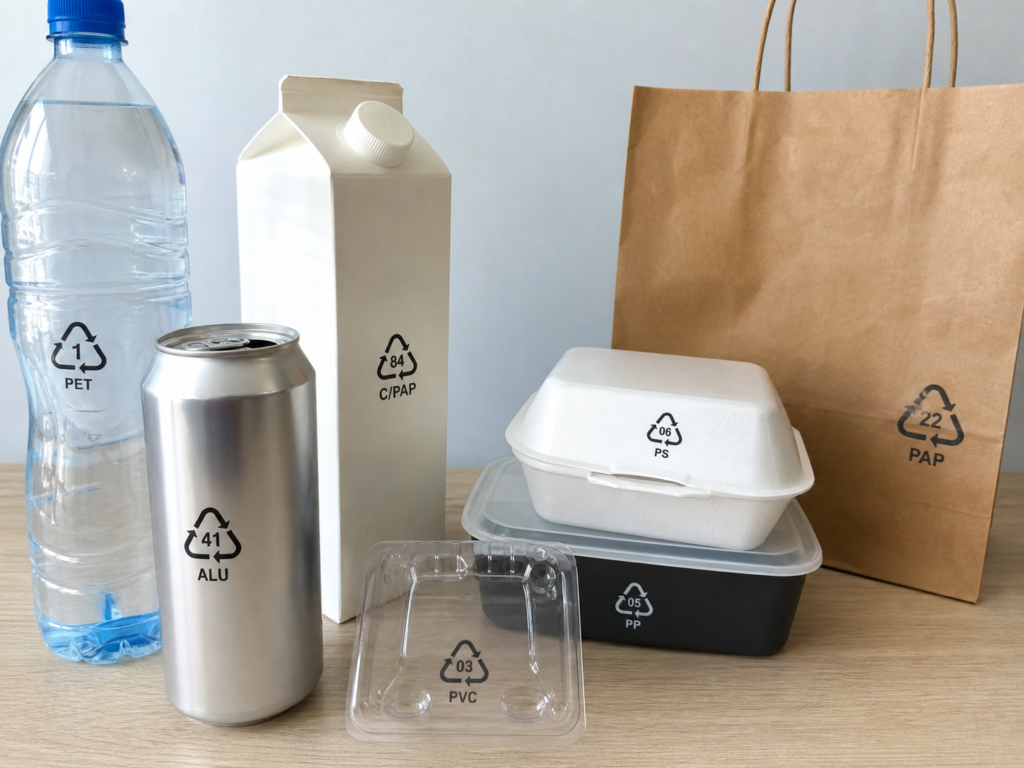
Judging the boundary is also simple: as long as it is a packaging material used to contain, protect, or handle goods, it falls within the scope of the rules, and is separate from the product itself. For example, the ceramic bowl you sell is the product, and the foam and paper box wrapped around it are packaging.
Many people ask: do very small packaging, medical product packaging, military packaging, and dangerous goods packaging not need to comply? The answer is that you cannot unilaterally determine that obligations are exempted. These types of special packaging do have special arrangements, but they only allow the labeling method to be adjusted according to legal conditions, such as printing the label on the outer packaging or attaching document explanations with the goods, not that they directly do not need to comply with environmental requirements.
Responsible Entity: Who Is Responsible for Compliance
Many small merchants think that packaging labeling is the supplier’s responsibility, but that is not the case. The responsible party in EU regulations is the “producer” who places packaging on the EU market. This “producer” does not only refer to factories, but also includes importers, private label owners, and cross-border e-commerce sellers. Simply put, whoever sells packaged goods to the EU market is responsible for the compliance of packaging labeling.
If you are an importer, you need to verify whether the packaging labels provided by overseas suppliers meet the requirements; if you are a cross-border e-commerce seller, you need to fulfill these obligations through a responsible party or authorized representative within the EU.
Real Consequences of Non-Compliance
Do not think that packaging labeling is a trivial matter; the actual consequences of non-compliance are very direct:
First, goods may be detained during customs clearance, or even directly returned, resulting in additional logistics and storage costs;
Second, fines will be imposed according to the rules of member states, especially for false and misleading environmental claims, which have much heavier penalties than missing labels;
In addition, it may trigger consumer complaints and affect brand reputation, especially in Western European countries with strong environmental awareness, where consumers pay high attention to packaging labeling.
Distinction of Easily Confused Labels
People who are new to this can easily confuse several different labels. Here, we first clarify the three most common ones:
The first is the CE mark: it is a conformity mark under specific product regulations, indicating that the product itself meets applicable EU safety, health, and other requirements; it is not equivalent to packaging recycling, classification, or EPR compliance labels, and CE cannot be used to replace packaging environmental labels.
The second is the food contact label, which is the symbol of a cup and fork. This is a material safety label proving that packaging materials can safely come into contact with food, and it also does not belong to the same set of rules as packaging recycling labels.
The third is the crossed-out trash bin label, which is a mandatory label for special products such as waste electrical and electronic equipment (WEEE) and batteries. Ordinary packaging has no unified mandatory requirement at the EU level, so do not print it casually.
Regulatory Logic: EU Framework + Member State Implementation + PPWR Transition Period
Many people wonder why EU packaging labeling rules are sometimes at the EU level and sometimes at the national level? This starts with the overall logic of EU packaging regulations.
Current Unified Basic Rules at the EU Level
The EU level first sets minimum standards for all member states, and each country can introduce stricter local rules on this basis, which is a common feature of many EU regulations. There are currently three main unified rules at the EU level:
The first is the core directive, the Packaging and Packaging Waste Directive, referred to as PPWD. It requires all member states to establish packaging recycling systems and standardize the information labeling of packaging, and is the foundation of the entire packaging regulation.
The second is Decision 97/129/EC, which is the EU’s unified packaging material numbering and abbreviation system. Simply put, it sets unified digital codes for packaging of different materials. As long as a member state requires the labeling of packaging materials, this set of standards must be used to ensure that sorting institutions across the EU can understand them.
The third is rules related to environmental claims: at present, there are consumer protection and anti-unfair commercial practice rules at the EU level that prohibit misleading environmental publicity, and member states have generally clarified evidence requirements through local anti-greenwashing regulations; the EU Green Claims Directive will further unify the verification standards and disclosure requirements for environmental claims across Europe, and the relevant requirements shall be subject to the finally adopted text and implementation date. No matter what implementation stage the special legislation on green claims is in, the current rules have clearly prohibited unfounded environmental publicity. This article adopts the conservative compliance approach of “any environmental claim requires a verifiable evidence chain”. In practice, all text and icon declarations related to environmental protection must be prepared with a complete and verifiable evidence chain, and cannot be made without basis.
Reasons for Differences in Member State Implementation
The EU only sets minimum requirements, and each member state needs to transpose the PPWD into local law. For example, Germany’s Packaging Act (VerpackG) and France’s Anti-Waste and Circular Economy Act (AGEC Act) are local implementation versions of the PPWD, and the requirements of many countries are stricter than the EU’s minimum standards.
A core principle to remember here: for cross-border sales of goods, you need to comply with all packaging labeling rules of the country of final sale. It is not enough to meet the EU’s minimum requirements, nor do you follow the rules of the country of dispatch.
Special Topic on the PPWR Transition Period
Recently, many people have heard of PPWR, the Packaging and Packaging Waste Regulation. Here we clarify its status to avoid unnecessary panic:
The PPWR has been officially adopted and is currently in a transition period. Current compliance is still subject to the PPWD, 97/129/EC, and the current regulations of member states. If existing packaging already meets the current rules of the target sales country, and there are no new markets, material changes, changes in deposit system applicability, or new environmental claims, there is usually no need to immediately revise the packaging just because of the PPWR transition period; however, new packaging designs can reserve space for digital information carriers such as QR codes in advance to facilitate adjustment when the new rules come into force later.
The core of the PPWR is to upgrade the original directive to a directly applicable regulation. In the future, more labeling requirements at the EU-wide level will be unified, such as unified material composition labels, reusable labels, deposit return labels, and the use of QR codes to carry digital information.
The specific implementation date shall be subject to the implementation acts supporting each provision.
EU Common Framework: Unified Coding, Prohibition of Misleading Claims, and Special Labels
No matter which EU country you sell to, there are several types of rules that are the bottom line applicable across the EU, which is what we call the common framework. Clarifying these first can solve half of the compliance problems.
97/129/EC Unified Material Coding System
First, clarify its application logic: not all EU countries mandate the labeling of materials on packaging, but if the target country requires labeling, or you choose to label yourself, you must use the unified number + letter abbreviation standard specified in 97/129/EC, and cannot make up your own.
This set of codes uses number ranges to distinguish different major material categories. Common material codes can be referred to in the table below:
| Major Material Category | Coding Rules (97/129/EC) | Common Examples |
| Plastic | 1-19 is the coding range for plastic materials, among which 1=PET, 2=HDPE, 5=PP, etc. are common single-material plastics; cross-material composite packaging is not within the scope of plastic coding, and needs to be confirmed according to 80-99 composite material codes and target country rules | Mineral water bottles (PET), laundry detergent bottles (HDPE), food containers (PP) |
| Paper/paperboard | 20-29 range | 20=paperboard, 21=paper (express cartons, paper bags, paper boxes) |
| Metal | 40-49 range | 40=steel (food cans, can bodies of aluminum cans), 41=aluminum (can lids of aluminum cans, aluminum foil) |
| Glass | 70-79 range | 70=colorless glass, 71=green glass (beverage bottles, jam jars) |
| Composite materials | 80-99 range | Paper-plastic composite bags, aluminum-plastic blister packs (mixed materials of different major categories that cannot be easily separated) |
For multi-material packaging, the labeling rules are divided into two situations:
If the parts are separable, for example, the body, cap, and label of a plastic bottle can be removed, the material of each part must be labeled separately;
If it is an inseparable composite material, such as a paper-plastic composite snack bag, priority is given to using the composite material code in 97/129/EC (usually in the 80-99 range) according to the target country’s rules, or labeling according to the main material/specified method if permitted by the target country; do not classify composite packaging into a single-material code on your own.
There is a hard requirement here: the labeled material must be consistent with the actual material, and cannot be falsely labeled. For example, if it is clearly PVC plastic but labeled as PET, this constitutes a false claim, and the penalty is much heavier than missing a label.
Prohibition of Misleading Environmental Claims (EU-Wide Bottom Line)
This is a hard rule that must be complied with across the EU. No matter which country you sell to, you cannot casually boast about environmental protection on packaging. The core requirement is very simple: all text and icon declarations related to environmental protection must have a complete and verifiable evidence chain, and cannot be made without basis.
Several of the most common environmental claims have clear evidence requirements:
• Claiming “recyclable”: you cannot only look at the material; you must prove that the target country where you sell has recycling facilities and sorting capabilities for the corresponding material, and can actually recycle this type of packaging. For example, if you sell to a small island area without a PET recycling system, even if the packaging is made of PET, labeling it “recyclable” is misleading.
• Claiming “compostable”: you must pass the test of the EU EN 13432 industrial composting standard and obtain the corresponding test report; you cannot casually print “degradable” or “compostable” on your own.
• Claiming “contains recycled materials”: you must specify which part of the packaging it is, what the proportion of recycled materials is, and have a complete supply chain traceability certificate; you cannot just say “eco-friendly recycled packaging”.
• Claiming “bio-based”: you must specify the source and proportion of bio-based raw materials, comply with the EN 16935 standard, and cannot imply that bio-based is equivalent to recyclable or compostable.
Many people confuse these concepts. Here we clarify: recyclable ≠ actually recycled ≠ contains recycled materials ≠ bio-based ≠ compostable. These five concepts are completely different dimensions, have no direct connection with each other, and should not be confused.
In addition, vague and unfounded absolute expressions such as “eco-friendly packaging” and “green packaging” must never be used. Such expressions are misleading claims in almost all EU countries.
Special Mandatory Labels at the EU Level
At the EU level, only specific categories of packaging have unified mandatory labels. Ordinary packaging does not have EU-wide unified classification prompt labels; classification prompts are set by each member state on its own.
The most common one is the crossed-out trash bin label, which only applies to product packaging under the jurisdiction of special regulations such as waste electrical and electronic equipment (WEEE) and batteries. Ordinary food, cosmetic, and daily necessities packaging has no unified mandatory requirement to print this label at the EU level.
Member State-Specific Requirements: Rules and Differences in High-Frequency Markets
After clarifying the bottom-line rules applicable across the EU, the next step is the supplementary requirements of each country, which is also the most headache-inducing part for many people – the requirements of different countries vary considerably. We will start with the relationship between EPR and labeling, and then talk about the specific rules of several high-frequency markets.
Relationship Between EPR and Packaging Labeling
First, let’s explain two frequently heard terms in plain language: EPR and PRO.
EPR stands for Extended Producer Responsibility. Simply put: if you place packaging on the market, you are responsible for the treatment of the packaging when it eventually becomes waste, and bear the cost of recycling and treatment; you cannot pass the cost on to the government and taxpayers.
PRO stands for Producer Responsibility Organization, which is the institution that operates the local recycling system in each country. Enterprises need to join the corresponding PRO and pay recycling fees to legally place packaging on the market.
So what is the relationship between EPR and packaging labeling? The regulations vary from country to country: some countries require you to print EPR-related labels on packaging, both as proof that you have paid the recycling fee and to guide consumers to sort correctly; some countries only require you to complete EPR registration and payment, and do not require exclusive labels to be printed on packaging.
Specific Rules of the Four Major High-Frequency Markets
Germany (VerpackG)
EPR registration in Germany is mandatory, and all merchants placing packaging on the German market must register, but there is no mandatory requirement to print the EPR registration number or exclusive label on the packaging.
Many people think that the “Green Dot” must be printed in Germany, but that is not the case. The Green Dot is a registered trademark of German PRO institutions. It can only be printed on packaging when you have joined the corresponding PRO and the contract stipulates that you can use the Green Dot label. It is not a statutory universal mandatory requirement, and must never be printed without authorization.
France (AGEC Act)
France’s packaging labeling requirements are among the strictest in the EU. All B2C packaging intended for French consumers must be labeled with the Triman logo + Info-tri sorting guide icon.
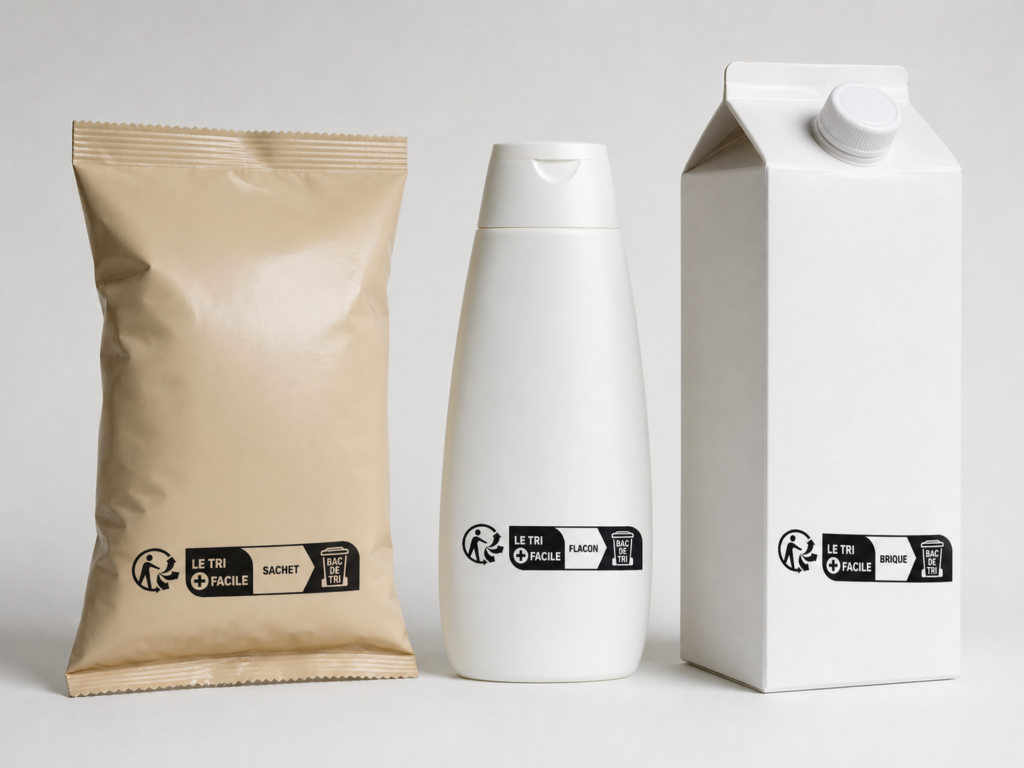
The Triman logo is a mandatory sorting guide label for consumers in France, associated with the French EPR classification system. It does not replace EPR registration, declaration, and payment obligations, and must be used together with the classification description of the corresponding material; it cannot be printed alone. Its size, position, and color have official specifications, issued by the French Environment and Energy Management Agency (ADEME) and CITEO, the PRO organization responsible for packaging EPR. It must be printed according to the latest graphic specifications. For very small packaging, QR codes can be used to replace printed labels if eligible, subject to official requirements.
Italy
Italy requires material classification labels to be labeled according to local rules, and some scenarios require the use of authorized labels from the Italian National Packaging Recycling Consortium (CONAI). In practice, it is usually necessary to confirm the material codes of each part of the packaging, the text instructions for sorting and disposal for consumers, language requirements, and the rule differences between B2C and B2B scenarios; when involving CONAI labels or official guide graphics, the latest rules issued by CONAI and local EPR institutions shall prevail.
Spain/Portugal
EPR registration is mandatory in both countries, but the specific requirements for packaging labeling depend on the rules of local PROs or the requirements of the deposit system. Do not default to following the German no-label or French Triman scheme; in practice, first confirm whether the packaging belongs to the B2C scenario and whether it involves deposit system beverage packaging, then check one by one the local PRO’s requirements for classification icons, trademark labels such as the Green Dot, and official language. Similar to Germany, labels such as the Green Dot are also registered trademarks of PROs, which require authorization to use and are not statutory universal mandatory requirements.
To facilitate your quick comparison and memory, here is a table summarizing the core labeling requirements of the four major high-frequency markets:
| Country/Region | Core Regulation | Mandatory Printing Requirement for EPR Labels | Mandatory Classification Label | Is the Green Dot Statutorily Mandatory? | Key Remarks |
| Germany | VerpackG (Packaging Act) | No mandatory requirement | No unified mandatory requirement (subject to PRO rules) | No | EPR registration is mandatory; Green Dot requires PRO authorization |
| France | AGEC Act (Anti-Waste and Circular Economy Act) | Triman logo (mandatory, bound to sorting guide) | Triman + Info-tri classification icon | No | Mandatory for B2C packaging; small packaging can be digitally replaced if eligible |
| Italy | Local packaging regulations | CONAI authorized labels required in some scenarios | Material classification label (subject to local rules) | No | Local language required; CONAI labels used according to authorization/guidelines |
| Spain/Portugal | Local packaging regulations | No unified mandatory printing requirement | Subject to local PRO/deposit system rules | No | Subject to PRO/deposit system rules; Green Dot requires authorization |
Other Common Difference Dimensions
In addition to the different labeling requirements mentioned above, there are several common differences between countries that should be noted when selling in multiple countries:
First is language requirements. Most countries require the text of the sorting guide to be in the local official language, and some countries allow multilingual labeling; it cannot be only in English.
Second is the size exemption threshold, that is, how small a package can be without printing a label. The thresholds vary from country to country, and the requirements of some countries are stricter than the EU’s recommendations, so you cannot judge based on your own feeling.
Third is the form of labeling. Some countries allow eligible small packages to use digital labels (such as QR codes) to replace some printed labels, but not all countries allow this, so you need to check the rules of the target country in advance.
Basic Strategy for Multi-Country Sales
If your products are sold to multiple EU countries at the same time, you do not need to pursue “one set of packaging for the whole of Europe” from the beginning. You can follow this idea:
First, clarify the list of countries where you actually sell, do not handle it generally as “the whole EU”, and focus on core markets first;
Then prioritize placing content that is common across the EU, such as material codes according to the 97/129/EC standard, and not making any misleading environmental claims, which are applicable to all countries;
Finally, plan separate printing areas for content that differs by country, or supplement it with labeling or digital information, without having to remake the entire set of packaging for a small market.
Labeling Judgment for Different Packaging Types: Match to the Scenario
After clarifying the hierarchy of rules, the next step is to learn to judge which category your packaging belongs to and what rules it should correspond to. In fact, as long as you grasp two core dimensions, you can quickly match it.
Two core judgment dimensions: the first is whether this packaging will eventually reach end consumers, that is, whether it is B2C or B2B; the second is what the function of this packaging is, whether it is sales packaging, transport packaging, combined packaging, or special category packaging. Using the combination of these two dimensions for judgment can basically correspond to the correct rules.
B2C Packaging (Including Service and E-commerce Direct Shipping Packaging)
The judgment condition is very simple: all packaging that is ultimately received and opened by end consumers belongs to this category, such as cosmetic bottles, snack bags, takeaway food containers, shopping bags, and e-commerce express boxes directly sent to consumers.
The labeling requirements for this type of packaging are the strictest, and need to comply with all B2C packaging labeling rules of the target country, including material labeling, sorting guides, EPR-related labels, etc.
There are two special subcategories to note:
If it is deposit system beverage packaging, you also need to add a prompt for deposit return or reuse according to the deposit system rules of the target country;
If it is compostable packaging and you make a compostable claim, be sure to clearly label the compliant composting conditions, such as “industrial compost only”, to prevent consumers from mistakenly throwing it into household kitchen waste bins.
B2B Transport/Industrial Packaging
Judgment condition: packaging only used for logistics turnover between enterprises and not intended for end consumers, such as logistics wooden pallets, stretch film for factory bulk goods, and turnover boxes for warehouses, all belong to this category.
The requirements for this type of packaging are relatively lenient. Usually, it is only necessary to label the material code according to the requirements of the target country to facilitate recycling and sorting at the enterprise end, and there is no need to print consumer-side sorting guides or EPR labels.
If it is reusable transport packaging, some countries require the addition of a recycling label, which shall be implemented according to local rules.
Combined/Multi-Item Packaging
Judgment condition: outer large packaging composed of multiple independent small packages, such as 6-pack cola, 10-piece pen boxes, and whole boxes of milk, all belong to combined packaging.
The labeling rule for this type of packaging is: the outer large packaging is implemented according to the corresponding scenario – if it is a whole box of goods sold directly to consumers, it follows B2C rules; if it is a bulk large package for distributors, it follows B2B rules. If the internal small packages meet the small size exemption rules of the target country, they do not need to be labeled, but be sure to confirm the local exemption threshold in advance, and you cannot decide on your own.
Special Category Packaging
Judgment condition: packaging with special regulations such as food, cosmetics, medicine, military, and dangerous goods all belong to this category.
The rule for this type of packaging is “special regulations take priority, environmental requirements are superimposed”: first meet the labeling requirements of special regulations, then superimpose the requirements of packaging environmental labels. In some special scenarios, the position of the label can be adjusted, such as printing the label on the outer packaging or attaching document explanations with the goods, but this does not automatically exempt environmental obligations, and must meet legal conditions.
Implementation Requirements: Printing Specifications and Compliance Archiving
After clarifying what to print, the next step is the practical issues of how to print and what materials to keep. These details are easy to cause pitfalls.
Position and Visibility Requirements
Labels need to be printed on the packaging body or fixed labels, cannot be folded, blocked, or worn off easily. It is not required to be printed on the front of the packaging, but it should be easily visible when consumers or recyclers handle the packaging.
E-commerce merchants should pay special attention: do not let express waybills or tape cover key labels, otherwise even if they are printed, they may be judged as non-compliant.
In addition, unless the target country explicitly allows digital replacement, barcodes, QR codes, or accompanying instructions cannot be used to replace mandatory printed labels. Do not be lazy to save printing costs.
Size and Clarity Requirements
The size requirements for labels shall be subject to the official rules of the target country. At the EU level, there are only recommended reference values. For example, for the crossed-out trash bin label of special categories, the EU recommends that the minimum side be no less than 10mm. This value is only a common reference for special categories such as WEEE and batteries. The final decision still depends on the corresponding special regulations such as WEEE and batteries, product size exception clauses, and the implementation requirements of the target country; ordinary packaging cannot derive a unified size standard from this.
Material codes must be clear and distinguishable. Small packaging can be appropriately reduced in size, but not to the point of being unrecognizable. Printing, embossing, and labeling are all acceptable, but it must be ensured that they will not become blurred or fall off during the normal service life of the packaging.
Language and Symbol Requirements
Priority is given to using officially released standardized graphic symbols, which can be accompanied by text descriptions to improve recognition, but do not casually design “official-looking” recycling or classification icons on your own, which can easily be judged as misleading.
Text descriptions need to use the official language of the sales country. Some countries allow multilingual labeling, but it cannot be only in English or Chinese.
Compliance Archiving Package (Mandatory)
Many people think that once the labels are printed correctly, it’s done, but that’s not the case. Archiving of compliance materials is equally important. In case of a random inspection, you will not be fined only if you can produce a complete evidence chain. The mandatory archived materials include three categories:
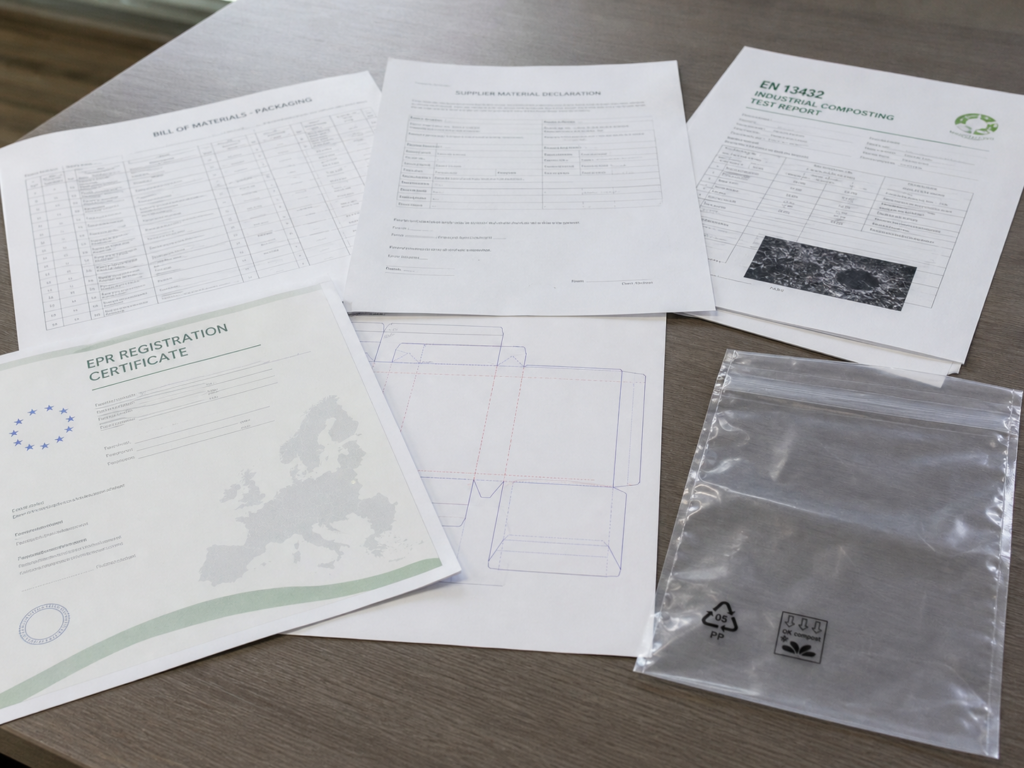
The first category is material documents: BOM (Bill of Materials) for each part of the packaging, and material declarations provided by suppliers, to prove that the material of your packaging is consistent with the label;
The second category is certification documents: if environmental claims are made, corresponding test or certification reports (such as EN 13432 report for compostable, traceability certificate for recycled materials), as well as EPR registration certificates; PRO/trademark authorization documents (such as authorization for the use of trademark labels like the Green Dot); applicable basis for official classification labels such as French Triman/Info-tri, PRO guidelines, layout confirmation records, or EPR membership certificates;
The third category is archival documents: packaging layout design drawings, list of sales countries, and packaging version update records, to facilitate subsequent traceability.
Pitfall Avoidance and Self-Check: From Understanding to Judgment
Novices are most likely to encounter pitfalls in cognition and operation. We have compiled common misunderstandings and a set of simple self-check methods to help you quickly judge whether your packaging has problems.
Most Common Labeling Cognition Misconceptions for Novices
1. Is the Green Dot a mandatory requirement, equal to recyclable? Wrong. The Green Dot is a registered trademark of PRO institutions. It can only be printed when you join the corresponding PRO and the contract stipulates its use. It has nothing to do with whether the packaging material can be recycled, nor is it a mandatory label applicable across the EU.
2. Does the circular arrow (Möbius strip) mean it must be recyclable? Wrong. This arrow only indicates that the packaging has recycling potential. Whether it can actually be recycled depends on the recycling facilities and sorting capacity of the target country. Most EU countries also do not mandate the printing of this label.
3. Does compostable mean it can be thrown into household kitchen waste bins? Wrong. Commonly referred to compostable usually refers to industrial composting, which requires specific temperature, humidity, and microbial conditions to decompose. The temperature and time of household kitchen waste bins cannot meet the requirements, so it cannot decompose, so it cannot be thrown away casually.
4. Are the numbers in material codes recycling grades? Wrong. The numbers are only used to distinguish material categories. For example, No. 1 is PET and No. 5 is PP. It does not mean that No. 1 is more environmentally friendly than No. 5, or has a higher recycling priority, and it has nothing to do with quality.
5. Is bio-based equal to compostable or recyclable? Wrong. These three are concepts of completely different dimensions: bio-based means the raw material comes from biomass, not petroleum; compostable means it can be decomposed by microorganisms under specific conditions; recyclable means it can be recycled and reused. There is no direct connection between the three, so do not confuse them.
6. Does the crossed-out trash bin need to be printed on all packaging? Wrong. It only applies to packaging of special categories such as WEEE and batteries. Ordinary packaging follows the rules of member states, and there is no unified mandatory requirement at the EU level.
Common Compliance Operation Misconceptions
1. Are the labeling requirements the same across the EU? Wrong. The EU only sets minimum requirements, and each country has its own supplementary rules. You must check according to the rules of the final sales country, and cannot say “it’s fine as long as I meet EU requirements”.
2. Can small packaging be exempted on its own? Wrong. The exemption for small packaging must meet the statutory size threshold of the target country, and you cannot decide not to print just because you think the packaging is small.
3. Is it enough to just print the label, regardless of whether the material is correct? Wrong. False material labeling constitutes a false claim, and the penalty is much heavier than missing a label. Be sure to ensure that the labeled material is consistent with the actual material.
4. Does transport packaging not need any labels? Wrong. B2B transport packaging usually needs to be labeled with material to facilitate enterprise recycling; if it is e-commerce transport packaging directly sent to consumers, it must be implemented according to B2C rules, not all transport packaging does not need labels.
5. Does printing the EPR label mean completing EPR compliance? Wrong. The label is only proof of your payment. Complete EPR compliance also includes processes such as registration, regular declaration, and fee payment. Only printing the label without registration and payment is also a violation.
5-Step Self-Check Method: Quickly Judge Whether Packaging Is Compliant
You don’t need to memorize complex rules. Follow these five steps to troubleshoot the vast majority of problems:
Step 1: Confirm basic information. First clarify three questions: what scenario your packaging belongs to (B2C or B2B, sales packaging or transport packaging), which EU member state it is ultimately sold to, what material each part of the packaging is made of, and whether it can be separated.
Step 2: Check EU common framework requirements. If material labeling is required, is the unified code of 97/129/EC used, and is it consistent with the actual material; are there any unfounded misleading environmental claims; if it is a special category such as electronics or batteries, does it meet the EU’s mandatory labeling requirements.
Step 3: Check target country-specific requirements. Whether to print EPR-related labels or classification labels (such as France’s Triman), whether there are special requirements for size, position, and language, and whether small packaging meets local exemption rules.
Step 4: Check special scenario rules. Whether the labeling of multi-material or composite packaging meets the requirements, and whether special category packaging meets the superimposed or adjusted requirements of special regulations.
Step 5: Check implementation and archiving. Whether the labels are clear, durable, and will not be blocked, and whether the compliance archive package is completely archived.
Situations That Require Confirmation from Professional Institutions
If you encounter the following situations, it is recommended to confirm with a local compliance institution or professional, and do not guess on your own:
Multi-material composite packaging, unsure how to label the material;
Selling to multiple EU countries at the same time, afraid of violating rules due to mixed labels;
Wanting to make environmental claims such as “recyclable” and “compostable”, unsure whether your evidence is sufficient;
Special category packaging, such as medicine and dangerous goods, unclear about the boundaries of label adjustment.
After mastering the above rule logic, you can not only accurately identify the meaning of common EU packaging labels and distinguish label systems under the jurisdiction of different regulations, but also sort out the timeline of current PPWD rules, member state differences, and the PPWR transition period, and complete preliminary compliance self-checks and material preparation according to packaging scenarios. In enterprise practice, you should first lock in core sales countries and packaging scenarios, then check layer by layer in the order of EU common framework, member state rules, special category requirements, and printing and archiving; when encountering multi-country mixed sales, composite material packaging, or doubtful environmental claims, it is recommended to hand it over to a professional institution for confirmation.