
Most cross-border sellers and hardware entrepreneurs targeting the U.S. market will encounter the “FCC ID” requirement: it may be required for listing on e-commerce platforms, checked during U.S. customs clearance, or requested by offline channels. However, many people lack a clear understanding of its definition, scope of application, and application process, and even incur unnecessary costs due to misjudgment. This article will systematically sort out the certification modes and full application process of FCC ID, from beginner-level judgment to practical pitfall avoidance.
1. First Step for Beginners: Determine Whether Your Product Requires FCC ID
Many people default to the idea that all electronic products need FCC ID when they first come into contact with it, but this is not the case. Clarifying the definition, applicable paths, and scope first can help you quickly judge whether you need to start the application.
What is FCC ID
You can think of the FCC ID as the “compliance ID card” issued by the U.S. for wireless transmitting products that require the highest compliance path, uniformly administered by the Federal Communications Commission (FCC). It should be clarified that the FCC ID is a unique identifier assigned after approval of the Certification path in the FCC device authorization system, and only applies to devices subject to FCC jurisdiction that require the Certification path. Specific requirements for customs clearance, e-commerce platform listing, and offline sales need to be verified separately in combination with device categories, corresponding regulations, and platform policies; FCC ID cannot be equated with a unified access credential for all scenarios.
Its core function is to prove that the product complies with FCC’s radio frequency and electromagnetic compatibility rules, reducing signal interference between devices. An important boundary must be drawn here: FCC ID only covers compliance requirements related to RF transmission and electromagnetic compatibility, and does not mean that the product meets other standards such as quality, safety, waterproofing, battery performance, etc. It cannot be equated with “full qualification certification”.
Differences Between the Three FCC Compliance Paths
The FCC has set up three different device authorization paths for electronic and electrical equipment, with different requirements corresponding to risk levels from low to high. Not all products require FCC ID:
| Compliance Path | Scope of Application | Review Requirements | FCC ID Issued? |
|---|---|---|---|
| Verification | Some low-risk unintentional radiation devices; specific applicable categories shall be confirmed in accordance with the corresponding FCC Part rules | The enterprise completes testing and archives the report on its own, no need to submit to a third party or FCC for review | No |
| Supplier’s Declaration of Conformity (SDoC) | Eligible unintentional radiation devices and some designated receiving devices | The enterprise self-declares that the product complies with the corresponding technical rules and archives supporting materials, no third-party review required | No |
| Certification | Most regulated intentional radiators (devices that actively transmit wireless signals) and some high-risk receiving devices | Must be reviewed and approved by an FCC-authorized Telecommunication Certification Body (TCB) | Yes |
There is a simple preliminary judgment direction: most devices that actively transmit wireless signals such as Bluetooth, WiFi, cellular networks, and RF remote controls need to follow the Certification path, but the final confirmation must be combined with the device’s operating frequency band, power, modulation method, and corresponding FCC Part rules; a conclusion cannot be drawn solely based on the words “active transmission”.
A common misunderstanding also needs to be clarified: not having an FCC ID does not mean that the product has not completed FCC compliance. For example, ordinary wired mice and ordinary radios that meet the rules can meet the requirements through the SDoC or Verification path, and do not need to apply for an ID at all.
Which Devices May Not Need to Apply for FCC ID
The authorization requirements for different devices need to be judged in combination with specific rules. The following types of devices usually do not need to apply for FCC ID, but all have corresponding applicable conditions:
- Devices that only receive wireless signals: Some receiving devices can follow the SDoC or Verification path according to corresponding rules, without applying for FCC ID. Not all receiving devices are exempt from authorization, which needs to be confirmed in combination with specific device categories (for example, ordinary FM radios mostly apply to the SDoC path).
- Devices meeting very low power exemption clauses: They must meet the strict restrictions on power, frequency band, and use scenarios in the corresponding FCC rules before being exempt from device authorization requirements.
- Devices for U.S. federal government use: Devices used by federal government agencies and complying with relevant exemption regulations, not for the general consumer market.
For devices subject to FCC jurisdiction and applicable to device authorization requirements, they must meet the corresponding compliance requirements regardless of whether they enter the U.S. territory through sale, lease, or carriage. There is also a common situation: the same device may involve two paths at the same time. For example, for a tablet with Bluetooth, the wireless transmission part follows Certification (requires FCC ID), and the digital circuit part follows SDoC, which do not conflict with each other.
How to Verify the Authenticity of FCC ID
The FCC official website has a public device authorization database query channel. When querying, you need to enter the complete FCC ID (format: [Grantee Code-Product Code], the hyphen in the middle cannot be omitted), then check the information from the following dimensions to judge whether it is consistent with the actual product:
- Basic information: Grantee name, product model, applicable FCC rule part
- Technical parameters: authorized frequency band, maximum output power, emission type
- Additional information: antenna list, internal and external product photos, restriction conditions in Grant Notes
- Report association: sample model, software and hardware version corresponding to the test report
Two special situations need to be noted to avoid misjudgment: First, newly approved certifications may have database synchronization delays, and the specific status shall be subject to the official final record; Second, enterprises can apply for confidentiality of sensitive documents such as schematic diagrams and photos of unlisted products in accordance with FCC regulations. Such content is not disclosed to the public, and you cannot judge the certification as fake just because you cannot find the confidential documents. If the corresponding ID still cannot be queried after excluding problems such as input format errors and synchronization delays, you can further contact the grantee or TCB for verification.
2. Core Basics: Numbering, Roles and Key Documents
After understanding the scope of application, first learn a few basic concepts, which will make it clearer when selecting modes and going through the process later.
Division of Labor Among Four Core Roles
FCC ID application is not directly connected with the FCC, but is completed by the division of labor and cooperation of multiple roles:
- FCC: The rule-maker and regulator, responsible for formulating device authorization rules, managing the authorization system and public database, retaining final supervision, spot check and rule interpretation rights, and does not directly review certification applications for ordinary products.
- TCB (Telecommunication Certification Body): A third-party review organization authorized by the FCC, responsible for reviewing certification application materials in accordance with the rules, and issuing the FCC ID Grant if the requirements are met. The certification review of ordinary products is completed by the TCB.
- Accredited Laboratory: A laboratory with FCC-accredited testing qualifications, responsible for completing RF, electromagnetic compatibility and other tests in accordance with corresponding standards and issuing official test reports, which is the core technical basis for certification applications.
- Grantee: The entity that bears ultimate legal responsibility for product compliance, which can be a brand owner, manufacturer or trader, with no nationality restriction; overseas grantees must designate a U.S. agent/service contact in accordance with FCC requirements to receive official FCC notices and regulatory communication. Note: The U.S. responsible party requirements under the SDoC path and the agent requirements under the Certification path belong to different rules and cannot be used interchangeably.
FCC ID Number Composition and Rules
A complete FCC ID consists of two parts, in the format of [Grantee Code-Product Code], for example ABC12-XXXXXX:
- Grantee Code: Bound to the grantee’s legal entity. Most codes newly applied for after 2018 are 5-character alphanumeric combinations, and most historical codes before 2018 are 3 characters; the code cannot be transferred privately. In case of enterprise merger, entity change, etc., the change or re-application must be handled in accordance with the procedures stipulated by the FCC. The specific code rules shall be subject to the current FCC allocation rules and database records.
- Product Code: Defined by the grantee itself, with a maximum length of 14 characters, used to distinguish different products or RF configurations under the same grantee.
It should be noted that one FCC ID corresponds to a set of fixed RF configurations; if multiple models share the same ID, it is necessary to prove in advance that the differences between models do not affect RF compliance, and the relevant instructions must be reflected in the Grant and test materials. It is not allowed to arbitrarily apply an already obtained ID to unrecorded models.
Functions of Three Key Documents
In the process of applying for and using FCC ID, there are three types of core documents that need to be clearly distinguished:
- Grant: The official legal document for FCC ID approval, equivalent to the “original compliance ID card”, which records the authorization scope, technical parameters, restriction conditions, etc., and is the core credential for compliance.
- Test Report: The “test transcript” issued by the laboratory, which is the basic basis for applying for the Grant, and records the methods, processes and results of all test items.
- FCC Knowledge Database (KDB): Rule interpretation and operational guidance documents officially issued by the FCC. When involving complex technical issues or rule boundaries, the latest interpretation of the KDB shall prevail.
In addition, for sensitive documents such as schematic diagrams and photos of unlisted products, enterprises can apply for short-term or long-term confidentiality from the FCC, but they must meet the confidentiality scope stipulated by the FCC, and not all content can be applied for confidentiality.
3. Certification Modes and Change Rules: Choose the Right Path to Reduce Compliance Costs
There is not only one application mode for FCC ID. According to the design status and existing foundation of the product, different paths can be selected. Reasonable selection can reduce unnecessary testing and review costs.
New Whole-Device Certification: The Most Basic Mode
This is the most commonly used basic mode, suitable for devices that apply for the first time, do not integrate wireless modules that have obtained FCC ID, and have core RF functions of brand-new design.
The core requirement is that the whole device must complete all RF, unintentional radiation, RF exposure and other tests required by the corresponding rules, and the applicant entity must meet the FCC requirements for grantees and U.S. agents. If your product is a self-developed brand-new wireless product, most will follow this mode.
Modular Certification: A Simplified Path Dedicated to Wireless Modules
If it is a wireless module (such as Bluetooth module, WiFi module, cellular module) that is independently designed and can be integrated into different whole devices in batches, and the module itself meets the technical requirements of FCC modular certification, it can apply for a module-level FCC ID separately.
Modular certification is divided into two categories, with different restrictions:
- Full Modular Certification: It needs to meet technical requirements such as independent RF shielding, independent power management, antenna interface or fixed antenna, and independently reproducible testing, with relatively few restrictions when integrated into the whole device.
- Limited Modular Certification: It can only be used under specified conditions (such as only matching with specified model antennas, only supporting specific power supply parameters, only installing in a fixed direction, etc.), and the use restrictions will be clearly marked in the Grant Notes of the module.
When a whole device integrates a wireless module that has obtained FCC ID, you cannot directly default that the whole device is compliant. You must first complete the following checks, and then judge the test items that can be reduced:
- Read the module’s Grant document and official installation instructions to confirm the module type (full/limited) and all use restrictions;
- Check whether the module installation method, antenna selection, power supply parameters, installation position, and distance from the human body in the whole device meet the Grant requirements;
- Evaluate the co-site/simultaneous transmission risk, unintentional radiation level, RF exposure compliance of the whole device, and the labeling requirements of the final product.
Only when all the conditions of the module Grant are met and the necessary supplementary assessment on the whole device side is completed, can the test data of the module be cited to reduce the amount of repeated testing. Special attention should be paid: Integrating a module with FCC ID does not mean that the whole device is automatically exempt from FCC ID. The whole device still needs to complete necessary compliance assessment and authorization application in accordance with corresponding rules.
Entity and Model Changes: Change in ID and Derivative Applications
If the core RF parameters of a product that has obtained FCC ID remain completely unchanged and only specific changes occur, you can apply for Change in ID or derivative certification without full retesting:
- Change of grantee entity: The original grantee needs to issue an official authorization document, and the technical configuration and responsibility scope of the product meet the relevant FCC requirements. Such changes are usually called Change in ID;
- Change of product model or brand: It is necessary to prove that the RF configuration of the new model is completely consistent with the original certified model, the difference is only the model label, brand or non-RF appearance/structural components, and the change will not affect RF performance and RF exposure level.
It should be noted that if changes to appearance, housing, installation method, or antenna position may affect RF performance or human exposure level, you cannot directly follow the derivative path, and need to re-evaluate compliance.
Post-Certification Change Judgment: Permissive Change and Re-Certification
After obtaining the FCC ID, if the product is modified, the corresponding treatment method should be selected according to the impact degree of the modification. The core judgment criterion is “whether it changes the RF emission parameters or compliance covered by the original authorization”:
- Class I Permissive Change: The modification does not affect emission parameters, RF exposure level and compliance (such as replacing passive components of the same specification, modifying non-RF related software functions). The grantee can keep the change records and compliance assessment documents by itself, without submitting to TCB for review.
- Class II Permissive Change: The modification does not change the basic compliance of the original authorization, but requires TCB review and confirmation (such as modifying RF software without changing emission parameters, replacing RF chips of the same specification and performance). After approval, no new FCC ID is required.
- Changes requiring re-application for certification: The modification exceeds the original authorization scope (such as modifying RF circuits, adjusting transmission frequency/power beyond the original authorization limit, changing antenna type, changing product use scenarios leading to changes in RF exposure requirements), you need to apply for a new FCC ID and go through the review process again as a new or derivative path.
Regardless of the size of the modification, it is recommended to complete a compliance impact assessment before the change to avoid violation risks.
Quick Reference for Certification Modes
You can make a preliminary judgment based on the product situation corresponding to the following directions:
- Devices with brand-new wireless design and no integrated certified modules: prioritize new whole-device certification
- Devices integrating wireless modules that have obtained FCC ID: first check the module Grant conditions and the whole device use scenario, then determine the degree of simplification
- Only changing grantee/model with completely unchanged RF configuration: evaluate whether it meets the conditions of Change in ID or derivative certification
- Product modification after certification: first evaluate the change level, then determine whether to file by yourself, submit TCB change or re-apply
4. Pre-Application Preparation: Get Ready in Advance to Avoid Detours
Many people take detours when applying because of insufficient preliminary preparation. Doing these things well in advance can reduce unnecessary time and cost investment.
Confirm Three Core Prerequisites First
Before spending money on testing, first confirm three core prerequisites to avoid invalid investment:
- The product falls within the scope of devices requiring the Certification path: it can be preliminarily judged in combination with the product’s emission type, frequency band, power and corresponding FCC Part rules, or a professional institution can be entrusted to conduct a preliminary compliance assessment.
- Meet the requirements for grantee and U.S. agent: overseas grantees must designate a U.S. agent/service contact in accordance with FCC requirements.
- The product’s RF functions are fully finalized: if the RF-related design is modified after the test is completed, retesting may be required, increasing time and cost.
Application Materials to Prepare
The application and technical documents submitted to TCB/FCC usually need to be in English, and non-English materials must be accompanied by a qualified English translation. General application materials mainly include:
- Basic product information: model, function description, English user manual, FCC ID label sample, internal and external product photos;
- RF technical information: RF parameter table (operating frequency, maximum output power, modulation method, bandwidth, etc.), antenna specification, circuit block diagram, schematic diagram;
- Entity information: grantee company information, U.S. agent/service contact information, FCC FRN account registration information;
- Others: mark confidential documents in advance and explain the reason for confidentiality to ensure compliance with the FCC confidentiality scope.
Different certification modes also need to supplement corresponding materials:
- Whole device integrating certified modules: need to provide the module’s Grant document, module installation instructions, and matching assessment materials between the whole device and the module;
- Change in ID/derivative certification: need to provide the original certification Grant document, original grantee authorization letter (if entity change is involved), and difference comparison description between old and new products;
- Permissive change application: need to provide difference description before and after the change, compliance impact assessment report, and relevant test data (if required).
Criteria for Selecting Service Providers
Most first-time applicants will choose third-party service providers. When judging, you can focus on two points:
- The testing laboratory must be on the FCC official accredited list and have testing experience with similar products; reports issued by unqualified laboratories are not recognized by TCB and cannot be used for certification applications.
- The agent or TCB service provider can provide full-process support such as document sorting, submission for review, and correction communication, which is suitable for first-time applicants who are not familiar with the rules.
It should be noted that the final review right of certification is with the TCB, and the FCC retains the right of follow-up spot checks. No institution can guarantee absolute approval, so you should make rational judgments when choosing service providers.
5. Standard Full Application Process: From Testing to Certification and Launch
The FCC ID application process can be divided into six core steps. By keeping an eye on the key checkpoints in each step, you can proceed smoothly.
Step 1: Rule Confirmation and Mode Selection
First, confirm the applicable FCC rules and test requirements in combination with the core characteristics of the product. The judgment dimensions include: transmission technology, operating frequency band, maximum output power, modulation method and bandwidth, antenna type, use scenario (portable/mobile/fixed), use distance from the human body, whether there is multi-antenna simultaneous transmission, whether it involves unintentional radiation, etc.
Short-range wireless devices such as Bluetooth and WiFi mostly apply to FCC Part 15 rules, but not all similar products automatically apply to Part 15, which needs to be finally confirmed in combination with specific parameters.
After the rules are confirmed, select the corresponding certification mode (new whole device/modular/derivative/change) according to the product situation.
Checkpoint: Rule and mode confirmation must be completed before testing, to avoid path mismatch after testing is completed, resulting in waste of time and cost.
Step 2: Sample Submission for Testing
Testing is the core pre-link of certification application, and only qualified test reports can be submitted for review. The test items are determined by the FCC Part rules and test standards applicable to the product, and are usually divided into three categories:
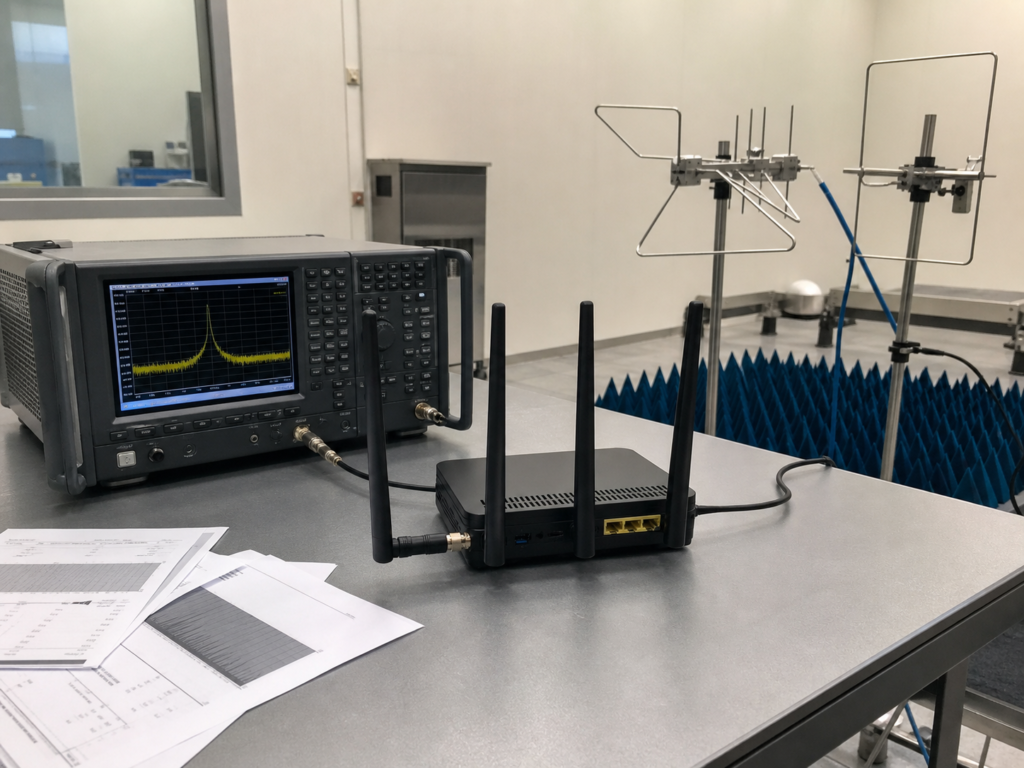
- Transmitter-related tests: Tests for active transmission functions, such as output power, occupied bandwidth, frequency stability, spurious/out-of-band emission, AC line conducted emission, etc. The specific items vary with device types.
- Unintentional radiation test: Test for unintentional emissions generated by product digital circuits, etc., to ensure that they will not cause interference to other devices.
- RF exposure assessment: Evaluate the impact of wireless signals on the human body when the device is working, divided into two types: SAR (Specific Absorption Rate, for portable devices used close to the body) and MPE (Maximum Permissible Exposure, for fixed or mobile devices located far from the human body); whether testing is required and which type to adopt need to be comprehensively judged in combination with the device’s operating frequency, power, antenna position, use distance from the human body, simultaneous transmission status, etc., not only determined by power level.
The test cycle is an empirical range: testing of single-function low-power short-range wireless products (such as Bluetooth BLE, single-band 2.4G WiFi) usually takes 1-2 weeks, and the cycle for multi-band, cellular, products requiring SAR testing or with complex functions will be extended accordingly. If the test fails, the product needs to be rectified before retesting, and the rectification and retesting time need to be calculated additionally.
If the product is of brand-new design, pre-testing can be carried out in advance to find design problems early and reduce the risk of formal test failure.
Checkpoint: The software and hardware version, configuration, antenna and accessories of the test sample must be consistent with the final mass production version, otherwise the test report cannot represent the compliance of the mass-produced product.
Step 3: Submit for Review
After passing the test, submit the complete test report, product technical materials, grantee and U.S. agent information, Form 731 application form and other materials to the TCB for review.
Regular products are reviewed by the TCB; if it involves special new technology products that the TCB has no review authority for, they need to be submitted directly to the FCC for review in accordance with FCC requirements, or apply for pre-rule review in advance.
After submitting the application, you will get a unique application number, which can be used to follow up the review progress.
Step 4: Review and Correction Handling
The regular review cycle of TCB is about 1-2 weeks. For projects submitted directly to FCC for review, with complex product functions, or requiring supplementary technical assessment, the cycle will be extended accordingly.
Common reasons for correction include: incomplete application materials, defects in test reports, inconsistent product descriptions and technical materials, etc. After receiving the correction request, supplement the materials or complete rectification and retesting according to the review opinions, then submit for re-review.
Step 5: Obtain Certification and Official Filing
After the review is passed, the applicant will obtain the official FCC ID number and electronic Grant, and the certification information will be synchronized to the FCC official device authorization database, which is publicly available for query.
Checkpoint: After getting the Grant, promptly check the FCC ID, grantee information, product model, authorization scope, restriction conditions and other content to ensure that they are completely consistent with the actual situation. If there are errors, contact the TCB to correct them in time.
Step 6: Product Labeling and Launch
After certification, the product must be labeled with compliance marks in accordance with the requirements of applicable FCC rules. The specific content, position and format of the label shall be confirmed in combination with the device type, size and visibility requirements:
- The FCC ID usually needs to be marked on the visible position of the product body; if the product is too small to be clearly marked, it can be marked on the packaging and manual in accordance with the rules, or use a compliant electronic label (such as displayed in the product’s system settings interface).
- The product manual must include the FCC compliance statement text required by the corresponding rules, as well as relevant use restriction instructions.
It should be noted that the FCC ID number must be completely consistent with the filing information in the Grant, and it is not allowed to arbitrarily alter, delete characters or change the format.
6. Cycle and Cost Estimation: How to Predict and Optimize
Regular Cycle Range and Influencing Factors
The certification cycle is an empirical range, affected by many factors such as product complexity, test pass rate, document completeness, laboratory scheduling, review corrections, etc.:
- If the test passes once and the materials are complete, it usually takes 3-4 weeks from testing to certification for single-function low-power short-range wireless products;
- For multi-band, cellular, products requiring SAR testing, with complex functions, or in case of test rectification and document correction, the cycle will be extended accordingly;
- Some service institutions can provide expedited services, which can shorten the cycle to a certain extent. The specific expedited range and cost shall be subject to the service contract.
Common Cost Components and Quotation Variables
There is no unified public quotation for FCC ID, which needs to be evaluated according to the specific product parameters and service content. Common cost items include:
- Test fee: related to the number of test items, number of frequency bands, whether SAR testing is required, whether multi-mode simultaneous transmission is involved, etc.;
- TCB review fee: certification review fee charged by TCB;
- Agent service fee: if a third-party agent is entrusted to apply, corresponding service fee will be incurred;
- U.S. agent/service contact fee: service fee for overseas grantees to appoint a U.S. agent. The charging method and amount are agreed in the service contract.
Overall, the more wireless functions the product has, the more complex the supported frequency bands are, and the more test items there are, the higher the compliance cost will be.
Practical Methods to Optimize Cycle and Cost
On the premise of ensuring compliance, unnecessary time and cost investment can be reduced through the following methods:
- Complete pre-testing before submission, find design problems early, and avoid rectification and retest costs caused by formal test failure;
- Prioritize the use of wireless modules with FCC ID modular certification and matching use scenarios to reduce the repeated testing volume of the whole device;
- Prepare all application materials in advance, check the consistency of model, parameters, labels and other information before submission, to avoid review delays caused by corrections;
- Submit for testing after the RF function is fully finalized, to avoid retesting caused by mid-process design changes.
7. Result Interpretation and Ongoing Compliance: Able to Judge and Maintain
Getting the FCC ID is not the end of compliance. In the follow-up, you need to be able to read the core documents and maintain ongoing compliance to avoid regulatory risks.
Interpretation of Core Information in Grant
The Grant is the official legal document for FCC ID approval. After getting it, you can check the key information in the following order:
- Basic information: FCC ID, grantee name, product model, applicable FCC rule part, confirm that the entity and product scope are correct;
- Technical parameters: authorized frequency band, maximum output power, emission type, ensure consistent with actual product parameters;
- Restriction conditions: focus on Grant Notes, which will clearly specify constraints such as antenna requirements, installation conditions, use distance limits, module integration requirements, etc. All restrictions must be strictly followed; violation means non-compliance even with an ID.
If a series of models share the same ID, you also need to confirm the model difference description listed in the Grant, and cannot use the ID for unrecorded models.
Check of Key Information in Test Report
You don’t need to read the test report page by page. Focus on the following core content to judge the validity and coverage of the report:
- Applicable rules and limits: confirm that the test standards and limit basis adopted in the report are consistent with the FCC rules applicable to the product;
- Test configuration and worst case: confirm that the most unfavorable configuration is selected during the test (such as highest power mode, worst antenna direction), and the test results are representative;
- Coverage: confirm that the test covers all wireless modes, frequency bands, power levels of the product, as well as supporting antennas and accessories;
- Results and margin: check the Pass/Fail conclusion of all test items, and pay attention to the test margin (the gap between the test value and the limit) — the smaller the margin, the higher the risk of exceeding the limit if product consistency fluctuates during mass production; you can also pay attention to the measurement uncertainty description to understand the reliability range of the test results;
- Sample consistency: confirm that the model, software and hardware version, and configuration of the test sample are consistent with the actual mass production version.
If the actual shipped product supports modes or configurations not covered by the test report, supplementary testing is required before confirming compliance.
Ongoing Compliance Requirements After Certification
After obtaining the FCC ID, you need to continuously meet the following requirements to maintain the validity of the certification:
- Evaluate before product changes: Do not arbitrarily modify RF circuits, emission parameters, antenna specifications or use scenarios. Any change that may affect compliance must first evaluate the change level, and follow the permissive change or re-certification process as required.
- Ensure mass production consistency: The RF configuration and parameters of mass-produced products must be consistent with the certified samples. Before replacing key materials (such as RF chips, antennas), first evaluate the impact on compliance.
- Maintain contact information: The grantee must ensure that the information of the U.S. agent/service contact is valid, and update the contact information after changes in time to avoid regulatory risks caused by the inability to receive FCC notices.
- Properly keep compliance documents: Save compliance materials such as Grant, test reports, change records, production consistency control documents, etc. in accordance with applicable FCC rules, in preparation for FCC market spot checks.
Key Points for Responding to Spot Checks or Complaints
The FCC conducts irregular market spot checks, and may also launch investigations due to consumer complaints or reports from relevant parties. When encountering such situations, you can handle them according to the following steps:
- Immediately sort out compliance materials such as Grant, test reports, change records, and production control documents, and cooperate to provide them as required;
- Check the consistency between the version of the currently sold product and the certified sample, especially the RF-related configuration;
- Prepare product change records and mass production quality control descriptions to prove that the product continuously meets compliance requirements;
- If there are indeed compliance problems, timely evaluate the rectification or re-certification plan, and if necessary, actively suspend the sales of related products to avoid risk expansion.
8. Clarification of Common Misconceptions
Cognitive Misconceptions
- Misconception: All electronic products require FCC ID
Correct answer: Only devices requiring the Certification path will receive an FCC ID. Most ordinary electronic products follow the SDoC or Verification path and do not need to apply for an ID. - Misconception: FCC ID has a fixed validity period
Correct answer: There is no unified fixed expiration date for FCC ID, but if product changes, FCC rule updates trigger re-evaluation requirements, or grantee/agent information is invalid and not updated promptly, it may affect the validity of the certification; ongoing compliance is the prerequisite for maintaining certification validity. - Misconception: With FCC ID, you can enter all American countries
Correct answer: FCC is an exclusive U.S. compliance system. Countries such as Canada and Mexico have their own wireless compliance requirements, and local certification needs to be applied separately. - Misconception: FCC ID represents that the product is fully qualified in all aspects
Correct answer: FCC ID only proves that the product’s RF emission and electromagnetic compatibility meet corresponding requirements. Other performances such as battery safety, energy efficiency, food contact, etc. need to meet the regulatory requirements of corresponding fields.
Application and Use Misconceptions
- Misconception: Using a wireless module with FCC ID, the whole device is automatically compliant
Correct answer: The whole device must meet all use restrictions in the module’s Grant (antenna, installation, power supply, etc.) and complete necessary compliance assessments on the whole device side to meet requirements. It is not automatically exempt just by integrating the module. - Misconception: If product functions do not change, no re-certification is needed
Correct answer: What FCC focuses on is whether RF emission parameters and compliance change. Even if functions remain unchanged, modifying antennas, power, RF circuits or use scenarios may require re-evaluation. - Misconception: If FCC ID cannot be queried, it is a fake certificate
Correct answer: New certifications may have database synchronization delays, and some sensitive documents can apply for confidentiality and not be disclosed. It is necessary to exclude factors such as input format errors, delays, and confidentiality, then judge based on information verification results. - Misconception: Modifying software after certification will not affect compliance
Correct answer: If software modification changes RF emission parameters (e.g. increasing emission power, adjusting operating frequency band), it is necessary to follow the permissive change or re-certification process, and cannot be modified without authorization.
Summary
FCC ID is the core identifier of the Certification path in the U.S. FCC device authorization system, targeting high-risk devices that actively transmit wireless signals. From judging the applicable scope and selecting the appropriate certification mode in the early stage, to preparing materials, completing testing and review in the middle stage, and maintaining ongoing compliance in the later stage, each link has clear rules and judgment standards.
For beginners, the core is to first confirm whether the product really needs to apply for FCC ID, then proceed according to corresponding rules, to avoid unnecessary cost input; for users with certain experience, the focus is to accurately judge the impact of changes, reasonably use simplified paths such as modular certification, and at the same time do a good job in mass production consistency control, to avoid regulatory risks.
As long as you sort out the logic of the rules and implement the checkpoints of each link as required, you can efficiently complete the application and maintenance of FCC ID, and meet the compliance requirements of the U.S. market.