
If you are a seller of charging products such as chargers, wireless chargers, and power banks planning to enter the Malaysian market, you will most likely encounter the issue of MCMC wireless certification — many people are unclear about its differences from SIRIM and ST certifications, and do not know whether their products need it or how to apply for it. Starting from the actual scenarios of charging products, this article clarifies the rules, judgment methods, application processes, and key points to avoid pitfalls of MCMC certification, from beginner to intermediate proficiency, which you can apply right after reading.
First Things First for Beginners: What MCMC Regulates, and How It Differs from ST and SIRIM
You can think of MCMC (Malaysian Communications and Multimedia Commission) as the official authority in Malaysia that specifically regulates wireless spectrum and access of communication equipment — it governs whether all devices with wireless transmission or communication functions can be sold in Malaysia and use local wireless frequency bands.
MCMC’s regulatory scope is not divided by product category, but comprehensively judged based on equipment classification, operating frequency band, transmission power, and current certification list. Its connection with charging products is very clear: Only charging products with wireless functions may trigger MCMC regulation, and pure wired charging products have nothing to do with it at all. MCMC only formulates rules and conducts supervision, while specific testing and certification issuance are handled by corresponding accredited or authorized bodies in accordance with current schemes. Common institutions include SIRIM QAS. SIRIM QAS may provide testing, inspection or certification services within its accredited or authorized scope; the statutory access approval for ST-regulated electrical equipment is the responsibility of ST (Energy Commission), and specific certificates or registration for MCMC communication equipment are handled in accordance with MCMC’s current certification schemes.
Many sellers confuse MCMC, ST, and SIRIM when they first come into contact with them. The division of labor among the three can be understood as follows:
| Regulatory/Service Entity | Core Jurisdiction | Relationship with Charging Products | What It Does Not Regulate |
| MCMC | Compliance certification/registration of wireless communication and radio frequency (RF) devices | Only charging products with wireless functions may trigger its regulation | Electrical safety, energy efficiency |
| ST (Energy Commission) | Access of regulated electrical products (including plugs, electrical safety, energy efficiency) | All charging products on the regulated list (whether wired or wireless) must comply | Wireless RF compliance |
| SIRIM QAS | May provide testing, inspection or certification services within its accredited or authorized scope | Can provide corresponding services for relevant MCMC wireless projects and ST electrical equipment projects | It is not a regulatory authority; the statutory access approval for ST-regulated electrical equipment remains the responsibility of ST |
The commonly asked about EMC (Electromagnetic Compatibility) cannot be simply classified as uniformly assessed by ST or MCMC for all products, nor can it be generally assumed that separate handling is not required. Whether EMC needs to be assessed and which compliance path covers it shall be confirmed separately based on whether the product is a communication device, whether it is an ST-regulated device, and applicable technical specifications. MCMC communication equipment certification usually includes applicable EMC requirements, but the Certificate of Approval (CoA) for ST electrical equipment is not equivalent to a unified EMC certification for all products.
One core conclusion to remember first: Charging products with wireless functions may require both MCMC wireless certification and ST electrical safety access. The two have completely different regulatory focuses and cannot replace each other. Do not assume that obtaining one is sufficient.
Basic Boundaries of MCMC Certification: Which Products Are Regulated
The objects of MCMC certification are usually complete assembled products sold to end consumers, but whether separate chips, fast charging protocols, and wireless modules need to comply cannot be directly ruled out just by the name “module”. For example, a separately sold Bluetooth module should first be confirmed based on its sales form, MCMC’s current equipment classification, certification list, and exemption provisions. It cannot be concluded that MCMC compliance is not required just because it is a module. If a Bluetooth module is installed in a wireless charger and sold as a complete device, the assessment shall be based on the integration of the complete device.
Many people think that using a certified wireless module automatically makes the complete device compliant, but this is not the case. The role of module certification is only to potentially simplify part of the RF testing of the complete device. Whether the final complete device is compliant is also affected by many factors: antenna model and gain, layout of the RF circuit on the PCB, charging circuit that powers the wireless module, firmware version (whether frequency is locked, whether power is adjustable), housing material (metal housing will change RF parameters), and end use (wearable or desktop). If any of these factors change, the RF performance of the complete device may need to be reconfirmed, so module certification can never directly replace the certification of the complete assembled device.
Quick Judgment: Does Your Charging Product Require MCMC Certification?
After clarifying the basic rules, you can first classify products by wireless attributes, then use the 3-step judgment method to quickly identify requirements, without having to ask a service provider right away.
Four Types of Wireless Attributes of Charging Products and Compliance Trigger Conditions
We divide common charging products into four categories based on wireless functions, corresponding to different MCMC requirements:
1. Pure wired power supply devices: For example, ordinary 65W GaN chargers, power adapters, pure USB-C plugs, and ordinary charging cables, which have no wireless transmission or other regulated communication functions at all. Such products are usually not within the scope of MCMC communication equipment certification, but it is still necessary to check the current equipment classification, ST’s regulated list, and other applicable regulations to determine whether access requirements such as electrical safety, plugs, and energy efficiency need to be met. Unregulated accessories (such as ordinary charging cables) do not require access approval.
2. Pure WPT (Wireless Power Transfer) devices: Wireless chargers that only have wireless power transfer function and no additional communication functions, such as the most basic 15W Qi desktop wireless charger, which has no Bluetooth or WiFi and is only used for charging. Such products are not automatically exempted, nor are they necessarily required to obtain MCMC certification. This needs to be confirmed by checking MCMC’s current WPT spectrum, power, and classification rules; if they fall within the scope of ST regulation, they must also comply with corresponding electrical safety and other applicable requirements.
3. Charging devices with wireless communication functions: Whether it is transmission, reception, or passive communication, such as smart chargers with Bluetooth pairing, NFC charging accessories, and power banks with GNSS/cellular. For such products, the path shall be determined based on frequency band, transmission parameters, equipment category, and current certification, self-declaration or exemption list, and cannot be judged solely by the phrase “with wireless”; they must also comply with relevant requirements of ST and other applicable regulations.
4. Combined charging devices with pre-installed wireless modules: For example, fast chargers with a Bluetooth module installed. Such products must undergo compliance assessment based on the module certificate conditions and complete device configuration. Simplified testing may apply, or supplementary or full testing may be required. The module certificate cannot be directly regarded as proof of complete device compliance; other requirements are consistent with those of complete devices of the corresponding category.
3-Step Judgment Method: Quickly Identify Whether Certification Is Required
If you are still unsure after classification, you can follow these three steps:
Step 1: First classify product attributes according to the four categories above. Pure wired products can usually be excluded from MCMC communication equipment certification requirements, but it is still necessary to check whether they have other communication functions, as well as ST and other regulatory requirements.
Step 2: Check the product’s operating frequency band, transmission power, and function type, and compare them with MCMC’s current equipment classification list to see which certification path it belongs to, or whether it is within the exemption scope.
Step 3: If the parameters are on the boundary, or the product is a relatively new type, directly find a certification body whose MCMC accreditation or authorization scope covers the project to conduct a pre-assessment. Do not trust verbal promises from freight forwarders or peers to avoid subsequent cargo detention.
Two most easily confused points need to be corrected here: WPT (wireless power transfer) is not equal to wireless communication, and the rules for pure power transfer devices and devices with data communication are completely different; pure receiving, passive wireless devices are not necessarily exempt from certification, and all must be judged separately against the rules.
Compliance Judgment Cases for Common Charging SKUs
We use 5 of the most common charging products as examples, which you can directly refer to for your own products:
• Case 1: Ordinary USB-C 65W charger without Bluetooth: The preliminary conclusion is that MCMC communication equipment certification is usually not required. It only needs to be verified whether it is on the ST regulated list. If it is regulated, it must comply with ST electrical safety and plug specification requirements.
• Case 2: 15W desktop Qi wireless charger with only WPT (no communication function): The preliminary conclusion is that MCMC’s current WPT rules need to be checked, and it is not directly exempted; it is necessary to verify whether the frequency/power meets WPT spectrum requirements, and also confirm whether the power negotiation signal of the Qi protocol is a supporting function of WPT. Whether this signal requires communication equipment certification shall be confirmed item by item based on the actual frequency, transmission characteristics, technical specifications, and MCMC’s current WPT/SRD classification, and exemption shall not be presumed; at the same time, it must comply with ST and other applicable requirements.
• Case 3: 20W smart wireless charger with Bluetooth pairing: The preliminary conclusion is that the applicable certification path needs to be further confirmed according to MCMC’s current equipment classification and list; it is necessary to verify whether the Bluetooth power and frequency band are on the SDoC (Supplier’s Declaration of Conformity, low-risk self-declaration) list to determine the certification path; at the same time, it must comply with ST and other applicable requirements.
• Case 4: 65W smart fast charger with 2.4G WiFi pairing: The preliminary conclusion is that the applicable path needs to be confirmed according to MCMC’s current equipment classification and list; it is necessary to verify the certification requirements corresponding to the WiFi frequency band and power; at the same time, it must comply with ST electrical safety and plug specification requirements.
• Case 5: 20000mAh power bank with 4G cellular positioning: The preliminary conclusion is that the certification path needs to be confirmed according to MCMC’s current cellular device rules; it is necessary to verify whether GNSS is pure reception or has backhaul, and whether it meets telecommunication equipment requirements; at the same time, it must comply with ST electrical safety and energy efficiency requirements (if regulated).
Judgment of Special Cases with Ambiguous Boundaries
Some special situations are easy to fall into pitfalls, so you must pay special attention to them:
• Wireless function can be manually turned off: As long as the product has a built-in wireless transmission function, even if it supports manual shutdown, it must still be assessed as a product with wireless function. The shutdown function cannot automatically exempt certification — after all, consumers can turn it on and use it after purchase, and regulation focuses on the functional configuration of the product itself.
• Built-in communication for Qi power negotiation: Many wireless chargers have built-in communication signals in the Qi protocol to negotiate charging power. In this case, it cannot be directly judged as a communication device, nor can exemption be obtained solely based on the Qi name. It needs to be confirmed based on the actual frequency, transmission characteristics, technical specifications, and MCMC’s current WPT/SRD classification.
• Antenna replacement/position adjustment for certified modules: Even if a wireless module that has passed MCMC certification is used, as long as the antenna model is changed or the antenna installation position is adjusted, it must be submitted to the certification body to re-evaluate the RF parameters, and the module certification cannot be directly used.
• Same model with different regional firmware: If the same product has different regional firmware versions, the version sold in Malaysia must be consistent with the firmware version used for testing and certification. You cannot use low-power firmware for testing and flash a high-power version for sale.
• USB interface wireless charging receiver: USB interface wireless charging receivers shall be judged based on their transmission/reception functions, WPT classification, sales form, and MCMC’s current equipment list. They cannot be uniformly regarded as independent devices solely based on the USB interface, nor can they be uniformly excluded from mobile phone accessories or other exemptions.
Core Compliance Requirements Exclusive to Charging Products
MCMC’s general requirements apply to all wireless devices, but charging products have many exclusive compliance key points due to special scenarios such as high current and fast charging protocol switching, which are also the places where problems are most likely to occur.
Core Technical Testing Requirements
• Frequency band and power: The frequency bands currently open by MCMC must be used, and the transmission power must comply with local limits. You must never directly copy the parameters of Europe and the United States (CE/FCC) — for example, some Sub-GHz frequency bands are open in Europe and the United States, but may have different power limits in Malaysia, or even not be open.
• RF and EMC: In addition to meeting the conventional requirements for transmission power and spurious radiation, special attention must be paid to ensuring that the charging circuit and wireless module do not interfere with each other. This is the most problematic area for charging products: for example, when a fast charger operates at high current, will it cause the spurious radiation of Bluetooth to exceed the standard; or will the signal of the wireless module interfere with the normal handshake of the PD fast charging protocol. Which EMC items need to be carried out and which compliance path covers them shall be subject to the equipment category and applicable technical specifications.
• Human body radiation (SAR/EMF): SAR or other RF exposure/EMF assessment shall be determined based on frequency band, power, antenna position, human body approach distance, and usage scenarios. WPT transmitting devices cannot be uniformly excluded, and pure receiving devices shall also be confirmed based on whether they generate RF transmission and applicable technical specifications; desktop Bluetooth or WiFi products will not automatically require SAR just because they actively transmit.
• Test conditions: The most unfavorable operating modes must be covered, such as under rated input voltage, at maximum charging output, during PD/PPS protocol switching, and when wired and wireless charging are performed simultaneously. These are all scenarios unique to charging products. You cannot only test the wireless module operating alone, and the specific results shall be subject to the laboratory’s confirmation.
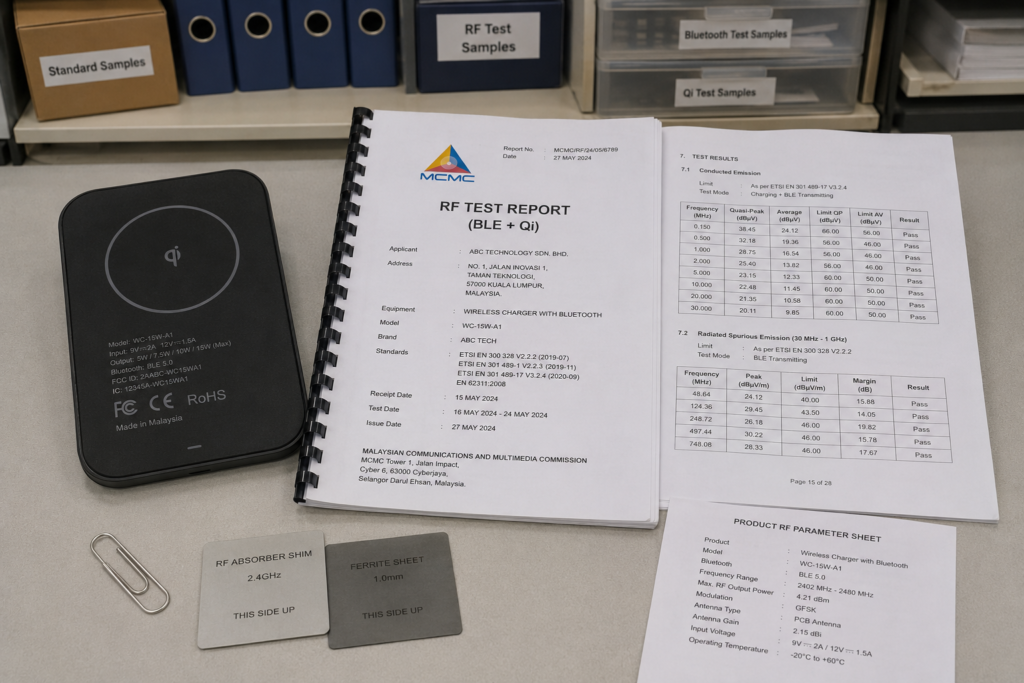
• Test report: The test report shall come from a qualified laboratory within MCMC or its accreditation scope, and the report parameters must be consistent with the declared product. Whether overseas reports are acceptable shall be confirmed by the current certification scheme and certification body; certificates such as CE, FCC, and KC cannot be automatically regarded as Malaysian certifications, nor can it be generally asserted that all overseas reports are invalid.
Label and Product Marking Requirements
• Marking content: The prescribed MCMC labels, certificate/registration information, or other markings shall be used according to the specific certification path and MCMC’s current label rules; requirements for different paths are not completely the same, and it cannot be generalized that all products must be marked with the same type of certificate number.
• Affixing requirements: Affix in accordance with MCMC’s current official specifications. The marking content, carrier, and position shall be subject to applicable official requirements, and shall be clear, durable, and not easy to wear — for example, they cannot be affixed to a protective film that is easy to tear off, nor printed on a surface that is easy to wear away.
• E-commerce display: When selling on e-commerce platforms, the promotional content must comply with advertising compliance and platform rules, accurately display the certification scope, and must not be exaggerated — for example, if only one model of smart charger is certified, you cannot say that the entire series of products has MCMC certification.
Application Materials and Submission Requirements for Overseas Sellers
• Basic product information: It is necessary to provide charging specifications (rated power, supported fast charging protocols, etc.), wireless parameter table (operating frequency band, transmission power, antenna gain, etc.), product manual, and complete device BOM (Bill of Materials, which must include the specific models of the wireless module and antenna).
• Compliance documents: Prepare test reports issued by qualified laboratories, declarations of conformity, and other required documents according to the applicable path.
• Submission rules: It shall be handled by suppliers, Malaysian local entities, or authorized representatives that meet the requirements of the current scheme, through the prescribed platform and by the corresponding certification body. Whether overseas sellers can submit directly and whether a local representative is required shall be confirmed according to the specific TA, SDoC, or special approval scheme.
• Precautions: All submitted materials must be consistent with the final mass production version. You cannot conceal wireless functions, nor falsely report parameters — for example, if you declare a 10W wireless charger but change it to 15W during mass production, once found, the certification will be directly invalidated, and you may even face penalties.
How to Choose a Certification Path? Explanation of Handling Process and Costs
MCMC’s certification paths are not divided by product category, but determined by equipment classification, risk, and applicable assessment rules. Choosing the right path can save a lot of time and cost.
Certification Path Selection: TA/SDoC/Special Approval
The basis for judging the path is MCMC’s current equipment classification list, technical standards, and conformity assessment list. Note: Charging power itself does not directly determine the certification path, but it will affect the test cost — the higher the power, the more complex the EMC and RF coexistence tests, and the cost may increase accordingly.
MCMC may involve multiple compliance paths, including:
• TA (Type Approval): Applicable to devices that require type approval in MCMC’s current classification. Whether it belongs to TA cannot be judged solely by technical names such as cellular, WiFi, UWB, or only by frequency band and power level.
• SDoC (Supplier’s Declaration of Conformity): Applicable to devices for which MCMC currently allows the use of supplier’s declaration of conformity. Low power does not automatically equal SDoC, and it is still necessary to check the specific equipment classification, frequency band, parameters, and applicable list.
• Special Approval: Applicable to special devices, special uses, or situations not included in the general path that require separate handling under current rules. Applications need to be made to the relevant authorities based on specific circumstances.
Therefore, the certification path for products such as 5GHz WiFi, UWB, Bluetooth, and NFC cannot be determined solely by technical name or power. It shall be confirmed against MCMC’s current equipment classification, frequency band parameters, technical specifications, and conformity assessment list whether TA, SDoC, special approval, or other applicable paths apply.
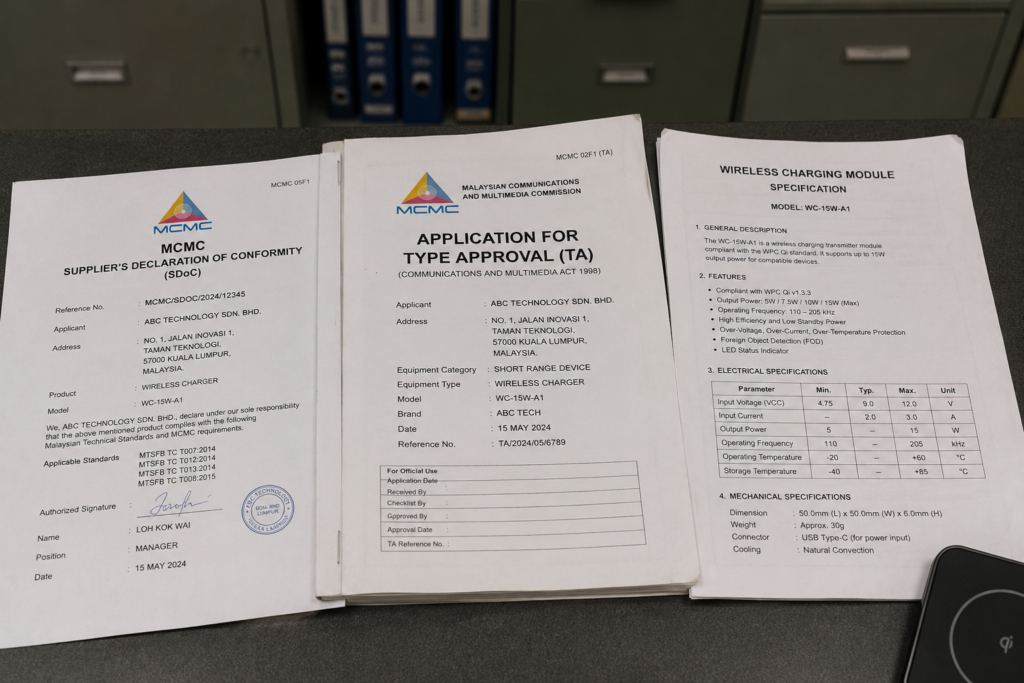
If there are multiple models using the same wireless solution and the same charging platform, you can consult the certification body about series application. However, whether they can be combined depends on model differences, the most unfavorable configuration, and sample representativeness. You cannot unilaterally guarantee that each model does not require separate testing.
Routine Handling Steps (Taking the SDoC Path as an Example)
For the most common low-risk short-range charging products, if current rules allow the use of the SDoC path, the process usually includes the following steps:
1. Prepare samples in mass production status and a full set of materials, and entrust a qualified laboratory that meets the requirements of the current scheme to conduct testing. The testing shall cover the working conditions where charging and wireless functions operate simultaneously, and cannot only test the wireless module.
2. The supplier, local entity, or authorized representative that meets the scheme requirements shall submit the test report, supplier’s declaration of conformity, and other materials through the prescribed platform, and complete the certification body procedures as required.
3. Complete the required review, registration, or conformity confirmation according to the specific equipment category.
4. Use the corresponding certification mark or label on the product in accordance with applicable official specifications, and then compliance preparation can be carried out after meeting other import and sales requirements.
Whether a certificate, registration, or number will be obtained, and who the issuing entity is, shall be subject to the specific equipment category and current process.
Fees, Cycle, and Validity Period (Empirical Estimation)
MCMC does not have a unified official pricing. The following are industry empirical values for reference only:
• Fee composition: Mainly includes RF/EMC/electrical safety testing fees, rectification fees (if the test fails), certification service fees, local representative fees, label fees, etc. The specific amount depends on the complexity of the product and the number of test items.
• Cycle estimation: The SDoC path generally takes 2-6 weeks, and the TA path generally takes 4-12 weeks. It may vary depending on factors such as whether the materials are complete, whether the test passes at one time, and laboratory scheduling.
• Validity period: The validity period varies for different certification paths and equipment categories, and the specific requirements shall be subject to the certificate or applicable scheme; if the product is changed, the certificate holder is changed, or MCMC rules are updated, the certification may become invalid in advance.
• Influencing factors: Equipment category, number of test items, number of samples, selected certification body, whether a local representative is required, and number of rectifications will all affect the final cost and cycle.
Exclusive Audit Checkpoints for Charging Products
Due to the fast charging circuit, charging products are more prone to problems during audit than ordinary wireless products. There are three common checkpoints:
• Test failure: The most common are RF exceeding the standard during high-load charging, frequency band offset caused by PD/PPS protocol switching, and mutual interference between the charge-discharge circuit and the wireless module.
• Material issues: For example, failing to clearly explain the power supply relationship between the charging circuit and the wireless module, or incomplete wireless parameters (such as failing to provide changes in transmission power under different charging modes), will result in the audit being rejected.
• Marking issues: For example, the product model is inconsistent with the declared one, or the format or position of the marking does not comply with MCMC’s official specifications.
Compliance Responsibilities in Import and Sales Links
• Responsible entity: The local Malaysian importer or authorized supplier is the first responsible party. Distributors and platform sellers also bear compliance responsibilities in the sales link. It is not that overseas sellers do not need to care — if the platform finds non-compliance, it will directly remove the product from the shelves.
• Import requirements: Before products are imported into Malaysia, the applicable MCMC certification, registration, declaration, or other required procedures must be completed. Customs may check certification documents, and if not available, the goods may be detained.
• Record retention: The certificate holder shall keep test reports, certificates, declarations of conformity, change records, and supply chain materials for the period specified by MCMC, ST, and the specific certification scheme for random inspection.
• Consequences of violation: If non-compliant, the goods may be detained, fined, the product removed from the shelves, or even included in the market access ban list, depending on the severity of the case.
Intermediate Advancement: In-Depth Judgment of Charging Product Compliance
If you already have certain compliance experience and need to more accurately judge costs and control risks, you can learn about these deeper rules.
Compliance Differences of Charging Products with Different Wireless Technologies
Charging products with different wireless technologies have very different compliance requirements and certification paths:
• Bluetooth/2.4GHz WiFi smart fast chargers: These are common smart charging products. The focus is on RF stability under high-load charging and the impact of fast charging protocol switching on wireless parameters. Whether to take TA, SDoC, or other paths shall be confirmed according to the current equipment classification list.
• NFC charging accessories: For example, charging docks with NFC and NFC-triggered wireless chargers need to distinguish between device type, communication distance, transmission characteristics, and applicable limits. The certification path cannot be judged only by frequency band, and the requirements for passive NFC and active NFC cannot be generalized.
• Sub-GHz remote control charging devices: For example, wireless chargers with remote controls and smart charging sockets using the Sub-GHz frequency band need to check MCMC’s latest spectrum and SRD (Short Range Device) requirements to confirm that the parameters meet the regulations. You must never directly copy European and American parameters — Malaysia’s Sub-GHz frequency band division is different from that of the European Union and the United States.
• Cellular/GNSS/UWB charging devices: The path for cellular (4G/5G), GNSS, and UWB products shall be judged separately based on whether the device transmits, the frequency band used, power, purpose, and current list; if GNSS is pure reception, the assessment method may be different, and if it has a backhaul function, it shall also be confirmed according to the rules of corresponding transmitting devices.
• Thread/Zigbee/LoRa smart charging devices: These belong to the short-range wireless category, and the path needs to be judged against MCMC’s equipment classification list. It cannot be inferred that they must belong to SDoC or TA solely based on technical name or power level.
Module, Antenna, and Product Change Management
Core Rules of Module Certification
To emphasize again: Certified wireless module ≠ automatic compliance of the complete device. Only when the module certificate and its integration conditions allow, and the complete device configuration meets the specified scope, can module certification be used to simplify part of the RF testing of the complete device. When the antenna, layout, transmission power, firmware, or power supply changes, it shall be submitted to the certification body for assessment, and the module certificate cannot be applied without authorization.
For charging products, even if the module integration conditions are met, additional verification of EMC interference from the charging circuit to the wireless module is still required — because the high current and high-frequency switching of the charging circuit will generate electromagnetic interference, which may affect the normal operation and transmission parameters of the wireless module. This is an area that charging products need to pay special attention to.
Product Change Risk Classification
Product redesign is common, but not all changes require re-certification. However, whether a change requires retesting, supplementary assessment, filing, or re-certification shall be confirmed according to the specific certificate conditions and the certification body’s change assessment procedures. Sellers cannot judge by themselves. The following classifications can only be used as factors to be assessed, and cannot be used as a conclusion to exempt assessment:
• High-risk factors: Replacing the wireless module/antenna, adjusting transmission power, adding wireless functions, replacing the power supply solution, and modifying the RF layout of the core PCB. These changes will directly affect RF parameters and may require retesting or even re-certification.
• Medium-risk factors: Adjusting the power supply circuit in non-RF areas, modifying the housing material/structure around the antenna, and adjusting charging power. These changes may affect RF or EMC performance, and may require supplementary testing of some items, filing, or re-assessment.
• Low-risk factors: Replacing the housing color, modifying the silk screen in non-RF areas, and adjusting non-critical structural parts that do not affect RF. These changes usually have little impact, but they should still be confirmed according to the certificate conditions and the certification body’s change procedures, and it cannot be guaranteed in advance that retesting is not required.
Judgment Rules for Multi-Model Series Applications
Many sellers want to save costs by combining multiple models to apply for series certification, but not all models can be combined. The core premise is: All models should share the same wireless solution, the same charging platform, and similar core PCB layout as much as possible. However, whether they can be applied as a series ultimately needs to be reviewed by the certification body for model differences, the most unfavorable configuration, and sample representativeness.
Differences such as appearance color, number of charging ports, housing material in non-antenna areas, and different power levels may affect the judgment of series applications. Even if the same fast charging IC or the same platform is used, different power levels, number of interfaces, housing, and power supply configurations may require supplementary or separate testing, and combination cannot be promised without authorization.
Differences that cannot be directly included in the same series include: different wireless module/antenna models, different RF layouts, and different core components of the charging solution. These differences will affect RF, EMC, or charging performance, and may require separate applications or additional assessments.
Note: Whether a series application is possible must be reviewed and confirmed by the certification body, and sellers cannot arbitrarily combine models by themselves.
Pitfall Avoidance and Verification: Avoid Common Misconceptions and Learn to Verify Authenticity
Avoiding Common Misconceptions
These are the 6 most common pitfalls for sellers, and you must avoid them:
1. With SIRIM certification, MCMC is not needed: Wrong. SIRIM QAS is an institution that can provide testing, inspection, or certification services within its accredited or authorized scope. The statutory access approval for ST-regulated electrical equipment remains the responsibility of ST, while MCMC communication equipment is handled in accordance with MCMC’s current schemes. The two have completely different regulatory focuses. Charging products with wireless functions may need to obtain both, and they cannot replace each other.
2. All wireless chargers require MCMC certification: Wrong. Pure WPT (only power transfer without communication) wireless chargers need to check MCMC’s WPT rules, and do not necessarily require communication equipment certification; wireless chargers with communication functions need to confirm the applicable path according to equipment classification, frequency band, and parameters.
3. International certifications can directly replace MCMC: Wrong. MCMC does not automatically regard certifications from other countries as Malaysian certifications. Whether international reports such as CE and FCC are acceptable depends on the current certification scheme, laboratory accreditation qualifications, applicable standards, and confirmation by the certification body. They cannot directly replace the applicable Malaysian compliance procedures.
4. Small batches/samples do not need compliance: Wrong. Devices for commercial sale should in principle meet applicable certification or declaration requirements before sale; whether samples, exhibitions, R&D, and temporary imports are exempted or require special approval shall be confirmed according to current MCMC and customs regulations, and they cannot be automatically sold just because the quantity is small.
5. Module with MCMC certification = complete device compliance: Wrong. Module certification can only simplify part of the testing when it meets the certificate and integration conditions. The complete device must also meet applicable requirements such as antenna, layout, power supply, and EMC to be considered compliant. It is not that everything is fine just because a certified module is installed.
6. If the wireless function can be turned off, certification is not needed: Wrong. As long as the product has a built-in wireless transmission function, regardless of whether it supports shutdown, it needs to be assessed for compliance as a product with wireless function. The shutdown function cannot be used as a reason for automatic exemption.
Official Compliance Information Verification Channels
All rules are subject to the latest official version. You can query the rules and verify the authenticity of certifications through these official channels:
• MCMC official website: You can query the latest spectrum division, technical specifications, equipment classification list, label requirements, and the database of certified devices. Be sure to review the latest rules here before handling.
• SIRIM QAS official website: If your project is handled by SIRIM QAS within its accredited or authorized scope, you can query relevant service and certificate information on their official website.
• ST (Energy Commission) official website: You can query the list of regulated electrical equipment, plug and energy efficiency requirements, and the list of approved devices. Products with wireless functions must also meet ST requirements, so you need to pay attention to them simultaneously.
• Laboratory accreditation verification: You need to confirm whether the laboratory you are looking for has the corresponding testing qualifications through the accredited laboratory directory officially released by MCMC or the current certification scheme. Do not use unqualified laboratories, as their reports may not be accepted.
MCMC Compliance Self-Checklist for Charging Products
You can use this checklist for daily self-checks to avoid compliance risks:
• Pre-verification: Whether the product’s wireless frequency band is within the open scope of MCMC, whether the technical specifications used are the latest version, whether the certification path is correctly selected, whether the applicant entity or authorized representative meets the requirements of the current scheme, whether the entrusted laboratory is within the accreditation scope, and whether the accreditation scope covers your product.
• Product-side verification: Whether the labels, certification numbers, or other markings on the product comply with applicable specifications, whether the product model is consistent with the declared one, and whether the wireless parameters match those on the test report.
• Sales-side verification: Whether the functions and parameters advertised for the product are consistent with the certification scope, and whether there is any exaggeration of the certification scope.
• Change verification: Before product redesign, have you found a certification body to evaluate the validity of the certification? Have you confirmed whether retesting, supplementary assessment, or filing is required?
• Import-side verification: Before product import, have you confirmed that the applicable certification, registration, declaration, or approval procedures have been completed and taken effect? Have you kept complete certification documents in accordance with relevant schemes for random inspection by customs, MCMC, or other regulatory authorities?
Summary
After reading this article, you should be able to independently complete the following tasks:
Quickly classify charging products by wireless attributes and judge whether MCMC certification is required; clarify the regulatory boundaries between MCMC, ST, and SIRIM to avoid wasting money on duplicate handling; confirm the applicable certification path according to the product’s wireless type and current equipment list, and avoid the exclusive audit checkpoints for charging products; judge the impact of module certification and product changes on the compliance of the complete device, so that certification will not be invalidated due to arbitrary redesign; verify the authenticity and validity of MCMC certification through official channels, so as not to be misled by unscrupulous service providers; complete basic compliance self-checks throughout the entire import and sales process to avoid common violation risks.
If your product has relatively special parameters, or you are unsure about the judgment result, the safest way is to directly find a certification body whose MCMC accreditation or authorization scope covers the project to conduct a pre-assessment, and simultaneously check ST and customs requirements, which is much more reliable than guessing on your own.