
For charging products seeking to enter the Taiwan market, BSMI-related commodity inspection requirements are an unavoidable important threshold. Many sellers easily fall into pitfalls when they first encounter them: either they think all charging products need to be processed, or they try to clear customs directly with CE certification, and end up either being refused entry by customs or removed from e-commerce platforms.
This article focuses specifically on charging products, and explains BSMI-related requirements thoroughly from entry-level judgment, pre-preparation, full-process handling to certificate maintenance. All content is used in actual processing, with no vague clichés; after reading it, you can advance the process on your own.
1. Introduction to BSMI Certification: Inspection Requirements for Charging Products Entering Taiwan
First, let’s clarify what BSMI is. Its full name is the Bureau of Standards, Metrology and Inspection of the Ministry of Economic Affairs of Taiwan, which is the official agency responsible for commodity inspection and related safety control in the Taiwan market. Some chargers, power supplies, cables and other related products are classified as commodities subject to mandatory inspection in Taiwan. Whether processing is mandatory, and which procedure applies among Registration of Product Certification (RPC), Supplier’s Declaration of Conformity (SDoC) or batch-by-batch inspection, shall be subject to the latest and corresponding announcements.
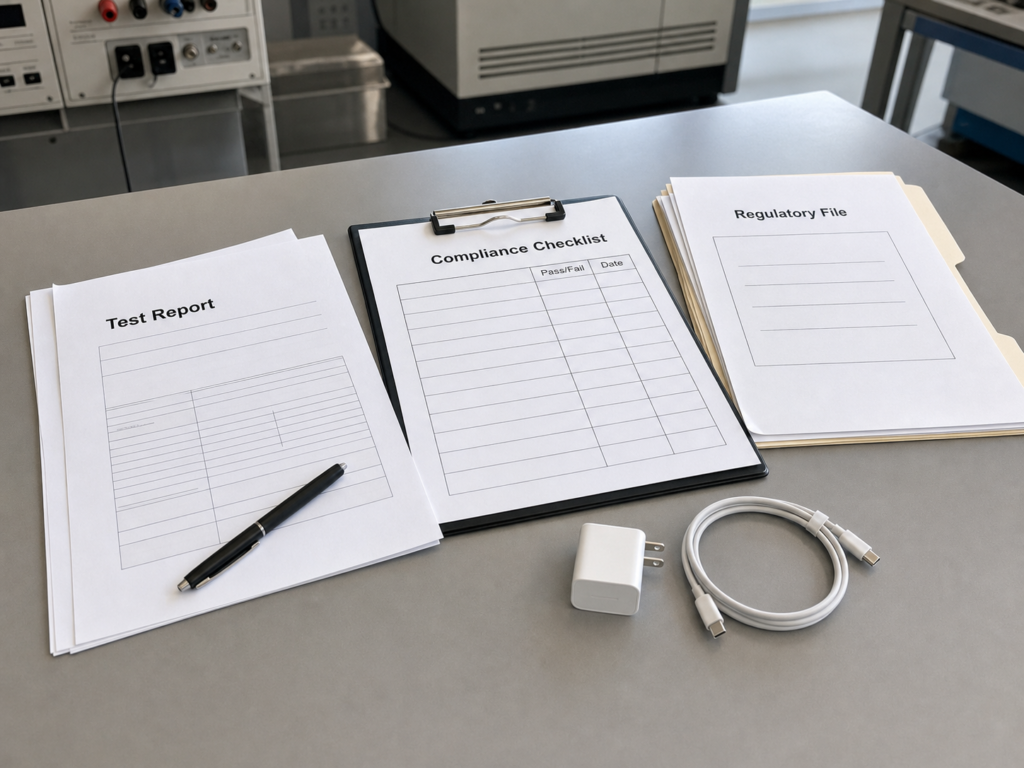
For charging products included in the scope, the relevant requirements mainly involve three aspects: first, electrical safety, for example, the product will not leak electricity, overheat or catch fire; second, electromagnetic compatibility (commonly referred to as EMC in the industry, which simply means that when the product is working, it will neither interfere with other electrical appliances nor be interfered by external sources); third, compliance with Chinese labeling, to ensure that Taiwanese consumers can understand product information.
If the procedures are not carried out in accordance with regulations, or the commodity inspection fails, the product may be refused entry or returned at the import stage, or may be required to make corrections within a time limit, stop sales, be recalled, confiscated or destroyed, and may be punished in accordance with the . The specific measures will vary according to the facts of the violation, the status of the commodity and the decision of the competent authority, and cannot be uniformly regarded as inevitable destruction or permanent loss of import qualification.
Many people have wrong initial understanding of BSMI. Here we first clarify the four most common misconceptions:
First, not all charging products need to apply for BSMI certification. When making a judgment, you should first check the specific item, scope and exclusion conditions in the latest based on the product’s use, structure, input/output and specifications. Direct connection to Taiwan’s mains electricity can only be used as a preliminary screening condition and cannot replace formal classification. Ordinary USB charging cables sold separately, if not included in the corresponding item, usually do not automatically incur BSMI mandatory inspection obligations just because they contain an E-Marker.
Second, overseas or mainland certifications such as CE, FCC, UL, and CCC cannot directly replace BSMI certification. Many European and American sellers think that with CE they can enter Taiwan, but this is not the case — CB reports that meet the recognition conditions can be used as part of the technical basis to help reduce repeated testing during application, but they still must be reviewed in accordance with BSMI’s specific items, standard versions, national differences and report conditions, and cannot be directly used to replace BSMI procedures.
Third, passing laboratory testing does not equal obtaining BSMI certification. Testing is only one part of the processing procedure; ultimately, the corresponding conformity assessment procedure is only completed after BSMI review, certification or registration is completed in accordance with the applicable system. It is not a done deal once the laboratory issues a report.
Fourth, not all charging cables are exempt from BSMI requirements. Whether detachable power cords, flexible cords and other cables are subject to inspection shall be judged according to their specific type, rated voltage and current, structure and the BSMI item list. “High-power charging cable” cannot be used as a general mandatory classification; ordinary USB signal cables or charging cables sold separately, if not included in the corresponding item, usually do not automatically require processing regardless of whether they contain an E-Marker.
2. Three Core Judgments Before Application
Since not all products need to be processed, before officially starting the procedure, make three core judgments first to clarify your own situation, so as to avoid wasting money and taking detours.
Judgment 1: Whether the product is within the mandatory scope
The core judgment logic is: first understand whether the product is connected to Taiwan’s power grid, then check the and corresponding announcements issued by BSMI. Whether inspection is mandatory ultimately depends on the commodity definition, specifications and exclusion conditions in the announcement; connection to Taiwan’s power grid can only be used as a preliminary judgment, not as the final determination.
Currently, among charging products, some wall-plug USB chargers, USB-C power adapters, charging docks with AC plugs and other products may fall into the relevant mandatory inspection items, but conclusions cannot be drawn solely based on the product name.
Passive USB charging cables sold separately, even C-to-C fast charging cables with E-Marker, are usually not within the scope of mandatory inspection if they are not included in the corresponding inspection items.
For self-inspection, you can follow three steps: ① First confirm the product’s use, input/output and structure; ② Check the latest item list, announcements and exclusion conditions on the BSMI official website; ③ If you still cannot be sure, consult a BSMI-recognized or designated laboratory, agent or import responsible entity.
Special reminder here: HS codes can only be used as auxiliary reference and cannot be used as the basis for final classification. Whether processing is required ultimately shall be subject to the BSMI item list, corresponding announcements and the competent authority’s judgment on the specific commodity.
Judgment 2: Select the appropriate conformity assessment method
Many people think there is only one type of BSMI certification. In fact, Taiwan’s commodity inspection system may involve procedures such as Registration of Product Certification (RPC), Supplier’s Declaration of Conformity (SDoC) and batch-by-batch inspection. However, these are not a general “choose one of three” mode that can be freely selected based on long-term shipment, risk level or trial order scale. Which procedure applies to a specific commodity is determined by the corresponding inspection announcement and commodity regulations of BSMI.
For the convenience of comparison, the basic concepts of the three procedures are summarized as follows:
| Conformity Assessment Mode | Core Requirements | Applicable Conditions | Core Features |
| Registration of Product Certification (RPC) | Sample testing, which may include factory inspection or other conformity requirements | Specified by specific commodity announcements | Obtain the corresponding registration of product certification certificate after completing the review |
| Supplier’s Declaration of Conformity (SDoC) | The manufacturer completes the assessment in accordance with regulations and retains test data for inspection | Can only be adopted when permitted by the announcement | Usually does not take official certification on a case-by-case basis as the core, and the manufacturer bears compliance responsibilities |
| Batch-by-batch Inspection | Each batch of goods is inspected in accordance with regulations | Specified by specific commodity announcements | Processed separately for each batch, applicable to commodities and situations specified in the announcement |
When it comes to charging products, you cannot make decisions on your own simply based on the logic of “choose RPC for long-term shipment, SDoC for low-risk cables, batch-by-batch inspection for small-batch trial orders”. Only when the announcement permits SDoC can manufacturers handle SDoC in accordance with regulations; if the announcement stipulates that RPC or batch-by-batch inspection must be adopted, you cannot change the selection on your own just because the shipment volume is small or it is only a trial order.
Judgment 3: Confirm application eligibility
Overseas manufacturers shall confirm their application eligibility in accordance with the specific inspection system. If required by the system or needed for actual processing, they shall designate an agent, importer or other compliant domestic responsible entity within Taiwan, and submit authorization and registration documents. It cannot be generally asserted that overseas entities are absolutely ineligible to apply, nor can “applicant” and “contact person” be regarded as interchangeable legal identities.
In actual preparation, it is usually necessary to confirm the company or registration information of the Taiwan responsible entity, the power of attorney from the overseas manufacturer, and the application documents required by BSMI or the handling agency.
If you are an individual seller, or do not have a local Taiwan company entity, you can consult local Taiwan compliance agencies, importers or other responsible entities that meet the system requirements to confirm who is responsible for application, liaison and subsequent commodity responsibilities.
3. Pre-preparation Checklist: Avoid 80% of Supplementary Document Rework
After confirming that processing is required, doing preparatory work in advance can avoid a lot of supplementary document rework, and save a lot of time and money.
First is the preparation of technical documents, which are divided into three categories:
The first category is basic product information: product specifications, user manuals, label samples. Among them, the specification sheet must clearly mark the input/output power, interface type, supported fast charging protocols, such as PD3.0, QC5, etc., all of which must be written clearly. Product labels, Chinese user manuals and statutory labeling shall use Chinese and include specified content in accordance with Taiwan regulations.
It should be noted that whether application forms, test reports, structural diagrams, parts information, etc. must be in Traditional Chinese shall be handled in accordance with the specific requirements of BSMI and the handling laboratory, and cannot be generalized as all documents must be in Traditional Chinese. Test reports can often be in English in actual applications, but they still must meet the format and content required by the system.
The second category is structure and parts information: simplified circuit block diagrams, as well as a list of key safety parts — for example, transformers, high-voltage capacitors, optocouplers and other parts directly related to safety must all be listed.
The third category is conformity certification: it is necessary to explain the product model naming rules and the differences between different models of the same series. For example, if products of the same series only differ in shell color, with the same internal circuit and parameters, they may be shared or included in the same certification scope under the condition of complying with applicable rules and being approved by review; but if the power, circuit or key safety structure are different, you cannot directly assume that they can be shared.
Then there are sample preparation requirements:
The number of samples and accompanying documents shall be subject to the corresponding inspection standards and the sample submission notice of the handling laboratory. Different commodity categories, test items, existing reports and laboratory requirements may vary. You cannot regard 3-5 sets of complete machines, 1-2 sets of key parts or 5-10 cables as a fixed quantity common to all charging products.
Regardless of the number of samples submitted for testing, the core requirement is: the samples must be consistent with the version that will be mass-produced and sold in the future, especially the model, key safety parts, rated input/output, plug, label and manual version. Engineering prototypes that are different from the mass-produced version cannot be used, nor can the internal structure be privately replaced after testing.
Finally, there are 4 self-check points before application. Check them in advance, so you don’t have to wait for BSMI to send them back for revision:
1. The parameters on the label should be consistent with the specification sheet as much as possible, such as output power, number of interfaces, model. You cannot have 65W on the label and 60W on the specification sheet.
2. Product labels, user manuals and statutory labeling shall be prepared in accordance with Taiwan’s Chinese labeling requirements; whether other application materials need to be in Traditional Chinese shall be confirmed in accordance with the requirements of BSMI and the laboratory.
3. Key safety parts shall be selected from parts that comply with corresponding standards and have consistent certificates, models, ratings and manufacturer information. This may reduce part of the document review or repeated testing, but whether they are recognized shall still be confirmed by the applicable standards, the laboratory and BSMI on a case-by-case basis.
4. The information of the Taiwan applicant, agent or other responsible entity is complete and valid, and the power of attorney and registration documents meet the requirements.
4. Full BSMI Processing Flow (General for Charging Products)
After the preparatory work is done, you can enter the official processing flow. The specific requirements for charging products vary by item, and you must check the corresponding announcements and checkpoints at each step.
Step 1: Regulatory Pre-review and Mode Confirmation
The operation is very simple: submit the product information to a BSMI-recognized or designated laboratory, agent or relevant responsible entity, and ask them to help you confirm whether the product is within the regulated scope, which assessment procedure applies, and what test standards correspond to it.
The checkpoint for this step is: clarify three pieces of information — what are the test items, whether factory inspection or other supervision is required, and what are the specific requirements for the Taiwan responsible entity.
If it is confirmed that the product is not within the mandatory regulated scope, there is no need to go through the corresponding mandatory inspection procedure; if it is within the scope, proceed to the next step. The final classification shall still be subject to the latest item list, corresponding announcements and specific commodity information.
Step 2: Entrust a Recognized Laboratory for Testing
There is a hard requirement here: you should select an institution recognized or designated by BSMI announcement, and whose authorization scope covers the commodity and test items. You cannot only check whether the laboratory is on the list, but also confirm whether it has valid authorization for the corresponding product, standards and test items.
Whether overseas testing or CB reports can be recognized shall also be confirmed item by item based on specific announcements, laboratory qualifications, report scope, standard version, product rated input range and Taiwan’s national differences. Therefore, you cannot assume that any report is valid just because the laboratory is “on the list”, nor do you necessarily need to go to Taiwan specifically for testing.
If the test fails, the laboratory will give specific rectification items, and you can submit samples for retesting after adjustment. The testing cycle varies depending on the product, laboratory scheduling, test items and number of rectifications.
If you already have a CB report, you can submit it to BSMI or the handling laboratory for evaluation. CB reports that meet the recognition conditions can be used as part of the technical basis. BSMI or the designated laboratory will review based on the specific item and Taiwan’s national differences, and decide which additional tests are needed. You cannot promise in advance that most items will definitely be reduced or exempted, nor can you simply assume that only one test under 110V voltage needs to be supplemented.
After the test is completed, a formal test report shall be issued by a laboratory with corresponding BSMI recognition or designated qualification and whose authorization scope covers the item. The report needs to meet the format and recognition conditions required for BSMI application, and cannot be generalized as all reports must be stamped with a unified “BSMI recognition seal”.
Step 3: Submit Certification Application
There are two submission channels: you can submit it yourself through BSMI’s online system, or entrust a laboratory or agent to submit it on your behalf — for overseas sellers, it is more convenient to find an agent familiar with the process to submit on their behalf, but you should still confirm the other party’s scope of responsibility and qualifications.
The application materials to be submitted include: compliant test reports, technical documents, BSMI official application forms, authorization documents, and other materials required by specific items.
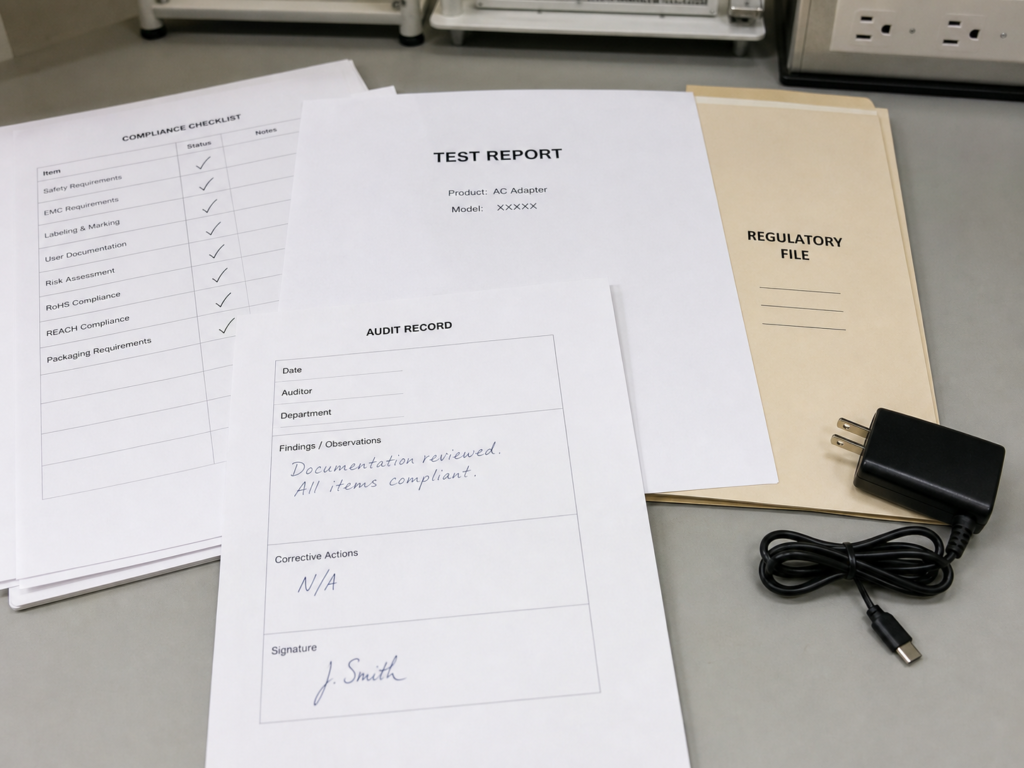
The checkpoint for this step is: the product model, manufacturer, applicant entity, specifications and labeling information in all materials must be consistent, and the test report must also be issued by a laboratory with corresponding qualifications and authorization scope. You cannot simply take “all materials are stamped with the official seal” as the only judgment standard, but should prepare in accordance with the document requirements of the BSMI online system, announcements and handling agencies.
If there are problems with the materials, BSMI will issue a supplementary document notice, and you can supplement or modify them as required. If the materials are not completed within the time limit, the application may be rejected, and you will need to resubmit or go through the relevant procedures again later.
Step 4: BSMI Review and Factory Inspection (if applicable)
First is document review. BSMI will check whether the materials and reports you submitted meet regulatory requirements. The review time varies depending on the commodity item, completeness of materials and complexity of the case.
Then there is factory inspection, which is not required for all applications. Whether to conduct initial factory inspection and subsequent supervision shall be determined based on the registration of product certification rules, announcements, factory qualifications and certificate conditions applicable to the commodity, and cannot be uniformly judged by “first application for registration of product certification”.
Factory inspection or other conformity supervision mainly checks the factory’s mass production consistency and quality control ability to ensure that bulk goods are consistent with test samples in key aspects.
If the review fails, you can either supplement the materials or have a re-inspection after the factory rectifies. Whether the processing can continue after rectification and the final result shall be determined by BSMI and the applicable system.
Step 5: Obtain Certificate and Pre-launch Self-check
After the review is passed, BSMI will issue the corresponding registration of product certification certificate, approval document or complete procedures such as SDoC in accordance with the applicable system. Only then is the corresponding commodity inspection requirement completed.
After obtaining the documents, you shall also mark the required commodity inspection mark, certificate or registration number and Chinese commodity labeling on the product, packaging, label or manual in accordance with the applicable inspection system and item regulations. Warning labels are only required when required by relevant standards or item regulations, and cannot be generalized as all products must have the BSMI logo, registration number and Traditional Chinese warning labels printed on the product body.
Before the official launch, it is recommended that you do another self-check to ensure everything is foolproof:
① The labeling on the product, packaging and manual shall be consistent with the information in the certificate, registration materials or SDoC, and there must be no wrong model or wrong power;
② Confirm whether the product involves other regulatory requirements. For example, products with Bluetooth, Wi-Fi or other regulated wireless transmission functions need to further confirm NCC requirements; products with batteries need to check the corresponding inspection regulations for power banks, secondary lithium batteries or electronic commodities;
③ Properly retain the certificate, test report, key parts procurement records and production consistency materials, which may be used in subsequent spot checks or supervision;
④ The information of the Taiwan responsible party has been correctly marked on the product, packaging, label or manual in accordance with regulations.
5. Key Processing Points for Different Charging Products
Different types of charging products have different key points during processing. You can compare them with your own products.
Wall-plug Chargers/USB-C Power Adapters (Most Common)
This type of product may be a key item under BSMI control. First, confirm that the product’s rated input range covers the voltage and frequency conditions applicable in Taiwan, then evaluate based on the nameplate, CNS safety regulations and plug standards. You cannot simply summarize it as “Taiwan is 110V”.
Other core review items also include: whether the plug meets applicable Taiwan standards, whether the primary and secondary safety distance is sufficient, whether the temperature rise during long-term operation meets the requirements, and whether the product is safe under abnormal conditions.
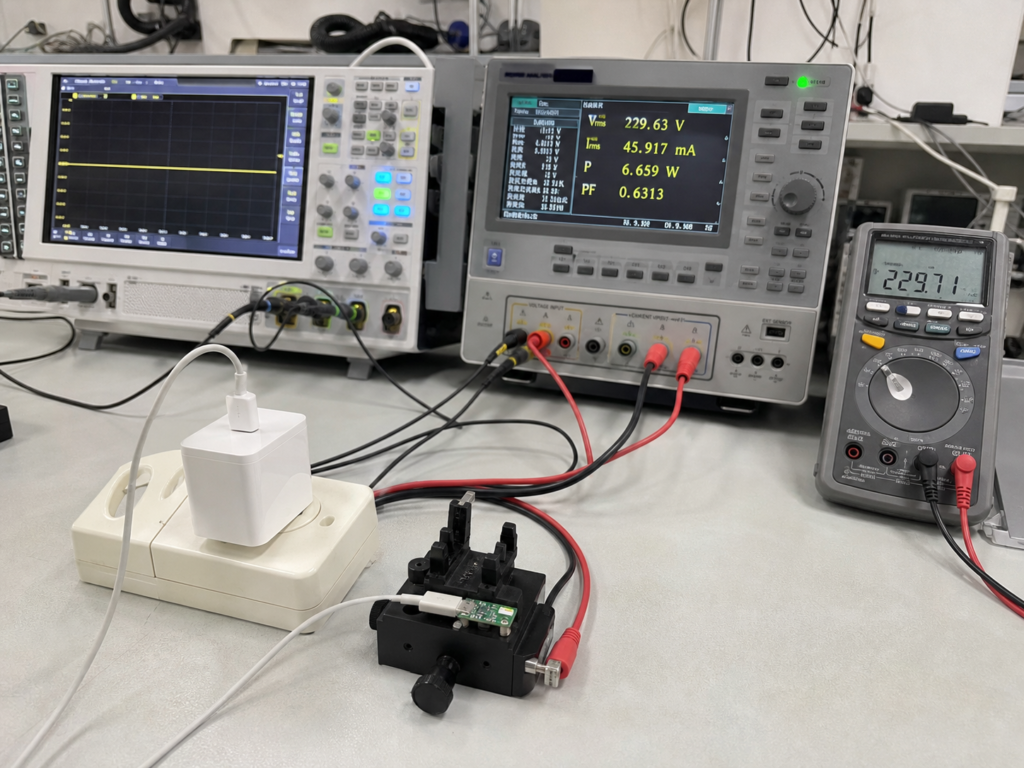
For products with multi-port output or with PD fast charging, the output, temperature rise, abnormal and load conditions shall be evaluated in accordance with applicable safety, EMC and performance test requirements. If the announcement or specific test plan requires verification of USB-C/PD functions, tests shall be conducted in accordance with the corresponding technical specifications. You cannot generally claim that all PD products must undergo independent protocol conformance testing, nor can you directly equate protocol parameter issues with inevitable failure of EMC testing.
Charging Cables/Cable Category
First, it is still necessary to clarify the mandatory scope: whether detachable power cords, flexible cords and other cables are subject to inspection shall be judged according to their specific type, rated voltage and current, structure and the BSMI item list. “High-power charging cable” cannot be used as a general mandatory classification; passive USB charging cables sold separately, if not included in the corresponding item, usually do not automatically incur mandatory inspection obligations just because they contain an E-Marker chip.
If the cable is sold together with a complete machine such as a charger, whether separate processing is required shall be confirmed based on the specific commodity definition, item list and announcements of the complete machine and the cable. It cannot be generally assumed that as long as it is sold with the complete machine, there is no need for separate inspection or only filing is required.
Key test items for cables may include: conductor resistance (to avoid excessive resistance and heating), insulation withstand voltage (to prevent insulation breakdown and electric leakage), flame retardancy (self-extinguishing after catching fire), terminal insertion and extraction life (no failure after repeated plugging and unplugging). The specific items are still subject to applicable standards and test plans.
Charging Products with Additional Functions
The wireless charging function itself does not automatically trigger NCC requirements. Only if the product contains Bluetooth, Wi-Fi or other regulated radio transmitters is it necessary to further confirm whether certification or type approval is required in accordance with NCC equipment classification, frequency band, power and technical specifications.
For power banks with built-in batteries, you should separately check BSMI’s current items and inspection requirements for power banks, secondary lithium batteries or related electronic commodities, and confirm whether transportation, recycling or other regulations are also involved. You cannot simply assume that all “battery-equipped” products are subject to the same set of battery commodity inspection regulations.
If the product has Bluetooth, Wi-Fi or smart control functions, you need to reconfirm the product classification, which may also involve other regulations, and you cannot directly follow the process for ordinary chargers.
6. Phased Pitfall Avoidance Guide: Save 80% of Rectification Costs
In the process of applying for BSMI, many pitfalls can actually be avoided in advance. Especially for charging products, there are several high-frequency rectification items. Paying attention to them in advance can save a lot of rectification costs.
Product Design Stage (Most Cost-effective)
Pit 1: Insufficient primary and secondary safety creepage distance. This is a common rectification item for charger products. Simply put, the insulation safety distance between the high-voltage side (the part connected to the mains) and the low-voltage side (the part connected to the mobile phone) is insufficient, which is prone to electric leakage. You should leave enough distance in advance during design, and don’t wait until the test fails to modify the circuit board.
Pit 2: Incomplete information or certification conditions of key safety parts. When selecting parts, prioritize safety parts that comply with corresponding standards and have consistent certificates, models, ratings and manufacturer information. This may reduce part of the document review or repeated testing, but it does not mean that testing is necessarily exempt, nor does it mean that the whole machine automatically meets BSMI requirements.
Pit 3: Non-standard USB-C PD fast charging output parameters. During design, the output capability, protection functions and conditions of each gear shall be confirmed according to applicable product standards and USB-C/PD technical specifications. If the announcement or test plan requires verification of relevant functions, test according to the corresponding plan; you cannot simply assume that all parameter problems will directly cause EMC test failure.
Pit 4: Using plugs that do not meet applicable Taiwan standards. For example, using inapplicable US or Chinese standard plugs may fail to meet product inspection and market labeling requirements. You should choose the appropriate plug according to the product category from the beginning.
Application Stage
Pit 1: Finding a laboratory without corresponding BSMI recognition or designated qualification for testing. The report may not be officially recognized, wasting money and delaying time. Be sure to check the laboratory’s authorization scope for specific commodities, test items and standards in advance, and confirm that it meets the requirements before cooperating.
Pit 2: The recognition conditions of the CB report are not confirmed. Whether a CB report can be used as a technical basis depends on the report version, product scope, laboratory qualification, standard version, Taiwan’s national differences and rated input conditions. Let BSMI or the handling laboratory confirm the items that need to be supplemented in advance, and do not presuppose that only a certain voltage condition needs to be retested.
Pit 3: Unqualified Taiwan responsible entity or authorization documents. For example, the agent, importer or other domestic responsible entity does not meet the system requirements, or the power of attorney is incomplete. Verify the application eligibility and document requirements in advance, and don’t wait until after submission to find problems.
Pit 4: Excessive differences between series models. For example, if the same series has both 65W and 120W products with completely different internal circuits, and you want to share one certification, you may be required to evaluate them separately. Sort out the model differences in advance. Only differences that do not affect safety and applicable standards, such as appearance and color, may be included in the same scope under the condition of complying with the rules and being approved by review.
Post-certificate Stage
Pit 1: Privately changing the product design. For example, replacing key safety parts such as chips and transformers, or modifying the circuit, but not applying for certification changes in accordance with regulations. If caught in a spot check, you may face rectification, suspension or other handling. Any change involving safety, rated parameters, manufacturer, factory or labeling shall first confirm whether a change needs to be processed.
Pit 2: Unable to provide procurement records of safety parts during supervision and inspection. Holders of registration of product certification may need to accept factory inspection, market supervision or other conformity supervision in accordance with regulations. If you cannot provide the qualification certificates and procurement records of key parts, you may not be able to prove mass production consistency. You should properly retain the vouchers and production materials of each batch of key parts at ordinary times.
Pit 3: Forgetting to update when the certificate expires or the standard is revised. This may cause the product to be unable to be sold normally, or even be removed from the shelves. The extension, renewal or revision process should be initiated in advance according to the validity period recorded in the certificate, applicable announcements and standard change requirements to avoid supply disruption.
Pit 4: Product labeling is inconsistent with the information in the certificate or registration materials. For example, wrong model or wrong power labeling, even if the relevant procedures have been completed, may be judged as non-compliant labeling or commodity. Be sure to check the labeling information one by one before launch.
7. Reference for Cycle, Cost and Certificate Maintenance
Finally, let’s talk about the processing cycle, cost and certificate maintenance that everyone is most concerned about, to provide a practical reference.
Processing Cycle Reference (Under the Premise of No Rectification)
The processing cycle can only be used as a case-by-case estimate, and a fixed number of weeks cannot be regarded as a general time limit for all charging products. The actual time needs to be confirmed by the handling laboratory or agent based on the specific item, sample, test items, report recognition status, factory inspection, supplementary document situation and material completeness.
The processing time for RPC, SDoC and batch-by-batch inspection may vary, but BSMI does not uniformly stipulate a fixed cycle of “4-8 weeks”, “2-4 weeks” or “1-2 weeks per batch” for all charging products. The actual cycle is affected by many factors, such as the number of test rectifications, laboratory scheduling, BSMI application volume, whether factory inspection is required, and whether your materials are complete. Therefore, it is recommended to plan as early as possible and not to process right up to the launch time.
Cost Composition and Reference
BSMI-related costs generally may include testing fees, application fees, factory inspection fees (if applicable), rectification and retesting fees, and agency service fees (if an agent is entrusted).
There is no unified total BSMI cost applicable to all 65W single-port USB-C chargers. Specifically, you should confirm the testing fees, official fees, factory inspection fees, rectification and retesting fees, and service fees with the handling laboratory, BSMI and agent respectively. The product’s power, number of interfaces, applicable standards, test items, whether factory inspection is required, and whether there is already a recognizable report will all affect the final cost. Therefore, it is not appropriate to take NT$10,000-30,000 as a general reference.
There are two main cost-saving tips: first, confirm in advance whether the existing CB report meets the recognition conditions, and if so, part of the repeated testing fees may be reduced; second, select key safety parts that comply with corresponding standards and have consistent certificates, models and ratings, which may reduce part of the document review or repeated testing. However, the specific reduction or exemption items and amounts must be confirmed by BSMI or the handling laboratory on a case-by-case basis, and a fixed ratio cannot be promised.
Certificate Maintenance and Change Rules
First is the validity period: it shall be subject to the validity period recorded in the certificate and applicable announcements. The RPC certificate is not uniformly valid for 5 years. The common validity period may vary depending on the specific system, and may also be affected by standard revisions, certificate conditions or announcements; renewal, extension or revision shall be handled in accordance with BSMI regulations. SDoC does not have a unified concept of certificate validity period, but manufacturers must still continuously maintain product conformity in accordance with regulations, and retain test reports and related materials for spot checks.
Then there is regular supervision: holders of RPC certificates must accept initial or regular factory inspection, market supervision or other conformity supervision in accordance with applicable regulations. The specific frequency and method shall be subject to the commodity system, certificate conditions and BSMI notice, and cannot be generalized as once every 1-2 years.
If the following situations occur, you must first confirm whether you need to apply for a certification change to BSMI, and cannot make changes privately: replacing the manufacturer or production factory, modifying input/output parameters, replacing key safety parts, modifying labels or models. Whether re-testing, certificate change or re-application is required shall be determined based on applicable standards and case-by-case review.
Failure to apply for extension within the time limit, violation of certificate conditions, failure to cooperate with factory inspection, failure to process product changes in accordance with regulations, or failure in spot checks may lead to different treatments such as correction within a time limit, suspension, revocation, annulment, cancellation or refusal of extension. The specific legal effect shall be determined on a case-by-case basis and in accordance with applicable regulations, and cannot be uniformly stated as the certificate being immediately invalidated.
By now, you should have a complete understanding of the BSMI-related processing flow for charging products: you can quickly judge whether your product may fall within the scope of mandatory inspection, confirm the applicable assessment procedure based on BSMI announcements, advance the processing according to the flow of “pre-review → testing → application → review → certificate obtainment”, avoid common pitfalls in the three stages of design, application and certificate obtainment, judge whether a change application is required when the product is changed, confirm compliance against the self-check list before launch, and also make preliminary plans for the processing cycle and cost.
If it is your first time processing, it is recommended to prioritize cooperating with laboratories that are recognized or designated by BSMI announcements and whose authorization scope covers relevant commodities and test items, or agents familiar with Taiwan’s commodity inspection system. This can save a lot of detours and also allow you to discover problems in product classification, documents, testing and labeling earlier.