
Anyone who exports charging products to South Korea or purchases charging accessories on South Korean e-commerce platforms will almost inevitably encounter issues related to the KC mark. Many people think the KC mark is just an oval sticker printed casually on a product, but that is not the case. As a statutory market access mark of South Korea, the use of the KC mark follows very detailed rules — from graphic proportions to information matching, a single mistake may lead to customs detention of goods or removal from e-commerce platforms. This article explains the KC mark usage specifications related to charging products thoroughly, from basic introductory knowledge to advanced risk avoidance, so that both ordinary consumers and cross-border practitioners can understand it.
1. First, Understand: What Exactly Is the KC Mark? (Must-Know for Beginners)
1. It Is Not a Quality Medal, but a Statutory Access Mark
The full name of the KC mark is the South Korea KC Conformity Mark. It is not a logo designed by the brand itself, not a medal for quality excellence, nor a proof of performance level, but a statutory market access conformity mark of South Korea. Only after the product passes the corresponding compliance test, obtains a valid certificate, or completes official registration can the mark be used — and printing only the standard KC pattern does not mean compliance; it must be matched with supporting information such as the certification number of the corresponding category to be valid. It is the core basis for South Korean customs clearance, e-commerce platform listing, and consumers to judge whether a product is compliant.
2. 3 Types of KC-Related Compliance Requirements
Many people think there is only one type of KC, but in fact, KC-related compliance requirements for charging products are divided into three categories, with different scopes of application:
- Safety Certification (KC Safety): This is the core of KC access, targeting the electrical safety requirements of products, such as electric shock prevention, fire resistance, high temperature resistance, etc. It mainly applies to products subject to mandatory safety certification, such as wall-plug chargers, desktop power adapters, and integrated charging cables with AC plugs; products such as ordinary passive charging cables and car chargers shall be handled in accordance with the corresponding self-regulatory confirmation category.
- Electromagnetic Compatibility Registration (KC EMC): Simply put, it requires that products with circuits do not emit excessive electromagnetic interference that affects other electrical appliances, and can also work stably in a normal electromagnetic environment. Most charging products with circuit boards need to complete this registration.
- Radio-related Compliance: It only applies to products with wireless transmission functions, such as wireless chargers. It belongs to an independent communication compliance system, is not within the scope of basic KC safety certification, and requires separate application and separate labeling of the corresponding number.
3. Which Charging Products Need to Be Labeled with the KC Mark
Combined with the actual situation of charging products, the scope of application of the KC mark can be divided into four categories:
- Mandatory labeling category: Wall-plug chargers, desktop power adapters, and integrated charging cables with AC plugs. These products fall within the scope of mandatory safety certification and must be labeled with the KC mark.
- Self-regulatory confirmation category (labeling required): Ordinary USB/USB-C passive charging cables and car chargers. Although these products belong to the category of self-regulatory safety confirmation and are not mandatory certified, they still need to be labeled with the corresponding category of KC mark as required.
- Exemption cases: Products carried in by individuals for personal use, exhibition samples for non-sales purposes, and after-sales maintenance spare parts are exempt from the KC mark. Note that trial sales and crowdfunding products are not within the exemption scope; as long as they are for sale, they must be compliant.
- Set product boundaries: If a charger is sold as a bundle with other devices (such as a charger given away when buying a tablet), the charger itself must be labeled with the KC mark separately; however, the built-in charging port of the device (such as the Type-C port on a mobile phone) does not need to be labeled with the KC mark separately.
4. 3 Misconceptions Beginners Most Easily Get Wrong
People who are new to KC can easily fall into these three basic pitfalls. Remembering them in advance can save a lot of detours:
First, the KC mark is only applicable to the South Korean market and cannot replace access marks of other countries and regions such as CE and FCC;
second, having a KC certificate does not mean the mark can be used at will — it must be pasted or printed in strict accordance with the official specifications for style, position, and information requirements;
third, one KC number only corresponds to the specific models covered by the certificate and cannot be used for the entire series. Even if the products look identical, as long as the parameters or structure are different, the same number cannot be shared.
2. A Qualified KC Mark Must Include These Core Elements
1. Strict Requirements for the Official Standard Graphic
The official graphic of KC is a fixed design of oval border + KC letters, with clear proportional regulations. It cannot be stretched or deformed, nor can any decorative elements be added — for example, adding shadows to KC, changing the font, or adding a special border are not allowed.
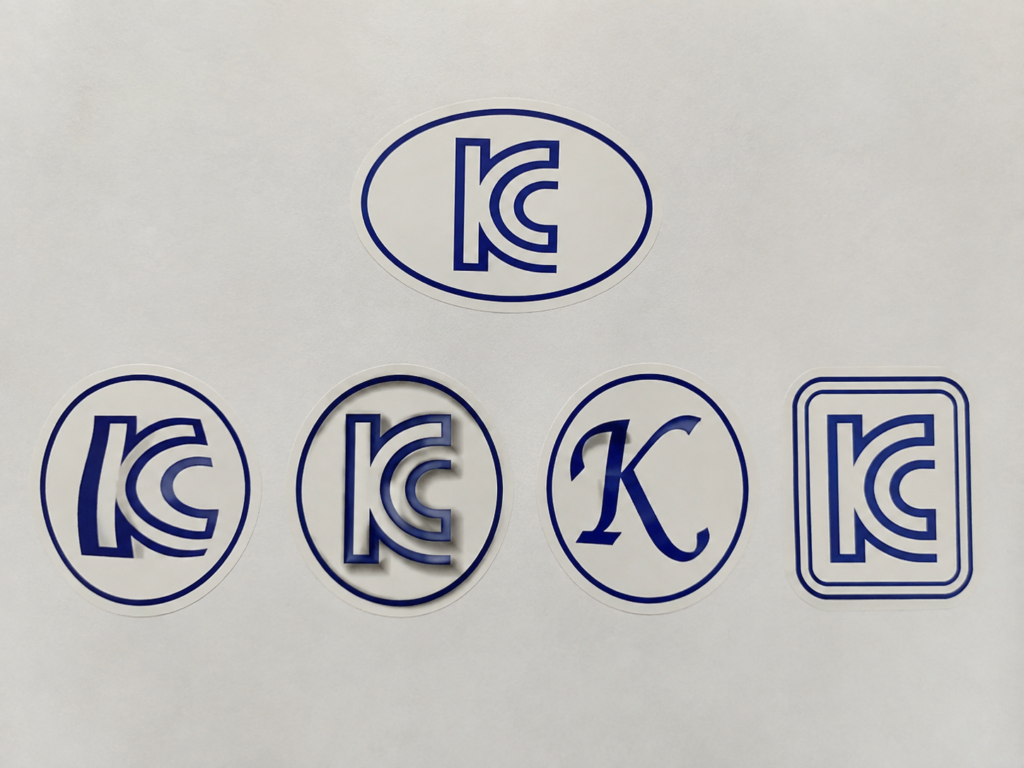
There is no mandatory fixed requirement for color, as long as it forms a clear contrast with the background. Monochrome printing and reverse white effects both comply with regulations, and the most common version on the market is blue.
Special attention should be paid: the KC graphic cannot be modified into a brand-style design, nor can text such as “KC approved” or “KC certified” be used to replace the official graphic. The standard oval KC mark must be used.
2. The Graphic Alone Is Not Enough; 4 Pieces of Supporting Information Are Also Required
A qualified KC mark usually needs to be matched with the following 4 types of key information. This information must be fully presented on carriers specified by regulations such as the product body, minimum sales packaging, and user manual (except for ultra-small volume products with special regulations), and does not have to all be printed in the same place on the product body immediately next to the KC graphic:
- Corresponding category certification/registration number: The prefix of the number must match the compliance category of the product, and cannot be labeled arbitrarily.
- Product model: Must be completely consistent with the model on the certificate. For OEM/ODM private label products, the actual sold model must be labeled, and only the factory internal model cannot be labeled.
- Key electrical parameters: Including input/output voltage, current, and power. For multi-port products, the maximum single-port output and total power distribution rules must also be clearly labeled.
- Domestic responsible party in South Korea: The name and contact information of the importer or local seller in South Korea must be labeled. Information of overseas factories alone cannot be labeled, as South Korean regulatory authorities need to be able to locate the domestic responsible entity.
3. Correspondence of Common Number Prefixes
The prefixes of KC numbers are not arbitrarily set. Different prefixes correspond to different compliance categories and product types. Here is a compilation of the common prefix correspondences for charging products for quick verification:
| Number Prefix | Examples of Corresponding Charging Products | Applicable Compliance Category |
|---|---|---|
| Starts with S | Wall-plug chargers, desktop power adapters, integrated charging cables with AC plugs | Mandatory Safety Certification (KC Safety) |
| Starts with SS | Ordinary USB/USB-C passive charging cables, car chargers | Self-Regulatory Safety Confirmation |
| Starts with R | Chargers, adapters and other products with circuits that require EMC registration (must be labeled together with the safety number; specific applicability is subject to official classification) | Electromagnetic Compatibility Registration (KC EMC) |
Note that the EMC number starting with R needs to be labeled separately from the safety category number, and they cannot replace each other. KCC Radio Certification is an independent system, mainly corresponding to charging products with wireless transmission functions such as wireless chargers. It is not within the scope of KC Safety numbers, nor can it be replaced by the EMC number starting with R.
3. Where to Paste and How to Print the Mark? Remember These General Rules
With qualified mark content, there are also clear requirements for the process and position of pasting and printing; it cannot be pasted just anywhere.
1. Pasting Position on Product Body: Visibility and Wear Resistance Are the Core
The KC mark should be preferentially pasted on a prominent, flat position on the product body that is not easily worn. Pins/contact points, detachable parts, areas that are easily blocked or subject to frequent friction are all positions where labeling is prohibited.
Common compliant positions for charging products include: the flat surface opposite the charger pins, the bottom of the adapter, and the plug shell of the charging cable.
If the product is particularly small and it is really impossible to print the complete KC mark and supporting information on the body, the complete information can be moved to the minimum sales packaging, but a traceable product model must be left on the product body to facilitate regulatory inspection.
2. Size and Readability: Clarity Is the Bottom Line
South Korean regulations do not have a unified mandatory requirement for the minimum size of the KC mark. The core principle is clearly distinguishable to the naked eye and viewable without disassembling the product. The common practice in the industry is that the height of the KC graphic on ordinary chargers is no less than 5mm. For ultra-small volume products, it can be scaled down proportionally, but not so small that a magnifying glass is needed to see it clearly.
For multi-language labels, it is necessary to ensure that the KC mark and core parameters are not blocked by other text, and the core information must be found at a glance.
3. Durability: Must Last as Long as the Product Lifespan
The durability of the KC mark needs to match the service life of the product. Under normal plugging/unplugging, wiping, and high-temperature environments of daily use, it must not fall off or become blurred.
Compliant manufacturing processes include silk-screen printing, laser engraving, and durable self-adhesive stickers; handwritten labels, ordinary tape pasting, and ordinary stickers that easily curl at the edges are explicitly prohibited.
There are additional requirements for charging cable labels: they must be resistant to bending and friction, and cannot only be printed on the packaging plastic seal. The situation where the mark cannot be found after removing the plastic seal is a violation.
4. Supporting Requirements for Packaging and User Manuals
In addition to the product body, packaging and user manuals also have corresponding labeling requirements. The core principle is electronic user manuals and outer packaging cannot replace the physical mark on the product body (except for ultra-small volume products with other regulations):
- The KC mark and corresponding certification number must be printed on the minimum sales packaging;
- If multiple models share one package, the specific models covered by KC certification must be clearly labeled, and consumers cannot be misled into thinking that all models have KC;
- The Korean user manual must include the KC mark, number, and basic safety precautions;
- Electronic user manuals cannot replace the physical marks on the product body and minimum packaging. Even if the electronic version is placed on the detail page, the physical marks on the body and packaging cannot be omitted.
4. Exclusive Labeling Rules for Different Charging Products
General rules are the foundation, and different types of charging products also have exclusive labeling requirements. Here, specific explanations are provided for three common types of products.
1. Chargers/Power Adapters
Chargers and power adapters belong to the mandatory safety certification category. The mark must be pasted on a prominent flat surface of the body, and cannot be pasted on pins, detachable power cords, or heat dissipation holes.
Information that needs to be labeled includes: mandatory safety number starting with S, corresponding EMC registration number (if any), and complete input and output electrical parameters.
For multi-port fast charging models, special attention should be paid: the maximum single-port output power and the power distribution rule when multiple ports are used simultaneously must be clearly labeled, for example, “maximum 65W for single port, 45W+18W for dual-port simultaneous output”, and cannot only label the total power vaguely.
2. Charging Cables and Plugs
Different types of charging cables have different labeling requirements:
- Integrated charging cables with AC plugs (such as a fast charging cable with a South Korean plug on one end and Type-C on the other), the mark is pasted on the shell of the AC plug, using a mandatory safety number starting with S;
- Ordinary USB/USB-C passive charging cables (cables with data interfaces on both ends and no AC plug), the mark is pasted on the connector or the durable label on the cable body, using a self-regulatory confirmation number starting with SS;
- For independently sold South Korean standard plugs, the KC mark and corresponding safety certification number must be printed on the body.
3. Special Charging Accessories
- Car charger: The mark is pasted on the side of the body, and pasting on the cigarette lighter plug is prohibited. Use a self-regulatory confirmation number starting with SS;
- Charger with replaceable plugs: The KC mark must be pasted on the charger main unit, and the replaceable South Korean plug itself also needs to separately meet KC safety requirements; certification cannot only be done for the main unit;
- Wireless charger: For wireless chargers with wireless transmission functions, in addition to meeting the basic safety KC mark requirements, they also need to be additionally labeled with the KCC Radio Certification mark and number; the specific mark form and number rules are subject to applicable regulations and official certificates, and KCC communication compliance requirements cannot replace safety KC requirements.
5. How to Self-Check Whether the KC Mark Is Compliant?
Whether consumers are purchasing products or cross-border sellers are stocking and listing products, they can quickly judge the compliance of the KC mark through the following methods.
1. Beginner 3-Step Quick Self-Check (Surface Inspection)
No need to check the system; a preliminary judgment can be made with the naked eye, in three steps:
Step 1: Check the style. Is the KC graphic a standard oval with KC letters? Is there any stretching, deformation, or added decorative elements? For example, adding an outer frame to KC or changing it to an artistic font is non-compliant;
Step 2: Check the information. Is there a certification number with the corresponding prefix? Do the model and electrical parameters match the actual situation of the product?
Step 3: Check the position. Is it pasted on a prominent position of the product body? Is it clear and wear-resistant, not coming off with a single scratch.
2. Advanced Verification: Check Whether the Certificate Is Really Valid
To confirm the authenticity and validity of a certificate, you need to select the corresponding official query channel according to the number type: KC safety certificates can be verified through official product safety information channels such as the official public query system of the Korea Certification Agency (KCA) and Safety Korea; EMC registration numbers and KCC Radio Certification numbers need to be verified through the corresponding special query entrance for conformity assessment. Do not mix up the query entrances for safety numbers, EMC numbers, and radio numbers.
When checking, pay attention to three core points: first, whether the certificate status is valid, whether it has expired or been revoked; second, whether the product model on the certificate is completely consistent with the actual product; third, whether the responsible entity on the certificate matches the South Korean responsible party on the label.
If the information cannot be found, do not directly judge it as fake first. It may be that the number type or query entrance was entered incorrectly, or that the certificate was just obtained and has not been entered yet, as there is a certain system delay.
3. Identify High-Risk Non-Compliant Marks at a Glance
Several situations are typical high-risk violations, and you should be alert when you see them:
- Only the KC graphic, without any supporting information such as certification number, model, parameters, etc.;
- The number prefix does not match the product type, for example, an ordinary passive charging cable uses a mandatory safety number starting with S (the correct one should start with SS);
- The KC mark is only on the packaging, not on the product body (except for ultra-small volume products);
- The parameters on the label do not match the certificate, for example, the label says 65W, but the certificate only covers 25W models.
4. Listing Checklist for Cross-Border Practitioners
Cross-border sellers operating in the South Korean market can quickly check according to four dimensions before listing to avoid violations:
- Product side: The style, information, position, and durability of the mark all meet the specification requirements;
- Packaging side: The KC mark and number on the minimum sales packaging are completely consistent with those on the product body;
- Documentation side: Hold valid KC certificates, Korean user manuals, and qualification documents of the South Korean responsible party;
- Channel side: The KC mark displayed on the e-commerce detail page is consistent with the actual product; do not use edited images or marks for the wrong model.
6. Common Misconceptions and Consequences of Violations
1. 5 Most Frequent Usage Misconceptions
Many people make mistakes not because they intentionally violate regulations, but because they have misunderstandings about the rules of the KC mark. Here are the 5 most common misconceptions:
- Misconception 1: If a complete machine is assembled with KC-certified parts, the complete machine does not need KC certification. KC certification is for the final finished product. Even if all parts have KC, as long as the complete machine has not passed certification, the KC mark cannot be pasted. For example, using a KC-certified power chip does not mean that the assembled charger has KC certification.
- Misconception 2: It is enough to paste the mark on the packaging. Except for special regulations for ultra-small volume products, the KC mark must be pasted on the product body; pasting only on the packaging does not meet the requirements.
- Misconception 3: Products of the same series with the same appearance can share one KC number. The KC number is bound to specific models. As long as the product’s power, circuit structure, and plug type are different, even if the appearance is identical, a separate certification application is required, and the number cannot be shared.
- Misconception 4: Certifications from other countries such as CE and FCC can replace KC. KC is an independent statutory access requirement in South Korea, and certifications from other countries and regions cannot replace it.
- Misconception 5: Product parameters can be modified freely during the certificate validity period. The parameters on the certificate are all filed. If you want to change the input/output parameters or model, you must first apply for a certificate change, and only after the change is approved can you update the mark; you cannot modify the label casually by yourself.
2. Do Not Confuse with These Two Types of South Korean Compliance Marks
There are two other common types of compliance marks in the South Korean market that are easily confused with the KC safety mark. Pay attention to the distinction:
- KCC Communication/Radio Conformity Assessment Mark: For products with wireless transmission functions, the applicable regulations, number system, and verification entrance are all different from those of safety KC. Communication/radio numbers cannot replace safety KC numbers. The display form of the mark may vary at different system stages, and practical verification is subject to the number type and official query results. Charging products with wireless functions (such as wireless chargers) need to meet both safety KC and KCC communication compliance requirements.
- Energy Efficiency Label: A label for the energy consumption level of products, which has nothing to do with safety compliance. It needs to be pasted separately, and the KC mark cannot replace the energy efficiency label.
3. What Are the Consequences of Violations?
The consequences of KC mark violations can be minor or severe, mainly divided into two categories:
- Customs clearance and market regulation side: Goods may be detained or returned by customs after arriving at the port. Products already on the market will be required to be removed from shelves or recalled, and serious cases may face regulatory penalties.
- E-commerce platform side: Cross-border e-commerce platforms will impose point deductions and sales restrictions on violating products, and in serious cases, may even directly suspend stores.
4. Key Points for Mark Maintenance When Certificate Changes Occur
KC certificates are not once-and-for-all. When subsequent changes occur, the mark must also be adjusted simultaneously. Pay attention to three key points:
First, when the product model, electrical parameters, or South Korean responsible party changes, you must first apply for a certificate change from the issuing authority, and then update the marks on the product and packaging after the change is approved. You cannot change the mark first and then supplement the certificate;
second, the certificate has a validity period, and renewal must be completed before expiration. After the renewal is passed, the original KC number can continue to be used without replacement;
third, if the certificate becomes invalid or is revoked, unsold inventory products can no longer be sold in the South Korean market. If rework is required to re-paste the mark due to changes, the re-pasting process must meet durability requirements, and you cannot just paste a new sticker perfunctorily.
Finally: Quick Comparison of KC Mark Compliance Capabilities
- Beginner level (applicable for daily purchase/basic stocking): Can quickly judge whether charging products need to be labeled with the KC mark when entering the South Korean market, can identify the core elements of a qualified KC mark (standard oval graphic + certification number with corresponding prefix + matching product parameters), and can find the correct pasting position of the mark.
- Advanced level (applicable for compliance verification/risk avoidance): Can judge the surface compliance of the mark through 3-step self-check, can verify the authenticity and validity of the KC certificate through corresponding official channels, can avoid common usage misconceptions, and proactively avoid customs clearance and platform violation risks.
South Korea’s KC regulations are adjusted from time to time. Whether before procurement or shipment, it is best to check the latest requirements issued by the South Korean official; for charging products with wireless functions or special power, it is also necessary to additionally confirm the corresponding communication or other special compliance requirements to avoid pitfalls.