
Sellers of charging products targeting the Canadian market often hear terms like “ISED certification” and “IC ID”, and easily confuse them with safety certifications: Do ordinary USB-C chargers need this certification? Why are wireless chargers subject to such strict inspections? What process should smart fast chargers with Bluetooth follow? In this article, we start from the actual scenarios of charging products, and clearly explain the applicable scope, mode selection, application process, compliance requirements, and common pitfalls of ISED certification, so that you can go from beginner to being able to independently judge basic issues.
1. ISED Certification Basics: Applicable Scope for Charging Products
What is ISED Radio Certification
ISED stands for Innovation, Science and Economic Development Canada. The radio certification it formulates is Canada’s market access rule for electronic products with wireless/radio frequency functions — simply put, it regulates whether your product will emit wireless signals indiscriminately and interfere with Canada’s local protected frequency bands such as broadcasting, communications, and aviation. The “IC certification” mentioned by many experienced sellers is its old name. After passing the certification, you will get a unique IC ID number.
Many sellers who have done the US market will ask: Is it the same as FCC certification? The regulatory logic of the two is similar, but their numbering rules, testing standards, and public databases are completely independent, and they cannot replace each other. Even if a product has passed FCC certification, it cannot be sold directly in Canada with wireless functions.
Applicable Scope for Charging Products
Many people think that all chargers need ISED certification, but that is not the case. There is only one core criterion for judgment: whether the product transmits/receives radio waves, or has wireless energy transmission — it has nothing to do with the name of the product, which is also the most practical judgment rule.
Specifically for charging products: those that require certification are charging/power products with wireless functions, such as wireless charging pads, smart fast chargers with Bluetooth or Wi-Fi, and charging accessories with wireless receiving functions; those that do not require certification are purely wired products, such as ordinary USB-C charging cables, power adapters without any wireless functions, and wired fast chargers — these products only need safety certifications (such as CSA/cUL), energy efficiency certifications, etc., and have nothing to do with ISED.
Here we must particularly distinguish ISED from safety certifications such as CSA/cUL: ISED regulates radio frequency (wireless signals, wireless energy transmission) compliance to prevent interference with public frequency bands; safety certification regulates electrical safety to prevent electric shock, fire, and electric leakage. The two are completely different regulatory dimensions and cannot replace each other. For example, wireless chargers need to pass both safety certification and ISED certification.
Necessity of ISED Certification for Charging Products
Why is it mandatory? There are three most practical reasons:
First, legal requirements. Canada Customs and market regulatory authorities conduct random inspections, especially wireless chargers are a category with high-frequency random inspections. Without certification, goods will be detained, returned, or even fined.
Second, channel requirements. Formal channels such as Amazon Canada and local chain supermarkets require ISED certification documents when listing charging products with wireless functions.
Third, trust endorsement. ISED has a public REL database, where all Category I certified products can be found. Consumers and channel providers can verify product compliance through the IC ID, which can reduce a lot of after-sales disputes.
Core Terms for Beginners
First, let’s explain the high-frequency terms that will be used later in plain language to avoid confusion later:
• RSS Standard: Radio frequency test specifications formulated by ISED, equivalent to an exam outline. All tests must be carried out in accordance with the corresponding RSS standards.
• IC ID: The unique number of a product after passing Category I certification, in the format of “IC: Company Number-Product Number”, which corresponds to an official test report and can be found in the REL database.
• REL Database: The official public certified product query platform of ISED. Customs, platforms, and consumers can use the IC ID to search and verify.
• Canadian Local Representative: A local Canadian liaison entity designated as required by ISED, responsible for cooperating with regulatory authorities in inspections, document retrieval, etc. The applicant/certificate holder can be the brand owner or manufacturer. When an overseas entity applies for Category I certification, it usually needs to designate a qualified Canadian local representative as the regulatory liaison.
• CB (Certification Body): It should be specially noted here that this CB is not the CB system certification commonly used for electrical products, but refers to a third-party certification body officially recognized by ISED, responsible for certification review and issuance of high-risk products.
2. ISED Certification Mode Classification and Selection Methods
After figuring out whether you need to apply, the next most concerned questions are which type to apply for, how much it costs, and how long it takes. ISED’s certification modes are divided according to the product’s wireless risk level, transmission power, frequency band used, and equipment category, totaling two categories: Category I and Category II. The core difference is whether a third-party institution is required to review and issue the certificate, and whether it needs to be entered into the REL public database. The cost of choosing the wrong mode is very practical: if you choose a higher mode, you will spend several times more money for nothing; if you choose a lower mode, you will be treated as non-compliant if found after listing.
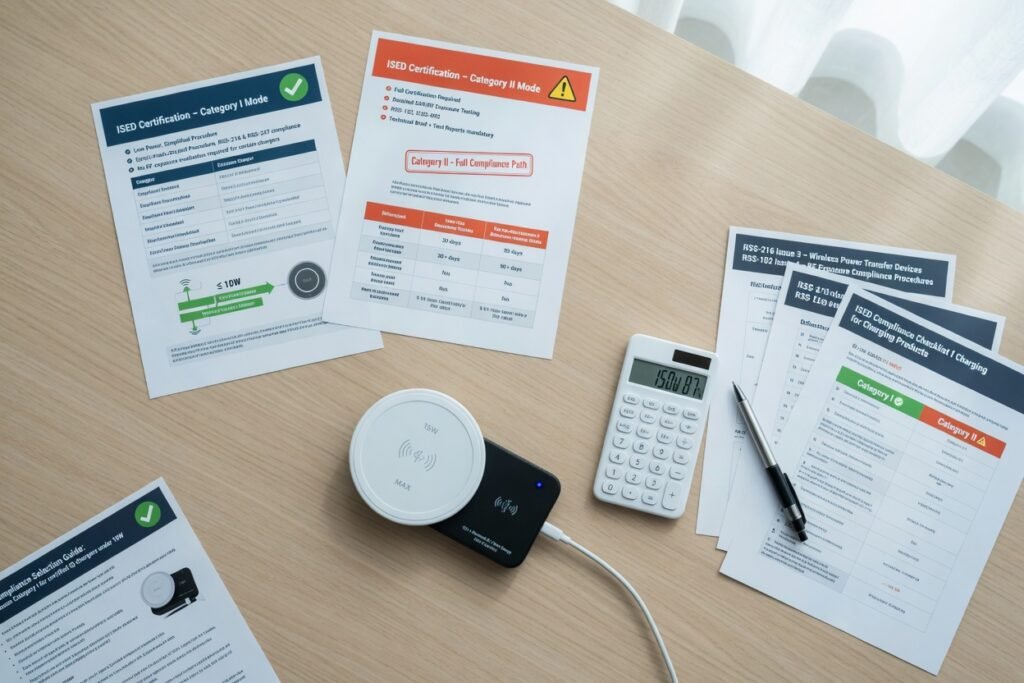
For easy comparison, we have organized the core differences between the two modes into a table:
| Comparison Item | Category II (SDoC Self-Declaration Mode) | Category I (Certification Mode) |
| Risk Level | Low | High |
| Third-Party Certification Issuance Requirement | No official certificate issuance required, keep materials for inspection by yourself | Requires review and certificate issuance by a CB recognized by ISED |
| Entered into REL Database | No | Yes, publicly searchable |
| Examples of Applicable Charging Products | Ordinary wireless chargers without additional communication transmission functions and complying with applicable RSS/ICES limits, low-power NFC charging accessories with only passive receiving function | Smart fast chargers with Bluetooth/Wi-Fi/cellular, high-power wireless charging stations, charging devices with App control |
| Cycle (with complete materials and one-time test pass) | 2-3 weeks | 4-6 weeks |
| Cost Reference | Several thousand RMB | 10,000 to tens of thousands of RMB |
Category II Mode (SDoC Self-Declaration)
Many people misunderstand it as “just say it’s qualified by yourself, no testing needed”, which is completely wrong. Its actual requirement is: low-risk wireless products do not need official certification, but must be tested by a qualified laboratory in accordance with the corresponding RSS standards. Enterprises must keep all test materials and declarations of conformity, and bear compliance responsibilities on their own. If you are subject to regulatory random inspections later, you need to be able to produce complete compliance materials, otherwise you will still be punished.
Scenarios suitable for charging products are mainly low-risk, simple-function wireless products, such as ordinary wireless charging pads without additional communication transmission functions such as Bluetooth/Wi-Fi and complying with the corresponding RSS/ICES limit requirements, as well as low-power NFC charging accessories that only have passive receiving functions and do not actively transmit wireless signals. If the NFC function involves 13.56MHz active transmission, it needs to be re-evaluated and classified according to the corresponding RSS standards, and cannot be directly classified as Category II.
Category I Mode (Certification Mode)
It targets higher-risk wireless products. Testing must be completed by an ISED-recognized laboratory, then submitted to an ISED-authorized CB for review. After passing, an IC ID is issued, and product information is entered into the REL database for public search.
Scenarios suitable for charging products include: smart fast chargers with Bluetooth, Wi-Fi, cellular networks, high-power wireless charging stations, charging devices with App control, outdoor power supplies with cellular modules, etc. — because such products have more complex wireless functions and higher transmission power, supervision is stricter.
Reuse Rules for Certified Wireless Modules
If you are making a smart fast charger with Bluetooth and Wi-Fi that uses an off-the-shelf wireless module that has obtained ISED certification, you can simplify the RF test items of the whole machine, saving time and cost. But there are several strict prerequisites for reuse:
First, you cannot modify any parameters of the module, such as transmission power and operating frequency band;
Second, you cannot replace the antenna type of the module. For example, if the module was originally equipped with an FPC antenna, you cannot replace it with a ceramic antenna;
Third, the use scenario of the whole machine cannot exceed the original certification scope of the module. For example, if the module is certified for consumer products, you cannot use it in industrial-grade equipment.
Here we must specially remind a common misunderstanding: a module with ISED certification does not mean that the whole machine is automatically compliant. Because the module is installed in the whole machine, for example, in a metal charger shell, or too close to the charging circuit, it may affect the RF performance, causing the radiation of the whole machine to exceed the standard. Therefore, even if you use a certified module, you still need to do an RF evaluation of the whole machine, and you cannot use it directly.
3-Step Method for Mode Selection for Charging Products
Following this method will basically not go wrong:
Step 1: First confirm whether the product has wireless/RF transmission or wireless energy transmission — if not, you don’t need to apply for ISED at all, don’t waste money.
Step 2: Initially match the mode according to the wireless type, transmission power, frequency band used, and equipment category — if you are not sure, you can find a formal certification service provider for pre-evaluation.
Step 3: Supplement compliance materials in combination with the requirements of sales channels — some e-commerce platforms or importers may put forward compliance certification requirements higher than the basic regulatory requirements. At this time, you should first confirm whether the product belongs to the equipment category that can apply for Category I certification; if the product itself only meets the applicable scope of Category II, you can provide the channel with compliance materials such as test reports issued by qualified laboratories, declarations of conformity, and Canadian local representative information, and you cannot arbitrarily upgrade Category II products to Category I applications.
Conditions for Changing Certification Mode
If your product is adjusted, it may cause the original certification mode to no longer apply. There are several common situations:
• Added wireless functions such as Bluetooth, Wi-Fi, cellular: products that originally did not need ISED now need to apply.
• Increased wireless transmission power, added used frequency bands, replaced antennas: may be upgraded from Category II to Category I, which needs to be re-evaluated in combination with applicable standards.
• Replaced a wireless module without ISED certification: will increase test items, and the application path will also change.
• Increased compliance requirements of platforms or importers: you need to first check the product’s own equipment classification and applicable standards. If it meets the Category I application conditions, you can submit a supplementary application; if it only applies to Category II, you should provide complete self-declaration compliance materials to meet channel requirements, and you cannot arbitrarily change the certification mode.
Mode Reference for Typical Charging Product Scenarios
You can directly match your situation (the final classification needs to be determined in combination with applicable RSS standards, and charging power cannot be the only basis):
Scenario 1: Ordinary USB-C power adapter without any wireless function → No need for ISED certification.
Scenario 2: Ordinary wireless charging pad of 15W and below, without additional communication functions such as Bluetooth/Wi-Fi, and whose operating frequency and field strength meet the corresponding low-risk standard requirements → usually evaluated according to Category II mode, and the final result is subject to the applicable RSS standards, power and field strength test results.
Scenario 3: 65W smart fast charger with Bluetooth App control → Category I mode.
Scenario 4: Multi-port wireless charging station with Wi-Fi + Bluetooth → Category I mode. If the wireless module used already has ISED certification, some tests can be simplified.
Scenario 5: Outdoor power supply with cellular module → Category I mode, and additional RF exposure (that is, radiation safety when in contact with the human body) evaluation is required.
3. Preparations Before ISED Certification Application (Exclusive for Charging Products)
After confirming that you need to apply, making preparations in advance can save you a lot of detours. Let’s first talk about three necessary prerequisites:
First, the product side: the wireless function must work normally, and there must be a complete product parameter specification, which contains key information such as charging parameters, wireless power, chip/module model — applying with an engineering prototype and incomplete parameters will definitely waste time.
Second, the entity side: you need to implement a Canadian local representative according to the requirements of the certification mode, responsible for cooperating with the inspection of regulatory authorities — without a qualified local representative, Category I applications cannot be submitted at all.
Third, the material side: prepare product appearance drawings, label drafts, and wireless module certification certificates (if certified modules are used) in advance.
Here we uniformly clarify two core requirements that run through the entire process, which will not be repeated in subsequent steps: First, the software and hardware versions of the samples submitted for testing must be exactly the same as the final mass-produced version. Don’t use engineering prototypes for testing. If the circuit or software is changed during mass production, the previous tests will be in vain; second, the more complete the parameters provided, the smaller the deviation of evaluation and testing. Don’t only provide the brief parameters on the promotional page.
Exclusive Material List for Charging Products
These are the contents that charging products need to pay more attention to than ordinary wireless products:
• Charging related: input and output voltage and current, USB-C/PD protocol parameters, rated power of wireless charger, number of coils — these parameters will directly affect the results of RF tests, and must be provided completely and accurately.
• Wireless related: operating frequency band, communication protocol (such as Bluetooth 5.3, Wi-Fi 6), antenna form, module model and corresponding ISED certification number (if any).
• Structure related: product appearance and internal photos, label position diagram. If it is a series of models, a description of the differences between different models must be provided.
• Version related: software and hardware versions must be consistent with the final mass-produced version.
Choosing a Reliable Certification Service Provider
This is the place where beginner sellers are most likely to fall into pitfalls. There is only one core judgment criterion: it must have ISED-recognized testing or certification qualifications — reports issued by unqualified institutions are not recognized by ISED at all, and the money spent is wasted.
For charging products, there is a small selection tip: prioritize service providers with experience in similar projects such as wireless chargers and smart fast chargers. They are familiar with the test focuses and common problems of charging products, and can help you avoid many pitfalls in advance, which is much more efficient than general service providers that do everything.
Pitfall avoidance reminder: Never believe false propaganda such as “guaranteed pass” or “get certificate in 3 days”. Formal ISED certification has fixed testing and review processes. If the test fails, you need to rectify and retest. It is impossible to guarantee 100% pass, let alone get the certificate in a few days — those who say this are basically scammers.
Cost-saving tip: If you need to apply for certifications in multiple regions such as FCC, ISED, and CE at the same time, you can ask the service provider to formulate a unified test plan. Many RF test items can share data, which can reduce repeated testing, saving both time and cost.
The Importance of Pre-Evaluation
Many sellers find it troublesome to skip pre-evaluation, and end up suffering big losses later. Pre-evaluation is to send product parameters, label design, module qualifications and other materials to the service provider before formal testing, to check compliance in advance. For charging products, the focus of pre-evaluation is: whether the transmission characteristics of the wireless charger meet the corresponding standard limits, and whether the electromagnetic interference during charging operation is within a reasonable range.
The role of pre-evaluation is very practical: discover potential problems in advance, such as high power and large circuit interference, and rectify them in advance, instead of finding them during formal testing, which will cost rectification fees and extend the cycle.
4. Standard ISED Certification Application Process (By Mode)
Process Overview and Cycle Influencing Factors
No matter which mode, the core process is actually five steps: product evaluation → sample testing → material organization → review/filing → certification/compliance. The overall cycle generally ranges from 2 to 8 weeks, which is specifically affected by three factors: the selected certification mode (Category II is faster than Category I), whether the test can be passed at one time, and whether the materials are complete and accurate.
You can avoid the three most common reasons for extending the cycle of charging products in advance: unqualified transmission parameters of wireless chargers, non-compliant electromagnetic interference during charging, and incomplete or incorrect submitted materials.
Step 1: Product Evaluation and Mode Confirmation
The core action is to send the complete product parameters and materials to the service provider, so that they can evaluate the corresponding certification mode, cost and cycle.
Three points must be checked in this step: whether the qualification of the Canadian local representative meets the requirements, whether there are certified modules that can be reused, and which RSS test standard the product applies to.
Evaluation deviations caused by incomplete parameters are common. For example, a product that is originally Category I is quoted according to Category II, and later you have to pay extra money and do extra tests. Therefore, you must provide a complete specification.
Step 2: Sample Testing (Exclusive Notes for Charging Products)
Testing must be completed by an ISED-recognized laboratory — even for Category II self-declaration mode, you cannot test casually by yourself. You must have an official test report issued by a qualified laboratory, otherwise it will not be recognized during random inspections.
There are four common test items for charging products:
1. Basic RF indicators: such as transmission power, operating frequency band, spurious radiation, etc., to see if they meet the RSS standard requirements.
2. Interference characteristics under charging state: ISED focuses on whether the conducted interference, radiated interference, spurious emission, out-of-band emission, etc. generated by the product under charging operation meet the applicable standard requirements, so as to avoid interference with other protected communication and broadcasting frequency bands.
3. Wireless charger power transmission compliance: for wireless charging products, check whether the frequency band and field strength of energy transmission meet the corresponding WPT-related standard requirements.
4. RF exposure evaluation for high-power products: for example, high-power wireless charging stations and outdoor power supplies with cellular modules need to test the radiation dose when in contact with the human body to ensure it is within a safe range.
If the test fails, rectification is required — such as lowering the transmission power, adding shielding to the circuit, optimizing the PCB layout, etc. After the rectification is completed, retesting will increase the cycle and cost, so pre-evaluation in advance is very important.
Test samples must meet the mass production version requirements specified above. If core parameters are changed later, re-evaluation is required.
Step 3: Material Organization and Submission
General necessary materials include: official test report, product specification, Canadian local representative information, declaration of conformity.
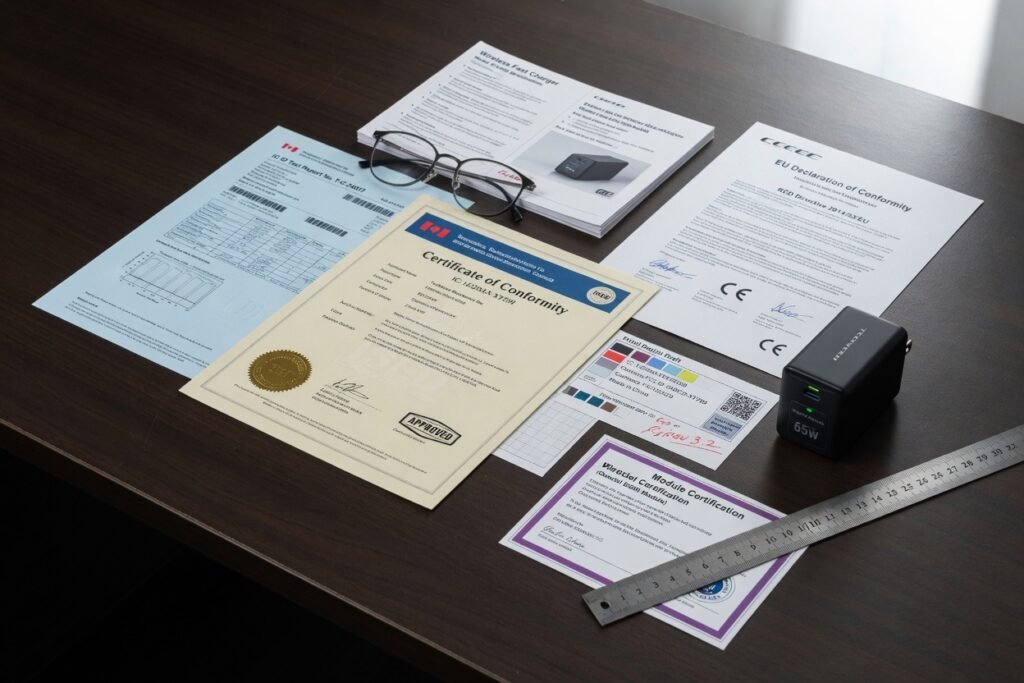
The difference between the two modes is: Category II materials do not need to be submitted to the official, and enterprises can keep them for inspection by themselves; Category I materials need to be submitted to the ISED-recognized CB for review.
Special attention should be paid to charging products: the charging parameters and use scenarios of wireless functions must be clearly marked in the materials, and must be completely consistent with the actual product — for example, if the material says it is an ordinary low-power wireless charger, but the actual sample has Bluetooth communication function, it will definitely be rejected.
Step 4: Review and Certification/Filing
The review processes of the two modes are completely different:
Category II mode: There is no official review process. After the enterprise signs the declaration of conformity, it can be officially listed for sale. All materials should be kept well and wait for random inspection.
Category I mode: The CB will check the submitted test report and all materials. If there are no problems with the materials, the review can generally be passed in 1-2 weeks and the IC ID can be obtained.
There are several common reasons for rejection: incomplete test items, non-compliant label design, inconsistent product parameters, and errors in materials.
After getting the IC ID, you can print the number on the product label and officially put it on sale.
Certification Validity Period Description
Many people ask how long the certification is valid? The general rule is: as long as the product parameters do not change and the corresponding ISED standards are not updated, the certification is valid for a long time.
But there are two exceptions: if ISED updates the relevant RSS test standards, or if the product undergoes major changes, re-evaluation or even re-certification is required.
5. Labeling and Market Compliance Requirements for Charging Products
Getting the certification is only the first step. The labels, manuals, and packaging after listing must also meet the requirements, otherwise it will still be considered non-compliant if found.
Product Label Requirements
Required information: For Category I products, the IC ID number must be marked on the label.
Label position: It is preferred to print on the product body, such as the bottom of the charger, the back of the wireless charger; if the product is too small (such as a mini wireless charger), it can also be printed on the packaging or manual.
Precautions: The label must be clear, wear-resistant, and not easy to fall off. You must never use the IC ID of other companies, nor use the IC ID of the wireless module to replace the IC ID of the whole machine — the module’s certificate is for the module. If the whole machine is Category I, it must have its own independent number.
Manual and Packaging Compliance Requirements
The manual must contain three contents: Canadian local interference statement, restrictions on the use of wireless functions, and if it is a high-power product, the RF safety distance (such as how many centimeters away from the human body during use) must also be marked.
Packaging requirements: For small-volume products, the IC ID or compliance statement can be marked on the outer packaging.
Language requirements: The compliance statement specified by ISED must use the official recognized standard text; when selling to Canadian consumers, it is also necessary to simultaneously check the federal and provincial language and labeling regulatory requirements. If the product is sold in French-speaking provinces such as Quebec, the necessity of French labeling must be evaluated in accordance with local regulations, and it cannot be assumed that English alone can cover all sales scenarios.
It should be noted that the content of the statement must match the real function of the product. Don’t just find a template and copy it — for example, if your product only has Bluetooth, don’t copy the statement template with cellular function, otherwise there will be problems if found.
Labeling Rules for Products with Certified Modules
If your whole machine uses a certified wireless module, you can mark “Contains IC: [Module IC ID]” on the outside of the whole machine, provided that the module’s certification certificate allows this installation method.
If the module is installed inside the product and the module number cannot be seen from the outside, you need to supplement the module’s certification information in the outer packaging or manual.
The brand owner of the whole machine must keep the module’s certification certificate and the RF evaluation record of the whole machine, and be able to produce them when subject to random inspection.
Compliance Risks in the Sales Process
Many sellers think that getting the certificate means everything is fine, but in fact there is still a risk of random inspection after listing:
• Customs inspection: When the goods arrive at the port, Canada Customs may conduct random inspections. Products without certification or with non-compliant labels will be detained, returned, or even fined.
• Platform random inspection: E-commerce platforms such as Amazon conduct random inspections from time to time, and non-compliant products will be directly removed from the shelves, and even accounts will be frozen.
The basis for regulatory authorities’ verification is the records of ISED’s REL database and the compliance materials kept by enterprises — so even for Category II mode, the materials must be kept well and not lost.
6. Post-Certification Change and Maintenance Rules
After the product is launched, it is inevitable to make some adjustments, such as changing the shell, modifying parameters, and changing suppliers. At this time, which changes require re-certification and which do not? We divide them into two categories according to common situations of charging products:
Changes Requiring Re-Certification/Evaluation (Common for Charging Products)
As long as one of them is met, re-evaluation is required:
• Wireless related: replacing wireless chips/modules, adjusting wireless transmission power, adding wireless functions, replacing antenna types — these directly affect RF performance and must be re-evaluated.
• Charging related: adjusting wireless charging power, changing coil structure or operating frequency — wireless chargers usually transmit wireless power through magnetic induction/magnetic resonance, and still need to meet ISED’s relevant requirements on wireless power transmission (WPT), interference control and RF exposure. Such changes will directly affect compliance judgment and require re-evaluation.
• Software related: software updates that change RF parameters, or modify regional restrictions (for example, originally only supported Canadian frequency bands, now added other countries’) — re-evaluation is required.
• Structure related: replacing metal shell material, adjusting antenna position — these will change the RF transmission and reception performance, and require re-evaluation.
Changes That Do Not Require Re-Certification (Only Need to Keep Records)
• Appearance related: changing shell color, replacing silk screen that has nothing to do with RF, adjusting packaging design — these do not affect wireless performance.
• Charging related: replacing the brand of charging interface of the same specification, adjusting the length of the cable but not affecting the wireless function — for example, replacing the USB-C interface from brand A to brand B with the same parameters, as long as the electrical parameters remain unchanged, there is no problem.
• Supply chain related: supplier replacement of the same specification, with key wireless and charging parameters completely consistent — for example, if the foundry is changed, but all parts, circuits, and software are the same as before, re-certification is not required.
Shared Rules for Series Models
Many sellers make series products, such as fast chargers with different colors and different numbers of interfaces. Can they share one ISED certification?
The premise for sharing is that the key RF parameters, charging parameters, and structural layout are substantially the same. At the same time, it is necessary to clearly state the similarities and differences between the series models in the certification materials, such as “only the shell color is different, and the wireless and charging parameters are completely consistent”.
Situations where sharing is not allowed: different wireless modules, different wireless power, and differences in charging power that affect RF performance — in these cases, separate certifications are required, and one IC ID cannot be shared.
Materials to Prepare for Post-Listing Random Inspections
You can organize them in advance:
• If it is Category I mode: prepare ISED certificate, test report, model difference description, product label and manual.
• If it is Category II mode: prepare test report, declaration of conformity, Canadian local representative information.
• If a certified wireless module is used: add the module’s certification certificate and the whole machine’s evaluation record.
7. Practical Pitfall Avoidance Guide for ISED Certification of Charging Products
Finally, we have sorted out several most frequent pitfalls for charging products, which can save a lot of time and money if avoided in advance:
Pitfall Avoidance for Mode Selection
Don’t blindly choose the highest level of certification. Many sellers choose Category I for all products for the sake of safety, but it is completely unnecessary. As long as the product meets the requirements of Category II and the channel has no special requirements, Category II is sufficient and can save a lot of money. If the channel has additional requirements, prioritize meeting them by supplementing compliance materials, and do not arbitrarily upgrade the certification mode.
Pitfall Avoidance for Application Preparation
Pitfall 1: Applying without confirming the wireless parameters clearly in advance. For example, not knowing the wireless transmission characteristics, operating frequency band or superimposed communication functions of the product, leading to wrong mode evaluation. Originally, Category I was required, but prepared according to Category II, and later need to supplement tests and materials, wasting time.
Pitfall 2: Choosing a wireless module without ISED certification. Using uncertified modules will increase many test items, which not only costs more but also takes longer. As long as the cost difference is not too big, it is more cost-effective to prioritize modules that already have ISED certification.
Pitfall 3: Not implementing a Canadian local representative in advance. Category I applications must have a qualified local representative as the regulatory liaison. Don’t wait until you need to submit materials to find one temporarily, which will easily delay the launch time.
Pitfall Avoidance for Testing (Exclusive for Charging Products)
Pitfall 1: The transmission parameters of the wireless charger exceed the standard. Many sellers make the wireless charger power higher than the nominal for promotional effect, and as a result, it does not meet the limit requirements during testing and needs rectification. Debugging the power parameters in advance and doing a pre-test can avoid this problem.
Pitfall 2: Excessive electromagnetic interference during charging. Especially for high-power fast chargers, the circuit interference will be relatively large in the fast charging state, and it is easy to fail the interference-related tests. Optimizing the circuit design in advance, or adding shielding to sensitive parts, can reduce a lot of retesting troubles.
Pitfall 3: The test sample is inconsistent with the mass production version. This requirement has been clarified in the pre-application preparations. If engineering prototypes are used for testing and core parameters are changed after mass production, the certification will be directly invalidated. Be sure to lock the mass production version before sending for testing.
Pitfall Avoidance for Market Compliance
Pitfall 1: The label position or content does not meet the requirements. For example, the IC ID is printed too small, blurry, or the module’s IC ID is used to replace the whole machine’s, which is easy to be rejected or fail the random inspection. Designing the label in accordance with ISED requirements in advance and asking the service provider to review it can avoid this.
Pitfall 2: Series models share certificates arbitrarily. For example, two models use different wireless modules but share one IC ID, which will be directly deemed non-compliant if found. Be sure to confirm that the differences are within the allowable range, and keep the formal difference description well.
Summary
After reading this article, you should have mastered the core capabilities of ISED certification for charging products: you can judge whether your product needs ISED certification, you can initially match the appropriate certification mode through the 3-step method to control costs, you can sort out the core application steps and necessary materials to prepare in advance, you can judge whether product changes require re-certification, and you can also avoid most frequent pitfalls and shorten the certification cycle.
If you are unsure about the certification mode and compliance requirements of a specific product, the safest way is to find a laboratory or certification service agency with ISED-recognized qualifications for pre-evaluation, and provide complete product parameters, and you can basically get an accurate judgment conclusion.