
Most practitioners working with charging products for the Canadian market will come across the concept of “ISED radio frequency testing”. Many novices tend to confuse its scope of application: they either think that only products with WiFi need compliance, or apply the same testing requirements to all charging products, which eventually leads to problems in customs clearance and platform review. In fact, ISED has different compliance paths for radio equipment, interference-causing equipment, and spectrum use. Whether testing is required, and whether to go through certification or self-declaration, requires comprehensive judgment based on product functions, operating frequencies, applicable standards, and exemption clauses. This article focuses on consumer electronic charging products, and explains the core ISED RF-related requirements clearly, from basic concepts to practical judgment and pitfall avoidance.
Basic Concepts and Regulatory Boundaries
First, clarify several core concepts, so that the subsequent rules will be easier to understand.
First is ISED, whose full name is Innovation, Science and Economic Development Canada. It is the official agency in Canada responsible for radio spectrum allocation and electromagnetic interference regulation of electronic equipment. Its core responsibility is to control all devices that emit wireless signals or electromagnetic noise, to prevent them from occupying frequency bands indiscriminately and interfering with the normal operation of other devices.
Second is “radio frequency (RF)”. Many people confuse it with dangerous ionizing radiation, but the two are completely different. WiFi, Bluetooth, mobile phone signals, broadcast signals, and even the energy used by wireless chargers to transmit electric power that people come into contact with daily all fall into the RF category. In essence, RF is high-frequency electromagnetic energy that transmits wireless signals or energy. Conventional ISED RF testing does not focus on “whether it will harm the body” (this falls under the category of RF exposure assessment, which will be explained separately later), but on “whether it will interfere with the normal operation of other wireless devices”.
For charging products, the core logic of RF-related compliance can be summarized in three points: products that actively emit RF must use permitted frequency bands, their transmission power must not exceed the specified upper limit, and abnormal leakage in non-operating frequency bands must be controlled within the limit values.
Two Types of Reasons for Charging Products to Be Subject to Testing
There are two main types of situations why charging products are subject to ISED regulation, corresponding to different compliance rules:
One category is intentional emission products, that is, devices that actively emit RF energy to realize their functions. For example, wireless chargers rely on RF energy to transmit power, and smart chargers with WiFi/Bluetooth rely on RF to realize communication. Such devices fall under the regulatory scope of radio equipment, corresponding to the RSS series of standards.
The other category is unintentional emission products, which do not have wireless transmission functions themselves, but may accidentally leak RF noise due to high-frequency operation of circuits during work. For example, high-power fast chargers with digital control and charging docks with high-speed data interfaces may interfere with surrounding WiFi, radios and other devices if the noise exceeds the standard. Such products fall under the regulatory scope of interference-causing equipment, corresponding to the ICES series of standards.
If non-compliant, products may face risks such as customs detention, removal from e-commerce platforms, and recall of sold products. The specific degree of penalty depends on the circumstances of the violation and regulatory requirements.
Several Types of Certifications That Are Easily Confused
People who are new to this field easily confuse ISED with other certifications. Here we clarify the boundaries of each:
The first category is the difference from the US FCC. The two have similar regulatory ideas, both covering wireless compliance and electromagnetic interference, but there are differences in specific limit requirements, labeling rules, application processes, and standard versions. FCC reports and certifications cannot replace ISED, and products sold to Canada need to complete the corresponding compliance process separately.
The second category is the difference from safety compliance. ISED RF/interference compliance focuses on “whether it will interfere with other devices”, while electrical safety focuses on “whether it will cause electric shock, fire, or safety accidents”. The two belong to completely independent regulatory categories and do not include each other. The electrical safety requirements for the Canadian market need to be confirmed according to product category, power supply method, and sales province. CSA and UL are common safety certification bodies, but not all charging products require mandatory third-party safety certification.
The third category is the difference from ordinary EMC (Electromagnetic Compatibility). EMC is a broader concept, which includes both the interference emitted by the device (emission side) and the ability of the device to resist external interference (immunity). The RF-related requirements of ISED are Canada-specific compliance rules, which only focus on the emission side, that is, whether the electromagnetic energy leaked by the product will interfere with other devices, and do not cover immunity requirements.
Quickly Determine Which Category Your Product Belongs To
After understanding the basic concepts, the most practical thing is to quickly determine whether the charging product in hand needs RF-related compliance and which category it belongs to. Note: The compliance requirements for charging products cannot be applied uniformly based on fixed power or interface version. They need to be comprehensively judged in combination with functions, circuit types, and applicable standards. The following is the general judgment logic.
| Comparison Dimension | Intentional Emission Category | Unintentional Emission Category |
| Core Feature | Actively emits RF energy to realize functions (power transmission or communication) | No wireless transmission function, accidentally leaks RF noise during operation |
| Typical Charging Products | Wireless chargers, smart charging devices with WiFi/Bluetooth/Zigbee | Fast chargers with digital control, charging expansion products with high-speed data interfaces |
| Applicable Standard System | RSS series (Canadian radio equipment standards) | ICES series (Canadian interference-causing equipment standards) |
| Core of Compliance | Verify that the frequency band, power, and leakage of the wireless function itself meet the requirements | Verify that the accidentally leaked electromagnetic noise does not exceed the limit values |
Core Steps for Judgment
You can make a quick preliminary judgment in three steps, and consult a professional agency for complex situations:
Step 1: Check whether there is an active RF transmission function. As long as the product is a wireless charger, or has a built-in wireless communication module such as WiFi, Bluetooth, or Zigbee, regardless of whether the function is advertised externally, it falls into the intentional emission category, and compliance requirements need to be evaluated against the RSS series of standards or wireless power transmission rules. The power supply method does not affect the category — wireless chargers powered by wall plugs, car chargers, or power banks all belong to the intentional emission category.
Step 2: If there is no active wireless function, then check whether it is a digital device regulated by ICES. Judgment needs to be made based on several dimensions: whether there is a digital control circuit, the operating frequency range of the switching power supply, whether there is a high-speed data transmission interface, and the product power supply form. Then compare with the applicable scope and exemption clauses of the corresponding ICES standard to confirm whether unintentional emission testing is required. A conclusion cannot be drawn directly based solely on power level or interface type.
Step 3: If you are unsure (for example, the product has complex functions and is just on the boundary of the standard), the safest way is to check against ISED’s official product classification list, or consult a third-party laboratory accredited by ISED, and do not make a judgment on your own.
For quick comparison, here is a reference scope of common products that require testing in the charging category — note that this is only an empirical list, and cannot be applied uniformly based solely on power or interface type. The final judgment still needs to be combined with the scope clauses of applicable standards:
• Reference for mandatory testing of intentional emission category: All types of wireless chargers, charging devices with wireless communication functions such as WiFi/Bluetooth/Zigbee, and smart charging products with App remote control or data synchronization
• Reference for mandatory testing of unintentional emission category: 65W and above high-power wired fast chargers, charging docks/multifunctional expansion products with high-speed data transmission interfaces
Among them, 65W is not a legal mandatory threshold, but just a common reference line for high-power fast chargers in the industry. If the product has complex digital circuits and high-speed signal ports, it may need to be included in the evaluation even if the power is lower than 65W; conversely, some high-power products with simple structures may not require separate testing if they meet the exemption clauses. The final result shall be subject to the applicable scope of the ICES standard.
Description of Common Boundary Products
Several types of products are prone to misjudgment, so special explanations are provided:
• Wireless chargers: They belong to Wireless Power Transfer (WPT) devices, and essentially actively emit RF energy, so they fall under the regulatory scope of intentional emission. However, the applicable rules are different from those of ordinary wireless communication devices (such as WiFi and Bluetooth). Common Qi wireless chargers operate in the range of 100-200kHz. Different solutions have different operating frequencies and powers, and corresponding compliance requirements also vary. Test items for wireless communication devices cannot be directly applied.
• Complete machines using certified wireless modules: The ISED certification of the module only covers the independent operating state of the module itself. After being installed in the complete machine, the shell material, coil/antenna installation position, power supply circuit noise, and surrounding component layout will all change the RF performance. Therefore, the complete machine still needs to complete the corresponding compliance evaluation, and the module certification cannot directly replace the compliance of the complete machine.
• Products with built-in unadvertised wireless modules: As long as the product has a built-in WiFi, Bluetooth or other RF communication module in hardware, even if the function is not advertised on the sales page, the function is turned off by default, or is locked and not enabled through firmware, it is necessary to first evaluate whether the hardware of the module has transmission capability, whether the frequency band and power for the Canadian region are locked in the firmware, and whether the complete machine integration will change the RF performance. You cannot judge that compliance is unnecessary solely based on “unadvertised function”. Otherwise, if a transmissible RF module is detected during platform review or import spot check, it will still be judged as non-compliant.
• Products that usually do not require separate RF testing: Ordinary wired slow chargers of 18W and below without complex digital circuits, multi-port chargers without wireless functions and with simple circuit structures, ordinary charging cables, pure conversion travel plugs, and passive charging bases without circuits. Such products usually do not need to go through a separate formal RF testing process, but still need to meet basic electromagnetic interference requirements and must not cause harmful interference to other devices. The final exemption shall be subject to the scope of applicable ICES/RSS standards and the judgment of the laboratory.
Rules You Must Know Before Testing
After confirming that testing is required, the pre-test preparation and rules directly affect the validity of the results. If you do not follow the requirements, the test may not be recognized even if you do it.
Requirements for Test Samples
The test samples must be final finished products in mass production state, and unshaped engineering prototypes cannot be used. Otherwise, the test results cannot represent the real level of mass-produced products. They must be sent for testing with a full set of original accessories actually sold (such as charging cables and plugs), because the shielding performance and length of the accessories will affect the RF test results. For wireless charger products, loads must be configured according to the requirements of applicable standards to simulate the typical/worst operating state in real use. The specific load specifications and test modes shall be determined by the corresponding standards and the laboratory’s test plan, and no-load testing is not allowed.
Test Environment and Qualification Requirements
The requirements for RF test sites and laboratory qualifications shall be determined according to the product’s compliance path and applicable standards: For devices that require ISED certification, the test must be performed by a laboratory that has obtained ISED accreditation (or accredited by a Canadian accreditation body). The test site (such as an anechoic chamber) must meet the requirements of the corresponding test method, which can not only block external wireless signals from interfering with the test, but also avoid product signal reflection affecting the accuracy of the results. The test power supply must be filtered according to standard requirements to eliminate the impact of inherent noise in the power grid on test results. Environmental conditions such as temperature and humidity must meet the provisions of applicable standards to ensure that the product can work stably in the rated state and that the results are representative.
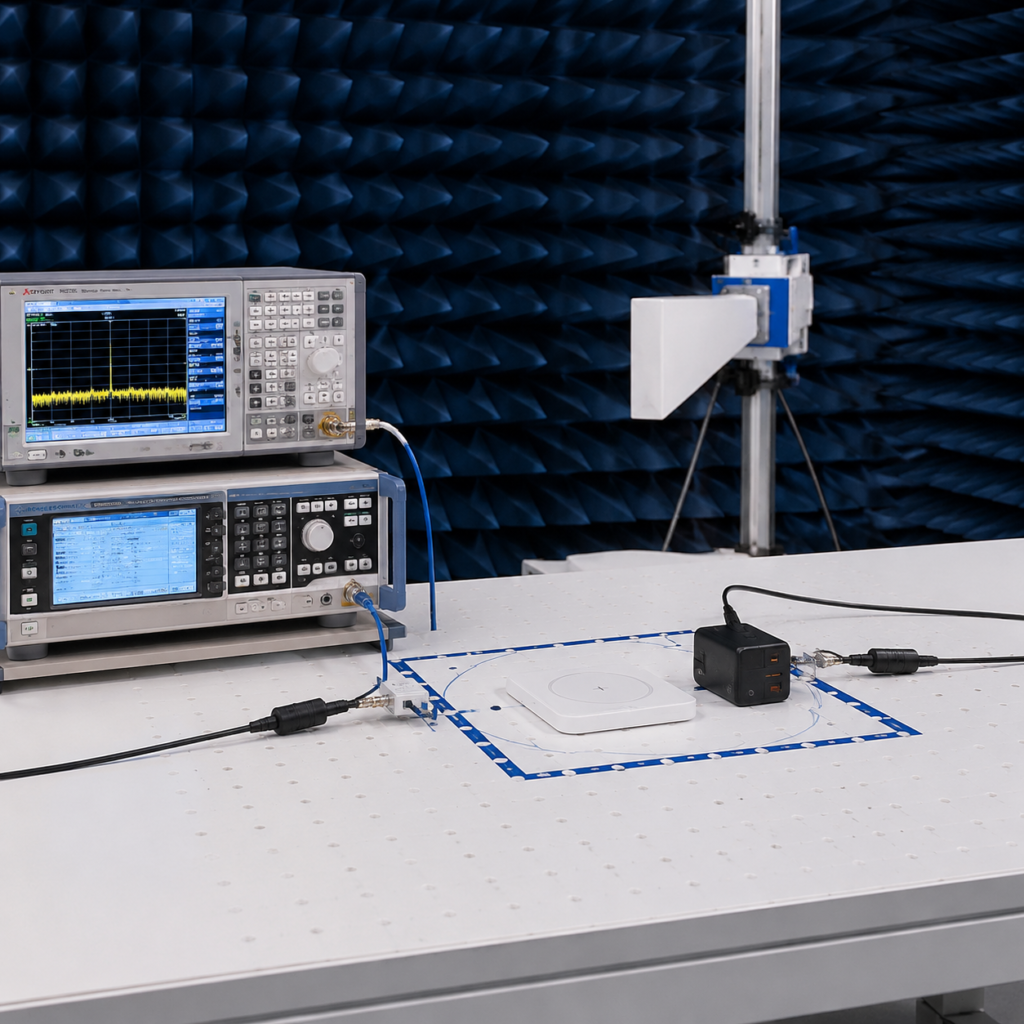
Even for interference-causing equipment or low-risk products that are subject to supplier self-declaration, a laboratory whose test site meets the requirements of standard methods, whose instruments and equipment are calibrated on schedule, and who has corresponding testing capabilities should be selected to issue the report. Otherwise, the report may not be accepted in platform review, customs spot check, or regulatory verification.
Worst-Case Test Principle
RF testing is not conducted when the product is in the best state, but must cover the “worst operating state” that is most likely to exceed the limit. In this way, after passing the test, there will be no problems in normal use. The worst state needs to be determined in combination with the product’s function matrix. Common requirements include: testing the product at the maximum rated output power; for products with multiple operating modes, it is necessary to evaluate which mode combinations will produce the maximum emission, and test single modes and high-risk combination modes respectively, rather than all modes must be turned on at the same time; wireless charger products need to be tested according to typical daily placement positions to simulate real use scenarios.
Key Variables Affecting Test Results
If you want to adjust in advance during the product selection or design stage to reduce compliance risks, you can remember four core influencing factors:
The first is the antenna/coil. For example, the gain of the transmitting coil of a wireless charger, whether the installation position is close to metal, and whether there is a shielding layer will directly affect the transmission power and the size of spurious signals.
The second is power supply and load. The input voltage range, load power level, and noise superposition when multiple ports output at the same time will all affect the final test results.
The third is software firmware. If the product has a region lock function, whether it will automatically adjust power and channels in different regions, whether the power calibration value in the firmware is accurate, and whether users are allowed to manually adjust transmission parameters, all of these will affect the compliance of transmission.
The fourth is the shell and cable. Whether the shell is plastic or metal, whether there is a built-in shielding layer, whether the charging cable has braided shielding, and what the length is, will all affect the radiation level of electromagnetic noise — for example, an unshielded charging cable is like an antenna, which will amplify and radiate the noise inside the charger.
Core Test Items and Requirements
The specific test items completely depend on the product type and applicable standards, and not all charging products need to test the same items. The following describes common test items in three categories and their corresponding applicable scenarios.
Common Test Items for Unintentional Emission Category (ICES Standards)
For unintentional emission charging products applicable to the ICES series of standards, the core test items usually include two categories. The specific ports, frequency bands, and limit values shall be subject to the applicable standards:
• Conducted Emission: Refers to the electromagnetic noise leaked by the product through conductive paths (such as AC power cords, DC output lines, and external cables). For example, noise at the AC power supply end will enter the power grid and interfere with other devices in the same power supply circuit. Insufficient filtering circuit design is a common cause of conducted emission exceeding the standard.
• Radiated Emission: Refers to the electromagnetic noise radiated by the product through the air, which may interfere with surrounding wireless devices such as radios and WiFi. The operating frequency of the switching power supply, PCB layout, and cable shielding performance will all affect the radiated emission level. The specific judgment shall be based on the test methods and limit values specified in the standards.
The limits of conducted and radiated emissions are usually divided by frequency band, test port, and equipment category/grade, and the requirements vary greatly under different applicable standards; some high-power or specific categories of devices may correspond to slightly relaxed limits or special test conditions. Limit requirements cannot be applied across standards, and the specific provisions shall be subject to the clear clauses of the corresponding ICES standard.
Common Test Items for Intentional Emission/Wireless Power Transfer Category (RSS Standards)
The test items for intentional emission products are determined by their wireless function type, operating frequency, applicable RSS standards or wireless power transmission rules, and not all products require all items.
Basic Test Items (applicable to most intentional emission devices, subject to specific standards)
• Operating frequency band compliance: The operating frequency of the product must fall within the corresponding license-exempt frequency band specified by ISED, and licensed frequency bands that require a license application must not be used. Different types of wireless functions (such as Bluetooth, WiFi, wireless power transfer) correspond to different permitted frequency bands, which need to be checked one by one.
• Transmission power limit: The maximum transmission power must not exceed the specified upper limit of the corresponding license-exempt frequency band/device type. The power definition (such as average power, peak power, Equivalent Isotropically Radiated Power (EIRP)) shall be specified by the applicable standard. Excessive power will interfere with the normal operation of other devices in the same frequency band.
• Occupied Bandwidth: The occupied bandwidth of the signal must meet the requirements of the corresponding standard, and must not exceed the specified range, so as to avoid occupying resources of adjacent frequency bands.
Advanced Assessment Items (only applicable when required by corresponding standards)
• Spurious Emission: In addition to the operating frequency band, the signal leaked by the product in other frequency bands must be lower than the specified limit to avoid interfering with devices in other frequency bands. For example, outside the operating frequency band of a wireless charger, too much noise cannot be leaked in the WiFi frequency band.
• Frequency Stability: When the input voltage and ambient temperature change within the range specified by the standard, the operating frequency of the product must be maintained within the allowable tolerance range, and must not shift outside the compliant frequency band.
• Adjacent Channel Power: The power of the signal leaked to adjacent channels must be lower than the limit to avoid interfering with other devices on adjacent channels. This item is usually applicable to wireless communication products with clear channel division, and is not necessarily required for ordinary wireless power transfer devices.
RF Exposure Assessment
Many people associate RF testing with “radiation harm”. In fact, conventional RF interference testing does not focus on the impact on the human body. What specifically manages this is RF exposure assessment, which evaluates whether the RF energy emitted by the product will affect human health, and is an independent compliance requirement.
For charging products, high-power wireless chargers used at close range, and smart chargers with wireless communication functions that are close to the human body during use may need to be evaluated in accordance with ISED’s RF exposure requirements. The logic for judging risk is simple: the lower the power of the product, the farther it is from the human body during use, the smaller the risk of exceeding the standard.
How to Read a Test Report
After getting the test report, you can’t just check whether there is a “PASS” at the end. You need to verify the validity and applicability of the report from multiple dimensions to avoid getting an invalid report that is not recognized.
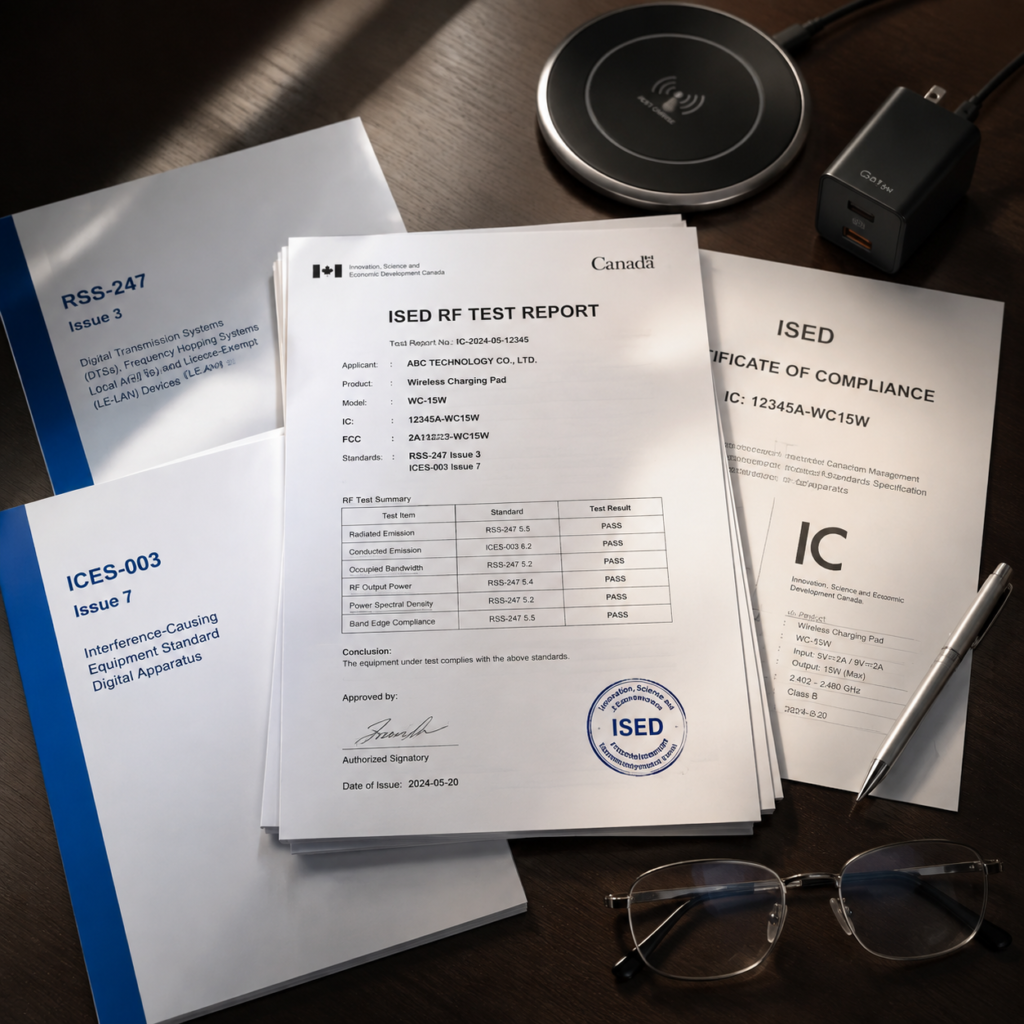
Verify Consistency of Product Identity and Configuration
The product model, brand, and hardware version on the report must be completely consistent with the actually sold products; core RF-related materials (such as wireless modules, antennas/coils, key filtering components, charging cable specifications) and firmware version must match the test configuration; if it is a series report covering multiple models, it is necessary to confirm that the RF-related circuits, modules, and layouts of all covered models are consistent, meet the requirements of series testing, and unrelated models cannot be randomly associated.
Confirm Applicable Standard Matching
The report must clearly indicate the product category, operating frequency, applicable standard number and version number. Intentional emission/wireless power transfer products should correspond to the RSS series of standards or wireless power transfer-related rules, and unintentional emission digital devices should correspond to the ICES series of standards; it is necessary to check whether the standard is applicable to your product type, and products in license-exempt frequency bands must not misuse standards for licensed frequency bands.
Reading Core Test Results
The results of all mandatory test items must be PASS for the overall product to be qualified. Different types of products can focus on the corresponding core items: for intentional emission category, focus on checking whether the operating frequency point, transmission power, and spurious emission meet the limits; for unintentional emission category, focus on checking the conducted emission and radiated emission results of each port.
In addition, you can refer to the test margin (the difference between the test value and the limit, unit: dB). The larger the margin, the lower the risk of exceeding the standard due to material fluctuations and process errors during mass production — for example, a product with a margin of 6dB has better compliance stability than a product with a margin of only 1dB.
Characteristics of Invalid Reports to Be Alert To
The following situations may cause the report to be unrecognized by ISED or the regulatory authority, and key investigations are required:
• There is an obvious difference between the test configuration and the mass production configuration, and the change evaluation procedure has not been implemented;
• The laboratory issuing the report has not obtained ISED accreditation for the corresponding test standard (for devices requiring certification);
• The test does not cover the worst operating state required by the applicable standard, and the test conditions are incomplete;
• The cited standard has expired and exceeded the transition period specified by ISED, or the standard does not match the product type at all.
Compliance Connection After Testing
After passing the test, subsequent procedures need to be completed according to the product’s compliance path before the product can be legally sold in Canada:
• If the product belongs to the intentional emission category and is applicable to the ISED certification path, it is necessary to apply for the corresponding certification number from ISED, and mark the product identification information and compliance statement on the product body, packaging, or user manual in accordance with the requirements of the applicable RSS standard. The content and position of the mark must comply with the corresponding rules.
• If the product belongs to the unintentional emission category or is applicable to the supplier self-declaration path, it is necessary to retain the complete test report, technical documents, and compliance statement in accordance with the requirements of the corresponding ICES or RSP specifications, in preparation for regulatory spot checks; some categories of products need to be marked with compliance marks as required.
• All compliance-related documents such as test reports, technical documents, and supplier statements must be retained for the period required by ISED, and must be provided in a timely manner when the regulatory department conducts spot checks.
Common Failure Causes and Pitfall Avoidance Methods
Many people will encounter pitfalls when doing ISED RF testing for the first time. In fact, common failure points are relatively concentrated, and most risks can be avoided by understanding them in advance.
Common Failure Points for Unintentional Emission Category
Unintentional emission devices such as wired fast chargers with digital circuits and charging expansion products are most prone to problems in the following areas:
• Insufficient filtering circuit design or poor material selection, leading to excessive conducted emission;
• Unreasonable PCB layout, such as too long high-frequency traces, insufficient spacing between high and low voltage circuits, and poor grounding design, leading to excessive radiated emission;
• Poor shielding performance of supporting cables will amplify the radiated noise of the circuit, leading to excessive radiated emission;
• For multi-port output products, when multiple ports work at full load at the same time, noise superposition leads to exceeding the standard.
Common Failure Points for Intentional Emission Category
Common failure points of intentional emission devices such as wireless chargers and smart chargers with wireless functions include:
• Poor coil/antenna matching or unreasonable installation position, leading to excessive spurious emission;
• Power calibration deviation, the actual maximum transmission power exceeds the standard limit;
• Insufficient isolation design between the wireless module and the power supply circuit, power supply noise couples into the wireless module, leading to increased spurious emission;
• When multiple operating modes run simultaneously, the noise of different circuits is superimposed, leading to excessive emission.
Early Pitfall Avoidance Methods
Most of these problems can be avoided in the early stage, and you don’t have to wait until the formal test to find them:
• When selecting core wireless components, prioritize wireless modules that have obtained ISED certification, and carefully check the module’s certification conditions, recommended antenna/coil specifications, installation restrictions, and firmware requirements, and evaluate the compliance risk after complete machine integration in advance; note that module certification cannot replace complete machine testing, it can only reduce the difficulty of compliance.
• Conduct pre-test before mass production to find out the risk of exceeding the standard in advance and make adjustments, to avoid time and cost losses caused by failure of formal testing.
• Do not randomly replace RF-related core materials (such as wireless modules, antennas/coils, key filtering components, PCB solutions) during the mass production stage. If replacement is necessary, the impact on RF performance must be re-evaluated, and re-testing shall be carried out if necessary.
• For products with smart functions, the operating frequency band and power upper limit allowed in Canada must be locked in the firmware to avoid non-compliance caused by user misadjustment.
Common Misconceptions and Compliance Boundaries
Common Cognitive Misconceptions
1. Misconception: Only products with wireless communication need to do ISED RF-related testing
Clarification: Products that transmit power through RF energy, such as wireless chargers, also fall into the intentional emission category and need to meet corresponding requirements; in addition, charging devices with digital circuits and high-speed data interfaces, if they fall within the regulatory scope of ICES standards, also need to conduct compliance assessment for unintentional emission, not only wireless communication products need it.
2. Misconception: FCC certification can replace ISED
Clarification: The US FCC and Canadian ISED are completely independent in regulation, with differences in limits, labeling, and application processes. FCC certification cannot replace ISED compliance. For detailed differences, please refer to the previous certification comparison content.
3. Misconception: If a certified wireless module is used, the complete machine does not need to do compliance testing
Clarification: Module certification only covers its own independent operating state. The shell, layout, power supply, etc. after the complete machine is integrated will change the RF performance, so the complete machine compliance evaluation still needs to be completed. For specific reasons, please refer to the previous boundary description.
4. Misconception: One test is valid for life
Clarification: The test results only correspond to the configuration and state at the time of testing. When the product is remodeled, core RF-related materials are replaced, or power is adjusted, re-evaluation or testing may be required. For specific judgment logic, please refer to the change retest rules later.
5. Misconception: Low-power wireless products do not need compliance
Clarification: As long as there is an active RF transmission function, regardless of the power level, it needs to meet the compliance requirements of the corresponding frequency band. It’s just that low-power products are usually easier to pass the test, not that they don’t need compliance.
Applicable Boundary Description
The requirements introduced in this article are only applicable to civilian consumer-grade charging products in the Canadian market. Charging products in industrial, medical, automotive and other fields have special regulatory rules and are not within this scope.
The content only covers products in license-exempt frequency bands. If the product uses frequency bands that require a license (such as cellular communication), a separate frequency band license application is required, and different compliance processes apply.
All test results and compliance certificates only correspond to the product configuration, firmware, and process at the time of testing. During mass production, they must be consistent with the test state, otherwise compliance may become invalid.
Judgment Logic for Retesting After Product Changes
When products are iterated or materials are adjusted, whether retesting is required needs to be judged according to the impact of the change on RF performance. Common situations are as follows:
• Changes that usually require retesting: Replacing wireless modules/antennas/coils, replacing power supply solutions/core PCBs, increasing rated power, replacing shell materials (such as plastic to metal), adding wireless functions — these changes will directly affect RF emission characteristics, and testing needs to be completed again.
• Changes that usually do not require retesting: Only changing the appearance color, brand packaging, silk-screened information, and without changing any RF-related circuits, materials, and firmware — such changes do not affect RF performance and do not require retesting.
• Boundary changes that require technical evaluation: Adjustment of the number of ports, change of cable specifications, adjustment of load specifications, firmware update involving frequency band/power parameters, adjustment of multi-port operating modes, etc. The impact of such changes on RF is uncertain, and needs to be evaluated by the laboratory or compliance engineer in combination with the margin of the original test report and the specific situation of the change. If necessary, partial or complete retesting shall be carried out, and it cannot be judged that retesting is unnecessary on your own.
After mastering the above content, you can quickly complete 5 core judgments: First, judge whether a charging product needs ISED RF-related compliance assessment, and whether it belongs to the intentional emission or unintentional emission category; second, clarify the sample preparation and basic rules before testing to ensure the validity of test results; third, after getting the test report, you can verify its validity and compliance; fourth, avoid common compliance risks in advance during the product selection and design stages; fifth, when the product is changed, you can initially judge whether re-evaluation or testing is required.
The core logic of ISED RF compliance is to ensure that charging products do not interfere with the normal operation of local wireless devices in Canada due to random RF signal emission or electromagnetic noise leakage. As long as you clarify the product classification, prepare in advance, and proceed according to the rules, compliance is not as complicated as imagined.