
Many cross-border sellers who deal with chargers and charging cables often assume that as long as they send samples for KC testing, they can smoothly obtain the certificate and list their products when first entering the Korean market. It is not until the certification body notifies them of a required factory inspection that they raise many questions: Isn’t testing samples enough? Why do you need to come to the factory for inspection? Will you inspect my other product lines? Do overseas factories also need to be inspected?
KC factory inspection is a core link in the KC safety certification system that directly affects certificate acquisition and maintenance. This article focuses on the compliance scenarios of charging products, explaining basic concepts, factory inspection demand judgment, key inspection points, process preparation, and risk avoidance one by one, to help everyone establish a clear compliance awareness.
First, Master the Basics: What is KC Factory Inspection
KC factory inspection is a factory compliance verification carried out by Korean designated certification bodies. Its core purpose is to confirm that mass-produced products maintain the same safety characteristics as the samples sent to the laboratory for testing and submitted to the body for filing. Simply put, it prevents the situation of “using the best materials for inspection samples but cutting corners on mass-produced goods” — for example, using copper core wires and safety capacitors for inspection samples, but replacing them with copper-clad aluminum and ordinary capacitors in mass production. This cannot be seen on the surface, but easily causes fire and electric shock risks during use. This checkpoint is to ensure product safety in the Korean market, and it is a mandatory, non-optional link for products applicable to the safety certification mode to obtain and maintain KC safety certification, which cannot be skipped.
It should be specially noted that factory inspection only targets products classified into the KC safety certification mode and for which the certification body explicitly requires factory inspection; products under safety confirmation and Supplier’s Declaration of Conformity (SDoC) categories usually do not undergo routine factory inspections, but still need to meet the corresponding mode’s requirements for document retention, labeling compliance, and market supervision.
Don’t Confuse: Boundaries and Common Differences of KC Factory Inspection
Many people mix up KC factory inspection with other audits when they first encounter it. In fact, its inspection boundary is very clear: it only covers sites, key safety components, quality control processes, and records related to the product applying for certification. As for whether the factory has ISO system certification, whether production capacity is sufficient, whether social responsibility audits have been conducted, and whether other product lines without KC certification are safe, none of these are within its inspection scope.
To help everyone distinguish faster, we have sorted out a comparison of several most easily confused audit types:
| Audit Type | Core Purpose | Coverage |
|---|---|---|
| KC Safety Factory Inspection | Verify consistency between mass-produced products and inspection samples | Only relevant sites, key components, quality control processes/records of certified products |
| KC Type Test | Verify the safety performance of a single sample | Only safety indicators of the submitted sample |
| Production consistency requirements in EMC compliance schemes (if explicitly required by the corresponding scheme) | Verify mass production consistency of electromagnetic compatibility | Only production and quality control processes required by the corresponding EMC compliance scheme |
| ISO System / Customer Factory Audit | Verify system or customer-specific requirements | Depends on standards / customer requirements, with a wider scope |
The above table is only a comparison of core differences. The most important point to clarify is: type test verifies the safety performance of a single sample, while factory inspection verifies the consistency between mass-produced products and filed samples. The two together constitute the core links of the KC safety certification mode (factory inspection required category); while the production consistency requirements in EMC compliance schemes follow independent rules and are not equivalent to KC safety certification factory inspection. Whether it needs to be carried out and the specific inspection content are subject to the corresponding EMC certification scheme and the written notice of the certification body.
Why Are Charging Products Often Given Key Attention?
If you operate products such as chargers and fast charging cables, you may feel that the relevant inspection requirements are more detailed. This is not targeted at a specific category, but determined by the safety attributes of the product. Charging products cover many categories, and the KC classification of different products varies greatly. Among them, products with mains input and built-in power conversion circuits have relatively prominent safety risks because they are directly exposed to high voltage; in addition, core power conversion components (transformers, safety capacitors, etc.) and core materials of fast charging cables are prone to replacement, and fast charging products have complex parameters that easily lead to inconsistency between labeling and actual conditions. Therefore, for charging products applicable to the safety certification mode, the inspection dimensions of factory inspection will be more detailed.
Whether a specific product falls within the key inspection scope shall be subject to the official catalog classification and the requirements of the certification body, and cannot be judged directly only by the product name or keywords such as “fast charging” and “charging”.
4 Common Cognitive Misconceptions for Beginners
People who are new to this field are prone to some wrong cognitions. Avoiding them in advance can save a lot of detours:
- “You can get the certificate after passing the sample test”: For safety certification products that require factory inspection, you must pass both the type test and the factory inspection to obtain the certificate; the certification process for other certification modes shall follow the corresponding rules.
- “Overseas factories do not need inspection”: As long as the product is applicable to the certification scheme requiring factory inspection, no matter which country/region the factory is located in, it must accept inspection. Only the inspection method may differ from that of local factories.
- “Pass once and it’s valid for life”: Products requiring factory inspection need to accept regular re-inspections as required after obtaining the certificate, and unqualified re-inspection may affect the validity of the certificate.
- “Low-risk products will never be inspected”: Even for products that do not require routine factory inspection, temporary inspections may be triggered in case of complaints, safety accidents, unqualified market spot checks, etc. There is no absolute exemption.
How to Quickly Judge Whether Your Product Needs Factory Inspection?
After understanding the basic concepts, the next thing everyone is most concerned about is: does my charging product need to accept factory inspection? KC factory inspection requirements are directly related to the certification mode applicable to the product. The electrical product compliance modes of Korean KC certification are mainly divided into three categories, which can be used for preliminary screening of factory inspection requirements:
The first category is safety certification: for electrical products with higher risk levels, the requirements are relatively strict, usually including sample testing, initial factory inspection, and regular factory inspection links, which is the category commonly referred to as “requiring factory inspection”. Specific requirements shall be subject to the corresponding certification scheme.
The second category is safety confirmation: for products with medium risk levels, the requirements of different subcategories vary greatly, and there is no unified process. Some take sample testing as the core requirement, usually do not arrange routine factory inspections, and inspections can be triggered under special circumstances.
The third category is Supplier’s Declaration of Conformity (SDoC for short): for products with lower risk levels, the supplier completes conformity confirmation in accordance with applicable Korean standards according to law, bears all compliance responsibilities, and needs to retain technical documents, test basis, production and sales records as required by regulations; whether designated laboratory testing, official filing, or follow-up inspection is required shall be implemented in accordance with the regulatory requirements corresponding to the specific product category, and the supplier shall not choose to evade statutory requirements on its own. Such products usually do not arrange routine factory inspections, but still need to accept market supervision, and temporary inspections can be triggered under special circumstances.
Which mode a product is specifically applicable to needs to be comprehensively judged in combination with multiple dimensions: product function, input/output mode and rated parameters, purpose, whether it is sold independently, whether it has a built-in power conversion circuit, etc., are all core judgment basis. For example, also called “charging cable”, an integrated cable with an AC plug and built-in power conversion circuit has a completely different applicable mode from a passive USB-C cable that only transmits electricity.
Reference for Factory Inspection Requirements of Common Charging Products
The following is only a preliminary direction reference, and the final classification shall be confirmed in accordance with the requirements of “Judgment Basis and Evidence Retention” later:
- Categories prioritized for inspection under the factory inspection required direction (mostly belonging to the safety certification category): wall-plug adapters with mains AC input and built-in power conversion circuit, PD fast chargers, integrated power conversion cables with AC plugs, high-power wireless chargers (the specific power threshold shall be subject to the official catalog); car charger products should be regarded as a category for priority verification of safety certification and routine factory inspection requirements, focusing on checking their on-board input attributes, built-in power conversion structure, rated input and output parameters, and whether they are sold independently. The final classification shall still be subject to the official catalog and confirmation by the certification body, and cannot be concluded directly only by the name “car charger”.
- Categories that usually do not require routine factory inspection (mostly belonging to safety confirmation / SDoC category): pure data USB cables without power conversion function, low-power passive charging accessories (the specific parameter threshold shall be subject to the official catalog).
- Easily confused categories that need key confirmation: charging cables with AC plugs and built-in power conversion circuits are usually prioritized for inspection under the safety certification direction, but the final classification still needs to be determined in combination with conditions such as whether they are sold independently, rated input and output parameters, and specific structure; passive fast charging cables and ordinary data cables need to be judged according to parameters such as rated current, structure, and whether they are sold independently. Not all cables with the word “fast charging” require factory inspection.
Judgment Basis and Evidence Retention
All classification judgments on certification mode and whether factory inspection is required shall be finally based on written confirmation from official channels and designated bodies. It is recommended to retain relevant evidence to avoid subsequent disputes.
There are three main query channels: the official website of the Korean Agency for Technology and Standards (KATS), the Safety Korea system, and the public catalog of Korean designated certification bodies.
When querying, it is recommended to prepare product function descriptions, rated parameters, structure diagrams, and sales form descriptions (for example, whether it is sold independently or as an accessory), so that the results obtained are more accurate.
Evidence to be retained after querying includes: official classification screenshots, product specifications, parameter label photos, and if you have consulted the certification body, you need to save the official reply record of the body.
If you are still unsure, the safest way is to submit complete technical materials to the certification body and apply for formal classification confirmation. Do not guess by yourself, let alone take chances.
3-Step Quick Self-Check for Factory Inspection Requirements
If you want to do a preliminary self-check first, you can follow these three steps:
Step 1: Compare with the official catalog, and combine the product’s function, parameters, structure, and sales form to preliminarily judge the applicable certification mode;
Step 2: Confirm whether the product falls within the scope of safety certification and is a category for which the certification scheme clearly requires factory inspection;
Step 3: Contact the Korean designated certification body and submit technical materials to confirm the final factory inspection requirements.
Who Performs the Inspection? What Types Are There?
Now that you know whether factory inspection is required, let’s talk about who conducts KC factory inspection and how many types there are.
First of all, we need to clarify two core entities:
The first is the competent authority: the Korean Agency for Technology and Standards (KATS for short), which is responsible for the formulation, supervision, and overall management of KC certification-related systems, and is the rule-making and supervising party.
The second is the implementing agency: Korean designated certification bodies, such as KTL and KTC that are commonly heard of. These bodies accept certification applications, carry out testing or factory inspection, and conduct daily certificate management within their authorized scope, and are the specific implementing parties.
For overseas factories, inspection methods may include on-site inspection directly dispatched by the body, inspection by a local third-party body recognized by the body, remote video inspection, etc. The specific method adopted must be subject to the written confirmation of the certification body, and do not believe the oral promises of third-party intermediaries.
According to different trigger scenarios, KC factory inspections are mainly divided into three categories: initial factory inspection, regular factory inspection, and non-routine inspection. We will explain them respectively.
Initial Factory Inspection: Core Link Before Certificate Issuance
Initial factory inspection is the first inspection before obtaining the certificate for products applicable to the safety certification mode and requiring factory inspection. Trigger scenarios usually include new application for KC safety certification of a product, first production of certified products in a new factory / new production line, etc. The core purpose is to confirm that the factory has the ability to mass-produce compliant products, rather than only being able to produce one or two qualified inspection samples.
For charging products, whether it is necessary to demonstrate the actual production process of the certified model during the inspection, and whether it is allowed to use similar models or document verification as a substitute, shall be subject to the inspection plan of the certification body and on-site requirements. Do not preset conditions on your own.
Regular Factory Inspection: Continuous Compliance Required After Certificate Obtainment
After getting the certificate, it is not all smooth sailing. The certification body will carry out periodic re-inspections as required, which is the regular factory inspection.
The cycle and frequency of re-inspection are affected by factors such as product risk level, historical inspection records, and body management rules. The specific arrangement shall be subject to applicable regulatory requirements, notification of the certification body, and the conditions specified in the certificate.
The core purpose of regular inspection is to confirm that mass-produced products are always compliant, and that key safety components or structures have not been changed without authorization.
Non-Routine Inspection: Triggered Under Special Circumstances
In addition to the fixed initial and regular inspections, there are also some non-routine inspections, some of which may not be notified in advance. There are three main types:
The first is special inspection: if consumers complain about product safety problems, safety accidents occur, or market spot checks are unqualified, inspection may be triggered. In some cases, it will take the form of a surprise inspection, and whether to notify in advance depends on the specific situation.
The second is change inspection: if you change the production factory, replace key safety components, modify the product structure or rated parameters, you should take the initiative to apply for a change to the certification body. The body will conduct supplementary inspection according to the change situation to confirm that the product is still compliant after the change.
The third is rectification re-inspection: if non-conformities are found in the last inspection, after the rectification is completed, the body will carry out re-inspection to confirm the rectification effect. The specific form depends on the rectification content.
Core Inspection Content for Charging Products
There are many contents of KC factory inspection, but the core is all around the logic of “mass-produced products are consistent with filed samples”. We will explain them in descending order of importance.
The Most Core: Production Consistency Inspection
This is the core of the entire factory inspection, and the inspection logic is very clear: mass-produced products must be consistent with the materials submitted to the certification body for filing (such as key component list, structure diagram, circuit diagram, parameter filing form), and key safety components or product structures shall not be adjusted without authorization; if adjustment is needed, you must apply in advance according to the change compliance process described later, and shall not modify without authorization.
How to judge whether a component is a key safety component? It mainly depends on these dimensions: safety level, rated value, manufacturer and model, structural position in the product, material, and corresponding certification documents, which are all clearly recorded in the filing materials.
For different charging products, the key points of inspection are also different:
- Key inspection for adapters / chargers: transformers, safety capacitors, fuses, PCB boards, USB interface chips;
- Key inspection for certified charging cables: core material and wire diameter, insulation layer thickness, shielding layer, plug metal parts;
- Key inspection for USB / USB-C products: interface type, supported fast charging protocols, rated output parameters; for multi-port USB-C chargers, it is also necessary to check the maximum output of a single port, power distribution rules when multiple ports are used at the same time, protocol switching or power reduction conditions, and the maximum total output of the whole machine one by one, to ensure that they are completely consistent with the filed test data and certification parameters.
The inspection method is usually to sample from the latest mass-produced finished products, disassemble them and compare them with the filing materials one by one. The sampling quantity and rules shall be subject to the inspection plan at that time.
Change Compliance Judgment Process
Many factories make mistakes because they change the product casually, thinking “it’s just a small part replacement”, and it turns out to be a serious non-conformity when found. All changes involving products are recommended to be judged first according to the following process, and do not decide on your own:
Step 1: Compare with the filed key safety component list, structure diagram, circuit diagram, rated parameters, and production site information to clarify the content involved in the change;
Step 2: If the change involves core safety-related content such as production site, key safety components, insulation / shell structure, rated parameters (high-risk change), you should first suspend mass production, submit a change application to the certification body, and the body will evaluate whether it is necessary to file, confirm equivalent substitution, conduct supplementary testing, or supplementary factory inspection;
Step 3: If the change involves packaging text, non-safety appearance parts, non-key structures and other content (low-risk change), you also need to confirm whether it affects the consistency of product labeling and filing information, and update relevant materials synchronously if necessary;
Step 4: If you are unsure about the nature of the change, directly consult the certification body and take its written reply as the standard. Do not handle it on your own based on experience.
What is Inspected in Production Process Quality Control?
In addition to checking the final product, it is also necessary to check whether quality is controlled during the production process, mainly checking four aspects:
First, incoming material inspection: whether key components are inspected when entering the factory, whether there are inspection records, how unqualified components are handled, and whether there is a corresponding process;
Second, key process control: for processes that have an impact on safety such as welding, injection molding, and wire forming, whether there are clear work instructions, and whether there are patrol inspection records;
Third, outgoing inspection: for safety items that require batch-by-batch inspection as required by the certification scheme or factory-filed inspection regulations, each batch of products shall be tested and records shall be retained. The inspection items of different products vary: adapters / chargers usually involve test items such as withstand voltage, insulation, output parameters, protection functions, etc.; charging cables may involve conduction, insulation, withstand voltage and other items according to whether they contain active circuits, rated current, etc. The specific test items, frequency, and judgment standards shall be subject to applicable product standards, certification schemes, and factory-filed inspection regulations, and not all products have exactly the same requirements.
Fourth, mixed line production control: if the production line produces several different models of products at the same time, whether there are measures to prevent wrong assembly and material mixing, such as storing materials of different models in separate areas with clear labels.
Basic Requirements for Document and Record Management
All controls must be supported by documents and records, otherwise it is impossible to prove whether they have been implemented. There are three main requirements for document and record inspection:
First, necessary documents must be complete: including certification application, type test report, key safety component list, product structure diagram, circuit diagram, all of which must be available;
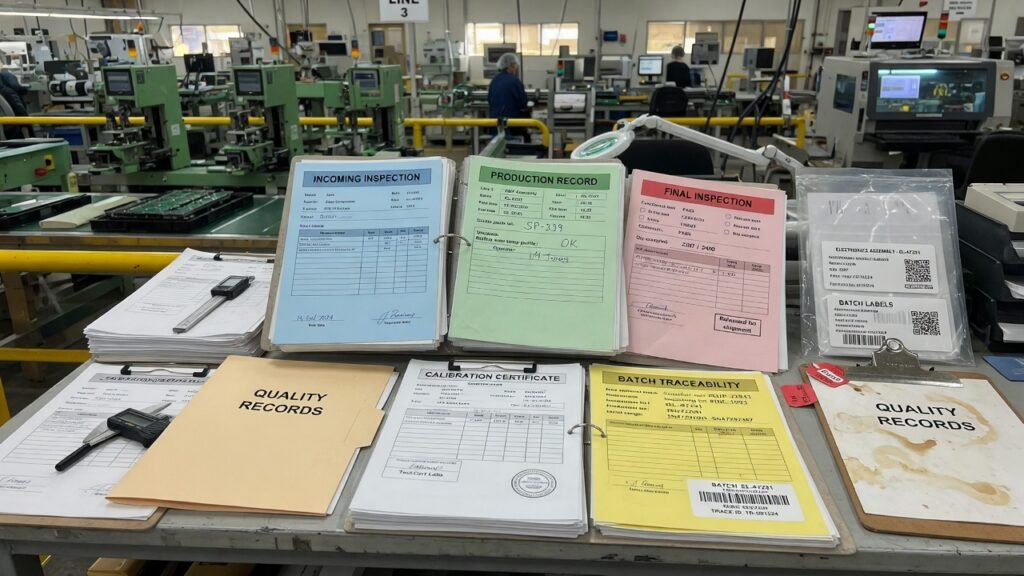
Second, records must be true, verifiable, and traceable: records need to form a complete traceability chain — purchase orders and supplier specifications should correspond to the model and batch of key safety components, incoming material inspection records should correspond to the incoming batch of key components, production material requisition and process records should correspond to the finished product production batch, and outgoing inspection records should correspond to the finished product model and production date, to ensure full traceability from key components to finished products. The record retention period shall be implemented in accordance with applicable product regulations, corresponding certification schemes, conditions specified in the certificate, and written requirements of the certification body, and shall not be shorter than the statutory minimum requirement. Records cannot be lost or missing;
Third, changes must have records: if there are changes to key components, structures, or parameters, there must be internal approval records, as well as records of reporting to the certification body (if involved).
Key Points of On-Site Production and Testing Equipment Inspection
The on-site production environment and testing equipment are also mandatory inspection items, mainly looking at three points:
First, production site: whether there are anti-static measures, whether qualified materials and unqualified materials are stored separately, and cannot be mixed together;
Second, testing equipment: key testing equipment such as withstand voltage testers, insulation testers, and power testers must be within the calibration validity period, and inaccurate equipment cannot be used for testing;
Third, warehouse management: finished products, semi-finished products, and key safety components must be stored in separate areas with clear labels to avoid taking wrong materials and material mixing.
Labeling and Packaging: Mistakes in Details Will Also Cause Problems
Many people think that labeling is a trivial matter, but in fact, unqualified labeling is a very common non-conformity, especially for charging products. Labeling inspection needs to be checked layer by layer. Not all text must be exactly the same as the certificate; the core is that compliance information matches and statutory requirements are met:
First, core compliance information alignment: core safety-related information such as product model, rated input and output parameters, and certified manufacturer specified in the certificate and filing materials must be consistent with the corresponding content marked on the product body. There shall be no problems such as false parameter labeling and model mismatch.
Second, product body labeling compliance: the content, format, and position of markings on the product body must meet the requirements of Korean mandatory labeling regulations for corresponding product categories, such as the specification and marking position of the KC mark.
Third, packaging and publicity compliance: Korean importer / responsible subject information and Korean safety tips that need to be marked on packaging, manuals, and sales pages must meet applicable regulatory requirements; publicity content such as product performance and fast charging parameters shall not exceed the certified scope covered by the certificate and the actual test performance.
Special attention should be paid to charging products: for products such as multi-port USB-C chargers, it is necessary to check the single-port output parameters of each port, power distribution and power reduction prompts when multiple ports are used at the same time, and the marking of maximum total output, to ensure that the relevant markings on the product body, packaging, and manual are consistent with the certificate filing and applicable standard requirements. There shall be no situation where the advertised power is higher than the certification scope. The specific checking standard shall be verified item by item in combination with applicable labeling regulations, certification documents, and the version confirmed by the certification body.
How Does the Whole Inspection Process Go? How to Calculate the Result?
Now that you know what to inspect, let’s talk about how the whole inspection process goes and what impact different inspection results have on the certificate.
What Preparations Should Be Made Before Inspection? (Exclusive for Charging Products)
Adequate preparation in advance can greatly improve the pass rate, especially for charging products. Pay attention to these points:
First, inspection timing: for initial factory inspection, you can confirm with the certification body in advance whether it can be arranged in parallel with sample testing and document review to plan the time reasonably; for regular inspection, you should make an appointment with the body before the expiration date to confirm the deadline for document submission and on-site requirements.
Second, document preparation: sort out commonly used documents such as key safety component list, type test report, outgoing inspection records, and change records in advance, and categorize them for easy access during inspection.
Third, on-site preparation: clean up the production workshop and warehouse in advance to ensure that key components, finished products, and unqualified products are stored in separate areas with clear labels.
Fourth, sample preparation: prepare the latest mass-produced certified model finished products, the quantity shall be in accordance with the requirements of the certification body. Do not be unable to provide them when needed.
Routine Steps of On-Site Inspection
The on-site inspection process is actually very fixed, generally divided into five steps:
Step 1, opening meeting: the inspector of the body explains the scope and requirements of this inspection, and the factory introduces the production situation of the product and the relevant responsible persons.
Step 2, on-site tour: the inspector goes to the production workshop, warehouse, inspection area and other places to conduct on-site inspection to understand the production environment and process.
Step 3, document verification: check the authenticity and completeness of various documents and records, and whether there are missing or fraudulent situations.
Step 4, sampling inspection: sample from mass-produced finished products, either disassemble and compare with filing materials, or conduct on-site testing to confirm consistency.
Step 5, closing meeting: the inspector informs the problems found in this inspection, and explains the rectification requirements and time limit.
Inspection Conclusion and Certificate Disposal
The judgment of inspection conclusion and corresponding certificate disposal shall be determined according to the safety impact, systematic nature, scope involved, and rectification situation of non-conformities, as well as applicable regulations and body procedures. Common disposal methods include the following categories (only for practical reference, the specific classification name, rectification period, and supplementary inspection requirements shall be subject to the formal inspection report and body notice):
The first type, no non-conformity: pass the inspection directly. For initial inspection, you can enter the subsequent certification process; for regular inspection, the certificate remains valid.
The second type, minor / general non-conformity (different bodies may have different names): usually you can submit rectification evidence within the specified period, and complete the rectification after passing the review of the body. Whether on-site re-inspection is required depends on the judgment of the body. Production, shipment arrangements, and certificate status during the rectification period shall be implemented in accordance with the official notice of the body.
The third type, serious non-conformity: it may be necessary to supplement on-site inspection, re-test, or conduct comprehensive rectification, and the certificate can be obtained or certification validity can be restored after passing. During the rectification period, production or shipment of relevant certified products is usually required to be suspended, and the certificate may be temporarily suspended, which shall be subject to the notice of the body.
The fourth type, serious violation or failure to pass rectification: the initial inspection will not issue a certificate, and regular inspection may directly suspend or even revoke the certification; if comprehensive rectification is completed later and passes the review of the body, those who meet the conditions can re-apply for certification or restore the validity of the certificate (specifically subject to applicable regulations and the formal decision of the body).
Evidence Chain Must Be Closed: These Red Lines Cannot Be Touched
KC factory inspection attaches great importance to the traceability of evidence, and all control actions must form a closed loop: for example, a safety capacitor, from purchase order, supplier specification, incoming material inspection record, production requisition record, finished product outgoing inspection record, to the calibration certificate of testing equipment and change approval record, must all correspond to each other. There shall be no contradiction or missing links.
Behaviors such as backfilling records, tampering with records, and providing false materials must never occur. Once found, they will be dealt with as serious violations, which will directly affect the results of this inspection and the certification process.
Special Rules for Overseas Factories and ODM/OEM
If the factory is overseas, or you operate ODM/OEM business, there are some special rules to pay attention to.
Inspection Methods for Overseas Factories
Many sellers with overseas factories will ask: my factory is not in Korea, how will the inspection be conducted? At present, there are two common methods, both of which shall be subject to the written confirmation of the certification body:
One is on-site inspection: either the certification body directly sends personnel to the overseas factory, or the body entrusts a local third-party body recognized by it to carry out on-site inspection. Only third-party inspections implemented with the recognition and authorization of the corresponding certification body and within the scope of authorization may be accepted; whether to accept and the specific qualification requirements shall be subject to the written confirmation of the body and applicable rules. Do not believe the oral promises of third-party intermediaries. Inspection arrangements that have not obtained the written confirmation of the body in advance may not be recognized.
The other is remote video inspection: through video connection, the factory cooperates to display relevant areas and products. Remote inspection has clear requirements for picture clarity and display range, which must be able to clearly photograph the internal structure of the product, component labels, and production process. Some bodies also require full screen recording for archiving; the specific applicable product scope and inspection process must obtain the written confirmation of the body in advance, and do not arrange it on your own.
Responsibility Division in Multi-Party Cooperation
In many cases, the certification of a product involves multiple entities such as the applicant, factory, and importer, and the responsibilities must be clarified:
- Applicant / certificate holder: responsible for submitting certification application, cooperating with inspection, and undertaking relevant obligations of certification;
- Manufacturer (i.e. factory): responsible for providing true information, cooperating with inspection, and implementing rectification requirements;
- Korean importer / seller: responsible for ensuring that product labeling and compliance meet the requirements of the Korean market;
- Certification body: responsible for carrying out inspections in accordance with the rules, issuing inspection reports, and managing the validity of certificates.
The specific responsibility division shall be subject to the certification materials, the contract between the two parties, and the requirements of Korean regulations. Do not shirk responsibility from each other when problems arise.
Can Multiple Models and Categories Be Inspected Together?
When the same factory has multiple products of different models and categories that need to undergo KC factory inspection, you can apply to the certification body for combined or associated inspection, which will be evaluated and confirmed by the body according to factors such as the product’s certification system, category, risk level, shared production line situation, key components, and quality system coverage.
It should be noted that: combined inspection can only reduce repeated on-site arrangements and general process verification, and does not change the compliance responsibility of each model — even if combined inspection is approved, it is still necessary to separately check the coverage of each certificate, the key safety component list of the corresponding model, structural differences, labeling requirements, and exclusive records. You cannot directly apply the inspection results of one model to other products. If the combined evaluation is passed, it can reduce repeated inspection links and lower compliance costs.
Cost and Cycle Reference
Many people will ask how much the factory inspection costs and how long it takes. In fact, there is no fixed number, and the difference is very large.
In terms of cycle, it is greatly affected by product category, inspection method, and rectification situation. For example, remote inspection may be faster than on-site inspection, and if there is rectification, the rectification time will be added. The specific situation shall be subject to the notice of the certification body.
In terms of cost, the cost varies greatly with different regions, different product quantities, and different inspection methods. For example, the cost of overseas on-site inspection is usually higher than that of remote inspection, and the cost will increase accordingly if there are many models. It is recommended to directly inquire with the certification body for a quotation, and do not believe the one-size-fits-all price of intermediaries.
Pitfall Avoidance Guide: Common Non-Conformities and Self-Check Methods for Charging Products
Finally, let’s talk about the most concerned pitfall avoidance problem: how to conduct self-check in advance to avoid problems during inspection.
Comparison Table of Common Non-Conformity Examples for Charging Products
The following are the most common non-conformity examples in factory inspection of charging products, only for early troubleshooting reference:
| Problem Performance | Common Risk Level | Inspection Evidence | Common Rectification Direction | Reporting Requirement |
|---|---|---|---|---|
| Unauthorized replacement of filed key safety components | High risk | Finished product disassembly, incoming material records | Need to be inspected and confirmed by the body after rectification | Usually need to apply and report in advance |
| Inconsistency between multi-port USB-C charger labeling and filed output parameters | High risk | Product labeling, packaging photos | Adjust the labeling and confirm compliance by the body | Usually need to report and re-check |
| Systematic differences in key components between inspection samples and mass-produced goods | High risk | Sampling disassembly, production records | Comprehensive investigation and rectification, accept body review | Must take the initiative to report and cooperate with inspection |
| Incomplete inspection records and unclear batch correspondence | General risk | Production / inspection records | Supplement and improve records, standardize traceability management | Handle according to body requirements as appropriate |
| Irregular pasting position and insufficient clarity of KC mark | Usually general risk, depending on whether the deviation affects statutory identification information, product safety parameters, or certification consistency | Product body, packaging and manual labeling photos | Adjust the labeling position and process to ensure clear visibility and compliance with regulatory requirements | Whether reporting is required shall be subject to the formal conclusion of the certification body |
Note: The above are only common examples, and the specific risk level, rectification requirements, and whether reporting is required shall be subject to the formal inspection report or written decision issued by the certification body.
Principles for Distinguishing Serious and General Non-Conformities
Many people panic when they encounter problems and don’t know whether it is a major or minor issue. In fact, they can make a preliminary judgment according to two dimensions:
- Situations that may be serious non-conformity: those that directly affect product safety, involve systematic fraud, or have batch consistency problems, such as secretly replacing safety capacitors, systematic differences between inspection samples and mass-produced goods. These usually have a great impact.
- Situations that may be general non-conformity: incomplete records, minor label deviations, etc., which do not directly affect safety, usually have low rectification difficulty.
This is only a preliminary reference for distinction, and the final judgment shall be subject to the formal conclusion of the certification body. The significance of the distinction is to predict the complexity and required time of rectification in advance, and reasonably arrange subsequent work.
4-Step Method for Factory Self-Check to Pass
In fact, you don’t have to wait for the certification body to come. Check it yourself in advance according to these four steps, and most problems can be solved in advance:
Step 1: Sample the latest mass-produced finished products and disassemble them, compare with the filed key component list and structure diagram, confirm that each key component matches and there is no unauthorized replacement;
Step 2: Check the incoming material inspection, production, and outgoing inspection records of recent months to ensure that each batch can be traced and the records are complete;
Step 3: Check the product labeling, packaging, and manual to confirm that the KC mark, rated parameters, and Korean safety tips meet the requirements, especially whether the output parameter labeling of multi-port chargers is consistent with the filing;
Step 4: Check the production site to confirm that unqualified products have a special storage area, key processes have work instructions, and materials are clearly labeled in separate areas.
For practitioners of charging products, the core of responding to KC factory inspection can be summarized into three long-term actions: first, confirm the product certification mode and factory inspection requirements through official channels in advance, and retain written evidence of classification confirmation to avoid misjudging compliance obligations; second, do a good job in key component control, production record retention, and labeling compliance in accordance with the requirements of the 4-step self-check method, and establish a complete and traceable evidence chain; third, when adjustments involving product safety are involved, confirm in advance in accordance with the change compliance process, and do not handle it on your own based on experience. KC-related rules may be adjusted with market supervision requirements, and the specific implementation shall be subject to the latest rules of Korean official and designated certification bodies.