
When many overseas users first come into contact with charging products in the Chinese market, they will see the CCC mark on the packaging or equipment, and often hear the saying that “products can only be sold after passing CCC certification”. But what exactly are the testing standards for CCC certification? How is it different from CE and UL? What tests are required for different chargers, charging cables, and sockets respectively? This article will thoroughly explain the CCC testing standards for charging products from introductory concepts to practical verification. Whether you want to sell products to China or identify compliance during procurement, it will be useful.
Core Concepts You Must Know First
First, clarify the three most easily confused basic concepts to avoid getting more confused as you read on:
First, CCC certification itself is China’s mandatory market access threshold – only products listed in the Catalogue of Mandatory Product Certification can be produced, sold, or imported within China after passing certification. To put it simply, it is the “entry ticket” to the Chinese market; products outside the catalogue cannot apply for mandatory CCC.
Second, CCC testing standards are the “scoring rules” for certification. They are not general requirements, but a series of clear Chinese national standards (code GB; those with a /T suffix are recommended standards, which become mandatory testing bases once cited by CCC). They clearly specify which items each type of product must test, what methods to use for testing, and what values are required to be considered qualified. Without standards, there is no basis for certification.
Third, test reports, certification certificates, and the CCC mark are three completely different things and cannot replace each other: first, send samples to a compliant laboratory for testing, and you will get a test report after passing; submit an application with the qualified report and factory audit materials, and you can get the CCC certificate after approval; only after getting the certificate can you print or affix the CCC mark on the product. Many people think that having a test report means you can affix the mark, or that having a certificate means you don’t need to care about the content of the report – both are wrong.
Core Significance of CCC Certification for Charging Products
Why are most charging products bound to CCC? There are two core reasons:
First, safety control. Charging products often come into direct contact with mains electricity. If something goes wrong, it may cause electric shock, damage equipment in mild cases, or cause fire in severe cases. The core of CCC testing is to control the most common safety risks such as electric shock, overheating, fire, and electromagnetic interference.
Second, mandatory access requirements. As long as the charging-related products are in the catalogue, if they enter the Chinese market without CCC, once found, they will face penalties such as goods detention, fines, and sales ban, which apply to both online sales and offline imports.
Common Cognitive Misconceptions for Beginners
People who are new to CCC are prone to several typical wrong cognitions, which are clarified here at once:
First, not all charging accessories require CCC certification. The mandatory scope of CCC is subject to the official catalogue. Accessories such as USB cables that only transmit low-voltage electricity/data are usually not within the separate mandatory scope. Do not judge that certification is required just because they are “charging-related”.
Second, CCC is only the minimum safety threshold, not a “quality certification”. It only assesses the basic safety requirements under the conditions specified in the standards, and does not involve performance indicators such as fast charging speed, service life, and interface compatibility, nor does it mean that the product will never have problems – improper use or cutting corners in mass production may bring risks.
Third, overseas certifications such as CE, FCC, and UL cannot directly replace CCC. Even if a product has passed the strictest certifications in Europe and the United States, it cannot be sold directly in China. At most, you can apply for differential supplementary testing according to the rules to reduce the cost of repeated testing, but complete replacement is impossible.
Fourth, certificates are not universal across the same brand. The certificate only covers the listed models, parameters, and configurations. Even for the same brand, products of different models must be certified according to the rules and cannot be used universally at will.
Scope of Application and Corresponding Testing Standards
After understanding the basic concepts, let’s look at the core question: which types of charging accessory products require CCC? What standards are used for testing respectively? We will explain them one by one according to the most commonly contacted categories.
Wall-plug Chargers/Power Adapters
This is the most common mandatory certification category. Whether certification is ultimately required shall be subject to the latest Catalogue of Mandatory Product Certification, CCC implementation rules, and the certification body’s judgment on the specific product use and category.
- Core safety standard: The commonly used general safety standard is GB 4943.1 Information Technology Equipment, Multimedia Equipment and Receivers – Safety – Part 1: General Requirements. The 2022 version merged the previously separate information technology equipment safety standard (old GB 4943.1) and audio-video equipment safety standard (GB 8898), with more unified requirements. The specific applicable version, new application requirements, and old certificate conversion rules shall be subject to the official version change announcements and implementation rules issued by the National Certification and Accreditation Administration and certification bodies. This type of standard focuses on assessing core safety indicators such as electric shock protection, insulation withstand voltage, temperature rise, shell flame retardancy, and abnormal protection.
- EMC (Electromagnetic Compatibility) standard: EMC testing covers multiple directions such as disturbance emission, immunity, harmonic current, and voltage change. The specific applicable standards and test items shall be determined according to product classification, rated power, and CCC implementation rules. The GB/T 9254 series is a commonly used standard related to disturbance emission for multimedia/information technology equipment. For products with different powers, some EMC limits or test items may differ.
- Evaluation requirements for multi-speed/fast charging products: If the product is declared to have multi-speed output and can trigger fast charging working modes, these modes will be included in the safety and EMC assessment under the most unfavorable working conditions during certification: after each output gear is triggered, it is necessary to check the stability of output voltage/current, as well as whether the protection functions such as overvoltage, overcurrent, and short circuit are effective. It should be noted that fast charging protocols such as PD and QC themselves are not within the performance assessment scope of CCC certification – CCC does not endorse protocol compatibility or fast charging speed, but only assesses the electrical safety performance after the protocol is triggered.
Charging Cables/USB-C Cables
This is the category whose boundary is most easily confused. The core basis for determining whether CCC is required is the current mandatory catalogue and corresponding implementation rules, which need to be comprehensively judged in combination with the product’s rated voltage, use, whether it is an independently sold component, and plug/connector structure. Conclusions cannot be drawn solely based on appearance.
- Mandatory judgment boundary: USB charging/data cables that only transmit low-voltage electricity/data are usually not separately included in the CCC mandatory scope, and can be evaluated together with the matching charger and terminal complete machine. Power cord assemblies that directly carry mains electricity need to be checked emphatically whether they belong to the wire and cable or power cord assembly categories in the catalogue. If they do, separate certification is required.
- Applicable standards and core test items: If they belong to the wire and cable/power cord assemblies in the CCC catalogue, the applicable standards shall be determined according to the conductor structure, rated voltage, and product category, which may involve wire and cable standards such as the GB/T 5023 series. Core test items usually include conductor resistance, insulation strength, mechanical strength, flame retardancy, etc.
- Notes on high-current and chip-equipped cables: For high-current USB-C cables such as 3A/5A, even if they usually do not apply for CCC certification separately, their conductor specifications, contact resistance, and temperature rise performance will be emphatically assessed in the safety evaluation of the matching complete machine. The specific requirements shall be subject to the standards applicable to the complete machine. For USB-C cables with E-Marker chips, their protocol identification and power negotiation functions are not within the CCC assessment scope, and relevant performance needs to be separately verified in accordance with corresponding technical specifications such as USB-IF.
Plugs/Sockets with USB Ports/Converters
Plugs, sockets, and converters that are directly connected to mains electricity are usually key control objects in the mandatory catalogue, but the final confirmation still needs to be combined with the mandatory catalogue, rated parameters, product structure, and implementation rules.
- Applicable standards: Mainly involve the GB/T 2099 series (standards for household and similar use plugs and sockets) and GB/T 1002 (standard for pin dimensions of Chinese plugs and sockets). Simply put, not only must safety requirements be met, but the size, shape, and spacing of the pins must also comply with China’s unified standards to avoid problems such as inability to insert and poor contact causing arcing.
- Core test items: Usually include pin size and insertion/extraction force, temperature rise, mechanical strength, flame retardancy. Some sockets also need to be assessed for child protection shutters – that is, to prevent children from touching live parts with fingers or small objects.
- Special boundary description: Sockets/converters with USB power supply function need to undergo complete machine certification according to the corresponding CCC catalogue category and implementation rules. The certification body will coordinately determine the applicable test items for the socket body and the USB power supply part, rather than two sets of independent split certifications. The certifiability of travel converters needs to be confirmed first according to the catalogue category, rated parameters, pin structure, and implementation rules. Complying with Chinese pin size requirements is one of the basic conditions. If the pin specifications are changed, re-evaluation is required. The coverage of multi-country converters shall be subject to the judgment of the certification body.
USB-C Charging Ports on Terminal Devices
Many people ask: Do USB-C charging ports on mobile phones and laptops need separate CCC certification? The answer is no.
USB-C is just an interface form, and it will not apply for CCC certification separately. Instead, it is evaluated together with the charger it belongs to or the terminal complete machine (such as mobile phones, laptops). The specific test items are determined by the product standards applicable to the complete machine, usually involving interface insulation, mechanical reliability, safety protection under abnormal conditions, etc. Here we also clarify a misconception: using a USB-C interface does not automatically meet CCC requirements. Whether the certification can be passed depends on the design of the entire product, and has no direct relationship with the type of interface itself; whether the terminal complete machine requires CCC also depends on whether it itself falls within the mandatory catalogue scope, and has nothing to do with whether it uses a USB-C interface.
Quick Method to Determine Whether a Product Requires Certification
If you are still unsure whether your product needs CCC, follow these three steps:
Step 1: First check the latest Catalogue of Mandatory Product Certification and corresponding implementation rules to confirm whether the product category falls within the mandatory certification scope. Do not judge by yourself solely based on “whether it is connected to mains electricity”.
Step 2: Assist in judgment by combining the product’s structure, rated voltage, and sales form – for example, whether it is an independently sold power supply/plug/power cord assembly, or a low-voltage accessory matched with the machine.
Step 3: If the boundary is still unclear, directly consult a CCC certification body or laboratory with corresponding qualifications. Do not guess by yourself to avoid misjudgment.
Plain-Language Breakdown of Core Test Items
Now that we know which products need testing and what standards to use, let’s break down the logic of the core test items, and use plain language to let you understand what each item is testing and why it is important. The specific test items for different categories will vary according to the applicable standards, but the core is centered around the following types of safety risks. You don’t need to memorize the standard numbers by rote, just understand the logic.
Electrical Safety (Electric Shock and Fire Prevention)
This is the most basic core item among all tests:
- Electric shock protection: Whether in normal use or after the damp heat treatment specified in the standard, users cannot touch parts with dangerous voltage. For example, the root of the charger’s pins is designed with insulation, and the low-voltage output end will not be connected to high-voltage electricity, all to meet this requirement. It should be noted that a common indoor charger meeting this requirement does not mean it can be used in humid places such as bathrooms.
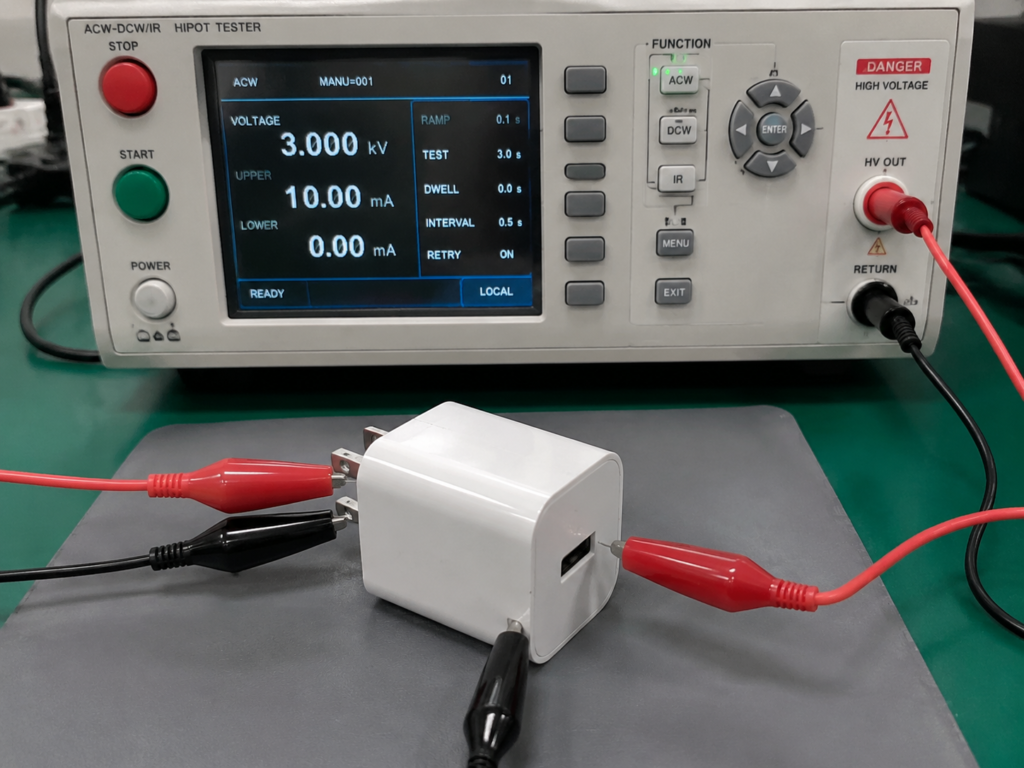
- Insulation withstand voltage: There are mains high-voltage circuits and low-voltage output circuits inside the charger. The insulating material in the middle must be strong enough to withstand the high voltage required by the standard without breakdown or leakage. Otherwise, if the insulation is damaged and high-voltage electricity runs to the output end, it will electrocute people or damage external equipment.
- Abnormal protection: Under the abnormal use scenarios specified in the standard, such as output short circuit, overload, and no-load, the product must not catch fire or explode. For example, if you directly connect the positive and negative electrodes of the charger together, a qualified product should automatically cut off the output instead of continuing to heat up and catch fire.
Temperature Rise and Heat Dissipation (Overheating Prevention)
Many people have had the experience that a charging head is too hot to hold, which is a problem of temperature rise. The temperature rise test will simulate the most severe use scenarios specified in the standard, assess whether the temperatures of the shell, plug, and internal components do not exceed the limits specified in the standard, and there must be no shell softening or deformation.
The temperature rise performance is related to the product’s power, volume, heat dissipation design, and shell material – for chargers of the same power, the smaller the size, the higher the heat dissipation difficulty, and the easier it is for the temperature rise to exceed the standard. Here we also clarify a common misconception: core safety requirements will not be reduced because the power becomes smaller. Only some EMC and temperature rise items have slight differences according to power segments. Don’t think that low power must mean it is easy to pass certification.
Structure and Mechanical Strength (Leakage Prevention After Damage)
The core is to prevent live parts from being exposed after the product is damaged:
- Shell strength: For example, after the charger is dropped from the height and in the manner specified in the standard, or subjected to external impact, the shell must not crack to expose internal live parts, otherwise users will get an electric shock if they accidentally touch it.
- Pin/interface reliability: The pins of the charger must not be loose, and the interface must not come loose or have poor contact after the number of insertions and extractions specified in the standard. Otherwise, if it is loosely inserted into the socket, it is easy to cause arcing and heating.
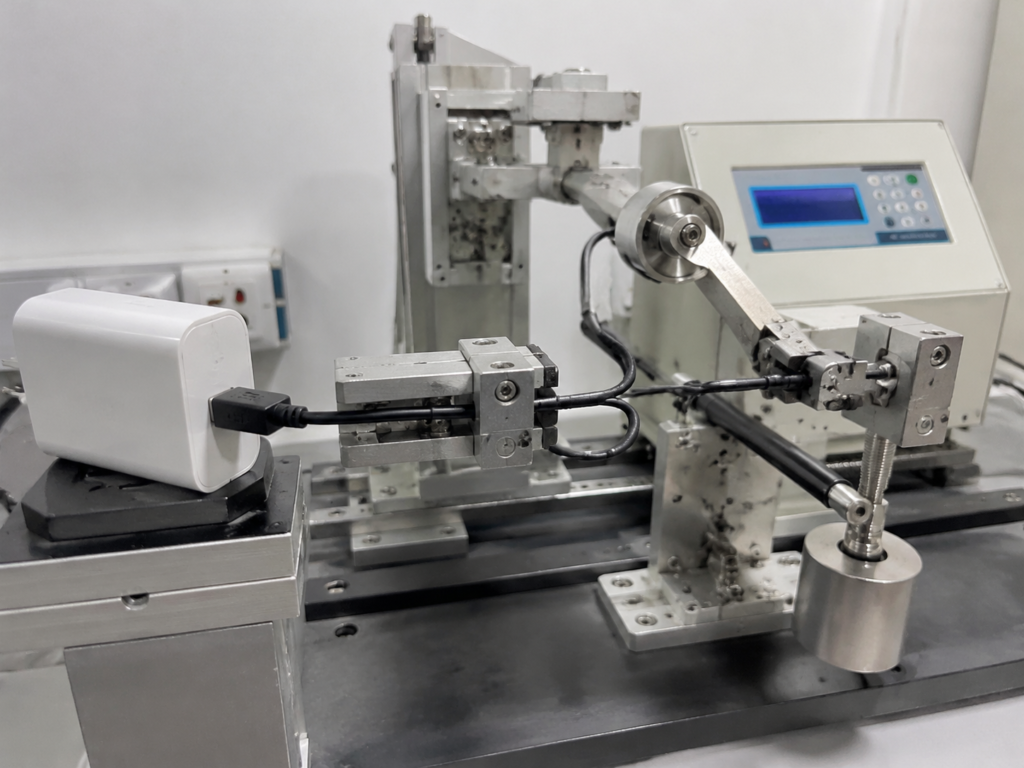
- Cable durability: After repeated bending and pulling, the insulation layer of power cords and charging cables must not be broken, and the internal conductors must not be broken. Otherwise, copper will be exposed after long-term use, which is very easy to cause electric leakage or short circuit.
Material Flame Retardancy (Fire Spread Prevention)
The shells of chargers and sockets, internal PCB boards, and insulating materials near heating elements must all meet flame retardant requirements. The requirement is that in case of internal fire, the material can extinguish itself after burning, and will not spread the fire outside the product to cause a larger fire. Many low-cost no-brand chargers on the market use non-flame-retardant recycled plastic, which burns as soon as it catches fire and drips molten material. This is also one of the most common non-conformity items.
Electromagnetic Compatibility (EMC) (Interference Prevention)
Many people don’t know that chargers emit electromagnetic signals when working. If they exceed the limit, they will interfere with nearby electronic devices such as TVs, routers, and radios. Conversely, if there is a fluctuation in the power grid or external electromagnetic interference, the charger must not get out of control, for example, it must not suddenly output abnormal high voltage and damage external equipment. Therefore, EMC testing is divided into two core parts: one is the disturbance test, which tests whether the product will interfere with other devices when working; the other is the immunity test, which tests whether the product can work normally without safety problems when disturbed by the outside world.
Labeling and Consistency (False Advertising Prevention)
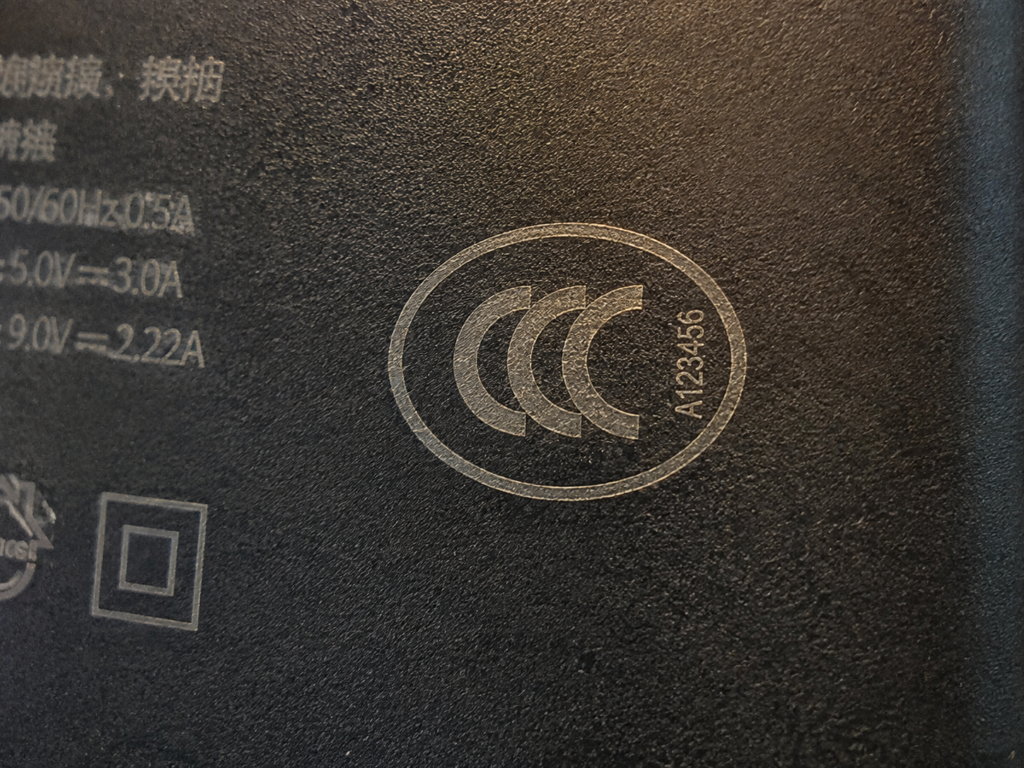
Many people only look at the CCC mark when buying things, not the nameplate. In fact, the information on the nameplate is very important. CCC requires that the product’s nameplate must be marked with input and output parameters, model, manufacturer, CCC mark and other information, and this information must be consistent with the actual product, and must not be falsely marked. For example, if you mark 65W but the actual maximum output is only 20W, it is unqualified. Common non-conformities also include false parameter labeling, no reserved position for the CCC mark, and the model on the nameplate does not match the actual product.
Basic Rules for Test Implementation
Now that we know what to test, let’s talk about the basic rules of test implementation to avoid being misled by unreliable information.
Subject Requirements for Legal Testing
The type test of CCC certification shall be completed by a laboratory entrusted or accepted by the certification body and with corresponding product testing capabilities. Reports issued by non-corresponding system laboratories cannot be directly used as the basis for CCC certification. Testing of charging products is usually prioritized to be carried out in domestic qualified laboratories. The acceptance of overseas test data shall comply with the relevant requirements of CCC implementation rules. To confirm whether a laboratory is formal, you can query the relevant directory through the official website of the National Certification and Accreditation Administration or the public channels of the certification body.
Basic Requirements for Test Samples
The test samples shall be representative prototypes of finalized mass production, with structure, parameters, and labels consistent with the final mass-produced goods. Specially optimized “engineering samples” shall not be used, as the test results will be meaningless for mass-produced goods. The number of samples sent for testing of charging products such as chargers and adapters is usually 3-10 units. The accompanying materials usually need to include complete packaging, manuals, nameplate labels, and instructions on the use position of the CCC mark, etc.; the specific quantity and supporting materials to be submitted (such as key component list, packaging draft) shall be subject to the sample sending requirements issued by the certification body or laboratory for specific products. Since some safety tests are destructive (such as disassembly for flame retardancy test, drop test, withstand voltage breakdown test), multiple samples are usually required to complete all items.
Application Rules for Standard Versions
The national standards applicable to CCC are updated from time to time. Products applying for CCC certification for the first time shall usually be implemented in accordance with the latest effective standard version that has been implemented at the time of submitting the application. The specific implementation time of version change, new application requirements, conversion period for certified products, and sales rules during the transition period shall all be subject to the official version change announcements issued by the National Certification and Accreditation Administration and corresponding certification bodies. There is no unified transition period duration. For example, since 2023, new applications for chargers have generally shifted to the relevant requirements of GB 4943.1-2022, and the specific situation shall still be subject to the official version change announcement and the requirements of the certification body. Before applying for product certification, you can first confirm the current applicable standard version with the certification body to avoid invalidation due to using the wrong standard.
Key Conditions Affecting Test Results
CCC test results are obtained based on specific preconditions, and changes in conditions may lead to differences in results. Understanding these key influencing factors can help you avoid risks in advance during product design or procurement.
Input Grid Conditions
The input voltage and frequency during testing will directly affect the results of items such as temperature rise and EMC. Therefore, the test shall be verified by selecting representative or most unfavorable working conditions in combination with the input range declared on the product nameplate in accordance with the requirements of applicable standards, covering the core risk points of the entire nominal range to ensure that the product can meet safety requirements within the nominal input range.
Load and Operating Status
Products have different temperature rise and EMC performance under different states such as no-load, light-load, and full-load. The test shall select the most unfavorable working conditions according to the standard requirements. For multi-port chargers, relevant working conditions need to be verified in combination with the power distribution rules declared by the product. Qualification of a single port does not mean that all combined working conditions are qualified; for products with multi-speed output, the safety performance under different output modes must be included in the assessment, and the specific test combination shall be subject to the implementation rules and laboratory judgment.
Environmental and Heat Dissipation Conditions
Ambient temperature, product placement method, shell material, and internal heat dissipation layout will all affect the temperature rise test results. The test shall be strictly implemented in accordance with the environmental conditions and placement methods specified in the standard. Therefore, products with the same power but different designs may have different test results, which is a normal phenomenon.
Supporting Components and Product Versions
The specifications of the cables used in the test (length, wire diameter, interface type) will affect the results of voltage drop, heating, insertion and extraction life, etc. Therefore, the certification only covers the confirmed supporting configurations. If the product replaces key components (such as transformers, safety capacitors, flame-retardant shells, cables), adjusts the structure, or updates the control software, it may affect the validity of the certification. You need to apply to the certification body for change assessment according to the rules, and you cannot continue to use the original certification after self-replacement.
Methods for Verifying Reports and Certificates
Whether you are purchasing products or applying for certification independently, mastering the verification methods of reports and certificates can help you avoid compliance risks.
Basic Judgment of Validity
To check the validity of CCC certificates and reports, the core points are as follows:
First, the certification certificate must be queryable on the National Certification and Accreditation Administration or the National Public Service Platform for Certification and Accreditation Information, with the status of “valid”, and the applicant, manufacturer, product model, and applicable standards on the certificate must be consistent with the actual product. It cannot be used across models or manufacturers.
Second, the type test report itself must have a compliant signature and seal: check whether the first page or signature page of the report has the official seal of the issuing testing institution, as well as corresponding qualification marks such as CMA/CNAS, and check whether the qualification capability scope covers the tested product category and applicable standards; at the same time, the report must be associated with the corresponding certificate and officially accepted by the certification body. The application unit, applicable standards, and test scope of the report must match the content covered by the certificate. Do not equate ordinary third-party test reports with CCC type test reports.
Third, in case of standard version change, it is necessary to check whether the certificate has been converted in accordance with the requirements of the version change announcement, or is still within the valid scope of the transition period. The validity cannot be directly judged only by the standard number on the report.
Key Verification Items for Charging Products
For charging products, you can focus on the following types of content after getting the report:
- Safety category: The results of insulation withstand voltage, temperature rise limit, and abnormal protection must all be qualified.
- EMC category: The measured value of disturbance emission must be lower than the limit specified in the standard.
- Multi-speed output products: Check the output range covered by the report and the verification of protection functions. Do not assume that all gears meet the requirements just based on the publicity of “supporting fast charging”.
- Key component list: The report will list the models and suppliers of key components such as transformers, safety capacitors, cables, and shell materials, which must be consistent with the actual product. If the components are replaced in mass production, even if the appearance is the same, it does not meet the consistency requirements.
Test Boundaries That Must Be Noted
Many reports and certificates have scope of application. It is not that you can use one certificate for all situations. For example, if the certificate only covers the power range of 65W, you cannot say that a 100W product has also passed CCC; some reports have additional restrictions, such as “only compatible with cables of specified models”, which must be read clearly.
In addition, the type test report is used to prove that the representative samples of the certified unit meet the standard requirements. The scope of the certificate is subject to the model, configuration, and key component control requirements listed in the certificate. The consistency of batch production shall be jointly guaranteed by the enterprise’s quality assurance system, post-certification supervision, and change control. It is not that having a report means that all mass-produced goods are qualified.
Practical Steps for Authenticity Verification
To verify the authenticity of reports and certificates, you can follow this path:
Step 1: First check the validity of the certificate: log on to the National Certification and Accreditation Administration or the National Public Service Platform for Certification and Accreditation Information, enter the certificate number, and check whether the applicant, manufacturer, product model, and certificate status are consistent.
Step 2: Then verify the authenticity of the report: the verification of the test report can be carried out through the official query channel on the report, the official channel of the issuing laboratory, or the supporting materials of the certification body to confirm the relevance between the report and the certificate.
Step 3: Check product consistency: Compare the product photos, parameters, and key component list (such as transformers, safety capacitors, flame-retardant materials, cables) in the report with the actual product to see if they are consistent. For non-key appearance changes, it is necessary to confirm whether they affect compliance according to the change rules of the certification body. Be especially vigilant against “certificate misappropriation” – this is the most common trick: situations where the appearance is the same but the model is different, or the model is the same but the internal key components are secretly replaced. These cannot be identified only by checking the certificate number, and the internal configuration must be checked.
Practical Pitfall Avoidance Guide for Overseas Users
In response to the common needs of overseas sellers and purchasers, here are several practical action points to help you avoid detours:
First, confirm the scope before starting. Before applying, first check the latest mandatory catalogue and implementation rules, or directly consult a formal certification body to confirm whether the product is within the mandatory scope and which type of standards apply, to avoid unnecessary costs.
Second, integrate compliance in advance at the product design stage in accordance with the core requirements of applicable standards (such as Chinese pin dimensions, safety structure, flame retardant requirements), to avoid rework due to failed testing, which wastes time and cost.
Third, choose formal channels for docking. Directly contact CCC certification bodies or laboratories with corresponding qualifications, do not trust the publicity of intermediaries such as “guaranteed pass” and “urgent certificate issuance”. If you encounter certificates or reports that cannot be verified on official platforms, directly refuse cooperation, and be vigilant against fake certificates, misappropriated certificates, and reports with old standards.
Fourth, control consistency throughout the whole chain. When purchasing or importing, check the consistency of product models, parameters, and key components with certificates and reports to prevent cutting corners in mass production; continuously pay attention to standard version change announcements, plan certificate updates in advance, to avoid certificate invalidation and inability to sell after the transition period.
In general, the core of CCC certification testing standards is to control the safety risks of charging products and guard the access bottom line of the Chinese market. Clarifying the applicable scope, core testing logic, and verification methods of different categories can help you quickly avoid common compliance risks in cross-border sales and product procurement, and make more stable decisions.