
Sellers of charging products operating in the Japanese cross-border market have almost all encountered the situation where “goods are detained by customs and PSE and METI documents are required.” Many people are confused when they first come into contact with this: what are these two documents for? Are what customs requires the same as what platforms require? Can CE certification be used as a substitute? Some people even think that paying a freight forwarder can solve the problem, but in the end, the goods are delayed until they are returned, or they face other dispositions.
In fact, PSE only applies to electrical appliances regulated by Japan’s ; entities engaged in related commercial import activities may also need to fulfill the import business notification required by METI. These are related to customs declaration, inspection, and subsequent sales supervision, but not all charging goods are required to submit both PSE and METI materials at the same time, nor can it be generalized that both are universally and directly linked to customs clearance. This article mainly focuses on charging products (including USB chargers, PD adapters, charging cables, power connectors, etc.), starting from the most basic role definitions, to how to judge whether your product needs to be processed, how to prepare documents, how the clearance process works, and then the specific pitfalls of charging products. After reading it, you can prepare materials more accurately and avoid many detours.
First, Understand the Three Core Roles and Don’t Mix Them Up
The root cause of many people’s customs clearance problems is that they don’t understand what customs, PSE, and METI each do, thinking they all manage product safety. In fact, the roles of the three are completely different.
Japan Customs is the department responsible for import declaration, cargo inspection, tax collection, and enforcement of related prohibited/restricted goods and other customs clearance regulations. It does not issue PSE certificates, nor is it the final judging authority for all PSE technical issues. However, for goods involving electrical appliance safety, customs may require the provision or explanation of relevant materials according to declaration and inspection needs, and may cooperate with the competent authority for verification. Therefore, customs cannot be simply understood as a “formal review department” that only looks at document format.
PSE is the electrical appliance safety conformity mark stipulated by Japan’s . It is not a unified certification that all electrical products must use, but a mark that can only be used in accordance with the law for products listed in the statutory target categories after completing obligations such as conformity inspection, suitability testing, and labeling according to corresponding procedures. PSE is also not a “clearance pass” for customs—even if a product is subject to PSE, whether it can pass customs still depends on import declaration, cargo inspection, document consistency, and other applicable regulations.
METI is the abbreviation for the Ministry of Economy, Trade and Industry of Japan. The “METI filing” mentioned in this article, more accurately, usually refers to the import business notification submitted by operators in accordance with the . It is mainly used to confirm commercial import activities and the responsible entity. It is not a product certification, nor a per-product approval, let alone a unified document that must be submitted for all goods clearance.
The relationship between the three can be understood as follows: if a product falls under PSE-regulated categories, the corresponding PSE compliance procedures must be completed; if an operator engages in commercial import of related regulated electrical appliances, they must also fulfill the import business notification as required, as well as obligations such as labeling and record keeping. Customs declaration and inspection are another set of procedures. Customs may require the provision or explanation of PSE, import business notification, or other safety materials, and may also transfer issues to or cooperate with the competent authority for verification. However, whether PSE meets specific technical requirements cannot be determined solely by a simple formal comparison between customs and the customs declaration form.
Here is a special reminder of the most common pitfall: **Customs release does not equal legal sales**. Even if the goods have cleared customs, if they are later found to violate the or other Japanese regulations, they may still face consequences such as sales suspension, recall, and administrative penalties.
What might happen if there is non-compliance? The actual handling method depends on the facts of the violation, the status of the goods, the declaration situation, and the formal decision of customs or the competent authority. Common situations include:
• Delayed customs clearance, with requests for supplementary explanations or submission of materials;
• Goods are detained, inspected, or required to be returned to customs or shipped back;
• If the product violates the or other regulations, it may face consequences such as administrative penalties, recalls, and sales suspension;
• The specific correction period, disposal method, and subsequent inspection intensity are subject to the formal notice of customs and the competent authority. You cannot apply a fixed 15–30 day period in advance, nor assume that the goods will definitely be destroyed or added to a so-called “blacklist”.
First, Judge: Does Your Charging Product Need PSE/METI?
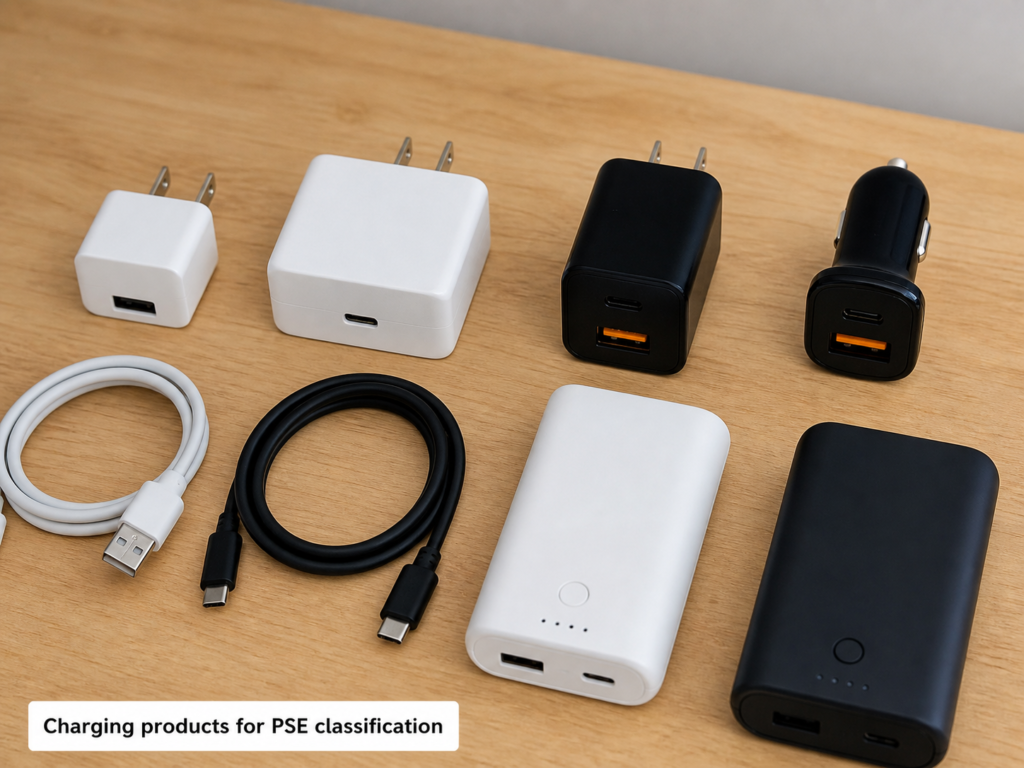
Not all charging-related products require PSE and import business notification. The key point of judgment is not the product name, but whether the product falls under the target categories of the , and then confirmed in combination with the input method, rated specifications, structure, and purpose.
Charging Products That Require Key Confirmation of PSE and Import Business Notification
The first category is products that are directly connected to Japanese AC mains, that is, USB chargers, PD adapters, wall chargers, travel chargers, etc. that can be plugged into household wall sockets. These products usually require key confirmation of whether they fall under statutory regulated categories such as “DC power supply devices”, and which type of PSE procedure applies. You cannot conclude that a charger must belong to a certain PSE category solely based on the name “charger”.
The second category is products with power conversion functions. As long as there is a power supply part inside the product that converts AC mains to other voltages, it is necessary to focus on verifying whether it falls under PSE target categories, and whether the rated input, output, and structure meet the requirements.
The third category is accessories with mains interfaces, such as certain Japanese-standard AC power components and connectors with voltage transformation or power conversion functions. Whether they are subject to PSE control still needs to be confirmed based on the specific structure, purpose, and statutory categories, not just based on whether it is an “accessory”.
For products that fall under PSE-regulated categories, commercial importers should also confirm whether they need to fulfill the import business notification, as well as product labeling, inspection records, and other legal obligations.
Charging Products That Cannot Be Directly Stated as “No PSE Required”
The first category is ordinary USB or USB-C cables. Many ordinary cables that only contain conductors, insulation layers, and connectors usually do not belong to PSE-regulated power supply devices, but the final determination should still be based on the target category list and specific structure. It is not safe to draw a conclusion solely based on “it is a data cable” or “it does not plug into a wall socket”.
The second category is adapters and connectors that only use USB low-voltage power supply. They may not fall under PSE target categories, but “low-voltage power supply” is not the only legal condition for automatically excluding PSE. It is necessary to confirm whether the product has a power conversion function, whether it belongs to other regulated categories, and whether it involves other regulations. Only after confirming that it does not fall under the target categories can it be stated that PSE does not apply.
If cables are sold as part of a set, for example, a charging cable is given as a gift when buying a charger, compliance cannot be ignored just because the cable is a free gift. If the AC adapter in the set falls under a PSE-regulated category, it should be ensured that the adapter itself has completed the corresponding compliance procedures; other products in the set should also be separately confirmed whether they are subject to PSE or other regulations, and ensure that the packaging, instructions, labeling, and actual model correspond to each other.
How to Judge the Easily Confused Boundaries?
Many products are on the boundary and are prone to misjudgment. Here are some more reliable rules.
First, wide voltage does not equal PSE compliance. Many sellers say “my charger is 100–240V wide voltage and can be plugged into Japanese sockets, so no PSE is needed”, which is wrong. Wide voltage only means that the product is designed to work under the corresponding input voltage; PSE focuses on the safety and technical requirements of applicable statutory categories, and the two are not the same thing. As long as the product falls under a regulated category, compliance must be completed according to the applicable procedures.
Second, the judgment path for car chargers is different from that of wall chargers. Car chargers are usually plugged into a car’s 12V or 24V power interface and do not directly connect to household AC mains, so the judgment method for wall chargers cannot be directly applied. However, whether it involves PSE or other requirements should still be verified based on the specific structure, input/output method, and purpose, and all regulations cannot be completely excluded solely based on the word “car-mounted”.
Third, power banks and wireless chargers cannot be simply classified as products that “do not require PSE”. For power banks, it should be confirmed whether they belong to lithium-ion batteries controlled by PSE, and they must also comply with lithium battery transportation rules. For wireless charging products, the applicable regulations for the wireless power supply body, AC adapter, and other components must be judged separately, and it cannot be generally concluded that PSE does not apply.
Fourth, samples and free gifts cannot be judged solely by quantity. If samples or free gifts fall under PSE-regulated categories and are intended for domestic sales in Japan, commercial use, or provision with goods, compliance obligations usually cannot be exempted just because there is only one. However, the may have exceptions or special treatment for specific purposes such as testing, inspection, maintenance, and export, which need to be confirmed in combination with the actual purpose. Personal use may affect the PSE judgment for commercial imports, but it does not mean that other requirements such as customs, wireless, battery, or transportation can be exempted.
1-Minute Quick Self-Check Method
If you are still unsure, you can quickly judge according to these three steps:
Step 1: Look at the power supply. Is the product directly or indirectly connected to AC mains? If yes, you should first verify whether it falls under PSE target categories.
Step 2: Look at the structure. Does the product have power conversion, storage battery, wireless power supply, or other special functions? If yes, it cannot be judged solely as an ordinary cable, and further verification is needed.
Step 3: Look at the purpose. Is it for sale, commercial use, set sales, or gifting? If yes, you should confirm the operator’s legal obligations and product compliance materials; personal use also does not mean exemption from other regulatory requirements.
If you are still unsure after these three steps, don’t guess on your own. Directly consult the Japanese competent authority, a certification or testing institution with corresponding capabilities, or ask the Japanese importer to verify based on the specific model and specifications.
How to Prepare PSE Customs Clearance Documents? How to Verify Their Validity?
PSE is an important compliance link for some electrical products entering the Japanese market. First of all, you need to know that there are two types of PSE marks, and the applicable products and handling procedures are not exactly the same. The specific category must be confirmed based on the target categories and rated specifications of the .
| Mark Type | Applicable Product Category | Main Compliance Method | Key Clearance or Compliance Documents |
| Diamond PSE (Specified Electrical Appliances) | High-risk categories listed as specified electrical appliances | Suitability testing conducted by a registered inspection agency, and fulfillment of related inspection and labeling obligations | Suitability testing certificate and compliance documents corresponding to the actual product |
| Circular PSE (Non-Specified Electrical Appliances) | Categories listed as non-specified electrical appliances | Statutory conformity inspection, record keeping, and self-declaration according to specific categories | Conformity inspection records, technical materials, self-declaration, and related certificates |
AC adapters, PD adapters, and wall chargers cannot all or mostly be classified as Diamond PSE. Whether they belong to regulated categories such as “DC power supply devices”, and whether Diamond or Circular PSE applies, must be confirmed in combination with the input method, rated specifications, and specific structure. When they belong to specified electrical appliances, suitability testing by a registered inspection agency is required; when they belong to non-specified electrical appliances, conformity inspection, record keeping, and self-declaration must be completed in accordance with the requirements of the specific category.
List of PSE Documents Required for Customs Clearance
During customs clearance, having only a PSE mark or a certificate does not mean all materials are complete. They should be prepared according to the product category and the actual requirements of customs and the competent authority:
• Suitability testing certificate corresponding to specified electrical appliances;
• Conformity inspection records, technical materials, and self-declaration corresponding to non-specified electrical appliances;
• Testing or inspection materials corresponding to the actual model, structure, and specifications;
• Samples of the PSE mark style, product nameplate, instructions, and safety warnings;
• Materials that can prove the identity of the goods, such as commercial invoices, packing lists, and product specifications.
The product model, rated input/output, power supply structure, manufacturer or import operator information in all materials should be as consistent as possible with the actual goods and customs declaration materials. The specific document required shall be subject to the applicable category and actual declaration requirements, and a certain document list cannot be applied to all products.
How to Judge Whether PSE Documents Are Valid?
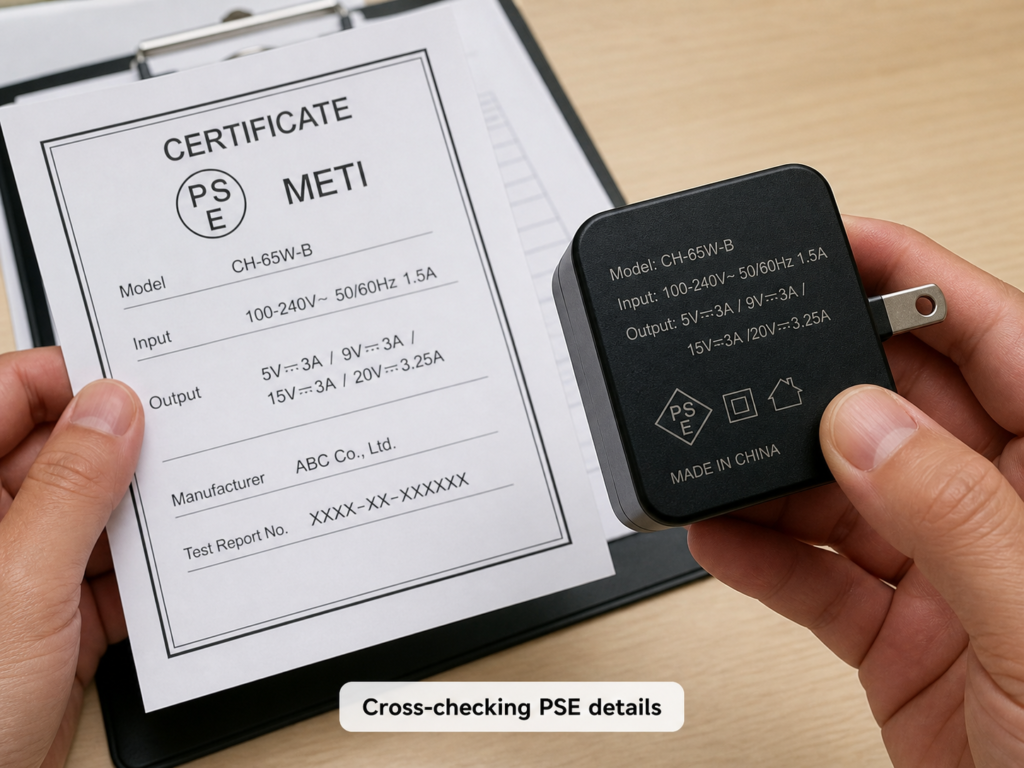
Many sellers get PSE materials provided by suppliers and think that having documents is enough, only to find that the materials cannot correspond to the actual product during customs clearance or market supervision. You can first check from the following aspects:
First, check the institution and procedure. The suitability testing agency for specified electrical appliances shall meet the requirements of the Japanese system; for non-specified electrical appliances, it is necessary to confirm that the conformity inspection and record keeping methods implemented by the enterprise meet the regulations of the corresponding category. You cannot take “issued by a domestic laboratory” or “issued by a Japanese laboratory” itself as the sole judgment standard.
Second, check the validity status stated on the certificate or materials. The validity period and conditions of the suitability testing certificate for specified electrical appliances shall be confirmed according to the specific statutory category and the content stated on the certificate, and a uniform range of “3 to 7 years” cannot be applied. The inspection records and self-declaration for non-specified electrical appliances shall also be reconfirmed in a timely manner as the product model, structure, materials, and parameters change.
Third, check consistency. The model, electrical parameters, and structure on the certificate and inspection records must be able to correspond to the actual goods and customs declaration documents. For example, the model on the certificate is CH-65W, and the one printed on the goods is CH-65W-B. Even if the difference seems to be just a suffix, you should first confirm whether the manufacturer regards it as the same model and whether the materials cover this variant, and cannot directly assume that they are universal.
Fourth, check the responsibility relationship. Import operators shall keep materials that can prove the correspondence between the actual product, manufacturer, model and the suitability testing certificate or conformity inspection records. If the certificate holder is different from the importer, authorization or supply chain certificates can be prepared according to the actual transaction relationship, but this is not a uniformly mandatory document for all cases. The key is to be able to explain why the materials apply to this batch of goods.
Fifth, check the product itself. A valid certificate does not mean that every batch of products is automatically compliant. It is also necessary to confirm that production inspection, structural changes, nameplates, and PSE marks all meet the requirements.
Common Situations of Invalid PSE Documents
There are several situations that can easily make materials unusable, which must be avoided:
The first is inconsistency in model, parameters, or structure, such as a difference of one letter suffix, mismatched output power, or the certificate corresponds to an old version of the circuit while the actual goods have been revised.
The second is self-printing the PSE mark without corresponding suitability testing, conformity inspection, or record support. This practice may trigger customs clearance and market supervision risks.
The third is using certifications from other regions such as CE and FCC to replace PSE. Japan’s PSE system has its own target categories and technical requirements, and certifications from other regions cannot automatically replace Japanese statutory procedures.
What is METI Import Business Notification? What Documents Are Required for Customs Clearance?
Many people confuse METI notification with PSE, thinking they are both product certifications, but in fact they are two different things.
The core function of METI import business notification is to allow entities engaged in related commercial import activities to submit business information to the Ministry of Economy, Trade and Industry in accordance with the , and assume corresponding responsibilities as import operators. It is not a product qualification certificate, nor a per-model approval, let alone a customs clearance pass.
For import businesses that fall under regulated categories, operators shall submit the import business notification as required, and at the same time ensure that the products have completed the corresponding PSE conformity procedures, and fulfill obligations such as labeling and inspection record keeping. Notification and PSE compliance are interrelated, but have different legal natures, and cannot be understood as “first obtain the PSE certificate number, then handle a product filing”.
There is a common misunderstanding here: many people think that METI notification is a unified document that must be submitted for all goods during customs clearance. Whether it is actually necessary to provide notification materials to customs depends on whether the product is subject to relevant laws and regulations, the declaration situation, the inspection situation, and the specific requirements of customs or the competent authority. Even if notification materials are not submitted for each shipment of goods during customs clearance, it does not mean that the operator’s legal obligations can be ignored.
Handling Requirements for METI Import Business Notification
The handling entity is not simply divided into “company” or “individual”, but depends on who actually engages in commercial import, and whether it meets the requirements of the for import operators and domestic responsibility links in Japan.
Entities engaged in commercial import shall submit the import business notification according to the actual business situation, and keep the submission certificate or relevant materials actually issued by the competent authority. Personal use imports and commercial imports need to be distinguished; you cannot generally deem all imports or notifications in the name of individuals as invalid, nor can you understand personal use as automatically exempting other requirements such as customs, battery, wireless, and transportation.
The specific items of the notification shall be subject to METI’s official notification format and handling instructions, and the focus is usually on the import operator and its business information. It should not be generalized as a product list that includes all product models and PSE certificate numbers, with per-model approval. Whether it is necessary to change the notification or resubmit it shall be confirmed based on changes in the operator, address, business scope, and other statutory matters.
List of METI Documents Required for Customs Clearance
If customs or relevant competent authorities require the provision of import business notification materials, you can prepare:
• Copy of the submitted import business notification;
• Electronic submission records, submission certificates, or acceptance materials actually issued by the competent authority;
• Materials that can prove the identity and responsibility link of the import operator;
• PSE suitability testing certificate, conformity inspection records, self-declaration, and other technical materials corresponding to the goods;
• Trade materials such as commercial invoices, packing lists, and product model lists.
There is no unified “METI filing acceptance receipt” or fixed number that applies to all importers. What kind of certificate is actually received, whether there is a specific receipt, and whether customs requires submission shall be subject to the actual notice of the declaration channel, competent authority, and customs.
How to Verify the Validity of METI Materials?
METI notification is not a product certificate in the usual sense, so the focus of verification is not simply checking “whether there is a number, whether it is expired”, but looking at the following contents:
First, confirm whether the notification is submitted by the actual import operator in accordance with regulations, and whether the submitted content is true.
Second, confirm whether it is necessary to handle changes or re-notification when statutory matters such as the import operator, address, and business scope change.
Third, confirm whether it is necessary to re-conduct conformity testing, conformity inspection, record keeping, or PSE labeling after the product’s technical parameters and model change. Changes in product parameters do not necessarily automatically invalidate the import business notification, but may affect the PSE compliance of the product itself.
Fourth, confirm that the notification materials, importer information, PSE materials, customs declaration documents, and actual goods can correspond to each other. Do not modify materials without authorization, nor use documents unrelated to the actual business as substitutes.
How to Control Risks in the Whole Process from Shipment to Customs Clearance?
Knowing which materials to check, you also need to know which links in the process are prone to problems. For charging products, most of the risk control should be done before shipment. Remedying after the goods have arrived at customs usually costs more time and money.
4 Things You Must Do Before Shipment
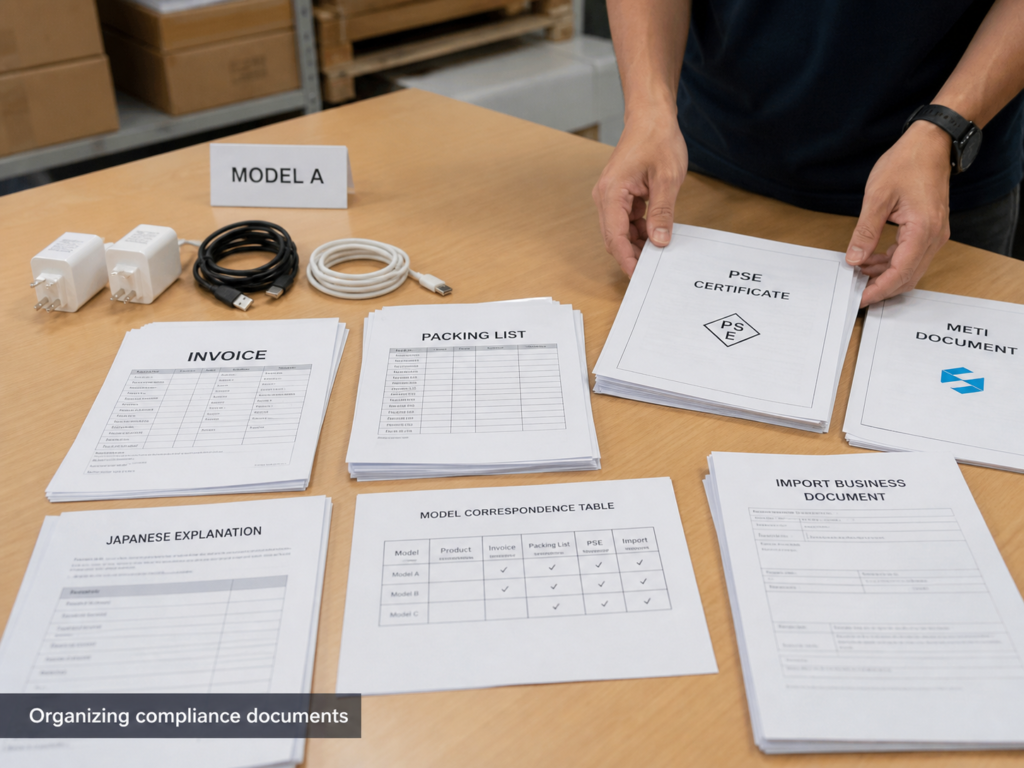
Step 1: First, confirm whether it is subject to PSE regulation and whether Diamond or Circular PSE applies based on the target category list of the and product specifications. Wall chargers and PD adapters cannot be generally classified as Diamond PSE, and should be judged based on specific input, output, and structure.
Step 2: The actual import operator shall submit the import business notification as required. It is not a product certification or pre-approval for customs clearance, nor does it necessarily produce a unified format of acceptance receipt; whether there is a submission certificate and what materials need to be submitted during customs clearance shall be confirmed according to the actual requirements of METI and customs.
Step 3: Organize compliance materials corresponding to the product. If the documents are in English or other languages, necessary Japanese explanations shall be prepared according to the requirements of customs, platforms, or competent authorities. When shipping multiple models in mixed loads, prepare a clear model correspondence table to ensure that products, invoices, packing lists, PSE materials, and import business materials can correspond to each other.
Step 4: Check the information of the goods themselves: whether the PSE mark style is consistent with the applicable category, whether the nameplate parameters are consistent with the compliance materials, whether the instructions and safety warnings meet the requirements of specific categories and Japanese consumer protection, and whether the plug meets the applicable shape, rating, and safety requirements of Japan.
Precautions for Customs Declaration
After shipment comes the customs declaration stage. Basic customs declaration materials usually include commercial invoices, packing lists, transport documents, and accurate goods descriptions and HS codes. The product name on the commercial invoice should be as specific as possible, for example, write “65W PD USB-C Wall Charger”, instead of just writing general terms such as “electronic products” or “accessories”.
Import declarations shall also truthfully fill in information such as product name, quantity, price, origin, and specifications required by customs. The declaration methods, document requirements, and inspection methods for different modes such as general trade, direct mail, and bonded warehouses may be different, and unpublished unified random inspection ratios cannot be used to judge risks. Direct mail or bonded delivery also does not mean that applicable product safety and import operator obligations can be ignored.
Whether PSE or import business notification materials need to be submitted along with the customs declaration form depends on whether the goods are subject to relevant laws and regulations and the case-by-case requirements of customs or the competent authority. Do not treat the PSE certificate number and the so-called “METI filing number” as universally required items for all customs declaration forms; if you receive a notice for supplementary materials, you shall provide the corresponding documents according to the notice.
How to Deal with Customs Verification?
Customs may check declaration materials, cargo model, quantity, specifications, purpose, and other customs clearance information. For goods involving electrical appliance safety, they may also require the provision or explanation of PSE-related materials, and cooperate with the competent authority for verification according to the situation.
If customs requires supplementary materials, you shall submit true and corresponding documents within the period specified in the formal notice. Do not use other models, expired materials, or documents that cannot prove the association to make up the number. If the product itself does not fall under the PSE target category, you should prepare materials that can explain the product structure, input method, rated specifications, and purpose, instead of just writing “this product does not require PSE”.
If it is finally determined that there is a non-compliance problem, handling such as delayed customs clearance, detention, return to customs, or shipment back may occur; if it also violates the or other regulations, consequences such as sales suspension, recall, and administrative penalties may also occur. The specific handling shall be subject to the formal decision of customs and the competent authority.
Requirements After Customs Clearance
Passing customs clearance does not mean that the subsequent sales links can be completely ignored. For products that fall under PSE-regulated categories, import operators shall still keep conformity inspection, testing, labeling, and transaction materials in accordance with the and the provisions of specific target categories.
The retention period and calculation method may vary depending on the obligation and category, and cannot be uniformly written as “at least 3 years”. Usually, focus should be kept on suitability testing certificates, conformity inspection records, technical materials, import business notification materials, customs declaration documents, product change records, and materials that can prove the supply chain relationship, and the specific period shall be confirmed according to the corresponding regulations or METI requirements.
The Linkage Between Cross-Border Platforms and Customs Clearance: Don’t Fall Into Pitfalls on Both Sides
Now many sellers sell charging products on platforms such as Amazon Japan, Rakuten, and Mercari. Platforms may require sellers to submit PSE, importer, or other product compliance materials, but platform rules will change with product categories, sales methods, and case-by-case reviews, and it cannot be generalized that all platforms and all products must upload both PSE and METI documents at the same time.
Differences Between Platform Review and Customs Verification
Platform review is usually an internal product listing or sales compliance review by the platform, and the focus may include document completeness, format, product information, and platform policy requirements. It is not a Japanese statutory certification, nor does it mean that Japan Customs or market supervision authorities have recognized the product as compliant.
Customs verification is carried out around import declaration, cargo inspection, applicable laws and regulations, and case-by-case document requirements. Passing platform review does not mean that the goods will definitely pass customs smoothly; similarly, the clearance of a certain shipment of goods does not mean that the platform will definitely allow continued sales.
Therefore, don’t have the idea that “since the platform has passed, customs clearance will definitely be fine”. Platform review, PSE compliance, import business notification, and customs inspection are interrelated but independent matters.
Try to Keep Platform and Customs Clearance Documents Consistent
Many sellers use materials provided by suppliers on the platform, and use another set of importer materials during customs clearance, resulting in the inability to correspond to product models, manufacturers, PSE documents, and import operator information.
A more reliable approach is to unify core information in advance: product model, rated parameters, manufacturer, import operator, and the PSE materials used. The documents required by the platform and the customs clearance materials are not necessarily exactly the same, but they cannot contradict each other, nor can the platform materials seem to correspond to one product while the actual imported one is another version.
Customs Clearance Risks of Different Shipping Modes
The responsibilities and declaration methods of different shipping modes are not the same.
If it is overseas direct mail, a single shipment may be imported in the name of the consumer or recipient, but continuous and bulk sales to Japanese consumers may still be recognized as commercial activities. Direct mail does not equal automatic exemption from product safety, import, and consumer protection requirements.
If it is the Japanese overseas warehouse mode, goods usually need to be imported into Japan in bulk first, and the import operator, purpose of the goods, and supply chain relationship are easier to verify. Therefore, it is even more necessary to prepare complete, true, and corresponding materials before shipment.
If it is platform drop-shipping or logistics agency customs clearance, it will not naturally change the product compliance responsibility. Platforms or logistics providers can assist with declaration and document transmission, but the legal obligations borne by sellers, manufacturers, and actual import operators shall still be confirmed based on the actual business relationship.
Will Platform Violations Affect Customs Clearance?
Platform delisting is usually a consequence of platform contracts or sales rules, and will not naturally trigger key customs verification. There is also no universal rule indicating that multiple platform violations will automatically cause importers to enter the customs high-risk list.
However, if the same product also has false declarations, PSE material problems, product safety problems, or other illegal clues, customs may take inspection measures based on risk management and the clues they have. Therefore, platform materials, actual products, and import declaration information should still remain true and consistent. Do not list them for sale first, and then try to make up materials that do not correspond to the actual product later.
Common Misconceptions, Charging Product-Specific Pitfalls, and Practical Tools
Finally, the most easily misunderstood cognitive misconceptions, common risk points for charging products, and pre-shipment inspection methods are sorted out for you to compare and avoid pitfalls.
The 4 Most Common Cognitive Misconceptions
Misconception 1: With the PSE mark, there is no need for METI import business notification. This is inaccurate. PSE is a product compliance and labeling requirement for regulated electrical appliances, while import business notification is another obligation borne by operators for related import businesses. The two have different legal natures and cannot replace each other.
Misconception 2: Domestic test reports can automatically replace PSE documents. This cannot be understood this way. Whether it can be used as evidence of compliance depends on whether the testing or inspection method meets the statutory requirements of the specific PSE target category. CE, FCC, or ordinary domestic test reports cannot automatically replace Japan’s statutory PSE procedures.
Misconception 3: Small-batch samples and free gifts definitely do not need PSE. Small quantity does not naturally constitute exemption. If samples or free gifts fall under PSE-regulated categories and are used for domestic sales in Japan, commercial use, or provision with goods, compliance obligations usually still need to be confirmed. At the same time, it is also necessary to check whether statutory exceptions apply to purposes such as testing, inspection, maintenance, and export.
Misconception 4: METI import business notification is a customs clearance pass. It is not a product certification, nor a unified customs clearance voucher. Whether customs requires the provision of relevant materials shall be judged based on the goods category, declaration situation, and case-by-case notice; but commercial importers shall still confirm whether they need to submit the notification in accordance with the law.
5 High-Frequency Pitfalls in Charging Product Customs Clearance
Charging products have several specific risk points, which beginners are especially likely to ignore:
First, seeing an E-Marker chip and concluding that a USB-C fast charging cable definitely requires PSE. E-Marker or other chips do not automatically make a cable a PSE-regulated electrical appliance. You should first check whether it falls under the target category. If it forms a set with a PSE-regulated AC adapter, at least ensure that the adapter itself is compliant, and confirm that the set’s labeling, instructions, materials, and actual model correspond to each other.
Second, the charger model and compliance materials differ by one letter or suffix, but they are directly used as the same product. For example, the material says CH-100W, and the goods say CH-100W-A. You must first confirm whether the suffix represents a different structure, parameters, or version, and cannot directly use the same set of materials just because the supplier says “it’s just a color difference”.
Third, understanding import business notification as something that can only be handled by Japanese companies, or believing that all imports in the name of individuals are invalid. In practice, personal use and commercial import should be distinguished, and whether the entity meets the conditions should be judged based on the requirements of the for import operators and domestic responsibility links in Japan.
Fourth, believing that as long as the plug and nameplate are not in Japanese style or in Japanese, they are definitely unqualified. The correct approach is to check the nameplate, instructions, and warnings according to the statutory labeling items, applicable technical standards, and Japanese consumer protection requirements of the specific PSE category, and confirm that the plug meets the applicable shape, rating, and safety requirements of Japan. You cannot take “all English will definitely be returned” as a unified rule.
Fifth, ignoring free products when selling in sets. When a charger comes with a cable, adapter, or other accessories, it is necessary to separately judge whether each component is subject to PSE or other regulations, and ensure that the product description, packaging labeling, instructions, and compliance materials of the set correspond to the actual content. You cannot take it for granted that a certain accessory does not need any compliance confirmation just because it is a free gift.
Pre-Shipment Compliance Checklist
Before shipment, you can check one by one against this list:
• **Product Judgment**: Confirm whether the product is within the scope of PSE control based on the target category list of the , input method, rated specifications, structure, and purpose. Do not judge solely by the product name.
• **PSE Documents**: Confirm whether Diamond or Circular PSE procedures apply according to the specific category; check whether the suitability testing certificate, conformity inspection records, self-declaration, and technical materials cover the actual model and version.
• **Import Business Notification**: Confirm whether the actual import operator has fulfilled the notification obligation as required, and keep the submission certificate or materials actually issued by the competent authority; if the operator, address, or business scope changes, confirm whether it is necessary to change or re-submit the notification.
• **Physical Inspection**: Check whether the PSE mark is applicable and clear, whether the nameplate, instructions, and warnings meet the requirements of the specific category, and whether the plug meets the applicable shape, rating, and safety requirements of Japan.
• **Customs Declaration Documents**: Information such as product name, quantity, price, origin, and specifications in commercial invoices, packing lists, and transport materials shall be accurate, and the model and product description shall be consistent with the compliance materials.
• **Set Inspection**: Confirm whether chargers, cables, adapters, and other accessories are separately subject to PSE, battery, wireless, or other regulations.
What to Do If Customs Clearance Is Blocked? Check in This Order
In case the goods are really detained, don’t panic, check step by step in this order:
Step 1: First verify the type of problem stated in the customs notice: whether it is a problem with trade documents, such as unclear invoices, doubts about the product name or HS code; or a safety compliance problem; or a mismatch between the actual goods and the declaration or PSE materials. First figure out where the problem is, so that you can solve it in a targeted manner.
Step 2: Compare the model, parameters, manufacturer, import operator, and purpose information in the actual goods, customs declaration form, PSE materials, and import business notification materials. Most problems that can be corrected need to be explained clearly with these materials.
Step 3: Contact the Japanese import operator to confirm whether the import business notification has been submitted as required, whether the operator’s information, address, and business scope have changed, and whether the product itself needs new conformity testing, inspection records, or PSE labeling processing.
Step 4: If it is indeed impossible to correct, for example, the product falls under a PSE target category but has not completed the necessary procedures, you should evaluate options such as return to customs, shipment back, rectification, or other disposal plans according to the notice of customs or the competent authority. Whether the goods can be shipped back, whether rectification is allowed, and how the costs are borne shall be subject to the actual case and the decision of the competent authority.
3 Things You Can Do Independently After Learning
Reading this, you have mastered the core knowledge of PSE/METI document clearance for Japanese customs, and you can at least independently complete these three things:
First, based on whether the product falls under PSE target categories, input method, rated specifications, structure, and purpose, initially judge whether charging products need further confirmation of PSE and import business notification obligations.
Second, check whether the PSE materials and import business notification materials are true, applicable, and valid, and confirm that the model, parameters, manufacturer, and import operator correspond to the actual goods.
Third, coordinate cross-border platforms, suppliers, import operators, and logistics parties to keep platform materials, actual products, import declarations, and statutory compliance materials consistent, reducing risks caused by information mismatch.
For cross-border business of charging products in Japan, compliance is the foundation of long-term operation. For products that fall under PSE-regulated categories, the corresponding PSE compliance procedures shall be completed; actual import operators shall also fulfill statutory obligations such as notification, labeling, and record keeping. These requirements apply separately to customs declaration, cargo inspection, and subsequent sales supervision, and cannot be simply understood as a unified set of “clearance vouchers”. Instead of waiting for the goods to be requested for supplementary materials and then handling them temporarily, it is better to check the rules according to the specific category and specifications before shipment, and prepare the products, import entities, declaration materials, and platform materials, so that the operation will be more stable.