
When selling charging products cross-border, the biggest headache is all kinds of certification documents: you collect a pile of certificates but the goods are still detained, you clear customs but the products are taken down by the platform, the manufacturer says it has CE but the EU says it is non-compliant. In fact, the root cause of many problems is not understanding that “documents required by customs” and “documents required for legal sale” are completely different things. This article focuses on common products such as wired chargers, power adapters, passive charging cables, and USB-C fast charging cables with E-Marker chips, from the most basic concept distinction to practical implementation, to help you go from beginner to being able to independently judge risks, without being confused by various professional terms.
1. First Understand the Boundaries of Four Types of Compliance Requirements
Many people who are new to cross-border compliance lump all documents with the word “certification” into one category. This article summarizes the documents most relevant to cross-border transactions of charging products into four categories, but actual requirements may also include licenses, import declaration authorizations, transport and dangerous goods documents, tax documents, insurance documents, and other materials such as recall and incident reports. The same document may also serve multiple purposes in different scenarios.
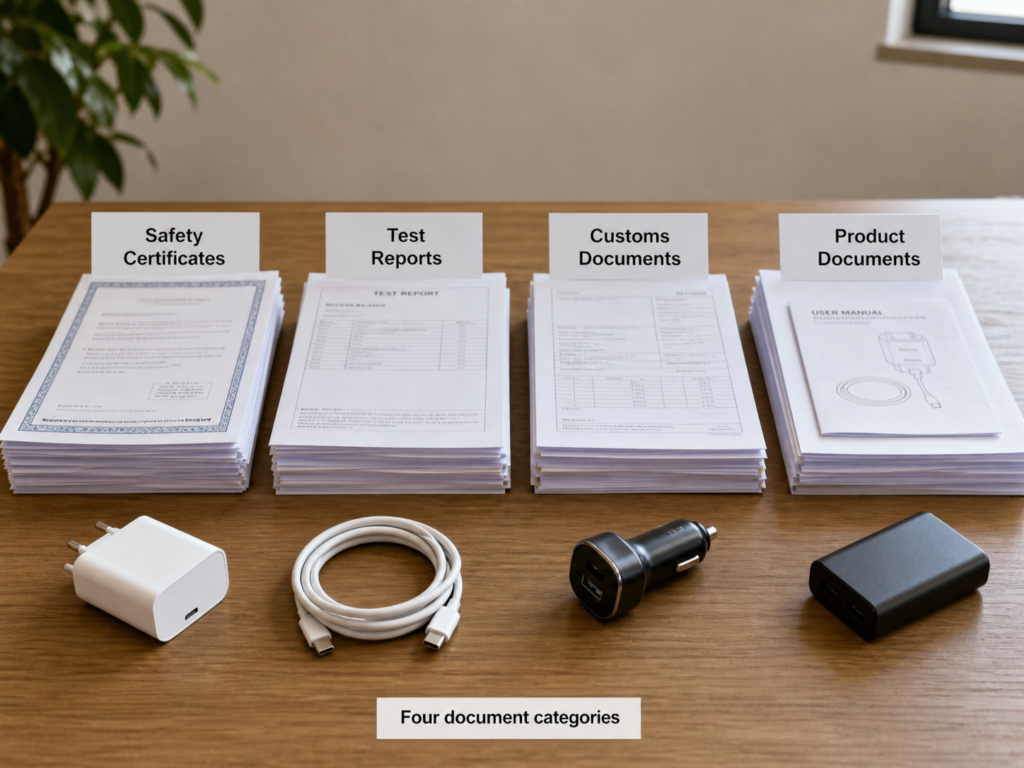
The first category is **customs declaration documents**, which are materials used by customs to verify the identity, value, origin, and regulatory qualification of goods. Their function is to enable legal customs clearance, equivalent to the “entry pass” of goods.
The second category is **product regulatory compliance documents**, which are used to prove that products comply with mandatory rules of the destination country such as safety, electromagnetic compatibility, and radio. Their function is to enable legal sale, equivalent to the product’s “market access certificate”.
The third category is **producer responsibility/environmental obligation documents**, which involve supply chain responsibilities such as recycling and chemical restriction. They are not certifications of the product itself, but responsibility requirements after the goods are sold.
The fourth category is **platform/commercial customer documents**, which are additional materials required by e-commerce platforms and retailers for entry or random inspection. The responsible entity is the seller, and these are commercial requirements rather than mandatory legal requirements.
Let’s first clarify one of the most common pitfalls: **passing customs clearance ≠ legal sale eligibility**. Customs only checks documents that are explicitly stipulated by law to be verified by customs, and will not proactively check all materials required for market access. Many people sell with confidence after their goods clear customs, only to find out they are missing documents when inspected by local market regulators or platforms later – this is falling into this misunderstanding.
To help you distinguish, below is a comparison of the core attributes of the four types of requirements:
| Comparison Dimension | Customs Declaration Documents | Product Compliance Documents | Producer Responsibility/Environmental Documents | Platform/Commercial Customer Documents |
| Issuing Entity | Seller/Exporter/Carrier | Manufacturer/Accredited Laboratory/Certification Body, depending on the system | Producer/Importer | Seller/Manufacturer |
| Trigger Scenario | When goods enter the country for customs clearance | When products are placed on the market for sale | Valid continuously after products enter the market | When entering a platform/cooperating with customers |
| Submission Recipient | Customs of the importing country | Market regulatory authorities, or provided to customs during statutory random inspections | Environmental/recycling competent authorities | E-commerce platforms/commercial customers |
| Responsible Party for Preservation | Importer/Customs Broker | Manufacturer/Importer | Producer/Importer | Seller/Platform |
| Preservation Period | Determined according to the customs and tax regulations of the importing country and the requirements of the carrier; may be several years or longer in different countries; shall be subject to the official regulations of the destination country | According to regulatory requirements, for example, technical documents for some products in the EU are usually kept for 10 years | According to environmental protection regulations | According to platform/contract requirements |
| Whether to Accompany Goods | Usually required, or declared electronically in advance | Usually do not need to accompany goods, need to be kept for inspection | Do not need to accompany goods | Do not need to accompany goods, submitted online via the platform |
| Typical Exceptions | Small parcels sent via direct mail may be exempt from packing lists | Non-sale samples may be exempt | Some small-batch samples may be exempt | Sales on independent websites may have no platform requirements |
Scope of Application and Validity Reminder
The general rules in this article mainly cover wired chargers/power adapters, passive charging cables, and USB-C cables with E-Marker/fast charging chips. Special categories such as power banks with large-capacity batteries and car chargers, as well as emerging markets such as the Middle East, Latin America, and Africa, have large differences in rules that require separate verification, and are not within the general scope of this article.
In addition, please note that national tariffs, certification rules, and platform policies may be adjusted in 2025-2026. Be sure to verify the latest official requirements before shipping, and do not directly use old experience from several years ago.
2. How to Determine Which Documents You Need: A Three-Dimensional Decision Framework
Rote memorization of the rules of various countries is useless. By applying the three dimensions of “product + market + scenario”, you can draw up your own exclusive document list, without doing useless certifications blindly.
Step 1: First Understand Your Product Attributes
Product parameters are the basis for all rule judgments. The core parameters to collect are: input and output parameters, whether there is AC-DC conversion, whether there is a wireless/digital circuit, whether there is a built-in battery, whether the USB-C cable has an E-Marker, whether the plug is detachable, and whether it is an own brand or OEM.
The corresponding regulatory judgment logic can be understood as follows:
• When there is AC input, electrical safety regulations shall be judged according to the rated voltage, product category, and target market;
• When there are communication transmission functions such as Bluetooth and Wi-Fi, radio equipment rules are usually triggered; wireless charging needs to be verified according to the specific classification of inductive power supply equipment in the target country;
• When there is a digital circuit/E-Marker chip, it is necessary to judge whether EMC (Electromagnetic Compatibility, simply put, the product does not interfere with other devices when working, nor is it interfered by other devices) regulations are triggered;
• When there is a built-in battery, it is usually necessary to judge battery safety and transport regulations;
• Cables with active chips (such as E-Marker) shall be judged according to the relevant rules of electronic products in combination with their overall functions and structure, and cannot be directly regarded as ordinary wires;
• If the plug/power cord is detachable, the plug itself must also comply with the plug standard of the destination country;
• For brand attributes (own brand/OEM), the division of responsibilities between the manufacturer and the brand party shall be clarified.
Step 2: Confirm the Market and Responsible Entities
You cannot only look at the final country of sale. The requirements of the importing country, transit or storage location, and final sales market shall be checked at the same time; the final country of sale cannot replace the compliance judgment of the first import location and the actual market placement location.
For example, if goods are shipped from China, transshipped through Singapore, and then enter the United States, the product regulations of the main sales market are usually judged according to the United States, but Singapore’s transshipment, warehousing, customs declaration, and local operation requirements may also apply respectively, and you cannot simply think that “it has nothing to do with Singapore”. If goods first enter one EU member state and then are transshipped to another member state, issues such as first import, importer responsibility, and actual market placement must also be considered separately.
The responsible entities should also be clarified in advance: the manufacturer is the one that makes the product, the importer is the one that receives the goods in the destination country, the authorized representative is the entity designated by the manufacturer in the destination country to undertake corresponding liaison or compliance duties within the scope permitted by regulations, and the platform is the channel for selling goods, each with different responsibilities. For example, some EU regulations require information on economic operators or responsible persons within the EU, but the specific responsible entity depends on the applicable regulations, the location of the manufacturer, and the sales method.
Different sales/logistics modes correspond to different document requirements:
• **General trade/overseas warehouse restocking**: Batch customs clearance usually requires commercial invoices, transport documents, packing lists (if required), and correct classification and license documents; product compliance, producer responsibility, and platform documents shall be prepared according to the target market and import mode, and submitted or kept for inspection when necessary;
• **Cross-border e-commerce platform warehouse**: Basically handled according to the overseas warehouse mode; in addition, it must meet the requirements of platform document accessibility, online upload, and random inspection;
• **Platform direct mail/personal express**: Cleared according to express procedures; low-value goods may enjoy simplified tax or declaration procedures, but this does not exempt market access responsibilities;
• **Third-party overseas warehouse warehousing**: Compliance documents must also be provided according to warehouse requirements to avoid warehousing rejection.
Step 3: Judge the Purpose and Scale of the Goods
• If it is **commercial sale**: no matter how low the value or how small the quantity, it is still necessary to judge and prepare applicable mandatory compliance documents; low-value/express rules mainly affect declaration taxes and customs clearance procedures, and do not automatically exempt the obligation of placing on the market;
• If it is **non-sale sample/personal use**: it must meet the three prerequisites of “non-sale purpose, reasonable quantity, marked as sample/not for sale” at the same time, and then verify the specific rules of the destination country; not all countries grant sample exemptions;
• If it is a **combination set** (for example, charger + cable sold together): judge separately according to the actual composition of the product and applicable regulations. For sets sold and packaged together, focus should also be paid to components with stricter regulatory requirements, and cannot be simply judged based on the cable or outer packaging.
Once all three dimensions are clarified, you can output an exclusive list of four types of documents: customs declaration, product compliance, producer responsibility/environmental protection, and additional platform requirements. You should also pay attention to whether there are special requirements, such as official language translation, notarization, format, and signature requirements.
3. General Customs Declaration Documents: Basically Required for Customs Clearance
Most commercial imports involve commercial invoices and transport documents; packing lists, certificates of origin, licenses, and other documents shall be determined according to the destination country, mode of transport, value of goods, and regulatory status of the goods. There is no completely unified list of customs clearance documents for different countries, modes of transport, and transaction modes.
Commercial Invoice: Core Voucher for Goods Value and Description
The commercial invoice is the core basis for customs to judge what your goods are and how much they are worth. Common contents include information of the buyer and seller, product name, model, quantity, unit price, total price, currency, and trade terms (such as FOB, CIF).
When filling in the product name for charging products, never write vague terms like “charging cable” or “charger”. Be sure to clearly state the interface type, power, and whether it has an active chip, for example, write “65W USB-C PD Power Adapter” or “240W USB-C Charging Cable with E-Marker”, and ensure that the description is consistent with the actual structure of the product.
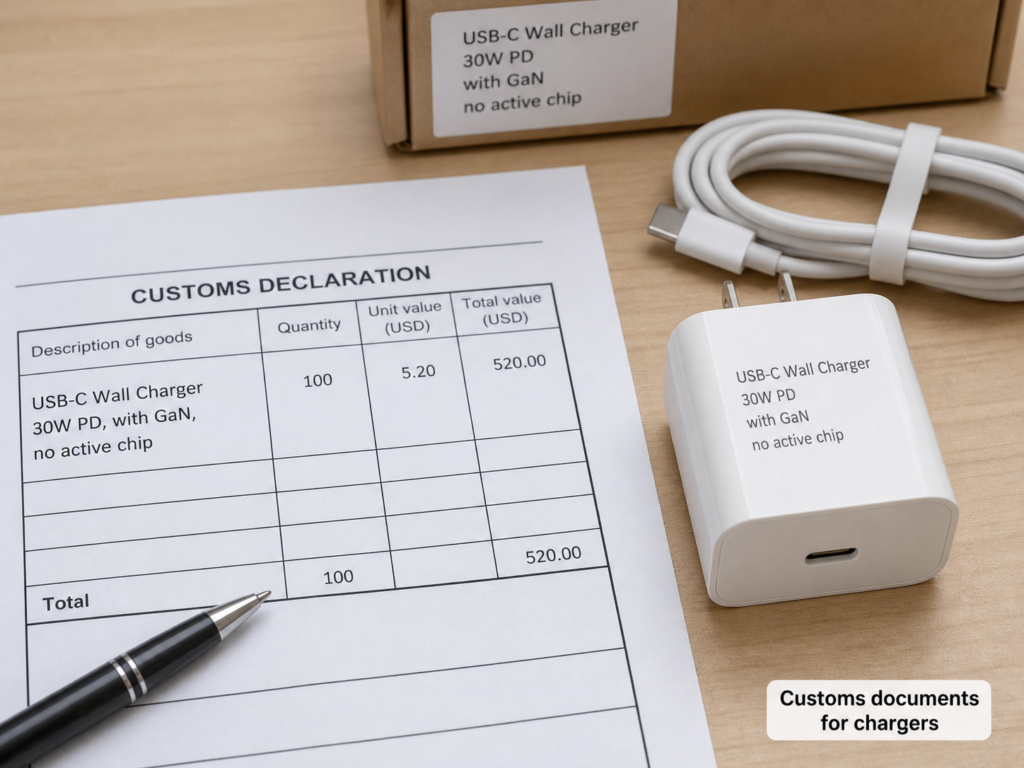
The declared value shall be consistent with data such as actual transactions, payment, freight and insurance, and shall be determined according to the customs valuation rules of the importing country. The platform selling price can only be used as a reference for reasonableness check, and cannot be mechanically used as the customs declaration value, because the platform selling price may include commissions, domestic taxes and fees, warehousing fees, freight, or retail prices for consumers. Underreporting to evade taxes or overreporting to defraud tax refunds will be punished if discovered.
Packing List: Voucher for Checking Goods Quantity and Weight
The packing list is a voucher used to check how many goods are in each box and how much they weigh. Common contents include box number, quantity per box, gross weight, net weight, and outer box dimensions. It is usually more necessary to provide when multiple boxes/multiple models are mixed, while small parcels sent via direct mail may not need it, depending on the carrier and the declaration requirements of the destination country.
Special attention should be paid for charging products: chargers with power supplies and passive cables should be marked separately to avoid confusion in HS classification and goods description.
Transport Documents: Voucher for Transport Chain
Transport documents are used to prove the transport contract, carriage chain, number of pieces, and consignee/consignor information; whether they have the function of a document of title depends on the type of document and applicable law. Common types include express waybills (for direct mail), ocean bills of lading (for FCL/LCL), and air waybills (for air transport).
When checking, note that core fields such as consignee, goods description, and number of pieces must match those on the commercial invoice, otherwise customs may require further explanation. If the goods are shipped in batches or transshipped, keep complete records of the transport chain.
HS Code: Code for Commodity Classification and Tariff Determination
Many people think the HS code is a certification number, but it is not. It is a code for classifying goods, used to determine tariffs and regulatory categories. The first 6 digits are globally universal, and the tariff code from the 7th digit onwards may vary from country to country.
The classification of charging products cannot be determined only by the product name, nor only by whether there is a chip. It shall be judged on a case-by-case basis based on the overall function, structure, connector, rated parameters of the product and the tariff interpretation of the importing country. E-Marker does not automatically determine a separate tariff code. If necessary, you should apply for a pre-ruling from the customs of the importing country, or consult a professional customs brokerage agency with corresponding experience.
Common products may involve power conversion equipment, electrical conductors with connectors, or other related tariff items, but the specific classification shall be subject to the tariff schedule and official interpretation of the destination country. Wireless chargers are not necessarily uniformly classified under ordinary power supplies or a fixed tariff code.
Here is a reminder: do not directly copy the old code given by the supplier, as it is easy to make mistakes. The final classification shall be subject to the pre-ruling of the customs of the importing country or the professional customs clearance opinion with corresponding experience.
Origin Documents: Voucher for Tariff Preferences
Many people confuse origin, thinking that the place of shipment or the place of brand registration is the origin, which is wrong. Origin shall be determined according to the non-preferential origin rules of the importing country or the origin rules of the applicable free trade agreement, which may involve criteria such as substantial transformation, regional value content, and tariff classification change, and cannot be simply equated with the location of the factory or the last production site.
Common forms include certificates of origin, origin declarations on invoices, and supplier declarations, but whether these documents can be used depends on the specific free trade agreement, the system of the destination country, and the qualification of the declarant. Relevant origin certificates are usually key documents only when you apply for preferential tariffs under a free trade agreement; ordinary non-preferential tariff scenarios may not require preferential origin certificates, but customs may still require explanation of non-preferential origin.
4. Compliance Requirements for Major Markets: Legal Sale Eligibility After Customs Clearance
In this part, we will explain the core requirements of each major market according to a unified logic. Let’s emphasize the general rule again: customs only checks documents that are explicitly stipulated by law to be supervised by customs, and will not proactively check all materials for market access. Passing customs clearance does not mean you can sell legally.
United States
Applicable products: chargers with digital circuits/RF, USB-C cables with active components, wireless charging products.
The core is FCC regulations, which are divided into several categories:
• **Part 15 Unintentional Radiation**: Devices with digital circuits or other unintentional radiation characteristics covered by FCC rules usually need to adopt SDoC or applicable certification procedures according to Part 15 Subpart B. The specific judgment shall be based on the device circuit, function, and FCC classification. Ordinary wall-mounted chargers cannot be directly deemed to necessarily require SDoC solely based on appearance or name;
• **Part 15 Intentional Radiation**: Products with communication transmission functions such as Bluetooth and Wi-Fi usually require an FCC ID, which requires prescribed third-party testing and FCC equipment authorization. Such information can be found in the official system;
• **Part 18**: May apply to some wireless chargers, and needs to be judged according to the specific operating frequency, function, and device classification.
Attention should also be paid to non-FCC requirements: UL/ETL safety certification is not a mandatory requirement of US federal customs, and may be required by platforms, retailers, insurers, or commercial customers; CPSIA mainly applies to children-related products, and ordinary chargers and cables cannot be subject to children’s product requirements just because they are sold to ordinary consumers.
Concurrent obligations: There is no unified federal-level producer registration system, but if the product contains or is accompanied by regulated batteries, state-level battery recycling or producer responsibility regulations must also be verified according to the sales state and battery type.
In terms of labeling, the prescribed compliance statement and user information shall be provided according to the applicable FCC clauses, and whether to use the FCC logo shall be judged according to specific rules; if the platform or retailer requires UL/ETL labeling, corresponding commercial conditions must also be met. The responsible entity usually involves a responsible party or importer within the United States, which shall be confirmed according to the product category and FCC procedures. Verification can be done through official or accredited channels such as the FCC ID query system and the OSIRIS laboratory accreditation database.
Special risks: Cables with E-Marker are not necessarily regulated by the FCC, depending on the specific digital circuit and function; SDoC is not a government-issued certificate and cannot be simply packaged as a so-called “FCC certificate”.
European Union
Applicable products: Charging products entering the EU market correspond to different regulations according to their functions.
The core is CE compliance. Note that CE is a manufacturer’s self-declaration, not a certificate uniformly issued by a third-party organization:
• Applicable regulations: Chargers with AC input usually need to judge requirements such as LVD (Low Voltage Directive, electrical safety), EMC (Electromagnetic Compatibility), and RoHS (Restriction of Hazardous Substances) in combination with rated voltage and product category; devices with wireless communication or wireless measurement functions such as Bluetooth and Wi-Fi usually also need to judge RED (Radio Equipment Directive);
• Usually requires EU DoC (European Union Declaration of Conformity), as well as technical documents and conformity assessment evidence that comply with applicable regulations;
• Whether a notified body, third-party laboratory report, or responsible person within the EU is required shall be judged according to specific regulations, product category, sales method, and location of the manufacturer, and accredited laboratory reports cannot be regarded as a unified mandatory document for all CE products;
• Technical documents are usually prepared by the manufacturer and kept according to applicable regulations. The retention period for some products in the EU is 10 years, and importers must also keep copies of declarations and cooperate in providing information according to regulations.
Concurrent obligations are not part of CE certification and must be implemented separately:
• **WEEE**: Products covered by WEEE rules usually need to use the prescribed recycling logo and fulfill corresponding producer registration, reporting, and recycling obligations in the member state where they are sold; specific procedures are determined by each member state;
• **REACH**: Involves chemical restriction and information declaration obligations, there is no unified “REACH certification certificate” applicable to all products;
• **GPSR**: Involves general requirements for consumer product safety, there is no unified “GPSR certification certificate”;
• **Common Charging Rules**: Directive (EU) 2022/2380 stipulates unified charging interface, charging capacity, labeling, and instruction obligations for listed categories of radio equipment. Some devices such as mobile phones apply from December 28, 2024, and categories such as laptops have subsequent application dates.
Labeling requirements usually include the CE mark, as well as the prescribed recycling mark and responsible person information when covered by WEEE rules. The responsible entity shall be judged in combination with the manufacturer, importer, authorized representative, and specific regulations. Verification can be done through the NANDO notified body query system, but NANDO can only be used to check the qualification of notified bodies, and cannot query the authenticity of all CE documents, because CE itself is not a unified third-party certificate.
Special risks: CE is a manufacturer’s self-declaration, and the core lies in technical documents, conformity assessment, and declaration of conformity. Many people think that having a “CE certificate” is called CE certification, but in fact, not all products require a notified body or third-party certification.
United Kingdom
Two parts of the UK have different rules: Great Britain (GB) and Northern Ireland (NI) cannot simply apply the same set of requirements.
• **Great Britain (GB)**: UKCA can be used according to specific regulations and product categories, and the UK also continues to recognize CE for many types of products;
• **Northern Ireland (NI)**: Usually applies EU-related product rules. UKNI is only used in specific cases where third-party conformity assessment is carried out by a UK accreditation body, and CE+UKNI cannot be used as a unified requirement for all products.
The core requirements of Great Britain include electrical safety, EMC, RoHS, and radio equipment regulations under the UKCA system, but whether UKCA must be used depends on specific regulations, product categories, and conformity assessment paths. The UK currently continues to recognize CE for many types of products, which shall be checked according to the scope, conditions, and effective dates of regulations announced by the UK government. It cannot be generalized that GB must use UKCA, nor that CE will soon be uniformly invalidated.
Relevant documents may include UKCA or CE declaration of conformity, testing and conformity assessment evidence, information on responsible persons within the UK, and technical documents, which shall be determined according to applicable regulations. Manufacturers are usually required to keep technical documents.
Concurrent obligations include producer responsibilities such as UK WEEE and battery recycling, which need to be checked separately according to whether the product falls within the regulated scope and relevant systems. Labeling requirements include the applicable UKCA or CE mark, as well as responsible person information.
Responsible entities may include manufacturers, importers within the UK, authorized representatives, or other economic operators, depending on product rules and sales arrangements. Verification can be done through the UK government’s official guide page on CE and UKCA. There is no unified “certificate query portal” covering all products in the UK, and focus should be on checking declarations, technical documents, and conformity assessment entities.
Special risks: UKCA is not a single certification, and different product regulations have different requirements; the rules for Northern Ireland are different from those for GB, and must be verified according to the product and assessment body before using CE, UKCA, or UKNI.
Japan
Applicable products: Charging products within the scope of the items of the Electrical Appliance and Material Safety Law; not all charging products require PSE.
The core is PSE compliance. The judgment logic is to first check the official item classification, rated parameters, and product structure, and then determine the grade:
• **Specified Electrical Appliances and Materials**: When falling within this scope, the prescribed inspection must be completed by a registered conformity inspection body according to the Electrical Appliance and Material Safety Law, and labeling requirements must be met. Whether the institution is located in Japan, required documents, and importer obligations shall be checked according to specific items;
• **Non-Specified Electrical Appliances and Materials**: Usually involves self-confirmation of conformity by the manufacturer or importer and retention of test records, and the specifics are still subject to items and regulatory requirements;
• **Ordinary cables**: Judge whether they fall within the PSE scope according to specific items; not all are applicable.
Products with wireless functions also need to judge the requirements of the Radio Law. For concurrent obligations, there is no producer registration system uniformly applicable to all charging products, and some categories may have recycling obligations. Labeling requirements include the corresponding PSE mark, as well as information on the Japanese importer or responsible entity marked according to specific rules.
The responsible entity usually involves the importer within Japan, which is one of the main responsible parties. Verification can be done through the Ministry of Economy, Trade and Industry’s list of electrical appliance items, notification supplier information query, and list of conformity inspection bodies.
Special risks: PSE is a statutory labeling system, not a voluntary certification; there is no unified public database for querying the authenticity of PSE certificates, and you cannot casually trust so-called query channels on the Internet. PSE labeling and importer obligations must be judged based on specific items, rated parameters, and product structure.
Australia
Applicable products: Chargers and charging products with electronic components that fall within the scope of electrical equipment regulation, but not all products automatically apply the same level of EESS requirements.
Core compliance requirements:
• **Electrical Safety**: First judge whether responsible supplier registration, evidence records, or certification is required according to EESS product grades and state/territory rules;
• **EMC/Radio and Telecommunications**: Check ACMA’s requirements for EMC, radio, and telecommunications equipment separately;
• **RCM Mark**: Used after meeting applicable safety, EMC, radio, or telecommunications requirements. RCM is a unified mark, not a single certification.
Concurrent obligations include producer responsibilities such as battery recycling, but further verification is only required when the product contains or is accompanied by regulated batteries, or triggers a specific state/federal producer responsibility system. Labeling requirements usually involve RCM and other information required by regulations.
The responsible entity is the responsible supplier within Australia. Verification can be done through the EESS registration database, ACMA-related compliance databases, and official guides.
Special risks: EESS mainly addresses electrical safety requirements and cannot replace ACMA’s EMC, radio, or telecommunications compliance. Conversely, completing a certain ACMA requirement does not mean that EESS electrical safety requirements are automatically met.
New Zealand
Applicable products: Charging products within the scope of electrical equipment regulation.
Core compliance requirements: Check New Zealand’s electrical safety and EMC regulations separately. Some devices need to comply with prescribed standards, keep compliance evidence, and use RCM or other marks according to applicable labeling rules; specific requirements are subject to the official regulations of MBIE and Radio Spectrum Management. In terms of electrical safety, not all products can be arbitrarily selected by suppliers for self-declaration or third-party certification; it still depends on the product category and applicable system.
Concurrent obligations include producer responsibilities such as battery recycling, which need to be verified separately. The responsible entity usually involves suppliers within New Zealand. Verification can be done through New Zealand MBIE official guides and relevant competent authority pages.
Special risks: Australian EESS/RCM rules cannot be directly applied; New Zealand’s electrical safety, EMC, radio, and labeling requirements must be confirmed separately.
Canada/South Korea (Simplified)
• **Canada**: Products with wireless/RF functions usually need to meet ISED certification requirements; ordinary digital devices need to meet applicable standards such as ICES-003, and specific procedures are judged according to device category;
• **South Korea**: Chargers may require KC safety certification, and those with wireless functions may also require additional KC radio compliance; at the same time, the responsible entity within South Korea and product category requirements must be confirmed.
5. Full Practical Process: From Requirement Confirmation to Document Archiving
After talking about the rules, next is the full practical process, step by step, to avoid doing certifications in vain and wasting money.
Step 1: Confirm the Requirement List (Avoid Wasting Certifications)
First, compare with the three-dimensional decision framework above, clarify the product attributes, target market, sales/logistics mode, and purpose of goods, output a list of four types of documents, and also confirm whether there are special requirements, such as translation, notarization, format, and signature. Many people get a CE certification right away, only to find that it is completely inapplicable for selling to the US, wasting money.
Step 2: Compliance Resource Screening (If Testing/Certification is Required)
If testing or certification is required, it is very important to choose the right institution. The screening criterion is to confirm the qualification of the corresponding entity according to applicable regulations, such as laboratories or certification entities involved in the FCC equipment authorization procedure, notified bodies under specific EU conformity assessment paths, etc. Not all products require a notified body or third-party certification, so the regulatory path should be confirmed first, and then the institution selected.
Prioritize institutions with compliance experience in similar products such as charging electronic accessories; they are familiar with the rules and can avoid detours.
Pitfall avoidance tip: Anyone who says “guaranteed pass”, “ultra-low price fast certificate”, or “no sample required” is basically worthy of vigilance. Whether samples, third-party testing, or notified bodies are required shall be subject to applicable regulations and product categories, and cannot rely on verbal promises from sales agencies.
Step 3: Submit Samples and Technical Materials
The samples must be finished products completely consistent with the bulk goods, including packaging and labels. The quantity shall be according to the test plan and laboratory requirements. Basic materials include product circuit diagrams, bill of materials (BOM), manuals, and label samples.
For charging products, additional preparation of input and output parameters, USB-C cable E-Marker parameters (if any), and fast charging protocol descriptions is required, otherwise testing or conformity assessment may not be carried out accurately.
Step 4: Document Preparation and Consistency Control
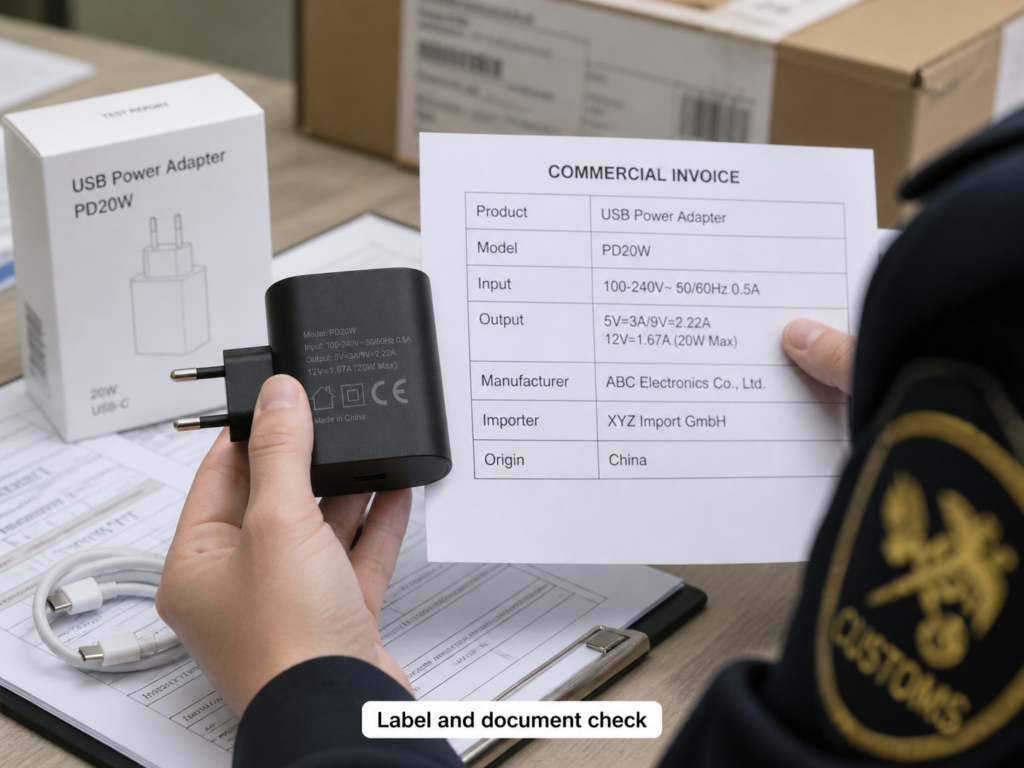
This is the most prone place for pitfalls. The core rule: the core fields of all documents must correspond to each other, and major inconsistencies may trigger supplementary certificates, inspections, or even penalties.
Customs declaration documents shall be filled in as mentioned above to ensure that the core information of the invoice, packing list, and waybill matches. The HS code shall be judged on a case-by-case basis according to the tariff schedule of the importing country and the actual structure of the product. Do not apply old codes solely based on names such as “charger”, “charging cable”, or “with chip”.
Compliance documents shall be verified:
• The model, parameters, and manufacturer on the declaration, report, or certificate must be consistent with the bulk goods;
• Confirm that the qualification of the issuing or issuing entity meets regulatory requirements;
• Verify relevant qualifications and registration information through the official entrances mentioned above;
• Confirm that product labels, manuals, and responsible entity information correspond to the documents.
Core mandatory check items: model, electrical/functional parameters, manufacturer/importer, origin, packaging label, test sample. If these do not match, it will most likely trigger supplementary explanations or further inspections.
Step 5: Document Archiving and Version Management
Archiving requires simultaneous retention of electronic and paper copies. The period is determined according to applicable regulations, platform rules, and contract requirements. For example, technical documents for some products in the EU are usually kept for 10 years.
It is best to make a ledger to clearly register the document version, corresponding model, production batch, manufacturer, test sample information, bulk goods change records, and signing/discontinuation date, which is convenient for future reference. If there are changes to the product, such as revision, change of core supplier, or change of key parameters/packaging, it is necessary to re-evaluate whether the documents can still be used, and cannot directly use the old ones.
6. Advanced Judgment: Risk Avoidance and Special Scenarios
Next is advanced content to help you judge risks and handle special scenarios, which you will encounter after doing this for a long time.
Judgment on Exemption for Samples/Small-Batch Goods
Core principle: **customs clearance simplification threshold ≠ exemption from market access obligations**, these two must be judged separately.
Customs clearance simplification depends on the express/small-batch value threshold of the destination country, which usually affects tariff payment, declaration materials, or customs clearance procedures. Market access exemption depends on product regulations and the purpose of the goods, and you cannot presume that they can be sold just because the value is low or the quantity is small.
Market access exemption must simultaneously meet non-sale purpose, reasonable quantity, marked as not for sale/sample, and also comply with the specific rules of the destination country; not all countries grant sample exemptions. The red line for charging products: as long as the goods are for sale, regardless of value/quantity, in principle, mandatory compliance documents must be prepared, and do not take chances.
Document Validity and Change Management
Many people think that if the core components are the same, they can directly combine certifications, and if they change something, they don’t need to retest. This is wrong. The impact of changes on test results and compliance conclusions must be evaluated one by one:
• **Hardware/key component changes**: For example, PCB, power/wireless chip, transformer, E-Marker chip, housing, power, cable length, etc., may affect safety, EMC, or wireless performance, and most likely require supplementary testing or even re-evaluation;
• **Firmware changes**: If they affect RF, EMC, or safety performance, supplementary testing or updating of conformity assessment documents is required; when they do not affect these performances, change judgment records must also be kept;
• **Supplier changes**: Verify the consistency between the new product and the original test sample, and retest if necessary;
• **Label changes**: When only changing the layout that does not affect safety, EMC, wireless performance, and statutory information, it can usually be handled through document review; if it involves rated parameters, warnings, statutory marks, or responsible entities, it shall be re-evaluated, and if necessary, supplementary testing shall be carried out and the declaration updated;
• **Sales region changes**: Recheck the regulations of the target market, and cannot directly apply documents from other markets.
The premise of series certification is products of the same series with the same circuit structure and core components. The most unfavorable model is selected for testing. Whether other models can be covered must be jointly supported by applicable regulations, testing institutions, and technical documents, and not any model can be included in one certificate.
Common Cognitive Misconceptions
A few common pitfalls, let’s emphasize again not to make them:
1. **Can a manufacturer’s test report clear customs/sell?**
A manufacturer’s report cannot automatically replace the conformity assessment documents required by the regulations of the destination country. If the applicable system allows manufacturers to self-test, the manufacturer’s report can be used as technical evidence, but must meet the corresponding regulations, test methods, laboratory capabilities, and record requirements; if regulations require a third party or notified body, ordinary manufacturer’s reports cannot be used as a substitute.
2. **Are CE/FCC certifications globally valid?**
No, national regulatory systems are independent and cannot be mutually recognized. Whichever country you go to, you must judge according to that country’s requirements.
3. **Does printing the CE/FCC mark on the product equal compliance?**
No, there must be corresponding written documents, technical support, and correct conditions for using the mark; just printing a mark is useless.
4. **If you find a freight forwarder to handle customs clearance, you don’t need to prepare compliance documents yourself?**
No, sellers, manufacturers, importers, or other economic operators may still bear corresponding compliance responsibilities. Freight forwarders only help you clear customs and cannot replace the product responsible entity.
5. **Small batches/samples definitely do not need compliance documents?**
No, only non-sale samples that meet the exemption conditions of the destination country may be exempted, and goods for sale still need to prepare documents according to applicable regulations.
Common Causes of Customs Detention and Handling Steps
Common document-related reasons for goods detention: no valid compliance documents or documents do not meet regulatory requirements; product models and parameters on compliance documents do not match the actual goods; inconsistent core information in customs clearance documents (mismatch of product name, quantity, value, consignee/consignor); forged documents or the issuing entity does not have corresponding qualifications; lack of information on local importers or responsible persons required by the destination country.
If the goods are really detained, remember the handling steps:
Contact the customs broker and the original compliance service agency immediately to confirm whether supplementary certificates, clarification of information, or updated documents are possible; provide product information to customs truthfully, and must not conceal or submit false materials; if it really does not meet the requirements, prioritize return or destruction to avoid higher fines and subsequent liabilities caused by forced customs clearance; keep all communication records for subsequent appeals or responsibility division.
Special Focus of Inspection for Charging Products
There are several special focuses in customs inspection of charging products, which you can self-check before shipping:
• Whether the input and output power and electrical parameters of the charger are consistent with the markings on the documents;
• Whether USB-C interface products comply with the interface specification requirements of the destination country, such as the EU common charging rules;
• Whether cables declared as “passive” actually have active electronic components such as E-Marker;
• Whether the certification marks and manufacturer/importer information on the product label are consistent with the documents;
• Whether products with wireless communication functions such as Bluetooth and Wi-Fi have corresponding RF compliance documents;
• Whether wireless charging products are classified into radio, EMC, industrial, scientific and medical equipment, or other special regulatory categories by the destination country.
7. Practical Tools and Practical Cases
Finally, we have sorted out some practical tools and cases for you, which can be used directly.
List of Official Compliance Verification Tools
These are all official entrances or query channels provided by competent authorities, which are more reliable for checking qualifications and registrations:
• **Americas**: US FCC ID Query System, OSIRIS Laboratory Accreditation Database, Canada ISED Certification Query System;
• **Europe**: EU NANDO Notified Body Query System, UK Government CE/UKCA Guide Page;
• **Asia-Pacific**: Japan METI Electrical Appliance Item List/Notification Supplier Query, South Korea KC Certification Query System, Australia EESS Registration Database, ACMA Compliance Database, New Zealand MBIE and Radio Spectrum Management Official Guides.
Pre-Shipment Self-Check List for Charging Products
• **Pre-preparation**: Confirm product attributes, target market regulatory requirements, shipping scenario and purpose;
• **Mid-term preparation**: Verify the qualification of compliance service agencies, prepare samples and materials that meet requirements, and ensure that the core information of documents corresponds;
• **Post-verification**: Verify qualifications/registration information through official channels, match documents with physical goods, and archive as required.
Practical Cases of Typical Products
Case 1: 65W USB-C Power Adapter (US Market, Overseas Warehouse Restocking)
**Product profile**: Wall-mounted 65W PD fast charger, with AC input, digital circuit, no wireless function, own brand.
**Compliance judgment**: Whether it falls within the scope of FCC Part 15 Subpart B and whether SDoC or other equipment authorization procedures are required shall be judged according to the device circuit, function, and FCC classification; UL/ETL safety certification is usually a commercial requirement of platforms, retailers, or insurers, not a unified mandatory requirement of US federal customs. Since the product does not contain batteries, it cannot be presumed that battery recycling registration is required just because it is sold to California.
**Document list**: Customs declaration category includes commercial invoice, packing list, ocean/air waybill, HS code judged on a case-by-case basis according to the tariff schedule of the importing country, and origin documents required when applying for preferential tariffs under free trade agreements; product compliance category includes applicable FCC compliance declaration or authorization documents, testing and technical materials, and UL/ETL documents required by platforms or retailers; producer responsibility category shall be judged according to whether the product contains regulated batteries and the requirements of the sales state; platform category includes entry qualification documents required by the platform.
**Risk reminder**: Do not mistakenly think that UL is a mandatory requirement of US federal customs; also do not mechanically use the platform selling price as the customs declaration value. The declared value shall be determined according to actual transactions, payment, freight and insurance data and US customs valuation rules.
Case 2: Passive USB-C Charging Cable (EU Market, Platform Direct Mail)
**Product profile**: Ordinary passive USB-C to C charging cable, no E-Marker chip, no active components, used for charging and data transmission.
**Compliance judgment**: Applicable requirements such as RoHS need to be judged, and corresponding product safety and information obligations shall be determined in combination with whether the product is covered by other EU harmonized regulations and the scope of GPSR application. WEEE obligations shall be checked according to the sales member state, producer identity, and whether the product falls within the scope of regulated electrical and electronic equipment.
**Document list**: Customs declaration category includes commercial invoice, express waybill, and HS code judged on a case-by-case basis according to the tariff schedule of the importing country and product structure; product compliance category includes applicable RoHS compliance evidence and EU DoC, and WEEE obligations are checked according to the member state where the product is sold; if GPSR applies, then implement EU responsible person and product information requirements according to its rules. Test reports can be used as supporting materials, but are not universally applicable statutory certificates; platform category includes uploading compliance documents required by the platform.
**Risk reminder**: Direct mail may only simplify the customs clearance process and does not exempt market access obligations; do not mistakenly think that passive cables do not need compliance, as market supervision or platform random inspections may still require documents.
Case 3: 240W USB-C Cable with E-Marker (Great Britain, UK, Platform Entry)
**Product profile**: 240W fast charging USB-C cable with E-Marker chip, with active digital circuit.
**Compliance judgment**: Applicable UK regulations such as EMC and RoHS need to be judged according to the product circuit and function, and the conformity assessment path shall be verified according to the UKCA or CE arrangements currently recognized by GB. A declaration of conformity, information on responsible persons or other economic operators within the UK, and technical documents consistent with the product shall be prepared. UK WEEE producer responsibility shall also be checked according to product scope and sales arrangements.
**Document list**: Customs declaration category includes commercial invoice, packing list, transport documents, and HS code judged on a case-by-case basis based on the tariff schedule of the importing country and the overall function and structure of the product; product compliance category includes applicable UKCA or CE declaration of conformity, testing and conformity assessment evidence, information on responsible persons or other responsible entities within the UK, and technical documents; producer responsibility category includes UK WEEE-related registration or declaration materials (if applicable); platform category includes compliance documents required for platform entry.
**Risk reminder**: Do not mechanically apply a certain HS tariff code just because the product has an E-Marker, nor declare it simply as an ordinary passive cable; it shall be judged according to the actual structure of the product and the applicable UK tariff schedule. The rules for Northern Ireland are different and require separate verification.
Case 4: 15W Wireless Charger (Japanese Market, General Trade)
**Product profile**: Wall-mounted 15W wireless charger, with AC input, using electromagnetic induction to power devices.
**Compliance judgment**: First check the official Japanese list of electrical appliance items, and confirm whether it falls within the PSE scope and applicable grade according to rated parameters and product structure. Whether the Radio Law or high-frequency equipment rules apply shall be judged according to the classification, frequency, and power requirements of Japanese official radio communication equipment and high-frequency equipment, and cannot be deemed as radio transmitting equipment just because it is a 15W wireless charger. The obligations of the importer or other responsible entities within Japan must also be confirmed.
**Document list**: Customs declaration category includes commercial invoice, packing list, ocean bill of lading, and HS code judged on a case-by-case basis according to product structure and the tariff schedule of the importing country; product compliance category includes applicable PSE marks and conformity documents, compliance documents related to the Radio Law or high-frequency equipment (if applicable), and information on the Japanese importer or responsible entity; producer responsibility category includes applicable recycling obligation materials; commercial customer category includes additional documents required by retailers.
**Risk reminder**: PSE is a statutory labeling system, not a voluntary certification. For products within the scope of application of the Electrical Appliance and Material Safety Law, the information of the Japanese importer or responsible entity shall be marked according to the specific PSE labeling rules; absence may lead to problems in import, sales, or regulatory disposal, and the specific consequences shall be handled by customs and competent authorities on a case-by-case basis, and it cannot be generalized that customs clearance is definitely impossible.
Case 5: Charger + Charging Cable Set (Australian Market, Cross-Border E-Commerce Sales)
**Product profile**: 20W USB-C charger + passive USB-C cable set, sold as a combination, no battery.
**Compliance judgment**: Judge according to the respective applicable regulatory requirements of the charger and cable, focusing on checking the EESS product grade of the charger, state/territory responsible supplier requirements, and ACMA’s applicable requirements for EMC, radio, or telecommunications. Whether to use RCM shall be based on the premise that all relevant safety and communication regulatory requirements are met. Since the product does not contain batteries, it cannot be presumed that battery recycling obligations apply just because it is a charging product.
**Document list**: Customs declaration category includes commercial invoice (separately marking the product name, quantity, and value of the charger and cable), packing list, transport documents, and HS code judged on a case-by-case basis according to the overall product structure and the tariff schedule of the importing country; product compliance category includes applicable EESS registration, evidence records or certification materials, ACMA EMC compliance documents, RCM mark samples, and information on responsible suppliers within Australia; for producer responsibility category, if the product and packaging do not contain regulated batteries, delete battery recycling documents; if they actually contain or are accompanied by batteries, then verify according to the specific systems of the Australian Commonwealth and relevant states; platform category includes compliance documents required by the platform.
**Risk reminder**: Set products cannot be judged only by the cable, nor can all compliance be confirmed solely by the “RCM certificate”. RCM is a unified mark, which needs to meet applicable safety, EMC, radio, or telecommunications requirements at the same time.
Reusable One-Page Templates
You can make a few tables by yourself and use them directly for each shipment:
• Product technical information collection form;
• Regulatory applicability judgment matrix;
• Customs declaration document package list;
• Product compliance document package list;
• Pre-shipment consistency check list.
Generally speaking, the core of preparing customs certification documents for various countries is not to rote memorize how many certificates there are, but to first clarify the boundaries between customs declaration, product compliance, producer responsibility, and platform requirements, and then use the framework of “product + market + scenario” to judge what you need.
At the same time, the requirements of the importing country, transit or storage location, and final sales market shall be checked separately. Customs clearance documents, market access documents, and platform materials cannot be mixed into one set, nor can the platform selling price, product name, or the existence of a certain chip be directly used as the conclusion of customs valuation and HS classification.
Charging products seem simple, but there are many pitfalls in details, especially cables with E-Marker, wireless chargers, and responsible entity requirements in different markets. Be sure to check the latest official rules more before shipping, and do not rely on old experience. By aligning product attributes, applicable regulations, document versions, and physical labels, most risks of detention, supplementary certificates, and delisting can be greatly reduced.