
If you run a cross-border business selling charging products in the EU, you may have recently received a notice from a freight forwarder or platform: “Please submit EUICOS certification materials, otherwise the goods cannot enter the country” — don’t rush to pay fees or upload materials yet. As of the date of verification, no EU unified official electronic certification or declaration system named “EUICOS” has been found in the official materials of the European Commission, EU Customs, and CE.
If this name comes from a freight forwarder, platform, or agent, you should further verify its operating entity, actual system name, and legal basis, and cannot conclude it is a scam solely based on the name. This guide will start with distinguishing authenticity, and explain step by step the real declaration processes, material preparation, common pitfalls, and pitfall avoidance methods that charging products need to comply with when entering the EU. Whether you are a new entrant to the industry or an experienced seller who wants to sort out compliance logic, you can use it directly.
First, Distinguish Authenticity: EUICOS Is Not a Verified EU Unified Official System
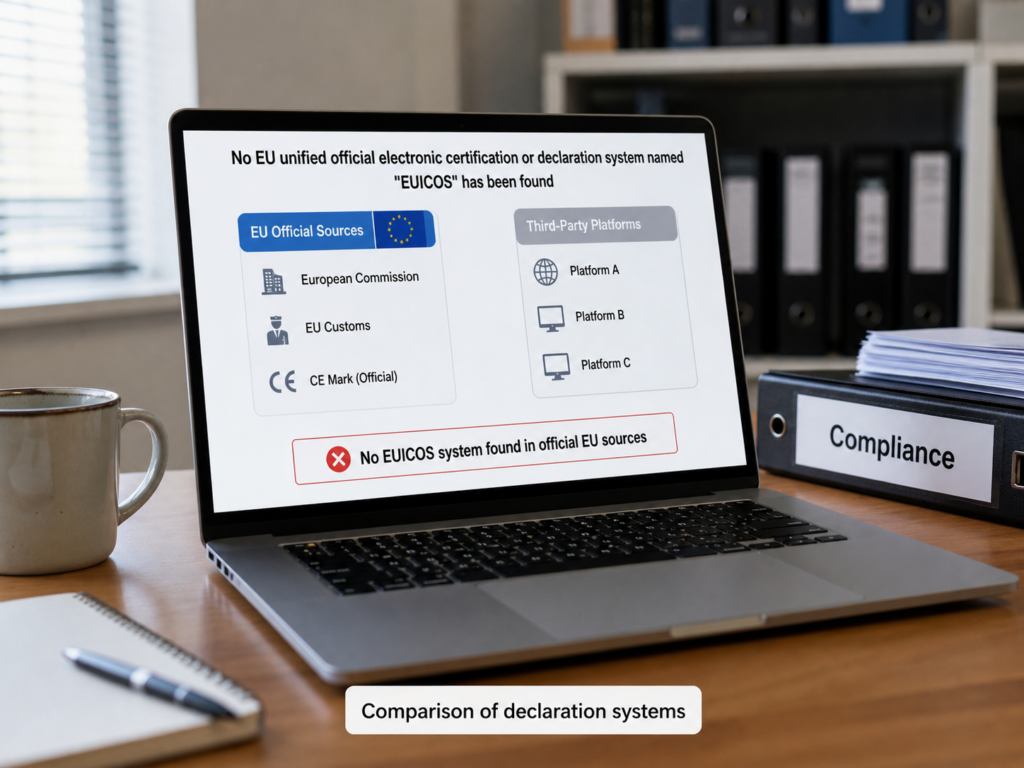
Let’s nail down the core conclusion first: as of the date of verification, no EU unified official electronic certification or declaration system named “EUICOS” has been found in the official materials of the European Commission, EU Customs, and CE. The term “EUICOS” circulating in the market may be a vague general term used by logistics providers, platforms, or agents for the entire process of “entry declaration + compliance verification”, or it may be a custom internal name of a certain enterprise. Therefore, you cannot conclude that the other party is definitely a scam solely based on the name “EUICOS”, but you must verify its real identity and legal basis.
You should keep one core reminder in mind: do not only use “EUICOS” as a keyword to search for the so-called official system. You should first request the full name of the system, operating entity, official link, declaration type, and legal basis from the party making the request; before the verification is fully clear, do not pay related fees to unfamiliar institutions, nor upload confidential materials such as business licenses, core technical documents, and bank information at will.
6 Types of Real EU Customs/Compliance Systems Easily Confused with “EUICOS”
Many people misreport real official or third-party systems as “EUICOS”. Here we explain their actual functions one by one to avoid confusion:
1. **ICS2 (Import Control System 2)**: A system used by the EU for entry safety and security risk analysis. Goods entering or transiting the EU customs territory usually need to submit an ENS (Entry Summary Declaration), but whether it applies, who submits it, and what data is required must be judged in combination with the mode of transport, type of goods, postal or express arrangements, transshipment arrangements, and applicable exemptions, and cannot be generalized as all commercial goods must be submitted without exception. ICS2 is mainly used for safety and security risk analysis, and does not replace import customs declaration or product compliance review. Incomplete declarations may also result in goods being unable to be loaded, delayed after arrival, or required to provide supplementary information.
2. **EORI Number (Economic Operators Registration and Identification Number)**: An identification number for enterprises in EU customs activities, usually used by relevant economic operators involved in customs activities. Whether and which party provides the EORI field for ENS/ICS2 declarations must be confirmed according to the role of the entity, mode of transport, and declaration data requirements. It is only an identity credential, not a compliance qualification.
3. **EU Customs Single Window**: An environment used by the EU for data exchange between customs and specific non-customs regulatory systems. It is not a unified entry point for all customs affairs, nor is it a general platform for uploading CE documents.
4. **Import Declaration System**: The relevant electronic customs system for formal customs clearance and tax payment after goods arrive at the port. After the import declaration is completed and customs release is obtained, the goods usually complete the corresponding customs procedures, but they must still meet applicable product safety, CE, labeling, EPR, and other market placement requirements before they can be legally sold in the EU market.
5. **Logistics/Freight Forwarder Internal Declaration System**: The freight forwarder’s own customer information collection system, which connects to the official system to submit after collecting all materials. It is a commonly used declaration channel for small and medium-sized sellers, and is not an official system itself.
6. **E-commerce Platform Compliance Review System**: Internal listing or warehousing review tools of platforms such as Amazon and AliExpress. These are the platform’s own rules, not a unified EU official system. Passing the review does not mean that official regulations have been met.
3-Step Verification Method to Avoid Scams
If someone mentions “EUICOS” to you again, verifying according to these three steps can avoid most risks:
Step 1: Directly request five key pieces of information from the other party: the full name of the system, operating entity, official link, declaration type, and sample number after successful declaration. If the other party hesitates and cannot explain clearly, and only repeatedly emphasizes “it’s EUICOS”, you should be vigilant.
Step 2: After obtaining the information, go to the official website of the European Commission or the official customs website of the corresponding member state to verify its authenticity. Real official systems usually have clear entry points, scope of application, and rule descriptions on official sites; if it is an internal system of a freight forwarder or platform, you should check its corporate identity, service contract, and the actual official process it is based on.
Step 3: Before the verification is fully clear, do not pay any “certification fees” or “system usage fees” with unclear names, nor transmit core confidential documents, to avoid property loss or information leakage.
The content of this article is compiled with reference to official pages of the European Commission such as ICS2, EORI, CE, and battery regulations. The rules will be updated and adjusted in line with EU regulations, and the latest official requirements shall prevail. The content is primarily applicable to charging electronic products such as chargers, USB-C cables, power banks, and wireless chargers.
Quick Judgment: What Declarations Your Charging Products Need to Comply With
After understanding the authenticity, the next step is to quickly judge what real declaration requirements your products and business need to comply with, so as not to do useless work.
First, Figure Out: Does Your Charging Product Need CE?
Many people think that all charging accessories need CE certification, but this is not the case. It must be judged according to four core dimensions: product function, supply voltage, whether it is a complete product placed on the market, and whether it has wireless functions.
You can directly refer to the judgment results of common charging products:
• **Mains-input chargers/power adapters (wall-plug type)**: If the product falls within the voltage range of the Low Voltage Directive (LVD), applicable requirements such as EMC must also be evaluated in combination with product functions. You cannot judge all regulations solely based on the word “charger”.
• **Products with radio transmission or reception functions such as Bluetooth and Wi-Fi**: Usually subject to the RED (Radio Equipment Directive). Its safety, health, and electromagnetic compatibility requirements are assessed according to RED, and cannot be mechanically stated as being subject to both LVD and EMC at the same time.
• **Wireless charging products**: Whether RED applies must be judged based on whether the product has radio transmission or reception functions and the specific technical design; you cannot generally conclude that RED applies just because of the words “wireless charging”.
• **USB-C/USB charging cables**: Whether LVD applies should be judged based on the rated voltage and product composition. Usually, cables with less than 50 V AC or 75 V DC are not within the LVD voltage range, but may still be subject to RoHS, WEEE, and other regulations related to product functions. You cannot directly presume LVD applies based on “ordinary” or “high-specification”.
• **Power banks with batteries and charging peripherals**: Need to be judged in combination with battery regulations, RoHS, WEEE, and other applicable requirements of the product itself; at the same time, they may also involve lithium battery transportation requirements.
Remember a common misconception: not all products called “charging accessories” need CE, and you cannot judge which regulation applies solely based on the product’s power level. You must judge based on specific attributes, don’t spend money recklessly just because someone says “all charging products need CE”.
Three Common Scenarios That Trigger Declarations
When charging products enter the EU, they usually encounter three completely different types of declaration requirements, with different triggering scenarios and responsible parties:
1. **ICS2/ENS Safety Declaration**: Goods entering or transiting the EU customs territory usually involve ENS declaration, but this needs to be confirmed in combination with the mode of transport, type of goods, postal or express arrangements, transshipment arrangements, and applicable exemptions. It is usually led by the carrier, freight forwarder, or other designated entities, and sellers need to provide true and complete information.
2. **Import Customs Declaration and Compliance Verification**: Triggered when goods enter the country for customs clearance, it is a formal customs procedure, usually involving taxes and customs procedures. Customs or market supervision authorities may require documents, physical goods, or supplementary information before release. Product compliance materials cannot all be prepared after customs clearance.
3. **E-commerce/Logistics Compliance Pre-review**: Internal review during platform warehousing or listing, or freight forwarder pickup. These are rules set by enterprises themselves, not unified EU official procedures, but failing to pass may result in inability to ship or list products.
Division of Responsibilities of All Participating Parties
Many sellers are confused about who is responsible for what. Here we make it clear directly to avoid being blamed:
• **ICS2/ENS declaration responsibility**: The carrier, freight forwarder, or their designated entity shall undertake the corresponding declaration tasks, but the consignor and consignee must provide true information and cannot make things up.
• **Product compliance responsibility**: Non-EU manufacturers shall determine whether an EU importer, authorized representative, or other responsible economic operator within the EU is needed according to applicable regulations. The scope of obligations of importers and authorized representatives is different. Authorized representatives only perform designated tasks within the scope permitted by relevant regulations after obtaining clear written authorization, and cannot automatically assume all responsibilities of the manufacturer.
• **Freight forwarders/logistics providers**: Usually only submit declaration data on behalf of others, and do not assume legal responsibility for product compliance as a result. Don’t think that everything is fine just because you have found a freight forwarder.
• **E-commerce platforms**: May require compliance certificates as a condition for warehousing or listing, but platform review does not replace official supervision responsibilities.
1-Minute Self-Test: What You Need to Do
You don’t need to memorize complex rules. Follow these three steps to quickly judge what you should prepare:
Step 1: First confirm the type of declaration required by the other party: is it a safety declaration, import customs declaration, or internal review of the platform or freight forwarder?
Step 2: Judge two core conditions: Does your product fall within the mandatory CE scope? Does this shipment involve entering or transiting the EU customs territory, and are there applicable exemptions?
Step 3: Confirm your role: Are you a seller, EU importer, or freight forwarder? Different roles have completely different things to do. Chinese sellers usually need to provide true information to the carrier, freight forwarder, or importer, but whether they need to handle a certain declaration by themselves depends on the specific transaction and transportation arrangements.
Pre-Declaration Preparation: Core Material List Exclusive to Charging Products
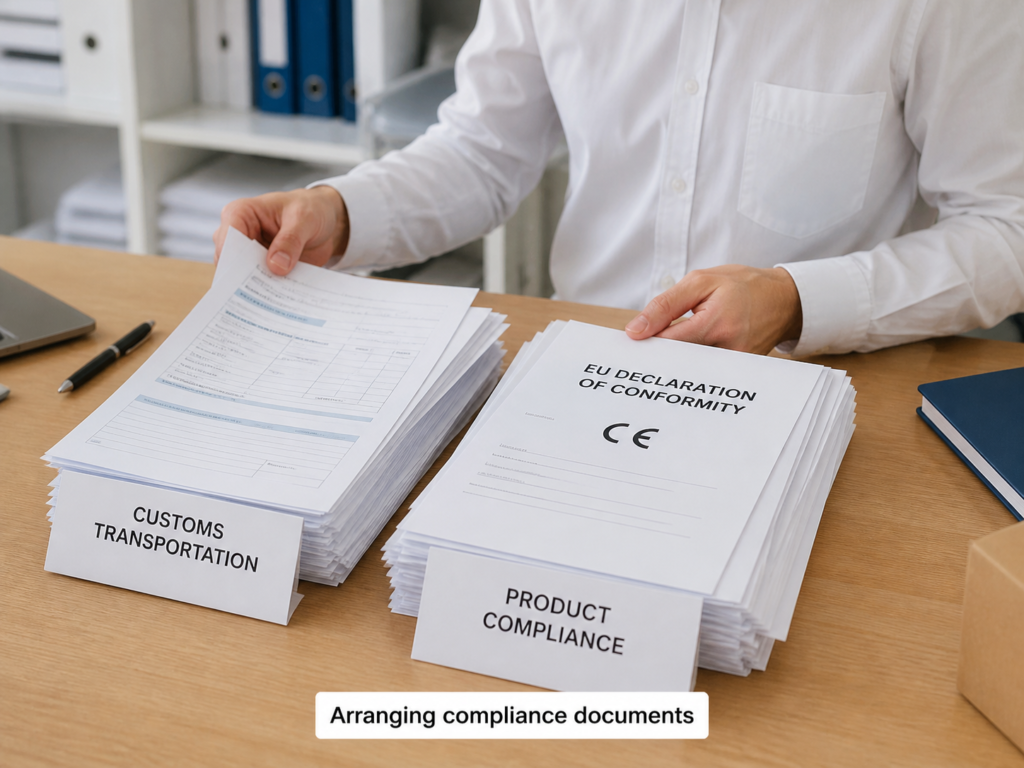
After clarifying the requirements, you can prepare materials in advance. They are divided into two categories: customs transportation and product compliance. Don’t mix them together.
Customs and Transportation Materials (for ICS2/Import Declaration)
This type of material is the basis for customs declaration and must be accurate:
1. **Entity Identity Credentials**
The core may involve the EORI number, that is, the EU Customs Economic Operators Registration and Identification Number. Relevant economic operators involved in EU customs activities usually need an EORI, but whether and which party provides the EORI field for ENS/ICS2 declarations must be confirmed according to the role of the entity, mode of transport, and declaration data requirements.
Non-EU enterprises may also directly apply for EORI when they meet the conditions, or be assisted by EU importers, customs representatives, etc. It should be noted that authorized representatives will not automatically assume all customs responsibilities. The specific responsibilities depend on the content of authorization, applicable regulations, and actual declaration arrangements.
2. **Product Classification Information**
The core is the HS code. The first 6 digits are globally unified, and more detailed CN codes or TARIC codes need to be checked within the EU. The preliminary classification direction of charging products can be referred to: chargers fall under 8504, cables under 8544, and connectors under 8536, but this is not the final conclusion. The specific classification must be judged in combination with product structure, function, and whether they are sold as a set.
If the classification is uncertain, you can apply for BTI (Binding Tariff Information) in complex cases. Once approved, it is valid within the specified period, which can help enterprises reduce the risk of tax supplementation, order rejection, or disputes caused by classification errors.
3. **Trade and Transportation Information**
Including goods value, currency, country of origin, trade terms (such as FOB, CIF), waybill number, mode of transport, port of entry, and estimated arrival time. This information must be completely consistent with the invoice and waybill, and there must be no discrepancies.
Product Compliance Materials (for future reference/platform review)
First, correct the biggest misconception: there is no such thing as a unified “CE certification certificate” in the EU. CE is a compliance mark on products, which means that the enterprise has completed the conformity assessment in accordance with applicable regulations and assumes corresponding responsibilities. It is not a certificate uniformly issued by the government.
The core compliance materials are as follows:
• **Applicable regulation analysis report**: Clarifies which EU directives or regulations the product complies with. It is the basis of all compliance documents, and regulations cannot be applied randomly;
• **Technical documentation**: Should be prepared according to applicable regulations, product risks, applicable standards, and conformity assessment procedures. The content may include product design, key components, risk analysis, test or evaluation records, etc. Not all products are required to provide a fixed form of “full set of production materials”;
• **EU DoC (Declaration of Conformity)**: A product compliance declaration signed by the enterprise, which must have clear product information, applicable regulations, and signatory information;
• **Test/evaluation records**: One of the technical bases, such as LVD or EMC related test records, but they do not naturally constitute a unified format “certification certificate”;
• **Product labels and instructions**: Should provide the CE mark, manufacturer, and necessary information of economic operators within the EU in accordance with applicable regulations, and provide instructions and safety information in accordance with the language requirements of the member state of sale. The specific label position, address form, and number of languages should be checked according to applicable regulations and member state requirements.
Whether a Notified Body (NB) is involved cannot be judged solely by whether the product is a wireless product or simply by distinguishing between high-risk and low-risk. It should be judged according to applicable regulations, the application of harmonized standards, and the conformity assessment procedure selected by the manufacturer. A Notified Body is only required when required by the selected procedure or specific regulations; otherwise, the conformity assessment can be completed in accordance with the permitted manufacturer’s internal assessment procedure.
There are two exclusive precautions for charging products:
• **USB-C cables with E-Marker chips**: Test records should cover chip-related parameters, such as supported power, voltage, and current, and cannot only test the cable itself;
• **Products with batteries**: Such as power banks, need to supplement lithium battery compliance documents and transportation appraisal materials, because lithium battery transportation usually has special requirements.
Regulation Diversification Table for 5 Types of Charging Products
The table below is only for preliminary judgment. There is no unified “customs clearance CE document checklist” applicable to all charging products in the EU. LVD, EMC, RED, and RoHS are mainly product compliance regulations; WEEE mainly involves producer responsibility, registration, reporting, and recycling obligations, and is not a product CE certification item in the general sense. Each type of product must be judged item by item according to product voltage, wireless function, battery configuration, and EPR requirements of the member state of sale.
| Product Type | Possible Applicable Product Regulations or Obligations | Key Judgment Factors |
| Mains Charger | LVD, EMC, RoHS, WEEE, etc. | Input voltage, product design, whether it has wireless functions, and EPR requirements of the member state of sale |
| USB-C/USB Charging Cable | RoHS, WEEE, etc.; LVD needs to be judged according to conditions | Rated voltage, product composition, whether it has E-Marker, whether it supports data transmission |
| Wireless Charger | May involve RED, EMC, RoHS, WEEE, etc. | Whether it has radio transmission or reception functions, wireless charging technology and specific design |
| Power Bank | Battery regulations, RoHS, WEEE, etc.; other requirements are judged according to product design | Battery type, rated voltage, capacity, whether it has wireless functions, and transportation arrangements |
| Interface Connector | RoHS, WEEE, etc.; LVD needs to be judged according to conditions | Rated voltage, connector structure, whether it is placed on the market as an independent product |
Customs clearance, market supervision, and transportation are different links. Customs may conduct inspections based on risks, goods categories, and declaration materials; market supervision departments focus on whether products meet applicable regulations; WEEE and battery producer responsibilities may also involve member state registration, reporting, and recycling arrangements, which cannot be simply classified into a fixed “customs clearance inspection item”.
Core Operation Path: Match According to Declaration Type
After the materials are prepared, you can follow the corresponding process according to the declaration type, and you don’t have to take everything on yourself.
First Confirm the Declaration Type and Submission Channel
No matter who asks you for materials, first ask for three pieces of information clearly: what is the full name of the declaration, which system to submit to, and what scope of materials is needed. Don’t submit them blindly.
There are three common submission channels:
• **Submission by freight forwarder/logistics provider on behalf**: The mainstream choice for small and medium-sized sellers. You don’t need to connect to the official system yourself, just give the materials to the freight forwarder as required;
• **Self-customs clearance**: Usually submitted through the electronic customs declaration system designated by the destination member state or authorized customs declaration channels;
• **Submission through platform internal system**: For warehousing or listing review of e-commerce platforms, just upload directly in the platform backend.
The EU Customs Single Window is only used in applicable customs and non-customs regulatory data exchange scenarios. It cannot be regarded as a general customs clearance platform, nor can it replace the electronic customs declaration systems of each member state.
Key Operation Points for ICS2/ENS Safety Declaration
ICS2 declaration is usually led by the carrier or freight forwarder. You need to provide information as required, and remember three key points:
• **Information to be provided**: Consignor and consignee information, EORI number when applicable, goods description, HS code, goods value, waybill information, etc. The more accurate the better;
• **Submission time limit**: Affected by the mode of transport, voyage, carrier rules, and applicable declaration data sets, the time limits for scenarios such as sea freight and air freight may be different. The specific requirements shall be subject to the carrier or official requirements. Try to provide materials in advance, don’t wait until the deadline;
• **Declaration result**: After submission, you should save the system receipt, declaration identifier, and status information. Whether MRN, ENS reference number, or other identifiers are generated depends on the mode of transport, declaration fragmentation, and system process. This receipt only indicates the status of the corresponding safety and security declaration process, and does not represent import customs declaration release, nor does it mean the product is compliant.
Key Operation Points for Import Customs Declaration and Compliance Verification
Import customs declaration is the customs process for the formal entry of goods, usually led by the EU importer or customs broker. You need to know:
• **Materials to be provided**: Customs declaration form, commercial invoice, packing list, transport documents, and product compliance materials prepared according to product category, declaration scenario, and requirements of the destination member state. Customs or market supervision authorities may require documents, physical goods, or supplementary information before release. You cannot assume that all products can be supplemented after customs clearance;
• **Compliance verification**: There is no unified public CE database in the EU. Enterprises should prepare in advance and submit or provide applicable declarations of conformity, technical documentation, and other compliance materials at any time as required;
• **Relevant numbers**: After the import declaration is accepted by the customs system, an MRN for this declaration is usually generated for query and tracking. MRN is not equal to a certificate of completion of customs clearance, nor does it mean the product is compliant, let alone that there is only one unified number for all customs links.
Key Operation Points for E-commerce/Logistics Compliance Pre-review
The internal pre-review of platforms or freight forwarders is only the rules of the enterprise itself. Pay attention to the following during operation:
• **Common requirements**: Upload CE-related documents, fill in product parameters, provide declaration numbers, and follow the format required by the platform;
• **Precautions**: Passing the pre-review only meets the internal requirements of the platform or freight forwarder, and does not replace official declaration and product compliance responsibilities. Even if you pass the platform review, if customs or market supervision departments find that the product is unqualified, the relevant responsibilities may still be borne by the corresponding economic operator.
Pre-Submission Consistency Checklist

Spend 5 minutes checking before submission, which can avoid many low-level rejections:
1. **Consistent information**: The declaration data is completely consistent with the commercial invoice, packing list, and waybill. There must be no discrepancies in product name, goods value, and quantity;
2. **Compliant documents**: Applicable regulations are correct, DoC is signed in a standardized manner, and test or evaluation records cover all declared models. You cannot declare 10 models and only provide 1 document that does not cover other models;
3. **Reasonable logic**: There is no obvious contradiction in goods value, weight, and quantity. For example, if 100 chargers have an extremely unreasonable total weight, you may be required to explain; the product name must match the HS code;
4. **Exclusive check for charging products**: The model spelling is completely consistent with the compliance documents, the attributes of products with batteries have been noted, and key parameters such as E-Marker have been filled in.
Exclusive Declaration Points for Charging Products: Avoid High-Frequency Errors
There are many exclusive declaration pitfalls for charging products. Here we list the most common errors and standards, and you can avoid pitfalls by directly comparing them.
Declaration Standards for Four Types of Core Products
Different charging products have different declaration requirements. Don’t declare them all generally as “electronic products”:
• **USB-C/USB charging cables**: Must indicate the rated voltage, whether it has E-Marker, and whether it supports data transmission. You cannot just write “charging cable”, otherwise it may affect accurate classification;
• **Chargers/power adapters**: Indicate input and output parameters, power, and number of interfaces. They must never be mixed with power cords, as the HS codes and compliance requirements of the two may be different;
• **Wireless chargers**: Indicate wireless charging power and whether it has data functions, and judge regulatory requirements such as RED based on whether it has radio transmission or reception functions. You cannot conceal the wireless function;
• **Power banks/products with batteries**: Supplement battery capacity, cell type, and transportation appraisal information. It is strictly forbidden to declare power banks as ordinary chargers. Concealing battery attributes may bring serious transportation and customs risks.
Declaration Differences in Different Sales Scenarios
Different sales models have different declaration methods. Don’t use one set of methods to deal with all scenarios:
• **B2B general trade**: Customs declaration is led by the EU importer, and the declaration is filled in according to the actual import transportation, transaction arrangements, and applicable customs procedures. The quantity must be consistent with the customs declaration materials;
• **Cross-border e-commerce B2C**: Overseas warehouses or platform warehouses should handle declarations according to actual import transportation and applicable customs procedures. There is no unified “declaration by inventory batch” rule; for self-shipping, you should cooperate with the freight forwarder to submit information in advance, don’t look for materials temporarily when it’s time to ship;
• **Samples/trial orders**: Whether simplified, low-value, or other special arrangements are applicable, and whether ENS is required, should be confirmed in combination with the mode of transport, nature of goods, purpose, value, and specific exemption rules. You cannot generally assert that samples must be submitted unconditionally or can be completely undeclared.
Boundaries for Batch Declaration of Series Products
Many sellers, in order to save money, classify different products into one series and use the same compliance document, which is very prone to problems.
The premise that compliance documents can be shared: product design, core components, and key parameters are basically the same, only the appearance or model naming is different, for example, the same charger only has a different printed logo.
If the model change involves changes in power, core chip, battery, shell structure, or key components, a re-evaluation must be carried out, and documents cannot be directly shared. You must never arbitrarily expand the scope of the series, otherwise, if the compliance documents are found to be mismatched, it may be deemed that the materials are insufficient or the product does not meet the requirements.
Top 5 High-Frequency Error Reminders
These five errors are very common in charging product declarations, and novices are especially prone to falling into them:
1. **Product name is too general**: Only writing “electronic products”, “gifts”, “accessories” may cause customs to require supplementary information, inspection, or delay, and it is not guaranteed to be rejected. You should write the specific product name clearly, such as “20W USB-C mains charger”;
2. **HS code classification error**: Classifying solely based on experience without checking the EU TARIC code may result in tax supplementation, order rejection, or penalties. Only when there is corresponding intent or other statutory constituent elements may it further involve tax evasion, fraud, or smuggling responsibilities;
3. **Mismatched compliance documents**: For multi-model declarations, only single-model documents are provided, and uncovered models are omitted. This is a common reason for platform review rejection;
4. **Concealing sensitive attributes**: Declaring a power bank with a battery as an ordinary charger, or concealing the wireless function. Once found, it may result in goods detention, delay, fines, and in serious cases, may trigger further law enforcement;
5. **Confusing declaration types**: Treating platform pre-review as official declaration, or treating ICS2 safety declaration as CE compliance certification, thinking that having a number means the product is compliant.
Abnormality Troubleshooting and Risk Avoidance
Even if you are fully prepared, you may encounter rejections or abnormalities. Here we teach you how to quickly locate and solve problems, and how to avoid core risks.
Five Types of Rejection/Abnormality Causes and Solutions
1. **Logistics provider data verification rejection**
The most common low-level error, usually caused by missing required fields, incorrect information format, or mismatched waybill numbers. Just complete the information according to the prompts, check the waybill and invoice data, and then resubmit.
2. **ICS2/ENS risk warning**
When a risk warning appears in the safety declaration, common causes are incomplete information, unclear goods description, need for further safety and security risk analysis, or the consignor and consignee have risk records that need to be verified. The solution is to cooperate in providing supplementary materials, correct the declaration information as required, and pay attention to the subsequent status returned by the carrier or system.
3. **Import declaration rejection**
The customs has returned the declaration form. Common causes are incorrect HS code, inconsistent goods value, incomplete declaration data, or missing required compliance materials. The solution is to correct the classification or goods value, supplement documents, and contact the EU importer and customs broker to cooperate in handling.
4. **E-commerce platform review rejection**
The platform does not allow listing. Common causes are unclear documents, non-standard DoC signing, or test/evaluation records not covering the model. Just complete the standardized documents according to the platform requirements, adjust the format, and resubmit.
5. **Market supervision spot check rectification**
Products are found by regulatory authorities after being listed. Common causes are products not meeting applicable requirements, non-standard labels, or missing technical documentation. You should cooperate in providing compliance materials, rectify as required, and recall if necessary to avoid escalation of penalties.
Four Types of Core Compliance Risks
These risks have serious consequences and must be avoided:
• **False declaration/forged documents**: May result in goods detention, return shipment, fines, and even stricter customs supervision. The specific penalty standards depend on member state regulations and the circumstances of the violation;
• **Omitted or concealed declaration of sensitive goods**: Concealing sensitive attributes such as batteries and wireless functions may trigger customs, transportation, or market supervision measures, and in serious cases, may bear legal responsibility;
• **Product compliance not up to standard**: Fake CE documents or products not meeting applicable requirements may result in delisting, sales suspension, market withdrawal, recall, or requirement to take other corrective measures, and may be subject to member state penalties; whether to restrict re-placement on the market and the restriction period depend on specific regulations and law enforcement decisions;
• **Non-compliant material retention**: Failure to save compliance documents in accordance with applicable regulations may also face regulatory penalties.
Efficiency and Cost Optimization Suggestions
You don’t need to spend unnecessary money on compliance. These methods can help you improve efficiency and reduce costs:
• **Prepare in advance**: Establish a product compliance ledger, organize all materials in advance and update them regularly, to avoid temporary rush delaying shipment;
• **Reasonable classification**: Confirm the HS code in advance, apply for BTI in complex cases, to avoid goods detention or tax supplementation caused by classification errors;
• **Agent selection**: Prioritize freight forwarders or customs brokers with experience in charging product declaration. They are familiar with the rules and can help you avoid fewer pitfalls;
• **Batch compliance**: Conduct unified compliance assessment for products of the same series to reduce duplicate costs, but don’t arbitrarily expand the scope of the series.
Compliance Material Retention Requirements
Many people don’t know how long compliance materials should be kept. Usually, the manufacturer shall keep technical documentation and EU DoC for at least the specified period in accordance with applicable product regulations. The common period for many CE-related regulations is at least 10 years after the product is placed on the market; importers shall perform corresponding obligations of verification, keeping copies, and assisting in supervision. Authorized representatives only perform designated tasks of keeping or providing documents within the scope of applicable regulations and written authorization.
The periods and responsible entities of different product regulations may be different. The specific situation should be confirmed according to applicable regulations. You cannot uniformly assume that all materials are kept by the EU importer or authorized representative.
Distinction of Easily Confused Concept Boundaries
When doing EU declarations, it is easiest to be confused by various concepts. Here we explain the most easily confused groups of concepts clearly, so you won’t be fooled again in the future.
Distinction of Customs Concepts
• **ICS2/ENS vs import declaration**: The former is a safety and security risk declaration before entry, and the latter is formal import customs clearance and related customs procedures. They are two different links. The ICS2 declaration status does not represent import customs declaration release;
• **Function of EORI**: It is the identification number of customs economic operators, not a compliance qualification. Having an EORI number does not mean the product is compliant, nor can it replace the legal obligations of importers or other responsible entities;
• **EU Customs Single Window**: Mainly used for data exchange between customs and specific non-customs regulatory systems. It is not a general CE document upload platform, nor is it a unified submission entry for all import declarations.
Distinction of Product Compliance Concepts
• **CE mark vs certification certificate**: CE is a compliance mark on products, not a unified certificate issued by the government. For many products, the manufacturer can complete the conformity assessment and sign the declaration according to the permitted procedures, without the need for a unified certificate issued by a third-party institution;
• **Self-declaration vs NB involvement**: Whether a Notified Body is involved must be judged according to the applicable product regulations and specified conformity assessment procedures, and cannot be summarized solely by high or low risk. A Notified Body is only required when required by the selected procedure or specific regulations; otherwise, the conformity assessment can be completed according to the permitted manufacturer’s internal assessment procedure;
• **CE compliance vs market supervision**: CE is one of the compliance requirements applicable when products are placed on the market. Enterprises should complete the conformity assessment and assume responsibilities in accordance with regulations; market supervision authorities may conduct spot checks after products are placed on the market, and may also participate in control before customs release. Affixing the CE mark does not mean the product is necessarily compliant;
• **Digital Product Passport (DPP)**: The ESPR has established a digital product passport framework, but the specific product categories and implementation requirements still need to be gradually determined by the corresponding delegated acts or implementing rules. The Battery Regulation also stipulates battery passports and corresponding timetables for some batteries. DPP is not equivalent to the current ICS2 or import declaration, but it cannot be generalized as a “future system” with no current regulatory basis at all.
Distinction of Platform/Logistics Concepts
• **Official declaration vs platform internal review**: The former is a procedure required by EU customs or regulatory authorities, and failure to do so may affect entry, release, or sales; the latter is an internal rule of the platform or enterprise. Failing to pass usually means you cannot sell on the platform or use its logistics services, but platform review does not replace EU legal requirements;
• **Freight forwarder declaration on behalf vs self-declaration**: Freight forwarders usually only submit data on behalf of others, and the legal responsibility is still borne by the corresponding declaration entity, importer, manufacturer, or other applicable economic operators. Sellers still need to ensure the authenticity of information and confirm product compliance.
Summary
After reading this guide, you will at least master two levels of ability:
Beginner Level (Operable After Reading)
• Quickly judge the authenticity of “EUICOS” related requirements, to avoid being scammed of money and information;
• Distinguish three common types of declarations, and clarify what materials you need to provide;
• Independently prepare customs transportation materials and compliance materials for charging products;
• Cooperate with freight forwarders or platforms to complete declarations, and understand basic declaration statuses.
Advanced Level (Able to Judge and Avoid Pitfalls)
• Judge the CE application scope and regulatory requirements of different charging products based on product voltage, function, wireless characteristics, and battery configuration;
• Quickly locate the causes of five common rejections or abnormalities, and complete basic rectification;
• Avoid core compliance risks, and reasonably optimize declaration efficiency and cost;
• Distinguish common customs, compliance, platform, and logistics concepts, and not be misled by wrong information.
The EU’s declaration and compliance rules seem complicated, but as long as you sort out the logic and prepare according to the requirements, they are actually not that difficult. The core is to first verify the name and entity, then match according to the real declaration type, and finally do a good job of consistency check of materials and information, so you can avoid many pitfalls.