
Practitioners who export charging products to the United States have almost all been troubled by questions about FCC and UL certifications: Are they really mandatory requirements by customs? Why are some shipments released without submitting certificates, while others are directly detained? For the same type of charger, why do some require an FCC ID while others only need an SDoC?
The core of these questions is a failure to understand the real logic behind U.S. customs inspection of compliance documents—it is not a unified “mandatory inspection list for entry”, but a system where different regulatory departments perform their respective duties, and customs verifies corresponding documents according to enforcement instructions. This article clarifies the FCC and UL-related inspection rules of U.S. customs for charging products such as wall-plug chargers, car chargers, wireless chargers, and USB-C charging cables, from basic knowledge to practical judgment, to help you avoid common pitfalls.
1. Core Basic Knowledge: Basic Compliance Logic
People who are new to this field easily confuse terms such as CBP, FCC, and UL. In fact, they belong to different links with completely non-overlapping responsibilities, and some are not even government agencies at all. Let us first clarify the boundaries of the six core compliance entities:
| Entity | Core Identity | Core Responsibilities | Common Trigger Scenarios | Core Legal Effects | Main Documents Involved |
| CBP (U.S. Customs and Border Protection) | Federal law enforcement agency | Import clearance enforcement, verifying documents per instructions | Random inspection, random referral, declaration abnormalities | Entry processing such as release/detention/return | Declaration materials + compliance certificates required by law enforcement |
| FCC (Federal Communications Commission) | Federal communications regulatory agency | Mainly regulates radio frequency (RF) devices, and the emission compliance of intentional and unintentional RF radiation | FCC enforcement instructions, declarations involving wireless/digital devices | Compliance determination, market enforcement | SDoC, FCC ID authorization records, test reports |
| CPSC (Consumer Product Safety Commission) | Federal consumer product safety regulatory agency | Consumer product safety risk management | Safety risk notifications, recall lists, reports | Safety risk disposal, market recall | General Certificate of Conformity (GCC), safety test reports, incident/recall reports |
| DOE (U.S. Department of Energy) | Federal energy regulatory agency | Energy efficiency regulation of power supply products | Special energy efficiency enforcement, declarations involving external power supplies | Energy efficiency compliance determination, penalties | Energy efficiency compliance reports, product markings, etc. |
| Local/AHJ (Authority Having Jurisdiction) | Local regulatory agency | Local electrical/safety regulation | Local inspection, commercial project access | Local sales/use access | NRTL certification certificates, installation compliance materials |
| Platforms/Purchasers | Commercial entities | Commercial access requirements | Listing/supply audit | Listing/cooperation qualification | Designated certifications, qualification certificates |
The Real Logic Behind Customs Inspection of FCC/UL Documents
After clarifying the responsibilities of each entity, you can understand one core rule: U.S. customs does not have a unified mandatory requirement that “FCC or UL certificates must be submitted for import”. As a clearance enforcement agency, CBP itself does not formulate certification rules for all products, and only verifies documents in accordance with the requirements of the corresponding regulatory department when there is an enforcement need.
Charging products, which involve electrical safety and electromagnetic radiation, are categories that receive relatively high attention in multi-department special enforcement in the United States. In addition, many sellers declare with vague product names and unclear parameters, so they may be more likely to trigger inspections than ordinary consumer goods.
Special reminder: Customs release only means compliance approval at the entry stage, and does not replace subsequent market supervision, local electrical access requirements, or platform listing requirements, nor can it exempt the importer from the obligations of declaration and reasonable care. Even if the goods have already entered the United States, if safety problems arise later, CPSC may still take measures such as recalls, and the FCC may also carry out market enforcement in accordance with the law.
3 Basic Misconceptions for Beginners
People new to the industry are most likely to fall into three basic misconceptions. Let us clarify them here first to avoid detours later.
The first misconception: Having either FCC or UL is enough. These two are requirements of completely different systems. The FCC mainly regulates RF devices and the emission compliance of intentional and unintentional RF radiation, focusing on whether the device exceeds the RF emission limits specified by applicable rules; it is usually not equivalent to a complete EMC system that also covers immunity requirements. UL, on the other hand, is a third-party product safety certification system, mainly focusing on safety risks such as electric shock and fire. The two have different regulatory directions, cannot replace each other, and there is no such thing as “having one is enough”.
The second misconception: UL is a mandatory federal import requirement in the United States. In federal-level import rules, there is no unified regulation requiring all charging products to have UL certification before entering the country. Whether a product requires safety certification may depend on specific circumstances such as the platform, purchaser, local authority having jurisdiction, applicable safety regulations, or whether the product is suspected of fraudulently using certification marks or has safety risks.
The third misconception: If the FCC/UL mark is printed on the product, there is no need to bring documents. The core of verification by customs or other competent authorities is the authenticity, matching degree, and applicable scope of the marks and documents. If the mark is printed but the corresponding valid authorization or compliance materials cannot be provided, it may instead be suspected of fraudulent use of marks or false labeling, facing risks such as cargo detention, return, confiscation, or even fines.
2. Preliminary Risk Screening: Compliance Document Judgment
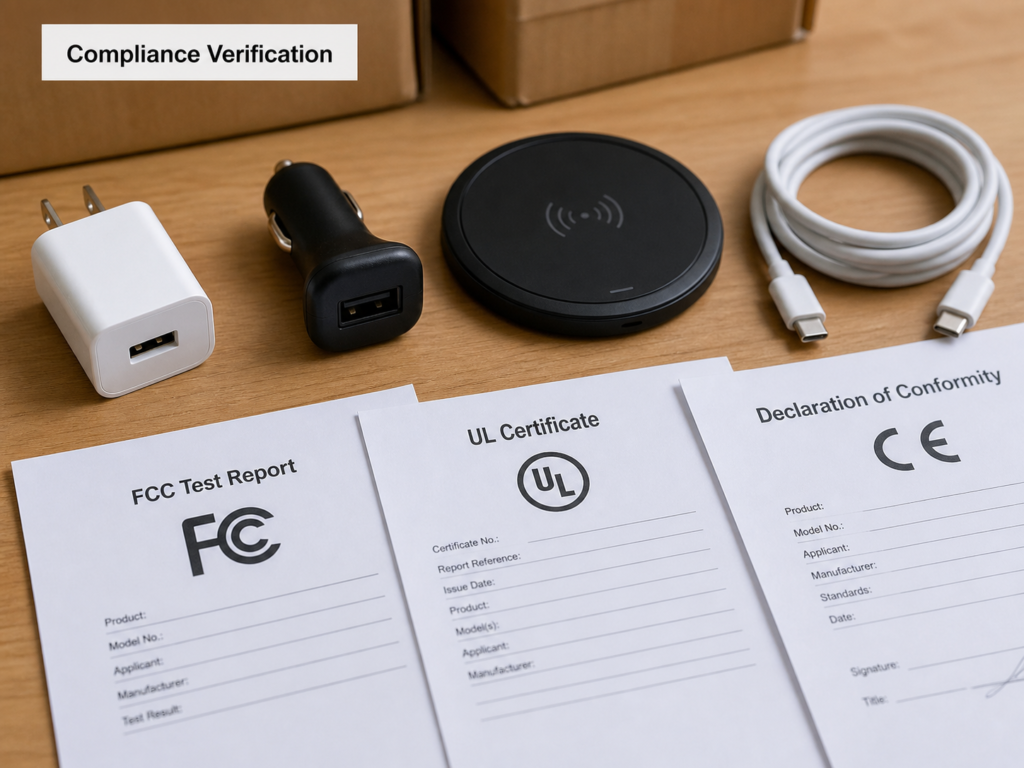
After understanding the basic logic, we can conduct the first round of preliminary risk screening on our own. Before the preliminary screening, let us first clarify two easily confused basic definitions.
**Active wireless transmission function**: Refers to the product actively transmitting RF communication signals such as Bluetooth, Wi-Fi, and cellular. Inductive energy transmission in wireless charging is not equivalent to wireless communication transmission itself, but the wireless power transmission function may still need to be evaluated in accordance with FCC Part 18 and related guidelines.
**Regulated digital devices**: For products containing digital circuits, it is necessary to combine 47 CFR §15.3(k), §15.101, and specific exemption clauses to determine whether they are “regulated digital devices” and what procedures apply. It cannot be simply understood as “as long as there is a chip, SDoC is definitely required”. The internal clock, the way digital technology is used, the maximum internal operating frequency, product functions, and specific exemption clauses may all affect the judgment. Functions containing wireless transmitters shall be separately evaluated in accordance with the corresponding transmitter rules.
Conditional Preliminary Screening of FCC Compliance Paths
The FCC compliance path cannot be judged solely by the product name, but must be determined in combination with the product’s RF characteristics, circuit structure, and applicable rules. It can usually be carried out in three steps.
Step 1: First, check whether it falls within the exemption scope. Some purely passive products or devices that meet specific exemption clauses may not require FCC equipment authorization or related documents. However, whether it is exempt cannot be judged solely by appearance or the term “low power”; the specific conditions in the applicable rules must be verified.
Step 2: Determine the applicable FCC rule parts. Charging products may involve two common parts:
• **Part 18**: Wireless power transmission functions usually need to be evaluated in accordance with Part 18 and FCC-related KDB guidelines. Whether Part 15 is also involved depends on whether the product has other digital devices, communication transmitters, or other RF functions applicable to Part 15.
• **Part 15**: Involves intentional radiators and unintentional radiators. Products with wireless communication functions such as Bluetooth and Wi-Fi are usually evaluated in accordance with the corresponding intentional radiator rules; products containing digital circuits shall be judged whether they are regulated devices under Part 15 based on the definition of digital devices, applicable limits, and exemption clauses.
Step 3: Determine the corresponding authorization path. The current FCC equipment authorization mainly includes two procedures:
• **Certification**: Usually applicable to intentional radiator devices that require certification, such as products with wireless transmission functions such as Bluetooth and Wi-Fi. After review by an FCC-recognized Telecommunication Certification Body (TCB), an authorization record corresponding to the FCC ID will be generated.
• **SDoC (Supplier’s Declaration of Conformity)**: Applicable to Part 15 devices that meet relevant conditions, such as certain unintentional radiator digital devices. The responsible party signs the declaration of conformity and retains test and technical records that can prove the product meets the requirements.
The original Verification procedure was canceled in 2017 and incorporated into the SDoC framework. Now, “Certification, SDoC, Verification” can no longer be regarded as three parallel current authorization paths. Whether a device does not require equipment authorization shall be confirmed in accordance with the exemption clauses in the specific applicable rules.
There are several special categories that need to be explained separately:
• **Wireless charging devices**: The wireless power transmission function usually needs to be evaluated in accordance with Part 18 and related FCC guidelines; if the product also includes wireless communication transmitters such as Bluetooth and Wi-Fi, or includes digital devices applicable to Part 15, the corresponding Part 15 obligations shall be evaluated separately, and cannot be handled under only one rule part.
• **USB-C cables with E-Marker**: It is not that FCC compliance is mandatory as long as there is an E-Marker, nor can it be directly determined that SDoC is required solely based on the E-Marker. The judgment shall be made in combination with whether there is a data communication function, the specific situation of the digital circuit, and whether there is regulated RF emission.
• **Passive pure charging cables**: If there are indeed no chips, digital circuits, or other regulated electronic functions, the FCC’s attention is usually relatively low, but it shall still be subject to the actual structure and applicable rules.
Preliminary Screening of NRTL Safety Certification Requirements
The commonly mentioned UL certification, more accurately, usually refers to product safety certification carried out by UL Solutions or other qualified third-party institutions. NRTL is a testing laboratory system recognized by U.S. OSHA. Whether a product requires NRTL certification cannot be judged solely by whether it is a charging product, but also by the product structure, usage scenarios, sales channels, and local requirements.
• **High-attention category**: Wall chargers, power adapters, and high-power fast chargers connected to 110V mains. Although there is no unified federal mandatory import requirement for such products, because they are directly connected to the mains, they have higher risks of electric shock and fire, and may receive key attention from regulators, purchasers, platforms, or local authorities having jurisdiction.
• **Accessory cables**: There is no unified regulation on whether NRTL is required. It depends on the structure of the cable, rated parameters, whether it is certified together with the finished product, and the purchaser’s standards; not all cables require it.
• **Low-attention category**: Products that are not directly connected to the mains, such as car chargers and passive data cables, usually have a lower probability of being randomly inspected for safety certification during the import stage, but platforms, purchasers, or specific sales scenarios may still require safety documents.
Many platforms require safety compliance documents for some charging products, but the specific requirements and what types of NRTL certification or test documents are accepted shall be subject to the sales platform, site, product category, and current notice. It cannot be generalized that all mainstream platforms mandatorily require NRTL finished product certification.
Preliminary Screening Steps and Special Circumstances
We can summarize the preliminary screening into four steps, based on which most charging products can establish a first-round judgment:
1. If the product has an active wireless transmission function, first confirm whether Certification is required, and whether the authorization is obtained by the whole device, or whether the authorization of a certified module can be used when conditions are met.
2. If the product contains digital circuits or is directly connected to the mains, FCC obligations shall be evaluated based on the actual circuit, applicable Part 15 definitions, limits, and exemption clauses; for mains-connected products, safety certification documents and requirements from platforms, purchasers, and local authorities shall also be evaluated separately.
3. If it is a purely passive charging cable, prepare basic product parameter descriptions and confirm whether there are data, chip, or other electronic functions.
4. Be sure to additionally check the regulatory requirements of the cooperating sales platform, purchaser, and local authorities where the product is sold; the requirements of these entities may be more specific or stricter than customs clearance requirements.
If you are unsure about the preliminary screening, do not guess blindly. You can confirm with a customs broker, compliance service provider, or platform compliance team. Ultimately, it shall be subject to applicable regulations, requirements of competent authorities, and the actual structure of the product.
There are also several special situations to note: even for products with the same name and appearance, as long as the internal functions are different—for example, one has Bluetooth and the other does not—compliance requirements may be different; for set products, each component shall be evaluated separately, and you cannot simply look at only one of the components; samples, small-batch shipments, and self-fulfilled shipments may also be randomly inspected, so do not take chances.
3. Core Document Verification Rules: Customs Inspection Judgment Standards
After the preliminary screening of what documents are needed, the next step is to know what exactly customs or relevant competent authorities verify when inspecting these documents. In many cases, it is not “having documents is enough”; the documents must be applicable, authentic, and match the actual product.
Key Points for FCC Document Verification
Many people think that FCC documents are just a certificate, but in fact they are a document chain, and the document composition required for different authorization paths is also different.
FCC Document Tree and Functions
• **Certification Grant corresponding to FCC ID**: Issued by an FCC-recognized Telecommunication Certification Body (TCB) and submitted to the FCC equipment authorization system, which can be queried in the FCC database. It certifies the specific certified device, model, and authorization conditions, and does not automatically cover other models or subsequent revised products.
• **Test report**: Used to prove the product’s performance in relevant electromagnetic or RF tests. For devices requiring Certification, the tests on which the application is based must usually be completed by an FCC-recognized accredited laboratory. The SDoC responsible party shall retain test and technical records that can prove conformity in accordance with 47 CFR §2.938, and the requirement that “they must be issued by an FCC-recognized laboratory” cannot be uniformly applied to all SDoC products.
• **SDoC declaration**: For products following the SDoC path, signed by the applicable responsible party, and usually including product information, applicable FCC rules, and responsible party information. The responsible party shall also retain corresponding conformity certification records.
• **Labels and user materials**: Labels and user materials shall be verified in accordance with the equipment authorization procedure. Certification devices must meet applicable label requirements such as FCC ID; SDoC devices must meet applicable compliance information requirements, but the FCC Logo is voluntary, and not all SDoC devices must print the general FCC Logo. The label requirements of any one path cannot be applied to all products.
A verification boundary should be reminded here: the FCC’s official database is mainly used to query the Certification authorization records corresponding to FCC IDs. SDoC declarations and related test records are usually not fully uploaded to this database, and need to be obtained from the supplier or responsible party and verified.
Applicable Boundaries of the Two FCC Paths
The SDoC path is mainly applicable to qualified Part 15 unintentional radiator digital devices, and does not require an FCC ID, but the responsible party shall sign the declaration and retain conformity records.
The Certification corresponding to the FCC ID is usually applicable to intentional radiator wireless devices that require certification, reviewed by an FCC-recognized TCB and submitted with authorization records. Whether Certification is specifically required shall be judged in accordance with the product’s actual transmission function and applicable Part 15 rules.
There is another common misconception: if a certified wireless module is used, does the whole device not need FCC certification? The answer is that it cannot be generalized. When using a certified module and fully meeting its authorization conditions, the host device usually does not need to re-apply for Certification for the transmitter covered by the module; but this does not mean that the whole device is completely exempt from FCC obligations. Other wireless functions of the host, unintentional radiation, the module’s antenna and installation conditions, co-location situations, and applicable label and user material requirements still need to be evaluated separately.
6 Core Dimensions of FCC Verification by Customs
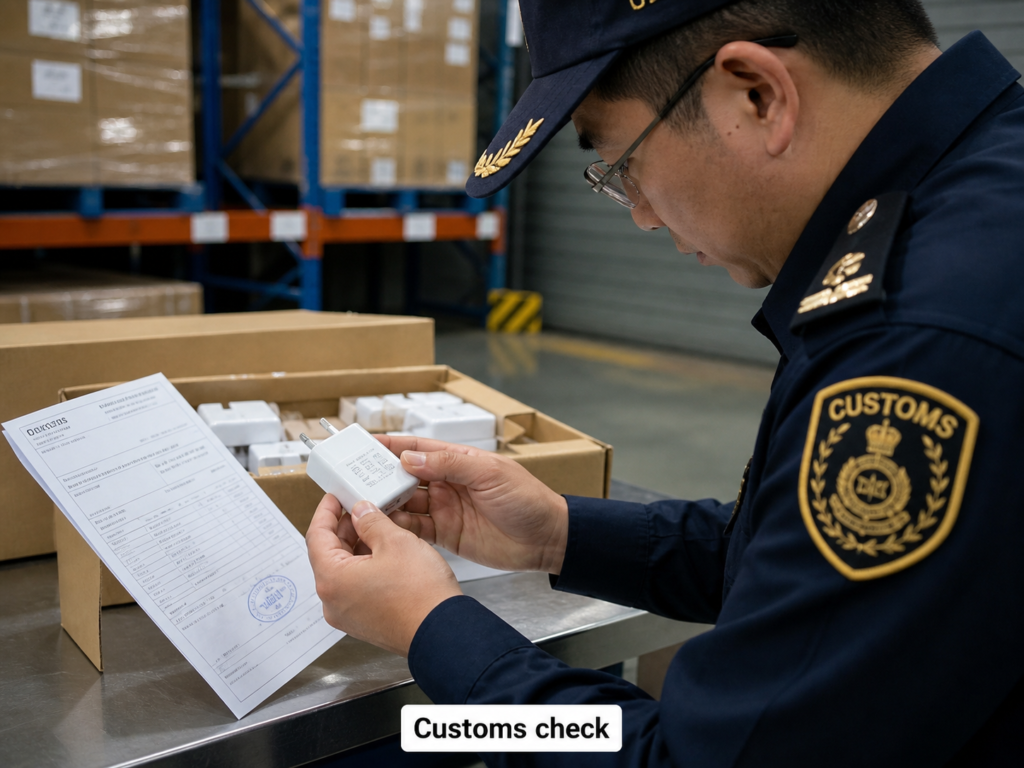
When customs or relevant law enforcement agencies verify FCC documents, they usually focus on the following aspects:
1. **Authorization path matching**: For example, for products with Bluetooth transmission function, a single SDoC cannot replace the required Certification.
2. **Model and version matching**: The model, hardware version, and product function on the documents shall correspond to the actual product, and the authorization of other products cannot be applied.
3. **Authenticity of qualifications and authorizations**: The FCC ID shall be queryable in the official equipment authorization system; the TCB and test laboratory shall have corresponding qualifications or recognition scopes.
4. **Label compliance**: The FCC ID, label content, user materials, and other compliance information shall be verified according to the Certification or SDoC procedure applicable to the product. It is not possible to simply require all products to print the same FCC mark.
5. **Clear responsible entities**: Information on entities such as the responsible party and grantee involved in SDoC or Certification shall correspond to product materials and import arrangements, and information from unrelated companies cannot be used arbitrarily.
6. **Correct application of rules**: For example, if a product includes both wireless charging and Bluetooth functions, the wireless power transmission rules cannot be used to explain all functions; instead, the applicable Part 18 and Part 15 obligations shall be evaluated separately.
Misconception About the Abolished FCC Form 740
Many veteran freight forwarders still mention FCC Form 740. The routine import declaration requirement for this form has been canceled, and there is no need to proactively prepare it for general import procedures. Some freight forwarders or suppliers require this form, which may only be an internal process, not a current universal official mandatory requirement.
At the same time, Form 740 cannot replace SDoC, FCC ID authorization, or other applicable FCC compliance documents. Actual operations shall still be subject to the then-effective FCC import rules, CBP notices, and specific cargo requirements.
Key Points for NRTL Safety Document Verification
Many people wonder: since there is no unified federal mandatory import requirement, why might safety certification documents still be inspected? There are several main reasons.
First, if a product involves safety risks such as electric shock and fire, CPSC or other competent authorities may carry out import monitoring or take safety disposal measures. Second, if the product fraudulently uses the certification mark of an NRTL institution such as UL, it may involve false labeling, trademark, or intellectual property issues. Third, risk information provided by platforms, retailers, or consumers may also become clues for regulatory authorities to pay attention to the product.
Therefore, whether a product must hold a certain certification and whether the product may be verified are two different issues. Even if there is no unified federal mandatory import certification, as long as the product is printed with an NRTL mark or belongs to a category with higher safety risks, authentic, valid, and scope-matched materials shall be prepared.
Comparison of Common NRTL Certification Types
The three types of UL certification are the most easily confused, which can be distinguished by the following table:
| Certification Type | Coverage Scope | Applicable Scenarios | Precautions |
| UL Listed (Finished Product Certification) | Covers the complete safety standards applicable to finished products | Applicable to end products such as finished chargers and power adapters | Cannot replace other compliance requirements such as FCC and DOE |
| UL Recognized (Component Certification) | Only covers a certain component inside the product | Applicable to parts such as power modules and capacitors inside chargers | Cannot replace finished product certification |
| UL Classified (Specific Performance Certification) | Only covers some specific safety indicators | Applicable to products that only need to verify a certain performance | Does not mean the whole device is safe and compliant, and cannot be directly used as finished product certification |
| Other NRTL Certifications | Issued by specific qualified NRTL institutions within their recognition scope | Applicable to scenarios that accept relevant NRTL certifications | Must verify the institution’s OSHA recognition scope, applicable standards, product categories, certification scope, and marks; cannot be judged solely by names such as ETL and CSA |
Four-Item Verification Checklist (General)
Whether it is UL or other NRTL certifications, the following checklist can be used for verification:
1. **Valid status**: Query in the official database of the corresponding institution to confirm that the certification has not been canceled, suspended, or restricted.
2. **Scope matching**: The model, power, plug specification, manufacturing factory, and product structure covered by the certification shall correspond to the actual product.
3. **Type matching**: Confirm that what you have is finished product-level certification; component certification or specific performance certification cannot be used to impersonate whole-device certification.
4. **Mark compliance**: The certification mark on the product must comply with the usage rules of the corresponding institution, and cannot be printed arbitrarily or used beyond the scope.
In addition, it shall be confirmed that the specific institution issuing the certification has the current recognition scope in the OSHA NRTL directory, and verify whether the institution’s recognized standards, product categories, certification scope, and marks cover the target product. It cannot be presumed that a certain NRTL requirement is met just because the document has ETL, CSA, or other institution names written on it.
Applicable Boundaries of Equivalent Certifications
If applicable rules, local authorities having jurisdiction, or procurement contracts require NRTL listing, the scope of OSHA recognition obtained by the specific laboratory, as well as the standards and product scope applicable to the certification, shall be confirmed.
Whether reports or listings from different NRTLs are accepted shall be subject to the requirements of specific competent authorities, platforms, purchasers, insurers, or contracts. OSHA’s NRTL recognition is mainly aimed at the qualifications of testing laboratories within specific standards and product scopes, and does not automatically establish a rule that “the certification effectiveness is exactly the same” for all products at the U.S. federal level.
Overseas certifications cannot be simply generalized. CE and CCC usually cannot replace applicable U.S. requirements such as FCC, DOE, CPSC, or NRTL/AHJ; RoHS and hazardous substance requirements shall be evaluated separately in accordance with applicable U.S. federal, state, and local laws. For example, some states may have their own hazardous substance restrictions. Overseas certificates or reports can be used as reference materials or technical evidence, but they do not automatically constitute U.S. legal compliance certificates.
Key Points for Verification of Other Regulatory Documents
In addition to FCC and NRTL, customs sometimes also verifies documents from other regulatory departments, the most common being CPSC and DOE.
CPSC-Related Documents
• **General Certificate of Conformity (GCC)**: Issued by the manufacturer or importer to certify that the product meets applicable safety standards. Whether a GCC is required shall be judged based on product category and applicable regulations; not all charging products automatically apply to the same set of GCC requirements.
• **Safety test report**: Used to support the GCC or the safety compliance of the product, and shall correspond to the specific model and applicable safety standards.
• **Mandatory report or recall materials**: Only required when involving safety accidents, statutory reporting matters, or recalled products; not routine import documents.
DOE Energy Efficiency-Related Documents
Mainly for external power adapters. It shall first be confirmed whether the product falls within the regulatory scope of relevant energy efficiency rules such as 10 CFR Part 430; some low-power or specific-purpose products may be exempt.
For products subject to DOE external power adapter rules, the applicable energy efficiency standards, DOE certification report submission obligations, and applicable product marking requirements shall be verified. Specific documents and marks shall be determined in accordance with 10 CFR Part 429, Part 430, and the corresponding product category, and cannot be generally understood as all products only needing an “energy efficiency compliance report, energy efficiency label, and general compliance declaration”.
Special attention should be paid here: DOE’s energy efficiency requirements are independent and cannot be replaced by FCC or NRTL documents; they must be evaluated separately.
4. Full Process of Customs Inspection: Triggers, Types, and Responses
After understanding the document rules, let us look at the common process of customs inspection: Why is it inspected? What are the types of inspections? What should be done if inspected?
Common Trigger Reasons
There are four common reasons for charging products to be inspected by customs.
The first is **category attribute**. Charging products involve RF emission, electrical safety, or energy efficiency requirements, and may receive key attention in different regulatory projects.
The second is **declaration abnormality**. For example, the product name is written vaguely, only “charger” without specifying the specific type; underdeclared price; unclear labeling of brand, model, power, or purpose—all of which may increase inspection risks.
The third is **historical records**. If the importer has had previous cargo detentions, false certifications, infringements, or declaration issues, subsequent shipments may be subject to stricter review.
The fourth is **external triggers**. Enforcement notifications from departments such as FCC, CPSC, and DOE, as well as platform reports, consumer complaints, or safety incidents, may cause customs to specifically verify corresponding products.
3 Common Types of Inspections
There are three common types of customs inspections.
The first is **document review**, which is also a relatively common form. Customs may verify whether compliance documents, invoices, packing lists, declaration materials, as well as product models and parameters can correspond to each other.
The second is **physical inspection**, that is, opening the box to check the labels, models, appearance, and some functions of the goods, and sampling for testing if necessary. This situation is usually related to document doubts, declaration abnormalities, or external risk information.
The third is **multi-agency collaboration or referral cases**. Special enforcement, major safety incidents, or cases referred by other departments may require joint handling by multiple agencies, with higher complexity. Certification bodies themselves are not equivalent to law enforcement agencies, and such problems shall be handled in accordance with the notice of the competent authority.
6 Inspection Processing Results
The processing results after inspection, from light to heavy, may mainly include:
1. Direct release: No problems found, normal customs clearance.
2. Release after review with supplementary documents: Documents are missing or information is insufficient, and after completion, they meet the requirements after review.
3. Decision after taking corrective or other disposal measures with permission: For label or document defects, whether they can be corrected, exported, or other measures taken must be subject to the written instructions of CBP and relevant competent authorities. It cannot be assumed that release is possible after relabeling in a bonded warehouse.
4. Refusal of entry or return: The product or documents do not meet entry requirements, and the goods are required to be returned.
5. Detention or confiscation: For example, if suspected of counterfeit certification, false labeling, or having serious safety risks, they may face detention, confiscation, and other handling.
6. Fines and subsequent enforcement: In serious cases, fines, recalls, or other subsequent enforcement may be imposed, and the risk of review for future imports will be increased.
All processing results shall be subject to the written notice of the competent authority, and shall not be judged solely based on the oral promises of freight forwarders or third parties.
General Response Principles for Inspection Notices
If you do receive an inspection notice, you can respond according to the following principles.
Step 1: Confirm through the customs broker which specific model and batch are being inspected, and what documents CBP or other competent authorities explicitly require to be provided. The importer may also directly consult or reply to the competent authority in the manner specified in the notice; it is not required that all communications must be completed by an agent or lawyer.
Step 2: Carefully verify the consistency between the documents and the actual product, and organize all required materials completely at one time. Before submission, the importer shall review the content to confirm that no inapplicable certificates, wrong models, or unsubstantiated statements are handed over to the competent authority.
Step 3: Evaluate the treatment plan according to the type of defect, but all plans must be officially approved:
• If there are differences in models, clear model mapping, difference descriptions, and documents that can prove the certification coverage scope shall be supplemented. You cannot claim shared certification solely based on the term “same series”.
• If there are label or document defects, evaluate whether they can be corrected, exported, or other disposal measures taken in accordance with the written instructions of CBP and relevant competent authorities. It is not allowed to relabel in the bonded warehouse without authorization, nor can it be assumed that reprinting the mark will solve the problem.
• If there are no valid compliance documents, priority shall be given to evaluating return, compliance rectification, or other plans approved by the competent authority, to avoid continuing to submit untrue or inapplicable materials that affect subsequent imports.
When necessary, you can entrust a licensed customs broker or professional lawyer to assist, but this is not a mandatory condition. The importer shall still reply in accordance with the contact person, time limit, and submission method specified in the written notice of CBP or the competent authority, and retain and review all submitted materials.
5. Common Pitfall Avoidance: Core Reasons for Inspection Failure
We have compiled the high-frequency reasons for inspection failure of charging products, most of which can be avoided in advance. You can check against them by yourself.
Top 4 Reasons for FCC-Related Failures
There are four most common reasons for FCC-related inspection failures.
The first is **document fraud**, such as forging test reports or applying the FCC ID of other products. This problem has high risks and may lead to cargo detention, return, or confiscation, and affect the importer’s subsequent credit and law enforcement records.
The second is **information mismatch**: the model, hardware version, and power parameters on the certificate do not match the actual product. For example, using the documents of an 18W charger to declare a 65W product cannot be solved solely by similar appearance.
The third is **authorization or compliance information mismatch**: for example, for wireless transmission products that should follow the Certification path, only an inapplicable SDoC is submitted; or SDoC products do not retain test records that can prove conformity.
The fourth is **authorization or test qualification issues**: for example, the FCC ID cannot be found in the official database, the TCB does not have corresponding authority, or the tests on which the Certification application is based are not completed in accordance with applicable requirements.
Label issues also require separate attention: for Certification devices, applicable label requirements such as FCC ID shall be verified; for SDoC devices, applicable compliance information requirements shall be verified. You cannot directly conclude that all FCC obligations are not met just because the product does not have a general FCC Logo; nor can you regard “printed with FCC Logo” as proof that compliance has been completed.
Top 3 Reasons for NRTL Safety-Related Failures
There are three most common reasons for failures related to NRTL safety certification:
The first is **mismatched certification type**: using component certification or specific performance certification to impersonate finished product-level certification. For example, using UL Recognized component certification as UL Listed finished product certification.
The second is **abnormal status or scope**: for example, the certification has been canceled or suspended, or the factory, power, and model covered by the certification do not match the actual product.
The third is **violation of mark usage**: for example, not using the mark in accordance with the requirements of the certification body, using the mark beyond the scope, or directly fraudulently using the certification mark of other enterprises.
Easily Overlooked Hidden Pitfalls
There are also several easily overlooked problems that many people only know about after falling into them.
The first is **neutral unbranded products also require applicability evaluation**. The fact that a product has no brand does not mean that applicable compliance documents can be omitted. As long as the product is within the regulatory scope, materials corresponding to the actual model and structure shall be prepared.
The second is **platform approval does not equal customs recognition**. The bases for platform review, customs inspection, and market supervision are different. Platform approval does not prevent customs from further verifying the factory, certification scope, responsible entity, labels, or declaration information.
The third is **non-compliant sets or accessory products**. For example, the charger in the set has finished product safety certification, but the rated parameters and certification scope of the matching cables, plugs, or other components do not match, which may also lead to further inspection of the entire batch of goods.
The fourth is **energy efficiency linkage issues**. Many sellers of power adapters only know about FCC and UL, but do not know about DOE’s energy efficiency requirements. The energy efficiency obligations of external power adapters are independent and cannot be replaced by other certifications; applicable standards, report submission, and product marking requirements need to be confirmed separately.
6. Proactive Compliance: Self-Inspection Checklist from Procurement to Shipment
Instead of waiting for remedial action after being inspected, it is better to do compliance in advance. The following self-inspection checklist from procurement to shipment can help beginners establish a basic document management process.
Pre-Procurement Certificate Verification Steps
Step 1: Before procurement, request documents for the corresponding model from the supplier: including documents for the applicable FCC path, SDoC or FCC ID and related test records, NRTL finished product certification and corresponding reports, and other possibly required documents.
Step 2: Verify the authenticity and applicable scope of the documents:
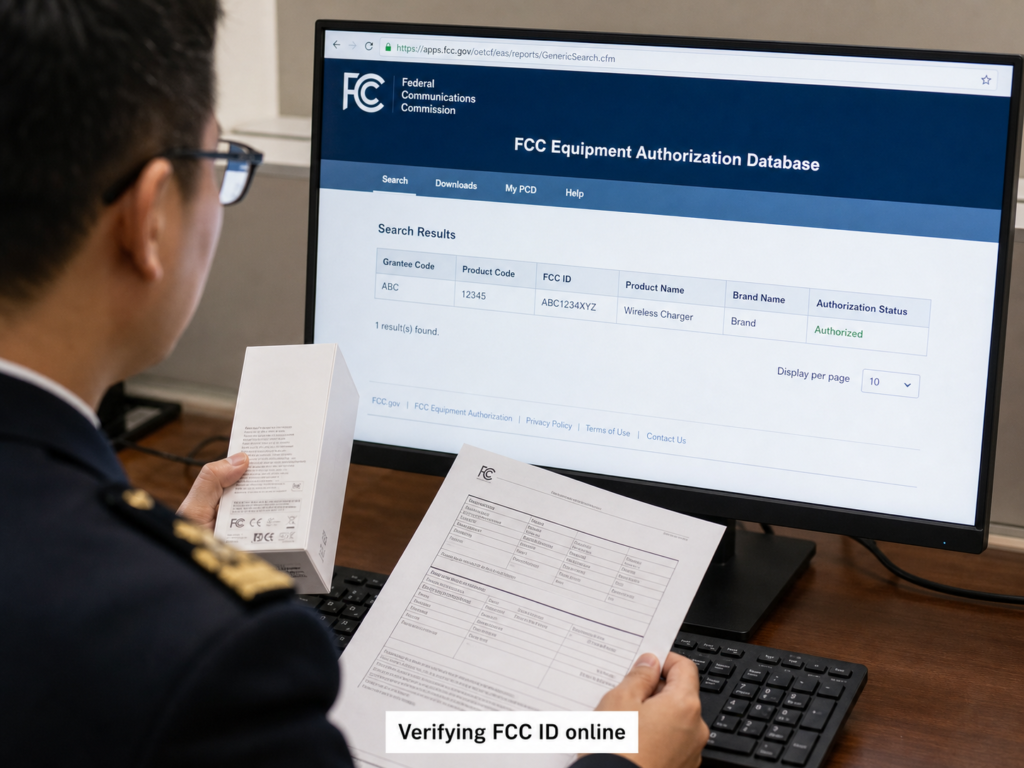
• **FCC ID**: Enter the ID number into the FCC official equipment authorization database to verify the model, brand, authorization status, and authorization conditions.
• **NRTL certification**: Verify according to the four-item checklist: valid status, scope matching, type matching, and mark compliance. UL certification can be confirmed through official query channels such as UL’s Product iQ, and other institutions shall also use their official databases or formal query channels.
• **Other documents**: For SDoC, GCC, DOE-related materials, etc., verify the applicable standards, model, responsible entity, and whether the documents are truly applicable to the product.
Step 3: Four core pieces of information must be verified: whether the model and power correspond, whether the certification status is valid, whether the manufacturing factory is within the certification coverage scope, and whether the responsible entity is clear. If one of them does not match, the supplier shall be asked to explain and provide evidence, and if necessary, re-evaluate or supplement the certification.
Import Required Document Matrix
All documents shall be organized before import, and organizing by category can reduce omissions:
• **Basic customs clearance documents**: Commercial invoice, packing list, bill of lading or declaration materials, customs code description.
• **Product certification documents**: Photos of products and packaging, photos of model and rating labels, product manuals.
• **Compliance documents**: Documents for the corresponding FCC path, NRTL certification (if required), CPSC GCC or safety test report (if required), DOE-related energy efficiency materials (if required).
• **Other documents**: Contact information of the importer, manufacturer, responsible party required by FCC or other regulations, as well as additional certification documents required by the platform or purchaser.
All documents must comply with one core principle: the actual product, packaging, commercial documents, and compliance materials shall be authentic, consistent, and traceable. If there are differences between sales models, SKUs, series models, or manufacturing models, clear model mapping and variant coverage descriptions shall be prepared, and it shall be proved that these differences will not lead to untrue declarations, nor will they exceed the scope of certification or testing.
Import Responsibilities and Evidence Chain Construction
Many people think that compliance is entirely the supplier’s business, but in fact, the importer also has important responsibilities. The importer shall be responsible for the authenticity of customs declarations and reasonable care, and shall confirm that the product meets applicable regulatory requirements. The specific statutory responsible entities and obligations under systems such as FCC, DOE, and CPSC shall be determined in accordance with the corresponding regulations respectively.
Customs brokers usually submit declaration materials in accordance with the importer’s entrustment, and cannot make all product compliance judgments on behalf of the importer. Suppliers and manufacturers shall provide authentic and valid product compliance documents and test reports.
To cope with possible inspections, it is recommended that each SKU build a complete evidence chain, made into a mapping table, to correspond information such as hardware version, manufacturing factory, label information, test report, certification record, sales or manufacturing model, and U.S. responsible party one by one. Once inspected, matching documents can be provided quickly.
Pre-Shipment Document and Label Inspection
A final round of inspection shall be done before shipment to avoid problems at the last minute.
The first is **label inspection**: Marks such as FCC, NRTL, and DOE shall comply with the usage requirements of corresponding rules or certification bodies, and be consistent with applicable certification records and product materials. It should be noted that the FCC Logo is not a mandatory mark for all SDoC products, and cannot be printed arbitrarily just to “look compliant”.
The second is **document organization**: All documents are sorted and organized by model and hardware version, and sent to the customs broker for backup in advance. Do not wait until you are inspected to look for documents everywhere.
The third is **set handling**: If it is a set product, compliance documents for each component shall be prepared separately, and a set combination description shall be attached to prove that the functions, parameters, and document scopes of each component can correspond.
The fourth is **rule review**: Before shipment, check the latest official requirements and enforcement notices to confirm that the rules have not been updated, to avoid using old compliance requirements to deal with new products or markets.
Precautions for Dual Compliance of Customs + E-Commerce Platforms
Sellers on e-commerce platforms must meet the dual requirements of both customs and the platform:
First, platforms may require safety compliance documents for some charging products, but the specific requirements will vary with the platform, site, category, and review status. Some platforms accept specific NRTL certifications, while others may require test reports of specific standards or other safety materials. It cannot be simply generalized that all products must have UL.
Second, never make fake documents just to pass platform review. Once customs or other competent authorities discover false certification, fraudulent use of marks, or false declaration, it may bring more serious consequences such as detention, return, confiscation, fines, and subsequent enforcement.
Third, model information shall be clearly corresponding: there shall be a clear mapping between the model listed on the platform, the model declared for import, the actual product, and the certification documents. You cannot use the documents of Model A to cover Model B products that have no evidence support.
7. Practical Judgment of Typical Scenarios
After talking about so many rules, let us use three common product scenarios in the charging industry to make practical judgments, and you can directly match them to your situation.
Scenario 1: Ordinary Wall-Plug Charger with Only USB-C Output
This type of product has no wireless, no Bluetooth, no smart functions, and is the most common charging product.
• **FCC judgment**: Whether an ordinary wall charger or power adapter requires FCC SDoC cannot be presumed solely based on the product name “charger”. It shall be judged model by model based on the actual circuit, internal digital technology, applicable Part 15 definitions, emission limits, and exemption clauses. Even if the product uses a switching power supply, it does not automatically mean it is a digital device subject to Part 15 SDoC.
• **Safety certification judgment**: Because it is a product directly connected to the mains, there is no unified mandatory UL requirement at the federal import level, but platforms, purchasers, local authorities having jurisdiction, or specific sales scenarios may require NRTL finished product certification or other safety documents.
• **Customs materials**: Basic customs clearance documents, FCC documents determined to be applicable, NRTL documents (if required), photos of labels and ratings.
Four practical elements:
• **Preliminary conclusion**: Whether FCC SDoC is required shall be confirmed model by model according to the specific circuit and applicable rules; NRTL finished product certification shall be prepared according to platform, purchaser, local requirements, and product usage scenarios.
• **Materials to be supplemented**: Circuit design description, internal digital circuit or chip information, product function description, confirmation of applicable rules and standards.
• **Special circumstances**: If it is a pure analog circuit, for special purposes, or meets specific exemption clauses, further evaluation is required.
• **Common misconceptions**: Thinking that no wireless function means no FCC is needed, or thinking that UL is a mandatory federal import requirement.
Scenario 2: Smart Car Charger with Bluetooth
This type of product can connect to a mobile phone APP to adjust power, and has an active wireless transmission function.
• **FCC judgment**: Products with Bluetooth transmission function usually must be covered by applicable FCC Certification. It can be that the whole device obtains Certification, or uses the authorization of a certified module when all conditions are met; in addition, the Part 15 unintentional radiation of the host device, as well as obligations such as labels and user materials, shall be evaluated separately.
• **Safety certification judgment**: Because it is vehicle-powered and not directly connected to the mains, the attention to its safety certification during the import stage is usually lower than that of wall-plug chargers, but some platforms, purchasers, or specific usage scenarios may require safety documents.
• **Customs materials**: Basic customs clearance documents, applicable FCC authorization materials, module authorization and whole device integration instructions, as well as safety documents required by the platform or purchaser (if required).
Four practical elements:
• **Preliminary conclusion**: Applicable FCC Certification coverage is required, which can be whole-device authorization or qualified certified module authorization; safety certification shall be prepared according to specific requirements.
• **Materials to be supplemented**: Authorization record of the Bluetooth module, module integration conditions, whole device antenna and installation method, co-location situation, as well as evaluation materials for other functions of the host device.
• **Special circumstances**: If the module exceeds the authorization conditions, the antenna or installation method changes, the software can modify RF parameters, or the host device adds other wireless transmission functions, the whole device certification requirements need to be re-evaluated.
• **Common misconceptions**: Thinking that using a certified module automatically exempts the whole device from all FCC obligations, or thinking that car chargers do not need safety certification at all.
Scenario 3: Ordinary Passive USB-C Charging Cable vs Fast Charging Cable with E-Marker
The compliance requirements of these two types of cables are often confused.
• **Ordinary passive cable**: If there are no chips, digital circuits, or other regulated electronic functions, the FCC’s attention is usually relatively low; safety certification shall be judged according to the cable structure, rated parameters, and requirements of the purchaser or platform.
• **Cable with E-Marker**: It is not that FCC compliance is mandatory as long as there is an E-Marker, nor can it be directly determined that SDoC is required solely based on the E-Marker. The judgment shall be made in combination with whether data communication is supported, the specific situation of the digital circuit, and whether there is regulated RF emission; in terms of safety, it shall meet the product’s rated parameters and applicable requirements.
• **Customs materials**: Basic customs clearance documents, corresponding compliance documents, and product parameter descriptions.
Four practical elements:
• **Preliminary conclusion**: The FCC’s attention to passive cables is usually relatively low; cables with E-Marker need to be evaluated in combination with specific circuits and functions.
• **Materials to be supplemented**: Circuit design description, E-Marker function description, whether data transmission is supported, rated voltage and current, and cable structure information.
• **Special circumstances**: If it has data transmission function, or contains other digital circuits and electronic components, FCC requirements need to be re-evaluated.
• **Common misconceptions**: Thinking that all USB-C cables require FCC or UL certification, or judging that SDoC is required solely because of the E-Marker.
8. Official Basis and Competency Summary
All compliance rules shall be subject to the content officially released. The following are common official query channels and their uses:
• **CBP official website**: Query import enforcement policies, declaration requirements, inspection processes, and specific notices.
• **FCC official website**: Query the Certification records corresponding to FCC IDs through the equipment authorization system, and consult 47 CFR Part 15, Part 18, and related equipment authorization rules.
• **CPSC official website**: Query GCC requirements, product safety standards, and recall information.
• **DOE official website**: Query the energy efficiency requirements, applicable scope, report submission, and product marking requirements of external power adapters.
• **OSHA official website**: Query the current NRTL recognition scope of specific laboratories, and confirm their recognized standards and product categories.
• **UL official website**: Query UL certification status and coverage scope through official channels such as Product iQ.
After reading this article, you should be able to quickly judge the following four things:
1. Able to preliminarily screen the types of FCC, NRTL, and DOE documents that need to be prepared for common charging products, without blindly asking suppliers for a bunch of inapplicable certificates.
2. Able to independently verify the authenticity, applicable scope, and basic customs compliance risks of materials such as FCC, UL, and ETL.
3. Able to identify common compliance pitfalls, such as using component certification to impersonate finished product certification, applying the FCC ID of other products, misusing wireless module authorization, fraudulently using certification marks, and directly using CE, CCC, or RoHS materials as U.S. legal compliance certificates.
4. Able to respond to customs inspections, know what to do first, which situations require supplementary evidence, which disposal measures must wait for written permission from the competent authority, and which false documents and fraudulent mark use risks cannot be touched.
This article is a general preliminary screening reference. Specific compliance requirements may be adjusted with changes in official rules, product functions, and sales scenarios. Actual operations shall be subject to the latest official requirements, notices from competent authorities, and model-by-model evaluation results of products.