
Many sellers of charging products who are new to the EU market’s first reaction is to look for a “EU Customs Certification Certificate” — they assume that with this certificate uniformly issued by customs, they can complete customs clearance smoothly all the way. In reality, no such universal certification document exists in the EU at all. All customs clearance-related materials are divided into different categories by purpose and submission scenario, and submitted in accordance with corresponding requirements.
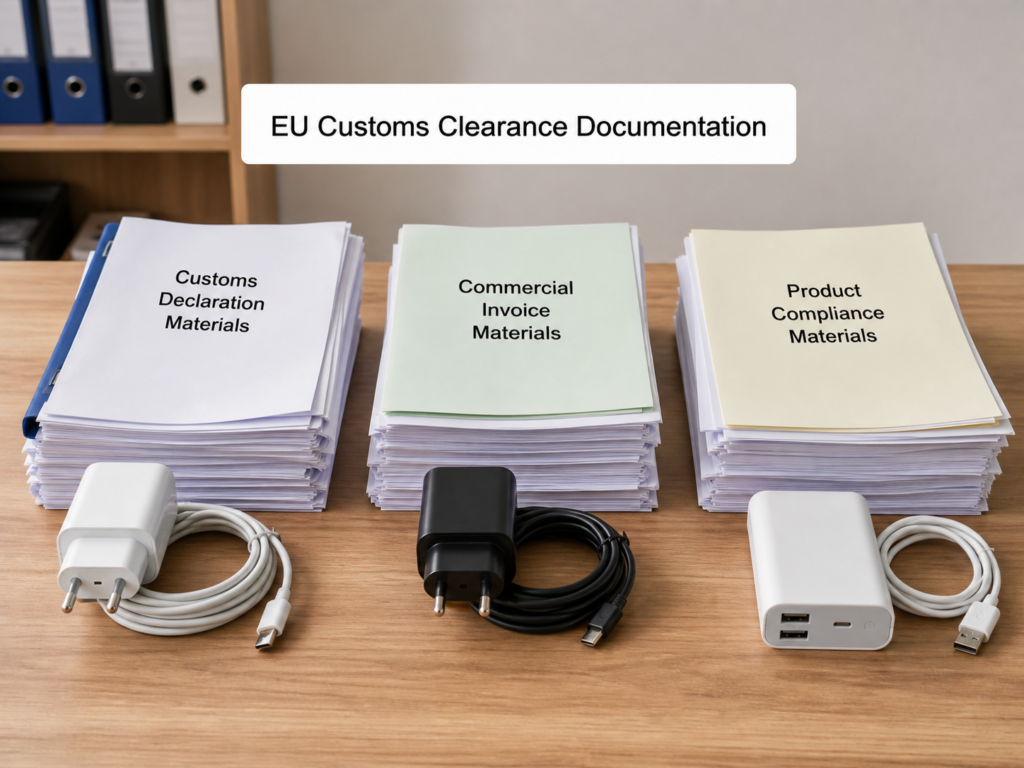
All customs clearance-related materials can be divided into three major categories by purpose: The first category is customs declaration materials, which are basic entry information used to initiate the customs clearance process. The second category is product compliance materials, used to prove that products comply with EU market rules, and are usually required to be kept for inspection. If they cannot be provided or the products do not comply with applicable regulations, it may lead to suspension or refusal of release, return shipment, market restrictions or other enforcement measures. The third category is tax, EPR, and transportation materials, used to calculate taxes and fees, meet extended obligations and transportation safety requirements. These materials can also be divided into three types by submission status: data or materials provided at the time of declaration accompanying the shipment, materials for random inspection and reference, and documents separately required to be uploaded by platforms or carriers. There is no “universal certificate” that can cover all scenarios.
Scope of Application and Core Misconceptions for Beginners
All requirements mentioned in this article are primarily targeted at products such as charging cables, USB/USB-C data cables, chargers, power adapters, interface connectors, and wireless charging devices, covering the three most common cross-border scenarios: B2B bulk import, B2C cross-border direct mail, and platform overseas warehouse stocking. For personal non-commercial use items, they usually do not fall under the category of “placing products on the market”, and may not be subject to full market compliance obligations such as CE and RoHS, but they must still comply with customs declaration, prohibited and restricted shipment, and border security requirements. Whether samples with no commercial value are subject to product compliance requirements shall be judged based on their purpose, whether they are used for display or testing, and specific regulations, and cannot be exempted solely by their “sample” status.
New sellers are very likely to make mistakes on four core issues. Here, we will state the conclusions clearly first to avoid detours:
First, CE is a product compliance mark, not a customs clearance permit. Many people think that printing CE will allow them to pass customs. In fact, CE is a mark that the product itself complies with EU safety, environmental protection and other regulations. Customs will not directly release the goods just because of the CE mark. If the CE mark is missing, used incorrectly, or the product does not comply with applicable regulations, customs or market surveillance authorities may suspend release, require supplementary materials, restrict sales, return the goods or take other enforcement measures.
Second, test reports are supporting materials and cannot replace the DoC (EU Declaration of Conformity). The DoC is usually made and signed by the manufacturer or its authorized representative in the name of the manufacturer. Importers should usually keep a copy and ensure that it can be provided. Test reports, technical documents and risk assessments are supporting materials to prove that the product meets the requirements; customs or market surveillance authorities may require the provision of DoC and related technical evidence based on the product type and risk situation.
Third, low-value parcels only simplify some tax procedures and do not exempt product compliance obligations. For parcels with an intrinsic value of no more than 150 euros per shipment, IOSS can be used to simplify the import VAT declaration when conditions are met, but this does not mean that the product can fail to meet applicable requirements such as RoHS and CE. If the product has compliance issues, it may still be required to provide supplementary materials, have its release suspended, or be subject to other measures.
Fourth, freight forwarders or platforms can handle submission on behalf of the seller, but they do not replace the final responsibility of the legal subject. Even if the freight forwarder declares for you and the platform submits documents for you, the responsibility for non-compliant products and false declaration information shall still be borne by the manufacturer, importer, seller or other legal subjects according to applicable regulations and specific roles, and will not be automatically exempted just because someone else handles it on your behalf.
Division of Responsibilities for Customs Clearance and Compliance
Many people cannot figure out who is responsible among the many roles in the customs clearance process. In fact, according to the mandatory degree of regulations, the responsibility boundaries of core roles can be understood as follows:
• **Manufacturer**: The primary responsible party for product compliance, responsible for completing the conformity assessment, signing the DoC and keeping technical documents in the name of the manufacturer. If there is a problem with product design or production, the manufacturer’s responsibility is usually traced first.
• **EU Authorized Representative**: Entrusted by the manufacturer to liaise with EU regulators and keep compliance documents. Under some CE regulations, an authorized representative may be an optional arrangement; however, certain product regulations or specific sales models may require an economic operator within the EU, which cannot be generalized.
• **EU Importer**: In applicable product regulations, it is usually the operator within the EU that first places products from third countries on the EU market. Its specific obligations depend on applicable regulations and supply chain arrangements, and it cannot be deemed to bear all product responsibilities just because it participates in customs declaration.
• **Distributor/Fulfillment Service Provider**: Distributors usually do not bear the primary responsibility of the manufacturer for design and manufacturing, but still have obligations for supply chain verification, storage and transportation, and cooperation with supervision as stipulated by applicable regulations. Fulfillment service providers may assume the obligations of responsible persons under the GPSR when conditions are met; if an entity sells under its own brand, substantially modifies the product or affects product compliance, it may also bear manufacturer responsibility.
• **Customs Declarant (IOR)**: The entity that actually submits the customs declaration, and bears corresponding responsibility for the declaration information it submits. The customs declarant can use its own EORI number, but the customs declarant and indirect agent are not automatically equivalent to the importer in the sense of product regulations, nor do they automatically bear all product compliance responsibilities.
• **EU Responsible Person**: The responsible economic operator within the EU required by the GPSR (General Product Safety Regulation). For products covered by the GPSR and provided by non-EU manufacturers, the responsible person shall be determined according to the supply chain role. This entity is responsible for liaising with regulators within the specified scope, and cannot replace the responsibilities legally borne by the manufacturer or other entities; non-EU sellers will not be exempted from their own responsibilities just because they have designated an EU responsible person.
To accurately judge responsibilities, first of all, three key nodes that are easy to confuse must be distinguished:
The first is **entry into the EU customs territory**, that is, the goods have just arrived at the EU border and have not gone through customs clearance procedures, which does not mean that the product has been placed on the EU market;
The second is **customs release/free circulation**, that is, after completing the declaration and paying all taxes and fees, the goods can move freely within the EU, but have not yet reached the end user;
The third is **placing on the market**, that is, providing products to EU end users for the first time, which triggers market compliance obligations related to specific product regulations. For example, the retention period of compliance documents usually needs to be judged according to specific regulations and subject obligations, and not all products are subject to exactly the same calculation method.
The division of responsibilities also varies for different sales models. Don’t default that others will take responsibility for you:
• Under the overseas warehouse stocking model, for products produced by non-EU manufacturers and placed on the EU market, it is usually necessary to have an economic operator within the EU that meets the requirements of applicable product regulations. This entity may be an importer, an authorized representative, or other eligible responsible persons when GPSR applies. It cannot be determined solely by the declaration role of the freight forwarder or customs broker that it bears all product compliance responsibilities;
• Under the platform fully managed/semi-managed model, the platform can declare on behalf of the seller, but product compliance responsibilities still need to be divided according to the legal roles of the seller, manufacturer, importer and other economic operators, and the specific arrangement depends on the cooperation agreement;
• Under the DDP (Delivered Duty Paid) model, the freight forwarder can declare on behalf of the seller, but the importer, customs declarant and economic operator in the sense of product regulations may not be the same entity, and their respective roles should be clarified in the contract and actual supply chain arrangements;
• Under the B2C direct mail model, when non-EU manufacturers provide products covered by GPSR to EU consumers through distance sales, the products must have the EU-based responsible economic operator required by GPSR, and provide the required information in appropriate places such as online product information, products, and packaging. The responsible person is specifically determined by the supply chain role and agreement in accordance with the law, and the platform does not automatically assume this role just because it participates in sales.
For non-EU sellers, three things must be confirmed before shipment: First, clarify the subject of the legal importer or other EU-based responsible economic operator (where applicable), and do not default that the logistics provider or platform will automatically bear compliance responsibilities; second, confirm that the EORI number of the declaring entity is valid; third, confirm that the manufacturer can provide a full set of compliance supporting documents corresponding to the specific model, rather than a general template.
Customs Clearance Document Matrix for Charging Products
You don’t have to memorize long document lists by rote. It will be very clear if you sort them by submission scenario.
Documents and Data Provided at the Time of Shipment Declaration
This type of information is the common basis for declaration, and should be prepared according to the declaration procedure, mode of transport, member state electronic systems, customs representative model and requirements of the customs broker. Not all attachments must be uploaded simultaneously with each declaration; some information can be directly entered into the electronic declaration system, and relevant attachments are submitted or kept for inspection when needed.
**Basic declaration category** usually includes: EORI information of the declaring entity or relevant economic operator; complete commercial invoice (including product name, SKU, cargo value, sender and recipient, HS/CN code, trade terms, country of origin); packing list (including number of boxes, net weight/gross weight, quantity of each SKU); transport document (bill of lading, waybill or label); and electronic declaration data or forms required by the customs of member states. The specific submission method may vary depending on the mode of transport, declaration procedure and customs system.
**Tax category (submitted on demand)** is mainly IOSS (Import One-Stop Shop VAT number), which is applicable to eligible non-excise import distance sales with an intrinsic value of no more than 150 euros per shipment. Special reminder here: IOSS ≠ VAT number ≠ OSS number ≠ EORI number. It is only a number used to simplify the VAT declaration for import distance sales, and should not be confused with other numbers.
**Special category (submitted on demand)** includes brand authorization letter (provided when selling branded products to prove the legality of sales), certificate of origin (submitted when applying for preferential tariffs, responding to trade remedy or quota verification, or required by customs, not required for every shipment). If applying for preferential tariffs, the certificate of origin in the prescribed form shall be prepared according to the applicable preferential agreement, cargo value and exporter qualification, such as declaration of origin, REX declaration or certified certificate of origin.
Documents for Random Inspection and Reference
This type of document usually does not need to be submitted for every declaration, but must be provided in a timely manner when required by customs or market surveillance authorities. If they cannot be provided, or the product does not comply with applicable regulations, it may lead to suspension or refusal of release, return shipment, market restrictions or other enforcement measures, depending on the product risk and case handling results.
Before preparing documents, you can first use a six-step decision tree to judge which regulations apply to the product, so you don’t have to prepare blindly:
Step 1: Determine whether it is EEE (Electrical and Electronic Equipment). EEE falling within the scope of RoHS must meet RoHS substance restrictions and retain corresponding conformity evidence. REACH obligations shall be judged item by item according to whether the product contains restricted substances, SVHC (Substances of Very High Concern), mixtures and specific supply chain situations, which may involve information transmission, restriction or other obligations, and does not mean that every charging product needs REACH registration or test report.
Step 2: Determine whether it is connected to the mains or designed to operate within the range of 50-1000V AC and 75-1500V DC. For electrical equipment falling within the scope of LVD, the safety requirements of the LVD (Low Voltage Directive) shall be assessed. The voltage range is only one of the applicable conditions, and the product definition, power supply structure and regulatory exclusions must also be checked. For example, a 65W charger with an input of 220V AC usually needs further LVD assessment; an ordinary USB-C charging cable with an operating voltage of 5V DC is usually not within the voltage range specified by the LVD.
Step 3: Determine whether it has active electronic functions. If yes, EMC (Electromagnetic Compatibility) compliance obligations need to be assessed; if it is a passive pure cable, it shall be judged according to the product structure and applicable regulations, and cannot be concluded solely by the name “cable”.
Step 4: Determine whether it has wireless communication or radio transmission functions. If yes, it is usually necessary to assess the RED (Radio Equipment Directive). If it is only near-field wireless energy transmission without communication or radio transmission functions, such as some ordinary wireless charging pads, then RED is usually not applicable, but other potentially applicable regulations must still be checked.
Step 5: Determine whether it contains a built-in battery. If yes, it is necessary to assess the EU Battery Regulation and related producer responsibility, labeling and transportation requirements; if there is no built-in battery, the relevant obligations for battery products themselves do not apply.
Step 6: Determine whether it is an external power supply product. If yes, it is necessary to check the current ecodesign and other energy efficiency and information requirements, depending on the product definition, power range and sales arrangement; it should not be judged solely by the name “charger”, nor should the energy label be regarded as a unified mandatory requirement for all external power supply products.
After determining the applicable regulations, there are three main types of corresponding general reference documents:
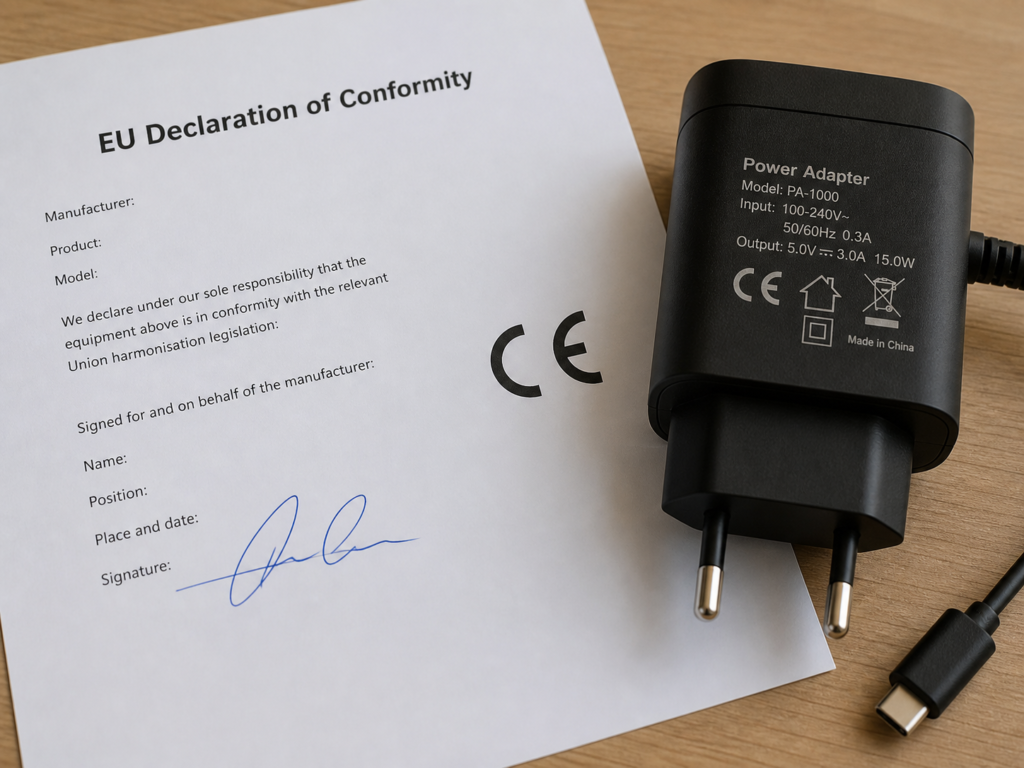
First, the DoC (EU Declaration of Conformity), usually signed by the manufacturer or its authorized representative in the name of the manufacturer, must correspond to the specific model and be signed by an authorized signatory. Importers should usually keep a copy and ensure that it can be provided upon request;
Second, technical documents, including design drawings, circuit diagrams, bill of materials, risk assessment, etc., are supporting materials for the DoC;
Third, RoHS/REACH compliance supporting materials, such as material data, supply chain declarations, test reports, etc. The specific materials required shall be judged according to the actually triggered regulations and product conditions.
In addition, special supporting materials corresponding to the triggered regulations must also be prepared, such as LVD or EMC related test and assessment documents, RED compliance documents, battery compliance certificates, etc. Prepare whatever is triggered. Test reports cannot replace the DoC, and the DoC cannot replace the technical evidence that the product should have.
When customs conducts unpacking inspection or regulatory verification, they will also pay attention to labels and marks, which should also be done well in advance. Product identification information, manufacturer information, importer or other EU economic operator information and necessary warnings shall be checked in accordance with each applicable product regulation. In principle, this information shall be marked on the product; if it cannot be done due to the nature or size of the product, it can be placed on the packaging or accompanying documents in accordance with applicable regulations. The CE mark shall also be marked on the product body or nameplate in accordance with applicable regulations, and can only be marked on the packaging or accompanying documents when permitted by regulations. The responsible person information required by GPSR shall be provided in accordance with the requirements of this regulation for online product information, as well as products, packaging or accompanying documents, and does not need to be bound to the CE mark.
Member State EPR and Platform Market Access Materials
This type of document is not a general customs clearance document for customs, and is only required during member state EPR regulatory verification, platform settlement or warehousing audit, and market surveillance random inspection.
It mainly includes three categories: WEEE (Waste Electrical and Electronic Equipment recycling), which is an EPR (Extended Producer Responsibility) obligation, usually registered by the country of sale; Packaging EPR, complete packaging registration and recycling obligations according to the requirements of the country of sale; Battery EPR, products containing batteries need to complete battery registration, recycling and labeling obligations according to the country of sale.
EPR registration obligations depend on the country of sale, producer identity, and product category. Do not confuse it with customs clearance documents, nor do you default that EPR registration certificates must be submitted for every import.
Carrier, Platform and Transportation Safety Requirements
ICS2/ENS belongs to the EU entry security declaration system, which is part of the EU customs safety and security requirements, not a simple voluntary management document of the carrier. Relevant carriers, freight forwarders or other legal declaring entities shall submit the required data according to the mode of transport and implementation stage. Sellers shall provide complete, accurate and specific cargo descriptions, consignor/consignee and classification information, and shall not regard it as a purely additional requirement of the carrier.
Lithium battery transportation documents and packaging labels shall be prepared in accordance with battery parameters, shipment status and dangerous goods rules for air, sea or land transport. Carriers may put forward additional operational requirements on the basis of legal requirements. Relevant materials may include UN 38.3 test summary, dangerous goods declaration, packaging and labeling documents, etc., depending on the battery type, mode of transport and shipment status. These are transportation safety compliance materials and should not be simply stated as being collected solely by the carrier on its own initiative.
Platform documents may include EU responsible person information, product label photos, manuals, EPR registration numbers, etc., subject to the current site policy of the platform and cooperation agreement.
Submission Channels and Full Process Operation
Three Mainstream Submission Channels
You can choose the appropriate submission method according to your own situation:
• Entrust a freight forwarder or customs broker: suitable for beginners and small-batch sellers. Prioritize service providers with experience in customs clearance of charging products to avoid problems caused by unfamiliarity with product classification or compliance requirements;
• Enterprise independent submission: requires a valid EORI number, suitable for large sellers and bulk import situations, and can independently control declaration information;
• Platform submission on behalf: fully managed or semi-managed platforms may make unified declarations. Sellers need to upload documents that meet the requirements in advance, and the specific rules are subject to platform requirements and cooperation agreements.
Full Process Operation Nodes
Sorted by timeline, the most critical is the preparation before shipment. Many customs clearance problems are caused by insufficient preparation in the early stage, and it will be very troublesome to supplement documents later.
In the **pre-shipment preparation** stage, four things must be done well: First, establish a SKU-model-compliance document correspondence table, and check that product parameters, CN/TARIC codes, quantities, and cargo values are consistent with the documents; second, submit documents in electronic formats accepted by customs systems, platforms, carriers and customs brokers, and do not regard PDF as the unified format requirement of the EU for all documents; third, the language of product descriptions, warnings, DoC and other documents shall be prepared in accordance with specific applicable regulations and the requirements of the destination member state, and English and the official language version of the destination country shall be provided if necessary; fourth, complete the determination of applicable regulations for the product in advance, retain the determination basis, confirm that the customs valuation complies with EU rules, and retain cargo value certification materials to avoid penalties for underreporting cargo value.

**Pre-shipment security declaration (ICS2)** is usually submitted by relevant carriers, freight forwarders or other legal declaring entities, but sellers need to provide accurate consignor/consignee information, HS codes and cargo descriptions. Do not only use vague descriptions that cannot identify the nature of the goods such as “gift”, “sample”, “accessories”, but provide accurate and specific product names, materials, uses and quantities. Insufficient data may lead to rejection of the declaration, request for supplementary information, or increased security risk assessment. The declaration time limit depends on the mode of transport, carrier and implementation stage, and should be confirmed with the service provider in advance.
The submission time of **formal customs declaration** shall be prepared in advance according to the requirements of the carrier, customs broker and destination country customs. The declaration content includes cargo information, classification, valuation, country of origin, tax calculation, etc. All information must be consistent with the attached documents. After declaration, you will usually get an MRN (declaration reference number), which can be used to check the customs clearance progress.
Common types of customs review include automatic release, document review, and unpacking inspection, but this is not an official classification uniformly stipulated by the EU, and the actual process varies depending on the member state and system. There is no unified standard for the review duration, which depends on the member state, mode of transport, whether there is inspection and the completeness of materials.
After release, documents must also be retained as required: customs declaration and tax records shall be kept in accordance with EU Customs Code and member state tax laws, and the specific period may vary depending on the type of record and member state requirements; CE technical and compliance documents shall be kept by the manufacturer, importer or other economic operators stipulated by applicable regulations, and usually need to be kept for a specified period after the last time the product is placed on the market. Many product regulations adopt a 10-year requirement, but the specific regulation shall prevail; EPR and platform records shall be kept in accordance with the EPR regulations of the country of sale and platform requirements.
There are three core red lines that cannot be touched during the submission process:
First, the product name, SKU, quantity, and manufacturer information of all documents must be corresponding and traceable. Inconsistent information can easily lead to document supplementation, inspection or other handling;
Second, documents must be clear, identifiable, unaltered, and in a format accepted by the customs system, platform, carrier or customs broker;
Third, the DoC must be signed by an authorized signatory, and the commercial invoice must be true, complete and traceable. Do not commit fraud.
Supporting Submission Requirements for Digital Cross-border Platforms
If you sell on a platform, you should also note that the platform’s submission rules and customs requirements are two separate systems, and do not confuse them.
Rules vary for different platform types: Third-party open platforms generally require sellers to upload compliance documents for review before overseas warehouse warehousing or listing, and customs clearance documents are prepared by the seller themselves, subject to the site policy; fully managed platforms declare on behalf of the seller, and sellers need to upload relevant certification and compliance documents in advance, subject to the cooperation agreement; in the independent website scenario, all documents need to be prepared by yourself, and cooperate with the verification of logistics, payment providers and customs declaration entities.
Platform rules and customs rules are related. Don’t think that passing the platform review means everything is fine:
If IOSS is applicable, the sales platform or its customs representative that has the right to use the IOSS number must include the number in the import declaration data in accordance with regulations. If the number is not correctly transmitted or IOSS is not applicable, VAT may be levied separately at the import stage. The specific responsibility and collection method depend on the sales platform, declaring entity and customs procedure;
Passing the platform review only means meeting the platform’s settlement requirements, not meeting the official standards of customs or other regulatory authorities. Products may still be required to provide supplementary materials, have their release suspended, or be subject to other regulatory measures;
Customs detention of goods and violation records may trigger platform review, leading to product removal and store traffic restriction, but whether they are shared and how to handle them depends on legal requirements, platform policies and entrustment agreements.
There are two special points to note for platform submission: First, it is necessary to additionally upload materials such as EU responsible person information (when GPSR applies), product label photos, and manuals; second, the information on the platform product page must be traceable and consistent with the customs clearance documents, for example, the model and parameters on the product page must correspond to the declaration documents.
Advanced Judgment Methods and Pitfall Avoidance Guide
After handling several shipments, you can master some judgment methods to quickly check risks and solve common problems.
Three-step Logic for Quickly Judging Required Documents
You don’t have to look through long lists every time. You can quickly sort it out in three steps:
Step 1: First look at the product attributes, determine which regulations are triggered according to the compliance decision tree, and prepare supporting documents accordingly;
Step 2: Look at the cargo value and model. For B2C distance sales with an intrinsic value of no more than 150 euros per shipment, IOSS can be used to simplify tax declaration when conditions are met;
Step 3: Look at the trade scenario. If applying for preferential tariffs, the certificate of origin in the prescribed form shall be prepared according to the applicable preferential agreement, cargo value and exporter qualification, such as declaration of origin, REX declaration or certified certificate of origin. B2B bulk import itself does not automatically require a preferential certificate of origin.
Common Causes of Customs Clearance Failure
There are three main reasons for the failure of customs clearance of charging products, which can be checked against:
First, document missing category, such as lack of valid EORI information, incomplete declaration data or inability to provide the required compliance documents in a timely manner. This is one of the common risks, and the actual frequency depends on the member state, mode of transport, declaration procedure, product type and carrier review rules;
Second, information inconsistency category, such as wrong HS/CN code classification, inconsistent cargo value or quantity with the declaration, mismatched model;
Third, compliance invalid category, such as inability to provide valid DoC, RoHS or REACH related supporting materials during random inspection, or expired documents, use of general templates that do not correspond to specific models.
Correct Classification Method for HS/CN Codes
Many sellers like to guess the code based on the product name, which is very easy to make mistakes. The core basis for classification is the actual parameters of the product: input and output voltage, current, power, whether it has power conversion function, whether it has a connector, whether it contains an active chip, these are the important references for classification, not what the product is called.
You can use the EU TARIC code database and member state customs classification guidelines for inquiry. If there is a classification dispute, you can apply for BTI (Binding Tariff Information), which is binding across the EU within its scope of application and can reduce the risk of subsequent disputes.
Response to Differences in Internal EU Rules
The core system of EU customs is unified, but different member states may have differences in declaration systems, languages, EPR requirements, tax rules, regulatory enforcement intensity and local operational details. Product regulations such as CE and RoHS should also be judged in combination with specific products and applicable regulations, and all obligations cannot be inferred solely from a unified label.
Don’t judge solely based on experience. It is best to consult a professional customs broker in the destination country, or confirm through TARIC, the official website of the member state’s competent authority and relevant EU platforms.
Basic Remedy Logic After Goods Detention
If measures such as suspension of release, document supplementation or other border measures are taken, don’t panic. First, handle according to the specific reasons given by the customs or regulatory authority:
If it is a document missing category, immediately complete the required declaration or compliance documents, and prioritize providing the DoC and core supporting materials corresponding to the specific model;
If it is a classification dispute category, provide product parameter certificates, apply for re-verification of the HS code, and consider applying for BTI if necessary;
If it is a serious violation category, such as excessive underreporting of cargo value, serious non-compliance of products, you can compare the costs of tax supplementation, fines, return shipment or destruction, choose an appropriate plan, and handle it according to professional advice.
Reference to Typical Cases of Charging Products
For a more intuitive understanding, here are three examples of common charging products:
The first is **passive USB-C charging cable** (no active chip, only transmits power or data), applicable scenario is B2C direct mail, intrinsic value of 20 euros per shipment, may be subject to RoHS and REACH related requirements. Variables that need to be confirmed include whether it has a connector, structure and function, and EPR requirements of the destination country. Common document supplementation points are HS code classification disputes and lack of supporting materials related to material compliance.
The second is **65W USB-C external power adapter**, applicable scenario is overseas warehouse stocking, bulk import, may be subject to LVD, EMC, RoHS, REACH and external power ecodesign requirements, depending on the product definition, input and output parameters and applicable regulations. Variables that need to be confirmed include input and output parameters, whether it is for consumers, and EPR requirements of the destination country. Common document supplementation points are inability to provide DoC corresponding to the model, non-standard CE mark or economic operator information.
The third is **wireless power bank with lithium battery (with Bluetooth function)**, applicable scenario is B2B bulk import. Usually, RED (Bluetooth wireless function, including corresponding safety, EMC and spectrum requirements), RoHS, REACH and battery regulations should be assessed; LVD applies only when the product itself meets the LVD voltage range and scope of application. Other requirements should also be checked according to the wireless charging function, input power structure and battery transportation status. Variables that need to be confirmed include battery capacity, installation status, type of wireless function, mode of transport and EPR requirements of the destination country. Common document supplementation points are lack of RED compliance materials and incomplete lithium battery transportation documents.
Pre-shipment Practical Inspection Checklist
You can directly check the list below to complete the self-inspection before shipment to avoid missing items:
Basic Declaration and Tax Inspection
• EORI information of the declaring entity or relevant economic operator is valid, and information of the importer or other EU responsible economic operator (where applicable) is accurate
• Product names, quantities, SKUs, and manufacturer information on commercial invoices, packing lists, and waybills are traceable and consistent
• CN/TARIC codes have been checked through TARIC or professional customs brokers, and classification basis is retained
• Country of origin information is filled in accurately; if applying for preferential tariffs, the corresponding form of certificate of origin has been prepared in accordance with applicable agreements
• For B2C distance sales with an intrinsic value of no more than 150 euros per shipment, the IOSS use qualification and number transmission method have been confirmed (where applicable)
• Customs declaration value complies with EU valuation rules, and cargo value certification materials are retained
Product Compliance and Label Inspection
• The determination of applicable regulations for the product has been completed according to the decision tree, and determination records are retained
• Compliance documents corresponding to the model (DoC, RoHS or REACH related supporting materials, etc.) are complete and can be retrieved at any time
• CE marks, product identification information, economic operator information and necessary warnings on products, packaging or accompanying documents meet the requirements of applicable regulations
• The language of manuals, warnings and labels meets the specific requirements of the destination member state
• Transportation documents, packaging and labels for products containing lithium batteries have been prepared in accordance with the mode of transport and dangerous goods rules
• Document versions are consistent with current regulations, and the manufacturer’s authorization chain and economic operator information are complete and traceable
Platform and EPR Inspection
• EU responsible person and EPR registration number required by the platform have been filed (where applicable)
• The model, manufacturer, and product description on the platform product page are traceable and consistent with the customs clearance documents
• Accurate information required for ICS2/ENS declaration has been provided to the carrier, freight forwarder or other relevant declaring entities
• EPR registration covers all countries of sale (where applicable)
Summary
By now, you should have a complete understanding of the submission requirements for EU customs certification documents: you can distinguish three types of customs clearance-related materials, and clarify that there is no unified “EU Customs Certification Certificate”; you can judge the documents required for importing charging products into the EU according to product attributes and trade models; you can choose appropriate submission channels and complete document preparation and declaration according to the process; you can distinguish the differences between official customs requirements, EPR obligations, transportation safety requirements and digital platform requirements; you can judge common customs clearance risks and master basic pitfall avoidance and remedy methods; you can also complete the full pre-shipment self-inspection against the inspection checklist.
It should be reminded that EU customs, product safety, radio, battery, EPR and platform rules will be updated over time. This article is a general reference and does not replace the case-specific opinions of the destination country’s customs, competent authorities or professional customs brokers. For each specific shipment, it is recommended to confirm the declaration procedure, responsible subject, document format, language requirements and applicable regulations with your customs clearance service provider in advance.