
Friends who do cross-border business of charging products may have often heard the term “supply chain cybersecurity compliance” in recent years – either platforms require documents, or customs detains goods. Many people are confused about whether their products need to be regulated, what needs to be regulated, and where to start. This guide is specifically for charging-related products such as charging cables, USB-C cables, adapters, and wireless chargers, and clarifies the compliance points of the whole process from entry-level judgment to practical implementation.
Two points are explained in advance: First, all regulatory information is updated as of June 2025. For specific implementation, please refer to the latest official texts issued by each market. This article is for general reference only and does not constitute professional legal advice. Second, if you only want to quickly confirm whether your product needs compliance, you can jump directly to the section “4-Step Quick Determination of Regulation Applicability” to get a preliminary conclusion in 1 minute.
1. First, Understand: Does Your Charging Product Need Cybersecurity Compliance?
Many people’s first reaction to “supply chain cybersecurity” is “this is a matter for big Internet companies, and it has nothing to do with selling charging cables”, but that is not the case.
1. Plain-Language Explanation of Supply Chain Cybersecurity Regulations
To put it bluntly, these regulations are rules set by various countries for products with digital functions: the entire chain from upstream chips, manufacturing to finished product sales must prevent vulnerabilities and malicious tampering. Some are mandatory requirements, and some are voluntary references.
Its core regulatory logic is not “all charging products need to be regulated”, but to set requirements according to the product’s digital capabilities, usage scenarios, and target markets, and there is no one-size-fits-all approach. Here are a few easily confused boundaries to clarify:
• It ≠ ordinary electrical safety regulations or EMC electromagnetic compatibility certification. Those manage physical safety and electromagnetic interference, while cybersecurity manages digital-level vulnerabilities and tampering risks;
• It ≠ enterprise internal information security systems such as ISO27001. Those manage the company’s internal data, while cybersecurity manages the digital security of the product itself.
2. Charging Product Compliance Trigger Judgment Matrix

Whether compliance is required does not depend on a single function, but needs to be comprehensively judged in combination with 5 core variables:
1. Whether it can connect to the Internet, such as Wi-Fi, cellular network, etc.;
2. Whether it can be accessed remotely, such as Bluetooth remote control of power, cloud management of devices, etc.;
3. Whether it processes or transmits user data, such as recording charging habits, binding device information, etc.;
4. Whether it contains updatable software or firmware;
5. Whether it is for ordinary consumers, or for specific industries such as government and critical infrastructure.
These variables are mainly used for preliminary screening and cannot replace the specific definitions of “products with digital elements”, “connectable products” or similar concepts in the target market. In particular, the EU CRA does not require products to be directly connected to the Internet; as long as a product has a direct or indirect logical or physical data connection with a device or network, it may need further judgment on whether it falls within the scope of the CRA. Therefore, products with E-Marker, firmware or Bluetooth communication cannot be directly excluded just because there is no Internet interface.
For your convenience, we have sorted out preliminary judgment references for common charging products:
| Product Type | Triggers Cybersecurity Regulation in Most Markets | Remarks |
| Pure passive charging cable with no digital functions | Usually does not trigger specific product cybersecurity regulations | But may still involve electrical safety, EMC, RoHS and other requirements |
| Basic adapter | Needs to be judged based on specific design and target market | Being outside the scope of cybersecurity regulations does not mean no other mandatory conformity requirements apply |
| USB-C cable with E-Marker chip | Cannot be excluded solely due to lack of Internet access | Should confirm whether the chip has digital elements, data connectivity, updatability, and the product’s intended use |
| Ordinary USB/USB-C data cable | No direct conclusion can be drawn | Data transmission alone does not equal processing of user data, but still needs to be judged in combination with product design and target market definitions |
| Ordinary wireless charger (local firmware, no Internet/Bluetooth) | Needs to be judged based on target market and specific design | Local firmware or digital control functions may affect whether it is a product with digital elements |
| Bluetooth-connected charger/wireless charger | Cannot be excluded solely due to lack of Internet access | Should judge whether it can connect to the Internet directly or indirectly via a mobile phone or other device, and whether it falls under regulatory exclusions |
| Internet/cloud-connected smart chargers, charging devices with APP | Usually require key verification | May trigger regulation of Internet-connected or digital element products in most mainstream markets |
| Charging products supplied to government/critical infrastructure | Need to additionally meet procurement contract requirements | This does not change the legal classification, only adds contractual obligations on top of statutory requirements |
3. 4-Step Quick Determination of Regulation Applicability
If the above table has not given you a clear answer, you can follow these 4 steps step by step to get a preliminary conclusion in 1 minute:
Step 1, verify product digital capabilities:对照 the 5 variables above, list clearly what digital functions your product has, including firmware, Bluetooth, E-Marker, data interfaces, remote updates and supporting APPs, etc.;
Step 2, define your role: Are you a brand owner, importer, manufacturer, platform seller or purchaser? Different roles have different responsibilities;
Step 3, clarify the target market: Clarify which country/region the product will be sold to, and where user data (if any) is stored;
Step 4, check application scenarios: Whether the product is supplied to special industries such as government, finance, and medical care, which usually have additional requirements.
4. Core Costs of Non-Compliance
Don’t think that cybersecurity compliance is “making a mountain out of a molehill” – if something goes wrong, the loss is not small:
• Direct losses: customs detention, forced removal from platforms, fines, product recalls. The maximum fine in the EU can reach the level of tens of millions of euros;
• Indirect losses: damaged brand reputation, collective claims from buyers, platform traffic restrictions affecting subsequent sales.
Non-compliance with applicable product safety, radio, market supervision or platform rules may lead to sales refusal, removal, recall or administrative disposal. Specific enforcement cases shall be subject to official announcements issued by relevant regulatory authorities or platforms, and individual cases cannot be generalized as universal enforcement conclusions.
2. Quick Reference of Core Requirements in Major Global Markets (Exclusive for Charging Products)
After confirming that the product needs compliance, the next step is to figure out the specific requirements of your target market – there is no globally applicable cybersecurity rule, and the control scope and strictness of each market are different.
1. EU: Full-Chain Digital Product Regulation
The core regulation of the EU is the **Cyber Resilience Act (CRA for short)**, and there are also supporting rules such as the NIS2 Directive and CE marking harmonized standards.
• **Applicable objects**: In principle, the CRA covers products and related software placed on the EU market that have digital elements and have direct or indirect data connections with devices or networks, but it is necessary to check the exclusion clauses in the regulation and the relationship with special EU regulations such as medical devices, vehicles, and aviation. Whether a charging product falls within the scope shall be judged according to its specific design and intended use. The NIS2 Directive mainly applies to relevant entities in key industries, and ordinary consumer-grade charging products are usually not directly bound by it just because they are consumer goods.
• **Key time nodes** (based on official information as of June 2025): From September 11, 2026, the CRA’s reporting obligations for actively exploited vulnerabilities and serious incidents will apply; the main compliance obligations for products will generally apply from December 11, 2027. The formulation, publication and referencing of harmonized standards shall be subject to the official documents of the European Commission, and cannot be simply understood as automatically fully applicable on September 11, 2026.
• **Core obligations** (vary by product category and conformity assessment procedure): Products shall be designed for safety, establish a vulnerability management mechanism, and provide security update support; upstream supplier risk assessment shall be conducted, and key components shall be traceable; actively exploited vulnerabilities and serious incidents shall be reported to the regulatory authority as required.
• **Compliance evidence**: Technical documentation, risk assessment report, and Declaration of Conformity (DoC) need to be prepared; judgment shall first be made according to the ordinary products, important products Class I/Class II and critical product categories specified in Annex III and Annex IV of the CRA, as well as the corresponding conformity assessment procedures. Some products can be self-assessed, and some products in important or critical categories may require Notified Body (NB) or other specified third-party conformity assessment, which cannot be simply divided into “low risk/high risk”.
• Products that meet the requirements usually need to fulfill CE marking related requirements, but there is no separate unified mandatory cybersecurity label.
• **Non-applicable boundaries**: Pure passive charging cables without digital functions are usually not within the scope of CRA control; basic adapters or products with digital control, firmware, and data connectivity functions need to be judged in combination with specific design, intended use and regulatory definitions.
• **Penalties**: Up to 15 million euros or 2.5% of the company’s global annual turnover, whichever is higher.
2. UK: Special Rules for Connected Consumer Products
The core regulation of the UK is the **Product Security and Telecommunications Infrastructure Act (PSTI for short)** and its subsidiary implementing regulations.
• **Applicable objects**: Relevant connected consumer products as defined by UK regulations need to meet corresponding cybersecurity requirements. When judging, you cannot only look at whether the product has its own Internet interface, but also consider whether the product can connect to the Internet directly or indirectly, and whether it falls under regulatory exclusions.
• **Core obligations** (vary by product type): Ban on universal default passwords, or equivalent measures permitted by regulations; clearly inform users of the security update support period; provide contact information for security issue reporting as required by regulations; manufacturer information must be traceable.
• **Compliance evidence**: Declaration of Conformity, security requirements documentation, update support period statement, and information such as reporting contact information required by regulations.
• **Non-applicable boundaries**: Charging products that only have data transmission function or only have Bluetooth function cannot be excluded from PSTI solely based on interface type. It should be further judged whether the product can connect to the Internet directly or indirectly, and whether it is a relevant connected consumer product and falls under exclusion categories under UK regulations.
• EU CE compliance documents cannot be directly used as UK cybersecurity compliance proof, and corresponding documents need to be prepared in combination with UK requirements.
3. US: Three-Tier Rules of Federal, State and Procurement Contracts
There is no unified federal-level mandatory cybersecurity certification for charging products in the US. The rules are divided into three tiers, which need to be confirmed in combination with the actual sales scope:
• **Federal FCC equipment authorization**: FCC rules mainly involve radio frequency emission, RF exposure, harmful interference and related technical requirements, and are not equivalent to a single “RF safety” regulation. Products containing intentional RF transmitters usually need to meet applicable FCC equipment authorization paths before being marketed in the US, but whether it is certification, Supplier’s Declaration of Conformity, integration of already authorized modules, or other paths, needs to be confirmed according to equipment category, module authorization conditions and specific rules. FCC authorization is not equal to cybersecurity compliance.
• **State-level connected device laws**: Some states such as California mandate a ban on hard-coded default passwords. Requirements vary greatly from state to state, and there is no unified standard.
• **Federal agency procurement contract requirements**: If products are supplied to the federal government, they need to meet supply chain security clauses as agreed in the contract. This is a contractual obligation, not a universal mandatory requirement.
• **Voluntary frameworks**: For example, the NIST Cybersecurity Framework is a voluntary reference, not a mandatory requirement, but can improve the trust of purchasers.
• **Compliance evidence**: FCC authorization documents, conformity declarations for requirements of corresponding sales states, relevant certificates required by government procurement contracts.
Special reminder here: US state-level requirements vary greatly. If you sell to multiple states, you need to confirm one by one according to each state’s requirements.
4. Verification Template for Asia-Pacific and Emerging Markets
Cybersecurity rules in markets such as Asia-Pacific, Latin America, and the Middle East are still gradually improving, and there is no unified standard. It is recommended to verify country by country according to the following dimensions, and do not judge based on experience:
1. Competent authority, official regulation name;
2. Product scope: whether it covers charging products, whether Internet or digital functions are required;
3. Mandatory or voluntary nature;
4. Core requirements: vulnerability notification, privacy, labeling, supply chain management, etc.;
5. Compliance evidence requirements;
6. Official query link.
The following are references for several representative markets (for preliminary understanding only, cannot be used as compliance basis):
• **China**: It should be judged whether the purchasing entity is a Critical Information Infrastructure Operator (CIIO), whether the product or service is a relevant network product or service, and whether it meets the statutory trigger conditions for cybersecurity review. “Smart charging devices” cannot be regarded as a unified category that naturally requires review. Whether ordinary consumer charging products need certification should be verified separately for CCC, radio, data security, personal information protection and other applicable systems, and cannot be generalized as “no unified cybersecurity certification”;
• **Singapore**: The consumer electronics cybersecurity label is a voluntary certification, and connected charging products for government procurement may require certification;
• **Australia**: The Cyber Security Act 2024 and its subsequent implemented smart device security standards, privacy law, consumer law and industry or procurement requirements should be verified. As of the corresponding verification date, it cannot be generalized that all connected charging devices automatically apply unified mandatory standards or unified vulnerability notification deadlines;
• **Japan and South Korea**: Connected charging products that collect personal information need to comply with local privacy regulations, and cybersecurity requirements are confirmed according to specific products;
• **Southeast Asia/Latin America/Middle East**: Most refer to European and American requirements, compliance certificates may be required during customs clearance, and regulatory intensity is tightening year by year.
5. Common Requirements and Core Differences Across Markets
Many mandatory regulatory or procurement frameworks involve some matters in risk assessment, vulnerability handling, supplier management or evidence retention, but specific obligations depend on the market, product category, responsible entity and application scenario, and cannot be generalized as unified requirements for all markets.
The core differences are also obvious: the scope of regulated objects, vulnerability notification time limits, security update support periods, and assessment methods are not unified. So the most critical conclusion is: **There is no globally applicable cybersecurity certificate, and compliance requirements must be confirmed separately according to the target market** – don’t think one certificate can be used everywhere.
3. Supply Chain Role Responsibilities and Contract Boundaries
Many people think that “compliance is the factory’s business”, but that is not the case. Different roles in the supply chain have different responsibilities. Some responsibilities can be agreed through contracts, and some cannot.
1. Core Differences Between Three Types of Responsibilities
First, clarify the nature of responsibilities to avoid blaming the wrong party later:
• **Statutory obligations**: Responsibilities clearly required by regulations cannot be transferred through contracts and must be borne by the statutory responsible entity. Regulators target the statutory entity;
• **Contractual responsibilities**: Cost sharing and collaborative execution responsibilities agreed between upstream and downstream parties only bind the two parties signing the contract and are useless for regulators;
• **Operational responsibilities**: Responsibilities for specific work can be entrusted or assigned to others, but even if others do it, the statutory responsibility is still borne by whoever should bear it, and will not be exempted as a result.
2. Statutory Obligations and Collaborative Responsibilities of Each Role
The following division of labor can only be used as a general supply chain collaboration reference. Different markets, product categories and sales methods may change the statutory responsible entity, and cannot be judged solely by the role name:
• **Manufacturer (including ODM/OEM)**: Usually responsible for product safety design, production control and firmware management, and bears obligations clearly assigned to manufacturers by target regulations;
• **Brand owner/importer**: If a brand owner sells products under its own name or trademark, it may be regarded as a manufacturer under some regulations; importers bear importer verification, information and cooperation obligations clearly specified by target regulations. The two cannot be generalized as a unified statutory ultimate responsible entity in all markets and all matters;
• **EU/UK authorized representative**: Acts as a local contact within the scope of authorization and cooperates with regulatory authorities in communication; authorized representatives can perform specific tasks, but will not change the manufacturer’s statutory responsibility as a result;
• **Chip/software suppliers**: Core suppliers that provide secure firmware, chips, patches, software lists and update commitments as agreed in the contract;
• **Cloud service providers**: Bear responsibilities such as cloud data security, update channel maintenance, and vulnerability response as agreed in the contract;
• **Cross-border platforms**: Verify compliance documents according to platform rules and cooperate with regulatory requirements for removal, recall and other operations;
• **Distributors/sellers**: Responsible for verifying upstream compliance documents and cooperating with recalls; if selling under their own brand or trademark, they may bear corresponding obligations of manufacturers under relevant regulations.
3. RACI Responsibility Reference for Core Compliance Matters
To divide responsibilities more clearly, we use the RACI model to sort out the responsibility allocation of core compliance matters. Here, R is the person responsible for specific execution, A is the ultimate responsible party at the internal or contractual level, C is the party that needs to be consulted for cooperation, and I is the party that only needs to be informed.
**Note: RACI can only be used as a reference for internal and contract execution division of labor, and cannot be uniformly equated with statutory responsibility.** Statutory responsibility must be confirmed separately for the obligations of manufacturers, brand holders, importers, distributors, authorized representatives and service providers according to the target market and specific regulations. Taking the EU CRA as an example, manufacturers still bear manufacturer obligations and specified vulnerability and incident reporting responsibilities, and importers, distributors and authorized representatives only bear corresponding obligations clearly specified by the regulations.
| Compliance Matter | R (Responsible for Execution) | A (Internal/Contractual Ultimate Accountable) | C (Consulted for Cooperation) | I (Informed) |
| Product safety design | Manufacturer | Determined according to target market regulations | Chip/software supplier | Distributor |
| Vulnerability receipt and grading | Brand owner or manufacturer | Determined according to target market regulations | Manufacturer/chip supplier | Platform/distributor |
| Patch development and release | Manufacturer/chip supplier | Determined according to target market regulations and contracts | Cloud service provider | Distributor |
| Regulatory notification | Manufacturer or authorized representative | Determined according to target market regulations | Brand owner/importer | Distributor |
| Compliance evidence retention | Brand owner/manufacturer | Determined according to target market regulations | Manufacturer/supplier | Platform |
| Product recall | Brand owner/importer | Determined according to target market regulations | Distributor/platform | Manufacturer |
4. Contract Boundaries and Risk Transfer Tips
Many people write “all compliance responsibilities are borne by the supplier” in procurement contracts, but this sentence is useless for regulators. We have sorted out what can be agreed through contracts and what cannot:
• **Content that can be agreed through contracts**: security update support period, vulnerability response SLA (Service Level Agreement), component compliance commitment, loss compensation sharing ratio;
• **Content that cannot be transferred through contracts**: statutory responsibility to regulatory authorities, fines, statutory obligation of product recall – these are still borne by the statutory responsible entity, but after you bear them, you can seek compensation from the supplier according to the contract.
Therefore, procurement contracts must clearly specify the upstream and downstream collaboration processes, evidence provision requirements, and breach compensation clauses, so as not to have vague responsibilities and disputes later.
4. Full-Chain Compliance Implementation Practice (From Product Selection to After-Sales)
After figuring out the requirements and responsibilities, the next step is how to do it specifically. We have sorted out the implementation actions from product selection to after-sales according to the full life cycle of charging products. You can choose the corresponding requirements according to your product’s risk level, and you don’t have to do the full set at the beginning.
1. Product Selection/Project Initiation Stage: Applicability Screening and Risk Stratification
Compliance should be considered when selecting products. Don’t wait until the products are made to find that they are non-compliant – the loss will be greater.
First, conduct applicability screening, which is to use the 4-step determination method mentioned earlier to confirm whether the product triggers cybersecurity regulation in the target market.
Then conduct risk stratification scoring, scoring from 8 dimensions. The higher the score, the higher the risk, and the higher the corresponding compliance requirements:
1. Connectivity: No connection < Local control < Bluetooth < Wi-Fi/cloud connection;
2. Software complexity: No software < Simple firmware < Complex operating system;
3. Remote update capability: No update < Local update < Remote OTA;
4. Data processing: No data < Anonymous device data < Personal information;
5. User scale: Small batch < Large-scale consumer grade;
6. Industry scenario: Ordinary consumption < Commercial < Government/critical infrastructure;
7. Market mandatory nature: Voluntary < State-level requirements < National mandatory;
8. Supplier maturity: Has mature compliance experience < No relevant experience.
Minimum compliance actions corresponding to different risk levels:
• **Low risk**: Retain supplier compliance commitments, confirm product function boundaries, and avoid unnecessary investment;
• **Medium risk**: Conduct basic risk assessment, request compliance certificates for key components, and establish a vulnerability management process;
• **High risk**: Full-process compliance design, third-party institution assessment, and prepare a complete compliance evidence package.
Special reminder here: Be sure to clarify the functional boundaries of the product. For example, if it is an ordinary wireless charger, there is no need to add a useless Bluetooth function, which will increase compliance costs for no reason. But once the product already has digital functions such as firmware, E-Marker or Bluetooth, it cannot be directly classified as low risk just because there is no Internet connection, and still needs to be further judged according to the target market definition.
2. Supplier Access and Procurement Stage: Control Risks at the Source
Compliance must be grasped from the source. A good supplier can save a lot of trouble later.
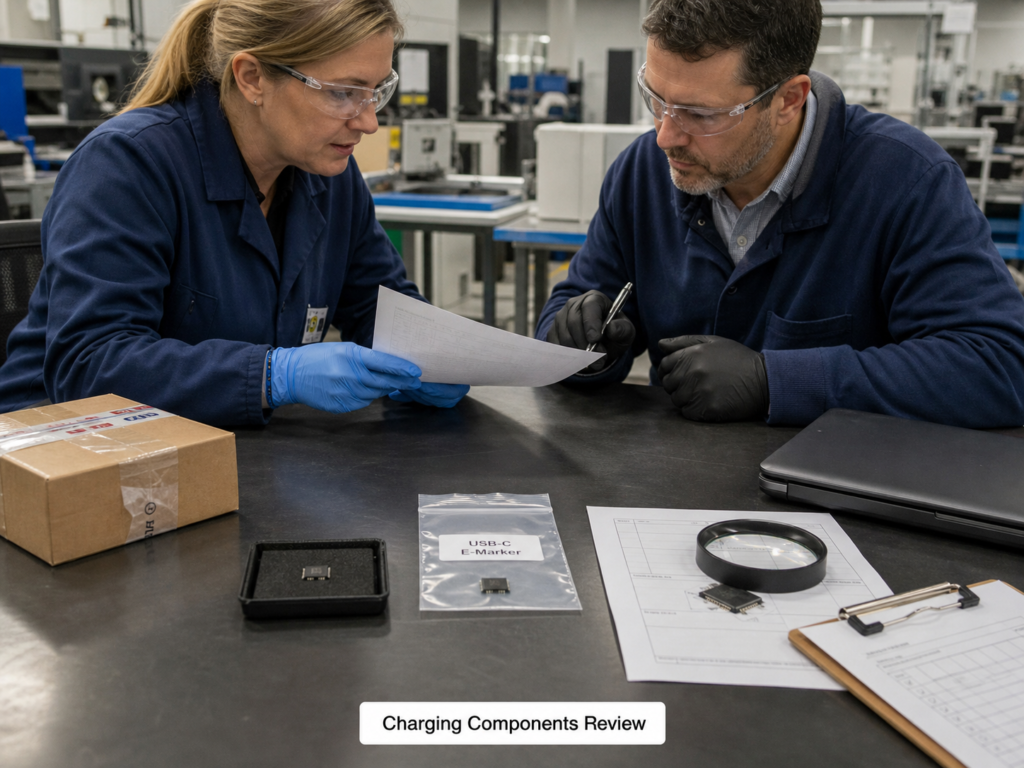
The key digital components to be verified for charging products are: charging control chips, USB-C E-Marker chips, and wireless charger transceiver chips. These components may affect the product’s digital functions, firmware management or data connectivity.
The basic supplier review should check these points: production qualification, past vulnerability or recall records, whether there is a dedicated vulnerability response team, and whether there is compliance experience with similar products.
When procuring, three things must be verified: the product’s digital capability description, whether it can provide compliance certificates for the target market, and how to divide the responsibilities for security updates and vulnerabilities.
Procurement contracts must add these core clauses:
• Suppliers must comply with the cybersecurity regulatory requirements of the target market;
• Clarify the security update support period and vulnerability patch response SLA;
• How to divide the compensation liability for losses caused by component vulnerabilities;
• Key chips, firmware or subcontractors shall not be replaced without the purchaser’s approval;
• Technical documents such as Software Bill of Materials (SBOM for short, equivalent to the “ingredient list” of software, listing all firmware and software components to facilitate quick troubleshooting when vulnerabilities occur) need to be provided.
3. Design/Production Stage: Implementation of Security Requirements
Security control in the design and production stages is divided into three layers. You can choose according to the product’s risk level and target market requirements, and don’t blindly use the highest-level configuration.
First Layer: General Basic Controls (Basic Requirements for Most Products with Digital Functions)
• Default credential security: Default passwords are unique, or password change is mandatory on first use, and there shall be no hard-coded administrator accounts;
• Material traceability: Firmware versions are traceable, and the sources of key chips are traceable;
• Production tamper-proofing: Firmware programming devices are disconnected from the external network, and production test equipment is prohibited from using storage media of unknown origin.
Second Layer: Connected/Smart Product Controls (Common Statutory/Standard Requirements)
• Communication security: Adopt appropriate transmission protection measures according to the transmission protocol and data type. Whether data is encrypted usually also depends on connected devices, communication protocols and application layers, and it cannot be simply asserted that pure data cables themselves “have no encryption capability”;
• Data minimization: Only collect necessary data, and the storage and transmission of user data comply with target market requirements;
• Security updates: Support security updates and clarify the update cycle; if there is no remote update capability, a recall or offline update plan must be prepared in advance;
• Vulnerability disclosure: Provide vulnerability feedback channels according to target market requirements;
• If the product or supporting software processes sensitive data, transmission protection, user notification and privacy obligations should also be evaluated according to the target market and actual communication protocol.
Third Layer: Advanced Controls for High-Risk Products (Best Practice/High-Risk Scenario Requirements)
• Secure boot: Only allow firmware that has passed signature verification to run; if this is not possible, strengthen the control of the firmware programming process;
• Signed updates: Firmware update packages need to be verified by official signature; if this is not possible, strengthen the security management of update channels;
• Key management: Encryption keys and signature keys are stored securely and rotated regularly; if this is not possible, clarify key protection measures;
• Debug interface closure: Close the chip’s debug interfaces after leaving the factory; if they cannot be closed, add access permission control;
• Software Bill of Materials (SBOM): Sort out the details of all firmware/software components used in the product to facilitate vulnerability troubleshooting;
• Update failure recovery: Automatic rollback is possible after firmware update failure; if this is not possible, clarify the remedial solution for update failure.
Two items must be checked before smart/connected charging products leave the factory: test the updatability of firmware, and scan for known public vulnerabilities (CVE for short, which are publicly disclosed universal vulnerability numbers, equivalent to the “ID card” of vulnerabilities). Here is a supplementary related term: CVSS is the Common Vulnerability Scoring System, which is used to initially judge the severity of vulnerabilities, but cannot be used as the only grading basis.
4. Regulation Requirements – Technical Controls – Compliance Evidence Mapping Table
Many people don’t understand “what technical actions to do corresponding to regulatory requirements, and what evidence to keep”. We have organized a mapping table that you can directly对照:
| Regulation Requirement | Corresponding Technical Control | Compliance Evidence |
| Ban on universal default passwords | Unique default password / mandatory password change on first use configuration | Configuration records, test reports |
| Security update support | Update mechanism, update cycle statement | Update test records, support period public announcement documents |
| Vulnerability notification | Vulnerability receiving channel, response process | Vulnerability handling records, notification template |
| Supplier management | Supplier audit, component traceability | Supplier audit report, material traceability records |
| Risk assessment | Product risk analysis document | Risk assessment report, Declaration of Conformity |
5. Pre-Market Release Stage: Document and Label Preparation
After the product is made, prepare compliance documents and labels before listing to avoid getting stuck when putting it on the shelves.
First is the general compliance evidence list – note that there is no unified mandatory “cybersecurity test report” applicable to all markets and all products. Don’t be misled by third-party institutions with a vague report concept:
• Declaration of Conformity (DoC), risk assessment documentation;
• Technical documentation (including design description, test records, bill of materials, etc.);
• Safety instructions in the user manual, compliance certificates for key components;
• Third-party assessment reports (only for high-risk products or specific market requirements).
Then are the label and publicity requirements: correctly paste the access mark of the target market, and do not exaggerate unfounded security publicity, such as “military-grade cybersecurity”, “world’s safest” and other unsubstantiated statements.
For platform listing, prepare the compliance documents required by the platform in advance, which should cover all actually sold models and versions. Don’t only prepare documents for one model, which cannot be used for other models.
6. Post-Market Continuous Management: Daily Maintenance
Compliance is not once and for all, and continuous maintenance is required after listing:
• **Change control**: If replacing key chips, firmware, software components, production factories or subcontractors, a risk-based assessment should be conducted in advance based on whether the change may affect product safety, cybersecurity functions, conformity assessment or technical documentation, and tests should be supplemented or documents updated if necessary;
• **Document retention**: Electronic + paper dual backup, and the retention period is confirmed according to the regulatory requirements of the target market;
• **Regular review**: Check regulatory updates, product vulnerability status, and supplier qualifications once a year to ensure continuous compliance.
5. Advanced: Vulnerability, Incident and Change Management
If your product is a medium to high-risk connected smart charging product, you also need to master the management methods of vulnerabilities, incidents and changes to avoid being caught off guard when problems occur.
1. Standard Vulnerability Handling Process
After discovering a vulnerability, follow this process and don’t panic:
1. **Receipt and confirmation**: Verify the product model, hardware/firmware version, impact scope, and submitter information corresponding to the vulnerability, and first confirm whether the vulnerability really exists;
2. **Risk grading**: Multi-dimensional assessment, not just looking at the CVSS score, refer to these dimensions: CVSS score, whether it can be exploited remotely, whether it involves personal data, affected user scale, whether it has been publicly exploited; the grading results are critical/high/medium/low, corresponding to different response time limits;
3. **Remediation response**: Release patches, temporary mitigation measures or security bulletins according to the severity; if the product has no remote update capability, start the recall or offline update plan;
4. **Verification and closure**: Verify the effect after remediation, and retain full-process records.
High-risk vulnerabilities usually should immediately enter the enterprise’s internal response process, but whether it is necessary to notify the regulatory authority depends on the incident type, active exploitation or serious impact and other trigger conditions and time limits specified by specific market regulations, and cannot be determined solely by CVSS or the “high-risk” label. Taking the EU CRA as an example, specific reporting obligations are for actively exploited vulnerabilities and serious incidents, and have corresponding reporting content and time limits.
2. Distinction and Trigger Conditions of Three Types of Security Incidents
Many people call all security problems “cybersecurity incidents”, but they are different. Different incidents trigger different regulatory requirements:
• **Cybersecurity incident**: The product has exploitable vulnerabilities, firmware is tampered with, or the update channel is hacked. Such problems usually need to enter the cybersecurity incident response process first; whether it triggers regulatory notification depends on the incident type and threshold specified by specific regulations;
• **Personal information incident**: The product illegally collects, transmits or leaks user personal information, which triggers privacy regulations;
• **Product safety incident**: Cybersecurity vulnerabilities lead to physical safety risks such as overheating and fire of charging products, which may trigger both cybersecurity and product safety regulations.
The incident level should be determined in combination with the affected countries/regions, user scale, industry attributes, whether actual damage has been caused, and the trigger conditions specified by target market regulations.
3. Key Points of Privacy and Cross-Border Data Compliance (Exclusive for Charging Products)
If your smart charging product collects user personal information, such as charging habits, device binding information, user account information, etc., and involves cross-border transmission, then it also needs to meet privacy and cross-border data requirements.
First, conduct data flow analysis to figure out these core elements:
• Type of data collected, purpose of collection (whether it meets the minimization principle, can we collect less if possible);
• Identity of data controller/processor (usually the brand owner is the controller, and cloud service providers and manufacturers are processors);
• Data storage location, whether cross-border transmission is involved, and the compliance mechanism for cross-border transmission;
• Legal basis for data processing (such as contract necessity, statutory obligation, legitimate interest, user consent, etc.);
• Data retention period, user right protection measures.
In terms of responsibility division, the brand owner, as the data controller, bears the statutory responsibility for personal information protection, and the processor bears corresponding responsibilities according to the contract. But the final role determination shall still be subject to the privacy regulations of the specific market and the actual processing method.
4. Cross-Border Incident Notification Decision Logic
If an incident that requires notification occurs, how to determine who to notify and when to notify?
• **Notification objects**: Upstream suppliers, downstream customers/platforms, target market regulatory authorities. Which ones to notify specifically depends on regulatory requirements, and not all incidents need to be notified;
• **Notification time limit**: There is no global unified standard, which needs to be confirmed one by one according to target market regulations, incident type, and starting time point. Don’t set the time based on experience;
• **Notification precautions**: Unify the factual caliber, retain all notification records, and do not release unverified speculative information.
You can make a checklist and check against it every time you encounter an incident: regulation name, trigger incident type, reporting object, statutory time limit, materials to be submitted.
5. Supply Chain Change Reassessment Rules
It was mentioned earlier that post-market changes need to be assessed. Here we clarify again: as long as the following changes occur, it should be judged whether they may affect product safety, cybersecurity functions, conformity assessment or technical documentation:
• Replacement of key chips, firmware or cloud services;
• Adjustment of Internet or data collection functions;
• Replacement of production factories or subcontractors.
For key changes that may affect the above matters, a risk-based change assessment should be conducted before listing, and tests should be supplemented, technical documents updated or conformity assessment re-conducted according to target market requirements. Whether it is necessary to suspend listing depends on specific regulations, certification schemes and contract requirements.
Listing and selling without authorization after replacing key materials without compliance assessment may lead to inconsistency between the product and the original compliance documents, certification samples or Declaration of Conformity, and may also bring risks of recall, removal and contract claims. Therefore, it should not be directly released before completing necessary assessments.
6. Compliance Evidence Verification and Common Risk Avoidance
Many people spend money on compliance but still step into pitfalls, either because the documents are fake or because of wrong cognition. In this section, we have sorted out common misconceptions and risk points to help you avoid pitfalls.
1. Clarification of Common Cognitive Misconceptions
First, clarify the most easily misunderstood misconceptions to avoid wasting money:
• **Misconception 1: Only large companies need compliance**: Wrong. As long as the trigger conditions are met, you must comply, regardless of enterprise size. Small sellers selling smart chargers also need to comply;
• **Misconception 2: Only finished product factories are responsible**: Wrong. Statutory responsibility is borne by the entity specified by regulations, and contracts cannot transfer statutory responsibility. The specific obligations of brand owners, importers, manufacturers, distributors and other roles should be confirmed separately according to target market regulations;
• **Misconception 3: Having CE/FCC marks equals cybersecurity compliance**: Wrong. CE and FCC are basic access marks, mainly covering safety, EMC, radio frequency, etc., and do not automatically prove cybersecurity compliance;
• **Misconception 4: Supplier signing a safety statement is enough**: Wrong. The statement is just a commitment and must be verified with actual technical documents and test records, otherwise it is just a piece of waste paper;
• **Misconception 5: Management systems such as ISO27001 can replace product regulations**: Wrong. Enterprise management systems manage the company’s internal affairs and cannot replace the product’s own compliance obligations;
• **Misconception 6: Finished product compliance equals full-chain compliance**: Wrong. If upstream key components have problems, brand owners, importers or other statutory responsible entities may still bear corresponding responsibilities, but can seek compensation from suppliers according to the contract;
• **Misconception 7: Having a certificate means definitely compliant**: Wrong. It is necessary to confirm that the model, firmware version, and sales market covered by the certificate are consistent with the actually sold product, otherwise the certificate is useless.
2. Compliance Evidence Package Verification Checklist

After getting the compliance documents from the supplier, don’t just put them away. Verify their authenticity and validity according to these points:
1. **Product consistency verification**: Whether the model, hardware version, firmware version, and function configuration on the certificate or report are consistent with the actually sold product;
2. **Institution qualification verification**: Whether the third-party testing or assessment institution has the qualification or accreditation required by the target market. For example, EU Notified Bodies should be verified through official accreditation channels;
3. **Validity period and scope verification**: Whether the report is within the validity period, whether it covers the regulatory requirements of the target market, and whether it covers the actual functions of the product;
4. **Production consistency verification**: Spot check the chip model, firmware version, and security configuration of bulk goods to see if they are consistent with certification samples and technical documents, to avoid sample compliance but bulk goods shrinkage;
5. **Document completeness verification**: Whether there are all technical documents, Declaration of Conformity, and record documents required by the target market, don’t be missing things;
6. **Authenticity verification**: Enter the report number on the third-party institution’s official website to query, and verify the institution’s qualification in the accreditation list of the target market regulatory authority.
3. Common Risk Points and Identification Methods in Charging Product Supply Chains
Charging product supply chains have several unique risk points that require special attention:
• **Risk 1: Refurbished/disassembled chips with unknown vulnerabilities**: Identification method: Purchase from regular agents, verify chip source certificates, and do not choose materials far below the market price;
• **Risk 2: Firmware cannot be updated, no remediation solution for vulnerabilities**: Identification method: Require suppliers to demonstrate the update process before procurement, confirm the update support period, and don’t listen to verbal promises;
• **Risk 3: Compliance documents only cover samples, bulk goods shrink/replace chips**: Identification method: Spot check bulk goods consistency according to the verification checklist above, and check chips and firmware versions;
• **Risk 4: Exaggerated “cybersecurity certification” publicity**: Identification method: Confirm the issuing institution, coverage scope, and validity period of the certification, and don’t believe unsubstantiated publicity such as “globally applicable cybersecurity certification”;
• **Risk 5: Suppliers have no vulnerability response capability**: Identification method: Verify past vulnerability handling records and vulnerability response team configuration, and clearly write the response SLA in the contract.
4. Trigger Conditions for Suspending Procurement/Listing
When encountering the following situations, procurement or listing should be suspended according to the degree of impact, and verification should be completed first:
• Discovered that suppliers provide false compliance documents;
• Key chips, firmware, or functions are replaced, which may affect the original compliance assessment or technical documents, but necessary assessments have not been completed;
• The product has a major security vulnerability, and there is no remediation solution for the time being;
• Target market regulations are updated, and the product does not meet the new mandatory requirements.
7. Low-Cost Compliance Ideas and Practical Tools
Many small and medium sellers and purchasers have limited budgets, so they don’t need to do a full set of certifications at the beginning. Following this idea can save a lot of money.
1. Low-Cost Compliance Ideas for Small and Medium Sellers/Procurers
Core principle: First match the mandatory requirements of product + market, and do not blindly do unnecessary certifications.
• **Low-risk products** (such as pure passive charging cables, basic adapters): If it has been confirmed that the product is not subject to a certain cybersecurity regulation, unnecessary certification for that regulation is not required. But still must separately verify target market requirements such as electrical safety, EMC, RoHS, energy efficiency, radio, product liability and platform rules. Supplier compliance commitments and qualification documents can be used as supply chain evidence, but cannot replace statutory conformity evidence;
• **Medium-risk products** (such as charging products with simple firmware, no Internet connection): Choose public model solutions that have passed target market compliance certification, no need to develop from scratch by yourself, to share compliance costs;
• **High-risk products** (such as connected/smart chargers): Cooperate with factories that have mature compliance experience, and share compliance costs together, don’t bear it all by yourself.
Note: The risk level should be determined according to the 8-item scoring table above, and cannot be directly determined by product type. For example, a Bluetooth wireless charger that can connect to the Internet indirectly or process personal information may need to be verified according to higher risk and stricter market requirements.
2. Free Official Query Channels
Different markets should use corresponding official sources, and do not only rely on third-party summaries:
• **EU**: CRA regulations and implementation information are优先 queried on EUR-Lex and the European Commission’s digital strategy page; Notified Body qualifications are verified through the European Commission’s NANDO database;
• **US**: The FCC official website is mainly used to query federal RF equipment authorization and related rules; state-level cybersecurity requirements should be queried on state legislatures, state governments or official regulation databases;
• **UK**: UK government, relevant competent authorities and NCSC official pages can be used to query PSTI related requirements and guidance;
• **General**: Official regulation databases, regulatory authority websites and industry association pages of corresponding markets can be used for cross-checking, but industry association materials cannot replace official regulation texts.
3. Reusable Compliance Templates
You can make these reusable templates according to your own needs to improve efficiency:
Product applicability judgment form, supplier access questionnaire, contract security clause list, risk stratification scoring table, SBOM field template, vulnerability incident record form, pre-market release verification checklist, evidence package verification checklist.
Core Capability Summary
After reading this guide, you should have mastered the core capabilities of supply chain cybersecurity compliance for charging products:
1. Can quickly judge whether charging products need supply chain cybersecurity compliance;
2. Can sort out the core mandatory requirements and applicable boundaries of major markets in the EU, UK, US and Asia-Pacific;
3. Can implement basic compliance actions according to the whole process of product selection – procurement – production – listing – after-sales;
4. Can verify the authenticity of compliance evidence and identify main supply chain cybersecurity risks;
5. Can choose low-cost compliance solutions according to product risk level and target market, to avoid excessive investment;
6. Know when to suspend procurement, suspend listing, or seek professional regulatory help.
Supply chain cybersecurity compliance seems complicated, but the core is just a few steps: “first judge, then stratify, implement according to market requirements, keep good evidence”. Don’t pursue perfection at the beginning. First do the mandatory requirements well, then gradually optimize. If you encounter complex situations that you are not sure about, it is recommended to confirm with local compliance lawyers or professional institutions in the target market, and don’t make decisions based on feeling.