
Friends who do cross-border business of charging products have most likely heard of “ISO 17025 laboratory reports” — whether for customs clearance, platform audit, or providing qualification proof to customers, they are often required. But many beginners easily get confused: Is this a certification for products, or a proof for laboratories? Can laboratories with this qualification test everything? How to avoid pitfalls when looking for one, so as not to spend money and get a useless report?
This guide covers the whole process from basic concepts to actual cooperation, combined with scenarios of common charging products such as chargers, USB-C cables, and wireless chargers, to clearly explain the selection, comparison, cooperation, and pitfall avoidance of ISO 17025 laboratories. After reading it, you can independently complete the whole process from demand sorting to report management, without being scammed by intermediaries or bad laboratories.
1. First, Understand the Basics: What is 17025, and What is Its Use for Charging Products?
Core Definition: Official Qualification Proof of Laboratory Testing Capability
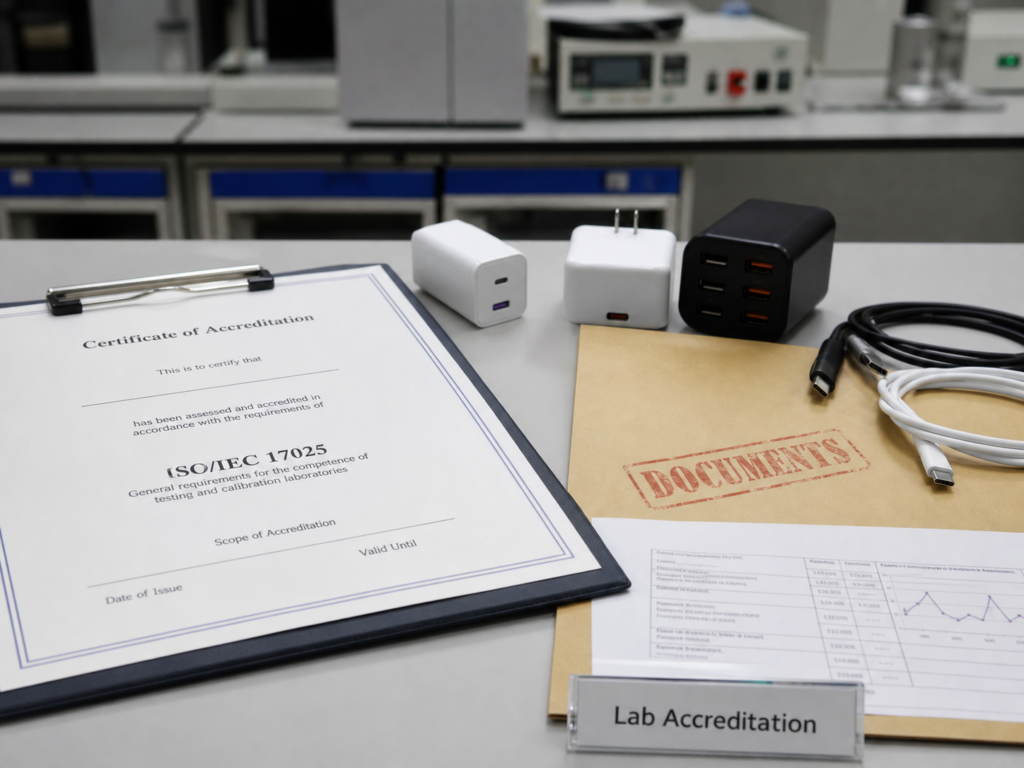
Many people think ISO 17025 is product certification, but it is completely the opposite — it is a **capability proof issued to laboratories**, proving that the laboratory has accurate technology and standardized procedures for specific testing items, and the data it produces is reliable.
Its core function is to “prove that the laboratory’s designated testing capabilities are credible”, **it is not a product qualification certificate** — whether a product is qualified depends on the specific test results; 17025 only ensures that the testing process is reliable.
The current globally mainstream version is **ISO/IEC 17025:2017**. Old version accreditations have usually been converted according to the requirements of accreditation bodies. Whether a specific report is acceptable should be checked against the current requirements of the accreditation body, target market, platform, or customer.
Many people confuse it with ISO 9001, but the difference is obvious: ISO 9001 is a general quality management system certification, which can be obtained by restaurants, factories, logistics companies, proving that internal management is organized; while ISO 17025 is a “technical capability assessment” specifically for laboratories. For example, when testing the safety of chargers, whether your equipment is accurate, whether personnel can operate it, and whether data will be wrong — these are the core of 17025 assessment.
4 Most Easily Confused Terms (First Step to Avoiding Pitfalls)
People who are new to compliance are most likely to confuse various “certifications” and “reports”. Here is a table to clarify:
| Term | Issued to | Core Function | Issuing Entity |
| Laboratory Accreditation (ISO 17025) | Testing laboratories | Proves reliable capability for certain types of testing items | Official accreditation bodies (such as CNAS, A2LA) |
| Product Certification (CE/FCC/PSE, etc.) | Specific products | Proves that the product meets applicable requirements of the target market | Completed by manufacturers, certification bodies, or conformity assessment bodies according to specific systems |
| Test Report | Submitted samples | Records actual test results of specified items | Testing laboratory |
| Declaration of Conformity (DoC) | Products | The enterprise self-declares that the product complies with regulations | The brand/importer itself |
A special reminder here: **DoC cannot replace technical documents, test evidence, or third-party conformity assessment required by applicable regulations**. However, not all markets and products mandate third-party test reports; whether they are required should be confirmed according to specific regulations, conformity assessment procedures, platform and customer requirements.
Take common markets as examples: CE conformity is usually the responsibility of the manufacturer to complete applicable conformity assessment, technical documents, and DoC; FCC applies Certification or SDoC according to equipment category; PSE also applies requirements such as assessment by registered conformity assessment bodies and manufacturer inspection according to the category of specified or non-specified electrical appliances. Therefore, “certification” of all products cannot be understood as being uniformly issued by the same officially designated body.
ILAC-MRA: International Mutual Recognition Is Not “Globally Universal”
You may often see the ILAC-MRA mark on test reports. It is the mutual recognition arrangement of the International Laboratory Accreditation Cooperation. In simple terms, **it provides a framework for mutual recognition of accreditation results within the agreed scope by signatory accreditation bodies**.
Common accreditation bodies include China’s CNAS, the United States’ A2LA and IAS, Spain’s ENAC, Germany’s DAkkS, Japan’s JAB, etc. The specific list and scope of signing must be based on the public information on the ILAC official website and relevant accreditation bodies, don’t just listen to the laboratory’s verbal statement.
A report may be accepted only when the laboratory, testing items, methods, and report purpose all meet the accreditation scope and the requirements of the receiving party. ILAC-MRA does not mean that all reports are unconditionally mutually recognized by countries, nor can it guarantee exemption from repeated testing. For example, a laboratory report accredited by China’s CNAS may be used as a reference for acceptance under the relevant US system, but it still depends on specific items, accreditation scope, equipment authorization path, and additional requirements of the receiving party.
3 Typical Application Scenarios for Charging Products
For products such as chargers, USB-C cables, and wireless chargers, 17025 laboratory reports are mainly used in three places:
1. **Statutory customs clearance**: For compliance scenarios such as CE, FCC, and PSE, whether an accredited laboratory report is required depends on specific regulations, product categories, and conformity assessment paths;
2. **Platform audit**: Some platforms, sites, or categories may require designated laboratories, reports within the accreditation scope, or other compliance documents. Specific requirements must be subject to the current platform rules and audit notifications;
3. **Supply chain quality control**: Factory self-tested data usually only represents internal control. Having a third-party 17025 laboratory conduct random inspections helps to verify key indicators such as power and temperature rise, reducing batch quality risks.
In scenarios where regulations, platforms, or customers require accredited laboratory evidence, reports issued within the accreditation scope are usually easier to meet evidence and acceptance requirements, but they cannot guarantee the passage of customs clearance, platform audits, or market access.
4 Cognitive Misconceptions to Avoid for Beginners
These 4 mistakes are most commonly made by beginners. Remembering them in advance can save a lot of money:
1. **Misconception 1: A laboratory with 17025 qualification can test everything**. Wrong, the qualification only covers specific items within the accreditation scope. For example, a laboratory that only has wire testing qualification cannot test the safety of chargers at all;
2. **Misconception 2: 17025 is a globally mandatory requirement**. Wrong, it is a “credibility bonus item”. Most regulations do not mandate it, but customs, platforms, and customers are more likely to trust reports with 17025 qualification; without it, you may fail the audit;
3. **Misconception 3: A laboratory’s self-declared qualification counts**. Wrong, it must be a certificate issued by an official accreditation body, and it can be checked on the accreditation body’s official website. Those that cannot be found cannot be used as valid accreditation qualification basis;
4. **Misconception 4: A report with the ILAC-MRA mark is globally valid**. Wrong, as mentioned earlier, some markets and platforms have additional designated requirements, not just having the mark works.
2. Sort Out Your Needs Before Looking for a Laboratory: Don’t Wait Until the Test is Done to Find It’s Useless
Many people’s first reaction when looking for a laboratory is “how much does it cost to test a charger”, but in fact, before looking for a laboratory, you have to sort out your needs clearly — otherwise it’s like going to buy medicine without knowing what disease you have, either testing the wrong items, or the laboratory’s report is not accepted, wasting money for nothing.
First Clarify Which Category Your Product Belongs To
Charging products all seem to be for charging, but different types have very different testing requirements. There are 5 common categories:
• Ordinary wired chargers (including GaN fast chargers): power adapters plugged into mains electricity, the most common type;
• USB-C charging cables (including E-Marker, data transmission models): cable products, testing focuses on interfaces, reliability, protocol compatibility;
• Wireless charging products (including those with Bluetooth function): if they have wireless communication or other radio functions, additional radio frequency items need to be evaluated;
• Charging products with built-in batteries (power banks, chargers with built-in cables): additional requirements for battery safety, transportation compliance, etc.;
• Combination sets (charger + cable, adapter + terminal): requirements for all products in the set must be considered at the same time, not just testing one of them.
Regulatory Requirements of the Corresponding Target Market
Different markets have different compliance requirements for charging products. You don’t have to memorize them by rote. First figure out where you sell, then find the corresponding requirements:
• **European Union**: Ordinary mains chargers usually assess LVD (Low Voltage) and EMC (Electromagnetic Compatibility) requirements; versions with wireless communication such as Bluetooth, Wi-Fi or other radio functions also need to assess RED (Radio Equipment Directive). Whether the pure wireless power supply function falls under RED should be judged in combination with specific technology and applicable scope. The CE mark is usually affixed after the manufacturer completes applicable conformity assessment, technical documents, and DoC. LVD/EMC conformity assessment is usually completed by the manufacturer according to applicable procedures; for RED, when applicable harmonized standards are not fully adopted, or when a conformity assessment module requiring third-party participation is selected, a notified body may be required to participate;
• **United States**: Charging equipment with digital circuits or related functions must be evaluated according to FCC Part 15 and specific equipment authorization paths. SDoC or Certification should be selected according to the equipment category, and the corresponding test laboratory, responsible entity, and test record requirements should be checked. Products with wireless functions such as Bluetooth and Wi-Fi must also be evaluated according to the relevant rules for intentional radiators;
• **Japan**: First, judge whether it is a specified or non-specified electrical appliance according to Japan’s Electrical Appliance and Material Safety Law and specific product items. Specified electrical appliances usually require conformity inspection by a registered conformity assessment body, while non-specified electrical appliances are subject to corresponding manufacturer inspection, record, and PSE marking requirements;
• **E-commerce platforms**: Platform requirements may be more specific or stricter than statutory requirements. For example, some Amazon sites or specific categories may require safety standard evidence such as UL/ETL, designated testing institutions, or other documents; this shall be subject to the current Seller Central audit notification and corresponding category requirements.
Distinguish the 3 Attributes of Test Items (Help You Control Costs)
More test items are not always better. They are divided into three categories according to attributes, choose as needed:
• **Mandatory by regulation**: Items mandatory in the target market, must be done, and you must find a laboratory that meets the acceptance requirements, cannot be omitted;
• **Customer requirements**: Additional items specified by the brand or importer, such as requiring 10,000 plug-in and pull-out life tests, follow customer needs;
• **Internal quality control**: Reliability and performance verification items added by the enterprise itself, such as temperature and humidity cycling, drop test, used to control product quality, can be increased or decreased as needed.
4 Steps to Quickly Sort Out Your Testing Needs
Don’t make it too complicated. Follow these four steps to sort out your needs clearly:
1. Step 1: Determine the product type, specific functions, and target market for sales;
2. Step 2: Match the statutory mandatory testing requirements of the corresponding market;
3. Step 3: Add additional needs from customers, platforms, and internal quality control;
4. Step 4: Clarify the specific purpose of the report (customs clearance/platform audit/internal random inspection) — different purposes have different acceptance requirements for laboratories.
3. Preparation Before Screening: Break Down Needs into Implementable Details
After sorting out the general direction, you also need to fill in the details, so that when you inquire about the price, you will not be quoted randomly, and you will not miss items.
3 Core Demand Dimensions Exclusive to Charging Products
When sending requirements to the laboratory, don’t just say “I want to test a charger”, be sure to clarify these three points:
1. **Test object**: Be specific to product details, such as “65W dual-C port GaN charger”, “100W USB-C 2.0 data cable with E-Marker”, the more specific, the more accurate the quotation;
2. **Report purpose**: Is it for customs clearance, platform audit, or internal random inspection — for example, if it’s just internal quality control, you don’t even need to find a 17025 laboratory, as long as there is corresponding equipment; but if it’s for platform audit, you have to first confirm the laboratory and document types accepted by the platform;
3. **Target market**: Corresponding to the accreditation body to be accepted, standard version, and platform rules, such as “US market, platform audit, requires FCC-related test records and UL/applicable safety standard report”.
Overview of Common Test Items for Charging Products
You don’t have to memorize all standards, just know what each category tests and when it is needed:
• **Safety category**: Such as insulation withstand voltage, temperature rise, flame retardancy, etc., used to judge the risk of electric shock, overheating, and fire. Many information and communication technology power adapters can be safety assessed based on IEC 62368-1 and the version adopted by the target market, but whether it is applicable and the specific test items must be confirmed according to the product category and target market standards;
• **EMC category**: That is, electromagnetic compatibility, testing whether the product will interfere with other equipment or be interfered by other equipment. Testing shall be determined according to target market regulations and applicable product, product family, or general standards, which may involve CISPR emission standards, IEC 61000-4 series immunity methods and corresponding national or regional adopted versions, and cannot be simply written as IEC 61000 series;
• **Interface protocol category**: Such as E-Marker chip reading, PD fast charging compatibility. Corresponding specifications and test plans shall be selected according to USB Type-C, USB PD, E-Marker and customer or USB-IF requirements. IEC 62680 is only a standard series related to USB interfaces, and cannot alone represent all protocol and interoperability requirements;
• **Reliability category**: Such as plug-in and pull-out life, bending times, temperature and humidity cycling, there is no unified mandatory standard, all are internal quality control or customer requirements;
• **Environmental protection category**: Such as RoHS (Restriction of Hazardous Substances), REACH (EU Chemicals Regulation). RoHS restricted substance testing can refer to the IEC 62321 method series; REACH shall be subject to compliance assessment according to specific substances, SVHC and restriction clauses, and IEC 62321 cannot be used to summarize all REACH requirements.
Prepare 2 Types of Basic Information in Advance
Before inquiring about the price with the laboratory, prepare these materials first, which can save a lot of communication costs:
1. **Basic product information**: Power, interface type, input and output parameters, model, function configuration, such as the output gear of the charger, the length and current specification of the cable;
2. **Known requirements**: Such as specified test standard version, report language, accreditation body requirements, platform rules, etc.
Here is a cost control tip: **separate the mandatory items required by regulations from additional needs**. Mandatory regulatory items must be tested by a laboratory that meets the acceptance requirements and cannot be omitted; additional reliability and performance tests can be done by a more cost-effective laboratory, or even different laboratories can be found separately, you don’t have to find expensive international big names for all items.
4. Core Screening Steps: Check Layer by Layer from Qualification to Capability
After sorting out the needs, you can start looking for laboratories. Screening laboratories cannot only look at the quotation, you have to check layer by layer from qualification to capability, no step can be missing, otherwise it is easy to step into pitfalls.
Step 1: Verify the Authenticity and Validity of Qualifications
First, ask the laboratory to provide two core documents: **17025 accreditation certificate, accreditation scope document** — many people only look at the certificate, in fact, the scope document is the key point, which will be discussed later.
After getting the certificate, **be sure to check it on the official website of the corresponding accreditation body**. Prioritize checking whether the accreditation body is a signatory to the relevant scope of ILAC-MRA, and confirm that both the laboratory and specific items are within the accreditation scope; whether accreditation from non-signatory bodies is accepted should be separately confirmed with the target market, platform, or customer, and cannot be directly said to be invalid.
For example, if it is CNAS accredited, check on the CNAS official website; if it is A2LA, check on the A2LA official website, enter the laboratory name or accreditation number to find it.
When checking, focus on three points:
• The certificate is within the validity period and has not been suspended or revoked (the official website will show the latest status);
• The name and address of the laboratory are completely consistent with the entity quoting you — for example, the quoting entity is “XX Testing Shenzhen Branch”, but the certificate only has the qualification of the Guangzhou headquarters, then the testing of the Shenzhen Branch is not valid, unless the official accreditation scope clearly includes the Shenzhen testing location;
• The accreditation scope, signing status of the accreditation body, and report purpose meet the requirements of the target market.
Step 2: Check the Matching Degree of Accreditation Scope (The Step Most Prone to Pitfalls)
This is the core pitfall avoidance point. Remember: **it shall be subject to the official website of the accreditation body or its verifiable electronic certificate, accreditation scope document and current status**, not the brochure printed by the laboratory itself. The accreditation scope is not necessarily presented as a stamped paper appendix; some accreditation bodies use online databases, electronic certificates, or electronic scope documents.
After getting the scope document, focus on checking these fields:
• **Product category**: Is it the product type you want to test, such as “power adapter” or “wire and cable”? Having electronic and electrical safety qualification does not mean you can test chargers;
• **Test standard/version**: Is it the standard and version you need, such as IEC 62368-1:2018 or the old IEC 60950-1, and whether the version meets the requirements of the target market;
• **Power range**: Is there a power limit? For example, the appendix says “only below 100W”, then testing a 200W GaN charger is out of scope;
• **Testing location**: Is it the laboratory you send samples to, or do you have to take it to another place for testing?
• **Subcontracting authority**: Which items can be subcontracted and which must be tested by themselves;
• **Marking restrictions**: Which items can use the accreditation mark and which cannot.
The key standards to check for charging products are the IEC 62368 series for safety, applicable product or product family standards for EMC and related IEC 61000 test methods, and the IEC 62680 series for interfaces. Also pay special attention to additional restrictions in the appendix, such as “only accept fixed model samples”, “only test under XX temperature environment”, don’t miss them and affect the validity of the report.
Step 3: Confirm the Acceptance of the Target Market/Platform (Exclusive to Cross-Border)
Having 17025 qualification is not enough, you have to confirm whether its report can be accepted by your target market or platform.
• Basic judgment: Reports accredited by signatories to the relevant scope of ILAC-MRA are usually easier to be used as acceptance references when they meet the requirements of the laboratory, items, methods, purposes, and receiving parties, but they are not 100% guaranteed;
• EU CE: LVD/EMC conformity assessment is usually completed by the manufacturer according to applicable procedures; for RED, when applicable harmonized standards are not fully adopted, or when a conformity assessment module requiring third-party participation is selected, a notified body may be required to participate. Ordinary 17025 laboratory reports can be used as part of technical documents or test evidence, but they do not automatically replace applicable conformity assessment procedures;
• US FCC: Charging equipment with digital circuits or related functions shall select SDoC or Certification according to the specific equipment category, and check the corresponding test laboratory, responsible entity, and test record requirements; products with wireless functions shall also be handled according to the corresponding wireless equipment authorization path;
• Japan PSE: First judge whether it is a specified or non-specified electrical appliance according to specific product items, then confirm the requirements of registered conformity assessment bodies, manufacturer inspection, records, and marking;
• Platform acceptance: Subject to the platform’s latest accredited laboratory list, product category requirements, and audit notifications. Laboratory reports that are not within the scope required by the platform may not meet the audit requirements even if they bear the accreditation mark.
Don’t just listen to the laboratory say “our report can pass”. **It is best to confirm with the customs of the target market, platform customer service, or your importer in advance** to avoid spending money on a report that cannot be used.
Step 4: Evaluate Technical Capability and Experience in Charging Products
Having qualification does not mean doing well, especially for charging products which update quickly, with new technologies such as GaN fast charging, USB4, PD3.1 emerging one after another, you need to find a laboratory that really knows the business.
How to judge? You can ask from these aspects:
• **Experience with similar products**: Have they tested products of the same type and specification, such as 140W GaN chargers, USB4 40Gbps data cables? If they have never tested them, not only are they prone to errors, but the cycle is also long;
• **Equipment matching**: Do they have corresponding test equipment, such as fast charging protocol testers, E-Marker readers, wireless charging test stands? If they don’t even have equipment, it definitely won’t work;
• **Regulatory familiarity**: Do they understand the special requirements of the target market, such as California CEC energy efficiency, Japan PSE product classification, platform charging product policies? If they don’t even know these, the report is likely to not meet the requirements;
• **Special product qualification**: If it is a product with wireless or battery functions, confirm whether there is corresponding test qualification, such as radio frequency test qualification, battery safety qualification.
Step 5: Verify Independence and Impartiality
If a laboratory acts as both an athlete and a referee, the credibility of the report will be affected, so it is necessary to verify the risks of independence and impartiality:
• **Conflict of interest investigation**: It shall be verified whether the laboratory identifies and controls the impartiality risks between testing and consulting, rectification services. If the laboratory participates in product design or rectification, confirm whether the service boundaries, personnel and processes are isolated, and whether the target accreditation body and report receiving party accept the relevant reports;
• **Mechanism confirmation**: Formal laboratories have formal complaint and appeal procedures, and there are channels to solve problems when they arise;
• **Supplier’s own laboratory**: Can only be used for internal quality control reference. For statutory customs clearance and platform audit items, confirm whether the receiving party accepts the results of the supplier’s own laboratory; if an independent third party is required, internal reports cannot be used as a substitute.
5. Laboratory Comparison and Quotation Decision: Don’t Just Look at the Total Price
After screening out several laboratories that meet the requirements in terms of qualification and capability, you can compare quotations and services. But comparing quotations cannot only look at the total price, you have to unify the caliber, otherwise the comparison is useless.
First Unify the Inquiry Caliber, Then the Comparison Makes Sense
Send the same product information and test requirement list to all candidate laboratories, and clearly require:
• Specific version of the test standard;
• Whether the report bears the accreditation body’s mark, and which items are within the accreditation scope;
• Specific purpose and target market of the report;
• The quotation must be broken down into details: basic test fee, expediting fee, retest fee, translation fee, shipping fee, etc., don’t just give a total price.
Application Scenarios of 3 Types of Mainstream Laboratories (Reference for Charging Products)
The testing laboratories on the market are roughly divided into three categories. There is no absolute good or bad, as long as it suits your needs:
| Laboratory Type | Representative Institutions | Advantages | Disadvantages | Suitable Scenarios |
| International Top | SGS, TÜV Rheinland, UL | Usually have rich market service experience | High price, cycle may be longer | High-risk products, brand overseas expansion, scenarios with high requirements for credibility |
| Local Laboratories in Target Market | Local institutions accredited by Japan’s JAB, local laboratories accredited by Germany’s DAkkS | May be more familiar with local regulations and communication habits | Inconvenient communication, troublesome cross-border sample sending | Scenarios with local designated requirements, such as PSE, KC certification |
| Laboratories in Supply Chain Locations (such as CNAS accredited) | Various domestic CNAS accredited laboratories | High cost performance, convenient communication, fast response | Acceptance in some markets needs to be confirmed in advance | Ordinary product random inspection, general compliance (confirm target market acceptance in advance) |
Large institutions usually have rich market service experience, but they still must be verified item by item according to the actual issuing entity, testing location, specific items, and accreditation scope, and global acceptance cannot be presumed based on the brand.
In addition to the above classification, several dimensions should be additionally evaluated: laboratory scale, whether on-site testing can be done, whether subcontracting is transparent, and actual recognition in the target market.
6 Core Dimensions for Quotation Comparison
Don’t just look at the total price, focus on comparing these six points:
1. **Accreditation scope coverage**: Whether all test items are within the accreditation scope, whether there are missing items. If there are missing items, the report cannot be stamped with the accreditation mark, which means it’s done for nothing;
2. **Test method/standard version**: Whether it meets the requirements of the target market. If the old version of the standard is used, no matter how cheap it is, it may be useless;
3. **Report acceptance**: Whether it is clearly accepted by the target market’s customs, platform, or customer, don’t just listen to the laboratory;
4. **Value-added services**: Whether there are services such as rectification suggestions, sample return, report modification, etc. Some laboratories only give a result if the test fails, without saying how to fix it, which is more costly instead;
5. **Retest fee rules**: How to charge for unqualified retests, how to charge for retests after rectification, this difference is very big;
6. **Test cycle**: The cycle shall be confirmed in writing by the laboratory according to the specific product, standard, items, sample quantity, scheduling, subcontracting, and retest possibility. The cycles of safety, EMC, and chemical testing will vary due to project complexity and laboratory arrangements, and a fixed number of weeks cannot be regarded as a general commitment; if you are in a hurry, also confirm whether expediting affects the accreditation scope of the report or the acceptance by the receiving party.
5 Typical Signs of Low-Price Traps
If you encounter a quotation that is significantly lower than other candidate options, you must be vigilant, but you cannot judge that the laboratory is violating regulations solely based on price. Price differences may come from different test scopes, locations, sample quantities, cycles, subcontracting, and report forms.
Focus on checking the following situations:
1. The quotation is significantly lower than other schemes of the same caliber, but cannot explain the difference;
2. The quotation only covers some items, and key items require additional fees — for example, only the safety fee is quoted, and EMC requires an additional price, and the final total price is higher instead;
3. Use non-accredited methods or expired standard versions — for example, still using the obsolete IEC 60950-1 standard, the report may not be accepted;
4. Conceal subcontracting of key items — after sending samples, they say they need to take them to another laboratory for testing, and the subcontracting laboratory does not have corresponding qualifications;
5. Promise “guaranteed pass” but do not mention the validity of the report — the so-called “guaranteed pass” may be accompanied by sample replacement, simplified testing, or opaque judgment methods, and the report may not be accepted.
Beginner’s Quick Scoring Idea (Adjustable Weight)
If there are too many candidate laboratories, you can use a simple scoring method to screen. The default weights are:
• Qualification matching degree: 40% (foundation, the most important)
• Service adaptability: 30% (cycle, communication, rectification support, etc.)
• Cost rationality: 30% (transparent quotation, no hidden fees)
The weight can be adjusted according to your needs: for high-risk products, increase the qualification weight; for urgent orders, increase the service weight; for low-risk internal quality control, increase the cost weight. But the premise is: all candidate laboratories must first meet the minimum requirements of qualification and acceptance, otherwise no matter how cheap they are, they cannot be selected.
6. Key Checkpoints in the Whole Cooperation Process: From Sample Sending to Report Receiving
After selecting the laboratory and signing the contract, you enter the testing phase. From sending samples to getting the report, there are several key checkpoints. Doing them well can avoid most disputes.
Before Sending Samples: Confirm All Core Information in Writing (Don’t Trust Verbal Promises)
Before sending samples, be sure to confirm all information in writing (email, contract, formal chat records are all acceptable) to avoid disputes later:
• **Core test information**: Test items, standard version, report purpose, test cycle, total quotation, none can be missing;
• **Confirmation of inapplicable items**: If the laboratory says a certain item does not need to be tested, they must be required to explain the standard basis in writing, don’t miss the test and fail the audit then;
• **Sample requirements**: The number of samples shall be confirmed according to applicable standards and the laboratory’s written sample list; at the same time, confirm whether spare samples, supporting power supplies, loads, cables, and samples of different configurations are needed;
• **Document requirements**: Specifications, schematic diagrams, BOM lists, etc. Sensitive materials can be signed with NDA (Non-Disclosure Agreement), don’t worry about leakage;
• **Subcontracting confirmation**: Whether there is subcontracting, subcontracting items, subcontractor’s qualifications, and whether your consent is required, all must be written clearly;
• **Contract terms**: Report ownership, modification rules, refund rules, sample damage liability, data retention period, these are agreed in advance, and there is a basis when problems arise.
Testing Process: Don’t Urge Every Day, Agree on Feedback Nodes
You don’t have to ask about the progress every day during the testing process. Just agree on feedback nodes with the laboratory in advance, such as feedback once a week, or active feedback when the test is halfway or unqualified, saving time for both parties.
• For high-risk items, you can apply for **on-site or remote witnessed testing**, but you should also check original records, equipment calibration, personnel authorization, data traceability, and accreditation scope. Witnessed testing alone cannot prove the authenticity of the results, nor can it replace these controls;
• If there are unqualified items, don’t rush to modify the product first: first ask clearly about the test conditions, test methods, and specific unqualified data, confirm that it is not a problem with the test operation, then consider rectification;
• Expedited services must be confirmed in writing: whether expediting affects the accreditation validity. For example, some items cannot be stamped with the accreditation mark if expedited, then expediting may not be useful.
After Getting the Report: First Do These 6 Checks (Exclusive to Charging Products)
Don’t use the report directly after getting it, check it first to avoid getting a fake or wrong report:
1. **Accreditation information**: Check whether the report issuing entity, accreditation body’s mark, accreditation number, and items are within the current accreditation scope. If the ILAC combined mark is used, also check its authorization and usage rules; the absence of the ILAC mark on the report does not mean the report is necessarily invalid;
2. **Report structure**: Has a unique number, complete page numbers, the signatory meets the laboratory’s authorization requirements, test data is traceable, and conclusions have clear basis;
3. **Product information**: Model, power, interface parameters, manufacturer, completely consistent with the samples you sent, not a template modified from another product;
4. **Test content**: Standard version, test items are completely consistent with the previous agreement, no missing tests;
5. **Conformity conclusion**: Confirm whether the report provides a conformity judgment according to the entrusted purpose. If a pass/fail conclusion is provided, the applicable standards, limits, and decision rules shall be checked, and all test reports cannot be required to write “qualified” uniformly. Note that “only responsible for the submitted samples” is a normal remark, because the laboratory only tested the samples you sent;
6. **Subcontracting marking**: If there are subcontracting items, whether they are clearly marked, and whether the subcontractor has corresponding qualifications.
Sample and Data Confidentiality
If your product has sensitive information, such as new circuit design, exclusive firmware, be sure to sign a confidentiality agreement with the laboratory in advance, clarifying:

• Confidentiality responsibility for sensitive materials (BOM, firmware, circuit diagrams);
• Retention period and access rights of test data;
• Disposal method of remaining samples (return/destruction/retention), don’t let samples flow into the market.
Reports Have No Unified Fixed Validity Period, and Continuous Management Is Required
Many people ask “how long is the validity period of the 17025 report”, in fact **ISO/IEC 17025 usually does not stipulate a unified report validity period**. But this does not mean that the report can be used automatically forever. Whether the report can continue to be used shall be regularly evaluated according to the standards and regulations at the time of issuance, product configuration and production consistency, laboratory accreditation status, and current requirements of the receiving party.
What you need to do is:
• Record the core information of the report: issuance date, standard version, model configuration of the corresponding product;
• Re-evaluate or send for inspection when these situations occur: core product design changes, major production process adjustments, regulation or standard updates, platform rule changes, customer requirement updates, and key component or supply chain changes;
• Establish a “model-report” correspondence when archiving. Never use the report of model A on model B, that is incorrect use of the report.
7. Common Risk Identification and Pitfall Avoidance (Intermediate Level)
Even if you follow the steps, you may encounter some hidden pitfalls, especially for beginners, who are easily taken advantage of by bad laboratories. You must be able to identify the following common risks.
Common Pitfalls in Qualification
• **Fake qualification**: The number cannot be found on the accreditation body’s official website, or the certificate subject is inconsistent with the testing address. For example, the certificate is from Guangzhou, but the testing is done in Shenzhen, and there is no Shenzhen accreditation address, which is basically fake;
• **Invalid qualification**: The laboratory’s accreditation has been suspended or revoked, but it is still taking orders. So be sure to check the latest status on the official website, don’t just look at the certificate photo given by the laboratory;
• **Fraudulent use of qualification**: Using another laboratory’s certificate to pretend to be your own. So you need to check the name, address, and accreditation number, all three must match.
Common Pitfalls in Accreditation Scope
• **Issuing reports beyond scope**: The items in the report are not within the accreditation scope, using similar standards or internal methods instead. For example, IEC 62368 should be tested, but IEC 60950 is used instead, which means it does not meet the agreed requirements;
• **Ignoring restriction conditions**: Not paying attention to the restrictions on power, product type, and testing location. For example, the laboratory can only test below 60W, and testing 65W is out of scope;
• **Abuse of flexible scope**: Some accreditation bodies have a “flexible scope” policy, allowing laboratories to add test items within a certain range, but it is not added arbitrarily. When a laboratory says “we have a flexible scope and can test everything”, be sure to ask them to show the rule basis of the accreditation body.
Common Pitfalls in Reports
• **Template report**: Modify the model and date of another product’s report and give it to you. How to check? Check the sample’s serial number, photo, test date. If the product in the photo is different from yours, or the test date is before you sent the sample, there must be a problem;
• **Vague critical results**: The test value is close to the standard limit, and the judgment basis is not stated. At this time, ask the laboratory to explain the “decision rule” — that is, how to make a pass or fail judgment in combination with the limit, measurement uncertainty, and agreed rules;
• **Abuse of marks**: Items that have not been accredited, subcontracted items, are illegally stamped with the accreditation mark or ILAC combined mark, which is a serious violation, and the relevant accreditation statements in the report may not be accepted.
Here is a little knowledge: Whether measurement uncertainty should be written in the report depends on the test method, rules, and purpose, not all reports must include it. But if the result is close to the limit, the laboratory should be required to explain the measurement uncertainty, coverage factor, limit, and applicable decision rule, and make a conformity judgment according to the rule. “±U” cannot be directly regarded as the interval where the true value of the measured quantity necessarily lies.
Common Pitfalls in Subcontracting and Cooperation
• **Hidden subcontracting**: Key items are subcontracted to other laboratories without telling you, and the subcontractor does not have corresponding qualifications. So be sure to agree in the contract that “subcontracting must be approved by the entrusting party, and the subcontractor must have corresponding qualifications”;
• **”Guaranteed pass” promise**: Most are achieved through sample replacement, simplified testing, or opaque judgment methods. Such reports are not accepted at all. When customs clearance fails or product safety accidents occur, you will lose out;
• **Hidden fees**: Retest fees, report modification fees, sample return fees are not mentioned in advance, and they add money when you need them. So be sure to ask the laboratory to split all fees in advance;
• **No constraints on delay**: There is no agreed handling rule for delay in the contract, and the laboratory delays for a month, and your order is ruined. So write the compensation or termination rules for delay into the contract.
3 Steps for Dispute Handling
If you really encounter a dispute, don’t panic, follow the steps:
1. Step 1: Negotiate with the laboratory’s contact person with written records (contract, email, chat records). Negotiated settlement is the best;
2. Step 2: If it is a serious violation such as qualification fraud or issuing reports beyond scope, directly complain to the corresponding accreditation body. For example, CNAS laboratories go to CNAS, A2LA laboratories go to A2LA. The accreditation body will investigate according to its rules;
3. Step 3: If negotiation fails, protect your rights through industry associations or legal channels. For overseas cases, prioritize local relevant channels, such as local consumer protection agencies, industry associations.
Advanced: How to Judge Critical Results
If the test result is close to the limit, it is a critical result. How to handle it?
• First clarify: Critical results refer to test values close to the standard limit, such as temperature rise close to the upper limit. At this time, you cannot only look at the apparent gap between the result and the limit;
• Judgment method: Require the laboratory to explain the measurement uncertainty, coverage factor, limit, and applicable decision rule, and make a conformity judgment according to the rule. Measurement uncertainty is not the “actual range” where the true value of the measured quantity necessarily falls;
• Handling method: If necessary, retest according to applicable standards, or evaluate whether the sample is representative. Increasing the sample size may not solve the measurement uncertainty problem, and simple retesting cannot be regarded as a method to automatically eliminate risks.
8. Non-Conformity Handling and Procurement Decision Application
Testing is not the goal, getting qualified products and avoiding compliance risks is. If you encounter unqualified situations, don’t rush to deny the product, and don’t rectify randomly, follow the steps.
First Determine the Cause of Non-Conformity, Don’t Directly Blame the Product
Non-conformity is not necessarily a product problem. First check these three types of causes:
• **Sample problem**: Wrong model sent, incorrect configuration, damaged during transportation, mismatched accessories (such as testing with a non-original cable), all can lead to inaccurate results;
• **Test problem**: Test conditions do not meet standards, wrong method used, equipment not calibrated, these are all laboratory problems, you can request review or retest;
• **Product problem**: It is really a design defect, unqualified components, or process problems, then rectification is needed.
Precautions for Rectification and Retest
After confirming it is a product problem, pay attention to these points for rectification and retest:
• Require the laboratory to provide **specific unqualified data, test conditions, and judgment basis**, don’t just say “unqualified”, you need to know which item is unqualified, how much it differs, and why it is unqualified;
• Whether it is a partial retest or a full retest cannot be determined only by “small items”. The retest scope shall be determined in writing by the laboratory according to the cause of non-conformity, rectification content, applicable standards, and decision rules, and confirm whether the target market or platform accepts the retest method. Even if only one component is changed, it may affect other safety or EMC characteristics;
• The cost and cycle of retest after rectification must be **confirmed in writing in advance**, don’t let the laboratory charge randomly then;
• Be wary of “rectification guaranteed pass”: Some laboratories say you can pay extra to guarantee pass, but in fact, they modify test parameters or replace samples, not really optimize the product. Such products will still have problems in the market, and even cause safety accidents, never touch them.
Scenarios That Must Be Re-Sent for Inspection
In the following situations, a change impact assessment shall be conducted, and then according to the regulation transition period, standard requirements, product differences, production consistency, and customer or platform requirements, decide whether to conduct supplementary testing, retest, or re-send for inspection:
• Major changes in product core design or production process;
• Updates to regulations, standards, or platform rules in the target market;
• Changes in customer requirements.
It cannot be simply assumed that all changes require a full retest, nor can old reports be directly used without assessment.
17025 Test Management Template for Charging Product Procurement
If you are often engaged in charging product procurement, it is recommended to establish your own test management system, so you don’t have to start from scratch every time:
1. **Laboratory access**: Establish a qualified laboratory list, clarify the qualification, capability scope, and accepted markets of each laboratory, update regularly, no need to find new ones every time;
2. **First article test**: For charging products from new suppliers and new models, they must pass the test of a 17025 accredited laboratory first, and only after passing can they be purchased in batches;
3. **Batch random inspection**: Set up a regular batch random inspection mechanism for high-risk products (such as high-power GaN chargers, power banks with batteries), for example, one inspection every 10 batches, to avoid factories cutting corners;
4. **Supplier change notification**: Require suppliers to notify in advance if there are changes in core design or process, and arrange change impact assessment in time;
5. **Rectification closure**: Unqualified items can only be closed after verifying the effectiveness of rectification (retest passed), not just listening to the supplier say “it’s been changed”;
6. **Report archiving**: Unified management of all reports and corresponding product information, regular review of applicability;
7. **Annual review**: Review the qualified laboratory list once a year, check whether the qualifications are valid and whether the acceptance situation has changed, and delete those that are unqualified.
9. Quick Toolkit and Capability Summary
Finally, I have sorted out several tools and checklists that can be used directly, to help you get started quickly, without having to flip through the full text every time.
3-Step Quick Laboratory Screening Checklist
1. **Check qualification**: Verify the certificate, accreditation scope and current status on the official website of the official accreditation body, confirm that the laboratory and test items are within the accreditation scope, and confirm that they are within the acceptance scope of the target market or platform;
2. **Match needs**: Test items, product type, and report purpose are completely matched, those that do not match need not be considered;
3. **Compare schemes**: Find about 3 laboratories that meet the requirements, inquire with a unified caliber, compare qualifications, services, and prices, and choose the most suitable one.
Required Field Template for Inquiry Emails
Just fill in directly, to avoid missing information:
Basic product information: [Product type, such as 65W dual-C port GaN charger], power, interface type, model, function configuration (such as PD3.0, PPS)
Test requirements: Specific test items [such as safety + EMC + RoHS], corresponding standard version [such as IEC 62368-1:2018], report purpose [such as platform US site audit], target market/platform [United States/platform name]
Service requirements: Estimated cycle, whether expediting is needed, report language [English]
Quotation requirements: Breakdown of details, retest fee rules, sample requirements (quantity, sample sending address)
Laboratory Quick Scoring Form (Adjustable Weight)
| Scoring Dimension | Weight | Scoring Points |
| Qualification Matching Items | 40% | Accreditation scope coverage, target market acceptance, qualification validity |
| Service Adaptation Items | 30% | Test cycle, communication efficiency, value-added services (rectification suggestions, etc.), rectification support |
| Cost Rationality Items | 30% | Quotation transparency, presence of hidden fees, cost performance |
Quick Report Validity Check Checklist
Go through the report quickly after getting it, use it only if there is no problem:
1. The issuing entity and accreditation body information match the accreditation scope;
2. Product information is consistent with the submitted sample;
3. Test content is consistent with the agreement;
4. If there is a conformity conclusion, the applicable standards, limits, and decision rules are clear; “only responsible for the submitted samples” is a normal restriction.
Core Capabilities You Can Master After Learning
After reading this guide, you should be able to:
• Distinguish the differences between ISO 17025 accreditation, product certification, and DoC, and know their respective application scenarios;
• Independently complete the “product-regulation-test demand” mapping for charging products, and will not choose wrong test items;
• Independently verify the qualification, accreditation scope, and cross-border acceptance of laboratories, and will not find fake laboratories;
• Sort out the test requirements for charging products, unify inquiries, and compare to select the most suitable laboratory;
• Identify common pitfalls such as low-price traps, qualification fraud, and out-of-scope report issuance, and avoid cooperation risks;
• Follow up the whole testing process, verify the validity of reports, and do a good job in continuous report management;
• Make procurement decisions based on test results, determine the cause of non-conformity, and handle rectification and retest issues.
In fact, the selection and cooperation of ISO 17025 laboratories is essentially “matching needs + verifying capabilities + avoiding risks” — you don’t have to blindly pursue the most expensive international big names, and don’t be greedy for small bargains and step into low-price traps. As long as the qualification and test scope match, the report meets the acceptance requirements of the target market or platform, and the service can keep up with your rhythm, it is a suitable laboratory for you. For cross-border charging products, a reliable test report is not only part of the compliance evidence, but also an important tool for you to control product quality and reduce after-sales risks.