
If you sell chargers through cross-border e-commerce, or often buy charging accessories overseas, you must have seen the two marks “IEC 62368” and “UL 62368”. Many people think they are two completely independent sets of standards, and even default that UL must be stricter than IEC — in fact, the two have a much deeper origin than you think, their core safety logic is almost from the same source, and the differences are mainly reflected in applicable markets and certification rules.
First, Get the Basics Right: Three-Tier Relationship and Core Concepts
Before the comparison, let’s sort out the most easily confused underlying logic to avoid getting more confused as we read on.
Three Core Tiers: From Standard to Market Access
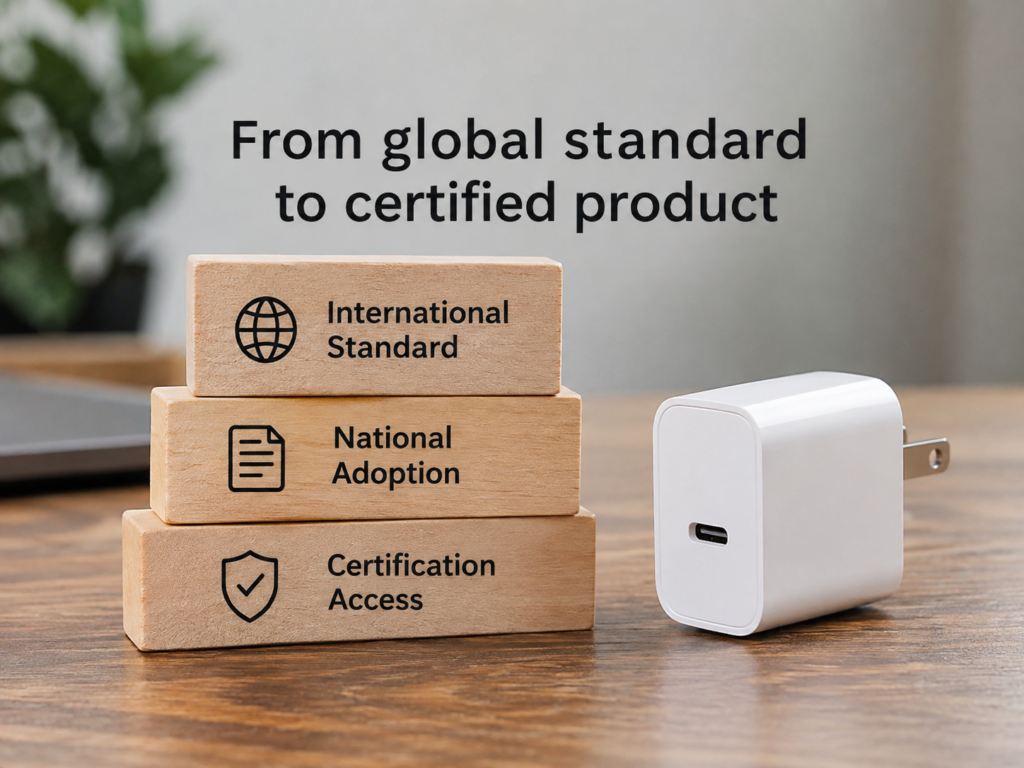
The two are actually different levels of the same safety system, following the three-tier logic of “international standard → national adoption → certification access”:
The first tier is the international standard, namely IEC 62368-1, issued by the International Electrotechnical Commission. It is one of the international basic standards referenced by many countries and regions when formulating or adopting safety requirements for information, audio-visual and communication technology equipment;
The second tier is the US adopted version, namely UL 62368-1, developed by UL Standards & Engagement; when approved through the ANSI process, it is designated as ANSI/UL 62368-1. It takes IEC 62368-1 as the technical basis and incorporates US national deviations. The corresponding national standard applicable in Canada is usually CSA C22.2 No. 62368-1, not ANSI/UL 62368-1;
The third tier is certification access. Here is a key point: the IEC standard itself is not product certification, and IEC headquarters does not directly issue product certificates to manufacturers. IECEE is the conformity assessment system of the IEC; CB certificates and CB test reports are issued by accredited National Certification Bodies (NCBs), and they cannot be collectively referred to as certifications directly issued by the IEC. What actually enables products to enter the market is the certification system of each country.
Shared Safety Logic: Layered Protection Based on Hazardous Energy
The core ideas of the two sets of standards are exactly the same: first identify all hazardous energy sources in the product, then superimpose protection layers according to the risk level, requiring that even if a single fault occurs (such as a component failure), the user shall not be exposed to the risk of electric shock or fire. You don’t need to memorize professional terms, just understand “higher risk, more protection”.
Take charging products as an example: a normal, compliant 5V USB output usually does not constitute an electric shock hazardous energy source; but risks such as faults, moisture, short circuits and abnormal heating shall still be prevented, and it cannot be generalized that all situations are completely free of electric shock or other safety risks. The high-voltage circuit inside the charger is of medium to high risk, which may cause electric shock or fire, so multiple layers of insulation, flame-retardant materials and other protections are required.
There is a common entry-level concept called Limited Power Source (LPS). Simply put, it limits the output power within a safe range through circuit design, so it is not easy to catch fire even in case of a short circuit. LPS is a power supply characteristic determined based on conditions such as standard limits, actual output capability, and short-circuit/overcurrent protection, and cannot be judged solely by the USB interface type.
Four Concepts You Must Clarify: Don’t Confuse Standards with Certification
Many people mix up standards, testing, certification and marks. Let’s distinguish them in plain language:
- A standard is a rule document that specifies safety requirements, equivalent to an exam syllabus;
- Testing is the process of verifying samples against the standard, equivalent to taking an exam;
- Certification is a proof of product conformity issued by a certification body according to a specific scheme; some mark certifications also include manufacturing site audits and ongoing surveillance, but schemes centered on mutual recognition of test certificates and reports, such as CB certificates, do not automatically include ongoing factory inspections;
- A mark is the certification credential printed on the product, equivalent to the steel seal on a diploma, for consumers and regulators to see.
Let’s emphasize the core misconception again: the IEC standard itself is not product certification, and IEC headquarters does not directly issue product certificates to manufacturers. IECEE CB certificates and CB test reports are issued by accredited national certification bodies, and cannot be called certifications directly issued by the IEC. Just printing “compliant with IEC/UL standards” on the packaging does not count; whether it has market access validity depends on the applicable compliance requirements of the sales location.
Unify the Premise Before Comparison: Avoid Invalid Comparisons
The reason why many people’s comparison conclusions are inaccurate is that they don’t even unify the premise of the comparison — comparing industrial power supplies with mobile phone chargers, or comparing old versions from ten years ago with the latest version, is meaningless at all. All comparisons in this article are based on the following unified rules.
Unified Product Scope: Only Consumer-Grade Charging Accessory Products
All comparisons in this article are for civilian charging products with rated voltage ≤ 600V, including wall chargers, desktop chargers, power adapters, and supporting charging interface components, provided that the products fall within the category of information/audio-visual supporting power supplies covered by IEC 62368-1.
Industrial-grade power supplies, in-vehicle charging devices, high-power energy storage chargers and other non-civilian or out-of-scope products are not discussed in this article, as they are subject to their own dedicated standards.
Version Verification: Same Standard Number Does Not Mean Same Requirements
Never think that the same standard number means exactly the same requirements. Differences in version, corrigendum, and national deviations can lead to vastly different requirements. When checking standards, you must confirm 5 core elements: IEC version and corrigendum, ANSI/UL version and publication date, national deviations of the target country, version actually adopted by the certification body, and version specified by the contract or sales platform.
For your reference: the 4th edition of IEC 62368-1 is IEC 62368-1:2023; if a corrigendum or consolidated version applies, it shall be checked against the full document number, COR number and publication date listed on the IEC Webstore. A corrigendum is not equivalent to the release of a new technical edition. Which version to use must be based on the requirements of the certification body and target market, and cannot be assumed arbitrarily.
Unified Comparison Dimensions: Only Content Users Really Care About
We will not talk about internal laboratory operation procedures, component-level design details or professional engineering calculations, but only compare 5 dimensions that ordinary users and small and medium-sized merchants care most about: applicable market and access validity, safety requirement comparison method, test judgment logic, certification process and budget, and labeling requirements.
At the same time, we will not casually make unfounded statements such as “UL is X percent stricter than IEC”. All comparisons are based on the core framework of “homologous technology + national deviations + certification scheme”, and specific differences shall be determined based on actual products.
Item-by-Item Comparison of Core Dimensions (For Consumer-Grade Charging Products)
Applicable Market and Access Validity
Both can be used as a basis for safety assessment of specific information, audio-visual and communication technology equipment and their applicable power supply products. Whether a specific product is applicable and whether it constitutes a market access condition shall be subject to the laws and regulations of the sales location, adopted national standards and certification/regulatory requirements; compliance assessment only indicates that the product meets the corresponding safety requirements within the specified scope and conditions.
As an international standard, IEC 62368-1 is adopted by more than 100 countries worldwide. CB test reports and certificates issued based on it can be used as the technical basis for applying for national certifications in some countries within the IECEE member system; whether to accept them and what supplementary deviation items are required shall be determined by the certification body of the target country. For the EU, CB reports can be used as one of the technical evidences for conformity assessment; the CE mark is not obtained by conversion from a CB report, but by the manufacturer completing the conformity assessment in accordance with applicable EU regulations and issuing the EU Declaration of Conformity. But note: a CB report is just a technical document, and cannot be printed directly on the product as an access mark; you must complete the corresponding compliance procedures in accordance with local applicable requirements.
ANSI/UL 62368-1 is the US national standard version; Canada usually applies CSA C22.2 No. 62368-1. When targeting both the US and Canada, you should check the US and Canadian versions, national deviations and certification mark coverage separately. There is a common misunderstanding here: there is no unified mandatory NRTL (Nationally Recognized Testing Laboratory, a third-party safety certification body recognized by the US Occupational Safety and Health Administration (OSHA)) requirement at the US federal level; whether NRTL is required shall be determined in combination with OSHA rules, local Authority Having Jurisdiction (AHJ) requirements, installation specifications, and the rules of purchasers or sales platforms. In addition, UL is just one of the NRTLs, not the only issuing body; ETL, TÜV Rheinland and other institutions also have NRTL qualifications, as long as they are recognized by the sales channel.
This conclusion is not absolute: some small countries may not join the CB system, so CB reports cannot be used for certificate conversion, and you need to check the local access catalog in advance; requirements also vary by sales channel in the US — for example, large e-commerce platforms may mandate NRTL, while small offline channels may not have hard requirements.
Core Safety Requirement Comparison Method
First, clarify a principle: there is no fixed conclusion of “who is stricter”. All differences must be checked in combination with the actual product, and cannot be judged by feeling. The general principle of comparison is: subject to the same version of the standard text, US national deviation clauses, and the engineering judgment of the certification body.
The specific comparison can be divided into three steps:
The first step is to confirm the rated input range of the product, for example, whether it is 100-240V wide voltage, or only supports 120V US voltage. Different voltage ranges may apply different clauses.
The second step is to check possible differences by module. For charging products, common potential differences include: in terms of electric shock protection, for high-power grounded products, the safety clearance of live parts may have different requirements due to national deviations; in terms of fire protection, both standards have clear requirements with no essential difference; in terms of interface protection, for USB-C/USB PD products, assessment shall be based on actual rated output, circuit protection, energy level, applicable 62368-1 clauses and national deviations; if it involves DC power transmission through communication ports such as USB, the applicable requirements of IEC 62368-3 shall also be checked. If you need to verify USB-C protocol, cable current capability and interoperability, relevant USB-IF/IEC 62680 specifications shall also apply. In terms of component requirements, using UL-recognized components can reduce the uncertainty of the whole machine assessment, but not all components must have UL recognition, as long as they can be proven to meet safety requirements.
The third step: the final difference list shall be issued by the certification laboratory. Individuals or merchants do not need to look for differences one by one against the standard, which is time-consuming and error-prone.
Test Methods and Judgment Logic
When the compared versions correspond and no applicable national deviations are involved, many basic safety tests have a common IEC technical basis, such as withstand voltage test, insulation test, plug and unplug test, temperature rise test, etc. Specific test items, conditions, samples and judgment shall still be confirmed according to the adopted version, national deviations and certification scheme.
The principle of comparison is: test conditions are subject to product rated parameters + standard test requirements, and there is no fixed working condition difference. For USB-C/USB PD products, abnormal working conditions shall be assessed according to actual rated output, protection circuit, applicable 62368-1 clauses and national deviations; USB-C protocol, cable current capability and interoperability shall also be checked according to applicable USB-IF/IEC 62680 specifications. Whether supplementary tests are required shall be determined by the certification body according to the design.
As for the number of samples, test cycle and other aspects, there is no fixed value, which will vary with the complexity of the product structure, certification scheme, and laboratory scheduling. Don’t fixate on the “average cycle” you see online; consulting the certification body directly is the most accurate.
Certification Process and Budget Variables
We will not give a fixed price figure, because there are too many influencing factors. Here we only talk about the core system differences and the details that must be confirmed when inquiring, to avoid later price increases.
The core system difference is clear: the CB system is centered on test report + certificate, there is no unified mandatory ongoing factory inspection, and when converting to local certification, it shall be implemented according to local requirements; while for NRTL mark certification (such as UL Mark), after obtaining the certificate, you need to enter the ongoing conformity service, and the certification body will regularly check the manufacturing site and product consistency to ensure that mass-produced products are consistent with the test samples.
When inquiring, you must ask clearly about 8 details: specific requirements for samples and technical documents, whether existing CB reports are accepted, scope of supplementary testing for US national deviations, initial production inspection requirements, frequency and cost of follow-up surveillance services, product change reporting rules, annual fee/mark usage fee, and retest trigger conditions.
Product Labeling and Manual Requirements
There is no unified mandatory list for labeling and manuals, which need to be checked in combination with four types of basis: the mark pattern authorized by the certification body, specific requirements of the certification file, relevant clauses of the applicable product standard, and local rules of the sales location.
The common requirements of both are: both need to mark product rated parameters and production/manufacturer related information.
Special attention for the US side: the NRTL mark must be used in accordance with the pattern authorized by the institution, you cannot modify the style or print it without authorization, and the labeling content must be completely consistent with the requirements of the certification file.
The bilingual (English/French) requirement for Canada is not uniformly mandatory; it depends on the product category, applicable standards and local regulations, and not all products need to be printed in bilingual.
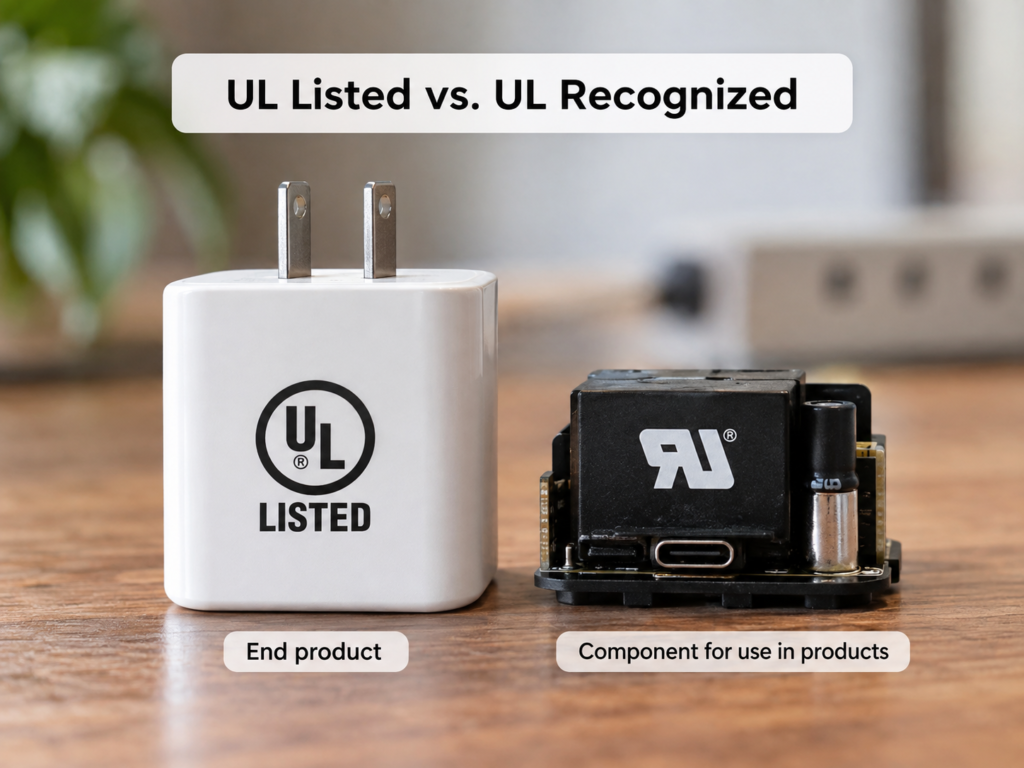
There is also a red line that must never be crossed: the UL component Recognized mark must not be used as a whole machine Listed mark. The former is certification for components, and its recognition scope and conditions of use must be confirmed in the final product assessment, and cannot be used as proof of whole machine compliance.
Applicability Boundary of Charging Products: Don’t Blindly Apply 62368-1
Many people think that all charging-related products are applicable to 62368-1, but that’s not the case. We will clarify the scope in four categories to avoid wasting money on useless certifications.
Whole Machine Category: Wall/Desktop Chargers, Power Adapters
If an external power supply or charger is an intended supporting device for audio-visual, information and communication technology equipment or business equipment covered by IEC 62368-1, and meets other scope conditions of the standard, including a rated voltage not exceeding 600V, it may be assessed in accordance with 62368-1; whether a dedicated standard should be used instead shall be confirmed according to the intended use of the product and the requirements of the sales location. But note that passing 62368-1 does not mean you can sell directly; you also need to additionally check energy efficiency regulations, electromagnetic compatibility requirements (such as US FCC), and additional requirements of sales channels.
Common misconception: the certified model is inconsistent with the actual sales model configuration — for example, the certified product is a single USB-A port charger, but the actual sold product is a dual USB-C port one, or the plug specification is different, these are all non-compliant.
Preparation before certification: circuit schematic, bill of materials, rated parameter description.
Active Cables/Electronic Accessories (USB-C cables with E-Marker, overcurrent protection chips)
This type of cable with electronic circuits may trigger additional safety assessment under 62368-1. Whether it is required shall be determined in combination with the cable structure, rated current/voltage, and electronic circuit function.
In addition to 62368-1, you also need to additionally check USB interoperability standards (such as IEC 62680 series) and cable material safety requirements.
Common misconception: thinking that an active cable with a separate 62368 certification can be matched with any charger. The independent assessment or certification of active cables does not automatically cover all charger combinations; their usable scope must comply with the rated values, protocols and conditions in the certification documents; if the combination will change safety functions, output capability or intended use conditions, the whole machine certification body shall confirm whether supplementary system-level assessment is required.
Preparation for assessment: chip parameters, cable ratings, circuit design description.
Passive Cables and Connectors (Ordinary USB/USB-C cables, interface terminals)
Passive USB cables and connectors do not necessarily need to be separately certified under 62368-1, but when they are accessories or components of equipment within the scope, they can be included in the 62368-1 whole machine or system assessment; when DC power transmission through standard cables such as USB is involved, IEC 62368-3 and the requirements of the sales location for cables, materials and labeling shall also be checked.
This type of product also needs to additionally check cable mechanical/material safety standards and USB interoperability standards.
There are two common misconceptions: first, thinking that all data cables are applicable to 62368-1. In fact, whether they need to be assessed according to 62368-1 or other standards depends on their use as accessories or components, rated values, sales location regulations and certification schemes; second, treating IEC 62680 as a dedicated wire safety standard. In fact, it is an interoperability standard, which governs whether different devices can charge and transmit data normally, not safety.
Materials to prepare: cable specification sheet, material certificate, rated parameters.
Special Charging Products
The main safety standard for wireless chargers can refer to 62368-1; car chargers, products with battery or energy storage functions must not be applied with 62368-1 solely based on their name. The applicable whole-machine, battery and in-vehicle/energy storage dedicated standards shall be determined according to the power supply method, intended use and requirements of the sales location, and may involve both 62368-1 and other standards when necessary.
Common misconception: thinking that all charging products can be covered by 62368-1.
Boundary of Two Types of UL Certification Marks
Here we will separately emphasize the difference between UL marks, which many people confuse:
- UL Listed: usually applied to end products assessed in accordance with corresponding UL requirements, but it does not replace other applicable regulations, local AHJ requirements or channel requirements;
- UL Recognized: usually applied to components intended to be installed in end products, its recognition scope and conditions of use must be confirmed in the final product assessment, and its recognition mark must not be used as a claim that the end product has obtained UL Listed.
When you see a UL mark, don’t directly judge that the whole machine is compliant. First distinguish whether it is Listed or Recognized, then check whether the certification file information is consistent.
Practical Decision-Making: How to Choose for Different Scenarios
You don’t need to memorize all the rules. Before making a decision, first clarify 6 variables: list of target countries/regions, list of NRTL institutions accepted by customers/platforms, whether to enter the Canadian market simultaneously, version and coverage of existing test reports, affordability of factory ongoing surveillance costs, and degree of product model serialization, then correspond to the following scenarios.
Scenario 1: Global Multi-Market Distribution (Including the US)
A common strategy is to first complete the IEC CB test report, then use the CB report to convert to local certifications for each target market (including US NRTL).
It is suitable for cases where the target market includes 3 or more CB system member countries and there are many product models that need to be serialized, which can reduce repeated testing costs. Note that CB certificates/CB test reports can be used as supporting materials when applying for assessment to US NRTLs, but whether to accept them, what US deviations need to be checked, and whether supplementary tests and factory audit arrangements are required are all determined by the target NRTL according to its certification scheme and product situation.
Scenario 2: Only Targeting the US Domestic Market
A common strategy is to directly find an OSHA-recognized NRTL institution for certification. You don’t have to choose UL, as long as the channel recognizes it.
It is suitable for cases where you only operate North American e-commerce/offline channels and have no global distribution plan, and the process is more direct. Be sure to confirm the list of NRTLs accepted by the sales channel in advance, don’t find out that the channel doesn’t recognize it after completing the certification.
Scenario 3: Only Targeting the Canadian Market
A common strategy is to directly apply for Canadian-recognized certification (such as cUL, cETL).
Note that you cannot directly use US UL certification to enter Canada; you must meet Canadian local standards and mark requirements. Don’t assume that North America is a unified market.
Scenario 4: Already Have a CB Report, Want to Enter the US Market
First do a pre-check: the CB report version matches the version adopted by the target NRTL, the product covers US power grid working conditions, and the technical documents are complete.
If the prerequisites are met, the CB certificate/CB test report can be used as supporting materials when applying for assessment to the US NRTL; whether to accept, what US deviation assessments or supplementary tests are needed, and factory audit arrangements are all determined by the target NRTL according to its certification scheme and product situation. Whether ordinary IEC 62368-1 test reports issued by non-CB system bodies can be adopted must also be confirmed by the NRTL. The advantage is that repeated testing can be reduced, and the specific savings amount is subject to the institution’s quotation.
Scenario 5: Ordinary Consumers Purchasing Charging Products
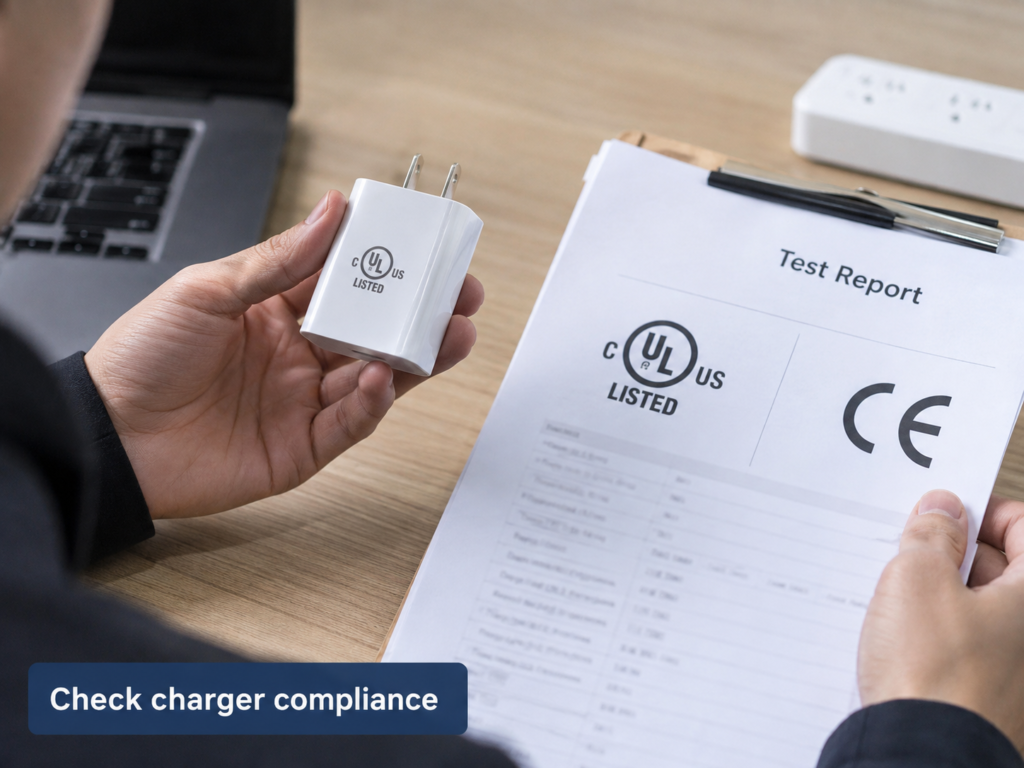
When buying non-North American version products, look at the local official certification mark (such as EU CE, Australia SAA). Note that CE is a manufacturer’s declaration of conformity, not a third-party certification; when buying US version products, check whether there is an NRTL Listed mark, and verify the consistency of the product model and the mark.
General reminder: you should check the compliance mark, declaration of conformity, certification certificate or official database records required by the sales location. If the sales location or channel requires a third-party certification mark, check the mark type and model; the absence of a third-party mark does not automatically prove that the product is non-compliant, but only the claim of “compliant with IEC/UL standards” is not sufficient to prove that it has met all compliance requirements of the applicable market.
Quick Decision Checklist
- Should you do IEC CB? If any of the following is met: target market includes CB system member countries, plan multi-market distribution, need to convert to multi-country certification, you can consider it;
- Should you do US NRTL? It is required if mandated by sales channel/platform, or applicable OSHA/AHJ rules require it;
- Applying to an NRTL does not take holding a matching CB report as a prerequisite; if you plan to use a CB report to reduce repeated assessment, the target NRTL shall confirm the report version, model and rated range coverage, and determine the required national deviation assessment, supplementary testing and factory audit.
Intermediate Proficiency: Pitfall Avoidance Guide and Authenticity Verification
Clarification of Common Misconceptions
We have sorted out 8 most common pitfalls to help you avoid 90% of compliance traps:
- Can you sell directly to the US with “IEC certification”? Wrong. The IEC standard itself is not product certification, and IEC headquarters does not directly issue product certificates to manufacturers; CB certificates and CB test reports are issued by accredited national certification bodies, and the US still requires compliance with local access requirements;
- Is the UL standard always stricter than IEC? Wrong. The differences come from US national deviations and certification schemes, and low-power products may have no substantial differences;
- Can the same standard number be used universally? Wrong. You need to check version, corrigendum, national deviations, and the version adopted by the certification body;
- Passing the 62368 standard = faster charging/more durable? Wrong. 62368 is a safety standard, it does not govern performance;
- Is a UL mark equivalent to whole machine certification? Wrong. You need to distinguish between Listed/Recognized types, and it must be consistent with the certification file;
- Are UL certification and FCC certification the same thing? Wrong. NRTL certification mainly involves product safety; FCC rules mainly cover radio frequency equipment and the RF emission and equipment authorization requirements for intentional/unintentional radiators; specifically, Certification, SDoC or other rules may apply, and they are not equivalent to covering full EMC, especially immunity requirements;
- Can the CE mark prove compliance with IEC 62368-1? Wrong. CE is the EU Declaration of Conformity, not equivalent to IEC standard certification;
- Do all chargers in the US require NRTL certification? Wrong. There is no unified mandatory requirement at the federal level, it depends on regulatory rules and channel requirements.
Four-Step Method for Compliance Authenticity Verification
Whether it is merchants choosing suppliers or consumers buying products, you can use these four steps to check the authenticity of compliance:
Step 1: Identify the mark type, distinguish whether it is NRTL Listed/Recognized mark or CE mark, different marks have different effectiveness;
Step 2: Query through official channels. You can check publicly available UL Listed/Recognized information on official channels such as UL Product iQ; IECEE allows query of publicly available CB certificate information. The full CB test report is usually not public; you should request it from the certificate holder or the issuing NCB and verify its number, version, covered models and validity;
Step 3: Check core information. Manufacturer, product model, rated parameters, file number/category control number, and use restriction conditions must be completely matched; if any one does not match, there may be a problem;
Step 4: Check the physical configuration. Product plug, number of output ports, and structure must be consistent with the description of the certification file. For example, if the certification is for US standard pins but the actual product has UK standard pins, it is non-compliant even if the model is the same.
Common Compliance Risk Points for Charging Products (Merchant Pitfall Avoidance)
The following are the most common compliance problems in charging products. Early investigation can reduce a lot of trouble, and the final judgment shall be subject to the certification body: the flame retardant performance of the housing material does not meet the standard requirements; the actual rated output, protection circuit or abnormal working condition assessment of USB-C/USB PD products does not meet the applicable 62368-1 clauses and national deviation requirements; key components have no valid recognition documents and cannot provide alternative compliance certificates; the safety clearance of internal live parts is lower than the standard requirements; the product labeling is inconsistent with the pattern/file requirements authorized by the certification body.
Quick Answers to Frequently Asked Questions
Can IEC Reports/CB Reports Replace UL Certification?
They cannot directly replace. CB certificates/CB test reports can be used as supporting materials for applying for US NRTL assessment, but whether to accept them, what US deviations need to be checked, and whether supplementary tests and factory audit arrangements are required are all determined by the target NRTL according to its certification scheme and product situation. Whether ordinary IEC 62368-1 test reports issued by non-CB system bodies can be adopted must also be confirmed by the NRTL.
Is UL Certification a Mandatory Requirement for the US Market?
There is no unified mandatory requirement at the US federal level. Whether it is required depends on OSHA rules, local AHJ, sales channel/platform, and customer requirements.
Can Products with CE Mark Be Sold Directly to the US?
The CE mark itself cannot prove compliance with US requirements, nor can it replace applicable US requirements. Products bearing the CE mark may still be sold if they simultaneously meet applicable US federal, state/local, FCC, energy efficiency and channel requirements; you must not claim that US access requirements are met solely based on the CE mark.
Does USB-C Data Cable Apply to IEC 62368-1?
Passive USB-C cables do not necessarily need to be separately certified under 62368-1, but when they are accessories or components of equipment within the scope, they can be included in the 62368-1 whole machine or system assessment; when DC power transmission through standard cables such as USB is involved, IEC 62368-3 and the requirements of the sales location for cables, materials and labeling shall also be checked. Active USB-C cables with electronic components require additional assessment in combination with cable structure, rated parameters and circuit functions.
Summary
After reading this article, you can at least independently judge three things:
First, IEC 62368-1 is the international basic safety standard, and ANSI/UL 62368-1 is the local version adopted by the US. Their core safety logic is from the same source, there is no claim that one is absolutely stricter than the other, and the differences mainly come from national requirements and certification processes.
Second, for charging products targeting the global market, you can first obtain a CB report and then convert to local certifications in various regions, saving repeated testing costs; if you only target the US market, it is more efficient to directly find an NRTL that meets channel requirements to issue the certificate.
Third, whether buying or selling, you can verify compliance through the compliance mark, declaration of conformity, certification certificate or official database required by the sales location; do not take “compliant with standards” publicity as formal proof that market requirements have been met.