
If you have been in the cross-border business of charging products such as power banks and battery-powered wireless chargers, you have most likely encountered this situation: freight forwarders require you to provide a UN 38.3 report before shipping, and e-commerce platforms require IEC 62133-2 certification before listing. Many people’s first reaction is: since both are battery safety standards, wouldn’t it be enough to do just one? That’s really not the case—these two standards govern completely different scenarios, they cannot replace each other, and in many cases both need to be completed.
First, understand the basics: the two standards address two completely different types of risks
To distinguish the difference between the two, we must first start with the two core risks of lithium batteries, which is also the fundamental reason for the existence of the two standards.
One type is transportation risk: for example, when a whole container of power banks is shipped by sea, or transported in the cargo hold of an aircraft, it will experience bumps, temperature difference changes, and stacking extrusion along the way. In the event of leakage or fire, the entire batch of goods and even the means of transport will be at risk. This type of risk corresponds to the UN 38.3 standard.
The other type is use risk: during daily use by consumers, situations such as dropping, exposure to high temperature environments, and abnormal charging may occur; if explosion or scalding occurs, it is a product use safety issue. This type of risk may involve the requirements of IEC 62133-2 for the safety of cells and batteries. However, the selection of external chargers, the overall safety of chargers, and charging protocols must be judged separately in accordance with corresponding product standards and regulations.
Simply put, one is in charge of “no accidents during transportation”, and the other is in charge of “no accidents during use”. The scenarios are completely independent, so naturally they cannot replace each other. For cross-border sold charging lithium battery products (such as power banks), which need to be both transported and sold, both standards usually need to be met.
Two basic terms you must understand first
Before continuing, let’s clarify the two most easily confused terms, otherwise it will be easy to get confused later:
- 电芯 (Cell): The most basic energy storage unit of a battery. For example, the commonly heard 18650 cylindrical cell can store electricity alone, but it has no protection circuit and cannot directly charge a mobile phone.
- 电池 (often called battery pack or Pack): Composed of one or more cells combined according to the design, which can integrate components such as protection circuits, connectors, and casings. The energy storage components built into power banks usually belong to batteries.
The identity and version of the standards, don’t mix them up
Many people ask “which is the latest version of UN 38.3”, but actually this question cannot be answered just by looking at a single version number.
- The full name of UN 38.3 is Section 38.3 of the United Nations Manual of Tests and Criteria, which is the basic basis for global lithium battery transportation testing. UN 38.3 has the currently published version of the United Nations Manual of Tests and Criteria; as of the time of verification, it is the 8th revised edition and 2025 Amendment 1. For specific transportation, you should also check the acceptance requirements of the applicable transport regulations and carriers for test versions, existing test data, and test summaries.
- IEC 62133-2 is a special safety standard for portable lithium batteries issued by the International Electrotechnical Commission, with Part 2 targeting lithium-based batteries; its version requirements depend on the regulations of the destination market. For example, the versions recognized by the European Union and North America may be different, and the newer version is not necessarily the better.
Special clarification: standard ≠ certificate ≠ market access
This is the most common pitfall, which must be clearly explained in advance: the three are completely different three levels of logic.
First, transport regulations will cite UN 38.3 as a technical requirement, market access regulations may cite IEC 62133-2 as a safety requirement, and customers may also put forward additional requirements; second, a standard is a set of technical rules, and a certificate is a proof issued by a third-party organization that “the product meets the standard”; finally, market access is a mandatory requirement of the destination regulatory authority, which may require a combination of multiple standards and multiple documents to meet.
For example: a UN 38.3 test report can only prove that the submitted sample has passed the UN 38.3 test of the corresponding version and can be used for transportation verification, but it does not mean that you can directly sell the goods in the local market.
Define the scope before comparison: we are talking about batteries for consumer charging products
Since it is a comparison, we must first clarify the boundaries, otherwise applying the requirements of power batteries to the batteries of consumer charging products will definitely lead to errors. All the following comparisons are for lithium batteries used in consumer charging electronic products—such as batteries in power banks, built-in batteries of USB charging devices, and built-in batteries of wireless chargers.
For power batteries, medical batteries, industrial energy storage batteries, lead-acid batteries, and non-rechargeable lithium metal primary batteries, their own special standards or regulations may usually apply, which are not within the scope of today’s comparison. Whether IEC 62133-2 applies should still first be judged according to its scope of “portable sealed secondary lithium cells and batteries” and destination regulations, and cannot be automatically excluded only based on industry uses such as medical and industrial.
Core differences in scope of application
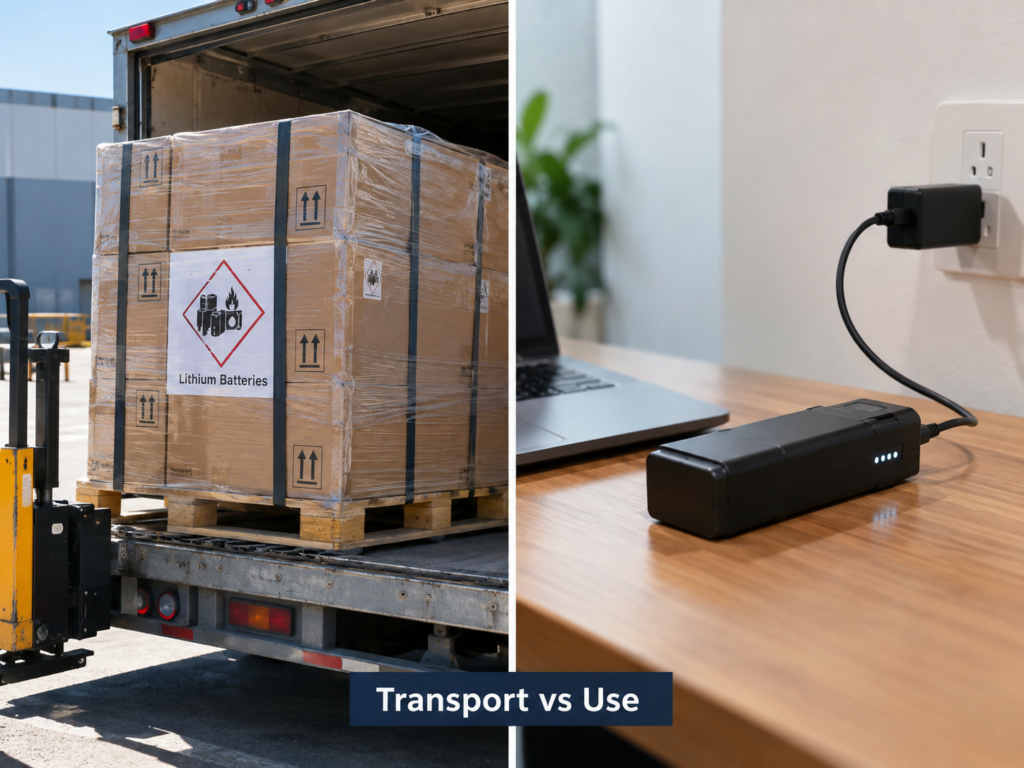
From the perspective of coverage, the difference between the two is very clear:
- UN 38.3 covers all lithium-based batteries, including non-rechargeable lithium metal primary batteries, and the core test objects are cells and battery packs.
- IEC 62133-2 only covers portable sealed rechargeable lithium cells and battery packs. Whether it is applicable should be judged in combination with whether the product meets the definition of “portable”, its use, structure, and the standard version adopted by the destination, not all rechargeable lithium batteries can apply it.
Which scenarios overlap, and which are completely unrelated
- Overlapping application: Cross-border sold power banks, USB charging devices with lithium batteries, and separately sold spare lithium batteries, which need to be both transported and sold to consumers, usually need to meet both standards.
- Direct exclusion: Charging accessories without lithium batteries such as pure chargers, charging cables, and adapters are subject to other electrical safety specifications, and have nothing to do with UN 38.3 and IEC 62133-2.
- Boundary categories: Whether button-type rechargeable lithium batteries can use IEC 62133-2 must be specifically judged according to the definitions in the standard, and cannot be generalized.
Item-by-item comparison of core dimensions: there is no absolute strictness, only different scenarios
Many people like to ask “which standard is stricter”, but actually there is no standard answer to this question—the management logic of the two is completely different, and how strict they are depends on the scenario you use them in.
Management logic: one focuses on transportation, the other focuses on use
- The core of UN 38.3 is transportation environmental stress, which simulates various situations encountered during transportation to verify that the battery will not have safety accidents during transportation.
- The core of IEC 62133-2 is electrical, thermal, and mechanical abuse during the use phase, which simulates the daily use and even reasonable misuse by consumers to verify that the battery is safe at this time.
Therefore, in transportation scenarios, UN 38.3 is the core threshold, and if you cannot pass it, you cannot transport; in daily use scenarios, the assessment of IEC 62133-2 is more comprehensive, covering more abuse situations.
Test item framework: they seem to overlap, but in fact the specifications are very different
T.1-T.8 test framework of UN 38.3
UN 38.3 has a set of test items from T.1 to T.8, but note: not all test objects need to complete all 8 items. The specific items to be done will be adjusted according to the type of test object and the standard version. We can understand the function of each test in plain language:
- T.1 Altitude simulation (low pressure): simulates the low pressure environment of an aircraft cargo hold, required for all cells and batteries;
- T.2 Thermal cycling: simulates the alternating hot and cold environment during transportation, such as transporting from the tropics to the frigid zone, required for all cells and batteries;
- T.3 Vibration: simulates the bumps during truck and ship transportation, required for all cells and batteries;
- T.4 Mechanical shock: simulates the shock load during transportation, not a package drop test, required for all cells and batteries;
- T.5 External short circuit: simulates the situation where the positive and negative electrodes of the battery accidentally touch and short circuit during transportation, required for all cells and batteries;
- T.6 Impact/crush: applicable to cells, using corresponding impact or crush methods according to the shape and size of the cell, not a general stacking crush test for all battery packs;
- T.7 Overcharge: simulates accidental overcharging during transportation, only required for rechargeable batteries and battery packs, not required for non-rechargeable lithium metal primary batteries;
- T.8 Forced discharge: simulates the situation where the battery is reversed and forced to discharge, only tested for cells.
Safety test framework of IEC 62133-2
The test logic of IEC 62133-2 is completely different from that of UN 38.3. First of all, it must be clear that it only assesses safety performance, and performance indicators such as battery capacity and charge-discharge efficiency are not within the scope of assessment.
Its tests are divided into three levels, verified layer by layer from the inside to the outside:
- Cell level: assesses the chemical, mechanical, and electrical safety foundation of the cell itself, which is equivalent to laying the foundation;
- Battery pack level: assesses the matching safety of the cell plus the protection circuit and casing, such as whether the protection board can work in time, and whether the casing can prevent damage from dropping;
- Charging-related level: assesses whether the safety protection logic under normal charging and abnormal charging is correct.
Also note its boundaries: IEC 62133-2 only covers the design and reasonable abuse safety of portable sealed rechargeable lithium cells/batteries. It does not cover things like the overall safety of chargers, USB-C PD protocol, electromagnetic compatibility (EMC), radio, energy efficiency, and overall equipment regulations. Don’t think that passing this standard means the product is fully compliant.
Differences in specifications of tests with the same name
Some people may say: both standards have short circuit and crush tests, so there must be one that is stricter, right? That’s really not necessarily the case. Even for tests with the same name, the preprocessing conditions, test objects, and judgment requirements will vary with product type and standard version. There is no general conclusion of “which is stricter”. If you really want to compare, you must check the original text of the standard in combination with the specific product and scenario.
Test coverage levels: it’s not all good just because the cell passes
From the perspective of test coverage levels, the focus of the two is also different:
- UN 38.3 mainly evaluates the transportation safety performance of cells and batteries. However, if equipment with batteries (such as power banks with built-in batteries) is to be transported, in addition to the cell/battery itself meeting UN 38.3, it must also meet a series of transportation rules such as short circuit prevention, accidental activation prevention, and packaging. It’s not all good just because the battery passes.
- IEC 62133-2 pays more attention to the matching of the cell, protection circuit, and casing—even if the cell passes the test, if the protection circuit is poorly selected, or the casing structure has problems, the battery pack may still fail the test.
The two standards have a common rule: test conclusions should correspond to the cell/battery type, model range, structure, and key parameters defined in the report, and the scope of use shall not be expanded without authorization. Whether it can cover other models or modified products shall be evaluated by the responsible entity and a laboratory or certification body with corresponding capabilities in accordance with applicable rules.
Compliance documents, cycle and cost
Common types of compliance documents
- UN 38.3 related: generally test reports and test summaries, used for carriers and customs to verify transportation qualifications;
- IEC 62133-2 related: there are many types, including manufacturer’s declaration of conformity, CB certificates, and compliance documents for various destinations, such as CE in the European Union and UL certification in North America.
It should be added here: IEC itself is a standard-setting body and does not issue certificates. All certification certificates are issued by authorized bodies.
Factors affecting cycle and cost
There is no fixed cycle and price, and the core influencing factors are very clear:
- Cycle: mainly depends on whether the samples and materials are complete, whether rectification is needed, whether to transfer to multi-country certification, and whether the laboratory schedule is tight;
- Cost: mainly depends on the number of test items, institutional qualification requirements, whether factory audit is included, and whether multi-country certification conversion is required.
Document validity period
Many people ask “how many years is the validity period of the report”, and the answer is there is no unified legal validity period. It depends on the regulations of carriers, e-commerce platforms, destination markets, and certification systems. Some may require annual updates, and some are valid as long as the product has not changed. It cannot be generalized.
How to choose for charging products? Just judge according to the scenario
After talking about so much theory, some people may still not know whether their product needs to be tested or which one to do. Next, we will provide a set of practical judgment methods for charging products.
Quick judgment by business scenario
- Only cross-border commercial transportation of lithium battery products/equipment with lithium batteries: first confirm the UN 38.3 requirements, and some countries may require additional safety certification for customs clearance;
- Only local sales of charging lithium battery products: first check whether local regulations cite IEC 62133-2 or equivalent standards, and determine in combination with the product scope;
- Both cross-border transportation and global sales: both types of standard requirements must be met, and they cannot replace each other.
Beginners can use the three-step quick judgment method: first step, confirm whether the product has a lithium battery; second step, confirm whether it involves public commercial transportation; third step, confirm whether it is sold to consumers. After completing the three steps, you can basically know what needs to be done.
If market access is involved, there is also a four-question destination regulation confirmation to help you avoid detours:
- Where is the sales country/region?
- Is the product use portable?
- What are the local battery safety standards and versions?
- Is overall equipment safety/EMC/radio/chemical substance compliance still required?
Correspond by charging product type
- Power banks/USB charging devices/wireless chargers with built-in lithium batteries: transportation corresponds to UN 38.3 requirements as “equipment containing lithium batteries”;
- Separately sold spare lithium batteries/cells: transportation corresponds to UN 38.3 requirements as “stand-alone lithium batteries”;
- Charging accessories without lithium batteries: returning to the exception scenarios mentioned earlier, neither type of standard applies, and other electrical safety specifications shall be followed.
Different transportation statuses have different rules
Even for the same battery, different transportation statuses have different applicable UN 38.3 rules:
- Cells/batteries transported separately: check the stand-alone lithium battery transportation rules of the corresponding transportation mode (air, sea, land);
- Batteries and equipment in the same package (not installed): check the relevant rules for lithium batteries transported with equipment;
- Batteries installed in equipment: check the relevant rules for equipment containing lithium batteries.
Stand-alone transportation, same package with equipment, and installed in equipment are subject to different classification, packaging, quantity, marking, and declaration rules respectively. Whether the actual requirements are strict cannot be concluded only based on the transportation status, but also must be checked according to the specific transportation mode, packaging instructions, battery specifications, and carrier rules.
There are also some special cargo conditions that cannot apply the general cargo rules: for example, samples/prototypes, damaged/defective products, waste/recycled products all have special transportation exception rules, which must be checked separately. In addition, for lithium batteries carried by passengers personally, you must check the carry-on/checked baggage rules of the carrier and entry-exit customs, which are completely different from the requirements for commercial shipping. Don’t mix them up.
Special reminder: UN 38.3 is not a shipping pass
This is the most common pitfall: passing the UN 38.3 test is only the basic condition for transportation compliance, not that you can ship directly with the report. You also need to check these requirements simultaneously:
- Correct UN number and proper shipping name;
- Rated energy (Wh)/lithium content threshold meets the limits of the corresponding transportation mode;
- Packaging meets the strength and short circuit prevention requirements of corresponding regulations;
- Lithium battery marks, hazard labels and other marks on the outer box meet the applicable transportation mode and packaging instructions;
- Shipper’s declaration documents (if applicable) are complete;
- Additional restriction requirements of airlines/shipping companies/freight forwarders.
Boundary scenario: small-capacity lithium batteries cannot be exempted from UN 38.3 by default
Many people think that batteries with particularly small capacity (such as the battery in a Bluetooth headset charging case) definitely do not need UN 38.3, but that’s actually wrong. Small capacity may mainly affect packaging, marking, declaration, quantity, and transportation restrictions, and it should not be inferred from this that ordinary mass-produced batteries can be exempted from UN 38.3.
Whether the conventional UN 38.3 test requirements can be waived can only be judged according to the special exception clauses in applicable transport regulations, such as prototypes, low-volume products, waste or recycled products, etc., and cannot be judged by feeling.
Document verification and change control: don’t use invalid documents as amulets
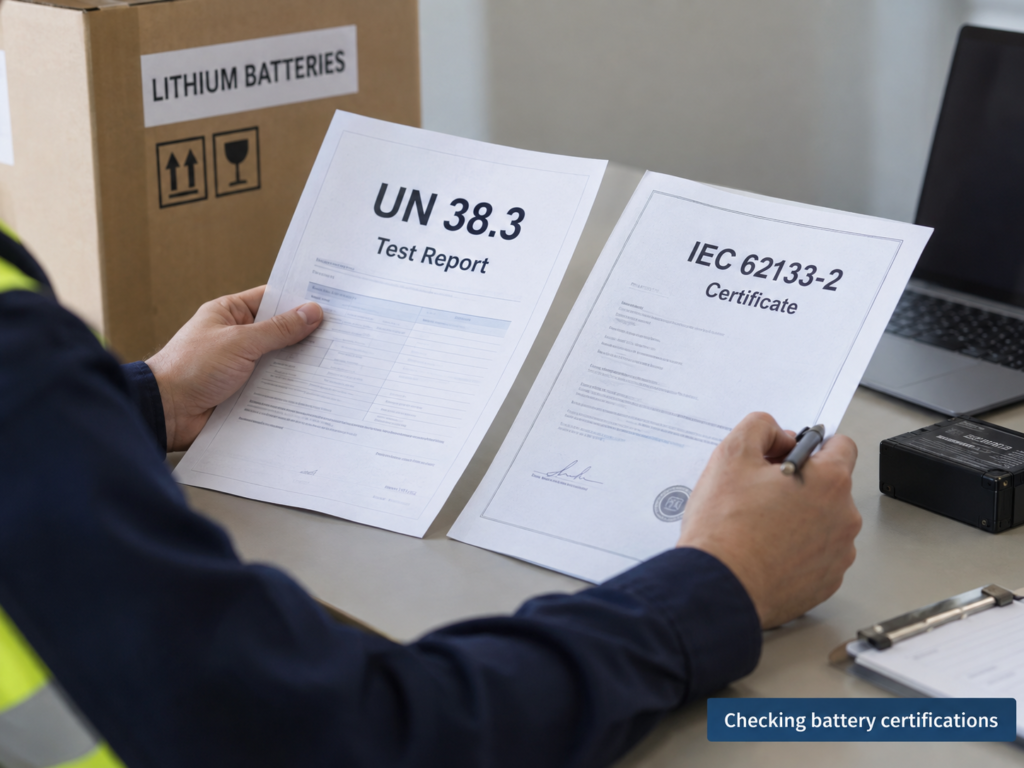
After getting the report or certificate, you can’t just put it aside. You must learn to verify its validity. Otherwise, if you get a fake or useless document, you will be the one who suffers in the end.
Proof boundaries of different documents
First, figure out what each document can prove, don’t overestimate or underestimate:
- Manufacturer’s declaration of conformity: it is the manufacturer’s self-declaration of conformity, which itself is not equivalent to a third-party certification certificate; its technical basis may include the manufacturer’s internal assessment or third-party test reports, and supporting technical documents and test evidence need to be consulted;
- UN 38.3 test summary/report: only proves that the submitted sample meets the UN 38.3 test requirements of the corresponding version, is used for transportation verification, and cannot be used as a market access document;
- CB certificate: CB certificates and CB test reports are conformity documents used for mutual recognition under the IECEE CB Scheme, which can support or simplify certification or market access procedures in some countries or regions; whether local certificates, supplementary national difference tests or other compliance documents are still required shall be confirmed in accordance with destination regulations and the requirements of the accepting authority;
- Destination compliance documents: for example, CE in the European Union is a conformity mark for which the manufacturer is responsible, requiring supporting technical documents and a declaration of conformity, and there is no unified “CE certificate”; another example is third-party certifications such as UL, which are more common in the North American market. Whether they are mandatory depends on the product type, local regulatory requirements, and purchaser scenarios, not all are mandatory. These documents are only valid within the regulatory scope of the corresponding country/region.
General verification operation checklist
When verifying documents, you can follow these steps, and basically there will be no big mistakes:
- Check document type: confirm that it matches the current demand, for example, UN 38.3 for transportation, corresponding certification for market access, don’t mix them up;
- Check standard version and test date: confirm that it meets the acceptance conditions of the current destination, transport regulations or certification system; old version reports do not necessarily automatically become invalid;
- Check issuing entity: confirm that the issuing body has corresponding qualifications (such as ILAC mutual recognition, IEC authorized certification system qualifications), otherwise the report will not be recognized;
- Check test object: confirm that the test object (cell/battery pack/equipment with battery) is consistent with the actual product;
- Check key specifications: confirm that core parameters such as battery model, rated energy, and cell specifications match the actual ones;
- Check change records: confirm that key product changes have been evaluated and recorded;
- Check compatibility: confirm that the scope of application of the document matches the requirements of the transportation mode/destination market.
What to do if the product is changed? Don’t decide by yourself
There is another very important rule: there is no general rule that “reports/certificates are automatically shared by products of the same series”. Many people think that batteries of the same series only have different capacities, and it’s enough to share one report, but that’s actually not the case. Whether it can be reused must be evaluated in writing by the laboratory or certification body, and cannot be decided by yourself.
Especially for the reuse of UN 38.3 test data and the expansion of series models, it must be evaluated by the responsible entity and a qualified laboratory in accordance with transportation rules. If the model is expanded or the design is changed without evaluation, the original document may no longer prove that the changed product meets the requirements; you should stop using it as the conformity basis for the changed product, and complete the written evaluation and necessary supplementary tests or certifications.
Generally speaking, these key changes need to be submitted for evaluation: cell chemistry system/model, rated capacity/energy, series-parallel structure, protection circuit, charging limit parameters. These are all core factors affecting battery safety, and changing them without evaluation is very risky.
Avoid common misconceptions
Finally, we have sorted out several of the most common pitfalls to help you avoid detours:
Standard positioning category
- Confusing applicable scenarios, thinking that the two can replace each other: emphasize again, one is for transportation and the other is for use, completely independent, cannot replace each other;
- Equating standards with market access certificates: standards are technical requirements, certificates are proofs, access is local mandatory requirements, the three are not the same thing;
- Thinking that IEC 62133-2 covers all lithium batteries: its core scope is portable sealed rechargeable lithium batteries; applications such as power, medical, and industrial energy storage may usually be subject to special standards or regulations, and whether IEC 62133-2 applies still needs to be judged according to the product scope and destination requirements.
Document validity category
- Thinking that reports/certificates are permanently valid: the validity period depends on the regulations of carriers, platforms, and destinations, not lifelong valid;
- Thinking that batteries of the same series can automatically share documents: must be evaluated by the institution, cannot be decided by yourself;
- Thinking that “certified” printed on packaging can replace formal documents: transportation, customs clearance, and listing all require formal reports and certificates, printing is useless.
Scope of application category
- Thinking that all products with batteries are subject to these two standards: batteries for special purposes may usually be subject to special standards or regulations, and whether IEC 62133-2 applies still needs to be judged according to its scope;
- Thinking that pure chargers/charging cables need to meet these two types of standards: both standards are for lithium batteries, and accessories without lithium batteries do not need them;
- Thinking that small-capacity batteries definitely do not need UN 38.3: small capacity may simplify packaging, marking, declaration, quantity or transportation restrictions, but it is not a reason for ordinary mass-produced batteries to be exempted from UN 38.3, you must check the rules.
Summary and quick checklist
Finally, summarize the core difference in one sentence: UN 38.3 governs the transportation link and is the basic test basis for lithium battery transportation safety; IEC 62133-2 governs daily use and is a general standard for the safety of portable lithium batteries; the two have independent applicable scenarios and cannot replace each other.
For the convenience of quick judgment, here is a quick checklist, just check the boxes:
□ Does the product contain lithium cells/batteries? No → neither standard applies
□ Does it involve public commercial transportation? Yes → need to check UN 38.3 related requirements
□ Is it sold to consumers? Yes → need to check IEC 62133-2 and local market access requirements
□ Is the battery for special purposes such as power/medical/industrial? Yes → also need to check the applicable special standards or regulations, and judge according to the scope of IEC 62133-2
□ Do documents, versions, specifications, transportation status match destination requirements? Yes → have preliminary applicable basis, still need to check carrier/regulatory requirements
After learning these, you should be able to do four things independently: distinguish the core positioning of the two standards, and not be misled by unreliable service providers; judge the required compliance requirements according to the type of charging products and business scenarios; initially verify the validity of UN 38.3 reports and IEC-related certification documents according to the checklist; identify common misconceptions and avoid invalid certifications or compliance risks. Of course, for the specific requirements of a certain product or a certain destination, it is still recommended to confirm with a qualified laboratory or compliance agency. After all, rules may be updated at any time, and it is safest to combine with the actual situation.