
If you are a brand owner, procurement professional, or product manager working on power banks, wireless earbud charging cases, or battery-powered USB accessories, you must have encountered situations where a customer simply says “IEC 62133 is required” or “UL 2054 certification is needed”. Both are battery safety standards — what exactly are the differences? Which is stricter? Can they replace each other? If you have one, do you not need the other?
Let’s make it clear first: this article only discusses the safety compliance approach for rechargeable lithium batteries in consumer electronics and portable products. It cannot replace the original standard text, the professional judgment of certification bodies, nor can it be directly used as the regulatory basis for the target market. Specific product classification, test items, and parameters shall be subject to current standards, requirements of the target country, and test plans of certification bodies.
Core Conclusions for Quick Understanding
Let’s lay out the most critical information first to help you quickly build an overall understanding, so you don’t have to scroll to the end to find the key points.
Basic Positioning of the Two Standards
IEC 62133-2 is an internationally accepted safety standard for portable sealed rechargeable (secondary) lithium-ion cells/batteries. It is a commonly used testing basis for the international CB certification scheme, and can serve as one of the bases for relevant testing/certificate pathways under the CB scheme; whether it is accepted by the target market and whether national difference assessment is required shall be subject to local regulations, standard adoption status, and certification requirements.
UL 2054 is a commonly used safety standard for household/commercial portable batteries in the North American market. Its specific scope of coverage shall be confirmed based on product construction and certification classification, and it is more aligned with the actual requirements of North American channels and customers.
The core function of both is the same: to reduce risks such as battery fire, explosion, electrolyte leakage, thermal runaway, and casing rupture under normal use and foreseeable misuse (such as accidental dropping, port short circuit, and use of wrong charger).
But neither of them proves the following: that battery capacity is not overstated, that cycle life is sufficiently long, that charging speed is fast, or that the battery is absolutely safe under extreme abuse (such as puncture or arbitrary modification).
Quick Comparison Table
For your intuitive distinction, we have organized the core differences into a table:
| Comparison Dimension | IEC 62133-2 | UL 2054 | Practical Tips |
|---|---|---|---|
| Core Objects | Portable sealed rechargeable lithium-ion cells and batteries | Portable primary and secondary batteries used as power sources for products; this article only discusses applications related to portable rechargeable lithium-ion battery packs | First clarify whether you are submitting cells, battery packs, or battery-powered end products for testing |
| Common Use | Technical evidence for international markets, one of the CB test/certificate pathways | One of the third-party certification pathways often required by North American channels, customers, or end product certifications | Which one is required is jointly determined by the regulations of the selling country, channel requirements, and end product standards |
| Relationship Between Cells and Batteries | The same set of standards covers the safety requirements for both cells and batteries, with different test items | Battery certification requires first assessing the safety recognition status of cells, which usually involve the UL 1642 standard | Cell qualification does not automatically mean that the battery pack or end product is qualified |
| Interchangeability | The two cannot be automatically interchanged | Existing reports can be used for document reuse, difference assessment, or supplementary testing, which shall be specifically determined by the certification body | |
| Relationship with End Product Safety | Both only address the safety risks of the cells/batteries themselves, and do not replace the end product safety assessment of the host product | For example, power banks require additional assessment of end product risks such as charging paths, ports, and casings |
Three Core Conclusions You Must Remember
- There is no “absolutely stricter” standard independent of product and market. You cannot assert which standard is stricter by just taking a single test parameter (such as drop height or heating temperature) out of context.
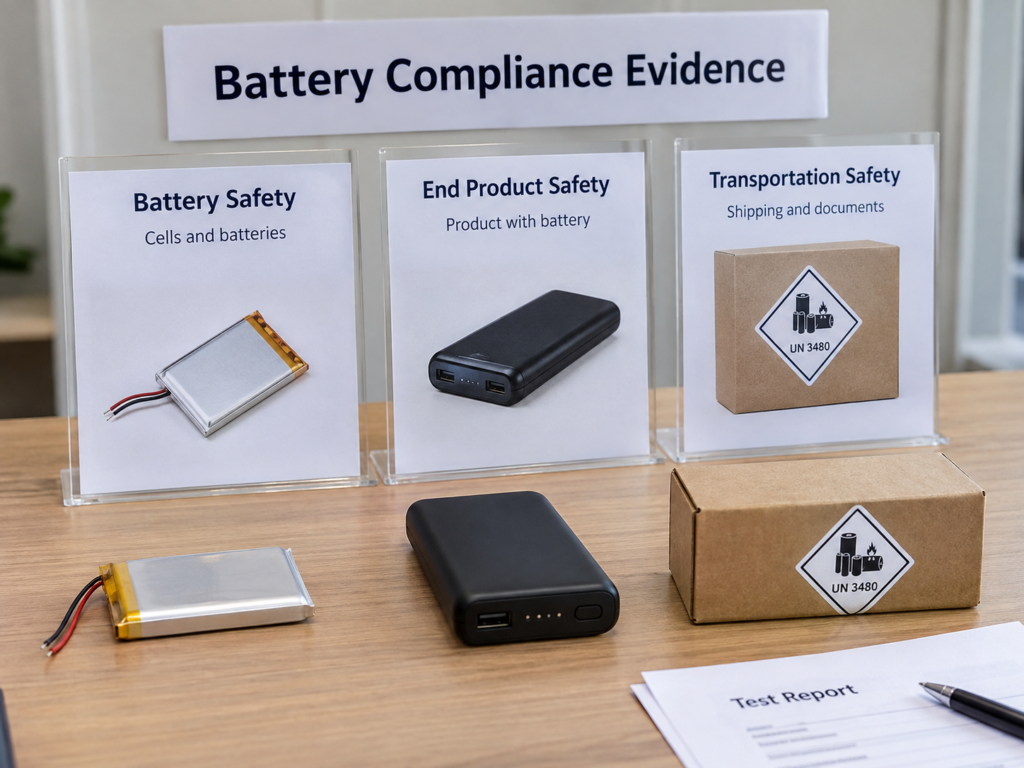
- The compliance path is not a multiple-choice between the two. For exporting battery-powered products, it is usually necessary to prepare three types of evidence at the same time: battery safety, end product safety, and transportation safety. Missing any one may cause clearance delays.
- The three most common mistakes in the industry: using cell reports as battery pack reports, using battery reports as end product reports, and using IEC/UL safety reports as UN 38.3 documents for transportation.
Basic Concepts for Beginners
To understand the differences between the two standards, you must first clarify several easily confused basic concepts, otherwise the comparison will only get more confusing.
Three Product Levels: Do Not Use Reports Across Levels
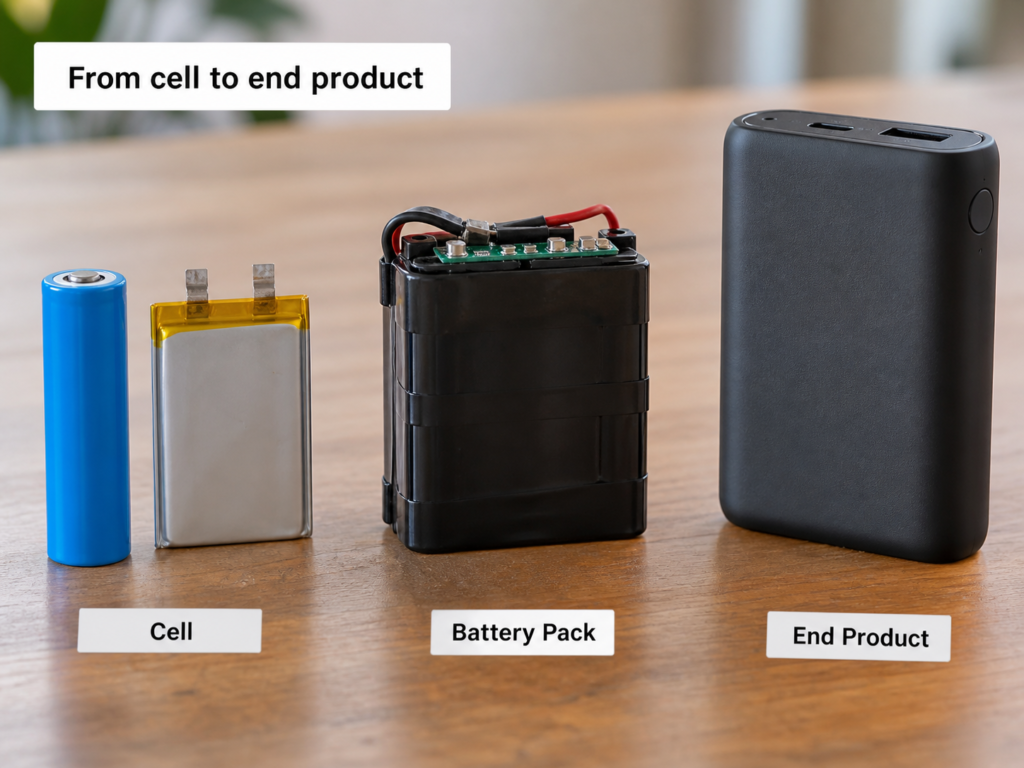
Many people cannot distinguish between cells, battery packs, and end products, which is also a high-incidence area for compliance errors. Let’s take power banks as an example:
- Cell: A single electrochemical energy storage unit, such as the common 18650 cylindrical cell and pouch lithium-ion cell, equivalent to the “minimum energy storage unit” of a battery.
- Battery/Battery Pack: A unit that can directly supply power, composed of one or more cells plus protection circuits, connecting pieces, casings, etc., such as the battery pack inside a power bank.
- Host Product/End Product: The complete electronic product with the battery installed, such as the entire power bank, wireless earbud charging case, or battery-powered USB small fan.
There is an ironclad rule here: the level tested by the report can only prove the safety of that level, and absolutely cannot cover across levels. For example, a cell that has passed IEC 62133 does not mean that a battery pack made with this cell automatically meets the requirements, let alone that the entire power bank is compliant.
Which Version of the Standard Are We Comparing?
Standards are updated regularly, and requirements may vary between versions. Comparisons are only meaningful when based on a fixed version. The basis for our discussion in this article is:
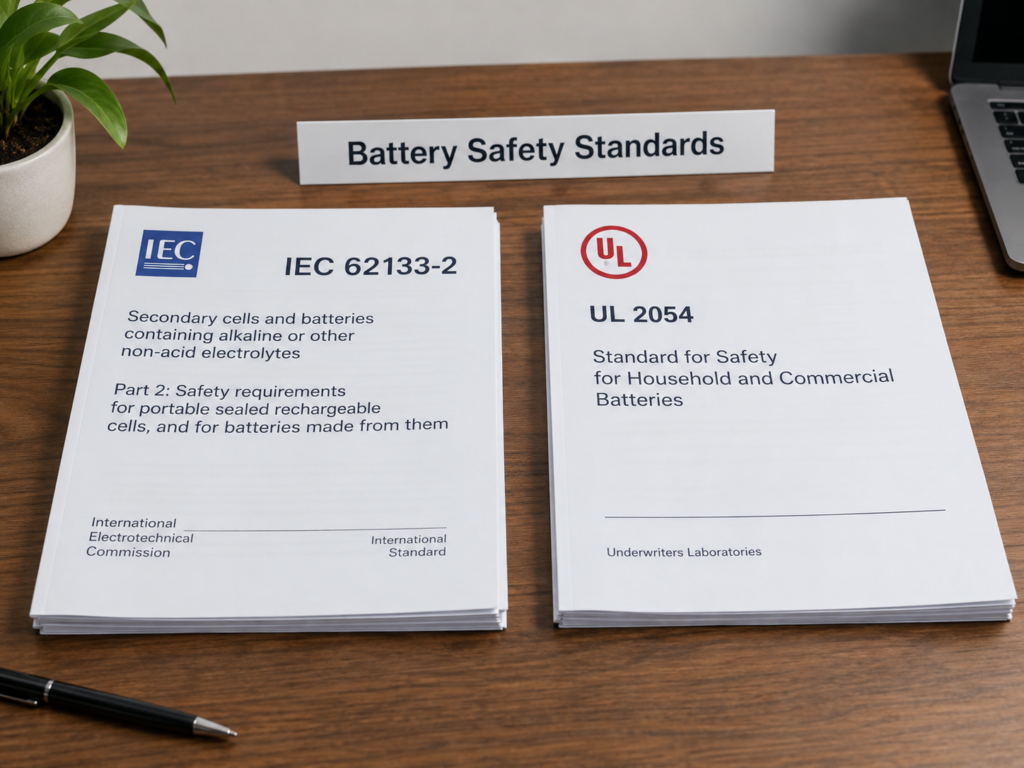
- IEC 62133-2: IEC 62133-2:2017+A1:2021 consolidated version
- UL 2054: UL 2054 3rd Edition and the revision status applicable to current projects
Remember one principle: quotations, contracts, test reports, certificates, and applicable certification/labeling documents shall be traceable; whether product labels need to mark the standard number or version shall be confirmed in accordance with applicable regulations, certification schemes, and marking rules.
Do Not Confuse These Compliance Documents
Many people treat standards, reports, and certificates as the same thing, but in fact their effectiveness and uses are completely different:
- Standard: A public technical rule text, equivalent to an “exam syllabus”. It is not a certificate itself and has no certification effectiveness.
- Test Report: Only corresponds to the submitted samples, models, construction, and test conditions, equivalent to a “transcript for a specific exam paper”. The report still reflects the results of the submitted samples under specified conditions at the time of issuance; however, after factory changes, design modifications, key material changes, standard version updates, or regulatory changes, the report may no longer cover existing products or no longer meet certification and market requirements.
- CB Test Report/Certificate: A document of the IECEE international mutual recognition system, which can be used to convert to certifications of other countries and conduct difference assessments, but it is not equivalent to a market access certificate for the local market.
- UL Certification/Listing: Includes product testing and assessment and follow-up factory inspection. It is necessary to distinguish between three different levels of effectiveness: “test report”, “component recognition”, and “end product listing”.
- CE Declaration of Conformity (DoC): A self-declaration issued by the responsible party based on EU regulations. IEC/EN test reports are only technical supporting materials; having a test report does not equal having CE certification.
- UN 38.3 Test and Summary: A transportation safety requirement specifically for lithium-ion cells/batteries, which is a different matter from product safety standards. Specific requirements shall be confirmed in conjunction with transportation regulations.
Scope Comparison: Which Standard Applies to Your Product?
First clarify what each of the two standards covers and what they do not cover, so that you will not choose the wrong certification path.
Applicable Boundaries of IEC 62133-2
Its core coverage objects are portable sealed rechargeable lithium-ion cells and batteries. Common related products include built-in batteries for power banks, batteries for wireless earbud charging cases, battery-powered portable electronic accessories, etc.
This set of standards includes safety requirements for both cells and batteries, but the test items for the two are not exactly the same.
Applications such as electric vehicles and high-voltage energy storage should usually be prioritized for assessment according to their dedicated battery standards; portable lithium-ion cells/batteries in medical devices can use IEC 62133-2 as one of the battery safety evidences when applicable, but they must still meet the dedicated requirements of medical devices and the target market at the same time.
It should also be noted that “internationally universal” does not mean that all countries mandate its adoption. It depends on whether the target country has adopted the standard and whether there are national differences. For example, some countries will add their own special requirements on the basis of IEC standards.
Applicable Boundaries of UL 2054
It covers portable primary and secondary batteries used as power sources for products. The specific applicable categories need to be confirmed by the certification body based on product construction and intended use. This article mainly focuses on rechargeable lithium-ion battery packs for power banks and portable electronic products.
Many people confuse UL 2054 with UL 1642. Let’s clarify here: UL 1642 is a standard specifically for lithium-ion cells. When conducting UL 2054 battery certification, it is first necessary to verify whether the cell has UL 1642 recognition and whether the usage conditions meet the requirements.
UL 2054 only tests the battery itself, and does not cover risks such as charging management of the host product, USB ports, adapters, and abnormal operation of the end product. These fall within the scope of end product safety standards.
Another reminder: UL certification is a voluntary third-party certification in North America, but many retailers, e-commerce platforms, insurance companies, and local authorities require it. In actual market access, it is often in a state of “not mandatory but required”.
Judgment for Several Typical Products
Let’s take products that people often come into contact with as examples to help you quickly correspond:
- 10000mAh power bank: It is necessary to handle three types of compliance separately: battery safety, end product safety, and UN 38.3 transportation safety. You cannot only do one of them.
- USB-C charger/power adapter without battery: These two battery standards are completely inapplicable. They shall be assessed according to the end product safety standards for power supplies.
- Ordinary charging cable/data cable: Battery standards are also not applicable. Their own safety requirements such as wire gauge, temperature rise, marking, and bending resistance need to be assessed.
Core Test Comparison: Stop Emptyly Comparing “Which Is Stricter”
Many people like to ask “which is stricter, UL or IEC”. This question itself is problematic — similar test names do not mean that test conditions and acceptance criteria are the same, and products of different levels cannot be directly compared.
Rules You Must Know Before Comparing Tests
- The same test item name does not mean the same conditions: sample type, state of charge (that is, how much charge the battery has), ambient temperature, application method, duration, and acceptance criteria may all be different.
- Cell-level tests and battery-level tests cannot be compared mixedly: in addition to cells, battery packs also need to test the risks of external components such as protection boards, casings, insulation, and wires.
- The test plan is not fixed: it will be affected by product construction. Battery packs with different cells and different structures have different assessment focuses.
- Qualification does not mean that the product can withstand abuse not specified in the standard or beyond the specified conditions. It shall not be inferred that the product can safely withstand behaviors such as puncture or arbitrary modification; for risks such as flame exposure, judgment shall be made according to the specific test items and conditions of applicable standards. UL 2054 contains relevant flame exposure/projectile test requirements.
Comparison by Risk Theme
We do not start from the names of test items, but compare from the perspective of “what risks are prevented”, which is more convenient for you to understand the practical significance.
External Short Circuit/Output Circuit Fault
- IEC: Assessed separately according to applicable clauses for cells or batteries
- UL: Assessed according to battery construction and applicable clauses
- Practical significance: It mainly checks whether fire or explosion will occur when short-circuit faults occur in battery terminals, protection boards, wires, and output circuits.
- Common misconception: Passing this test does not mean that the product’s USB port, charging cable, and end product interfaces are also qualified. Those fall within the scope of end product testing.
Overcharge or Abnormal Charging
- IEC: Focuses on the risk of abnormal charging under specified conditions
- UL: Focuses on abnormal charging and related construction risks
- Practical significance: For products such as power banks, in addition to the overcharge protection of the battery itself, designs such as charging management ICs and temperature detection must also be reviewed at the same time.
- Common misconception: Do not think that passing this standard means you can use off-brand, unqualified chargers casually for a long time.
Forced Discharge/Over-discharge Risk
- IEC: Applicable requirements for cells and batteries shall be checked separately
- UL: Checked according to battery construction and applicable clauses
- Practical significance: It mainly assesses the safety risks after battery protection failure, long-term idle storage, abnormal load, and cell imbalance.
- Common misconception: “Forced discharge” in the standard is a professional test condition, which is not the same as users’ daily practice of “using up the battery before recharging”. Do not panic excessively.
Mechanical Stress (Shock, Vibration, Drop, Crush, etc.)
- IEC: Different test objects and clauses cover different types of mechanical stress
- UL: The combination of test items and test methods are determined according to product construction and certification plan
- Practical significance: For portable products, focus should be placed on the risks of dropping during daily carrying, vibration during transportation, heavy object compression, and insufficient casing protection.
- Common misconception: You cannot assert which standard is stricter by comparing a single parameter (such as drop height, crush pressure, or number of vibrations). Judgment must be made in combination with the overall requirements of all mechanical test items.
Heat-related Risks (High and Low Temperature, Thermal Abuse, Temperature Cycling)
- IEC: Test requirements are confirmed according to cell/battery type and specific clauses
- UL: Test requirements are confirmed according to battery construction and specific clauses
- Practical significance: Leaving the battery in a car in summer, charging in a high-temperature environment, and poor heat dissipation will all increase battery risks, while the thermal design of the end product needs to be separately assessed.
- Common misconception: Do not treat a certain storage or heating item as a mandatory test for all products. It depends on the product type and certification plan.
Casing, Insulation and Protection
- IEC: Requirements are confirmed according to applicable clauses and battery construction
- UL: Has key requirements for casing strength, personal protection under abnormal conditions, etc.
- Practical significance: The flame retardancy of the casing material, structural fixation reliability, terminal short-circuit prevention design, and fragment protection ability of power banks are all critical.
- Common misconception: You cannot claim that the product will definitely pass certification solely based on “flame-retardant casing”. Comprehensive judgment must be made in combination with structure, thickness, and test conditions.
Typical Focus Directions of the Two Standards
In addition to the common risk themes above, the two standards have their own focuses:
- IEC 62133-2 focuses more on: Strictly distinguishing between cell and battery levels, with battery packs additionally considering the impact of protection circuits, series-parallel connections, and casings; focusing on mechanical and environmental stress (vibration, shock, drop, heat-related items) during portable use; focusing on safety consequences under abnormal electrical conditions such as overcharge, external short circuit, and forced discharge; in addition, there are special requirements for coin/button rechargeable lithium batteries, and the experience of ordinary batteries cannot be applied.
- UL 2054 focuses more on: Construction safety, abnormal charging, external short circuit, mechanical and temperature stress of household/commercial portable batteries; lithium batteries must be comprehensively assessed in combination with the UL 1642 recognition status of cells, usage conditions, and product construction; battery packs focus on verifying casings, insulation, wires, terminals, protection components, and abnormal state protection; the specific test combination shall be subject to the engineering requirements and test plan issued by the certification body.
Correct Method to Compare Strictness
If you really want to judge which standard is stricter for your product, don’t listen to others’ empty claims. Compare it yourself according to these four steps (taking a 10000mAh 3.7V power bank as an example):
- Step 1: Lock the actual construction: First clarify the specific design such as cell combination method, protection board configuration, whether there is NTC temperature detection, and whether there is a fast charging chip. Different constructions lead to completely different test focuses.
- Step 2: Lock the sales channel: Clarify the specific requirements of the target country, sales channel, customer or platform. It is meaningless to talk about standards without considering the market.
- Step 3: Compare the engineering conditions of the same risk theme item by item: For example, for the same external short circuit, compare whether the sample is a cell or a battery pack, the state of charge during the test, ambient temperature, short-circuit resistance, duration, number of samples, and acceptance criteria, instead of just looking at “there is this test item”.
- Step 4: Complete the end product assessment: Battery standards only test the battery itself. End product requirements such as input charging, output current limiting, port short circuit, casing temperature rise, and adapter matching must be added to form a complete product safety assessment.
In the end, you will find that there is no conclusion of “absolutely stricter” at all, only the judgment of “which standard is more suitable for your product and target market”.
How to Implement Certification and Compliance Pathways?
Now that we know the differences, let’s talk about how to promote certification and manage compliance evidence in actual operation.
List of Documents to Prepare Before Application
Preparing these documents in advance can save you a lot of detours:
- Basic battery pack information: model, rated voltage, rated capacity, watt-hour (Wh), label draft. These are the basis for judging product categories.
- Cell information: manufacturer, model, chemical system, specification sheet, existing safety recognition or test documents.
- Circuit information: series-parallel structure diagram, BMS/PCM schematic diagram, protection IC/MOSFET model, protection parameters (overcharge, over-discharge, over-current, short-circuit thresholds).
- Structural material information: specifications of temperature protection components, wires, nickel sheets, connectors, fuses, as well as casing material and flame retardant grade.
- If it is a battery-powered end product, additional information is required: input/output specifications, charging management solution, PCB design, adapter requirements, list of key components, product structure diagram, sample photos.
Evidence Chain and Change Control
Many people think that getting a certification once is a once-and-for-all solution. In fact, the effectiveness of certification has prerequisites:
- Validity of standard version: If the standard is updated or the standard adoption status of the target country changes, it is necessary to assess whether the old report/certificate still meets the requirements, and supplementary testing is required if necessary.
- Applicability of report: The report still reflects the results of the submitted samples under specified conditions at the time of issuance; however, after factory changes, design modifications, key material changes, standard version updates, or regulatory changes, the report may no longer cover existing products or no longer meet certification and market requirements. The certification body, regulatory requirements, or the responsible party shall assess whether to declare changes, conduct supplementary testing, retest, or update the certificate.
- Sustainability of certification: Certifications like UL include follow-up factory inspection and product consistency control requirements. Getting the certificate is not the end of the story.
- These changes must be assessed in advance: changing cell model/supplier, changing series-parallel connection method, adjusting BMS/key software parameters, replacing key protection components, changing casing material, and relocating production factory.
The correct approach is: For products with continuous certification such as UL, or products where applicable regulations or contracts clearly require change control, change assessment and necessary approval shall be completed in accordance with the provisions of the certification body or the responsible party before implementing key changes that may affect certification coverage. When there is only an ordinary test report, the responsible party shall also assess whether the change exceeds the coverage of the report and decide whether supplementary testing or re-assessment is required.
Market-based Compliance Decision Steps
No matter which market you sell battery-powered products to, following these six steps will ensure you don’t miss any items:
- Confirm the source of requirements: First clarify who requires certification — is it mandatory by regulations, customs requirements, customer contracts, e-commerce platforms, retailers, or insurance companies? Requirements from different sources may vary.
- Confirm product classification: Is it a separately sold battery pack, power bank, battery-powered wireless charger, or battery-powered USB accessory? Different classifications apply to different standards.
- Confirm battery safety evidence: According to market requirements, choose IEC 62133-2/CB, UL 2054, or other recognized battery safety solutions.
- Confirm end product safety: For example, audio/video/information product safety standards such as IEC/EN/UL 62368-1, which are specifically determined according to product category.
- Confirm transportation compliance: Including UN 38.3 test summary, packaging requirements, labeling requirements, declaration requirements, state of charge requirements during transportation, etc.
- Complete technical documentation and marking: For example, technical documentation and Declaration of Conformity (DoC) required by the EU, and certification marks and file management required by North America.
A Practical Example: Compliance of a 10000mAh Power Bank
Taking the most common 10000mAh 3.7V power bank with two 5000mAh cells connected in parallel as an example, complete compliance covers four levels:
- Battery level: Confirm that the cell model, parallel structure, PCM/BMS configuration, temperature protection, casing material, etc. are completely consistent with the certification documents. Materials cannot be changed casually.
- End product level: Review charging management circuit, boost output circuit, short-circuit/over-current protection, port accessibility, casing temperature rise, flame retardancy of casing material, adapter compatibility, etc.
- Transportation level: IEC/UL product safety reports cannot replace UN 38.3 compliance evidence required by applicable transportation regulations. For normal commercial transportation, it should usually be confirmed that the cell/battery type has passed the UN 38.3 test in accordance with applicable regulations and can provide a test summary; exceptions for prototypes, small batches, etc., as well as packaging, marking, documentation, and state of charge requirements, shall be verified according to the specific transportation mode, special provisions, and carrier rules.
- Mass production level: Lock the list of key materials and change freeze table. For products with continuous certification such as UL, or products where applicable regulations or contracts clearly require change control, key material changes shall be assessed in accordance with the provisions of the certification body or the responsible party; when there is only an ordinary test report, it shall also be assessed whether the change exceeds the coverage of the report.
Boundaries of Related Standards: Stop Confusing Them
Battery safety is only part of the compliance of battery-powered products. There are several easily confused boundaries that need to be clarified.
Three Types of Safety Are Completely Non-interchangeable
This is the area with the highest error rate in the industry, so be sure to remember:
- Battery safety: Addresses the safety of cells/batteries under specified use and foreseeable misuse. Common mistake: using cell reports as battery pack reports.
- End product safety: Addresses the overall safety risks such as charging, output, ports, temperature rise, and casing after the battery is installed in the product. Common mistake: using battery reports as end product reports.
- Transportation safety: Addresses the risk of dangerous goods during transportation, as well as packaging and document management requirements. Common mistake: using IEC/UL safety reports as UN 38.3 documents.
The three are completely independent requirements, and none can replace the other.
Applicable Boundaries of Related Products
Let’s clarify the applicable situation of several common charging-related products:
- Charger/adapter without battery: These two battery standards are completely inapplicable. They shall be assessed according to power supply safety standards.
- Ordinary charging cable/data cable: Battery standards are not applicable. Requirements such as rated current, conductor cross-sectional area, temperature rise, connector reliability, bending resistance, and marking need to be assessed.
- Wireless charger without battery: Mainly focuses on end product safety, wireless charging function, electromagnetic compatibility, and local regulatory requirements, and has nothing to do with battery standards.
- Wireless charger/USB accessory with built-in battery: The battery part and the end product part need to establish separate compliance evidence chains, and you cannot only do one of them.
How to Verify Reports and Certificates?
Whether you are checking a supplier’s report or managing your own certification, you must learn to verify the authenticity and applicability of the report to avoid pitfalls.
Report Verification Checklist
When you get a report, focus on checking these items:
- Product identity: Model, rated voltage, capacity, Wh, cell model, series-parallel connection method, and label information shall be completely consistent with the actual product.
- Key construction: Protection board/BMS, protection IC, MOSFET, NTC, wires, fuses, and casing material shall be consistent with the bill of materials in the report.
- Standard information: Standard number, full version number, national differences, issuance date, and scope of application shall be clear and unambiguous.
- Test level: Clarify whether the report covers cells, battery packs, or end products. Absolutely no cross-level promotion or use is allowed.
- Conclusions and deviations: Check the results, remarks, test conditions, deviation descriptions, and restrictive conclusions of all test items. Don’t just look at the word “qualified” on the first page.
- Model coverage: If it is a series model report, confirm whether the coverage logic is clear, and whether changes in capacity, number of cells, casing, and protection board are within the coverage scope.
Verification Methods for Different Types of Evidence
- CB certificate/report: Verify the issuing NCB (National Certification Body), relevant CBTL (Testing Laboratory), certificate number, and standard version. It can be verified on the IECEE official website or the query system of the issuing body.
- Ordinary test report: Verify whether the laboratory is accredited by an accreditation body with the corresponding scope, and check whether its accreditation scope covers the corresponding standards and items; if international mutual recognition is involved, further verify whether the accreditation body is a signatory to the ILAC MRA. Ordinary test reports are not equivalent to CB reports; their acceptability shall be judged according to the issuing entity, accreditation scope, regulations, customer and certification scheme requirements.
- North American certification/listing: If regulations or law enforcement in the US market require NRTL certification, verify whether the issuing body is an OSHA-recognized NRTL; for Canada and other North American markets, verification shall be carried out according to the local accreditation system, certification body, and product category. Regardless of the system, product category, file number, manufacturer, model, and certification status shall be checked, which can be queried in the public database of the issuing body.
If you encounter situations where only the first page/partial screenshot is provided, the model does not match the actual product, the standard version is vague, or the institution or number cannot be found, you must be vigilant — there is a high probability that there is a problem.
Common Problems in Power Bank Verification
Let’s take power banks as examples of several common verification pitfalls:
- The cell series-parallel structure does not match the report: For example, the report says single cell, but the actual product has two cells in parallel. Immediately verify the coverage scope of the report — it is most likely inapplicable.
- Cell model replacement: Even if the capacity and appearance are the same, as long as the model is different, it is a key change, and a difference assessment must be done again.
- Replacing ordinary protection board with fast charging board: The charging path, thermal design, and protection thresholds have all changed, and the original battery report will not automatically cover the new design.
Correctly Understand the Boundaries of Certification
Finally, you need to have the right mindset:
- Certification only means that the submitted samples or controlled mass-produced products meet the requirements within the specified scope. It does not mean that there is absolutely no risk in any batch, any modification, or any environment.
- Qualification does not mean that the product can withstand abuse not specified in the standard or beyond the specified conditions. It shall not be inferred that the product can safely withstand behaviors such as puncture or arbitrary modification; for risks such as flame exposure, judgment shall be made according to the specific test items and conditions of applicable standards. UL 2054 contains relevant flame exposure/projectile test requirements.
- Certification marks, test reports, and transportation test summaries each have their own uses. They cannot be promoted or submitted across purposes. For example, UN 38.3 for transportation cannot be promoted as a product safety certification.
Common Misconceptions and Frequently Asked Questions
5 Most Common Misconceptions
- Misconception: UL 2054 is definitely more advanced and stricter than IEC 62133-2.
Correct answer: There is no absolute ranking independent of products, clauses, and test conditions. Judgment must be made in combination with specific risk themes and certification pathways. - Misconception: If a cell passes IEC/UL, the battery pack and end product will automatically be compliant.
Correct answer: Battery packs add risks from protection boards, casings, connections, and series-parallel configurations; end products add risks from charging management, ports, and thermal design. All require separate assessment. - Misconception: IEC 62133-2 is CE certification.
Correct answer: IEC is a standard. CE requires completing conformity assessment, establishing technical documentation, and issuing a Declaration of Conformity (DoC) under the EU regulatory framework. IEC/EN test reports are only technical supporting materials. - Misconception: Having an IEC or UL report means you can transport lithium battery products.
Correct answer: IEC/UL product safety reports cannot replace UN 38.3 compliance evidence required by applicable transportation regulations. For normal commercial transportation, it should usually be confirmed that the cell/battery type has passed the UN 38.3 test in accordance with applicable regulations and can provide a test summary; exceptions for prototypes, small batches, etc., as well as packaging, marking, documentation, and state of charge requirements, shall be verified according to the specific transportation mode, special provisions, and carrier rules. - Misconception: Legally, all battery-powered electronic products sold in the US must have UL 2054.
Correct answer: Whether it is required depends on regulations, product category, installation scenario, sales channel, local authorities, insurance, and customer requirements. It is not mandatory for all products.
5 Most Frequently Asked Questions
Q: What is the difference between UL 1642 and UL 2054?
A: UL 1642 is mainly for lithium-ion cells; UL 2054 covers portable primary and secondary batteries and battery packs, and this article focuses on its application to rechargeable lithium-ion battery packs. When conducting UL 2054 battery certification, cells usually need to obtain UL 1642 recognition first, and then a comprehensive assessment is conducted in combination with the construction of the battery pack.
Q: Can the CB report of IEC 62133-2 be directly converted to UL 2054?
A: Usually they cannot be directly equated, but existing CB documents can assist in document review and difference assessment, which may reduce some repeated tests. Whether it is possible and how much can be reduced shall be determined by the certification body according to the product situation.
Q: Do ordinary chargers and charging cables need to do IEC 62133-2 or UL 2054?
A: Products without batteries are usually not applicable to these two battery standards. They should assess corresponding safety, performance and other requirements according to their own product category and the requirements of the sales location.
Q: Is it enough for a wireless charger with built-in battery to only have a battery report?
A: No. The battery report can only prove the safety of the battery itself, and cannot replace the end product safety assessment of wireless charging function, input power supply, temperature rise, casing, ports, etc.
Q: The report has no “validity period”. Can it be used permanently?
A: No. Existing test reports still reflect the results of submitted samples under specified conditions at the time of issuance; however, after standard version updates, key material changes, regulatory changes, product design adjustments, or production factory changes, the report may no longer cover existing products or no longer meet certification and market requirements. It is necessary to assess whether to declare changes, conduct supplementary testing, retest, or update the certificate.
Final Summary
After reading this article, you should be able to establish a clear understanding of battery safety compliance:
You can accurately distinguish the different positions of IEC 62133-2, UL 2054, UL 1642, end product safety standards, and transportation safety requirements, and will no longer confuse them;
You will no longer obsess over vague questions like “which is stricter”, but will make practical judgments based on product construction, risk themes, target markets, and certification pathways;
You can build a complete compliance evidence chain of “cell – battery pack – end product – transportation – mass production change” for battery-powered electronic products, without missing any items;
You can also independently verify the consistency between the report and the product, identify high-risk changes such as cell replacement, BMS change, casing replacement, and production relocation, to avoid pitfalls.
Battery safety compliance is never a matter of “just choose one standard and get it done”. Instead, it requires building a complete evidence chain step by step in combination with the product and market, which is also a basic capability for cross-border electronics business.