
If you have ever bought a charger in Europe, or done business in 3C products for the EU market, you have definitely heard of the term “ErP energy efficiency certification”. Some say it is part of CE, some say it is a sign of power saving, and others think that a separate ErP certificate is required for it to be valid. In fact, many of these statements are inaccurate, and there are quite a few pitfalls.
In this article, we will start from the most basic definitions, covering scope determination, core requirements, regulation versions, special product rules, compliance processes, verification methods, and pitfall avoidance guides. Whether you are an ordinary consumer looking to choose a power-saving charger, or a cross-border seller needing to make your products EU-compliant, you can find the corresponding answers here.
First Things First: What Exactly is ErP?
The commonly mentioned ErP, whose full name is the EU Energy-related Products Ecodesign Regulation, is the EU’s ecodesign framework. Only energy-related products that fall within the scope of the corresponding product implementing regulations need to meet the ecodesign requirements specified in the regulation. For external power supplies currently regulated by (EU) 2019/1782, key requirements include no-load power consumption, average operating efficiency, and power factor for specific products.
For products like power adapters, the core requirements of ErP mainly have two directions: first, consume as little power as possible when plugged in and not in use (no-load); second, transfer as much electricity as possible to the device when charging, with less wasted as heat.
Here we need to correct one of the most common misconceptions first: ErP is not a safety certification, nor a quality certification. It only covers energy efficiency, and does not concern whether the product leaks electricity, is durable, or charges fast. Moreover, there is no separate “ErP certificate” issued by the EU competent authority. ErP usually adopts manufacturer’s self-conformity assessment: the manufacturer shall complete the conformity assessment in accordance with regulations, prepare and retain technical documentation, and sign the Declaration of Conformity (DoC for short). Energy efficiency testing can be completed by competent internal or external laboratories.
Many people confuse ErP with other common certifications and marks. We have sorted out the most easily confused categories, so you can see the difference at a glance:
| Commonly Confused Certifications/Marks | Core Differences from ErP |
| CE mark | ErP is one of the energy efficiency regulations under CE; having a CE mark does not mean compliance with ErP. You need to check whether the Declaration of Conformity (DoC) lists the applicable ErP regulations |
| US DoE Level VI | Two independent mandatory energy efficiency systems in Europe and the US, with similar testing methods but different limit values, not mutually recognized |
| Energy Star | ErP is a mandatory requirement for applicable external power supplies in the EU; Energy Star is a voluntary program. The two differ in scope, version, testing methods, and limit values. They should be compared item by item according to specific product categories and applicable versions, and cannot directly replace each other |
| A-G energy label | Energy label for EU household appliance products, external power supplies do not need to be affixed with it |
Different people care about ErP for different reasons:
• For ordinary users, products compliant with ErP shall meet minimum requirements such as no-load power consumption and operating efficiency under specified test conditions. Actual power savings and temperature rise still depend on load, usage time, output power, and heat dissipation design; ErP compliance itself cannot be used as a conclusion on durability.
• For cross-border sellers and purchasers, ErP is an entry threshold for the EU market. Compliance is required for customs clearance and listing on e-commerce platforms. Non-compliant products will be detained, returned, or even destroyed, and product listings may also be taken down.
Three-Step Judgment: Does Your Power Adapter Need ErP Compliance?
ErP does not regulate all power supplies; it has a clear scope of control. Following these three steps for verification will not go wrong:
Step 1: Confirm that it is an “external power supply” as defined by the regulation — that is, a product that is directly connected to the mains, can be separated from the electrical equipment, and whose core function is power supply. For example, mobile phone chargers and laptop power bricks are, while power boards built into computers are not.
Step 2: Check whether the rated output power is ≤250W. External power supplies exceeding 250W are not within the current scope of control.
Step 3: Confirm that it is not on the statutory exemption list.
Commonly Regulated Products
Most of the external power supplies we use daily are within the scope, such as:
• Mobile phone chargers with USB-A and USB-C interfaces, including fast chargers supporting PD and PPS, both single-port and multi-port are included;
• Laptop power adapters and desktop power bricks;
• External power supplies for routers, monitors, and small network devices.
Statutorily Exempt Products
According to the provisions of the current regulation (EU) 2019/1782, the following types of external power supplies do not need to meet ErP requirements:
• Non-removable power boards built into equipment;
• External power supplies dedicated to medical, railway, and aerospace use — note that they must meet the statutory definitions of the corresponding industries to be counted; printing a “medical grade” label casually does not qualify for exemption;
• UPS uninterruptible power supplies, lighting control converters, and active PoE injectors;
• Pure battery chargers and electric vehicle chargers, which are subject to separate regulations.
Products That Are Easily Misjudged
There are several types of products that are often misjudged, so special attention should be paid:
• After-sales replacement spare power supplies: there are special transitional rules, and they are not directly judged according to the requirements for new products;
• Docking stations with USB ports: cannot be judged solely by “core function”. It is necessary to confirm respectively whether their power supply part meets the statutory definition of an external power supply and whether there is an applicable exemption; if the docking station is equipped with an independent, detachable mains external power supply that meets the definition, the external power supply should usually be evaluated separately;
• Car chargers: they draw power from the cigarette lighter, not directly from the mains, so they are not within the scope of ErP control.
Core Requirements: 3 Key Energy Efficiency Indicators Regulated by ErP
If your product is within the scope of control, next you need to understand which indicators ErP regulates and what the passing thresholds are. ErP’s regulation of power adapters mainly revolves around 3 indicators, of which the first two must be met by all products, and the third only needs to be met by products with a rated output power exceeding 75W.
1. No-Load Standby Power Consumption
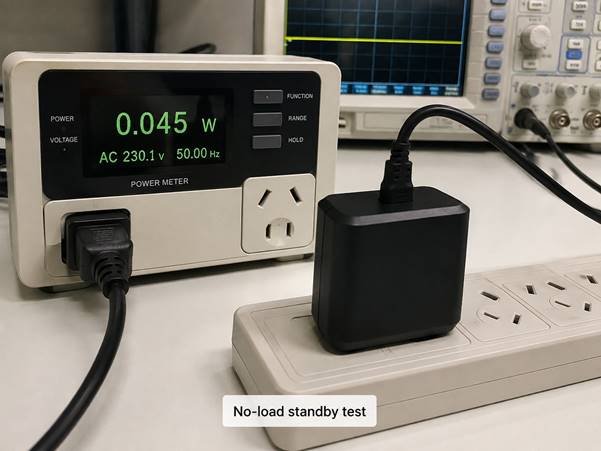
No-load standby power consumption is the input power of a charger when it is plugged into the mains and nothing is connected to the output end. Note that if a fully charged device is plugged in, that does not count as no-load — because the device still has a holding current, and the charger is under load.
The current passing thresholds are:
• For products with rated output power ≤49W, no-load power consumption ≤0.1W;
• For products with rated output power >49W, no-load power consumption ≤0.21W;
• For products with multi-voltage output, no-load power consumption ≤0.3W.
You may not have a clear idea of 0.1W. To put it another way: a power consumption of 0.1W takes about 10,000 hours to consume 1 kWh of electricity, which is less than 1 kWh in almost a whole year.
There is a common misconception here: many people use household power sockets to measure the no-load of chargers, and when it shows 0W, they think it consumes no power at all. In fact, the accuracy of ordinary household sockets is insufficient to measure such a small power, it is not truly zero power consumption.
2. Average Operating Energy Efficiency
Average operating energy efficiency is the useful electricity output by the charger divided by the total input electricity. The difference is the electricity wasted as heat — the higher the energy efficiency, the less electricity is wasted, and the lower the heat generated by the charger.
Why is it “average” energy efficiency? Because in actual use, chargers rarely work at full load all the time. For example, when a mobile phone is almost fully charged, it is under light load. Therefore, ErP requires measuring the efficiency at four rated load points: 25%, 50%, 75%, and 100%, then taking the arithmetic average, which is closer to actual usage scenarios.
The current passing standards are divided into single-voltage external power supplies and multi-voltage external power supplies according to rated output power (abbreviated as Pno, unit W):
• Single-voltage external power supply, Pno ≤1W: ≥0.486×ln(Pno) + 0.800;
• Single-voltage external power supply, 1W < Pno ≤49W: ≥0.0834×ln(Pno) + 0.850;
• Single-voltage external power supply, 49W < Pno ≤250W: ≥0.870;
• Multi-voltage external power supply: ≥0.0834×ln(Pno) + 0.850.
For example, if a 20W charger is a single-voltage external power supply, after substituting into the formula, the minimum average operating efficiency is:
0.0834×ln(20) + 0.850 ≈ 0.8998
Which is about 89.98%.
For multi-voltage and multi-port products, the test status will be determined according to the corresponding test method, not just testing any random gear.
Here we also need to correct a common misconception: high energy efficiency does not equal fast charging. Charging speed mainly depends on output power and charging protocol. High energy efficiency only means less power waste and lower heat generation, and has no direct relationship with charging speed.
3. Power Factor Requirement (Only for Products with Rated Output Power Exceeding 75W)
Many people confuse the power factor indicator with conversion efficiency. Simply put, it measures how much of the electricity delivered by the grid is actually used for useful work. The lower the value, the more reactive losses in the grid. This indicator is mainly to reduce the overall load of the grid, and has no direct relationship with ordinary users’ electricity bills or charging speed — because the electricity bill you pay is calculated based on active power.
External power supplies with a rated output power exceeding 75W need to meet the requirement of power factor ≥0.9 at full load rated output. Products with a rated output power of exactly 75W do not trigger this requirement, and low-power products do not need to pay attention to it.
Key Conditions Affecting Energy Efficiency Indicators (Advanced)
If you need to judge the energy efficiency performance of a product more accurately, you also need to know these conditions that will affect the test results:
• Load size: The efficiency difference between light load, half load, and full load can be very large, so you cannot only look at full load efficiency;
• Output voltage: For products supporting adaptive voltage (such as PD fast chargers), the efficiency of different voltage gears is different;
• Product type: The limit rules for multi-voltage and multi-port products are different from those for single-voltage single-port products, and cannot be directly applied.
Regulation Versions: Don’t Use the Wrong Rules
ErP is not an isolated certification, but consists of the EU’s ecodesign framework regulation plus implementing regulations for specific products. There are currently two versions of the regulation for external power supplies: the current version and the upcoming new version.
Current Regulation: (EU) 2019/1782
The currently implemented energy efficiency regulation for external power supplies is (EU) 2019/1782, which applies to all external power supply products newly placed on the EU market from April 1, 2020. The applicable regions include the 27 EU member states and the European Economic Area (EEA, including Norway, Iceland, and Liechtenstein).
The three core requirements we mentioned earlier — no-load power consumption, average operating efficiency, and power factor for products with rated output power exceeding 75W — all come from this regulation.
New Regulation: (EU) 2025/2052
The EU issued a new ecodesign regulation (EU) 2025/2052 in 2025, in which the provisions related to external power supplies will be mandatorily implemented from December 14, 2028, replacing the current (EU) 2019/1782.
Note the time determination rule here: it is based on the date when the product is first placed on the EU market, not the production date; there are special transitional rules for after-sales spare parts.
There are three main changes in the new regulation:
1. Added the requirement for 10% light load efficiency, with stricter energy efficiency requirements for low load conditions;
2. The scope of control is expanded to include USB-C cables and wireless chargers;
3. The limit values of original indicators are further tightened.
If your product has a long sales cycle, it is recommended to reserve time for testing and label updates in advance to avoid being too late to switch when the time comes.
Relevant Rules of Other Major Markets (Advanced)
If you are not only doing business in the EU market, you also need to understand the rules of these two major markets:
• United Kingdom: After Brexit, there are separate UK Ecodesign requirements. The rules are close to those of the EU, but a separate DoC needs to be issued, and EU compliance documents cannot be used directly;
• United States: Compliance with the DoE Level VI energy efficiency standard is mandatory. The testing method is similar to ErP, but the limit values are different, and the two systems are not mutually recognized.
Official Verification Channels
If you want to check the latest content of the regulations, you can directly go to the EU’s EUR-Lex website to query. All official regulations and harmonized standards can be found on it, which is the most authoritative source.
Special Products: Special Rules for PD/Multi-Port/PPS Chargers
The rules for traditional fixed 5V chargers are very simple, but now mainstream fast charging products have their own output characteristics, and the judgment method for ordinary fixed output products cannot be directly applied solely based on the interface or fast charging protocol.
USB-C PD Fast Chargers
The characteristic of PD fast chargers is that the output voltage changes through negotiation with the device. For example, there are multiple gears such as 5V, 9V, 12V, and 20V, and the energy efficiency performance of different gears is different.
The PD protocol itself is not an independent ErP product category. It should be determined whether it is a single-voltage or multi-voltage external power supply according to the voltage that the product can simultaneously provide at the output end and the regulatory definition, and tested under the specified rated output and load conditions in accordance with the measurement methods applicable in Annex III of (EU) 2019/1782. Compliance cannot be judged based on only the gear with the highest efficiency.
Multi-Port Chargers
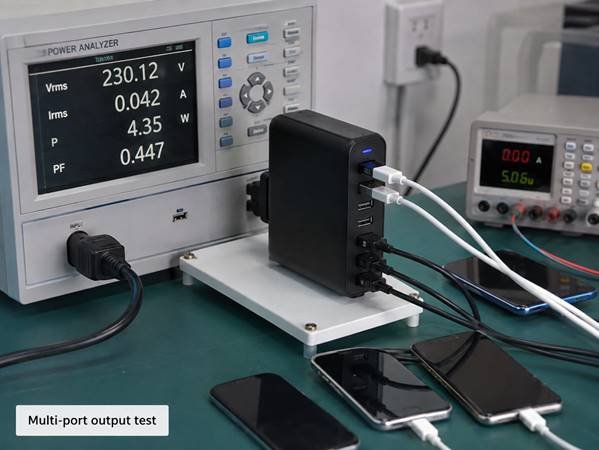
The rated total power of a multi-port charger is not equal to the maximum power of a single port — for example, a 65W dual-port charger may support a maximum of 65W for a single port, and 45W + 20W when both ports output simultaneously.
The multi-port interface itself is not an independent ErP category either. Testing should be carried out according to the product category, nameplate rated output, and load conditions specified by the regulation. You cannot say the whole machine is compliant just by testing a single port. The rated total output and simultaneous output capability of the product should also be clearly stated in the technical documentation.
PPS Adaptive Output Products
Products supporting PPS (Programmable Power Supply) dynamically adjust voltage and current according to the needs of the device. Upgrades of firmware or control solutions may affect energy efficiency performance.
The PPS protocol itself does not automatically determine the product category. Such products should also be classified according to their output characteristics and regulatory definitions, and tested under the specified rated output and load conditions; it is not allowed to only select the output state with the highest peak efficiency. If there are changes to the subsequent solution, such as upgrading the firmware or replacing the control chip, compliance needs to be re-evaluated. In addition, the new regulation taking effect in 2028 has stricter requirements for light load efficiency, so PPS products should be prepared for adaptation in advance.
Compliance Handling: How to Complete ErP Compliance
ErP is a self-declaration type of compliance requirement, and does not require official certification, but neither the process nor the documents can be missing, otherwise it will be deemed non-compliant if inspected.
Responsible Entities and Duties
First of all, the responsibilities of different roles must be clarified:
• Manufacturer: is the ultimate responsible party, responsible for product design, testing, issuing DoC, and retaining technical documentation. If there is a problem, the manufacturer is the first to be contacted;
• EU Authorized Representative/Importer: needs to retain compliance documents, ensure that products meet requirements, and cooperate with inspections by regulatory authorities; if the seller directly mails products to individual consumers in the EU, the seller may need to bear the responsibility of the importer;
• Distributor: needs to verify the compliance marks of products and cannot sell non-compliant products.
Pre-Compliance Preparation
Before formal testing, do these things first:
1. Pre-confirmation: first confirm that the product is within the scope of control according to the three-step method mentioned earlier, and clarify the applicable regulation version for the target market;
2. Prepare materials: product specifications, model parameter list, information of the manufacturer and importer;
3. Sample preparation: the samples sent for testing must be exactly the same as the version to be sold, the quantity and configuration shall be in accordance with the requirements of the laboratory, and specially adjusted “engineering samples” cannot be sent.
Core Handling Steps
There are only three core steps for ErP compliance:
1. Complete energy efficiency testing and conformity assessment: Energy efficiency testing can be completed by competent internal or external laboratories. Entrusting a third-party laboratory with ISO/IEC 17025 competence is a common practice to reduce testing risks, but it is not a mandatory procedure specified by ErP regulations.
2. Organize the technical documentation package: After passing the test, organize all relevant documents into a complete technical documentation package for inspection by regulatory authorities.
3. Sign DoC and affix CE mark: The manufacturer signs the Declaration of Conformity (DoC) and affixes the CE mark on the product, then the compliance is completed.
Compliance Documentation Package and Verification Key Points
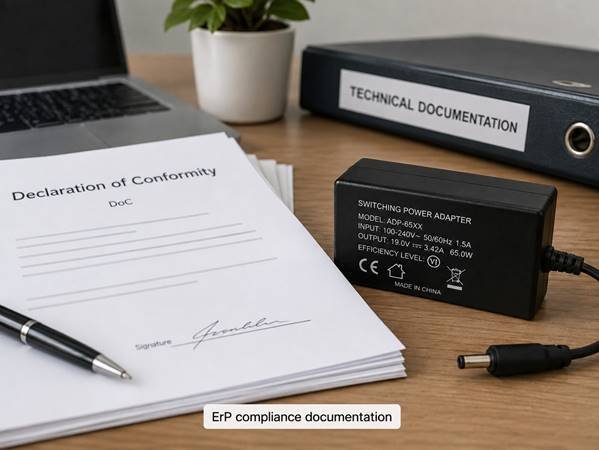
The compliance documentation package is the core of regulatory inspection, mainly including two parts: technical documentation and DoC.
The technical documentation needs to include the following contents: product specifications, design description, BOM list and key component parameters, energy efficiency test report, calculation and change records, product label photos.
The DoC shall, in accordance with applicable templates and regulatory requirements, state product or model identification, name and address of the manufacturer or its authorized representative, declaration of conformity, applicable regulations or implementing measures, technical standards (if applicable), identity of the signatory, date of signing and signature. Importer information can be provided according to other applicable regulations or business needs, but should not be understood as a mandatory field for all ErP DoCs.
In addition, the product nameplate must be marked with the manufacturer’s name and address, product model, and rated parameters, which can be traced back to the corresponding technical documentation. You can look at the nameplate on the charger, usually on the side or bottom of the plug, and this information should be clearly legible.
Rectification Directions for Test Failures
If the test fails, don’t panic, just rectify according to the corresponding directions:
• No-load power consumption exceeds the standard: you can optimize the standby control logic, adjust the circuit design, and replace components with lower power consumption;
• Insufficient average efficiency: you can adjust the power supply topology, replace higher efficiency components, and optimize the power distribution scheme;
• Power factor does not meet the standard (only for products with rated output power exceeding 75W): you can adjust the power factor correction (PFC) scheme and optimize component parameters.
It should be noted that if the rectification involves circuit changes or replacement of core components, the energy efficiency of the whole machine needs to be re-evaluated, and you cannot sell directly after just making changes.
Validity Period and Change Rules (Advanced)
Many people will ask how long the validity period of ErP is and whether annual review is required. In fact, ErP has no fixed validity period and does not require annual review — as long as the product is not redesigned and the regulation is not updated, the compliance conclusion is valid for a long time.
But if these situations occur, re-testing and evaluation are required: modifying the circuit, adjusting the rated power, replacing core components, increasing or decreasing the number or configuration of ports.
In addition, the regulation requires that technical documentation and DoC be kept for at least 10 years, and regulatory authorities may request them at any time.
Verification Methods: How to Quickly Judge Whether a Product is Compliant
There are several methods with different accuracy to judge whether a product complies with ErP, let’s look at them from simple to professional.
Beginner: Preliminary Judgment from Product Markings
The most basic is to look at product markings. A compliant product must have a CE mark and can provide the corresponding compliance documentation package (technical documentation and DoC).
There are several typical fake compliance characteristics to pay attention to:
• Only marked with “ErP certification” but no CE mark — because ErP is part of CE, compliant products must have a CE mark, and there is no need to mark “ErP” separately;
• The parameters on the nameplate are vague or falsely marked, for example, only marked “65W fast charge” without specific input and output parameters;
• The supplier cannot provide the DoC and test materials for the corresponding model, only verbal promises.
Household Tool Screening (For Preliminary Reference Only)
Many people use household power sockets for testing. It should be clarified here: the accuracy of household power sockets is insufficient, and readings under low load have no compliance judgment effect, and can only be used for preliminary screening.
For example, if you measure the no-load of a 20W charger and the reading shows 0.5W, which is much higher than the 0.1W limit, then it is probably non-compliant; but if it shows 0W, it does not prove compliance — it’s just that the socket cannot measure such a small power.
Formal energy efficiency testing must use calibrated power analyzers and electronic loads, and be tested in a standard environment according to the specified method, so that the results are valid.
Advanced: Understanding ErP Test Reports
If you want a more accurate judgment, you can ask the supplier to provide a test report, focusing on verifying these points:
1. Whether the product identity is consistent: It should be verified whether the actual product is clearly covered by the report and technical documentation. When there are differences in model, rated output, port configuration, hardware, firmware, or key components, the manufacturer shall explain the differences and the basis for coverage; if coverage or worst-case representativeness cannot be proven, re-evaluation shall be carried out and supplementary testing shall be done when necessary;
2. Whether the applicable rules are correct: Whether the product classification is wrong, whether the regulation version used is currently valid, and whether the limit value corresponds to the power level of the product;
3. Whether the core data meet the standard: Whether no-load power consumption, average operating efficiency, and power factor for products with rated output power exceeding 75W all meet the limit requirements.
There are several typical invalid reports to avoid: only full load efficiency data (no average efficiency), no marked applicable regulation version, model does not match the actual product, using US DoE test reports to replace ErP reports.
Formal Verification Channels
If you still have doubts, you can verify through these formal channels:
• Supplier verification: Request test reports + DoC that are completely consistent with the product model, and verify parameters and seal information;
• Official inquiry: Check recalls and risk notifications issued by the EU and member state regulatory authorities to see if the product has any violation records;
• Third-party verification: For questionable products, entrust a qualified laboratory to re-test, which is the most accurate method.
Pitfall Avoidance Guide: Common Misconceptions and Non-Compliance Risks
Quick Check of Common Misconceptions
Many people have deviations in their understanding of ErP. We have sorted out the most common misconceptions into a table, and you can avoid pitfalls by comparing them:
| Common Misconception | Correct Statement |
| Having a CE mark equals compliance with ErP | CE covers multiple types of regulations. It is only considered compliant if the DoC lists the applicable ErP regulations (such as (EU) 2019/1782) |
| Low-power power adapters do not need ErP compliance | Except for statutorily exempt products, all external power supplies ≤250W need to meet ErP requirements |
| Low no-load power consumption = high overall energy efficiency | No-load power consumption and average operating energy efficiency are two independent indicators, which respectively control power consumption in standby and operating states |
| Products with the same shell but different power can share one report | After changes in power, circuit, port configuration, key components, or control software, the manufacturer must re-evaluate whether the requirements are still met and update the technical documentation; if the changes may affect no-load power consumption, average efficiency, power factor, or the original test data cannot cover, corresponding supplementary or re-testing shall be carried out |
| The higher the nominal power of a charger, the more power it consumes | Actual power consumption depends on load size and conversion efficiency. A high-power high-efficiency charger charging a low-power device may not consume more power than a low-power low-efficiency charger |
| ErP certification requires annual review | As long as the product is not redesigned and the regulation is not updated, the compliance conclusion is valid for a long time and no annual review is required |
Common Consequences of Non-Compliance
If the product is non-compliant, it may face these consequences:
• Market side: Detained, returned, or even destroyed during customs clearance; e-commerce platform listings taken down, sales permissions restricted;
• Regulatory side: Required to rectify, recall products, or even face administrative penalties — the specific penalty intensity depends on the laws of each member state and the circumstances of each case.
Practical Pitfall Avoidance Actions
Whether for procurement or personal use, these actions can help you avoid most pitfalls:
1. Request the complete compliance documentation package before procurement, and do not accept verbal promises;
2. For products with rated output power exceeding 75W, focus on verifying whether the full load power factor meets the standard;
3. For products with long sales cycles, pay attention to regulation updates and prepare for adaptation in advance;
4. For multi-port and PD fast charging products, verify the compliance of the whole machine, not just look at single-port parameters.
At this point, you have mastered the core content of ErP energy efficiency certification for power adapters from beginner to semi-proficient. To sum up, you can now independently complete the following judgments:
First, use the three-step method of “whether it is an external power supply, whether the power is ≤250W, whether it is on the exemption list” to quickly judge whether a power adapter falls within the scope of ErP control;
Second, understand the meaning of the three core indicators: no-load power consumption, average operating energy efficiency, and power factor, and know the corresponding passing standards;
Third, initially identify invalid ErP test reports and avoid common cognitive misconceptions;
Fourth, verify the compliance of products through three methods: preliminary judgment from markings, supplier verification, and official inquiry;
Fifth, select the corresponding regulation version according to the target market and the planned sales time of the product, and prepare in advance.
ErP seems to be a professional compliance requirement, but its core logic is actually very simple: it is to make power supply products waste less electricity, which is a good thing for both consumers and the entire market.