
Amazon sellers who sell products like chargers and USB-C charging cables have most likely encountered the situation where a compliance certification application is rejected: either a product ready to be launched gets stuck in category review and cannot be put on sale, or a well-performing listing is suddenly taken down, with a compliance rejection notice popping up in the backend. Many new sellers panic at first: they either randomly grab a couple of documents and submit them, or pay a lot of money for so-called “guaranteed appeal services”, and in the end, they either fail the appeal or cross even more serious violation red lines.
In fact, compliance rejection is not a scourge. As long as you understand the platform’s review logic and conduct troubleshooting and rectification step by step, you can handle the problem more targeted. This article starts from the most basic common sense, covers specific appeal operations and key points to avoid pitfalls, and addresses common compliance document review issues for charging products. Even new sellers can follow along step by step.
Must-Know Basics: First Understand What a Compliance Rejection Is
Many people have the biggest misunderstanding about “certification rejection”: they think Amazon certifies products, and a rejection means the product is unqualified. That’s completely not the case — a rejected certification application usually means the compliance documents you submitted did not meet the requirements of that review. The platform may temporarily restrict sales, and the platform does not certify any products. This in itself does not necessarily mean the product has been found non-compliant, but it may also reflect substantive compliance issues with the product, labeling, declaration, or test coverage, which must be verified against the notice and the actual product.
Here are a few core premises to clarify first:
First, all requirements are subject to the rejection notice you receive. The required documents are completely different for different product types, different sites, and different policies. There is no unified “mandatory submission list”, so don’t blindly apply generic templates found online.
Second, the appeal we are talking about only applies to cases where **compliance document review is rejected**. Issues such as infringement, selling counterfeit goods, insufficient category permissions, or unmet account performance are not in this category, so don’t go in the wrong appeal direction.
Third, for charging products, compliance reviews are usually triggered by the following scenarios: category review before listing, random spot checks during sales, verification after buyer complaints about safety issues, and re-verification after supplier or product changes. For example, if someone complains that the USB-C cable you sell gets hot during charging, the platform may trigger a compliance check and require you to submit relevant certificates.
Many people worry that rejections will affect account performance. The specific impact of a single document request or rejection is subject to the notice and the Account Health page. It may only affect the relevant ASIN, or it may trigger broader account measures in cases of serious or persistent non-compliance. You must not submit false materials, and should handle the matter within the time limit and through the channels specified in the notice.
Impact of Rejection and Time Requirements
The direct impact of a rejection depends on the specific notice: products that have not been listed may temporarily not be available for sale, and already listed ASINs may be suspended or taken down. Subsequent recovery conditions are subject to the case handling result, listing status, and inventory status. Situations such as serious or persistent non-compliance, or submission of false materials, may escalate to broader account measures.
A special reminder here: there is no unified “7 days” or “14 days” for the appeal period. All time requirements are subject to those marked on the rejection notice you receive. Don’t believe the unified statements online — missing the deadline will cause trouble.
Quickly Understand the Rejection Notice
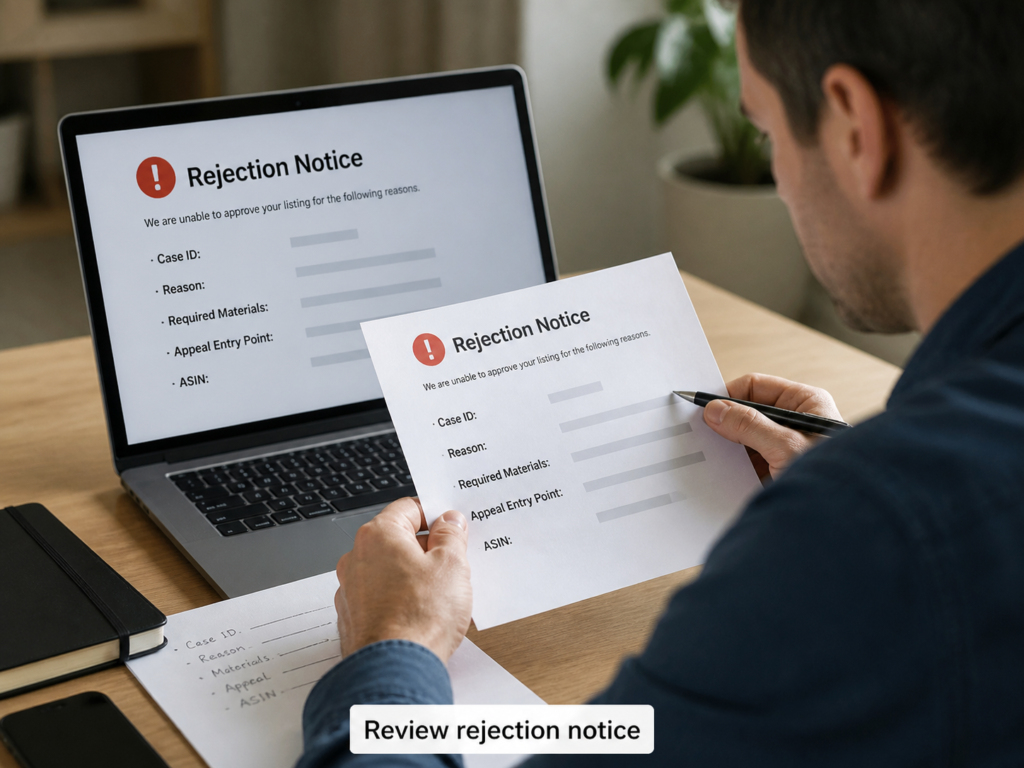
Don’t panic when you get a rejection notice. First find 5 core pieces of information: Case ID (case number, which will be used for all subsequent communications), the specific reason for rejection, the materials you are required to supplement, the entry point for submitting the appeal, and the corresponding ASIN (product code). Once you have all five pieces of information, you will know which direction to work in.
For charging products, common rejection keywords are: invalid report, non-compliance with standards, missing labeling, inconsistent information, and laboratory qualification issues. When you see these words, you can roughly identify the type of problem.
Notices usually appear in three places: performance notifications in the seller backend, the compliance portal, and the email you used to register your account (remember to check spam, many people miss it there).
Also, distinguish between two types of notices: one is a **supplementary document notice**, which means you are missing materials and can just supplement them as required, and it is not necessarily a formal rejection; the other is a **formal rejection**, which means there is a problem with the materials you submitted, and usually you not only need to supplement materials but also explain the rectification situation as required by the notice. The handling difficulty of these two is different. Don’t treat a formal rejection as a simple supplementary document request, and don’t take a supplementary document request too seriously.
5 Common Types of Compliance Rejection Reasons for Charging Products
After clarifying the basic concepts, let’s break down the 5 types of rejection pitfalls that charging products are most likely to fall into. You can make a preliminary identification by comparing with your own notice first.
1. Issues with Document Authenticity/Verifiability
When reviewing compliance documents, the platform first confirms that the documents are authentic and consistent with the product. The most common situation is that the laboratory does not have valid ISO/IEC 17025 accreditation. ISO/IEC 17025 accreditation is used to prove that a laboratory has the corresponding testing capability within its accredited scope; if the platform notice or applicable requirements stipulate that reports must be issued by such accredited laboratories, you should also check whether its accreditation scope covers the relevant standards and test items. For example, if a laboratory only has the accreditation scope for cables, but issues a test report related to chargers, the platform may not accept it.
There are more serious cases, such as forged reports, reports using others’ credentials, missing key safety test items, and even passing off factory self-test results as third-party laboratory reports. Here is a common pitfall for new sellers: submitting a DoC (Declaration of Conformity, which is equivalent to the manufacturer declaring that the product meets relevant requirements) written by the manufacturer themselves as a third-party certification report. A DoC is not a third-party test report and cannot replace a third-party test report when the platform explicitly requires one; however, for products subject to EU regulations, the EU DoC signed by the manufacturer is one of the statutory compliance documents, and should be submitted together with the corresponding technical documents or test evidence as required by the notice.
2. Issues with Document Applicability
Simply put, it means “the report is real, but it’s used in the wrong place”. Documents prepared for EU CE conformity cannot be directly used as the documents required by the US site; you should check the regulations, standards, test items, and document requirements listed in the US site notice. Regulations and standards vary by region, and so do document requirements.
When standards, products, or platform requirements change, you should ask the laboratory to evaluate whether the existing report can still support the current product and current requirements. You cannot judge validity or invalidity solely by the report date. Another issue is insufficient coverage: for example, if you use the report of a single-port 20W charger to apply for a dual-port 40W charger, or use the report of a 1-meter charging cable to apply for a 2-meter one, the product parameters are different, and the report may not cover them.
3. Inconsistent Information Across Four Sources
That is, the information on the report, the physical product, the listing page, and the packaging does not match. This is a very common type of rejection for charging products. Many sellers have no problem with their products or reports, but the information is not aligned.
For example, core parameters do not match: the charger output written on the report is 5V3A (15W), but the listing marks 20W fast charging; or the USB-C cable report says 3A current and 1 meter length, but the page marks 5A and 2 meters — these will all result in direct rejection.
There is also inconsistent identity information: for example, the product model, brand, and manufacturer on the report are different from those filled in your listing or backend. For example, the factory’s model is A1, but you gave it a sales name A1 Pro without explaining that the two models are the same product, which will be judged as inconsistent information.
In addition, illegal page promotion is also common: for example, randomly labeling “fast charging”, “medical-grade safety”, “military-grade durability” without corresponding certificates or actual capability support. Especially performance claims such as “fast charging” should be true, verifiable, and consistent with the power, protocol, interface, and adaptation conditions actually supported by the product; if the notice or applicable rules require performance certificates, corresponding evidence should be submitted, and claims beyond the evidence and actual capabilities are not allowed.
There is also the problem of mixing reports for multi-variation listings: for example, a listing has several variations with different specifications, but only the report of one of them is submitted, without proving that the safety performance of other variations is consistent with the main tested model, which will also result in rejection.
4. Issues with Submission and Entry Point Errors
These are low-level mistakes, but many new sellers make them. For example, submitted materials are blurry, missing pages, or do not meet format requirements — for example, the photo of the product parameter nameplate is so blurry that the text cannot be seen, which definitely will not pass. There is also the omission of necessary materials required by the notice: for example, only submitting the test report without submitting the laboratory’s qualification certificate and product label photos — missing any one item may result in a return.
There are also cases of choosing the wrong submission entry point or category: for example, submitting a power adapter through the review entry for the cable category, the system cannot match the corresponding requirements, and it will be directly rejected.
5. Issues with Product Revision or Historical Risks
For example, if a product of the same model has been complained about compliance issues by other sellers before, when you submit the report for this model again, the platform may review it more strictly. There are also cases where the product structure, core safety components (such as transformers and power chips in chargers), or suppliers have changed, but the original old report is still used. At this time, the safety performance of the product may have changed, and the old report naturally may not be applicable.
Triage Before Appeal: Find the Right Rectification Direction, Don’t Submit Blindly
Now that you know the common rejection reasons, don’t rush to modify and submit materials. First spend 10 minutes doing a triage judgment to figure out which category your situation falls into and what method to use for rectification, to avoid wasted effort or even crossing red lines. You can check step by step against the following four questions:
| 4 Questions to Ask Before Appealing | Core of Judgment |
| 1. What documents are explicitly required by the rejection notice? | First figure out what the platform wants, don’t assume what’s missing on your own |
| 2. Are the physical product parameters and labeling consistent with existing documents? | Compare core parameters by putting the product, packaging, and report together |
| 3. Do existing documents cover the target site, current model, and all sales specifications? | Check whether the applicable region, standards, model, and parameters of the report match |
| 4. Can the problem directly prove compliance through supplementary materials/explanations? | Whether the problem can be solved without modifying the report or retesting |
| Corresponding Decision Direction | Supplementary documents, modify listing page, suspend sales for rectification, contact laboratory for supplementary evaluation/retesting |
Based on the answers to these four questions, there are usually three situations:
Can Directly Supplement Documents/Modify Pages (No Retesting Needed)
If your original report is authentic and valid, and fully covers the product, and you only missed uploading attachments such as the laboratory’s qualification page and product label photos, just supplement them. Or if the parameter difference is just a typo in page entry — for example, you accidentally wrote 20W as 25W, but the physical product, packaging, and report all say 20W — just modify the listing and submit the modified screenshot.
There are also differences in model naming: for example, the report uses the factory’s internal model, and you use your own brand sales model. Just ask the factory to issue a model comparison table or conformity statement to prove that the two models are the same product. In addition, if there is only illegal promotional content on the page, such as randomly labeling “medical-grade safety”, and it meets the requirements after deletion, you can also appeal directly.
Need to Contact Laboratory for Supplementation or Retesting
If there are indeed parameter differences in the physical product or model, the original laboratory can supplement the coverage statement or revise the report, which needs to be evaluated by them based on the actual product and applicable standards.
If the product interface, output combination, circuit, key components, or other designs change, a laboratory with the corresponding accreditation scope should evaluate the coverage of the existing report in accordance with applicable standards; supplement only when the laboratory and platform confirm that it can be supported by supplementary documents, otherwise necessary testing should be carried out.
But if the laboratory qualifications do not meet the requirements, the report is forged, or the test standard version does not meet current requirements, you have to find a qualified laboratory to redo it. Also, if the product structure, core safety components, or suppliers change, and the original report cannot cover them, re-evaluation or testing is also required. In addition, if the platform explicitly requires that reports must be issued by designated or accepted laboratories, and your previous laboratory is not on the list, you also have to redo it.
Appeal Red Lines (Absolutely Must Not Cross)
There are three types of behavior that are absolute red lines. Crossing them will most likely result in heavier penalties, or even account suspension:
First, you must never use Photoshop to modify the model, date, parameters, or seal of the report. Platform reviewers are professionals and can easily spot it. Once it is determined that false materials have been submitted, it will directly result in account-level penalties.
Second, you cannot use reports from other models or other sellers as a substitute, even if the appearance is exactly the same. If found out, it will be considered false submission.
Third, if you find that the product may not meet safety requirements, the physical product is inconsistent with the declaration, or it is involved in a safety incident, you should immediately stop selling and shipping, preserve records, and take corrective, reporting, recall, or other disposal measures in accordance with applicable laws, platform notices, and requirements of competent authorities; you must not submit appeal materials until both the product and documents truly meet the requirements.
Appeal Material Preparation: Complete Checklist and Verification Key Points
Once the rectification direction is confirmed, you can prepare appeal materials. Many people fail their appeals not because the product is non-compliant, but because the materials are not well organized, reviewers cannot find the required information, or there are contradictions between materials, resulting in a direct return.
Core Appeal Documents
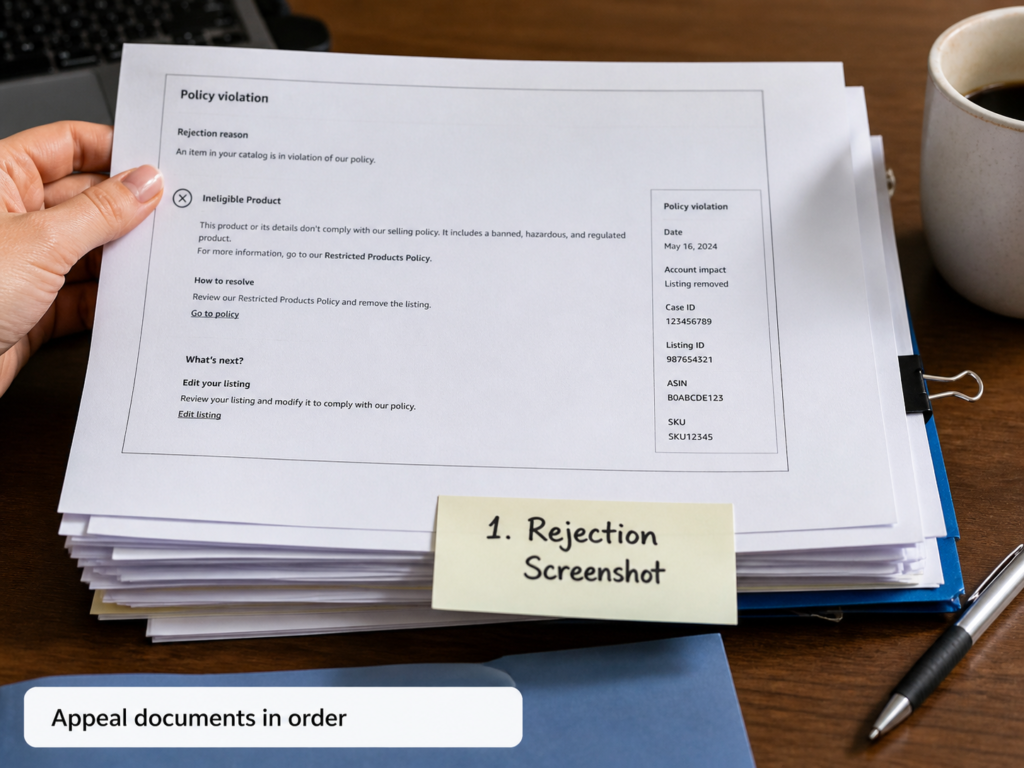
These items are mandatory, and should be placed in order for the convenience of reviewers:
First, put the screenshot of the rejection notice or the Case ID at the very front. It is best to mark it clearly on the first page. Reviewers handle many cases a day, and if you give them the case number directly, they can quickly correspond to your case.
Second, the complete report or certificate required by the notice, as well as the information of the laboratory/certification body and the description of the accreditation scope. Don’t just upload the report cover; attach the complete test pages and qualification pages.
Third, the appeal explanation letter (also called POA, Plan of Action), which should correspond to the rejection reasons one by one, explaining what rectification you have done and where the corresponding supporting materials are.
Also note that do not upload irrelevant documents — for example, if you sell chargers, uploading a bunch of product marketing images is useless; do not upload contradictory materials, such as two reports with different parameters; and do not upload content containing sensitive personal information, such as your ID card or bank statement. The platform does not need these, and they instead pose information security risks.
Consistency and Supporting Materials
These materials are used to prove that your product, page, packaging, and report are consistent:
First, real photos of the product: take close-ups of the interface, parameter nameplate, and compliance marks, taken from the angles required by the notice. For example, for a charger, take photos of the plug, output interface, and parameter label on the bottom, clear enough to read every word on it.
Second, packaging photos: take close-ups of the outer packaging, nameplate, warning labels, and responsible person information. When selling to the EU, you should check the content and labeling position of information such as the manufacturer, importer, or EU responsible person in accordance with applicable regulations; relevant information can be labeled on the product, packaging, parcel, or accompanying documents according to rules. When submitting photos, show the actual labeling position as required by the Amazon notice.
Third, screenshots of the listing: ensure that the model, parameters, and description on it are completely consistent with the report. If you have modified the listing, submit the modified screenshot.
Fourth, if it is a multi-variation product, attach a multi-variation description listing all specifications covered by the report and their correlation with the main tested model, such as “except for different cable lengths, the conductor material, interface, and rated current are all consistent”.
There are also some supplementary supporting materials that can be submitted as needed, such as the factory’s conformity statement, purchase vouchers with prices redacted, and explanation letters issued by the laboratory. These are used to enhance persuasiveness and are not mandatory, but can be supplemented when there are doubts.
Exclusive Must-Check Items for Charging Products (Four-Way Consistency)
For charging products, there are several core points that must be ensured to be completely consistent across the report, physical product, listing, and packaging — none can be wrong:
• Chargers: input and output parameters, plug specifications, number of interfaces, power level
• USB-C/charging cables: cable length, rated current, interface type, whether data transmission is supported
Laboratory and Report Verification Methods
Be sure to check it yourself before submitting. Don’t wait until the platform returns it to find out it’s fake:
First, check the core information on the report: report number, laboratory information, issuance date, product model, applicable standards, test items, accreditation scope — check them one by one to see if there are any errors or omissions.
Then verify the authenticity of the report. You can check public certification or listing information through the issuing body or certification database; for non-public test reports, you should verify the report number, issuance status, and applicable scope with the issuing laboratory or certification body through official contact methods. Accreditation body queries can be used to verify the laboratory’s accreditation status and scope, but cannot alone prove that a specific report is authentic and valid. If you cannot find it, or the information does not match, first ask the issuing laboratory for an official explanation. You must never submit materials that cannot be verified, otherwise they may be regarded as fake reports.
Document Format Requirements
Don’t stumble on such trivial matters:
Submit according to the file type, size, and upload method specified on the case page. Test reports and other documents, if required by the notice, should retain the original, non-editable version; product, packaging, and label images should be clear, complete, and meet page requirements. Do not tamper with any documents or images to evade review.
File naming should preferably follow the rule of [brandfile typeA263320240501.pdf”, so reviewers can tell what the file is at a glance.
Full Appeal Operation Process: Follow the Steps to Avoid Pitfalls
After the materials are prepared, it’s time for the formal appeal submission. It seems simple, but in fact, many small details will affect the review result.
Find the Correct Appeal Entry Point
Prioritize using the exclusive link provided on the rejection notice or compliance request page, and submit according to the steps of that case. This entry point usually directly corresponds to your case, which can reduce the risk of choosing the wrong site or category.
If the notice points to Account Health, find the corresponding ASIN in Product Compliance or Document Requests in Account Health. The page path and button names will vary by site, product, and case type. Some pages display “Provide Documents”, not necessarily “Appeal” directly.
A special pitfall to avoid here: be sure to choose the right site. For example, if you have a rejection on the US site, don’t submit it through the entry point of the European site. Cross-site submission is useless and will waste time. When you need to solve access or process issues through customer service, you should quote the original Case ID and follow the guidance of customer service or the notice.
Fill in Basic Appeal Information
First select the appeal reason option that matches your rejection reason. Don’t choose randomly — for example, if the report is invalid, select the report-related option; if the information is inconsistent, select the information mismatch option. Then accurately fill in the Case ID, ASIN, and product model, which must be completely consistent with the information in the backend. Don’t fill in incorrectly.
When uploading materials, it is best to upload them in the order of the rejection reasons. For example, if the first rejection reason is invalid report, upload the report and laboratory qualifications first; if the second is inconsistent information, then upload the listing screenshot and physical product photos. This way, reviewers can check one by one in order, which is more efficient.
Appeal Explanation Letter (POA) Writing Framework
Here is a general framework for charging products. Just follow it to write, no need for nonsense:
• **Opening**: Clearly mark the Case ID, corresponding ASIN, and the specific rejection reason you received, for example: “Case ID: 123456789, ASIN: B0XXXXXX, in response to the rejection notice of ‘laboratory qualification mismatch and parameter inconsistency’ received on May 1, 2024, the appeal is submitted as follows”.
• **Middle**: Correspond to the rejection reasons one by one. For each one, explain what rectification you have done and where the corresponding supporting materials are (which document, which page), for example: “First rejection reason: the laboratory does not have corresponding testing qualifications. Rectification measures: We have re-commissioned XX Laboratory with CNAS accreditation to issue a UL62368-1 test report. Pages 3-15 of Annex 1 are the main text of the report, and page 16 is the laboratory’s ISO/IEC 17025 accreditation scope page, covering power adapter test items.” Don’t write defensive words like “I’m a new seller and didn’t know I needed to submit this” — it’s useless. Just say what you changed and where the evidence is.
• **Closing**: Promise that you will strictly abide by the platform’s compliance rules in the future, and leave an effective contact method (email or phone) where you can be reached.
The language of the appeal explanation and attachments is subject to the case notice, submission page, and applicable product regulatory requirements; unless otherwise specified in the notice, use clear language that the review team of the target site can handle, and ensure that documents such as instructions and warnings used by consumers meet the language requirements of the target sales country.
One-Page Review Before Submission
Do a final check to avoid low-level mistakes:
Check item by item whether these pieces of information are completely corresponding: Case ID → ASIN → Site → Brand → Model → Physical product label → Page parameters → Report page number — none can be wrong.
Confirm that you are submitting through the entry point specified in the notice or backend. If you need to solve page access, case association, or process issues through customer service, you should quote the original Case ID and follow the guidance of customer service or the notice.
Finally, be sure to keep vouchers: save the full set of materials before submission, and take a screenshot of the submission entry point and submission time. In case of problems later, you can take it out to prove that you submitted.
Key Follow-Up Points After Submission
Many people ask how long the review takes. In fact, there is no unified fixed duration. Some cases get results in two or three days, some take one or two weeks. The specific time is subject to the case status update. Don’t believe online statements like “guaranteed pass in 3 days”.
Progress can be checked through notifications in the seller backend and status updates in the compliance portal.
Special attention should be paid here: unless the notice requires supplementing or updating materials, avoid repeatedly submitting the same documents to avoid confusion in material versions; the review duration and whether supplementary documents are needed are subject to the case status and Amazon notices.
Quick Handling Card for Common Rejection Reasons
For your convenience in quickly corresponding to your own situation, I have compiled a quick handling card for the 5 most common types of rejections. When encountering corresponding problems, you can directly follow the operations:
| Rejection Type | Situations Where Documents Can Be Directly Supplemented | Situations Where Old Reports Should Be Discontinued/Retesting Required | Evidence Package to Prepare | Forbidden Zones Absolutely Must Not Cross |
| Invalid report/not recognized | Only missed uploading laboratory accreditation qualification/scope description, and the qualification is authentic and valid | The laboratory does not have corresponding qualifications, the report is forged/using others’ credentials, or the standards are completely non-compliant | Complete report that meets requirements + laboratory accreditation qualification + sample conformity statement | Falsely claiming the laboratory has qualifications, concealing the true source of the report |
| Product/page information inconsistent with report | Only page entry typos/illegal promotion, which completely match the report and physical product after modification | There are indeed differences in physical product parameters/models from the report, and the original laboratory cannot supplement coverage | Modified listing screenshot + real photo of product nameplate + corresponding report page (or laboratory supplementary coverage description) | Randomly modifying product model naming to muddle through, falsely claiming parameters are consistent |
| Product labeling/packaging non-compliant | Only labeling position/clarity issues, which can meet requirements after re-shooting | Missing labeling content that does not meet target market regulations, requiring reprinting | Close-ups of rectified product/packaging + labeling position description (as required by notice and regulations) | Using Photoshop to modify label photos, concealing actual packaging situation |
| Incomplete submitted materials/format errors | Only missed submitting individual materials or format does not meet requirements, which can be fixed after supplementation | Repeatedly rejected due to format/missing submissions, and all requirements have not been verified | Full set of materials sorted according to the notice list, with a list of supplemented contents noted on the first page | Complaining that platform requirements are cumbersome, submitting unorganized scattered files |
| Insufficient multi-variation coverage | Variations only differ in color/outer packaging, or the difference does not affect safety performance, and correlation proof can be provided | Core parameters of variations such as cable length/power/interface are different, and the original report cannot cover | Difference description between main tested model and variations + factory/laboratory conformity statement | Concealing core parameter differences of variations, forcing shared use of reports |
Advanced Response: Second Rejection and Site Differences
If the first appeal fails, don’t panic. First figure out the reason for the failure, then decide what to do next.
Response to First Appeal Failure
First, read the second rejection notice to distinguish whether the previous problem was not thoroughly rectified, or the previous round of materials exposed new problems. For example, the first rejection was “invalid report”, and after you changed the report, it was rejected again for “parameter mismatch” — this is a new problem, indicating that you only paid attention to the report issue last time and did not check parameter consistency.
Many people ask how many times they can appeal. In fact, there is no unified fixed number of times, which is subject to the platform’s notice. Some cases can be appealed several times, some have only one chance — the specific details depend on the description in the notice.
First handle it according to the review, supplementary document, or appeal path in the second rejection notice; if you do have questions about page access, case association, or process, you can contact Seller Support and quote the original Case ID, but do not assume that opening a new case can replace formal review or will definitely be forwarded to a professional team.
If you are unsure, you can also find compliance service providers in Amazon’s official service provider directory to help with evaluation. Don’t look for external “guaranteed pass” agencies — many of them are scams, and may even submit false materials for you, harming your account.
A pitfall to avoid here: after the first appeal fails, don’t only supplement the latest pointed out problems. Do a full review of all materials to avoid fixing one problem only to have another new one pop up.
Situations With Extremely Low Appeal Success Rate
There are also some situations where the appeal success rate is extremely low, and product safety and real compliance issues need to be prioritized: for example, the certification report is forged, using others’ credentials, or tampered with; the product itself does not meet applicable safety standards, the physical product is seriously inconsistent with the declaration, or it has caused a safety incident (such as fire, electric shock); and there are cases where the account is marked by the platform for repeatedly submitting false materials — in such cases, the account may be at risk.
If you find that the product may not meet safety requirements, the physical product is inconsistent with the declaration, or it is involved in a safety incident, you should immediately stop selling and shipping, preserve records, and take corrective, reporting, recall, or other disposal measures in accordance with applicable laws, platform notices, and requirements of competent authorities; you must not submit appeal materials until both the product and documents truly meet the requirements.
Differences in Compliance Requirements for Charging Products Across Major Sites
Compliance requirements for charging products vary across different sites, and documents cannot be directly mixed across sites. Here is a breakdown of the differences across major sites:
• **US site**: All requirements are subject to platform notices and applicable regulations and programs. There is no fixed “UL+FCC” combination, and requirements vary by category. Don’t do the full set right away — first check what the platform requires.
• **European site**: The CE mark and EU Declaration of Conformity (EU DoC) need to be based on actually applicable EU regulations. For example, charging products usually apply the Low Voltage Directive (LVD), Electromagnetic Compatibility Directive (EMC), RoHS Directive, etc. It’s not just a matter of sticking a CE mark randomly.
• **Japanese site**: First, it is necessary to judge whether the product is subject to PSE based on its specific structure, power supply method, and statutory catalog. AC/DC power adapters with AC input are usually classified as specified electrical appliances and involve the diamond PSE mark; whether cables such as USB cables are regulated and what mark applies cannot be judged solely by name, but should be confirmed based on the catalog, technical requirements, and platform notices.
Long-Term Pitfall Avoidance: Reduce Rejections From the Root
Appealing is only a remedy after the fact. The real way to save trouble is to do a good job of compliance management in advance to avoid rejections from the root. For charging products, doing these few points well is enough:
First, before product selection and stock preparation, first find out the certification requirements of the target site. When looking for a laboratory, be sure to verify whether its ISO/IEC 17025 accreditation scope covers charging products. Don’t wait until the goods are produced to find out the laboratory has no qualifications.
Second, before listing, be sure to do a “four-way consistency check”: the core parameters and information of the report, physical product, listing, and packaging must be completely aligned. Don’t fill in parameters randomly when listing.
Third, before listing multi-variation products, confirm one by one whether each specification is within the coverage of the report. If you are unsure, ask the laboratory to evaluate. Don’t share a report just because you think the appearance is the same.
Fourth, when the product is revised or the supplier is changed, re-verify the applicability of the certification documents, and ask the laboratory to confirm whether supplementary testing is needed. Don’t use the old report directly.
Fifth, establish your own compliance files, archive all certificates and reports by site, regularly pay attention to corresponding standard updates and platform rule changes, and adjust in advance. Don’t wait until you get a rejection to find out the standards have changed.
Clarification of Common Misconceptions
Here are a few more clarifications of common misconceptions among new sellers:
1. **Is the certification provided by the supplier real?** No. The authenticity of reports provided by suppliers should not be judged solely by price, appearance, or report number; you should check the report issuer, laboratory accreditation scope, product model and parameters, and verify through the issuer’s official channels.
2. **Is a certification number a real certification?** No. Report fraud using others’ credentials also uses real certification numbers, but the model, parameters, and coverage do not match at all. For example, using someone else’s UL number for your own product — the number is real, but the report is fake. Be sure to check the specific product information.
3. **Will small-batch sales not be checked?** No. Regardless of sales volume, sellers may receive product compliance document requests; when receiving complaints, risk reminders, or platform compliance requests, you should verify and submit materials in time as required by the notice. The specific trigger mechanism is not something sellers can assume on their own.
4. **Can reports be shared if the appearance is similar?** No. Differences in cable length, power, interface, and core safety components will affect the safety performance of the product. The laboratory must first evaluate the coverage. You can’t just think it’s almost the same.
Quick Answers to Frequently Asked Questions
• **How to write a compliance appeal?** Follow the POA framework to correspond to the rejection reasons one by one, explain the rectification actions, attach the location of supporting materials, use concise and objective language, and don’t write nonsense.
• **What to do if the test report is rejected?** First verify the authenticity and applicability of the report, then use the four-question triage table to determine the rectification direction: supplementary documents, modify the page, or retest.
• **Can I still sell chargers if the certification is rejected?** Whether the relevant ASIN can continue to be sold, when it will be suspended, and the recovery conditions are subject to the compliance notice and account status. If the ASIN has been suspended from sale, you should confirm whether the listing and inventory status have been restored only after the rectification is truly completed and approved according to the specified process.
• **Where is the appeal entry point?** Prioritize using the exclusive link provided on the rejection notice or compliance request page; if the notice points to Account Health, find the corresponding ASIN in Product Compliance or Document Requests. The specific entry point is subject to the case page.
After reading this article, you can do these 3 things right now: First, find your rejection notice, and locate the specific rejection reason, Case ID, and appeal period; second, self-check against the common rejection reasons above, and use the four-question triage table to determine your rectification direction; third, prepare appeal materials according to the material list, submit them through the official entry point, and ensure four-way information consistency.
Overall, Amazon compliance certification rejection is not a big deal. The core is not to take chances, not to cross the red line of false materials, rectify as required, and submit authentic, complete, and mutually consistent materials, which can reduce rejections caused by missing documents or inconsistent information; whether it passes still depends on the actual compliance of the product and the case review result. Doing a good job of compliance management on a regular basis is the real way to save trouble, so you don’t have to worry about your listing being taken down every day.