
If you make products like USB-C chargers, laptop power supplies, or multi-port fast chargers and want to sell them in the EU market, the first unavoidable term is CE certification. Many people who encounter it for the first time treat it as a “quality medal issued by the EU” — either they spend a lot of money to get a so-called “CE certificate” from a third party, or they just stick a label randomly before shipping. In the end, they either waste money for nothing or have their goods detained by customs.
Actually, the logic of CE certification is not that complicated. Its core is “manufacturer’s self-declaration + retention of compliance evidence”. As long as you understand the rules, you can judge by yourself and avoid pitfalls. This article starts from the most basic concepts, covers applicable boundaries, assessment requirements, handling processes, and pitfall avoidance methods, covering all the core knowledge you need from beginner to independent self-inspection.
First, Understand: What Exactly is CE?
Many people’s first misunderstanding of CE is that they regard it as a “qualification certificate issued by the EU”. Let’s clarify its essence in three sentences first:
First, CE is the minimum safety access threshold for the EU/EEA market, not a quality rating or performance certification — affixing the CE mark means the manufacturer declares that the product meets the requirements of applicable EU harmonized legislation; it is not a guarantee of quality or performance, nor does it mean that the product will never have safety or environmental protection problems.
Second, the essence of CE is a manufacturer’s legal declaration of compliance, not a unified certificate issued by the EU official. The vast majority of ordinary consumer electronic products do not require certification from an EU-designated body; manufacturers can assess and take responsibility themselves.
Third, the compliance basis of CE is EU harmonized legislation, not a single unified standard. For example, power adapters basically need to meet RoHS environmental protection requirements, while requirements for energy efficiency, radio, etc. depend on the specific functions and parameters of the product.
Why Must Power Adapters Meet CE Requirements?
Some people may ask: Why are there so many requirements for a small charger? There are three core reasons:
First, the vast majority of mains-input power adapters fall within the scope of the Low Voltage Directive — products plugged into 220V mains power are prone to electric shock and fire accidents if they have poor insulation or structural problems, so a unified safety bottom line is necessary.
Second, power adapters are essentially switching power supplies, which generate electromagnetic interference during operation. If not controlled, they may interfere with nearby radios, routers, and even medical equipment. At the same time, it must be ensured that they will not fail due to interference from other electrical appliances.
Third, this is a mandatory legal requirement: Products subject to CE harmonized legislation may only bear the CE mark and be placed on the EU/EEA market after completing the conformity assessment, compiling technical documentation, and signing the EU DoC. Technical documentation must usually be retained and provided upon request by regulatory authorities, while instructions, safety information, and DoCs required by some regulations shall be attached in accordance with applicable regulations.
4 Most Easily Confused Sets of Concepts
People who are new to CE almost always step on these conceptual pitfalls. Let’s clarify them all at once:
1. CE mark ≠ CE certificate: Most ordinary consumer adapters follow the self-declaration route and do not need a third-party body to issue a “CE certificate”. The CE mark affixed to the product is just a compliance label, not the proof itself. The real core proof is the Declaration of Conformity signed by the manufacturer and the full set of technical documentation.
2. Test report ≠ compliance certificate: The test report proves the results under the sample, configuration and test conditions defined in the report; whether it can be used for other models or mass-produced products depends on model coverage, consistency of key structures, and risk assessment. It is not possible to directly determine that all products are compliant based solely on one report. To be compliant, you also need complete supporting technical documentation, a Declaration of Conformity, and ensure that mass-produced products are consistent with the tested samples.
3. CE certification ≠ globally valid: CE is only valid in the EU/EEA and a few countries/regions that recognize CE. It is not interchangeable with UL/FCC in the US, CCC in China, or PSE in Japan. You cannot say that having CE means you can sell globally.
4. CE ≠ UKCA: Great Britain (England, Scotland, Wales) applies UK product regulations and the UKCA system; however, the UK currently continues to recognize the CE mark indefinitely for most related products. Northern Ireland applies EU rules; if a Northern Ireland conformity assessment requiring participation by a UK-approved body is applicable, a combined CE and UKNI mark may be required. Confirm according to specific product regulations, and do not confuse UK and EU certifications.
How to Judge Whether Your Power Adapter Needs CE?
Not all power adapters need CE, nor is it enough to just do one “CE” — products with different functions and parameters have different applicable requirements. You can judge step by step according to the following three steps:
Step 1: First confirm whether the product is to be placed on the EU/EEA market — including online sales. For example, if you list a product on Amazon Europe, it counts as being placed on the market and needs to meet the requirements. If it is only a sample for R&D, a non-sale item for exhibition display, or a small number of second-hand adapters brought in for personal use, it is not required.
Step 2: Determine applicable regulations based on functions and parameters: Common ones include LVD (Low Voltage Safety), EMC (Electromagnetic Compatibility), RoHS (Environmental Protection), and Ecodesign (Energy Efficiency). If it has wireless functions (such as a smart charger with Bluetooth), RED (Radio Equipment Directive) requirements must also be added. Special attention should be paid here: the LVD Low Voltage Directive only applies to products with AC ≥ 50V and DC ≥ 75V. If your product’s input voltage is below this threshold (such as some car chargers), it does not need to comply with LVD, but may still need to meet EMC, RoHS and other requirements.
Step 3: Simultaneously confirm non-CE supporting obligations: For example, WEEE recycling obligations, GPSR General Product Safety Requirements, etc. Although these are not within the scope of CE directives, they are also mandatory for placing products on the EU market.
Which Power Adapters Fall Within the Applicable Scope?
The vast majority of common external power supplies are within the scope of CE jurisdiction, such as:
• USB-A/USB-C wall chargers, including PD/QC fast chargers and GaN gallium nitride models;
• External power adapters for laptops, tablets, and small digital devices;
• Desktop multi-port chargers, travel chargers with interchangeable plugs;
• External power supplies sold separately for routers, monitors, etc.
In Which Cases Is Independent CE Not Required?
There are three cases where independent CE for power adapters is usually not required:
1. Non-sale samples or prototypes only used for R&D and exhibitions, because they are not placed on the market;
2. Power modules that are only for further assembly and not independently placed on the market for end users. Usually, the final complete machine completes the whole machine conformity assessment and CE marking; however, the module’s own obligations must still be judged according to its intended use, independent use capability and applicable regulations, and the complete machine manufacturer shall retain the module’s compliance evidence. Once a module is placed on the market as an independent product, the applicable requirements shall be re-determined;
3. A small number of second-hand adapters brought into the country for personal use, such as two personal chargers brought when traveling to the EU.
These Scenarios Require Additional Assessment
If your product is not an ordinary consumer adapter, additional assessment is required:
• Sold as a set: If sold together with cables and terminal equipment (such as mobile phones, laptops), the compliance responsibility of the entire set needs to be assessed, not just the adapter itself;
• With wireless function: Adapters with Wi-Fi, Bluetooth, or cellular communication need to be assessed against the RED Directive; inductive wireless charging products shall be judged whether they are under the jurisdiction of RED according to the official definition;
• Special regions: For example, although Switzerland recognizes CE, it has local supplementary requirements, so you cannot sell directly with CE;
• Special purposes: Power supplies dedicated to medical equipment, power supplies dedicated to lamps, etc. need to comply with additional regulations in the corresponding fields, and cannot use the standards for ordinary IT/AV products.
What Exactly Does CE Certification Check?
Many people think that CE is just “testing whether it is safe”, but that is not the case. Different regulations assess completely different content. We have sorted out the common compliance requirements for power adapters into the table below for your quick comparison:
| Regulation Type | Core Purpose | Applicable Conditions | Key Assessment Points |
| LVD Low Voltage Directive | Prevent electrical safety risks | Products with AC 50-1000V / DC 75-1500V | Insulation withstand voltage, electric shock protection structure, temperature rise control, mechanical strength |
| EMC Electromagnetic Compatibility Directive | Reduce electromagnetic interference and ensure anti-interference capability | Almost all electronic and electrical products | Conducted/radiated emission, anti-interference capability, select items such as harmonics as needed |
| RoHS Directive | Restrict hazardous substances in products | Almost all electronic and electrical products | Limits of 10 hazardous substances (calculated based on the smallest non-detachable material) |
| Ecodesign Regulation | Improve energy utilization efficiency and reduce standby consumption | External power supplies within the statutory scope ((EU) 2019/1782) | No-load power consumption, average efficiency in active mode |
| RED Radio Equipment Directive | Regulate the use of radio spectrum | Products with wireless communication functions | Spectrum compliance, electromagnetic safety, specific equipment needs to meet cybersecurity requirements |
Let’s explain the core details of each regulation one by one below:
Electrical Safety (LVD Low Voltage Directive)
The core of LVD is to ensure that products do not have risks such as electric shock, fire, overheating, and mechanical injury. The applicable voltage range is AC 50-1000V and DC 75-1500V — the vast majority of mains-input chargers and power adapters fall within this range.
Key inspection items include: insulation withstand voltage (whether it will break down and leak electricity under high voltage), electric shock protection structure (whether fingers can touch live parts), temperature rise control (whether the temperature is too high during normal use), safety after dropping or squeezing (whether it will crack and expose live parts when dropped on the ground).
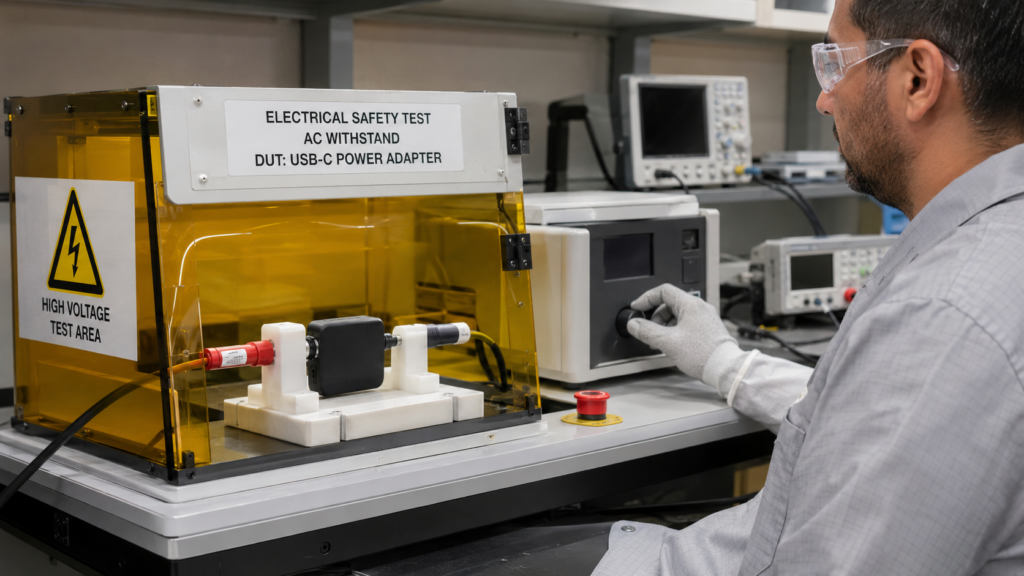
The corresponding harmonized standards (that is, the “reference answers” recognized by the EU, compliance with the standards can presume compliance with the directive requirements): EN 62368-1 is commonly used for IT/AV adapters, and EN 61558 series is used for general switching power supplies.
Electromagnetic Compatibility (EMC Directive)
The requirement of EMC is “do not disturb others, nor be disturbed by others”: it must not generate excessive electromagnetic interference that affects other electrical appliances, and must also be able to withstand certain external interference and work normally.
The assessment directions are mainly conducted emission (interference transmitted through power lines), radiated emission (interference transmitted through air), and various anti-interference capabilities. Not all items need to be tested. For example, items such as harmonics and voltage fluctuations shall be selected according to input conditions, power, and product category. There is no unified “mandatory test list”.
There is no universal standard selection either. It is necessary to match the corresponding emission and immunity standards according to product category, port, and use environment. Among them, multi-port fast chargers, high-power, and GaN structure adapters are high-risk EMC models due to high power density and complex circuits, so special attention should be paid during testing.
Environmental Protection Requirements (RoHS Directive)
The role of RoHS is to restrict harmful heavy metals and organic substances in products, reducing harm to the environment and human body. There are currently 10 controlled substances: lead, mercury, cadmium, hexavalent chromium, PBB, PBDE, and 4 phthalates.
The limit rule is calculated based on homogeneous materials — that is, the smallest unit material that cannot be disassembled further. For example, the plastic shell of a charger and the copper parts of the plug are each calculated separately for limits, not the average of the entire product to meet the standard.
Compliance verification can rely on the supplier’s material declaration, or testing can be done; if there are applicable exemption clauses, the validity period and applicable conditions of the exemption shall be checked. The preparation of technical documentation can refer to the EN IEC 63000 standard, which is the EU-recognized RoHS technical documentation specification.
Energy Efficiency Requirements (Ecodesign Regulation)
Many people miss the energy efficiency requirement, thinking that safety compliance is enough — in fact, the energy efficiency of external power supplies is separately regulated by the EU, based on Regulation (EU) 2019/1782, which is a completely independent requirement from LVD.
First, check whether the product is within the applicable scope: whether it is an external power supply as defined by law, whether it is sold separately or as a set, whether the parameters are within the control scope, and whether it is an exclusion item. There are two assessment indicators: no-load power consumption (power consumption when plugged into the wall without connecting a device), and average efficiency in active mode (conversion efficiency during normal operation). The specific values are determined according to output power and product type.
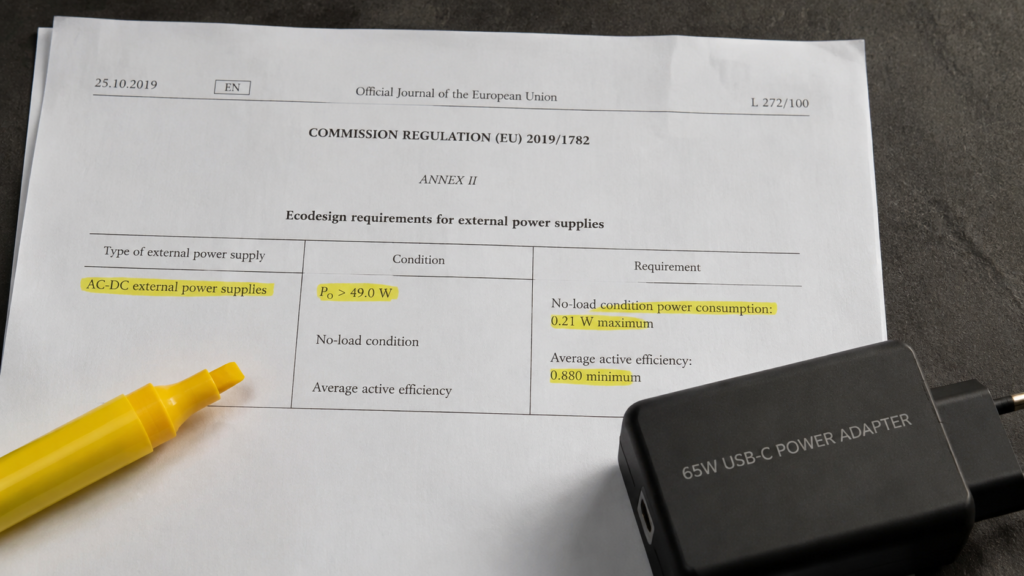
Special reminder: Safety compliance does not mean that energy efficiency is automatically met. It must be verified separately. Many low-cost CE packages miss this item, and only find out that it is non-compliant when inspected after going on the market.
Radio Requirements (RED Directive)
Only adapters with wireless communication functions need to comply with the RED Directive, such as smart chargers with Bluetooth remote control, power strip chargers with Wi-Fi, etc. Inductive wireless charging products shall be judged whether they are under the jurisdiction of RED according to the official definition.
The core assessment content includes: spectrum compliance (the frequency and power used are within the allowable range), electromagnetic safety (the wireless part will not bring safety risks), and cybersecurity (only for specific equipment defined by regulations). The cybersecurity requirement comes from Regulation (EU) 2022/30, which will officially apply on August 1, 2025, so there is no need to worry too much in advance.
Supporting Obligations That Must Be Met Simultaneously
There are two other requirements that are not part of the CE directives but are also mandatory for placing products on the EU market:
• WEEE recycling obligation: The crossed-out trash can recycling mark must be marked on the product, and some countries (such as Germany) also require producer registration to be completed in advance;
• GPSR General Product Safety Regulation: Officially applicable from December 13, 2024, mainly applicable to consumer products and products that can be reasonably foreseen to be used by consumers. For products regulated by EU special product safety legislation, GPSR applies supplementarily to risks, risk categories or risk categories not covered by the special legislation.
How to Check the Latest Regulations and Standards?
If you want to verify the validity of regulations and standards by yourself, you can use two EU official platforms:
• For regulation inquiries, use EUR-Lex, where you can check the current version, revised content, and effective date;
• For harmonized standard inquiries, use OJEU (Official Journal of the European Union), where you can check the standard number, version, citation date, and date of cessation of presumption of conformity.
When filtering, you can narrow the scope by product category (such as external power supplies, IT/AV equipment) without going through all of them. Note: The standard version marked on the laboratory report cannot replace official public information. You must check whether it is within the validity period by yourself.
From Preparation to Market Launch: Full Compliance Process
After figuring out what requirements to meet, how to implement them specifically? Let’s explain step by step according to the normal process:
Step 1: Choose the Right Compliance Path, Don’t Waste Money
Many people make a mistake at the first step — thinking that CE must be certified by a third-party body, spending thousands or even tens of thousands of yuan on a so-called “CE certificate”, when in fact ordinary consumer adapters do not need it at all.
For ordinary adapters that are usually subject to LVD, EMC, and RoHS, manufacturers can generally adopt Module A (Internal Production Control), that is, the self-declaration route: the manufacturer completes the test, organizes the technical documentation, and signs the Declaration of Conformity by itself, then it can affix the CE mark and go on the market. Not using harmonized standards does not automatically require the participation of a notified body, but the manufacturer must prove compliance with the essential requirements on its own.
If the product is subject to RED and does not use or does not fully use harmonized standards covering the relevant essential requirements, an appropriate conformity assessment procedure shall be selected in accordance with Article 17 of RED, which may require the participation of a notified body. Merely the name “medical power supply” or thinking that “the product is safer” does not constitute a reason to must find an NB.
It should be particularly emphasized here: self-declaration ≠ doing it casually. You still need to complete all necessary tests, retain complete technical documentation, sign the Declaration of Conformity, and bear full legal responsibility — if the product is non-compliant, the manufacturer is the first responsible party.
Step 2: Preparations Before Handling
Before officially starting, sort out the product information first, otherwise you can’t even judge which regulations are applicable:
1. Confirm basic product information: brand, model, power, interface type, plug specification, supported fast charging protocols, whether it has wireless function;
2. Sort out key parameters: input and output voltage and current, power distribution rules for multi-port products (such as total power when charging two ports simultaneously, maximum power for a single port), list of core components (such as transformers, safety capacitors, optocouplers and other key safety components);
3. Match applicable regulations: according to the applicable boundaries mentioned earlier, determine all applicable directives and regulations, do not miss any items.
Step 3: Risk Assessment and Standard Matrix
Many people skip this step and directly find a laboratory to do testing. In fact, risk assessment is the core of compliance — testing is just a means to verify whether risk control is effective.
The scope of risk assessment should not only cover normal use, but also reasonably foreseeable misuse (such as the user getting the charger wet, using unqualified cables) and abnormal conditions (such as output short circuit, excessive input voltage). Assess whether there will be safety risks in these cases, and whether the risks are controlled.
For easy management, you can organize the regulations, standards, and test evidence corresponding to all models and configurations into a standard matrix, with dimensions including: model, plug specification, output gear, number of ports, key components, applicable regulations, corresponding standards, test sample, report number, compliance conclusion. In this way, which models cover which requirements is clear at a glance.
Remember: The test report is one of the core evidences, but it cannot replace risk identification and judgment — you can’t say “I have a test report so everything is fine”. You also need to assess whether there are risks not covered by the test.
Step 4: Determine Test Samples: How to Save Money for the Same Series?
If you have multiple models and multiple configurations in the same series, you don’t need to test each one separately. You can select the “most unfavorable configuration” for testing and share test data, but the premise is that it must meet the requirements of combined assessment.
What is the most unfavorable configuration? Select the strictest one for different test items: for example, for safety temperature rise test, select the model with the highest power and the densest ports, because the heat generation is the most serious; for EMC emission test, select the configuration with the maximum load and the highest switching frequency, because the interference is the strongest.
The premise of combined assessment is: the design architecture is consistent, key safety components are consistent, and risk envelope is consistent for the same series of products — for example, they are all GaN architecture, use the same transformer, and only have different output power gears, then data can be shared. If one is an ordinary silicon tube and the other is GaN, with completely different architectures, they cannot be combined.
Finally, a formal model family coverage matrix must be formed to clarify the test items and evidence corresponding to each configuration. It is not enough to verbally say “we are the same series”.
Step 5: Testing and Rectification
Test items must cover all applicable regulatory requirements you have determined. You cannot only test safety and miss energy efficiency, RoHS, etc.
When choosing a laboratory, prioritize those with ISO 17025 accreditation for the corresponding items. Such reports have stronger credibility and are more recognized by regulatory authorities. But note: The test report is only one of the compliance evidences, and cannot replace risk assessment, technical documentation, Declaration of Conformity, and mass production consistency control — it is not that having a test report equals compliance.
There are four most common reasons for failure of power adapters: insufficient insulation, excessive temperature rise, excessive electromagnetic interference, and unqualified no-load power consumption. The corresponding rectification directions are also very clear: if insulation is insufficient, adjust the shell structure and replace insulating materials; if temperature rise exceeds the standard, replace better heat dissipation materials and optimize circuit design; if electromagnetic interference is large, add filter components and optimize PCB layout; if no-load power consumption is unqualified, optimize the standby circuit.
Step 6: Mass Production Consistency and Change Management
This is a step that many people easily ignore: the tested sample meeting the standard does not mean that the mass-produced products are also compliant. Mass-produced products must be kept under controlled consistency with the assessed samples and technical documentation, and cannot be changed casually.
Changes are managed at two levels:
• Key changes: such as adjustment of transformers, safety capacitors, insulating parts, interfaces, circuits, rated power — these changes that affect safety, EMC, and energy efficiency must be re-assessed for impact, and if necessary, supplementary testing and updating of technical documentation are required;
• Non-key changes: such as adjustments to appearance, packaging, etc. that do not affect compliance — change judgment records must also be retained to prove that you have assessed that they do not affect compliance.
The red line that must never be crossed: using the best materials for the test version to meet the standard, but cutting corners and reducing configurations during mass production — once found by supervision, it will be directly judged as non-compliant, and the penalty is very serious.
Step 7: Document Signing and Market Launch
After all tests and assessments are completed, organize the full set of technical documentation, sign the EU Declaration of Conformity (DoC), affix the CE mark and product nameplate in accordance with specifications, confirm that all changes have been assessed, and then you can go on the market.
Cycle and Cost Reference
Many people care about how long it takes and how much it costs. Here is a general reference:
• Cycle: For ordinary consumer adapters, if there is no rectification, the entire process can generally be completed in 2-4 weeks; if there is rectification, the time will be extended;
• Cost: Mainly affected by power size, number of ports, number of test items, and laboratory qualifications. The higher the power, the more ports, and the more complete the test items, the higher the cost.
Pitfall avoidance reminder: Many ultra-low-cost CE packages on the market often miss testing items such as energy efficiency and RoHS. You think you have done the full set, but actually only did safety. Only when you are inspected after going on the market do you find the problem. Be sure to confirm the test scope in advance.
Required Documents and Markings: Don’t Fail on Details
Many people pass the product test, but are inspected due to non-standard documents or wrong markings. You must pay attention to the details of this part.
Technical Documentation List: Must Be Kept for 10 Years
For common applicable regulations such as LVD, EMC and RoHS, manufacturers usually must keep technical documentation and EU DoC for at least ten years from the date the relevant product is placed on the market; if other regulations apply, their respective retention periods shall also be checked. Technical documentation and DoCs for all applicable regulations shall be archived uniformly, not stored separately.
A complete technical documentation includes at least:
1. Basic product information: model, parameters, pictures, structural description, intended use;
2. Design and component information: list of key safety components, material information of shell/interface/cable;
3. Compliance evidence: test reports covering all applicable requirements, list of applicable standards/technical specifications, RoHS supply chain declaration or test report;
4. Risk assessment documents: risk assessment report covering normal use, foreseeable misuse, and abnormal conditions;
5. Consistency statement: consistency statement between test samples and mass-produced products, change management records.
How to Write a Valid DoC (EU Declaration of Conformity)?
The DoC is a legal document signed by the manufacturer, equivalent to a “guarantee letter” you give to the EU, declaring that the product meets all applicable regulations. It is the core compliance document, more important than the test report.
The DoC shall be filled in according to the annex of each applicable regulation, and usually includes:
• Unique identification information of the product (model/batch);
• Name and address of the manufacturer, and information of the authorized representative if applicable;
• Manufacturer’s responsibility declaration;
• Names/numbers of all applicable regulations;
• Standards or technical specifications used;
• Notified body information and signing information if applicable.
The contact information of the responsible economic operator shall be marked on the product, packaging, parcel or accompanying documents in accordance with applicable rules.
Common invalid DoC errors include: only writing “compliant with CE” without listing specific regulations, model parameters not matching the actual product, signing in advance before the test is completed. In addition, the DoC must cover all actually sold models, and you cannot just sign one model for the whole series to be universal.
CE Marking Usage Rules
The CE mark cannot be affixed casually; there are clear specifications:
• Basic requirements: clear, visible, legible, and durable, cannot be wiped off by hand;
• Affixing position: usually must be affixed to a conspicuous position on the product body. Only when the product size is too small or the nature is special and cannot be affixed to the body, can it be placed on the packaging or accompanying documents;
• Size requirements: the conventional height is not less than 5mm, and special circumstances shall be implemented in accordance with the requirements of applicable legislation;
• Prohibited acts: affixing the mark before completing compliance, using a fake CE mark with wrong proportions, using misleading marks similar to CE.
Product Nameplate and Promotion Requirements
The manufacturer’s name, registered trade name or trademark and postal address, product identification information and CE mark shall be marked in accordance with applicable regulations; when the product size or nature does not allow, some information can be placed on the packaging or accompanying documents in accordance with regulations. Rated input/output parameters, model, energy efficiency information and safety warnings shall be determined in combination with applicable regulations and standards. The contact information of the importer or other responsible economic operators can be marked on the product, packaging, parcel or accompanying documents in accordance with applicable rules.
The following can be placed in the packaging or accompanying documents: importer information, multi-port power distribution rules, full gear description of PD/PPS, safety warnings, use environment restrictions (such as cannot be used in humid environments).
The instruction manual shall be in the language of the member state where it is sold, and shall be easy to understand, including instructions for fast charging and multi-port power, as well as usage restrictions. For online sales, the parameters and markings on the page must be consistent with the actual product, and you cannot conceal single-port/gear restrictions. For example, if the dual-port simultaneous charging is only 30W, but only the single-port 65W is promoted, this is illegal promotion.
Who is Responsible? What to Do After Market Launch?
CE compliance is not “once and for all”. There are ongoing responsibilities after the product goes on the market, and the responsibility division of different roles is very clear.
Core Responsibilities of Each Role
• Manufacturer/brand owner: responsible for design testing, compiling technical documentation, signing DoC, affixing CE mark, and ensuring mass production compliance. Is the first responsible party;
• EU importer: shall verify CE documents, retain DoC, and bear joint and several liability for market supervision — if the regulator cannot find the manufacturer, it will find the importer;
• Distributor/e-commerce seller: shall check the integrity of markings and documents, and cannot sell known non-compliant products;
• Private label seller: if you sell products produced by others under your own brand, you are regarded as the manufacturer and shall bear full compliance responsibility, and cannot shift it to the factory.
EU Economic Operator Requirements
Many cross-border sellers easily miss this: products placed on the EU market must have an economic operator within the EU as the contact person for supervision — that is, the person that EU regulators can liaise with.
Products subject to Article 4 of the Market Surveillance Regulation shall have a responsible economic operator within the EU before being placed on the EU market:
1. Manufacturer within the EU;
2. Importer;
3. Authorized representative (EU rep): an authorized representative who has received written authorization to perform relevant tasks;
4. Fulfillment service provider: in the absence of the aforementioned entities, a qualified fulfillment service provider shall assume this role.
Whether a non-EU manufacturer can designate an authorized representative and the scope of authorization shall also be confirmed in accordance with applicable product regulations.
The name, registered trade name or trademark and contact information of the responsible economic operator shall be marked on the product, packaging, parcel or accompanying documents in accordance with applicable rules for regulatory inquiry, and cannot only be known to you.
Ongoing Compliance Requirements After Market Launch
After the product goes on the market, it’s not the end of the story. You also need to do a good job of ongoing compliance:
• Assess the impact when regulations/standards are updated: after a new harmonized standard is released, assess whether it covers the product, whether it has restrictions, and the date of cessation of presumption of conformity of the old standard. Harmonized standards are usually voluntary; manufacturers can adopt current harmonized standards to obtain presumption of conformity, or adopt other technical solutions and prove compliance with essential requirements on their own;
• Re-assess changes when encountering these situations: design/key component/process adjustments, customer complaints exposing compliance risks, regulatory random inspections putting forward rectification requirements;
• Cooperate with regulatory random inspections: when receiving a random inspection notice, provide the full set of technical documentation in a timely manner;
• Conduct regular consistency checks: ensure that mass-produced products always meet the requirements, and do not cut corners over time.
Pitfall Avoidance Guide: How to Verify Whether CE is Truly Compliant?
Whether you do compliance yourself or check whether a supplier’s CE is valid, you can use this four-step method for preliminary verification:
Step 1: Verify economic operator information and product traceability markings — whether there is a contact person within the EU, whether the product can be traced back to the manufacturer, and whether the information is true.
Step 2: Check the DoC — whether the required fields are complete, whether the applicable regulations are complete, whether the model matches the product, and whether requirements such as energy efficiency and RoHS are missing.
Step 3: Check compliance evidence — whether the test report and risk assessment cover all applicable regulations; whether the standards used in the report are consistent with the applicable requirements and the citation of harmonized standards at the time of placing on the market, and pay attention to citation restrictions and the date of cessation of presumption of conformity. When harmonized standards are not adopted, other sufficient technical evidence is required to prove compliance with essential requirements.
Step 4: Check the physical product — whether the product’s parameters, key components, and structure are consistent with those in the technical documentation, and whether there is corner-cutting.
In addition: only products for which regulations clearly require the participation of a notified body need to go to NANDO (EU Notified Bodies Database) to verify the NB’s qualifications and authorization scope; ordinary self-declaration products do not need NB participation at all, so there is no need to check.
6 Most Common Misconceptions
We have sorted out the 6 most common pitfalls for practitioners. Avoiding these can save a lot of detours:
1. Having a CE mark equals compliance: Wrong. It must be accompanied by DoC and technical documentation. The mark itself is just a label, not a compliance certificate.
2. One model with CE can be used for the whole series: Wrong. Products with different power, different circuits, and different interfaces need to be assessed separately. Only those of the same model family that meet the combination conditions can share test data.
3. Supplier’s test report can be used directly: The supplier’s report can be used as evidence, but it is necessary to verify whether its samples and configurations cover the actual product, whether the key structures are consistent, and the actual manufacturer shall incorporate it into its own technical documentation and DoC. Even if the report can be used, you as the brand owner still have to bear full compliance responsibility.
4. Low-power chargers don’t need to do compliance seriously: Wrong. Low-power also has risks of electric shock, overheating, and interference. Especially low-power models with PD and multi-port have more complex circuits and higher risks instead.
5. With CE certification, goods will not be detained by customs: Wrong. Non-standard markings, inability to provide documents, and inconsistent parameters will all lead to customs detention. It’s not enough to just have a mark.
6. CE must be certified by a third-party body: Wrong. Ordinary consumer adapters can follow the self-declaration route and do not need third-party certification. Many people have wasted money.
Consequences of Non-Compliance
If it is non-compliant, the consequences may be more serious than you think:
• Customs detention, destruction or forced return, direct loss of goods value;
• Market supervision requires removal from shelves, rectification, mandatory recall, and also bear recall costs;
• Administrative penalties, even civil and criminal risks, depending on the regulations of member states and the circumstances of the violation — if personal injury is caused by product safety issues, criminal responsibility may be borne.
Finally: Practical Self-Inspection Checklist and FAQ
Pre-Market Compliance Checklist
Before going on the market, you can check item by item according to these four categories to ensure no omissions:
• Product side: model/parameters/plug/interface confirmed correct, multi-port power consistent with label, key components traceable;
• Document side: complete technical documentation, test reports covering all applicable requirements, DoC signed correctly and model matched;
• Marking side: CE mark standardized, complete nameplate information, instruction manual with safety tips in the language of the selling country;
• Responsibility side: clear economic operator within the EU, information has been marked on the product, packaging, parcel or accompanying documents in accordance with applicable rules.
After Reading This Article, You Can Independently Do These 4 Things
1. Quickly judge which CE-related requirements power adapters/chargers need to meet;
2. Explain the core requirements and basic handling process of CE certification;
3. Preliminarily verify the validity of CE compliance according to the four-step method and avoid common pitfalls;
4. Complete pre-market compliance self-inspection according to the checklist.
FAQ
Does CE Certification for Chargers Require Third-Party Certification?
Ordinary consumer chargers usually do not. The vast majority of chargers that are usually subject to LVD, EMC, and RoHS can follow the Module A self-declaration route. The manufacturer can complete the test, organize the technical documentation, and sign the DoC by itself. If the product is subject to RED and does not use or does not fully use harmonized standards covering the relevant essential requirements, an appropriate conformity assessment procedure shall be selected in accordance with the RED regulations, which may require the participation of a notified body.
Can the Supplier’s CE Test Report Be Used Directly?
It depends. The supplier’s report can be used as compliance evidence, but it is necessary to verify whether the samples, configurations and test conditions in the report cover the products you actually sell, whether the key structures are consistent, and whether it covers all applicable regulations. Even if the report is under the supplier’s own brand, it is not automatically unusable; the key is whether the actual manufacturer can incorporate it into its own technical documentation and sign a matching DoC accordingly. As the brand owner/seller, you still have to bear full compliance responsibility and must verify the validity of the report yourself.
How to Sell Compliant Chargers in the EU Without an EU Importer?
You can designate an authorized representative (EU rep) within the EU as the responsible economic operator; when there is no manufacturer, importer or authorized representative within the EU to assume relevant responsibilities, a qualified fulfillment service provider may also assume this role. The name, registered trade name or trademark and contact information of the responsible economic operator shall be marked on the product, packaging, parcel or accompanying documents in accordance with applicable rules for regulatory inquiry.
Do GaN/PD Fast Chargers Have a Special CE Certification Path?
No special path. Like ordinary adapters, applicable regulations are determined according to functional parameters, and the corresponding compliance route is followed. It’s just that GaN chargers have high power density, and PD fast charging circuits are complex, so items such as EMC, temperature rise, and energy efficiency are more prone to problems. During testing, attention should be paid to selecting the most unfavorable configuration to ensure that all risks are covered.
Can the CE Mark Only Be Printed on the Packaging?
It is generally required to be affixed to a conspicuous position on the product body. Only when the product size is too small or the nature is special and cannot be affixed to the body, can it be placed on the packaging or accompanying documents. It cannot be simplified arbitrarily.
What Are the Main Items of CE Testing for Power Adapters?
The specific items depend on the applicable regulations. Conventional ones include: LVD safety items (insulation withstand voltage, electric shock protection, temperature rise, mechanical strength, etc.), EMC items (conducted/radiated emission, immunity, etc., select harmonics etc. as needed), no-load power consumption and average efficiency testing of Ecodesign; for RoHS, technical documentation proving that restricted substances meet the requirements needs to be formed, which can include supply chain material declarations, material data, risk assessment and testing when necessary. Not all products require mandatory finished product RoHS testing; if it has wireless function, RED-related tests must also be added. The specific items shall be determined according to product parameters, categories and applicable regulations. There is no unified “mandatory test list”.
Actually, although CE certification seems to have many items, the core logic is very simple: the EU lists the bottom-line requirements such as safety, environmental protection, and energy efficiency, and the manufacturer assesses, declares, and retains evidence by itself, and is responsible for the results. Don’t think of it as too complicated, nor can you be too casual — follow the steps, avoid common pitfalls, and you can successfully sell your products to the EU market.