
If you are a cross-border seller or purchaser of charging products such as chargers and USB/USB-C cables, choosing a third-party certification laboratory is definitely a step you cannot afford to mess up: losing money is a minor issue, but if your goods are detained by customs, removed from platforms, or even recalled due to safety problems, the losses may far exceed the certification cost. Today, we will thoroughly explain the methods of selecting a reliable laboratory, from basic knowledge to practical operation details, covering the entire process from inquiry to subsequent changes.
First, Understand the Basics: What is a Third-Party Certification Laboratory
Many people’s understanding of third-party institutions stays at “spending money to buy a report”, but it is far from that simple. A third-party certification laboratory is a professional institution independent of product manufacturers and purchasers, whose core function is to issue test reports and certification documents that meet market regulatory and cross-border platform requirements. However, the validity of a report does not depend on whether there is a seal, but on the qualification, accreditation scope, authorization qualification, document type of the testing entity, as well as the specific rules of the target market or platform.
Special attention should be paid here: the responsibilities and authorities of ordinary laboratories, certification bodies, EU Notified Bodies (NB), U.S. Nationally Recognized Testing Laboratories (NRTL), and brand association certification bodies are completely different and cannot be confused. Ordinary laboratories are only responsible for sample testing and issuing test reports; certification bodies are entities that have obtained official authorization and can issue mandatory certification certificates; EU NBs only carry out corresponding conformity assessment when third-party participation is required by applicable EU harmonized regulations and their conformity assessment procedures, and not all products bearing the CE mark or LVD and EMC projects require NB involvement; U.S. NRTLs are safety certification bodies recognized by OSHA; while industry association institutions such as USB-IF and Qualcomm are only responsible for interoperability certification of their own fast charging protocols. Before looking for an institution, first clarify the services you need, and don’t go to the wrong party.
For charging products, the common services of third-party institutions include four categories: safety testing (whether it will leak electricity or catch fire), EMC (electromagnetic compatibility) testing (whether it will interfere with other electrical appliances or be interfered with), fast charging protocol certification (such as whether PD and QC comply with specifications), and energy efficiency and environmental protection testing (whether energy consumption meets standards and whether there are hazardous substances).
Why You Must Choose a Reliable Institution
Choosing the right laboratory essentially avoids three types of risks: first, market access risk. Non-compliant products will be detained by customs and fined. For example, if EU customs finds chargers without valid technical documents, they may directly return the entire container; second, platform rule risk. Cross-border platforms such as Amazon and Temu have increasingly strict compliance requirements for electronic products, and non-compliant products will be directly removed and store permissions will be restricted; third, safety liability risk. If a product causes an accident due to quality problems, the cost of compensation and recall will be very high without valid compliance documents.
For a simple example: the documents required for USB cables and chargers should be determined according to the target market, whether they contain electronic functions, power supply methods, product declarations, and platform requirements. High-power or GaN chargers usually require more prudent assessment of applicable requirements such as safety, EMC, and external power supply energy efficiency, but fast charging protocol certification is not naturally mandatory just because of 65W or GaN.
First Distinguish Several Core Terms
Novices are most likely to be confused by various documents and qualifications. We have sorted out the most core categories into a table for easy comparison and understanding:
| Category | Name | Popular Explanation | Validity Description |
| Product compliance documents | Test report | Record of test results of submitted samples by the laboratory | It is the basis of all compliance assessments, and does not in itself mean “certification passed” |
| Product compliance documents | Certification certificate | Compliance certificate issued by an officially authorized body | Such as NRTL and PSE certificates, which are vouchers for mandatory access |
| Product compliance documents | Declaration of Conformity (DoC) | A “compliance guarantee letter” written by the manufacturer itself | The premise is that applicable conformity assessment has been completed and corresponding technical documents and conformity evidence are retained; test reports are usually one of the important evidences, but not all scenarios require a test report to be attached to the DoC |
| Institution qualification | Accreditation qualification | Official endorsement of the testing/certification capability of the institution | Such as ISO/IEC 17025, which is the basic proof of laboratory capability, but the specific accreditation scope should be checked |
4 Common Cognitive Misconceptions for Novices
Many people make mistakes when looking for an institution for the first time because of preconceived wrong ideas:
1. **A report with a seal is valid**: Wrong. The report must completely match your product, cover all required test standards, and be verifiable through official channels, otherwise no amount of seals will help. For example, if you sell a 65W charger, but the report is for a 5W charger, it cannot be used even if there is a seal.
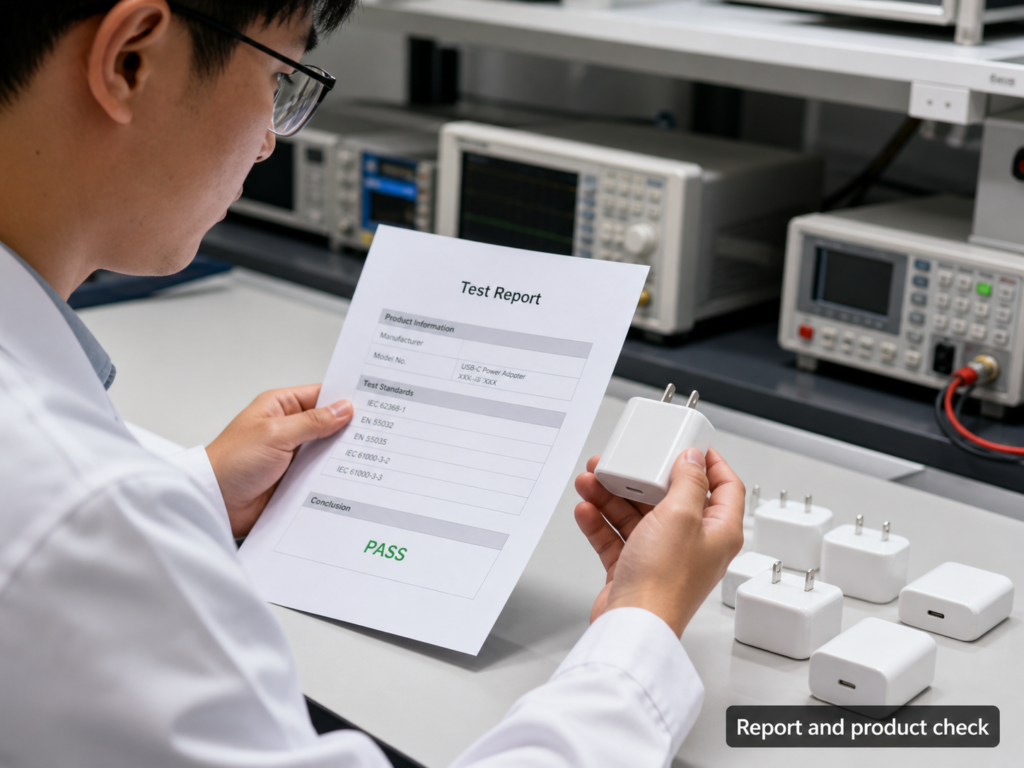
2. **A factory’s own laboratory is equivalent to a third-party laboratory**: Wrong. Factory self-testing usually cannot replace independent third-party documents explicitly required by regulations, certification schemes or platforms; however, under systems that allow manufacturers to conduct self-conformity assessment, internal testing can be used as technical evidence.
3. **With ISO/IEC 17025, you can do all tests**: Wrong. ISO/IEC 17025 is an internationally recognized standard for laboratory capability accreditation, but each laboratory has a limited accreditation scope. When a laboratory’s accreditation scope does not cover a certain project, the project should not be claimed as an accredited test; whether the report is accepted by regulators, certification schemes or platforms must still be confirmed according to target regulations, certification schemes and platform rules.
4. **Institutions that promise “guaranteed pass” are more capable**: Wrong. Compliance testing is an objective judgment. If the product is unqualified, it is unqualified. A truly reliable institution will not promise 100% pass. Those who say “guaranteed pass” either cut test items or forge reports, and the seller will be the one who suffers in the end.
Before Looking for a Laboratory, Sort Out These 3 Things First
Many people start by searching “which certification institution is better”, but in fact they can’t even explain what they need, and end up being led by the salesperson. Before choosing, you must make three preparations first:
First, Clarify the Real Configuration of Your Charging Product
Different configurations cannot default to sharing the same report. You need to sort out in advance:
• If it is a charger/power adapter: confirm the rated power, plug version (US/EU/UK, etc.), number of ports, shell material, whether it supports fast charging, and whether it comes with a cable;
• If it is a USB/USB-C charging cable: confirm the length, wire diameter, interface type, whether it has an E-Marker chip, and the nominal maximum power.
Here is a key reminder: whether the same series of models can be covered must be confirmed in writing by the applicable certification scheme or the laboratory according to key differences, worst-case samples, report coverage scope and change assessment; when the coverage scope is exceeded, supplementary testing or re-assessment should be carried out. For example, 20W and 65W chargers of the same series have completely different main control chips, which usually require separate testing or difference testing, and cannot directly use the same report.
Second, Clarify the Access Rules of the Target Market and Platform
The requirements of different markets and platforms vary greatly, and there are four types of compliance documents with completely different natures, which cannot replace each other: the first type is regulatory compliance documents, such as EU EU DoC and U.S. FCC declaration, which are issued by the manufacturer, but must complete applicable conformity assessment and retain corresponding technical documents and conformity evidence; the second type is platform audit documents, which are materials submitted by cross-border platforms according to site and category requirements, which may include reports, certificates, photos, labels, etc.; the third type may include safety certificates required by regulations or certification schemes to be issued by designated or accredited bodies, such as NRTL certification or PSE conformity certificate under applicable categories; RCM is a regulatory compliance mark used by Australian and New Zealand responsible suppliers after meeting applicable requirements, not a certification certificate uniformly issued by institutions; the fourth type is interoperability/association certification, issued by industry associations or brands, such as USB-IF and Qualcomm QC certification.
We have sorted out the core requirements of several major markets for your reference:
• **United States**: FCC applicability must be judged item by item according to whether the product contains radio frequency transmission functions, whether it constitutes a digital device within the meaning of Part 15 and its exemption conditions; the fast charging protocol itself cannot be used as a criterion for judging FCC applicability. Equipment mainly sold as power supply may be exempt under Part 15; NRTL safety certification is not uniformly mandatory at the federal level, but is required by many platforms, retailers and local regulations; DOE energy efficiency is only for external power supplies (EPS) that meet the definition, and it is necessary to confirm in advance whether they meet the exemption conditions.
• **European Union**: CE is not a single certification issued by a body. Manufacturers must identify all applicable EU harmonized regulations, prove and ensure that products meet their substantive requirements, complete the prescribed conformity assessment and technical documents, then sign the EU DoC and affix the CE mark; chargers need to comply with LVD (Low Voltage Directive), EMC (Electromagnetic Compatibility), ErP (Energy-related Products), RoHS, REACH and other regulations; passive USB charging cables (pure charging cables without electronic circuits) are not subject to LVD and EMC directives, but still need to comply with GPSR (General Product Safety Regulation), RoHS, REACH and platform requirements.
• **Japan**: Confirm whether PSE certification is required and the corresponding technical standards according to the product category. For example, power adapters are specified electrical appliances and require diamond PSE certification.
• **Australia and New Zealand**: Follow the safety and EMC requirements under the RCM and EESS frameworks. The statement often called “SAA certification” in the market is not the statutory compliance path for Australia and New Zealand, and should be confirmed according to RCM/EESS and applicable state and territory requirements.
If you want to lay out multiple markets, you can consider doing a CB report first – member states of the IECEE CB Scheme can use the CB report as the technical basis for local certification, but it does not mean automatic certification. Usually, national difference testing and document review are required, and some markets also require factory inspections.
As for the requirements of cross-border platforms, they must be subject to the compliance notice of the corresponding site, category, and specific ASIN, and do not listen to other people’s experience. Confirm in advance whether the platform has a designated laboratory list, report format or standard version requirements – many times the platform’s requirements are stricter than local regulations, and must be subject to the latest platform rules.
Third, Clarify Your Own Priorities and Additional Needs
Figure out whether you prioritize budget or time to market, don’t want everything. Additional needs should also be listed in advance: for example, whether you need expedited service, whether you have rectification guidance needs, whether you need English communication, whether you need batch consistency spot checks, and whether you have the need for certification transfer to new markets.
In addition, choose according to the sales scale: if it is small-batch trial sales, first do the core access items, no need to spend a lot of money on full authoritative certification; if it is a brand going overseas for a long time, it is recommended to do full authoritative certification to avoid affecting brand reputation due to compliance problems later.
Four Hard Thresholds, Eliminate Those That Do Not Meet Directly
After sorting out the needs, you can start screening institutions. First pass these four hard thresholds. If any one is not met, eliminate directly, don’t waste time talking.
First: Qualifications are True and Valid, and Cover Your Products and Test Items
The basic requirement is that the laboratory has valid ISO/IEC 17025 accreditation within the validity period, but the core is the **accreditation scope**, not just having this certificate. In addition, special qualifications for the corresponding market or category should also be verified separately according to the specific system: FCC SDoC usually does not require FCC-recognized laboratories, and for equipment subject to FCC Certification, confirm the laboratory or TCB requirements according to FCC rules; whether EU test laboratories require NB participation depends on the conformity assessment procedures specified in the specific harmonized regulations, and LVD and EMC usually do not require NB; for USB-IF certification, you need to confirm whether you have the official authorization or qualification required by the USB-IF system.
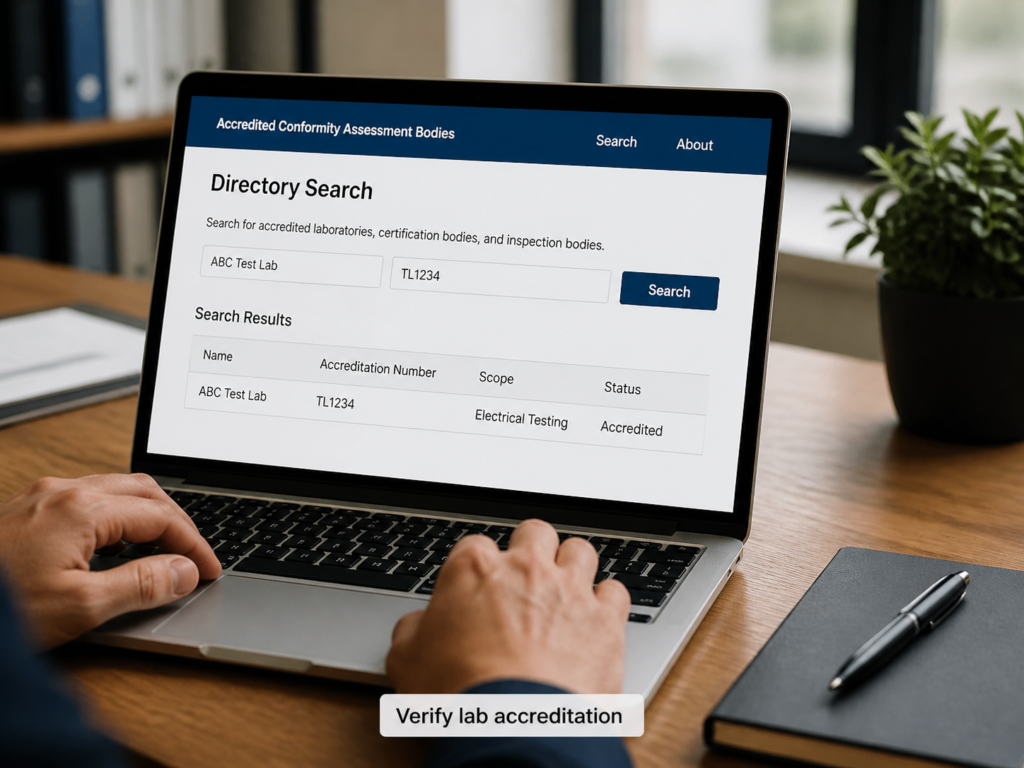
To verify qualifications, don’t just look at the plaques hung on the institution’s official website. Be sure to search for the institution name and qualification number in the official directory of the corresponding certification. For example, check NRTL on the U.S. OSHA official website, check NB institutions in the EU NANDO database, and check 17025 accreditation on the official website of the corresponding national accreditation body or the ILAC database.
When checking, focus on: whether your product type, corresponding test standards, and specific test items are in the accreditation scope. In addition, pay attention to subject traceability: when the contracting party, payee and report issuing party are different, you should require a written explanation of the legal relationship between the parties, the actual testing or issuing subject, subcontracting arrangements and liability assumption, and verify the real qualifications of the report issuing laboratory and the accreditation mark. Just because the subjects are different, you cannot directly judge that it is affiliated or the report is invalid.
Second: Have Practical Testing Experience in Charging Products
Laboratories that have not done charging products are easy to use wrong standards and miss test items, and the report will be useless in the end. How to verify experience? You can ask the other party to provide past anonymous report cases of similar products, such as report sample pages of 65W GaN chargers and 240W USB-C fast charging cables (customer information can be redacted).
Reliable institutions can accurately explain the corresponding test requirements according to your product structure, covering safety, EMC, protocols, cable current carrying, material environmental protection and other categories, instead of just saying “we can do everything”. Here is a quick test tip: you can ask “For the same series of chargers, if we change 20W to 65W and replace the main control chip, can we share the previous report?” If the other party directly says “yes” or answers off the point, eliminate directly – core chip and power changes are high-risk changes, which usually require re-testing or difference assessment, and cannot directly share the report.
Third: Actual Testing Capability and Transparent Subcontracting
Prioritize laboratories that have their own equipment for core test items (such as safety, EMC, fast charging protocol testing), and don’t look for “intermediaries” that outsource all items. Non-core items can be subcontracted, but the institution must disclose in writing the subcontracting items, subcontractor qualifications, responsibility division, and report issuing subject.
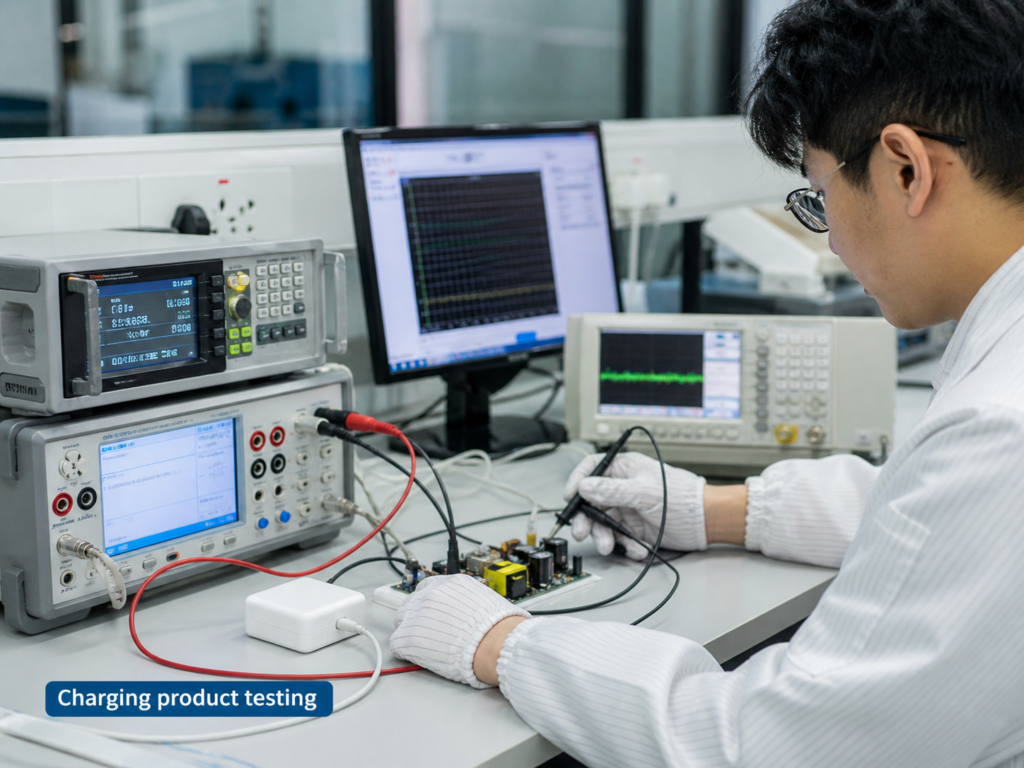
The verification method is very simple: ask the other party to provide real photos of key test equipment, calibration certificates, and ask whether witness testing or other process transparency measures are provided. Witness testing means you can go to the site to watch the testing process; but if the laboratory does not accept witnessing due to safety, confidentiality or test management reasons, you should also ask it to explain the reason, and verify through test plans, sample circulation records, phased information and report traceability. If the institution refuses to disclose the subcontracting situation, or hesitates and can’t explain clearly, the risk will be very high: subcontracting will not only lengthen the cycle and increase costs, but also may lead to the subcontractor having no qualifications and no one being responsible for problems.
Fourth: Verification of Platform/Regulatory Acceptability
Before sending samples, it is best to confirm with the platform customer service, importer or local regulatory channel whether the institution’s report is accepted, and file the confirmation record in writing. The content to be confirmed includes: report format requirements, applicable standard version, laboratory access restrictions, report validity period requirements, and accompanying material requirements.
Many people ignore this step, spend money to make a report, but the platform says the standard version is too old, or the format does not meet the requirements, and does not accept uploads, so they can only redo it in the end, wasting time and money.
After Passing the Hard Thresholds, How to Choose the Most Suitable One for You
Institutions that meet the hard thresholds are basically compliant, but to choose the most suitable one, you can also make advanced comparisons from four dimensions.
First Calculate the Total Cost of the Whole Cycle, Don’t Just Look at the Low Price at the Beginning
Many people choose institutions only looking at the first number on the quotation, and finally find that they spent twice as much money after finishing. The full cycle cost includes: basic testing fee, certification/application fee, national difference testing fee, sample transportation fee, rectification and retesting fee, annual fee/factory inspection fee, all of which should be clarified in advance.
A reliable quotation will definitely clearly state: test product model, coverage standards, included items, number of report copies, issuing subject, subcontracting situation. If the quotation is particularly low, be vigilant: it may be that necessary test items are deleted, expired standards are used, subcontracting is concealed, and the final report is invalid. In addition, when comparing prices, you should limit the same conditions: same time, same region, same standard, same product configuration, whether certification is included, whether it is calculated based on one pass, otherwise there is no comparability.
Look at Service Reliability to Avoid Subsequent Disputes
Service seems to be a soft indicator, but it will directly affect efficiency when actually doing projects. Reliable institutions generally have these characteristics: there is a fixed contact person, smooth English communication, and consultation response time does not exceed 24 hours; if the test fails, specific reasons for failure and basic rectification suggestions will be provided, instead of just saying “unqualified”; there is a clear phased schedule, and the progress will be actively synchronized without you chasing every day; after the report is issued, if the platform has questions, it can cooperate to provide explanations or supplementary materials, instead of losing contact after issuing the report.
Pay Attention to Sample and Information Security
If your product is a new product not yet on the market, or has an exclusive design, this point is particularly important. First, sign a Non-Disclosure Agreement (NDA) to protect confidential information such as product design and BOM. Second, clarify sample management rules: the storage period of samples after testing, return rules, and damage compensation liability. Finally, confirm the ownership of test data: without your consent, the institution shall not disclose your product information or use your product for publicity.
Look at the Special Adaptability of Charging Products
Charging products have many exclusive test requirements, which ordinary electronic laboratories may not be able to cover:
• For fast charging protocol certification, you must choose an institution with corresponding official authorization. Authorizations of different systems are not universal. For example, having USB-IF authorization does not mean you can do Qualcomm QC certification;
• For high-power chargers, confirm that the laboratory has high-voltage and high-current test qualifications under the corresponding standards. For example, for chargers above 100W, the power capacity of the test equipment must be sufficient;
• For USB cables with data transmission, confirm that the laboratory has the ability to test data transmission stability and speed;
• For multi-port chargers and replaceable plug adapters, confirm that the laboratory can test performance and safety under different combinations, such as power distribution when multiple ports output at the same time, and insulation performance after changing plugs.
Full Practical Process: From Inquiry to Change Control in One Step
Knowing how to choose, the specific operation can be carried out in the following 8 steps, which is not easy to miss items:
Step 1: Sort Out Requirements and Data List
First list your needs clearly: product model, parameters, target market, required document type, expected cycle, budget range. Then prepare relevant materials: product specification sheet, circuit schematic (optional), BOM (optional), label/manual draft. Finally, sort it into a unified inquiry document, and all candidate institutions use the same one, so that the subsequent quotations can be compared horizontally.
Step 2: Initially Screen 3-5 Candidate Institutions
Reliable channels for finding institutions include: official certification directories, cross-border platform recommended service providers, and real recommendations from peers. Don’t just search for ads on search engines. During the initial screening, you only need to ask three questions: whether there is corresponding qualification, approximate quotation range, and approximate cycle. Eliminate those that do not meet the hard thresholds, and leave 3-5 for re-examination.
Candidate institutions can be selected in combination: for example, 1 large comprehensive institution, 1 vertical institution specializing in charging products, 1 local institution in the target market, so that the comparison is more comprehensive and can match different needs.
Step 3: Send a Unified Inquiry Document
Send the same product information and demand list to all candidate institutions, require the other party to quote in a unified format, and clearly list test items, cycle, cost details, and subcontracting situation. Don’t give different information to different institutions, for example, tell A it’s 65W and tell B it’s 20W, the final quotations can’t be compared at all.
Step 4: Re-examine Qualifications and Cases, Confirm the Partner
First verify the authorization qualifications and accreditation scope of each institution through official channels, don’t just listen to the salesperson. Then compare the cases of similar charging products, ask the other party to provide report sample pages with customer information redacted to confirm that they have actually done it. Next, carefully check the contract terms: cost details, cycle, rectification support, retest rules, confidentiality clauses, subcontracting rules, all should be written into the contract. If necessary, you can confirm with the platform customer service whether the institution’s report is accepted by the corresponding category, and sign the contract after there is no problem.
Step 5: Final Check Before Sending Samples
The number of samples should be confirmed in writing by the laboratory according to the test plan, considering the needs of destructive testing, spare samples, multi-model combinations, etc., don’t just send a few randomly and they are not enough. The samples must be exactly the same as the mass-produced version, and cannot use temporarily modified prototypes, otherwise the test will be useless.
Do a simple self-test before sending the samples: check whether the samples can work normally, whether there are obvious short circuits, shell damage and other problems, to avoid sending broken ones and wasting test time. The accompanying materials should be complete, and the model and parameters of the samples must be exactly the same as the declared information. In addition, you must keep 1-2 identical samples for subsequent rectification or re-examination.
Step 6: Test Process Follow-up and Draft Check
You don’t have to rush for progress every day, but pay attention to several key nodes: sample sign-in, test start, problem feedback, report draft issuance. After getting the report draft, first check the basic information: whether the product model, parameters, brand, and sample photos are wrong, these text errors can be modified.
But remember: original test records and results shall not be arbitrarily altered; if errors in entry, calculation or report preparation are found, the laboratory shall revise the report according to controlled correction and traceable procedures. The new conclusion after product rectification must be based on retesting or confirmed supplementary assessment, and the original results cannot be modified artificially. If the institution says it can help you change the data, terminate the cooperation directly, this is fraud. If the test fails, first ask the reason and rectification suggestions, then decide whether to retest.
Step 7: Verify Validity After Getting the Report
After getting the official report, first verify the authenticity: if there is a public database, directly enter the report number on the official website of the issuing body to query. When checking, note: the accreditation mark can only be used for items within the accreditation scope. If a test item is not within the accreditation scope but the report is stamped with the 17025 seal, it is non-compliant; the certification certificate should be confirmed to be valid through official channels. Finally, keep the original report and query verification records for platform upload and customs clearance.
Step 8: Mass Production Consistency and Change Control
Many people think that doing a report once is once and for all, but it’s not. First, establish a product baseline: archive the BOM, key components, software version, and structure to ensure that the mass-produced version is consistent with the test sample. If you want to make changes later, first judge whether it is a high-risk change – such as power main control/protocol chip, transformer, Y capacitor, fuse, PCB, shell flame retardant grade, plug, wire diameter, these are all high-risk changes, which will directly affect safety and performance.
When a high-risk change occurs, you must first apply for a change assessment from the laboratory or certificate holder, confirm that re-testing is not required, or after completing the difference test, then continue to use the original report. Products with changes that have not been assessed shall not default to using the original report or certificate as their compliance basis. The original report is still the record of the original tested sample, but whether it is applicable to the changed mass-produced product must be assessed by the laboratory, certification body or certificate holder according to the applicable scheme.
Pitfall Avoidance Guide: Never Step on These Pitfalls
5 Frequently Asked Questions for Novices
1. **Is the more expensive the institution, the better?** No. It’s enough to match your needs. For small-batch trial sales, there is no need to choose top international institutions, as long as the qualifications are real and the report is accepted by the target market and platform.
2. **Is the report globally universal?** Most certifications have regional restrictions. For example, U.S. FCC is useless in the EU. CB reports can be used as the technical basis for multi-region certification, but do not mean automatic certification. They need to be transferred to local certification and supplemented with national difference testing.
3. **Is the institution responsible if the test fails?** Generally not responsible. Testing is an objective judgment of the submitted samples. Unqualified is a problem of the product itself, but reliable institutions will provide specific rectification suggestions to help you optimize the product.
4. **Can I ask the factory to find a laboratory on my behalf?** Yes, but you must verify the qualifications and the authenticity of the report by yourself. Many factories will find cheap institutions to reduce costs, or even fake reports, and the seller is still the one who bears the responsibility in the end.
5. **Must I choose a local institution in the target market?** Not necessarily. As long as there is corresponding official authorization, it is okay. Local institutions may be more familiar with local rules, but the cost is usually higher, so choose according to your needs.
Eliminate Directly When Encountering These Situations, Don’t Hesitate
• Those who promise “100% guaranteed pass” “full refund if not passed”;
• Those whose quotation is far lower than the market price, whose certificate issuance speed is abnormally fast, and cannot give a reasonable basis;
• Those who promise to provide CE certificates/reports without assessing applicable regulations or requiring sample testing, or cannot provide corresponding technical documents and issuance basis;
• Those who cannot provide qualification numbers, cannot be found in official directories, and whose accreditation scope does not cover your products;
• Those whose subjects cannot be traced and refuse to disclose subcontracting situations;
• Those who actively sell “ready-made reports” and say that certificates can be issued without sending samples.
Finally: Quick Checklist
If you can’t remember all the above content, follow this checklist and you won’t make big mistakes:
1. First sort out the needs: clarify the charging product parameters, target market/platform, required document type, budget/time priority;
2. Must pass hard thresholds: qualifications are real and cover products, have practical testing experience in charging products, transparent subcontracting, acceptable to platforms/regulators;
3. Choose the best: compare the total cost of the whole cycle, service reliability, confidentiality measures, and special adaptability of charging products;
4. Operate according to steps: sort out materials → screen candidates → unified inquiry → re-examine → send samples → follow up → verify report → change control;
5. Pitfall avoidance principle: don’t believe “guaranteed pass”, “ultra-low price”, “ultra-fast certificate issuance”, all qualifications must be verified through official channels.
After reading this article, you should be able to distinguish core compliance terms, avoid 4 novice misconceptions, understand the accreditation scope requirements of ISO/IEC 17025, use 4 hard thresholds to quickly screen unqualified institutions, judge the rationality of quotation and cycle of charger and USB-C cable test reports, and also complete the whole operation from inquiry to change control according to the process, identify fake institutions and invalid reports, and meet the compliance requirements of cross-border platforms.