
Anyone selling charging products into the US market will almost inevitably encounter the confusing terms ETL, NRTL, and UL. Some say ETL and NRTL are two peer-level certifications with different effectiveness; some say only UL is hard currency and other certifications are useless; others think that if customs doesn’t check, there’s no need to do it, and passing customs means compliance. In fact, most of these statements are misunderstandings about the subordinate relationship and applicable boundaries of certifications. After clarifying the logic, you can not only avoid pitfalls but also save a lot of unnecessary costs.
Beginner’s Basics: Clarifying the Hierarchy of ETL, NRTL, and UL
First, let’s clarify the product scope discussed in this article: this article focuses on products that are directly connected to AC power, have power conversion functions, or perform regulated power supply functions, such as wall/desktop chargers, power adapters, USB/USB-C charging cables, car chargers, charging ports/connectors, etc. Pure data cables usually do not trigger NRTL requirements due to their USB data function itself, but if they are used for building wiring, have a specific flame retardant rating, include power supply functions, or have additional requirements from target channels, applicable standards and certification requirements still need to be verified separately.
Many people think NRTL is a type of certification, but it is not. The full name of NRTL is **Nationally Recognized Testing Laboratory**, which refers to third-party testing and certification bodies accredited by the US Occupational Safety and Health Administration (OSHA). The accreditation scope of each body is listed by specific product safety standards and product categories, and its certification can only be used to meet corresponding OSHA requirements within the scope of products and standards covered by applicable regulations or workplace requirements.
Common NRTL bodies currently include UL, Intertek (the body that issues ETL certification), CSA, TÜV Rheinland, etc. It should be noted that NRTL is not a master list of product certification bodies recognized by all US regulations and mainstream channels, and OSHA does not require all electrical products to be certified by an NRTL. Whether a specific body has the accreditation scope for a certain type of product and standard can be queried on the official OSHA website.
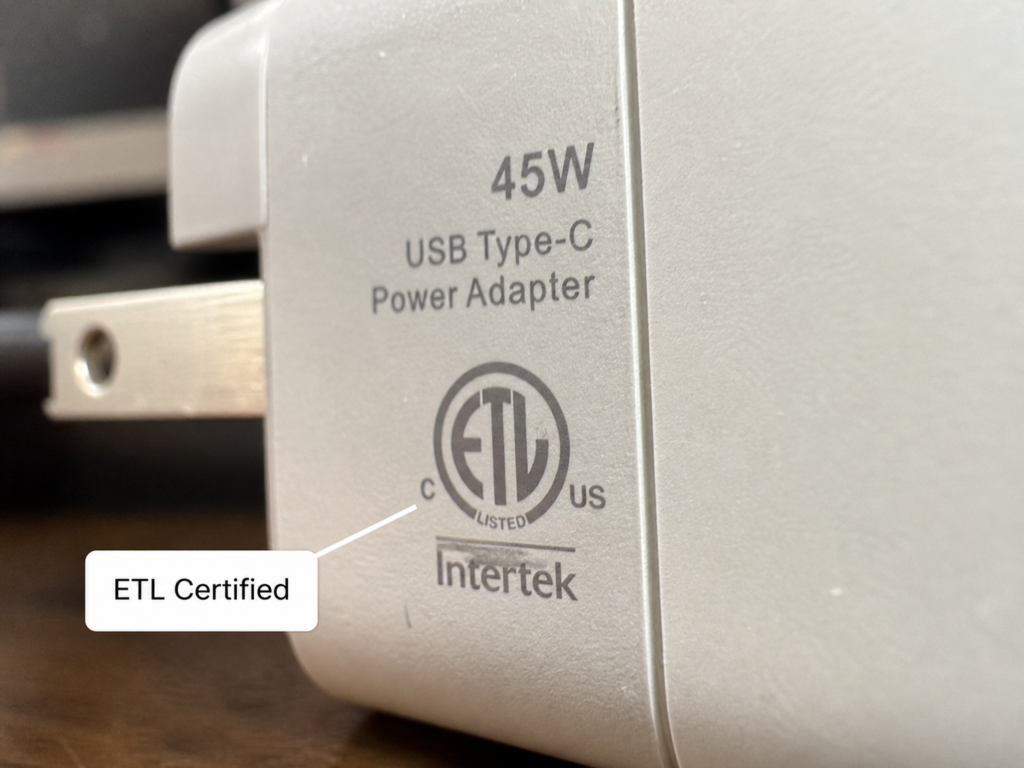
So what is ETL? ETL is a product safety certification mark issued by Intertek, an NRTL body, and is a type of NRTL body certification—just like coffee sold by Starbucks is a type of coffee, the two are not parallel categories. ETL can cover many chargers, power adapters and related products, but whether a product can be certified and which standard applies shall be subject to Intertek’s NRTL accreditation scope, product standards, and final certification records.
If a product is sold in both the US and Canada, you can apply for the cETLus mark covering the requirements of both countries from a body with corresponding capabilities. This usually requires simultaneous assessment of applicable standards and differences between the US and Canada, and Canadian recognition cannot be automatically obtained solely based on US certification. A special reminder here: only products marked “ETL Listed” are formally certified; a single test report is not equivalent to a formal listed certification, and cannot be directly used to affix the certification mark or serve as proof of Listed certification in platform audits.
Now let’s talk about the most familiar UL. UL is currently one of the most well-known NRTL certification marks. Its parent company, UL Solutions, is itself a long-established body on the NRTL list, and has also participated in the development of a large number of North American electrical safety standards, so it has very high consumer awareness. However, it should be noted that UL is only one of the NRTL members, not the only legitimate issuing body, and there is no need to deify it.
Many people who are new to this field treat ETL and NRTL as two certifications of the same level, thinking that NRTL is a certificate issued by another body with different validity than ETL. This is a very common misconception. The source of this misunderstanding is that some channels refer to certifications issued by other NRTL bodies as “NRTL certification” for short, and over time this has become a concept parallel to ETL.
In fact, judgment needs to be made at two levels simultaneously: first, whether the issuing body is an OSHA-recognized NRTL; second, whether the body has the corresponding accreditation scope for your product and applicable standards, and whether the certificate covers your specific model, factory, and sales conditions. When the same applicable requirements are met, different NRTLs within the OSHA accreditation scope can usually be used to meet the corresponding OSHA recognition requirements, but this does not mean that all regulatory, channel, and customer requirements are automatically equivalent.
Boundary Judgment: Does Your Charging Product Need NRTL Certification?
Now that we have clarified the hierarchy of the three, the next core question arises: does my charging product need NRTL certification? Why do many people say it is the “de facto threshold” for the US market?
First, let’s clarify the most common misunderstanding: NRTL certification is not a unified mandatory customs clearance document for US Customs. In many cases, products may clear customs without certification, but this does not mean the product is compliant.
For applicable workplace electrical equipment, OSHA and state and local electrical codes may require the equipment to be evaluated or listed by an accredited body; whether this applies should be confirmed in combination with the equipment type, installation location, applicable regulations, and the local authority having jurisdiction. Lack of required recognition may lead to rectification, enforcement, or failure to pass on-site acceptance, but this is not the case for all products uniformly.
In terms of channels, some platforms, retailers, and purchasing customers may require verifiable NRTL listing or other safety compliance documents for products such as chargers. Which bodies and documents are specifically accepted shall be subject to the current rules and written requirements of the target channel. Platform policies vary by product category, sales site, specific product, and audit situation, and the requirements of a certain platform or supermarket cannot be generalized as a unified rule for the entire US.
In terms of risks, if a product lacks applicable safety certification or listing, it may affect platform sales, retailer procurement, insurance arrangements, and accident liability determination. Therefore, for legitimate market operators, NRTL is often an important compliance option, but whether it is a necessary condition for a specific product still needs to be confirmed item by item in combination with the product, use, sales channel, and jurisdiction.
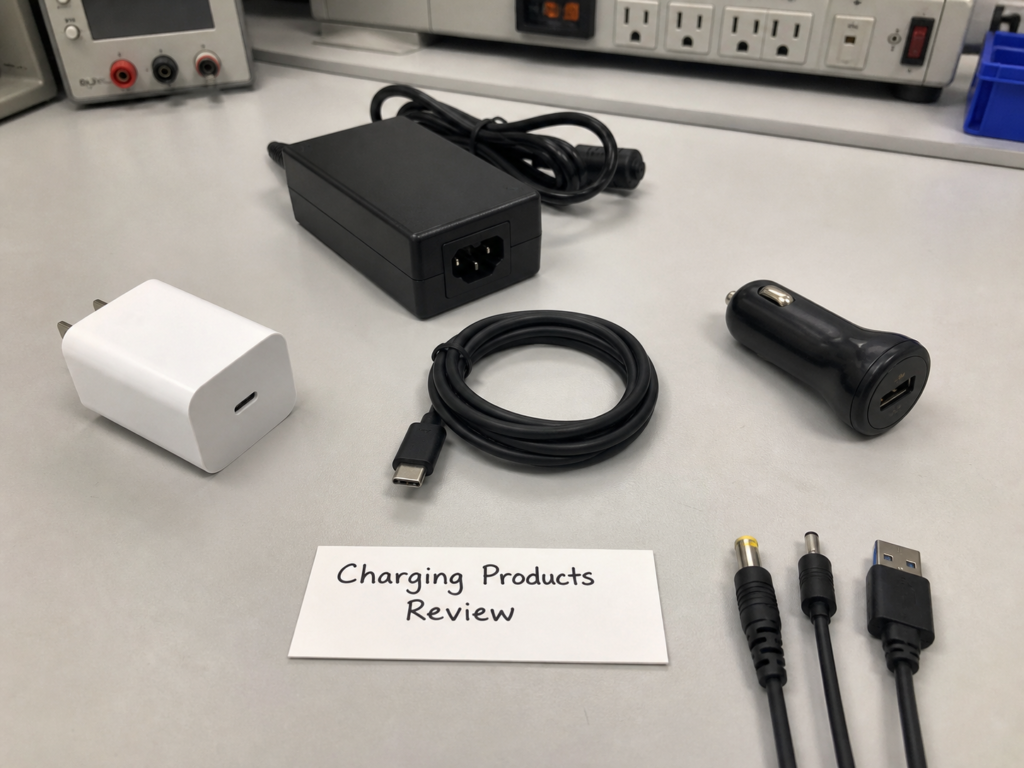
For different charging products, the requirements are also different; let’s go through them one by one.
First are wall-mounted chargers and power adapters, which are categories that are often the focus of regulatory and channel audits. Because they are usually directly connected to household AC power and may remain energized for a long time, NRTL applicability assessment should be prioritized.
They may involve UL/CSA 62368-1, UL 1310, or other specific product standards. UL 62368-1 applies to many information technology, audio-visual, and communication equipment, but is not the only standard for all adapters; UL 1310 is mainly for Class 2 power units, and cannot be used as a general standard for all power adapters. The final confirmation shall be made by the NRTL based on the product structure, use, and sales or installation scenario.
A misconception needs to be corrected here: you cannot directly judge whether NRTL listing is mandatory solely based on power, number of interfaces, or “AC input”. Low power does not necessarily mean automatic exemption, and AC input does not mean that all power products are subject to the same certification requirements.
Next are the most frequently asked about USB/USB-C charging cables; judgment cannot be based solely on whether there is an E-Marker. USB cables with power supply functions, especially high-current or special-structure cables, should be separately verified for applicable cable safety standards, such as UL 9990, and whether the target channel requires listing or a mark. E-Marker itself is not NRTL certification, nor can it alone determine certification obligations.
For pure data transmission cables, NRTL requirements are usually not triggered by the USB data function itself; however, if they are used for building wiring, have a specific flame retardant rating, include power supply functions, or are explicitly required by the channel, separate assessment is still required. The NRTL certification of a charger does not automatically cover matching cables; when cables are sold separately, it is especially necessary to check whether the certification document explicitly covers the cable.
For kits or special categories, the rules are a bit more detailed. For kits of charger plus data cable, complete machines, and separately sold accessories, the coverage scope of certification documents must be checked separately. If separate sale or component replacement changes the certification conditions, the NRTL needs to confirm whether independent certification or supplementary assessment is required.
Detachable power cords should meet applicable cable or cord assembly requirements, for example, involving UL 817 when applicable, but UL 817 cannot be generally referred to as the standard for all plugs and accessories, nor can the compliance of the entire product be judged solely based on existing marks on components.
There are also car chargers, which may apply to corresponding standards such as UL 2089, which are not necessarily the same as those for household chargers. You cannot directly use the certification of a household charger to cover a car charger. When checking, be sure to follow the model, components, and applicable scope on the certificate; you cannot assume the entire product is compliant just because a certain component has certification.
Finally, we need to draw a clear boundary between NRTL and other common US certifications; they cannot replace each other.
NRTL mainly assesses product safety, including risks related to electricity, energy, temperature rise, mechanics, and fire. Products with digital circuits or radio frequency functions should also be judged for requirements such as FCC Part 15 respectively; when applicable, Supplier’s Declaration of Conformity (SDoC) or FCC equipment certification may be used, and all situations cannot be collectively referred to as “applying for FCC certification”.
DOE or California CEC are energy efficiency requirements that some power adapters need to comply with. USB-IF is a voluntary compatibility certification for USB interfaces, proving that the interface meets USB specifications, but it cannot replace NRTL safety certification.
Core Comparison: ETL vs Mainstream NRTL (Using UL as a Reference)
Since formal NRTL certifications that meet the same applicable requirements can usually be used to meet corresponding OSHA recognition requirements, what is the difference between ETL and the most familiar UL?
Let’s first state the premise of the comparison: it must be a formal OSHA-recognized certification for the same product, same applicable standard, and same model, and the issuing body must have the accreditation scope for the corresponding product standard. Situations such as fake certificates, misappropriated certificates, test-report-only certifications, and certifications beyond the authorized scope are excluded. If a channel specifies a certification, the product is special, the body does not have authorization for the corresponding standard, or the customer has additional requirements for certification documents, the conclusion may be adjusted.
For quick reference, we have compiled a comparison of core dimensions:
| Comparison Dimension | ETL Certification | UL Certification (Mainstream NRTL Reference) |
| Recognition and Applicability | When within Intertek’s corresponding NRTL accreditation scope and meeting specific project requirements, it can be used to meet corresponding OSHA recognition requirements | When within UL Solutions’ corresponding NRTL accreditation scope and meeting specific project requirements, it can be used to meet corresponding OSHA recognition requirements |
| Channel Coverage | Accepted by many channels, but need to verify the target platform, product category, and current audit rules | Accepted by many channels; some channels or customers may specify UL |
| Testing Standards | Applicable US or North American safety standards are adopted according to the product and project | Applicable US or North American safety standards are adopted according to the product and project |
| Regular Certification Cycle | Subject to the quotation and schedule of the specific project | Subject to the quotation and schedule of the specific project |
| Regular Cost (Low-power Single Model) | Subject to the specific written quotation | Subject to the specific written quotation |
| Flexibility for Same-series Models | Subject to the certification plan and project rules | Subject to the certification plan and project rules |
Next, let’s add a few details not fully listed in the table.
First is the difference in recognition. When the same applicable requirements are met, NRTLs within the OSHA accreditation scope can usually be used for corresponding OSHA recognition scenarios, but commercial channels are not necessarily completely unified. Many channels accept ETL or other NRTL listings that meet their requirements and can be verified in the issuing body’s database; at the same time, the target channel, product category, and current audit rules must be checked one by one. Some channels or customers may specify UL or other specific bodies.
In terms of regional versatility, if selling in both the US and Canada, ETL can apply for the cETLus mark covering the requirements of both countries, and UL also has a corresponding US/Canada combined mark. The standards, national differences, certification scope, and follow-up requirements of the two countries may be different, and US certification cannot be automatically regarded as Canadian recognition.
In terms of consumer awareness, UL does have higher popularity. If your main selling point is safety and you want to use certification for brand endorsement, UL’s consumer awareness advantage may be more obvious, but this is a difference at the brand and marketing communication level, and does not mean that other NRTLs necessarily have lower safety effectiveness when meeting the same applicable requirements.
Next are testing requirements and processes. If both parties adopt the same applicable standard for the same product, the core safety requirements are usually comparable, but the certification plan, national differences, factory follow-up, and model expansion rules shall be confirmed according to the specific project rules of each body, and cannot be generalized as ETL necessarily being more flexible.
The core process usually includes sample testing, factory audit, certification issuance, and follow-up tracking services, but the specific arrangement varies by certification type and body plan. It should also be noted that test reports from different NRTL bodies are not necessarily directly mutually recognized. If you previously did UL and now want to switch to ETL, or vice versa, the new body needs to assess whether existing materials can be used, supplementary testing is needed, or a dedicated certificate transfer process is required; you cannot directly exchange the report for a certificate.
Cost and cycle must be subject to the written quotation and schedule of the specific NRTL for the product, standard, model, factory, and service scope. There is no fixed price difference and fixed cycle for ETL or UL that applies to all charging products. The actual cost is affected by factors such as product complexity, number of rectifications, factory location, number of models, certificate type, body schedule, and follow-up service arrangements.
Therefore, it cannot be taken as a fixed fact that ETL is necessarily cheaper and faster, or that its annual fee, factory inspection fee, and model addition fee are necessarily lower than those of UL. When comparing, you should look at the testing fee, rectification and retesting fees, initial factory audit fee, and the total cost of follow-up tracking services and model expansion at the same time.
Finally, mark use and authenticity inquiry. The mark styles of the two are different. Whether a US or Canadian regional mark is required, as well as the size and use position of the mark, must be strictly implemented in accordance with applicable product standards, certification documents, and the Marking and Labeling requirements of the issuing body.
Charging products are not all uniformly required to have the mark placed on the product body or minimum packaging. The marking method for small cables or connectors may not always be directly placed on the connector housing, and must be approved by the issuing body in advance.
The logic for checking authenticity is universal: first, go to the official OSHA website to check whether the issuing body has the relevant NRTL qualification; second, go to the official website or official database of the issuing body, enter the certification number, and check whether the product model, parameters, and manufacturer are consistent; third, confirm that the body has the accreditation scope for the relevant product standards, and check whether the certificate covers the actual product, factory, and sales conditions. Only formal Listed certification can use the corresponding mark; a single test report cannot replace formal certification.
Decision-Making Method: Choose ETL or Other NRTLs
After comparing the differences, should you choose ETL or other NRTLs? Actually, there’s no need to struggle; we can judge step by step according to scenarios and needs.
First are three typical scenarios where ETL can be prioritized for assessment.
The first is small and medium-sized sellers or purchasers with limited budgets. As long as there are no special requirements from the channel, ETL can be used as an NRTL option that meets project requirements. The second is new products rushing to market, for example, new fast chargers rushing to peak sales seasons like Black Friday or Prime Day. You can compare the actual schedules of different bodies and choose a plan that can meet the launch plan. The third is sales through ordinary channels, such as focusing on mass e-commerce platforms like Amazon and eBay, or ordinary offline supermarkets. The specific requirements of these channels need to be checked one by one, and you cannot pre-assume that all sites and products uniformly accept ETL.
Correspondingly, there are three situations where it is not recommended to only choose ETL.
The first is when the channel or customer explicitly requires UL or another specific NRTL mark. In this case, follow the requirements and do not force ETL, otherwise you may fail the audit. The second is industrial, engineering, or specific customer projects. For such products, priority should be given to checking whether the procurement specification, engineer, or Authority Having Jurisdiction (AHJ) specifies a certain NRTL; you cannot infer that UL must be chosen based on 100W or other single power threshold. The third is brands positioned as high-end safety-focused, which need higher-recognition certification for endorsement. UL’s consumer awareness advantage may be more obvious.
If the above scenarios still can’t help you make a decision, you can use the more systematic “three-layer demand judgment method”, in order of priority from high to low.
The first layer is legal and installation scenario requirements. You need to first confirm whether the product type, use location, applicable regulations, and local authority require recognition or listing; you cannot treat all charging products as uniformly requiring mandatory NRTL.
The second layer is channel requirements. Check the rules of the platforms and supermarkets you want to enter in advance, and confirm which certification bodies, document types, product models, and factory information they accept. Some channels accept ETL, while some may specify specific bodies or require additional materials.
The third layer is customer or brand needs. If your customer explicitly requires a certain certification, or your brand positioning requires higher-recognition endorsement, then consider choosing a more well-known body like UL.
When making a judgment, be sure to follow this order: first look at regulations and installation scenarios, then channels, and finally brand needs. Don’t choose the most expensive one right away, and don’t choose one that doesn’t meet requirements just to save money.
More experienced practitioners should also learn to calculate the total cost of certification, and not make a decision based solely on the initial quotation. The cost of certification usually includes testing fees, initial factory audit fees, follow-up tracking service fees, model expansion fees, and possible fees for rectification and retesting. The charging methods and service arrangements of different bodies are not necessarily the same, and you cannot simply assert that ETL is cheaper for all projects.
In addition, you should also consider the impact of the certification cycle on launch time. During peak seasons, schedule differences may affect sales plans, and the revenue from launching one or two weeks earlier may exceed the cost difference of the certification itself. Therefore, it is recommended that you compare the expected total cost and maintenance arrangements for at least several years, rather than just looking at the first quotation.
Finally, here is a 5-step quick checklist; going through it will help you determine which to choose:
First, has the target channel or customer specified a specific NRTL mark?
Second, is the issuing body you chose on the OSHA NRTL list? Does it have the accreditation scope for the corresponding product standard?
Third, does the certification document cover your specific product, model, manufacturing factory, and sales country?
Fourth, is the total cost of certification, including follow-up maintenance fees, within your budget? Can the certification cycle match your launch plan?
Fifth, does your brand positioning require higher-recognition certification endorsement?
Authenticity Verification: Judging Whether ETL/NRTL Certification is Real and Valid
After choosing the certification type, there is another very important step: how to verify that the ETL or NRTL certification you received is real? After all, there are many pitfalls of fake and misappropriated certificates on the market, especially for charging products. Platforms are very strict in inspections, and fake certificates cannot pass audits and may even lead to penalties.
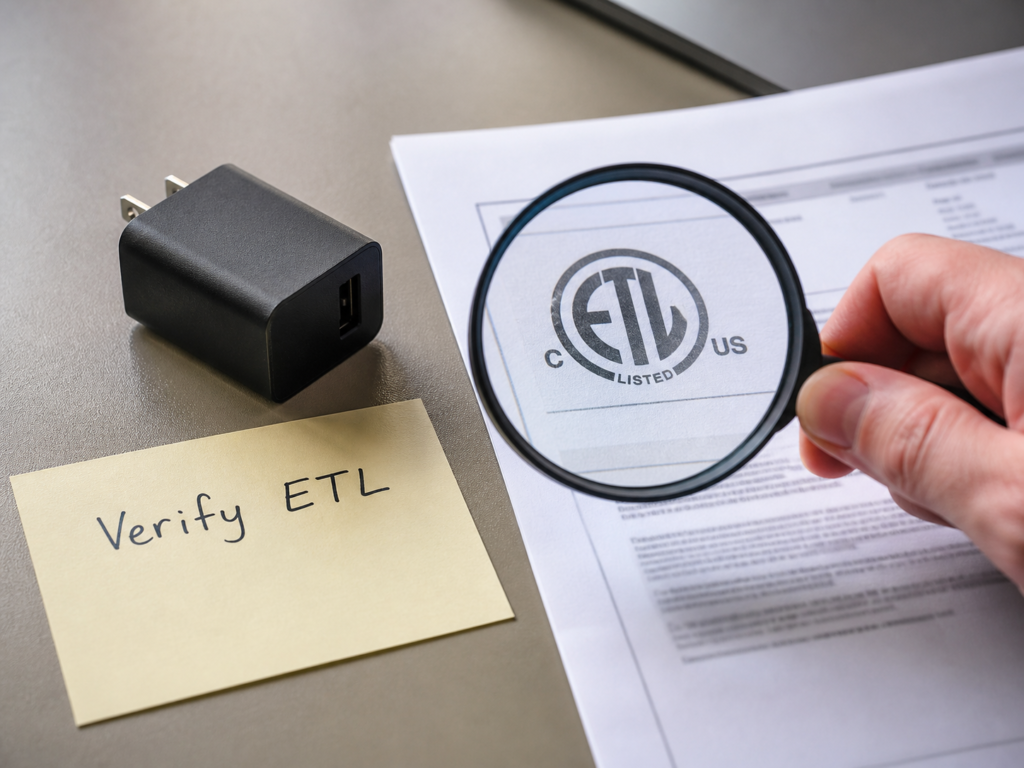
The entry-level verification method is very simple and can be done in three steps.
First, check whether the issuing body is on OSHA’s NRTL list, and confirm that the product standard is within its accreditation scope. If it claims to be NRTL certification but the issuing body is not on the OSHA list, or the product standard is not within its accreditation scope, it cannot be accepted as OSHA NRTL certification. But this does not mean that any non-NRTL test or other compliance documents are “definitely fake certificates”; they may be another type of compliance document, just cannot impersonate OSHA NRTL certification.
Second, go to the official website or official database of the issuing body, enter the certification number, and check whether the product model, parameters, manufacturer, and production location on the certificate are consistent with your actual product.
Third, confirm that the certification scope covers your corresponding product type, applicable standards, and actual sales or installation scenarios, and check whether the certificate status is valid.
For charging products, there are several details that need to be focused on for verification.
First is rated parameters: input voltage, output power, interface type, etc., must be consistent with the actual product. For example, if your certificate says 20W but the actual product is marked 65W, you definitely cannot use the same certification directly.
Second is the manufacturing factory. Check whether the actual manufacturing factory is listed in the authorized production locations, Follow-Up Service, or supplementary documents of the certification or Listing. One certification may cover one or more authorized production locations, but factories not covered cannot directly use the certification, even if the product model is the same.
Third is the certificate status: it must be valid. Suspended, canceled, or otherwise no longer valid certification records cannot be used for current product sales.
Fourth is the model list: for same-series products, confirm that the specific model you sell is in the certified model list; you cannot assume all same-series products can use it.
There are also several common tips for identifying fake and misappropriated certificates that you can remember.
First, be wary of ultra-low-priced, ultra-urgent certifications. For example, if others take weeks but they say you can get the certificate in a few days at half the price, you should require the other party to provide the formal project scope, body name, and official inquiry records; you cannot judge solely based on promises.
Second, be wary of situations where there is only a test report. A test report is just a record of test results, not equivalent to formal ETL Listed or UL Listed certification, and cannot be used to affix the formal certification mark or replace the Listed proof required by the platform.
Third, there are situations where the mark on the packaging does not match the certificate. For example, if the packaging is printed with ETL but the certificate is from another body, the product nameplate, certification documents, and official directory records of the issuing body shall prevail, and confirm that the mark use is authorized.
Finally, for private label sales, confirm that your brand, model, and production location are within the certification authorization scope. Otherwise, even if the product itself does have certification, your private label sales may not meet the coverage conditions of the certification document.
Pitfall Avoidance in Application: Common Misconceptions for Charging Products Applying for ETL/NRTL
Now that we know how to choose and how to check, finally let’s talk about several common pitfalls in applying for ETL/NRTL certification. Many novices fall into them the first time, and avoiding them in advance can save a lot of money and time.
First are the pitfalls in pre-application preparation.
First, never mass-produce before getting certification. Many people are afraid of delaying time, so they produce the bulk goods first. As a result, if the test fails and rectification is required, all bulk goods need to be reworked, causing greater losses. A more prudent approach is to first complete sample evaluation and certification confirmation, then arrange mass production.
Second, prepare NRTL certification or other recognition documents for key components in advance, such as plugs, USB-C interfaces, transformers, etc. Having appropriate component documents can sometimes reduce repeated assessments, but whether fees can be reduced or testing simplified shall be confirmed by the NRTL based on the specific project; you cannot default that all marked components can automatically get reductions.
Third, clarify the sales region in advance, and confirm the combined US and Canada plan with the issuing body before applying. Existing US certification usually cannot automatically cover Canada, but when conditions are met, you can apply for expansion or a combined mark. What supplementary tests, documents, and fees are specifically needed shall be assessed by the body based on standard differences and product conditions.
Fourth, do a pre-assessment before formal application. Find a body to help you check if there are obvious non-conformities in the product, and rectify them in advance to reduce the number of rectifications in formal testing and shorten the cycle.
Next are the pitfalls in choosing a service body.
First, do not use agents without NRTL authorization. Some small agents claim they can issue certificates, but in fact they have no qualification at all, and the certificates they issue cannot be queried and are not recognized. Be sure to confirm who the actual issuing body is and whether it has NRTL accreditation scope for the relevant product standards.
Second, ask clearly what items are included in the quotation: whether it includes testing fees, initial factory audit fees, follow-up tracking service fees, and whether there are hidden rectification fees, retesting fees, or model expansion fees. The quotation structures of different bodies may be different; don’t just look at the low total price, only to end up paying more in additional fees.
Third, confirm that the body has testing and certification authorization for the corresponding product. Not all NRTL bodies can certify charging products. Some bodies only have qualifications for partial categories or standards, so be sure to ask clearly whether the product and standard are within their accreditation scope.
Fourth, do not easily believe promises of “guaranteed pass”. Tests by formal bodies are all carried out according to standards; if they don’t meet the standards, rectification is required, and no one can guarantee a 100% first-time pass. Those who say guaranteed pass are most likely up to something fishy.
Finally are the pitfalls in use after getting the certificate. Many people think everything is fine once they get the certificate, but that’s not the case.
First, do not arbitrarily change product parameters, such as changing output power, replacing core components, replacing PCB boards, etc. These changes may affect certification conditions, and you should confirm with the issuing body in advance whether reporting, supplementary assessment, or retesting is required.
Second, do not ignore post-certification tracking services. After obtaining certification, you must accept regular factory follow-up inspections and pay maintenance fees as required by the issuing body. The inspection frequency is not necessarily once a year, and may be arranged according to the specific certification plan. Failure to complete inspections may lead to certification suspension, restriction, or cancellation, and the specific consequences shall be subject to the certification plan.
Third, when uploading product information on the platform, the model, parameters, manufacturer, and production location must be completely consistent with the certification documents, otherwise the product may be removed from the shelf if the platform conducts a random inspection.
Fourth, the use of the certification mark must be standardized, printed in accordance with the Marking and Labeling requirements of the issuing body. Do not arbitrarily change the style, proportion, color, or use position of the mark. The marking methods for small cables, connectors, and packaging should also be confirmed in advance according to the specific certification plan.
In general, ETL and NRTL are not parallel categories; ETL is a formal certification mark issued by Intertek, an NRTL body. For certification projects that meet the same applicable requirements and are within the corresponding accreditation scope, different NRTLs can usually be used to meet corresponding OSHA recognition requirements, but this does not mean that all regulatory, channel, and customer requirements are automatically the same.
For many chargers and power products directly connected to AC power, NRTL listing is often an important requirement for workplaces, state/local installation, retail channels, or customer procurement; but it is not a unified federal customs clearance or market entry condition for all charging products entering the US market. Whether to choose ETL or other NRTLs specifically depends on product structure, applicable standards, use scenarios, channel requirements, budget, cycle, and brand positioning. As long as you can clarify the hierarchy, judge product needs, verify the certification scope, calculate the total cost, and verify authenticity, you can avoid the vast majority of pitfalls and choose a certification plan that is more suitable for you.