
US market importers of products such as charging cables, chargers, and wireless chargers may encounter inspections, delayed release, or enforcement measures due to device authorization, labeling, documentation, or other customs and regulatory issues. For example, certificates provided by suppliers may not cover actual models, or products may have relevant documentation but fail to complete labeling as required. It should be noted that FCC is not a unified import certification threshold for all charging cables, chargers, or electronic products; whether FCC authorization is required should first be determined based on specific product classification.
Similar issues may also arise when listing on platforms: some platforms require submission of test reports or safety certification documents, while other platforms have different documentation requirements based on product category, site, and risk policies. Many people cannot clarify the relationship between FCC and UL, which is required by federal regulations, and which is required by channels or usage scenarios, not only wasting money but also delaying sales progress.
In this article, we will clarify the rules of FCC and UL/NRTL from the practical perspective of importers, covering basic concepts, path determination, application processes, procurement pit avoidance, and checklists, covering your full-process needs from product selection to listing. After reading it, you can make basic judgments on your own without being led by others.
Assess Before Spending Money: Pre-Evaluation of Compliance Paths
After clarifying the basic concepts, don’t rush to ask laboratories for quotes. The first step is to determine what category your product falls into and which compliance path to take. Otherwise, it is easy to spend extra money on unnecessary certifications, or miss required items.
First, clarify the applicable product scope. The logic discussed in this article mainly targets three types of products:
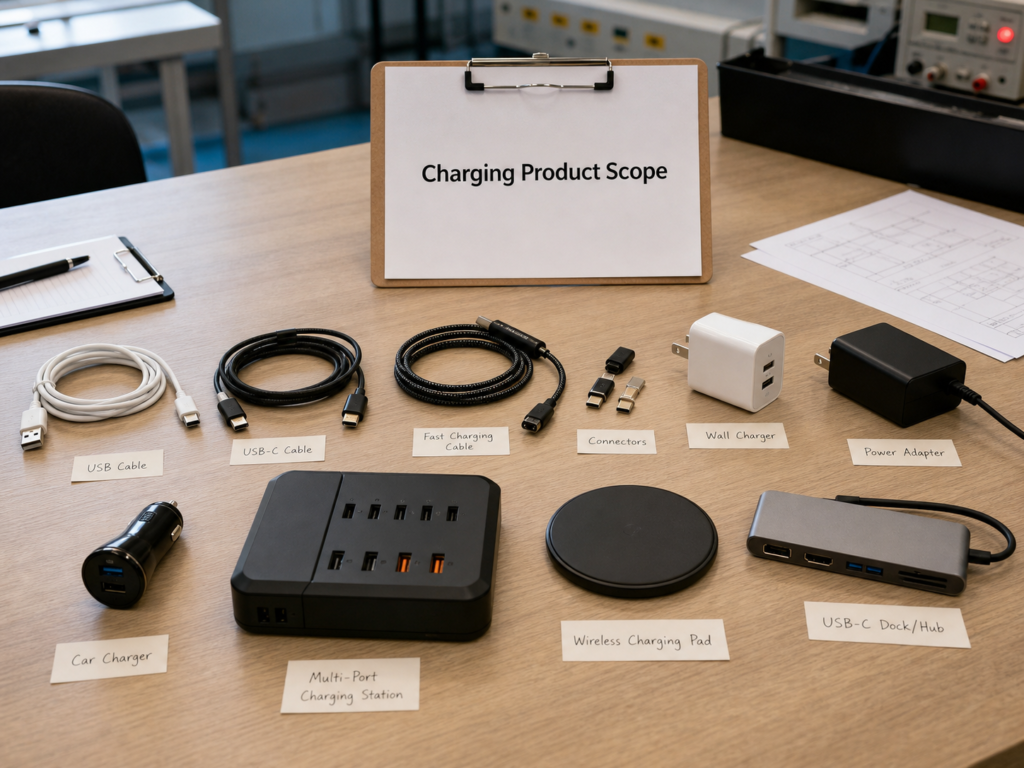
• Cable category: ordinary charging cables, USB/USB-C cables, active fast charging cables, connectors;
• Power supply category: wall chargers, power adapters, car chargers, multi-port charging stations, wireless charging pads;
• Edge category: USB-C docks, hubs with charging function, can also refer to this logic for determination.
How to Determine the FCC Path?
Before determining the FCC path, you need to prepare several key pieces of information first: whether the product has radio frequency functions (Bluetooth, Wi-Fi, etc.), whether it has digital circuit or data processing functions, the specific parameters of the wireless charger, and whether it is an accessory for a complete device.
Depending on the product, FCC may involve different paths such as exemption, SDoC, or Certification, which cannot be determined solely by the product name or whether it is plugged into power.
The first is **exemption scenarios**. Pure passive ordinary charging cables, such as cables without active electronic circuits, are usually not devices that require separate FCC device authorization. If used as a system accessory, the manufacturer or laboratory should determine whether it needs to be included in the complete device test based on the connected host, final configuration, and test plan, rather than treating “evaluation with the complete device” as a fixed legal process for all passive cables.
The second is **SDoC (Supplier’s Declaration of Conformity)**. It usually applies to unintentional radiators that are subject to Part 15 Subpart B but do not intentionally emit radio waves. For example, for an ordinary 20W wall charger or a multi-port charging station without wireless functions, first confirm whether it is indeed subject to Part 15 and whether exemptions such as Part 15.103 apply; if it is a device applicable to SDoC, corresponding tests should be completed in accordance with FCC regulations, and a conformity declaration should be signed by a responsible party located in the United States.
For SDoC devices, the laboratory used cannot be generally required to be an “FCC-recognized laboratory”. The testing laboratory should have corresponding capabilities to complete tests and issue qualified reports in accordance with FCC requirements; specific qualification requirements should be confirmed based on the device category and authorization path.
The third is **Certification (formal certification)**. It usually applies to devices that intentionally emit radio waves, such as Bluetooth, Wi-Fi, and cellular networks. Such products generally need to be reviewed and certified by an FCC-recognized TCB (Telecommunication Certification Body), and obtain a unique FCC ID, which can be queried in the FCC official database.
There is a special category to note here: wireless charging pads. Wireless chargers work by electromagnetic induction or other wireless power transmission methods. Different frequencies, power levels, coil structures, and designs may involve FCC Part 15, Part 18, or other applicable rules. They cannot be fixedly classified on their own, and must be evaluated by the laboratory based on the specific design.
The determination of cable categories also cannot rely solely on whether there is a chip. Active cables with E-Marker or other chips should undergo FCC applicability evaluation, but it should not be concluded that separate FCC authorization is required just because they contain chips. The laboratory needs to combine the specific circuit, interface, working method, and final configuration to determine whether it is subject to Part 15, whether it can be evaluated with the host, and whether SDoC, Certification, or exemption path applies.
How to Determine the UL/NRTL Path?
Before determining the UL/NRTL path, you need to prepare the following information: the input and output parameters of the product, output power, whether it is a Class 2 circuit, whether it is directly plugged into mains power, whether the usage environment is household or industrial, who the end user is, and whether there is a built-in battery.
The **Class 2** here is not a simple concept of “low voltage and low current”, nor is it a product attribute automatically obtained as long as the voltage is low. It is a power-limited circuit classification specified by applicable standards, and needs to be confirmed by the laboratory in combination with factors such as output voltage, power or energy limits, overcurrent protection, and power supply structure.
First, it is necessary to clarify which scenarios may require UL/NRTL certification? Common situations include: use in workplaces under OSHA jurisdiction, installation in areas that adopt relevant electrical codes, scenarios that require acceptance by the local AHJ (Authority Having Jurisdiction), and situations required by mainstream channels, commercial insurers, or large-scale commercial projects.
OSHA does not uniformly require all workplace chargers to have the UL mark, and NEC does not simply require all products to have the UL mark. Actual requirements usually depend on the product, installation method, locally adopted regulations, and the specific requirements of the AHJ, employer, customer, insurer, or sales channel.
Different charging products have different applicable UL standards, and the final evaluation shall be subject to the evaluation of the NRTL laboratory. The common corresponding relationships are:
• Wall chargers/power adapters: UL 62368-1 (Safety of information technology/audio-visual equipment) or UL 1310 (Class 2 power supplies), depending on the output rating and product structure;
• Car chargers: UL 2089;
• USB charging cables: high-power fast charging cables may require UL 9990, and whether passive cables require separate evaluation depends on product use, sales method, and channel requirements;
• Wireless charging pads: safety standards must be determined by NRTL based on input method, output power, coil structure, purpose, and final product category, and UL 2738 cannot be uniformly specified in advance; UL 62368-1 is also not necessarily applicable to all wireless charging pads.
If you find it troublesome, there is a quick determination tip: as long as it is a finished product that is directly connected to mains power, has high current, or is to be sold through mainstream channels, you should confirm as early as possible whether UL/NRTL certification is required. But this is only a preliminary screening and cannot replace the judgment of the laboratory, AHJ, or customer on specific products.
How to Determine for Kits/Combined Products?
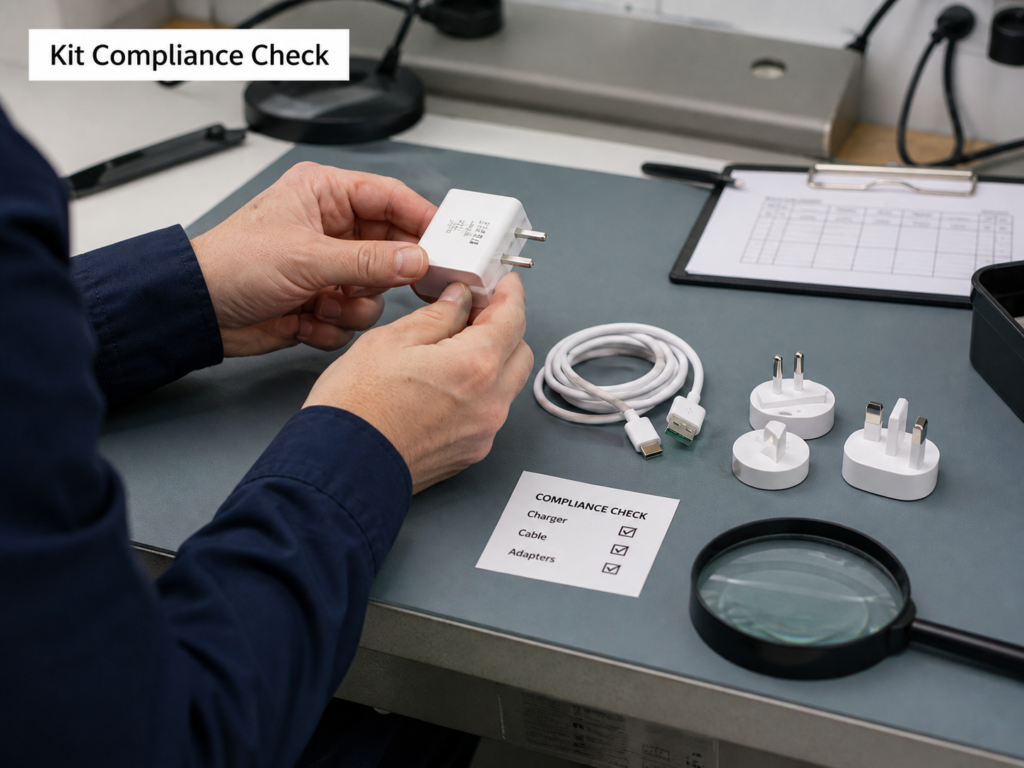
Many people sell chargers with cables, and the determination rules for such products are:
1. **Charger + cable kits**: Each component must be checked for compliance separately. The certification of the charger does not automatically cover all cables, adapters, or other accessories in the kit. When selling in combination, it is also necessary to confirm whether the final kit configuration is within the scope of testing and certification.
2. **Charging products with extended functions**: For example, chargers with USB hubs, wireless chargers with card readers, FCC and UL requirements must be evaluated separately for all functions, and cannot be judged solely as charging products.
3. **Products with the same appearance but different configurations**: For example, chargers with the same housing, one is 20W and the other is 65W, the internal circuit, power, and functions may be different, and the applicable compliance paths may be completely different. It cannot be assumed that the same certification is shared.
Compliance Cases of 4 Typical Products
To give you a more intuitive understanding, we take 4 common charging products as examples:
1. **Ordinary 20W USB-C wall charger**: No wireless function does not mean it must be an SDoC device. It should first be determined whether it is subject to Part 15 Subpart B or applicable to exemption; if it is an unintentional radiator applicable to SDoC, then proceed with SDoC. In terms of safety, if sold through mainstream channels, NRTL certification corresponding to UL 62368-1 may be required.
2. **65W multi-port charging station with Wi-Fi**: Having Wi-Fi makes it an intentional radiator, which usually requires the FCC Certification path with an FCC ID; at the same time, because it is a finished product connected to mains power, mainstream channels or usage scenarios may require NRTL safety certification.
3. **Ordinary passive 60W USB-C cable**: Usually does not require separate FCC authorization; if used as a system accessory, it should be determined whether to be included in the complete device evaluation based on the host and final configuration. When sold separately or entering channels that have requirements for accessories, UL 9990 may be required.
4. **240W fast charging cable with E-Marker**: Because it contains active chips, it should be evaluated by a laboratory for FCC applicability. It cannot be concluded that separate authorization is required just because it has chips; when sold separately, channels may require UL 9990 certification.
Full Process of UL/NRTL Safety Compliance (Importer’s Perspective)
After talking about FCC, let’s talk about the UL/NRTL safety compliance process. Many people are confused about UL marks and authorizations, so we start with the most basic mark identification.
UL Service Types and Mark Identification
UL certifications are divided into several types, with different effectiveness and coverage:
1. **Finished product listing (UL Listed)**: UL Listed means that the product has been listed in accordance with corresponding standards under specified uses, structures, ratings, and conditions. It is not a general safety recognition for all uses or all sales scenarios, nor does it automatically replace local regulations, AHJ, or channel requirements.
2. **Component recognition (UL Recognized)**: This is component-level certification, only for a certain part in the product, such as transformers, capacitors, etc. in chargers. The component recognition mark cannot be used as finished product certification for promotion. Many unscrupulous suppliers use this to impersonate finished product listing, so be sure to pay attention.
3. **Classification certification (UL Classified)**: Only certifies specific performance of the product, such as certain fire protection or specific performance grades. It is less used for charging products, and should not be confused with finished product listing.
Another emphasis: UL is only one member of NRTL. Marks such as ETL and CSA can usually meet the corresponding regulatory requirements only when the corresponding institution is an OSHA-recognized NRTL and the certification covers the applicable product standards and scope. Whether it is accepted by a certain state, AHJ, channel, or customer still needs to be confirmed separately. It cannot be generally considered that all NRTL marks are unconditionally equivalent to UL in any scenario.
Specific Steps for UL/NRTL Application
From the importer’s perspective, the process of obtaining UL/NRTL finished product certification roughly includes the following links:
1. **Confirm product category and scenario, evaluate applicable standards**: Tell the laboratory the product parameters, usage scenarios, installation methods, and target channels to confirm which safety standards apply, to avoid using the wrong standards.
2. **Select a qualified NRTL body or authorized laboratory**: Confirm that the body is an OSHA-recognized NRTL, and its recognition scope covers the product and applicable standards.
3. **Submit samples for testing and complete factory evaluation**: Mass production certifications such as UL Listed usually require initial factory evaluation and subsequent follow-up services. The form of factory audit for other NRTL or on-site evaluation schemes may differ, and shall be subject to the official certification scheme and files of the issuing body.
4. **Obtain listing or recognition authorization, establish official files**: After testing, factory evaluation, and other requirements are completed, obtain the corresponding listing or recognition authorization. UL certification files can usually be queried in Product iQ.
5. **Label as required, accept ongoing compliance supervision**: Use the certification mark in accordance with the regulations of the issuing body. After certification, regular follow-up inspections or other ongoing compliance supervision are usually required. The specific frequency and method shall be subject to the certification files and service agreement.
6. **Do a good job in change control**: When core safety components, power, materials, factory, PCB layout, etc. change, they should be reported to NRTL in advance, and NRTL will determine whether supplementary testing or modification of the certification scope is required.
Label and Authorization Usage Rules
• **Label requirements**: The marks, file numbers, manufacturer or production information, and label position requirements may vary for different NRTLs, product categories, and certification programs. The marks, file numbers, manufacturer or production information, and label position shall be used in strict accordance with the Follow-Up Service Procedure of the issuing NRTL, product category, and certification file regulations. Using packaging to replace body marking must have a clear regulatory basis.
• **Authorization rules**: If using the certification of a supplier or third party, it must be confirmed that your product is within the coverage of the certification file, and obtain formal authorization from the certificate holder. Products not within the scope of the file cannot use the relevant marks without authorization.
• Common mistakes include: privately affixing certification labels, not reporting after model changes, continuing to use after certification expires, or promoting component recognition marks as finished product listing.
Compliance Verification and Platform Requirements
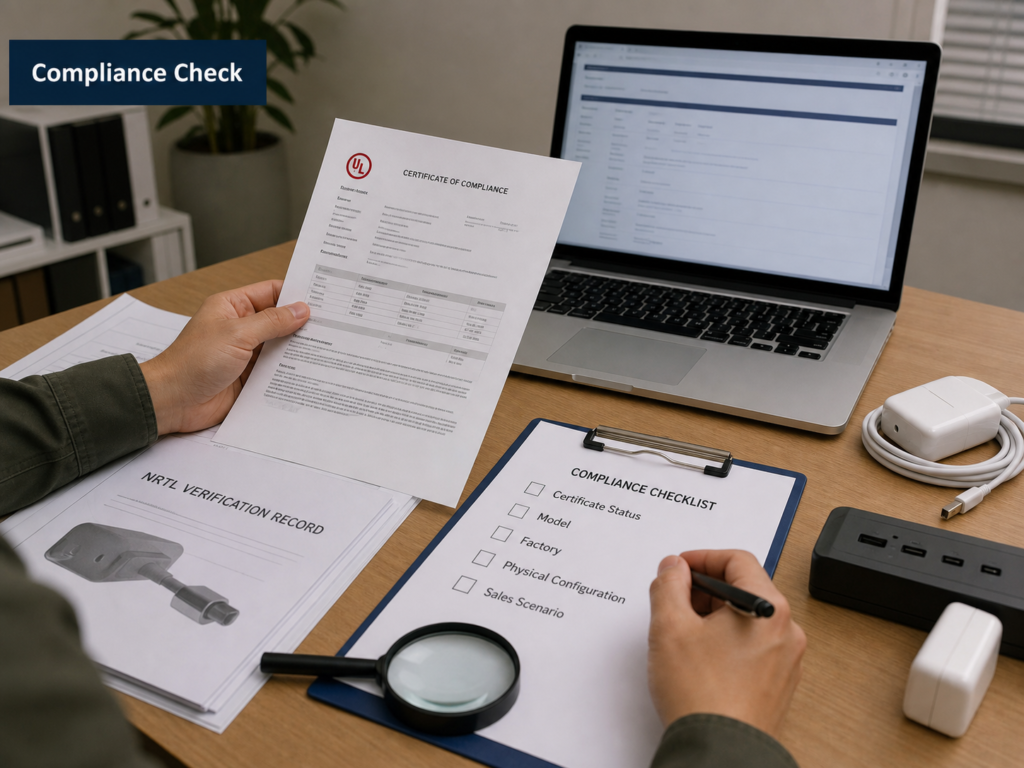
• **Authenticity verification**: UL certification can be queried in the UL Product iQ official database, and other NRTL certifications can be queried on their respective official websites. Similarly, verification must be done one by one according to the five principles of “certificate status, model, factory, physical configuration, sales scenario”, and you cannot believe just because there is a certificate.
• **Platform review**: Platforms may require UL/NRTL documents, test reports, compliance declarations, or other product materials based on product category, site, and risk policies. Whether a specific UL standard is required and what consequences will result from not submitting documents shall be subject to current platform policies and individual case review requirements.
• Common reasons for platform review failure include: fake certificates, model mismatch, wrong applicable standards, expired certification, or the actual product is not within the coverage of the certification file.
When is Reporting Required?
Same as FCC, when modifying UL/NRTL certified products are changed, it is also necessary to determine whether reporting is required:
• **Situations where change evaluation is required**: Replacing core safety components (such as optocouplers, transformers, fuses), adjusting output power, changing the flame-retardant material of the housing, changing the production factory, etc. These changes may directly affect safety, so they should be reported in advance, and retested if necessary.
• **To be determined after evaluation**: Replacing non-core components of the same specification, adjusting internal wiring, etc., should be evaluated by the issuing body or laboratory to determine whether it affects the certification, and then decide whether to report or supplement testing.
• **Situations with usually minor impact**: When only changing packaging, modifying the text of the manual, and not involving safety parameters, ratings, or product structure, generally no retesting is required, but it is best to keep change records.
Procurement Implementation: How to Handle Contracts and Supplier Documents
Many importers’ compliance issues arise during the procurement stage: either the responsibilities are not clearly specified in the contract, or the documents provided by the supplier cannot cover the actual product, and the importer ends up bearing the responsibility.
Mandatory Compliance Clauses in Procurement Contracts
When signing a procurement contract with a supplier, be sure to add these compliance clauses, which can reduce liability disputes when problems arise:
1. **Certification clause**: Clearly specify which FCC and UL/NRTL requirements the product must meet, who bears the certification cost, and what documents need to be provided.
2. **Change notification clause**: If the supplier wants to change the model, replace core components, or change the production factory, it must notify you 30 days in advance, and mass production can only start after compliance is confirmed, and no secret changes are allowed.
3. **Liability division clause**: Clearly specify who bears the losses such as cargo detention, fines, and recalls caused by product non-compliance, and what the proportion of liability is.
4. **Recall assistance clause**: If a recall is required due to compliance issues, the supplier must cooperate in providing relevant documents, samples, and rectification technical support.
Document Package Required from Suppliers
Before placing an order, be sure to ask the supplier to provide a complete compliance document package, don’t wait until shipment to ask for it:
• **Compliance documents**: FCC test reports, conformity declarations or certification certificates, UL/NRTL certification documents; if the certificate is held by a third party, an authorization for use certificate must also be provided.
• **Product documents**: BOM (Bill of Materials, which must clearly mark the certification status of key components), circuit schematic diagrams, product specifications, label drafts.
• **Factory documents**: Exact address of the production factory, quality system certification (such as ISO 9001), past change records.
Full-Process Pit Avoidance: Violation Risks and Responses
When doing US market compliance, the most feared thing is falling into pitfalls. Some problems may not be immediately exposed when purchasing goods, but may appear during platform review, customer inspection, accident investigation, or regulatory spot checks.
4 Common Misconceptions in Practice
1. **Supplier’s certificates can be used directly** — Wrong. First, verify according to the five verification principles, confirm that the document status, model, factory, actual configuration, and sales scenario all match, and also confirm whether there is formal authorization from the certificate holder.
2. **Only certifying the charger is enough** — Wrong. If sold as a kit, the cables, adapters, and other accessories inside must also be checked separately, and confirm whether the final kit is within the scope of testing and certification.
3. **CE reports can be directly converted to FCC/UL** — Wrong. The standard limits, test methods, and certification systems of the two may be different. Only some test data may be reused after laboratory confirmation, and CE reports cannot be directly used to replace FCC or UL documents.
4. **A product that works normally is compliant** — Wrong. A product that works only means its function may be normal, and cannot prove that it meets FCC or safety rules. Regulatory authorities, platforms, or customers may require corresponding compliance documents, test records, and markings.
Consequences of High-Risk Violations
• **Consequences of FCC violations**: May include inspection, delayed release, detention, return shipment, fines, sales ban, or recall, etc. Specific measures depend on the product, nature of the violation, and enforcement decision.
• **Consequences of UL/NRTL violations**: May include channel delisting, certification cancellation. If a product has a safety accident, commercial insurance may refuse compensation, and the enterprise may also face claims for personal injury or property loss.
• The common risk of both is damage to brand reputation. Violation records may also lead to stricter scrutiny, delays, or other enforcement measures for subsequent related goods, but the specific scope depends on FCC, CBP, and case-by-case risk assessment, and it cannot be asserted that all future imported goods will be subject to key inspection.
What to Do If There Is a Violation?
If you really encounter compliance problems, don’t panic, follow these four steps:
1. **First suspend the sales and import of related products** to avoid further expansion of losses, don’t continue to sell with a fluke mentality.
2. **Find a formal compliance agency or laboratory for assistance** to verify where the violation is and the severity of the violation.
3. **Submit a rectification plan**, handle according to the cause of the violation. For example, if the label is wrong, change the label; if the applicable certification is not completed, supplement the test or certification; if the model correspondence is unclear, reconfirm the model and authorization scope.
4. **Follow up on the review results**, submit to the relevant department or platform for review after rectification is completed, and resume sales and import after passing.
Importer Compliance Checklist (Ready to Use)
Finally, we have compiled a full-process checklist for you, you can directly check against it to avoid missing items.
Pre-Product Selection/Pre-Order Check
□ Collect all functional, parameter, and structural information of the product, and find a formal laboratory to evaluate FCC applicability and UL/NRTL path
□ Confirm the requirements of the target sales scenario, and clarify the scope of acceptable NRTL bodies
□ The compliance documents provided by the supplier have been verified through official databases or issuing body channels, and comply with the five verification principles
□ The procurement contract has clearly specified compliance clauses and liability division
Pre-Shipment Check
□ The labels or declarations on the product body, packaging, and manual meet applicable FCC and UL/NRTL requirements, and the model and parameters are correct
□ The key configurations of mass-produced products and certification samples are consistent, no unauthorized changes
□ The full set of compliance documents has been sorted out, and the contact information of the US responsible party or agent is valid
Pre-Customs Clearance/Pre-Listing Check
□ The product information on the invoice, packing list, and outer carton can accurately reflect the actual product, and can establish a clear model correspondence with FCC authorization or compliance records
□ Electronic copies of FCC compliance documents are ready and can be retrieved as required
□ Electronic copies of UL/NRTL certification documents (if any) are ready and can be submitted at any time
□ The contact information of the US importer and responsible party or agent is accurate and valid
□ The e-commerce listing information is consistent with the certification scope, and there is no exaggeration of the certification level, such as claiming component recognition as finished product listing
Summary
For compliance of charging products in the US market, the first step is not to directly purchase a certain certificate, but to first determine what type the product is, what rules apply, and what requirements are put forward by the target sales scenario.
• **Entry-level determination**: Products that are plugged in, contain digital circuits, or have wireless functions should usually first undergo FCC applicability classification evaluation, and then determine whether it is exemption, SDoC, Certification, or other paths; passive cables, exempt devices, and certain accessories do not necessarily require separate FCC authorization. Products entering mainstream channels should also evaluate UL/NRTL safety requirements.
• **Intermediate determination**: Products with wireless functions such as Bluetooth and Wi-Fi usually need to evaluate FCC Certification; ordinary unintentional radiators must first confirm whether they are subject to Part 15 Subpart B and whether exemptions apply, and then determine whether to adopt SDoC. In terms of safety, finished products connected to mains power and with high current should prioritize confirming applicable NRTL standards and channel requirements.
• **Core principle**: Verify throughout the process according to the five verification principles of “certificate status, model, factory, physical configuration, sales scenario”. Don’t just trust the documents provided by the supplier, and don’t treat the certification of a component as the certification of the complete device or kit.
• If you are really unsure, don’t guess by yourself, and don’t listen to the supplier’s one-sided words. First find a laboratory with corresponding capabilities to do product classification and compliance evaluation, and confirm the applicable rules before shipping, which is usually more time and cost saving than remedial measures afterwards.