
Friends who sell chargers in cross-border e-commerce often encounter platform requirements to provide test reports from ISO 17025 accredited laboratories; when buying chargers, you also often see merchants promoting “tested by ISO 17025 accredited laboratories”. Many people think this is a product certification, or that laboratories with this qualification can test everything, but neither is correct. Today, we will explain ISO 17025 clearly from basics to practical operation, with a particular focus on scenarios related to charging products. After reading this, you will be able to check qualifications, distinguish authenticity, and avoid pitfalls on your own.
First, understand the basics: core definitions and applicable boundaries
In plain terms: it is the “specific testing ability work permit” for laboratories
The essence of ISO 17025 is that a third-party accreditation body confirms that the laboratory has the ability to “issue reliable test/calibration data according to specified methods”. It is a qualification certificate for laboratories, not a product certification.
The current valid version is “ISO/IEC 17025:2017”, jointly issued by the International Organization for Standardization (ISO) and the International Electrotechnical Commission (IEC). Special attention should be paid here: ISO itself does not issue accreditation certificates; the issuing bodies are national accreditation bodies. Only certificates issued by bodies that have joined the ILAC MRA (International Laboratory Accreditation Cooperation Mutual Recognition Arrangement) have international mutual recognition effect, and the specific effect should be judged in combination with the validity of the laboratory certificate.
Take charging products as an example: if a laboratory accredited by UKAS (United Kingdom Accreditation Service) has charger safety items in its accreditation scope, it can issue test reports with accreditation effect in accordance with the EN/IEC 62368-1 standard. But its ability has boundaries: it only proves the laboratory’s testing ability within a specific scope, does not guarantee that every report is 100% correct, and cannot replace the compliance judgment of the product itself.
Official scope of application
The activities officially covered by ISO 17025 include testing, calibration and related sampling. This article mainly focuses on the scenario of consumer electronics testing laboratories – that is, the testing of products such as chargers, USB-C cables, and power adapters that people often come into contact with, and will not involve calibration-specific requirements, which is more in line with the actual needs of ordinary users and sellers.
The 3 most easily confused concepts, clarified at once
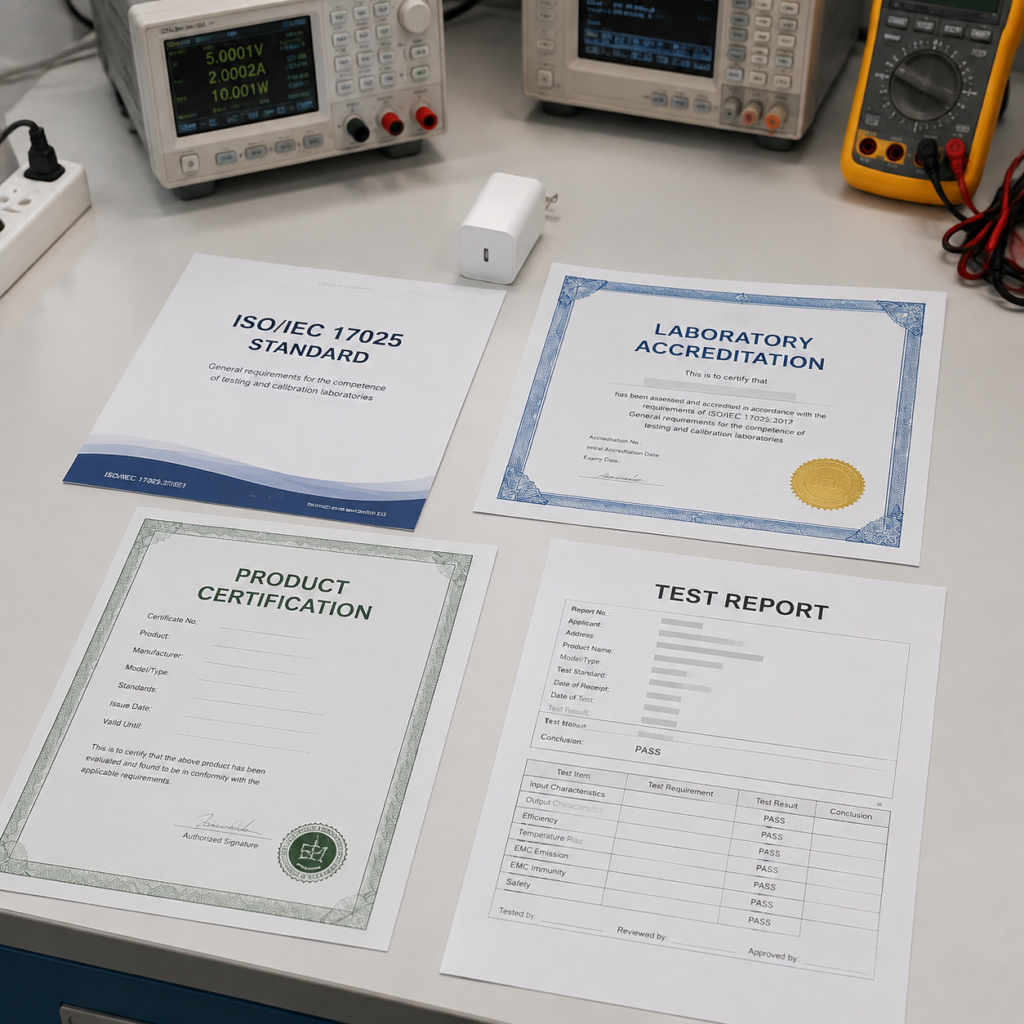
Many people confuse “ISO 17025 standard”, “ISO 17025 accreditation”, “product compliance certificate” and “test report”. Here is a table to clarify:
| Name | Target Object | Core Function | Quick Identification Method |
|---|---|---|---|
| ISO 17025 Standard | All testing/calibration laboratories | A unified requirement document that specifies laboratory capabilities | The header is ISO/IEC, it is a standard text |
| ISO 17025 Accreditation | The laboratory itself | Proves that the laboratory meets the standard requirements and has specific testing capabilities | The header is an accreditation body such as UKAS/CNAS/A2LA |
| Product Compliance/Certification Certificate | Specific products | Proves that the product meets the corresponding regulations/standard requirements | The header is a certification body, with the product model marked |
| Test Report | Submitted sample | Shows the specific test results of a certain sample | The header is a testing body, with test data and conclusions |
There is also the simplest judgment method: look at the header of the certificate or document – if it is issued by an accreditation body like UKAS or CNAS, it is an accreditation certificate; if it is issued by a testing body and records the sample test results, it is a test report; if it is issued by a certification body and corresponds to a specific product model, it is a product certification.
2 core rules to remember for beginners
Remember these two rules, they will be useful for all subsequent judgments:
- Rule 1: Only items within the accreditation scope schedule are valid, the certificate only proves the laboratory’s accredited qualification, and does not mean that all tests can be performed.
- Rule 2: Accreditation is an endorsement of laboratory qualifications, and has no direct relationship with whether a product is qualified.
3 most common beginner misunderstandings
- Misunderstanding 1: This is a mandatory requirement — No, it is voluntarily applied for in most countries, and is only required when specific regulations, platform rules, or contracts explicitly require it.
- Misunderstanding 2: All tests from accredited laboratories are reliable — No, only items in the scope schedule are accredited; items beyond the scope are no different from those of ordinary laboratories (echoing Rule 1).
- Misunderstanding 3: Having 17025 accreditation equals product qualification — No, accreditation is a proof of the laboratory’s ability; whether a product is qualified depends on the specific test results (echoing Rule 2).
What scenarios is it used in? What is its value for charging-related parties?
Which laboratories need to apply for 17025 accreditation
- Third-party laboratories that undertake external testing and calibration services, such as commercial institutions that specialize in product testing for sellers;
- In-house laboratories of enterprises also need to apply if they need to issue impartial data to the outside, or meet the requirements of customers and certification bodies — for example, the laboratories of some large factories will apply for accreditation if they need to issue formal test reports to downstream customers.
Which situations do not require application
- Laboratories that are only used for internal production quality control and do not issue formal reports to the outside, such as test stations next to factory production lines, which are only used for self-inspection of their own products and do not need to be shown to external parties;
- Laboratories purely for R&D verification, whose data is only for internal R&D reference, also do not need to apply.
Practical value for charging-related parties
- Cross-border sellers/enterprises: Can be used for platform review, product compliance, and buyer trust endorsement. Moreover, due to international mutual recognition, there is no need to repeat tests in every market, which can reduce costs;
- Ordinary consumers: Can be used as a reference for judging the credibility of test data of chargers and USB-C cables. For example, if a merchant says a charger will not overheat, the credibility will be higher if there is a report from a 17025 accredited laboratory;
- Certification/regulatory bodies: Do not need to re-assess laboratory capabilities every time, and directly recognize qualifications within the mutual recognition framework, which can reduce audit costs and improve efficiency.
Rules and boundaries of international mutual recognition
At present, accreditation bodies from more than 100 economies around the world have joined the ILAC MRA mutual recognition framework. Simply put: as long as it is a 17025 accreditation certificate issued by a signatory accreditation body, it will be recognized in other signatory economies.
Common signatory accreditation bodies that people encounter include: A2LA (USA), UKAS (UK), CNAS (China), DAkkS (Germany).
But pay attention to the boundary of mutual recognition: mutual recognition does not equal automatic access, and the regulations and platform rules of the target country have higher priority. For example, some platforms only accept reports from local EU laboratories. Even if you have a report from a laboratory accredited by A2LA in the US, it may not meet the requirements. Be sure to follow the specific rules of the target scenario.
What exactly does 17025 assess? Core requirements in plain language
Official structure and our simplified logic
The official text of ISO/IEC 17025:2017 is divided into 5 categories of requirements: general requirements, structural requirements, resource requirements, process requirements, and management system requirements. For ease of understanding, we simplify it into two parts: “management requirements” and “technical requirements”, and the core logic is completely consistent with the official one.
Management requirements: ensuring impartiality and process stability
This part of the requirements is mainly to ensure that the laboratory can conduct tests impartially and stably, will not change results at will, and will not use one standard today and another tomorrow.
- Impartiality risk management: The laboratory must identify risks that may affect impartiality, such as financial pressure and sales performance pressure. It cannot change results because the customer pays more, nor can it relax requirements because of cooperation;
- Confidentiality: Strictly keep customers’ samples, technical materials, and test results confidential, and cannot disclose them to third parties at will;
- Document and process control: All test methods and operation procedures must have written specifications, and cannot be operated at will based on employee experience, to ensure that different people test the same sample and get consistent results;
- Complaints and continuous improvement: There is a special complaint handling mechanism, regular internal audits are carried out, corrections must be made when errors occur, and recurrence must be prevented, to continuously optimize processes.
Technical requirements: ensuring accurate and traceable data
This part is the core of 17025, and is directly related to whether the test data is accurate and credible.
- Personnel competence: Personnel responsible for testing must be trained and authorized, master the corresponding equipment operation and test methods, and inexperienced personnel cannot be allowed to operate casually;
- Equipment calibration and metrological traceability: For equipment that has a significant impact on test results, the measured values must be traceable to international or national metrological benchmarks. For example, multimeters for measuring voltage and thermocouples for measuring temperature must be calibrated regularly. But not all equipment needs external calibration; for example, tools that have no impact on results, such as sample placement racks and ordinary screwdrivers, do not require mandatory calibration;
- Method selection and deviation control: Testing shall prioritize methods specified in international standards and national standards. For example, IEC 62368-1 is used for charger safety testing. If non-standard methods are to be used, or if there is a deviation from standard methods, the reliability of the method must be verified first, customer consent obtained (when applicable), and records kept;
- Environment and sample management: The test environment must meet standard requirements. For example, temperature rise testing cannot be performed in a position directly blown by air conditioning, otherwise the results will be inaccurate. Samples must have clear identification, be traceable from sample receipt to test completion, and samples from different customers cannot be mixed up;
- Measurement uncertainty: Simply put, it is the reasonable fluctuation range of test results. Any measurement has errors and cannot be completely accurate. Not all reports need to provide uncertainty; it is only required when required by standards, required by customers, or when test results are just near the qualification limit;
- Conformity assessment rules: If the test result is just near the critical value, whether it is qualified must be agreed with the customer in advance, and the impact of measurement uncertainty must be considered. For example, if the safety requirement is that the temperature rise does not exceed 70K, and the measured value is 69.9K, it cannot be directly judged as qualified or unqualified, and must be implemented in accordance with pre-agreed rules;
- Data and information management: All original records and test reports must be completely preserved, traceable and reproducible, and cannot be tampered with at will. For example, if the measured voltage is 5.2V, it cannot be changed to 5.0V, and the original data must be kept on file;
- Quality monitoring: The laboratory must verify the accuracy of its own test data through blind sample testing, inter-laboratory comparisons, etc. For example, test a blind sample with unknown results to see if the results are consistent with those of other laboratories.
It should be specially noted here: 17025 does not require a unified SOP template or management software, as long as the above core requirements are met. Different laboratories can adjust processes according to their own situation.
Accreditation scope: a more important judgment basis than the certificate itself
Why is the scope the core? (Echoing Rule 1)
Many people think that getting a 17025 certificate means all tests are accredited, but that is not the case at all. The accreditation certificate only proves that the laboratory has the qualification to be accredited; the truly valid items all depend on the “accreditation scope schedule” attached to the certificate.
For the same laboratory, only some products, some test items, some test methods, and some office locations may be accredited. For example, a laboratory may be accredited for environmental testing, but not for charger safety, then the safety report it issues cannot use the 17025 name. Therefore, to judge whether a report is valid, priority should be given to checking the scope, not just looking at the logo on the certificate.
What is in the accreditation scope schedule
A formal accreditation scope schedule contains at least the following information:
- Test object: such as power adapters, USB-C cables, connectors, specific to product categories;
- Test items: such as electrical safety, fast charging performance, EMC electromagnetic compatibility;
- Applicable method standards and versions: such as EN/IEC 62368-1:2014+A1:2017, there must be a specific standard number and version, not just “safety testing”;
- Measurement range, capability limits: for example, the voltage test range is 0-1000V, and testing cannot be performed beyond this range;
- Laboratory address: if there are multiple test locations, the accreditation scope of each location will be listed separately. For example, the scope of the Shanghai laboratory and the Shenzhen laboratory may be different.
Common accredited test items for charging products
For the charging products we often come into contact with, common items that need to be included in the accreditation scope are:
- Charger/power adapter category: electrical safety, output performance, abnormal operating condition test, temperature rise test, EMC electromagnetic compatibility, energy efficiency/standby power consumption (when applicable to the energy efficiency requirements of the target market);
- USB-C cable/connector category: wire gauge and voltage drop test, E-marker chip test (applicable to cables with E-marker), connector plug-in durability, protocol compatibility and power supply capability test.
Precautions for checking the scope of charging products
When checking, you can’t just look at the general idea, you have to pay attention to details:
- You must confirm specific product + test item + standard version, not just look at general descriptions like “electrical and electronic product testing”. For example, even for safety, the applicable standards for chargers and USB-C cables may be different;
- The standard version must correspond to the target market: for example, IEC 62368-1 is an international standard, the EU uses the converted EN IEC 62368-1, and the US uses UL 62368-1. Different target markets adopt different standard versions, which must be matched;
- Labeling rules for external results: if the laboratory uses external services or test results (for example, it cannot test EMC by itself and finds a partner institution), it must be clearly marked in the report. Whether the 17025 accreditation mark can be used depends on the rules of the issuing accreditation body and the specific accreditation scope.
How to get accreditation? Is there follow-up supervision?
Regular acquisition process (simplified version)
For a laboratory to obtain 17025 accreditation, it generally goes through the following steps:
- First, establish its own management system and technical processes in accordance with the requirements of the ISO/IEC 17025 standard, and conduct a trial operation for a period of time to ensure that the processes can run stably;
- Submit application materials to the local accreditation body, such as system documents, personnel qualifications, equipment calibration records, etc.;
- The accreditation body first conducts a document review, and arranges on-site assessment after there are no problems. For charging-related laboratories, the on-site assessment will focus on core content such as the calibration of safety equipment and the method verification of PD fast charging tests;
- If non-conformities are found during the assessment, the laboratory must complete rectification. After the rectification is passed, it can obtain the accreditation certificate and the corresponding scope schedule.
Continuous supervision and change rules
Getting the certificate is not a once-and-for-all matter; you also have to accept continuous supervision:
- The modes of supervision and reassessment vary by issuing body. For example, the supervision cycles of CNAS, UKAS, and A2LA may be different, depending on the information stated on the certificate and the rules of the issuing body;
- If there are major changes in the laboratory’s address, key personnel, or accreditation scope, it must apply to the accreditation body for re-evaluation or information update, and cannot change without authorization;
- If you want to add new test items (that is, “scope expansion”), you must apply to the accreditation body, and after passing the assessment, the new items can be added to the accreditation scope.
Practical tutorial: how to judge the 17025 qualification of a laboratory/report
This part is the most practical, whether it is for sellers looking for laboratories, or consumers checking merchant promotions, it can be used.
Step 1: First check the basic information of the report
First of all, note: Accredited reports do not necessarily carry the ILAC MRA combined mark, because the use of the mark is subject to strict rules. For example, non-accredited items cannot be marked, and marking is not allowed in some scenarios, so you cannot judge authenticity solely by whether there is a mark.
The core items to check are:
- Whether there is a statement on the report such as “This test is an activity accredited by ISO 17025”;
- The name and specific location of the laboratory that issued the report;
- The laboratory’s accreditation number;
- Information of the authorized signatory.
If the report only has the laboratory’s own logo and no accreditation-related information, it definitely cannot prove that it is an accredited test.
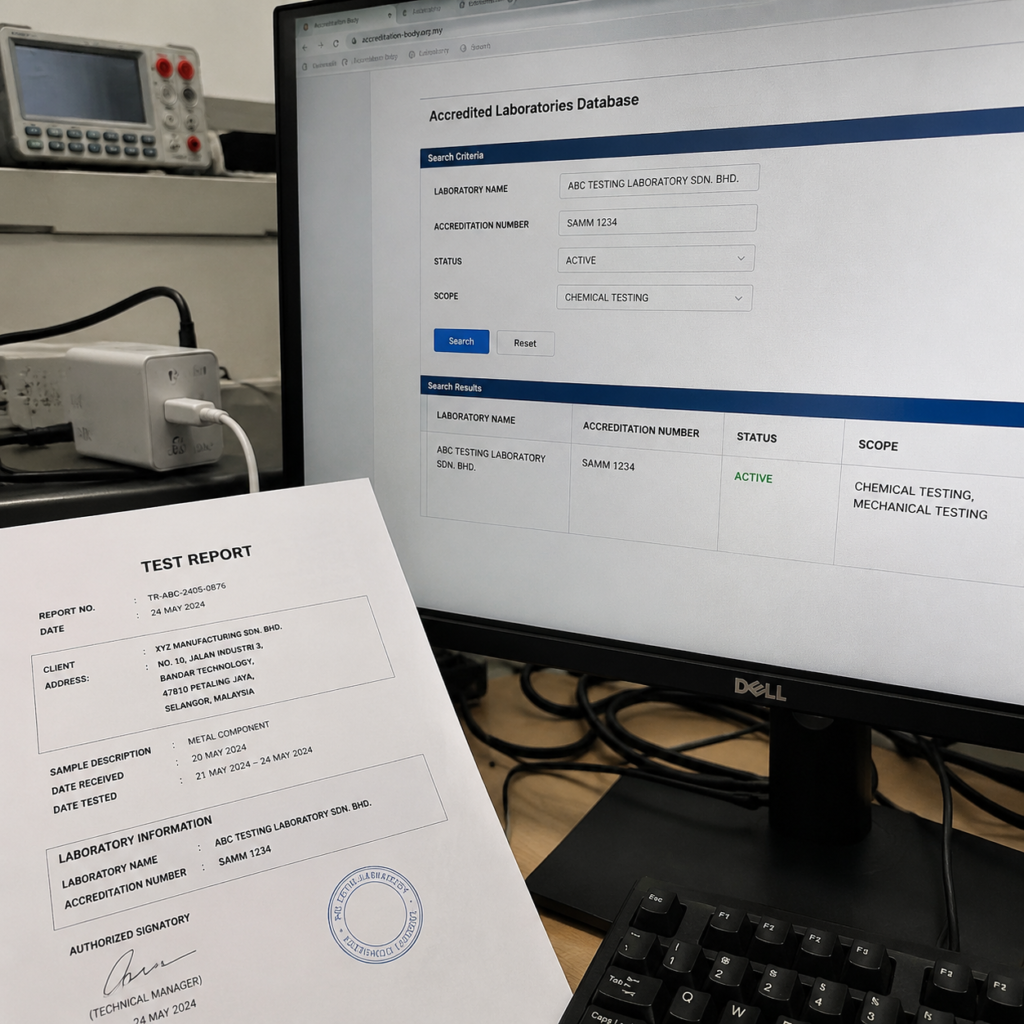
Step 2: Check the authenticity and status of qualifications through official channels
Just looking at the information on the report is not enough; you have to verify it through official channels:
- Priority query channel: The official website of the issuing accreditation body. Enter the laboratory name or accreditation number to search, and you can check the qualification status of the laboratory, and also download the latest accreditation scope schedule;
- Cross-border supplementary verification: If it is an overseas laboratory, you can go to the ILAC official website to check whether the issuing accreditation body is a signatory to the MRA, to ensure that the qualification is mutually recognized.
Note here: the ILAC official website only publishes information on signatory accreditation bodies, and cannot directly query the real-time accreditation scope of all laboratories around the world. The specific scope still needs to be checked on the official website of the issuing body.
When verifying, focus on: whether the laboratory’s name, address, and accreditation number are consistent with those on the report, whether the qualification is within the validity period, and whether there is an invalid status such as suspension, revocation, or expiration.
Step 3: Check that the accreditation scope matches your needs
After finding the scope schedule, carefully check whether your test requirements are within the scope:
- Confirm that the scope includes the test items + standard version of the corresponding product. For example, if you want to test the safety of a USB-C charger, you need to find specific entries like “Power adapter/charger Electrical safety EN/IEC 62368-1:2014+A1:2017”;
- Be especially vigilant about out-of-scope situations: for example, if the laboratory is only accredited for environmental reliability testing (high and low temperature, vibration, etc.), then the charger safety report it issues is invalid, even if it has a 17025 certificate (echoing Rule 1).
Step 4: “Five-question checklist for report applicability” for cross-border/compliance scenarios
If it is used for formal scenarios such as product compliance and platform review, you have to ask yourself five more questions to ensure the report is usable:
- Does the target market, platform, or certification program accept reports issued by 17025 laboratories?
- Is the location of the laboratory that issued the report in the address list of the accreditation scope?
- Do the test object, items, method standards and versions fully cover your needs?
- Are the model, configuration, and parameters of the submitted sample completely consistent with the product you actually mass-produce and declare?
- Do the report date, issuance status, and conformity assessment rules meet the requirements of the target scenario?
Common invalid/fraudulent situations
If you encounter these situations, directly judge them as invalid:
- Fraudulently using the accreditation number and mark of another laboratory;
- Using the accreditation mark beyond the accreditation scope, for example, only having environmental testing qualifications but putting the 17025 mark on safety reports;
- Continuing to use the accreditation qualification after it has expired, been suspended, or revoked;
- Illegally marking the accreditation mark on non-accredited items.
Differences from other common qualifications/compliance certificates
Differences from ISO 9001 quality management system
Many people confuse 17025 and 9001, but they are completely different:
- Different applicable objects: ISO 9001 applies to all types of organizations, whether factories, trading companies, or service institutions; while ISO 17025 only applies to testing and calibration laboratories;
- Different core requirements: ISO 9001 focuses on general process management to ensure the stable quality of an organization’s services/products; while ISO 17025 focuses on testing technical capabilities and data traceability, with higher and more professional requirements;
- Misunderstanding clarification: Having ISO 9001 certification does not equal having ISO 17025 accreditation, and the two cannot replace each other.
Relationship with three common types of product compliance certificates
Many people ask: Do CE and FCC require reports from 17025 laboratories? Actually, it depends on the specific rules:
- CE (EU): CE is a conformity mark. Under normal circumstances, manufacturers can affix the CE mark after conducting conformity assessment and signing the DoC (Declaration of Conformity) themselves. Only some directives (such as specific requirements for some medical devices and wireless products) explicitly require 17025 laboratories to participate in testing;
- FCC (USA): For electromagnetic compatibility requirements, there are different paths such as SDoC and Certification. Among them, the Certification path requires reports from FCC-recognized laboratories (that is, laboratories that meet 17025 requirements);
- USB-IF Certification: This is a conformity program of the USB Industry Association. To obtain USB-IF certification, testing must be done in its accredited laboratories, and all these laboratories are required to meet ISO 17025 requirements.
General rule: Whether to use reports from 17025 laboratories must be confirmed according to the target market, product category, and corresponding specific rules, and cannot be generalized.
Relationship with local laboratory accreditation in various countries
Each country has its own accreditation body, such as CNAS in China, A2LA in the US, and DAkkS in Germany. These bodies all assess laboratories in accordance with the ISO/IEC 17025 standard. As long as the certificate is issued by an accreditation body that has joined the ILAC MRA, its effect within the mutual recognition framework is equivalent, and there is no such thing as “which country’s accreditation is more advanced”. Of course, if some countries have special mandatory requirements, local rules must still be followed.
Common misunderstandings and decision-making suggestions for charging product scenarios
4 most common usage misunderstandings
- Misunderstanding 1: Having 17025 qualification means you can do all charging-related tests — Wrong. You must check the specific items in the accreditation scope. For example, a laboratory that can test charger safety may not be able to test USB-C PD protocol (echoing Rule 1);
- Misunderstanding 2: A 17025 report must meet the compliance requirements of all countries — Wrong. The report is only the test result. Whether it is compliant depends on the regulations, standard versions, and certification process requirements of the corresponding country. For example, for CE, a report alone is not enough; you also need an EU responsible entity, technical documents, DoC, etc.;
- Misunderstanding 3: The accreditation effect of in-house laboratories is lower than that of third-party laboratories — Wrong. As long as they are within the accreditation scope and belong to the ILAC mutual recognition framework, the reports of in-house laboratories and third-party laboratories have the same effect;
- Misunderstanding 4: Passing the test means there is no problem with batch products — Wrong. The report is only for the submitted sample. If components or processes are changed during mass production, the results may change. You cannot use one report to say all products are qualified.
Practical suggestions for charging product enterprises/sellers when choosing a laboratory
If you are a seller of charging products, you can follow these steps when looking for a laboratory:
- First clarify the test requirements: is it to test the safety of the charger, or the PD fast charging performance of the USB-C cable? Is the target market the EU or the US? Clarify the requirements first, don’t just ask “Do you have 17025” right away;
- Prioritize laboratories accredited by bodies within the ILAC mutual recognition framework, which have wider cross-border applicability;
- Use the “five-question checklist for report applicability” mentioned earlier to check one by one to ensure the report can meet your target scenario needs;
- Don’t just look at the price. Prioritize confirming that the qualification and test cycle match your needs. If you are greedy for cheap and find an out-of-scope laboratory, the report will be unusable and it will be a waste of money instead.
Cross-border practical example: USB-C charger exported to the EU
Take a specific example, if you want to sell USB-C chargers to the EU, how to use 17025:
- First confirm the applicable regulations: EU LVD (Low Voltage Directive), EMC (Electromagnetic Compatibility Directive), the corresponding standards are EN IEC 62368-1 (safety), EN 55032/EN 55035 (EMC), etc.;
- Choose a laboratory whose accreditation scope includes “Power adapter Electrical safety EN IEC 62368-1” and corresponding EMC items, and whose test location is within the accredited address;
- After the test is completed and the report is obtained, the responsible entity within the EU must complete the conformity assessment, prepare technical documents, and sign the DoC, before the CE mark can be affixed. It is not that you can sell directly with a 17025 report.
How ordinary consumers can refer to it
If you are an ordinary consumer and see a merchant promoting “tested by ISO 17025 laboratory”, you can use it like this:
- Ask the merchant to provide the report, and check the authenticity and scope of the report according to the previous steps, don’t just look at the promotional slogan;
- Focus on items related to safety and user experience, such as safety and fast charging performance, and whether they are within the accreditation scope;
- Do not equate “tested by 17025 laboratory” with “product has official certification”. It only means that the testing laboratory has the corresponding ability. Whether the product itself is qualified depends on the test results (echoing Rule 2).
Core abilities you can master after reading this article
- Can accurately distinguish the differences between ISO 17025 accreditation, product compliance certificates, and ISO 9001, and will no longer be confused by promotional slogans;
- Can independently query the authenticity of the 17025 qualification of a laboratory/report, as well as the specific coverage scope;
- Can use the “five-question checklist for report applicability” to judge whether a report can meet the cross-border and compliance needs of charging products;
- Can identify common pitfalls such as qualification fraud and out-of-scope use, to avoid stepping into traps.
Frequently Asked Questions
Is ISO 17025 accreditation equal to product certification?
No. ISO 17025 accreditation is a proof of the laboratory’s testing ability, while product certification/compliance is a judgment on whether the product itself meets the standards. The two are completely different things (echoing Rule 2).
How to query the 17025 accreditation scope of a laboratory?
Priority is given to querying through the official website of the issuing accreditation body. Enter the laboratory name or accreditation number to search and download the latest accreditation scope schedule. The ILAC official website can only be used to verify the mutual recognition qualification of the accreditation body, and cannot directly query the specific scope of the laboratory.
Is a report with the 17025 mark always valid?
Not necessarily. Three conditions must be met at the same time: the laboratory’s accreditation qualification is within the validity period, the test items are within the accreditation scope, and the report meets the specific requirements of the target scenario. All three are indispensable.
Overall, ISO 17025 is a very practical ruler for us to judge the testing ability of laboratories, but it is not omnipotent, nor is it valid just by pasting a logo casually. Whether you are choosing a laboratory for cross-border business, or looking at promotions when buying charging products, as long as you remember the two core rules and check the scope and status step by step, you can avoid most pitfalls and truly use this qualification correctly.