
Friends who sell charging products overseas deal with terms like “testing”, “certification”, “DoC”, and “accreditation” almost every day: some e-commerce platforms, purchasers, or regulatory authorities in the target market may require test reports, DoCs, certification certificates, or other compliance documents; whether they need to be submitted during customs clearance shall be subject to the provisions of the target market and specific products. Suppliers claim their USB-C cables have passed dozens of tests… But many newcomers either confuse these concepts, or think conformity assessment is just “paying for a certificate”, ending up either wasting money or being delisted and fined for non-compliance.
In fact, conformity assessment is a set of general processes with clear rules. Whether you make chargers, power adapters, or charging cables, as long as overseas market access is involved, this framework can be applied. Today, we start from the most basic concepts, move on to being able to judge paths independently and avoid common pitfalls, and fully sort out the logic of conformity assessment.
1. Must-Know for Beginners: Basic Understanding of Conformity Assessment
1.1 Plain Language Definition and Core Value
Let’s start with the most basic: what exactly is conformity assessment?
In plain terms, it is a formal process in which a competent entity, in accordance with clear rules, proves that a product, an institution, or even a set of management systems meets specified requirements; this is also the core meaning of the term “conformity assessment”.
For charging products, its value is reflected in three aspects: First, meeting the applicable statutory compliance requirements of the target market is the prerequisite for legal import and sale; when requirements are not met, measures such as detention, return, recall, or sales ban may be taken by customs or market regulatory authorities. Second, it reduces safety risks; for example, safety tests on chargers can help identify problems such as fire and electric leakage. Third, it enhances market trust. Whether it is e-commerce platforms or purchasers, they will feel more reassured when seeing formal assessment credentials.
1.2 5 Most Easily Confused Core Terms
Many people cannot distinguish various “certificates” and “reports” in conformity assessment. In fact, there are 5 core concepts, which we will explain with examples of charging products:
- Testing: A laboratory tests samples according to specified methods and finally issues data results. For example, perform specified numbers of plug-in, bending, and durability tests on USB-C cables in accordance with applicable USB specifications, connector specifications, or enterprise test specifications; the specific number of times shall be subject to applicable documents. Testing is only responsible for the submitted samples and the test conditions at that time.
- Inspection: Check the appearance, marking, and structural consistency of the product against established requirements, without destructive testing. For example, verifying whether the parameters on the charger nameplate are completely consistent with the design documents, and checking whether the interface of the charging cable has burrs, all fall under inspection.
- Certification: An independent third-party body issues a conformity proof and a certificate in accordance with a complete assessment scheme, including testing, factory audit, supervision, etc. For example, the commonly mentioned UL safety certification for chargers is a typical product certification. Note that certification is not a once-and-for-all matter after getting the certificate; subsequent supervision is required according to the specific scheme, and it does not mean the product is “permanently qualified”.
- Accreditation: A more authoritative body, such as a national accreditation body, endorses “the body conducting the assessment”, proving that it has the capability to carry out the corresponding assessment business, it does not endorse the product. For example, if a laboratory has obtained ISO/IEC 17025 accreditation, it means its capability to carry out corresponding tests has been accredited, but it does not mean that a certain charger tested by it is necessarily qualified.
- Declaration of Conformity (DoC): The manufacturer issues a document itself, promising that the product meets relevant regulatory requirements, and bears the responsibility itself. For example, some markets and product categories allow manufacturers to issue DoCs on their own without third-party certification, but complete technical documents must be retained for inspection.
1.3 Four-Dimensional Comparison of Core Terms
To make it more intuitive for everyone to distinguish, we have sorted common conformity assessment credentials into a table according to four core dimensions:
| Document Type | Issuing Entity | What It Certifies | Applicable Scenarios | Whether Continuous Supervision Is Required |
|---|---|---|---|---|
| Test Report | Competent or compliant laboratories | Test data/results of the tested sample under specified conditions | Technical evidence, support for DoC, R&D verification | Usually does not include continuous supervision in the sense of product certification |
| Inspection Report | Inspection bodies/inspectors | Appearance, marking, and structural consistency of samples or batches | Pre-shipment verification, batch acceptance | Usually does not include continuous supervision |
| Certification Certificate | Third-party certification bodies | The product or system meets the requirements of the specified certification scheme | Market access, commercial acceptance, mandatory certification | Usually required, subject to the specific scheme |
| Accreditation Certificate | Authoritative accreditation bodies | The conformity assessment body (e.g., laboratory or certification body) has corresponding capabilities | To prove the capability and scope of the conformity assessment body | Usually required, subject to the specific accreditation system |
| Declaration of Conformity (DoC) | Manufacturer/importer or the responsible entity specified by regulations | Self-commitment that the product complies with applicable regulations, with responsibility borne by the issuer | Scenarios where self-declaration is permitted by regulations | No third-party supervision, but documents must be retained as required |
| Registration/Filing Certificate | Regulatory authority of the target market or designated body | The statutory registration process has been completed | Pre-procedure for market access | Whether update or verification is required is subject to the specific system |
1.4 Clarification of 4 Common Misconceptions for Beginners
People who are new to conformity assessment are prone to these misconceptions. We will clarify them in advance to avoid detours:
- Misconception 1: Conformity assessment = quality ranking/absolute safety Conformity assessment only proves that the product meets “the specified set of requirements”, it does not grade or rank products, nor can it eliminate all extreme risks. For example, a charger that meets UL safety standards cannot guarantee safety under intentional damage, because the standard only covers its specified use conditions and related foreseeable risks.
- Misconception 2: Having a test report = having certification A test report is only responsible for the submitted sample and test conditions. Without factory audit, continuous supervision and other links required by the certification scheme, you must not use the certification mark directly, nor claim that the product has “passed XX certification”. Many bad merchants use ordinary test reports to pretend to be certification, so special attention should be paid.
- Misconception 3: One certificate is valid globally Regulations and standards vary across countries and regions. Credentials may only be accepted if there is a mutual recognition arrangement between the two parties, or if the target market explicitly accepts them. For example, taking EU CE-related documents to sell directly in the United States cannot replace applicable US requirements such as FCC.
- Misconception 4: One assessment is valid for life Except for some scenarios where self-declaration is allowed, most third-party certifications may have requirements for supervision, status maintenance, and change management. After changes to key components, structure, or production address of the product, whether the original credential is still applicable must be re-judged according to the specific certification scheme, and cannot be assumed to be permanently valid.
1.5 Core Participants in Overseas Charging Scenarios
Conformity assessment is not a matter of one party. There are usually four core roles, which we correspond to the scenario of charging products going overseas:
- Applicant: Usually a brand owner or OEM, responsible for providing real samples and technical materials, and responsible for product consistency.
- Conformity assessment body: Testing laboratories and certification bodies with competence and accreditation or authorization within the corresponding scope, responsible for specifically implementing testing, inspection, audit, and issuing corresponding assessment credentials.
- Regulator: The relevant competent authority of the target market. For example, the US FCC is responsible for applicable radio spectrum and equipment authorization rules; in the EU, member states’ market regulatory authorities implement product supervision, and the European Commission is responsible for relevant coordination.
- Accepting party: E-commerce platforms, large purchasers, ordinary consumers, who decide whether to list, purchase, or buy products based on assessment results. In many cases, platform requirements are higher than statutory requirements.
2. Overview of the Boundaries and General Framework of Conformity Assessment
After understanding the basic concepts, let’s take a step back to look at the overall boundaries and general framework of conformity assessment — it does not come out of nowhere, but has a top-down rule system, and the process is not fixed; it will be adjusted according to many factors.
2.1 From Regulations to Implementation: Three-Tier Rule System
The requirements for conformity assessment are usually implemented from upper-level rules downward, which can first be understood in three tiers:
- Top tier: Target market regulations/technical regulations: These are mandatory requirements with legal effect, stipulating the basic obligations that products must meet. For example, the EU EMC Directive, US FCC Part 15 rules, are regulatory rules that need to be applied in conjunction with specific product scopes. Violation of applicable requirements may lead to law enforcement measures.
- Middle tier: Technical standards: Technical standards are usually common technical paths to meet regulatory requirements, generally voluntary to use, but may be cited by regulations, adopted by certification schemes, or become de facto mandatory requirements due to contracts and platform rules. For example, IEC 62368-1 is a commonly used safety standard for audio-visual and information technology equipment, and many countries convert it into their own national standards as a technical basis for meeting safety requirements.
- Implementation tier: Assessment schemes/certification rules: These are specific implementation details, clarifying sampling methods, whether factory audit is required, supervision frequency, change processes, etc. Certification bodies determine requirements such as sample quantity, factory audit, production consistency supervision, and change management based on applicable standards and their certification schemes, rather than a single safety standard alone determining all certification details.
In addition, international organizations such as ISO (International Organization for Standardization) and IEC (International Electrotechnical Commission) are responsible for formulating international standards, promoting alignment of national rules, and reducing the cost of repeated assessments. However, whether an international standard is adopted by a market, and to what extent, still depends on local regulations and specific systems.
2.2 Relationship Between Assessment Results and Market Access
Many people think that “getting a certificate means you can enter the market”, but that is not the case. The relationship between the two should be viewed in two points:
First, different credentials have different legal effects: test/inspection reports are technical evidence, self-declaration is the manufacturer’s commitment, certification certificate is a third-party proof, registration/filing is just a registration certificate; these credentials have different effects and cannot replace each other.
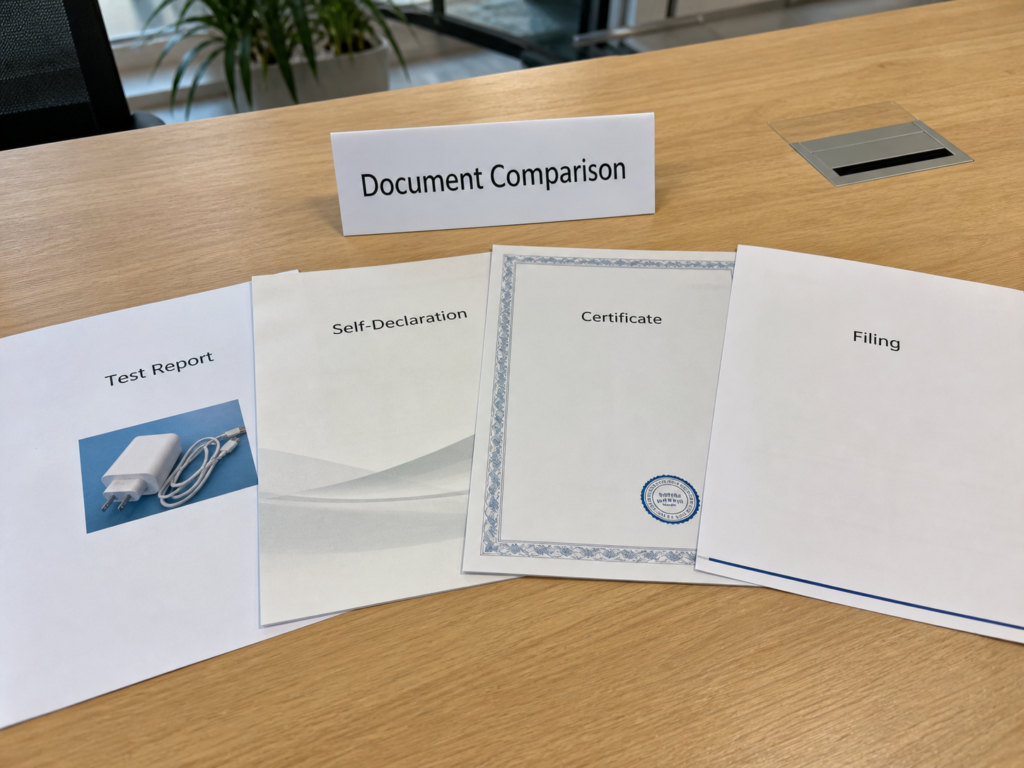
Second, market access is usually a combination of multiple types of credentials. The specific ones required depend on the target market’s regulations and product category. For example, chargers exported to the EU may involve regulatory requirements such as low-voltage safety, EMC, RoHS, ecodesign/energy efficiency; whether registration or database declaration is required shall be verified according to specific products and applicable regulations, and “energy efficiency registration” cannot be taken as a universal step for all chargers.
Also note that commercial requirements are often higher than statutory mandatory requirements: for example, US federal regulations do not generally require all chargers to have UL safety certification, but some e-commerce platforms or purchasers may require sellers to provide third-party safety certification to list products; this is a typical case where commercial requirements are higher than statutory requirements.
2.3 Five General Core Links (Not a Fixed Process)
Although the assessment processes for different products and different markets are different, the core logic can usually be summarized into five links. Note that this is not a fixed step-by-step process; they can be merged, split, or added with links such as registration, filing, market spot check according to actual situations:
- Demand confirmation and product boundary determination: First clarify what to assess, what rules to assess by, and what mode to use for assessment.
- Assessment preparation: Prepare representative samples and a full set of technical documents.
- Verification implementation: Carry out testing, inspection, audit and other work to collect compliance evidence.
- Conclusion issuance: Review all evidence and issue corresponding compliance credentials.
- Continuous supervision and change management: Maintain the validity of credentials and ensure that products continue to meet requirements.
2.4 Why Does the Process Change? 4 Core Influencing Factors
You may ask: Why are the processes for making chargers for the US and the EU so different? Why do some cables only require self-declaration, while others require certification? There are four core influencing factors:
- Target market regulatory requirements: The more and stricter the mandatory requirements, the more complex the process. For example, a market that involves safety, EMC, energy efficiency, and registration requirements at the same time will naturally have a more complex process than a market that only requires one type of technical document.
- Product attributes and risks: The input type, function, power, and configuration of the product will affect risks and applicable requirements. Special attention should be paid here: power is not the only judgment factor. USB-C products with active electronic components, signal conversion, or specific interface functions may have additional compatibility or EMC assessment requirements; ordinary passive cables shall be judged according to target market regulations and applicable standards.
- Assessment type: First-party, second-party, third-party assessment, or self-declaration, testing, certification, the process differences are very large. For example, self-declaration can be completed by the responsible entity within the scope permitted by regulations, while third-party certification usually also involves sample testing, factory audit, and supervision.
- Commercial requirements: Additional requirements from platforms and purchasers will increase links; for example, some large buyers may require additional factory audits, even if not mandated by regulations.
3. Detailed Explanation of All Links of the General Framework (Applicable to Charging Products)
Next, we will break down the five core links and explain them thoroughly in combination with the actual scenarios of charging products. Each link will end with a beginner check point, so that newcomers can follow it without making big mistakes.
3.1 Pre-step: First Figure Out What Category Your Product Belongs To
Before officially starting the assessment, the first step is to judge what type your product belongs to and what requirements it corresponds to. Otherwise, if you find the wrong standard or choose the wrong mode, it is a pure waste of money.
The assessment requirements for different charging products vary greatly:
- Mains-powered chargers/power adapters: Plug directly into household sockets, involve higher voltage, usually need to consider electrical safety, EMC, energy efficiency, marking and other aspects.
- Ordinary USB charging cables (no data/low voltage): Low-voltage passive products, requirements vary by market, material, structure, and sales channel; may involve material, RoHS, product safety, contract or platform requirements; whether a DoC, test report, or third-party certification is required shall be verified according to specific regulations.
- USB-C cables with data function: Cables with active electronic components, signal conversion, or specific interface functions may require additional signal integrity, compatibility, or EMC assessment; whether ordinary passive data cables require EMC testing shall be judged according to target market regulations and applicable standards.
- Wireless chargers: Usually need to evaluate safety, EMC/radio regulation and compatibility requirements according to operating frequency, transmission method, and whether they include communication functions such as Bluetooth. Qi certification is an industry compatibility or certification project, and whether it is required depends on product positioning, customer and market requirements.
In addition, some special configurations will also affect the assessment path: for example, chargers with built-in batteries, products with plug converters, multi-port output chargers, products supporting private fast charging protocols, may all require additional test items or follow different assessment schemes.
Beginner judgment points: First clarify the product’s input type (mains or low voltage), core functions (whether it can transmit data, whether it has wireless charging), special configurations (how many ports, whether it has fast charging, whether it has a battery), then match the corresponding regulations and standards.
3.2 Link 1: Demand Confirmation and Scope Definition
This step is the foundation of the entire process. If the demand is not correct, everything that follows will be wrong. There are four main things to determine:
First, determine the assessment object: Is it the whole machine, a component, or the factory’s quality system? For example, if you want to do safety certification for a charger, the object is the whole machine; if you want to prove the factory’s quality management capability, it is system certification.
Second, determine the assessment basis: Distinguish between mandatory requirements (i.e., target market regulations) and voluntary or commercial requirements, and also carefully check the version, release date, and scope of application of applicable standards. For example, the old version of some standards can no longer be used for current projects; some standards only apply to power adapters of specific power or structure, and cannot be directly applied to other specifications.
Third, determine the assessment mode: Can be used in combination; common modes include Declaration of Conformity (DoC), third-party testing, product certification, factory audit, registration/filing. The principle of selection is: prioritize meeting mandatory regulatory requirements, then match commercial requirements. For example, a certain type of US wired equipment is subject to FCC SDoC, and the platform requires UL safety certification, so the combination mode of “FCC SDoC + UL product certification” may be required, which shall still be subject to applicable rules and platform requirements.
Fourth, determine the coverage scope: Is it a single model, or a model family of the same series? Should it cover matching cables and plugs? Whether models of the same series can be covered as a model family must be evaluated and confirmed by applicable regulations, standards, and certification bodies based on circuit, key components, structure, software, rated parameters, and worst-case conditions; it cannot be guaranteed in advance that models with different powers such as 18W and 20W do not need to be tested separately.
Beginner check point: Be sure to confirm in advance that the regulator of the target market or the accepting party, such as an e-commerce platform, recognizes the assessment mode you choose. Don’t make a DoC yourself only to find that the platform doesn’t recognize it, wasting effort.
3.3 Link 2: Assessment Preparation and Sample/Document Submission
After the demand is confirmed, it is necessary to prepare samples and technical documents. The core of this step is “consistency” and “representativeness”.
Let’s first talk about the requirements for sample preparation:
- Sample status: Must be representative samples of mass production or pre-mass production, clearly marked with model and parameters. Do not send “golden prototypes” specially optimized by the laboratory for testing; that is compliance fraud, which will have serious consequences if found later.
- Representativeness principle: For charging products, the “worst-case configuration” for each test item must be identified. Highest power, highest input voltage, longest cable, most complex functions, etc., may affect different test items respectively. The worst-case configuration shall be identified and recorded for each item; other models can only reference corresponding results after the technical differences and coverage relationship are confirmed by the assessment body.
- Sample quantity: Determined according to test items and certification schemes. For example, safety testing may require dismantling multiple samples, and EMC testing may require separate samples, so ask the assessment body clearly how many are needed in advance to avoid delays due to insufficient samples.
- Consistency requirement: The design, materials, and process of the submitted samples must be completely consistent with the subsequent mass-produced products. Do not temporarily replace parts just to pass the test.
Then there is technical document preparation, which is mainly divided into two categories:
- Basic materials: Product manual, label nameplate, rated parameter table, circuit schematic, BOM (Bill of Materials) list.
- Key component materials: List of key components and corresponding conformity certificates; for example, power ICs, optocouplers, and USB-C connectors in chargers all need corresponding certification documents.
If it is a product with multiple models of the same series, also make a product configuration matrix, listing the differences of each model, such as power, number of interfaces, shell color, to facilitate the assessment body to judge which can be covered by testing and which need to be tested separately.
Beginner check point: Before submission, be sure to check that all documents and samples have exactly the same model, parameters, and configuration. Even a wrong letter on the nameplate may lead to invalid testing.
3.4 Link 3: Implementation of Verification and Evidence Collection
This step is the core, and all compliance evidence is generated in this link.
First, common verification methods, each with applicable scenarios:
- Laboratory testing: Test the product’s safety, performance, EMC and other indicators in the laboratory according to standard requirements, which is the core source of evidence.
- On-site inspection: Check the batch, marking, and structural consistency of products at the production site or warehouse. For example, verifying whether the parameters and markings of a batch of charging cables are consistent with the order before shipment is on-site inspection.
- Factory audit: Check whether the factory’s production control and quality system meet requirements. For example, check the incoming material inspection process, production process control, and finished product inspection system of a charger OEM to ensure that mass-produced products are consistent with the submitted samples.

Common test items for charging products are determined according to regulations, standards, and product functions:
- Chargers/power adapters: Mainly test electrical safety, EMC, energy efficiency, marking consistency.
- Charging cables/data cables: Mainly test current-carrying capacity, mechanical durability (such as plug-in, bending), flame retardancy; those with data function also need to evaluate signal compatibility, EMC and other items according to specific product structure and applicable requirements.
Test results are not random; many key conditions affect the results and must meet standard requirements:
- Electrical conditions: Input voltage is 110V or 220V, output load, what charging protocol is used, all affect test results, must be set strictly according to standard requirements.
- Environmental conditions: Temperature, humidity during testing, product installation/placement method, also affect results, must meet the environmental requirements specified in the standard.
- Test rules: Sampling method, number of repeated tests, calibration status of test equipment, all must meet requirements, otherwise the results may not be valid evidence.
If non-conformities are found during testing or audit, it is not an immediate failure; there are corresponding handling rules. However, the classification of non-conformities, rectification period, retest scope and acceptance deviation rules shall be subject to the applicable certification scheme, audit rules or regulations; it cannot be preset that all items adopt the three-level classification of “serious, general, minor”.
Usually, after rectification, rectification evidence shall be submitted, and whether to retest and which items to retest shall be determined according to specific rules. Some schemes allow the assessment body to make technical judgments on deviations that do not affect compliance, but whether to accept and how to record shall be subject to applicable rules and the body’s conclusion.
Finally, note: The retention period of technical documents and records must be determined separately according to target market regulations, certification schemes, and contract requirements. Many EU product regulations usually require technical documents and DoCs to be retained for 10 years, but this cannot be generalized to all markets and all records.
Beginner check point: Before starting verification, be sure to confirm that the implementing body has applicable accreditation or authorization scope for the corresponding project. For example, if you want to do USB-IF PD protocol testing, you must confirm whether the laboratory is within the official authorization scope of USB-IF, otherwise the test may not be recognized by the platform.
3.5 Link 4: Conclusion Review and Credential Issuance
After testing and audit, reports are not issued directly; there is an independent review link — personnel who did not participate in the testing or audit check all evidence to ensure the conclusion is accurate and reliable, avoiding errors.
After getting the credentials, be sure to understand the legal and commercial boundaries of different credentials, and never mix them:
- Test report: Issued by a laboratory, only proves the test results of the tested sample under specified conditions, has no follow-up supervision in the sense of product certification, cannot claim “certification”, nor can use the certification mark.
- Certification certificate: Issued by a third-party certification body in accordance with the certification scheme. Whether follow-up supervision is required, how the certificate is maintained, and whether the certification mark can be used depend on the specific certification system and certificate scope, and do not mean the product is permanently qualified.
- Declaration of Conformity (DoC): Issued by the manufacturer/importer or the responsible entity specified by regulations, requires retention of complete technical documents for inspection, and responsibility is borne by the issuing party.
- Registration/filing certificate: A registration certificate from the regulatory authority or designated body, does not directly represent product compliance, only indicates that the corresponding registration process has been completed.
- Platform audit document: A commercial access certificate, only used to prove that you meet the platform’s listing requirements, cannot replace statutory compliance obligations — even if the platform allows you to list, if you are found non-compliant by the regulatory authority, you may still be subject to law enforcement measures.
When checking credentials, check the assessment object, basis, result, issuer, standard or regulation version, restrictions, and applicable status according to the credential type. The validity period and official query method depend on the specific credential system and cannot be used as a unified requirement for all credentials. Some test reports may not have a separate “validity period”, and DoCs are usually not pre-registered by regulators with a unified number for query.
Beginner check point: After getting the certificate or report, check the number, issuance scope and current status through official channels provided by the assessment body, accreditation body, industry organization or regulator; for DoCs or test reports that do not have a unified database, check the issuing entity, technical documents and applicable rules.
3.6 Link 5: Continuous Supervision and Change Management
Many people think that getting the certificate means everything is fine, but third-party certification usually involves supervision and status maintenance, and once the product changes, it may affect the applicability of the credential.
Common supervision methods include the following, depending on the certification scheme requirements: regular or irregular factory inspections, market sampling retests, production consistency inspections, the core is to ensure that mass-produced products are consistent with the originally submitted samples.
Several common changes for charging products must be notified to the assessment body in advance, and change assessment shall be carried out according to the certification scheme:
- Key component/parameter changes: For example, changing the power chip, USB-C connector, adjusting output power, fast charging protocol, these may affect the safety and performance of the product.
- Structural/process changes: For example, changing the shell design, internal wiring, or changing the core production process, may also require re-assessment.
- Production site changes: For example, changing the OEM, moving the production address, may require supplementary audits or updating certification information.
Whether a change requires re-testing, supplementary assessment, certificate renewal or just filing depends on the specific certification scheme and the impact of the change. Product changes do not necessarily automatically cause the credential to expire immediately, but continuing to use the original credential without confirmation by the assessment body may result in the credential’s coverage scope not matching or the status being suspended or revoked.
Beginner check point: As long as it involves changes to key parts of the product, first consult your assessment body, complete change declaration and assessment according to the scheme, and do not directly use the original credential on your own.
4. Semi-Proficient: Differences in Assessment Types and Path Selection
After understanding the basic process, let’s take a step further to learn to distinguish different assessment types, and initially select the appropriate assessment path according to your own products and target market, without having to ask agents for everything.
4.1 Three Categories by Assessment Entity: Different Usage Scenarios
According to different entities conducting the assessment, conformity assessment can be divided into three categories. Their entities, independence and usage scenarios are different, and cannot be simply ranked as “from low to high credibility” universally:
- First-party assessment: That is, the enterprise conducts assessment on itself, such as internal quality inspection of the factory, pilot testing in the R&D stage, usually used for internal control. If applicable regulations allow manufacturers to self-assess or self-declare, first-party evidence can also become part of the statutory compliance proof, but its acceptance scope depends on regulations and commercial requirements.
- Second-party assessment: Conducted by purchasers or platforms, such as incoming material inspection or supplier audit by large buyers, the process is usually customized, mainly used to screen suppliers and control incoming quality.
- Third-party assessment: Implemented by independent bodies, usually more suitable for market access or commercial acceptance scenarios that require independent proof. However, third-party bodies must have accreditation or authorization within the corresponding business scope; the third-party identity itself does not automatically guarantee that the credential is accepted by the target market or platform.
Judgment tip: For mandatory compliance items for charging products sold overseas, whether third-party participation is required depends on specific regulatory requirements. Even for self-declaration, the issuing entity of the test report, accreditation or authorization requirements shall also be determined according to specific regulations and platform rules. Under systems such as FCC SDoC, corresponding testing, record-keeping and responsible entity requirements shall be met, and third-party accredited laboratories cannot be taken as a unified prerequisite for all DoCs.
4.2 Three Categories by Assessment Object: Don’t Mistake Laboratory Accreditation for Product Certification
According to different assessment objects, it can also be divided into three categories, which many people confuse:
- Product conformity assessment: Targeted at specific products, the core is sample testing plus production consistency supervision. For example, UL safety certification for chargers, USB-IF related product compliance projects for charging cables, are all product-level assessments.
- Laboratory accreditation assessment: Targeted at the capability of the laboratory, the core is to check whether the laboratory’s personnel, equipment, and management system meet requirements, and there is continuous supervision, such as ISO/IEC 17025 accreditation. It only proves that the laboratory has the capability to conduct testing within the specified scope, and does not represent that any product is qualified.
- System certification: Targeted at the factory’s management process, such as ISO 9001 quality management system certification, only proves that the factory’s management system meets the standard, not for individual products, usually as a supporting requirement for product certification.
4.3 4 Common Assessment Modes for Charging Products
Combined with the overseas sales scenario of charging products, there are four common assessment modes:
- Declaration of Conformity (DoC): The process is relatively simple, applicable to product categories where regulations allow manufacturers to self-declare. But note that it is not just writing a statement casually; there must be complete technical documents and test data to support it, and the responsibility is borne by the manufacturer or the responsible entity specified by regulations.
- Third-party sample testing: Mainly responsible for the submitted samples and specified test conditions. The cycle depends on the project, sample status, laboratory scheduling and rectification situation. It is often used for R&D verification, technical support for self-declaration, or meeting some simple commercial requirements.
- Product certification: May include sample testing, factory audit, production consistency inspection and supervision, applicable to scenarios required by mandatory regulations or platforms and purchasers. Note that CE is not a unified product certification. CE is a mark after the manufacturer declares that the product complies with applicable EU harmonized regulations; only when required by specific regulations and conformity assessment modules, a EU notified body is required to participate.
- Factory system audit: Only checks the factory’s management process, not for individual products, usually as a supporting requirement for product certification, or a supplier access requirement for large buyers.
4.4 Five-Step Decision-Making Process for Charging Product Assessment Paths
Here is a general decision-making path for you. No matter what charging product it is or which market it is going to, following it can initially determine the direction:
- Step 1: Clarify product attributes: First list the product’s input type, function, configuration, then find the applicable regulations corresponding to the target market.
- Step 2: Sort out mandatory requirements: List the statutory mandatory requirements of the target market, including regulations, standards, registration and filing, etc., determine the minimum compliance path, that is, what is the minimum required to meet statutory requirements.
- Step 3: Superimpose commercial requirements: Add commercial requirements from platforms, purchasers, and brand positioning. For example, if the platform requires third-party safety certification, then add the corresponding items on the basis of the minimum path.
- Step 4: Match assessment modes: According to the above requirements, select a combination of appropriate assessment modes, and confirm the qualification and acceptance scope of the assessment body — that is, whether the certificate issued by the body you find is recognized by the target market and platform.
- Step 5: Evaluate cycle and cost: Finally, evaluate the approximate cycle and cost, and start the project if there is no problem.
Decision tip: Power is only one of the factors affecting test conditions, and cannot be used as the only judgment standard for the strictness of the assessment mode. Low-power USB-C products with active electronic components or special functions may have more requirements than high-power cables without these functions.
5. Semi-Proficient: Key Judgment Methods and Pitfall Avoidance Guide
The most common pitfalls in conformity assessment are finding the wrong body, getting a fake certificate, or thinking that having a certificate means everything is fine. This part teaches you how to judge the qualification of the body, how to check the validity of credentials, and avoid the most common pitfalls for charging products.
5.1 How to Judge Whether the Qualification of an Assessment Body is Really Valid?
Now the testing and certification bodies on the market are mixed. Many newcomers are easily fooled by “guaranteed pass” and “ultra-low price”, and end up with a useless certificate. You can judge in four steps:
- Step 1: Check the legal entity and business qualification: First confirm that the body is legally registered and has the issuance authority for the corresponding assessment business — for example, some bodies can only issue test reports and have no qualification to issue certification certificates at all.
- Step 2: Check the accreditation/authorization scope: This is the most core step. If it is an accreditation qualification, such as ISO/IEC 17025, be sure to check whether its accreditation scope covers your product category, test method, standard version, parameter range, and issuance location. If it is an industry authorization, such as USB-IF authorized laboratory, Qi authorized laboratory, check the official list of the industry organization to confirm that it is on the list and can only carry out business within the authorization scope.
- Step 3: Check acceptance rules: Confirm whether the regulator of the target market and the platform you want to list on accept the credentials of this body. For example, reports issued by some small bodies are not recognized by the platform at all, so doing it is a waste of time.
- Step 4: Check mutual recognition arrangements: If the credential is used cross-border, confirm whether the accreditation body has signed relevant mutual recognition arrangements, and whether the laboratory is within the specific mutual recognition scope. Whether China CNAS laboratories are accepted by overseas regulators or platforms shall be checked against CNAS’s specific accreditation scope, ILAC MRA coverage scope, and the target market’s regulations and acceptance rules; ILAC mutual recognition does not equal automatic global acceptance.
Pitfall avoidance tip: Promotions such as “no sample submission required”, “guaranteed pass”, “certificate issued in 1 day” are high-risk signals. You should check the actual service type, assessment basis, sample requirements, accreditation/authorization scope and official query records, and cannot make absolute judgments based solely on slogans. Some document review, existing report review or change services may not require re-submission of samples, but this does not mean that applicable assessment requirements can be bypassed.
5.2 Checklist for Credential and Process Completeness
We have sorted out two checklists for you. After getting the credentials or completing the project, you can check against them to ensure there are no problems:
Credential Validity Check
- Check the number: Whether the corresponding record can be found on the official platform provided by the assessment body, accreditation body, industry organization or regulator.
- Verify information: Product model, rated parameters, and applicable standard version are completely consistent with the actual product.
- Check status: Confirm that the credential has not been suspended, revoked, or cancelled, and meets the status requirements specified by the specific system.
- Check scope: Confirm that it covers your sales market, usage scenarios and actual models; do not directly use documents from one market for another market.
Process Completeness Check
- Clear requirements: Product, target market, applicable standard version are confirmed clearly at the beginning, with no ambiguity.
- Sufficient evidence: Samples, technical documents, and test conditions are completely consistent, and the implementing body has corresponding qualifications.
- Clear conclusion: Clearly states pass or fail, as well as restrictive conditions, with no ambiguous expressions.
- Controllable follow-up: There are change assessment, continuous supervision or status maintenance mechanisms, and the whole process is traceable.
5.3 Note: Authentic Credential ≠ Current Product Compliance
This is a point that many people ignore: even if your credential is real, it does not mean that the product you are selling now is compliant. An authentic credential only represents that the sample or system at the time of assessment meets the requirements, and may no longer be applicable for many reasons later:
- Certificate status change: For example, the certificate is suspended, revoked or cancelled due to failure to complete the required supervision audit.
- Product change: Key components, structure, process, production address have changed, and have not been reported and assessed in advance as required.
- Mismatched coverage scope: The actual sold model and parameters are not within the coverage scope of the credential, for example, the certificate is for a 20W charger, but you sell a 30W one.
- Production inconsistency: Mass-produced products are different from the submitted samples, for example, a key chip was used for submission, but other components were replaced in mass production shipments.
Therefore, after getting the certificate, you should also regularly check the status of the certificate. The query channels can be the official website of the assessment body, the official platform of the accreditation body or industry organization, and the regulatory platform of the target market.
5.4 6 Most Common Pitfalls for Charging Products
Finally, let’s talk about several common pitfall scenarios in the charging product industry, which you can refer to avoid pitfalls:
- Using ordinary charging cable test reports to pretend to be fast charging cable reports: Fast charging cables may have higher current-carrying and protocol requirements, and ordinary cable test reports cannot automatically cover fast charging scenarios, which is incorrect or misleading use.
- Confusing the scope of USB-IF industry authorization and government accreditation: USB-IF authorization only proves that the laboratory can conduct USB-related compatibility tests within the authorization scope, and cannot automatically prove that its safety test qualification is valid; the two are not the same thing.
- Still promoting after the certificate expires/is suspended: Many merchants still put certification marks on packaging and detail pages when their certificates have expired or been suspended, which may constitute misleading publicity or violate platform and regulatory requirements.
- Using component certification to replace whole machine certification: For example, if the USB-C connector in a charger has UL certification, it is said that the whole charger has UL certification, which is completely wrong — component certification does not mean the whole machine is compliant, and the whole machine needs to be separately assessed or certified according to the applicable scheme.
- Confusing CE mark and certification: CE is a conformity mark for EU market access, not a unified third-party certification. Whether a notified body is required depends on the applicable EU harmonized regulations and their conformity assessment modules for the product, and cannot be generally referred to as “CE certification”.
- Confusing commercial requirements and statutory requirements: Either doing too little — for example, only meeting statutory requirements but not platform requirements, so cannot be listed; or doing too much — for example, regulations only require self-declaration, but insisting on spending a lot of money on certification, wasting costs.
6. Practical Example: 20W USB-C PD Fast Charger Exported to the US
After talking so much theory, let’s use a common hypothetical scenario to demonstrate the entire process, to facilitate everyone’s understanding. Note: This example is only to demonstrate the process, not a general requirement; specific requirements shall be subject to the current regulations and platform rules.
6.1 Example Background
- Product: Mains-powered 20W USB-C PD fast charger, with digital circuits, no wireless function.
- Target market: United States.
- Requirements: Statutory mandatory requirements, including applicable FCC electromagnetic compatibility rules; commercial requirement is that the e-commerce platform requires third-party safety certification.
6.2 Specific Actions for the Five Links
We correspond to the five links mentioned earlier to see what needs to be done in each link:
- Demand confirmation: The assessment object is the whole machine; the assessment basis and applicable scope need to be confirmed by the project body according to the product, for example, involving FCC Part 15B related requirements and applicable product safety standards; the assessment mode may be FCC SDoC + UL product certification. Whether the coverage scope includes two models of the same series, 18W and 20W, needs to be evaluated and confirmed by the certification body based on circuit, key components, structure, rated parameters, and worst-case conditions; it cannot be guaranteed in advance that the two models can be merged and covered.
- Assessment preparation: Provide representative samples, as well as circuit schematics, BOM lists, certification documents of key components, factory qualification documents, and model configuration materials.
- Implementation of verification: The laboratory completes applicable EMC and safety tests, and conducts factory audit according to UL’s specific certification scheme; a general non-conformity is found during the test, such as the label position not meeting requirements, and the retest passes after rectification. How actual non-conformities are classified and handled shall be subject to the specific scheme.
- Credential issuance: After independent review, the laboratory issues corresponding EMC and safety test reports; the manufacturer or US responsible party signs the FCC SDoC, and prepares, saves and provides conformity materials in accordance with FCC rules; unless the product is subject to other special requirements, it shall not be stated that FCC registration must be completed. The certification body issues a UL product certification certificate according to the applicable scheme.
- Continuous supervision: Conduct regular or irregular factory inspections, production consistency inspections, and sampling or retesting specified in the scheme according to the specific UL certification and follow-up service scheme; the frequency and scope are subject to the certification documents. If you want to change the power chip or modify the output power later, you should declare and evaluate to UL or the relevant certification body in advance.
6.3 Cycle and Cost Reference
Here is an approximate project initiation estimation range, not a fixed value, actually affected by many factors:
- Cycle reference: Regular 4-8 weeks (excluding rectification time), affected by body scheduling, product complexity, number of rectifications.
- Cost reference: Thousands to tens of thousands of US dollars, varying according to test items, number of factory audits, number of models, and body level.
- Main influencing factors: Number of rectifications, standard version, number of test items, number of factories, size of model family, body scheduling, market/platform requirements.
6.4 Key Check Points
In this scenario, there are two key check points that must be noted:
- Before assessment: Confirm that the laboratory’s accreditation/authorization scope covers the specific EMC or safety test items required for 20W chargers, and confirm that the report will be accepted by the relevant certification body, regulatory system or platform.
- After getting the certificate: Confirm that the model, parameters, and production address on the credential are completely consistent with the actually sold product, and do not exceed the coverage scope.
In addition, note that platform requirements will be adjusted with site, category, and time, so be sure to subject to the official rules at the time of launch.
7. Frequently Asked Questions
What is the difference between a test report and a certification certificate?
The core differences are in four aspects: different issuing entities, different certification scopes, different whether there is follow-up supervision, and different whether the certification mark can be used. Test reports usually record the results of the tested sample under specified conditions; certification certificates represent the conformity conclusion made by the certification body according to the specific certification scheme, and may be accompanied by production consistency supervision and mark use conditions.
What is laboratory accreditation? What is its relationship with product certification?
Laboratory accreditation is an endorsement of the laboratory’s testing capability, such as ISO/IEC 17025 accreditation. It is not product certification, nor does it mean the product is qualified. Product certification requires the use of test data that meets the requirements of the specific scheme as evidence. Whether the report must be issued by an accredited laboratory shall be judged according to applicable regulations, certification schemes and platform rules, and cannot be generalized.
How to choose between FCC SDoC and FCC certification?
It shall be determined according to the product category and applicable FCC rules. Products with intentional wireless transmitters such as Bluetooth and Wi-Fi usually undergo certification and obtain an FCC ID in accordance with the corresponding FCC Part 15 rules; wireless chargers shall evaluate FCC Part 18, Part 15 or other applicable requirements respectively according to operating frequency, transmission method, and whether they include a communication module. Ordinary wired chargers and products without wireless function may be subject to FCC Part 15B related requirements and adopt SDoC, but still need to be confirmed according to specific products and rules.
Is CE a certification?
CE is a conformity mark for EU market access, not a unified third-party certification. You should first determine the applicable EU harmonized regulations, and then judge whether a notified body must participate according to the conformity assessment modules specified in the regulations. After completing the procedures required by the regulations, the manufacturer signs the DoC and affixes the CE mark as required.
What conformity assessments are generally required for charger exports?
There is no unified answer, which must be determined by combining three factors: regulatory requirements of the target market, product functions and configurations, and commercial platform or purchaser requirements. For example, exporting to the US may involve FCC requirements, exporting to the EU may involve CE-related regulatory requirements; it also depends on whether the product has wireless function, whether it has a battery, and whether the platform has additional requirements.
8. Learning Summary: Core Judgment Abilities You Should Master
At this point, the general framework of conformity assessment is finished. Whether you are a newcomer who has just entered the industry, or a practitioner who wants to improve compliance capabilities, as long as you master these core abilities, you can handle most daily scenarios:
- Can understand the three-tier rule system of conformity assessment, as well as the logic and respective roles of the five core links.
- Can accurately distinguish the meanings and applicable scenarios of testing, inspection, certification, accreditation, and self-declaration, and will no longer confuse them.
- Can initially match the overseas compliance assessment path for charging products according to the five-step decision-making process, without having to ask agents for everything.
- Can initially judge the qualification of assessment bodies and the validity of compliance credentials, and identify common risks of fake certificates and out-of-scope issuance.
- Can distinguish the difference between “authentic credential” and “current product compliance”, know how to query the current status of certificates or other documents, and avoid compliance failure due to changes or production inconsistency.
Conformity assessment seems complicated, but the core logic is very clear: first clarify the requirements, then prepare and verify according to the rules, and finally maintain compliance continuously. As long as you sort out the framework clearly, you won’t be confused by various concepts, and can save a lot of wasted money.