
If you make charging products (such as USB-C chargers, data cables, wireless chargers) and want to sell them to Europe or the United States, you must have heard of CE and FCC. Many novices easily get confused: is having one of them valid globally? Is sticking a label on the product considered compliance? Does having certification mean good quality?
In this article, we use the most familiar ordinary household 20W single-port wired USB-C charger as a unified benchmark sample, and explain CE and FCC thoroughly from basic definitions, applicable scopes, test requirements to authenticity identification and cost control. The content ranges from beginner to semi-proficient level. After reading it, you will be able to judge most certification issues of charging products by yourself, and avoid pitfalls such as cargo detention and fines.
Beginner’s Must-Know: Core Positioning
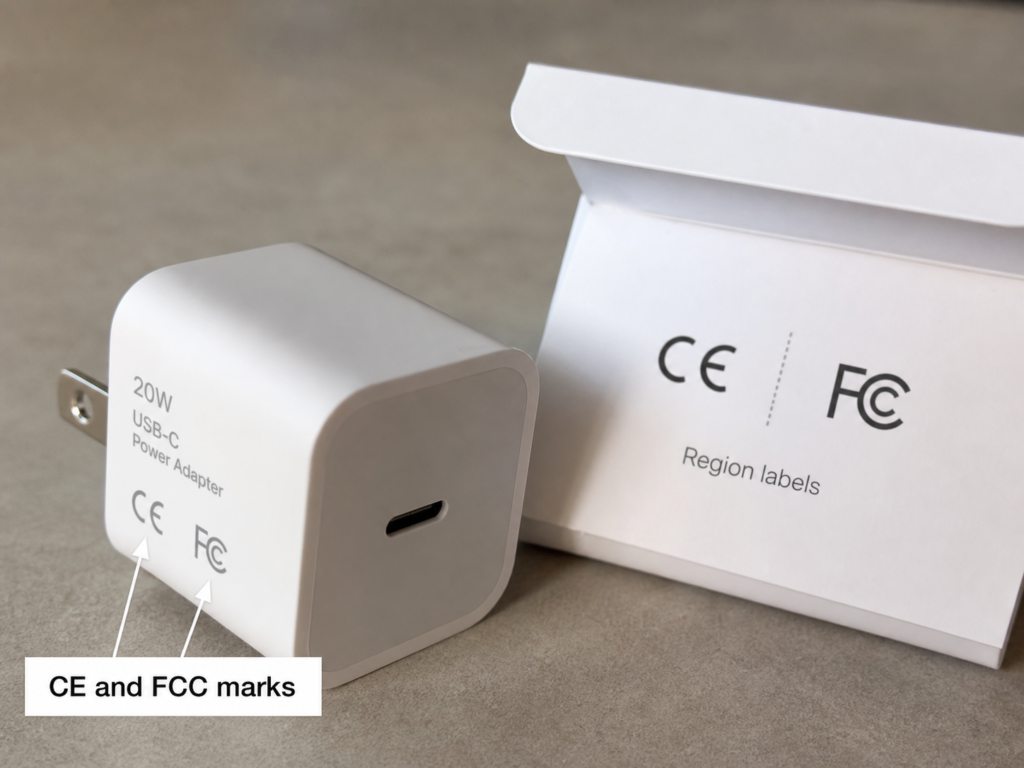
First, let’s clarify the basic concepts of the two certifications to avoid going astray at the beginning.
What is CE Certification
Many people think that CE is an “official certificate”, but it is not — it is a mandatory access compliance declaration for the European Union and the European Economic Area (EEA). In essence, it is a “compliance set” where the manufacturer itself promises that the product meets a series of relevant EU regulations, not a single certificate issued by a certain institution.
Its coverage includes the 27 EU member states, plus the three EEA countries: Iceland, Liechtenstein, and Norway. Special attention should be paid: after the UK’s Brexit, Great Britain still recognizes the CE mark for many products within the specified period and applicable product scope, and UKCA is an available alternative path; Northern Ireland usually continues to apply EU CE rules, and whether UKNI is required depends on specific product regulations and conformity assessment methods. Therefore, before entering the UK market, the applicable mark should be confirmed according to product category and sales region. It cannot be simply said that CE is completely invalid in the UK, nor that all products must switch to UKCA.
For charging products, CE is the basic threshold for legal sales in the EU. Without CE compliance that meets applicable regulatory requirements, goods may face regulatory inspections, e-commerce platforms may require supplementary documents or take down links, and penalties may even be imposed in serious cases.
What is FCC Certification
Now let’s talk about FCC. It is a mandatory equipment authorization and technical requirement formulated by the US Federal Communications Commission for some electronic products. It mainly focuses on electromagnetic interference and radio frequency emission, and is not responsible for the electrical safety of the product itself — for example, whether the charger will leak electricity or catch fire, these are usually not the responsibility of FCC. Safety is covered by voluntary safety certifications such as UL and ETL, as well as other applicable regulations and liability requirements.
It should be noted that not all charging products can be generally classified as “must have FCC”. Whether FCC equipment authorization is required depends on whether the product belongs to digital devices, unintentional radiators, intentional radiators, or other FCC rule categories. For electronic products subject to FCC equipment authorization rules, the applicable authorization procedures must be completed.
FCC-related rules mainly apply to the US market. Neighboring Canada requires ISED certification, and Mexico requires NOM and other corresponding requirements; FCC cannot directly replace them.
For charging products, products with wireless transmission functions such as Bluetooth and Wi-Fi usually require special attention to FCC authorization and FCC ID; for ordinary wired chargers, data cables with circuits, etc., the applicable equipment authorization method should be judged according to their specific circuits and FCC rules, and conclusions cannot be drawn solely from the term “charging product”.
Core Value of Both
Many people equate CE and FCC with “good quality”, which is actually wrong. For sellers and purchasers, these two certifications are essentially market entry tickets — they only prove that the product meets local applicable regulatory requirements and can be sold legally, and do not represent faster charging speed, better durability, or higher quality level.
For ordinary consumers, charging products that meet CE-related requirements usually mean that the product has been evaluated for applicable safety, electromagnetic compatibility and other regulatory requirements; FCC compliance mainly reduces the risk of mutual interference between electronic products, such as reducing interference caused by chargers to radios, headphones or other electronic devices. Neither is a comprehensive quality score.
Applicable Scope for Charging Products
Before the formal comparison, we first clarify the unified reference and coverage to avoid misunderstandings caused by different product types. All our basic comparisons are based on 「ordinary household 20W single-port wired USB-C charger (no wireless function)」 as the benchmark sample, and differences for special products will be marked separately.
In terms of categories, charging products that may be covered by CE and FCC include: wired chargers/power adapters, USB-C data cables with chips, wireless chargers, and charging connectors with circuits. Industrial-grade charging equipment, special-purpose car chargers, and power banks with batteries are not included in this basic comparison because they involve additional regulations and require separate evaluation.
Judgment Criteria for Mandatory Certification (Exclusive to Charging Products)
Many people are most torn about “whether my product needs certification”. In fact, for charging products, it first depends on the product’s own circuit, function, sales method and target market.
As long as it is an active charging product with electronic components and working circuits, such as a charger with a PCB board and control chip inside, it usually needs to evaluate the corresponding compliance requirements for the target market. However, whether FCC is applicable still needs to be judged in combination with specific equipment categories and rules such as Part 15, and all active products cannot be directly classified into the same FCC certification path.
Pure passive ordinary data cables without chips, such as ordinary USB-A to C cables with only copper wires and no E-Marker chip, usually do not involve FCC active circuits or wireless transmission. But if they are placed on the EU market as independent electrical and electronic equipment, they may still involve regulatory requirements such as RoHS. It cannot be simply said that CE-related compliance is completely unnecessary, nor can it be automatically covered by the matching charger. Whether the CE mark is required should be evaluated according to the EU regulations applicable to the data cable itself and the sales method.
In addition, each has special requirements: for typical mains input chargers, CE usually requires evaluation of electrical safety, EMC, RoHS, and meeting the eco-design and energy efficiency requirements of external power supplies when within the applicable scope. FCC mainly focuses on applicable electromagnetic compatibility and radio frequency requirements, and charging safety-related content cannot be replaced by FCC; if channels or platforms require safety certification, voluntary certifications such as UL and ETL need to be considered separately.
Quick Check of Certification Requirements for Different Products
For your quick comparison, we have sorted out the certification requirements of common charging products into a table. The content in the table is the direction of judgment, not a one-size-fits-all conclusion for all models:
| Product Type | CE Certification Requirements | FCC Certification Requirements |
|---|---|---|
| Pure passive ordinary data cable (no chip) | Usually does not involve complex active circuit testing, but when sold as an independent product, applicable requirements such as RoHS still need to be evaluated, and cannot be automatically covered by the charger | Usually does not involve FCC active circuit or wireless transmission requirements, but still needs to be judged in combination with specific products |
| Data cable with E-Marker/conversion chip | Evaluate EMC, RoHS and other applicable requirements according to actual circuit, function and sales form | If it is a digital device subject to Part 15, applicable equipment authorization must be completed; whether SDoC is applicable depends on the specific equipment category and rules |
| Ordinary wired charger | Usually requires evaluation of safety, EMC, RoHS; external power supplies must also meet energy efficiency requirements when within the applicable scope | Complete applicable FCC equipment authorization and electromagnetic emission requirements according to specific equipment categories |
| Wireless/charging products with Bluetooth/Wi-Fi | Wireless transmission functions such as Bluetooth and Wi-Fi are usually subject to wireless equipment conformity assessment according to RED; whether a notified body is required depends on the selected assessment path | Intentional wireless transmission functions such as Bluetooth and Wi-Fi usually require FCC certification and FCC ID; ordinary Qi wireless chargers need to be judged according to operating frequency, transmission method and applicable rules, and some devices may be subject to Part 18 or other rules |
Item-by-Item Comparison of Core Dimensions
After clarifying the basic definitions, we compare the two from several core dimensions. All basic items are based on the 20W single-port wired USB-C charger, and places involving functional changes will be explained separately.
Regulatory Attributes and Legal Basis
CE is a mandatory requirement legislated at the EU level, following the logic of 「manufacturer’s self-declaration of compliance + technical documents and corresponding evidence support」, and the manufacturer bears the main responsibility for product conformity. If the manufacturer is not located in the EU, it can designate an EU authorized representative, but the authorized representative only assumes specific obligations within the scope of written authorization, and cannot be generally understood as taking full responsibility on behalf of the manufacturer. CE has a wide coverage, from electrical safety, electromagnetic compatibility, environmental protection restrictions to wireless equipment requirements — as long as the relevant regulations are applicable, they must be met separately.
FCC is a federal mandatory requirement formulated by the US Federal Communications Commission, which may involve different equipment authorization methods such as Supplier’s Declaration of Conformity (SDoC) or certification. The specific responsible party and document retention obligations shall be judged in accordance with applicable FCC rules. FCC’s jurisdiction is relatively focused, mainly responsible for electromagnetic interference and radio frequency emission, and nothing else.
There is an important change point here: As long as the product has wireless or radio frequency functions, it needs to be evaluated in accordance with applicable wireless regulations and equipment authorization rules, but it does not mean that CE and FCC must be issued by official agencies under any circumstances. Whether a CE product requires a notified body shall be judged according to applicable regulations and the selected conformity assessment procedure; when wireless products are evaluated according to RED, they may also use the manufacturer’s internal production control under the condition of meeting the requirements and adopting corresponding harmonized standards.
Certification Types and Applicable Scenarios
The certification logic of the two is not simply “wired is lenient, wireless is strict”, but the path should be selected according to the product category and applicable rules.
On the CE side, for ordinary wired charging products, such as our benchmark 20W charger, manufacturers can usually complete the conformity assessment in accordance with applicable regulations, prepare technical documents and sign the EU Declaration of Conformity. Third-party laboratory reports are common compliance evidence, but the EU system does not generally require all ordinary wired products to obtain third-party laboratory certificates; under the applicable self-assessment path, manufacturers may also use internal tests or other technical evidence.
Products with wireless functions such as Bluetooth and Wi-Fi usually need to undergo wireless equipment conformity assessment according to RED. Whether the participation of a notified body is required depends on the conformity assessment module selected by the manufacturer, whether the relevant harmonized standards are fully adopted, and the specific regulatory requirements. It cannot be concluded that a notified body certificate must be obtained just because the product has wireless functions.
On the FCC side, the classification depends on specific rules: ordinary wired products may be unintentional radiators or digital devices, and usually need to complete applicable equipment authorization; whether SDoC is applicable should be confirmed according to the equipment category and FCC rules; products with intentional wireless transmission functions such as Bluetooth and Wi-Fi usually need to undergo FCC certification and obtain an FCC ID, with accredited institutions participating in the evaluation and filing. Ordinary Qi wireless chargers cannot determine the path just by the name “wireless charger”, but also need to judge whether it applies to Part 18, Part 15 or other rules.
Because of this, when a product upgrades from wired to wireless, the certification path, cost, and cycle will change, which must be confirmed in advance during the product design stage.
Core Test Requirements (Plain Language Version)
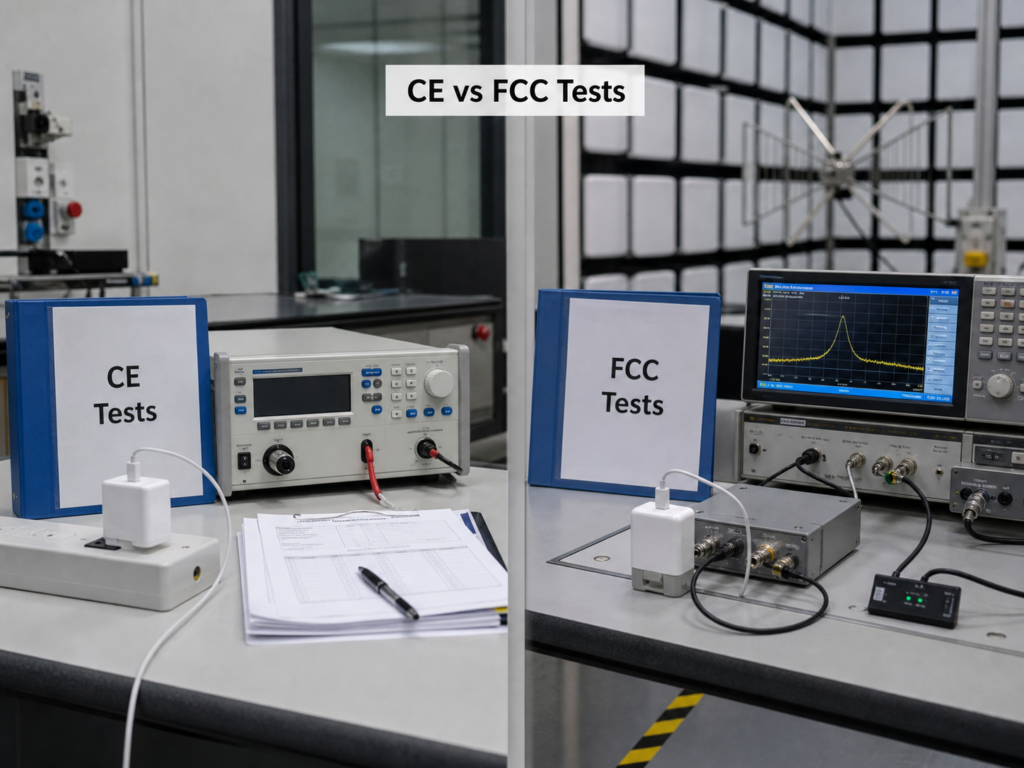
We will explain the test content that everyone is most concerned about in plain language, trying not to use professional terms.
Still taking the 20W wired charger as an example, a typical CE assessment usually includes several core parts:
The first is electrical safety, simply speaking, it is to prevent electric leakage, fire, and excessive temperature during operation. For mains input products within the scope of the Low Voltage Directive (LVD), they need to be evaluated in accordance with relevant safety requirements;
The second is EMC (Electromagnetic Compatibility), which includes two parts: one is that the electromagnetic signal emitted by the product during operation cannot interfere with other electrical appliances (called “emission”), and the other is that the product itself cannot be easily interfered by other electrical appliances (called “immunity”) — for example, when other electrical appliances are working nearby, the charger cannot easily fail;
The third is RoHS, which restricts harmful substances in products, such as lead, mercury, cadmium and other common substances, whose content cannot exceed the limits specified by the EU;
The supplementary item is energy efficiency. When external power supplies are within the applicable scope, they must also meet the EU’s corresponding eco-design and energy efficiency requirements, such as standby power consumption and other indicators. Whether it is specifically applicable should be confirmed item by item in combination with the product’s input and output range, purpose and regulatory exemptions.
The test focus of FCC is mainly on applicable electromagnetic emission and radio frequency requirements, such as conducted emission, radiated emission or wireless emission parameters. It is not responsible for replacing electrical safety, immunity or harmful substance assessment. The specific test items shall be determined according to the equipment category and applicable FCC rules.
It should be noted here that even if both involve electromagnetic emission, the test methods, limits and regulatory purposes may be different, so the reports cannot directly replace each other. However, you can find a laboratory with relevant testing capabilities at the same time, use the same set of qualified samples to test the two sets of requirements separately, reducing repeated sample submission.
If it is a product with wireless functions such as Bluetooth or Wi-Fi, CE usually needs to add radio frequency-related assessments under RED, and FCC also needs to add radio frequency parameter tests, such as transmission power, frequency band used, etc. Ordinary Qi wireless chargers need to first confirm the applicable FCC rules before determining the specific test content.
Process, Cycle and Cost
Let’s talk about the process, cycle and cost that everyone is most concerned about. Here, it cannot be preset that all products have a fixed number of weeks or a fixed price. The actual result will be affected by the product structure, test standards, sample status, number of rectifications, wireless standards and laboratory scheduling.
The basic process of both is roughly: first determine the product category and applicable regulations, then prepare samples and technical materials, complete the corresponding tests or conformity assessment, then prepare compliance declarations, authorization documents or other required materials, and finally complete the marking and go on the market as required.
In terms of cycle, both CE and FCC can only provide estimates by the laboratory for specific models, standards, test scopes and scheduling. Ordinary wired chargers may be simpler than products with wireless functions, but CE cannot be fixed at 2–4 weeks, FCC at 1–3 weeks, nor can it be judged that a certain category must be faster.
There is also no uniform ratio for costs. The quotation for a 20W single-port wired charger may be affected by test items, laboratory qualifications, number of samples and complexity of technical documents; “the difference is within 10%–20%” cannot be used as a general conclusion. Wireless products usually increase test items and document workload, but whether the cost increases by 2–3 times and how much it increases must be based on the specific wireless type, product structure and formal quotation.
Whether it is CE or FCC, the common factors affecting the cycle and cost are almost the same: product power, number of ports, whether it has wireless function, whether rectification is required, laboratory scheduling and data completeness will all affect the final result. Especially when the test fails and rectification is required — for example, changing the chip, modifying the shielding structure, adjusting the circuit, the cycle and cost may increase significantly, which is a hidden cost that many novices easily ignore.
Marking and Compliance Documents
The last core comparison dimension is marking requirements and necessary compliance documents, which are all materials that regulatory agencies and platforms may require to provide.
First look at the marking: the CE mark has clear specifications, with a height of usually at least 5 mm, clear and wear-resistant. It is preferred to be affixed to the product body; for particularly small products, it can be placed on the packaging or manual in accordance with applicable rules. Moreover, the proportion of the CE mark cannot be changed at will — neither widening nor flattening is allowed.
FCC does not have a unified official logo applicable to all products. SDoC products usually need to provide a compliance statement in the manual, packaging or the position required by the rules; if the product is a device that requires an FCC ID, the FCC ID should usually be marked on the device body or allowed positions in accordance with the rules. For devices with limited size, surface or structure, FCC rules may also allow specific alternative marking or electronic marking methods, but must meet the corresponding conditions.
Then look at the necessary compliance documents: on the CE side, you need the EU Declaration of Conformity (DoC), technical documents and evidence that can support the conformity judgment, such as test reports or internal test records. The document retention period and responsible subject shall be implemented in accordance with applicable regulations, and many common EU product regulations require retention for 10 years. On the FCC side, SDoC products require SDoC declarations and corresponding technical materials, and FCC ID products require certification application materials, test reports and database records, etc., which are kept by the responsible party required by the rules for inspection.
There is a common judgment principle for both: the key information such as model, rated power, input and output parameters on the marking and documents must be clearly corresponding to the actually sold product. The model naming does not have to mechanically require each character to be exactly the same, but any hardware, software, radio frequency, power or structural differences that affect compliance must be included in the assessment and kept traceable. If it is a particularly small-sized product (such as a mini charger) and the marking really cannot be pasted, it can be moved to the packaging or manual in accordance with applicable rules, but must be clearly visible.
Compliance Identification Methods (Semi-Proficient Level)
Many people get the certification documents from the supplier and don’t know if they are real or compliant. Below we will explain how to identify them, and after reading, you can avoid many charging certification pitfalls.
How to Judge CE Compliance
First, we need to clarify the biggest misunderstanding: CE does not have a unified official query platform, and ordinary wired charging products usually do not need the so-called “official CE certificate”.
To judge whether CE is compliant, there are three core points:
First, there must be an applicable EU Declaration of Conformity and complete technical documents. Test reports are common compliance evidence, but it cannot be generally considered that all ordinary wired products must have third-party laboratory reports; some applicable self-assessment paths allow manufacturers to use internal tests or other technical evidence;
Second, there must be a clear correspondence between the declaration, technical documents and the actual product, and there should be no differences affecting compliance in information such as rated power, input and output parameters, structure and key components;
Third, whether an EU notified body certificate is required depends on the applicable regulations and conformity assessment modules. When products with wireless or radio frequency functions are evaluated according to RED, they may also use the manufacturer’s internal production control under the condition of meeting the requirements, and it cannot be determined that the certificate must be issued by a notified body just because the product has wireless functions. If a notified body is indeed used, the name, number, assessment scope and relevant documents of the body should be checked.
There is an exclusive pitfall for charging products: many suppliers only test EMC for the CE documents they provide, and do not cover the applicable electrical safety requirements. For typical plug-in chargers with mains input and within the scope of LVD, only EMC reports are usually not enough.
How to Judge FCC Compliance
The judgment of FCC should be divided into different equipment categories and authorization paths.
If it is a product with wireless functions such as Bluetooth and Wi-Fi that requires an FCC ID, you can go to the FCC official database, enter the FCC ID number, and check the corresponding product model, applicant, wireless parameters and authorization scope.
If it is an ordinary wired product or digital device, because SDoC or other equipment authorization methods may be applicable, there may not be a public “certificate entry” that can be directly queried. At this time, you should check the product category, applicable FCC rules, test reports, SDoC declarations or product information on certification materials, and confirm that these materials are consistent with the actual product.
The exclusive pitfall of FCC for charging products is: products with intentional wireless transmission functions such as Bluetooth and Wi-Fi usually cannot rely only on SDoC, and need to complete FCC certification and FCC ID process in accordance with applicable rules. But ordinary Qi wireless chargers cannot be determined to have an FCC ID just by the words “wireless charger”; you should first confirm its operating frequency, transmission method and whether it applies to Part 18, Part 15 or other rules.
Common Non-Compliance Scenarios
We have sorted out several of the most common non-compliance scenarios, you can check them against:
The first is certificate fraud, that is, using the report of a low-power model to pretend to be a high-power one — for example, using the report of a 20W charger as a 65W one, the parameters do not match, and it will be found out as soon as checked;
The second is missing items, for example, CE is missing applicable safety tests, or FCC products with wireless functions such as Bluetooth and Wi-Fi lack due certification materials and only have SDoC;
The third is fake marking, that is, the CE or FCC mark is printed randomly on the product, with no corresponding compliance document support — it is pure fraud;
The fourth is fake CE, that is, using the so-called 「China Export」 mark to pretend to be CE certification. The letter spacing and style of this mark are different from the real CE mark, and many novices are easily deceived;
The fifth is sample inconsistency, that is, the engineering prototype sent for testing uses good components and adds extra shielding, which can pass the test, but during mass production, the quality is cut corners, and the components and structure of the actual product are completely different from the test samples. Even if there is a real report, this is non-compliant.
Practical Selection Logic (Semi-Proficient Level)
After figuring out how to identify, we will talk about how to choose when actually doing certification, how to reduce costs legally, and how to avoid pitfalls.
Select by Sales Region
If you only sell to the EU and EEA regions, you should complete the CE compliance applicable to the product. Ordinary wired chargers usually need to evaluate safety, EMC, RoHS; external power supplies must also meet energy efficiency requirements when within the applicable scope.
If you only sell to the US, you cannot simply say that all charging products only need FCC. For products subject to FCC equipment authorization rules, applicable FCC authorization should be completed; safety certifications such as UL and ETL usually belong to another set of safety evaluation systems, and whether they must be obtained depends on the product category, sales channel, platform, and state or local requirements.
If you sell to both European and American markets at the same time, it is preferred to choose a laboratory or compliance service provider that can cover both relevant CE and FCC test requirements, and prepare samples and materials at the same time, which can reduce repeated sample submission and testing. However, the two sets of regulations still need to be confirmed separately, and one report cannot automatically replace the other set of compliance conclusions.
Precautions by Product Type
For pure passive ordinary data cables, if they are sold separately, it is best to confirm the platform, customs and regulatory requirements of the target market in advance. They usually do not involve FCC active circuits or wireless transmission, but when sold as independent products in the EU, they may still need to evaluate RoHS and other requirements; if they are sold together as charger accessories, it cannot automatically exempt the applicable requirements of the data cable itself, and whether some documents can be shared depends on the product combination and the way of placing on the market.
Data cables with chips (such as USB-C cables with E-Marker, adapter cables with conversion chips) should be evaluated separately for corresponding certifications as active products, and cannot be confused with ordinary passive cables, which is easy to miss items. Whether to adopt SDoC in the US also needs to be confirmed according to the specific equipment category and FCC rules.
Wireless charging products should judge the wireless type and working mode in advance. Ordinary Qi wireless chargers cannot judge the FCC path only by name; if they also have functions such as Bluetooth and Wi-Fi, they usually need to complete CE and FCC evaluations in accordance with the corresponding wireless equipment rules to avoid wrong certification paths.
Key Points for Legal Cost Reduction and Pitfall Avoidance
The methods of legal cost reduction are all within the scope of compliance, don’t go astray:
The first method: for products of the same series with highly similar circuits, you can apply to the laboratory for series evaluation — for example, chargers of different power made with the same solution, only with differences in individual component parameters. The laboratory may judge the test scope based on similarity and risk, which does not mean that each model can be exempted from testing unconditionally;
The second method: when doing CE and FCC certification at the same time, you can share test samples that meet the requirements of both parties, and some test data may also be technically referenced or reused, but compliance materials still need to be issued separately in accordance with their respective standards, limits and document requirements.
But there are some situations that require re-evaluation, you can’t save this money, otherwise it will be non-compliant:
First, the core charging IC or circuit board is replaced, or the rated power is adjusted — for example, changing the original 20W to 33W, you need to re-evaluate relevant safety, EMC and other applicable requirements;
Second, the radio frequency parameters are modified, or the wireless module and antenna are replaced — for example, replacing the original brand A Bluetooth module with brand B, you must re-evaluate;
Third, the shielding structure or shell is replaced, and this change will affect EMC performance — for example, changing a metal shell to a plastic shell may cause excessive radiation, and you need to re-test or conduct supplementary evaluation.
Finally, let’s talk about two points that are easily misunderstood in cross-border compliance: EU customs may conduct inspections based on product categories and risks, and market regulatory authorities or e-commerce platforms may require the provision of DoC, technical documents, test reports and other materials; in the US, FCC equipment import restrictions depend on the specific equipment category, authorization requirements and declaration status. For wireless products, you should first confirm the applicable FCC rules and authorization methods, then check the FCC database and equipment marking, and cannot generalize that customs will definitely directly check a certain document or directly detain all wireless charger products lacking FCC ID.
Clarification of Misconceptions and Applicable Boundaries
Finally, we have sorted out the most common pitfalls and the applicable boundaries of certification — many conclusions are not static, and the requirements will change when the product, region, and sales method change.
Common Beginner Misconceptions
Almost every novice has fallen into these four pitfalls:
The first misconception: treat CE and FCC as quality certifications. Let me emphasize again that they are only regulatory access requirements, the minimum requirement for “legal sale”, and have no direct equal relationship with charging speed, durability, and product quality level;
The second misconception: think that the two can be used across markets. CE and FCC are two completely independent systems, they do not replace each other. To enter the EU, you need to complete applicable CE compliance; to enter the US, you need to complete applicable FCC equipment authorization according to the product category. You can’t have one and travel all over Europe and America;
The third misconception: think that all charging products need the same certification. Pure passive ordinary data cables usually do not involve FCC active circuits or wireless transmission, but when sold independently in the EU, they may still involve RoHS and other requirements; active chargers, data cables with circuits and wireless products need to be evaluated separately, and cannot be generalized;
The fourth misconception: think that having a mark equals compliance. The mark is only part of compliance, and must be supported by applicable declarations, technical documents and other evidence. Just pasting a mark is fake compliance, and problems will arise as soon as it is checked.
Advanced Applicable Boundaries
That is, under what circumstances will the previous conclusions change:
First, product form change: if a passive data cable adds an E-Marker or conversion chip, it changes from a simple passive product to an active product, and needs to re-evaluate the corresponding EU and US requirements;
Second, functional change: after adding wireless functions such as Bluetooth and Wi-Fi to an ordinary wired charger, it usually needs to add RED and FCC wireless equipment evaluation; but the specific path of ordinary Qi wireless chargers still needs to be confirmed according to the operating frequency, transmission method and applicable rules, and it cannot be generally concluded that it must be issued by an agency or must obtain an FCC ID;
Third, change in sales method: data cables sold separately and data cables sold as charger accessories may face different document, marking and combination product judgments. Being an accessory does not automatically exempt the data cable from applicable requirements such as RoHS, nor can it unconditionally share all the compliance conclusions of the charger;
Fourth, regional change: Great Britain of the UK still recognizes CE for many products under specified conditions, and UKCA is an available alternative path; Northern Ireland usually continues to apply EU CE rules, and whether UKNI is required depends on specific product regulations and conformity assessment methods. Canada requires ISED to replace FCC, and you can’t sell directly with CE or FCC;
Fifth, product change: if it is just a change that does not affect the circuit and EMC performance, such as changing the shell color or the outer skin color of the cable, it can usually be confirmed through change assessment whether there is no need to re-test; but if the core components are changed, or the power, wireless module, antenna or structure are modified, it must be re-evaluated.
Distinction of Easily Confused Certifications
There are three other certifications that are most easily confused with CE and FCC, here is a brief distinction:
The first is RoHS. Many people think RoHS is a separate certification. In fact, RoHS is a regulatory requirement of the EU to restrict harmful substances, and relevant products need to be included in the assessment when completing applicable CE compliance. A separate RoHS report is not equal to complete CE compliance, and CE may also include safety, EMC and other content;
The second is UL/ETL. These are common voluntary safety certifications in the US, and are two completely independent systems from FCC. FCC is mainly in charge of electromagnetics and radio frequency, not charging safety, while UL/ETL are mainly used for safety evaluation — don’t confuse them;
The third is USB-IF. This is the compatibility certification of the USB organization, which tests the protocol compatibility, function and performance of USB products, etc. It has nothing to do with the market access requirements of CE and FCC, nor is it a substitute for CE or FCC.
Core Summary
Finally, we提炼 the core content into several easy-to-remember points for your quick recall.
3 core differences for quick memory:
First, different jurisdictions: CE corresponds to the EU and EEA regions, FCC mainly corresponds to the US;
Second, different coverage focuses: CE usually needs to evaluate safety, EMC, environmental protection and wireless requirements according to the applicable regulations of the product, and FCC mainly focuses on electromagnetic interference and radio frequency emission subject to its rules;
Third, the certification path for ordinary wired charging products may be relatively simple: CE may adopt manufacturer self-assessment, and FCC needs to select applicable equipment authorization methods according to the equipment category, and the cycle and cost cannot be preset as fixed values.
After reading this article, you should be able to independently judge three things:
First, what CE or FCC compliance requirements your charging products (chargers, data cables, wireless chargers) need to complete when entering the European and American markets;
Second, whether the CE and FCC certification documents you get are real and compliant, and whether you have stepped into the exclusive pitfalls of charging products;
Third, how to choose the certification path when selling across regions, and how to reduce certification costs on the premise of compliance.
The certification of charging products seems complicated. In fact, as long as you grasp the three core points of 「active or passive, wired or wireless, which region to sell to」, combined with the applicable regulations and equipment categories of the product itself, you will basically not make big mistakes.