
Whether you are an overseas seller running a cross-border business of charging products, or an ordinary consumer who frequently buys digital accessories, you must have seen the CE and UL marks on the body or packaging of chargers, USB-C charging cables, and power adapters. Many people generally regard them as “quality certifications”, and even think they are the same type of certification just for different regions — in fact, the two are very different in nature, requirements, and legal effect.
In this article, we will thoroughly explain the core differences between CE and UL based on the most commonly contacted ordinary consumer-grade charging products (18W-65W conventional chargers, USB-C cables, desktop power adapters, and ordinary charging connectors): from the entry-level “what they are and what they do” to the advanced “how to choose, how to verify, and how to avoid pitfalls”. You can apply what you learn directly after reading.
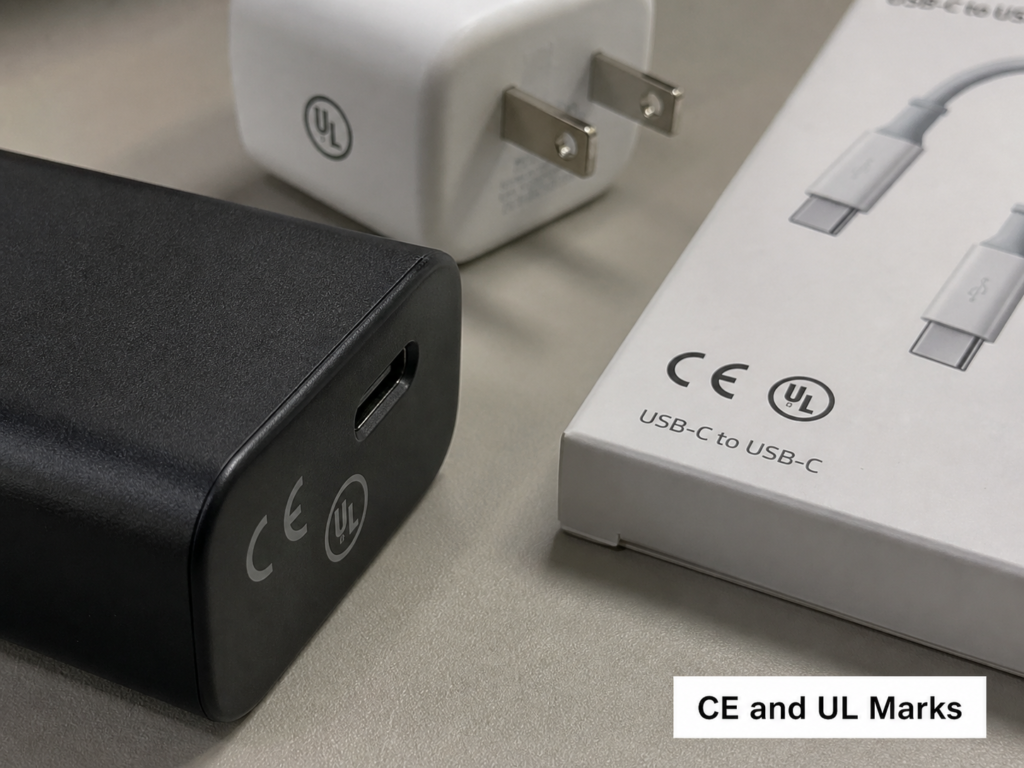
First, Understand the Basics: What Exactly Are CE and UL?
CE Certification: The Compliance Mark for the EU Market
CE can be understood as a compliance declaration made by the manufacturer to the EU market: the product has completed the corresponding conformity assessment under the applicable EU regulatory requirements, and the manufacturer promises that the product meets relevant safety, health, environmental protection or other requirements. It is not a “quality certificate” that covers all items uniformly.
CE mainly applies to the markets of EU member states and the European Economic Area, but whether CE is required specifically depends on whether the product falls within the scope of application of a certain EU harmonized regulation. The Great Britain region of the UK currently continues to recognize compliant CE for many regulated products, but the specific rules, validity periods and product categories need to be confirmed in accordance with UK government regulations; Northern Ireland applies the corresponding CE or CE UKNI rules, so it cannot be generally said that all products entering the UK must separately obtain UKCA.
For charging products, power adapters and other similar products usually need to undergo conformity assessment in accordance with applicable regulations on low voltage, electromagnetic compatibility, restriction of hazardous substances, ecodesign, etc., and affix the CE mark after meeting the conditions. Whether USB-C cables and connectors require an independent CE mark needs to be specifically judged based on their structure, function, operating voltage and sales method. Passive cables or connectors do not automatically apply to all CE regulations just because they “are charging accessories”.
Many people think that CE is a certificate issued by the EU official, but this is not entirely the case. Many ordinary power adapters can complete conformity assessment through the manufacturer’s internal production control, where the manufacturer compiles technical documents, signs the EU Declaration of Conformity (EU DoC), and assumes responsibility for product compliance. Whether the participation of an EU Notified Body is required depends on the applicable regulations and the conformity assessment procedures stipulated therein; it cannot be simply judged by the label of “high-risk charging products”.
UL Certification: A Highly Recognized Safety Credential in the North American Market
UL usually refers to product safety certification or recognition carried out by institutions such as UL in accordance with corresponding standards. It has a high reputation in the US market, and is often used by retailers, installers and consumers to judge whether a product has undergone continuous safety assessment.
The main application markets for UL are the United States and Canada, but the certification marks and applicable standards for Canada need to be confirmed separately. UL can carry out Canadian certification in accordance with applicable Canadian standards, and products may use the cUL mark or the cULus mark that covers both the United States and Canada; whether Canadian requirements are met depends on the specific standards, certification scope and recognition status, and not all products entering Canada will automatically use cUL.
Among charging products, chargers and power adapters are usually categories with high demand for UL safety certification. Whether accessories such as data cables and connectors require UL certification depends on the product category, sales channel, customer requirements and specific certification plans, and it is not mandatory for all channels.
UL certification usually requires testing and evaluation by UL or other certification bodies with corresponding qualifications and scope, and factory and product consistency supervision shall be carried out in accordance with project requirements. Enterprises cannot use the UL mark solely based on their own declaration.
3 Basic Misconceptions That Beginners Must Clear Up
Many people are prone to fall into these 3 pitfalls when they first get in touch with certification. Let’s clarify them in advance to avoid getting more confused later:
- Misconception 1: CE is a certificate issued by the EU official — No. CE is essentially a compliance mark. For many ordinary charging products, the manufacturer can complete the required conformity assessment and make a self-declaration, but it is still necessary to prepare technical documents and the EU DoC, and be responsible for the authenticity and continuous compliance.
- Misconception 2: UL is a mandatory certification under US law — Not entirely correct. At the US federal level, there is usually no requirement that all charging products must bear the UL mark, but US regulations, state or local installation rules, retailers and platforms may require applicable NRTL safety certification or relevant test documents. Whether UL, ETL, CSA, etc. are accepted shall be verified according to the current policies of specific products and channels.
- Misconception 3: Having CE/UL means the product is of good quality — Completely wrong. These marks mainly indicate that the product has completed the safety or regulatory conformity assessment within the corresponding scope, and do not automatically mean that performance such as charging speed, durability, and data transmission speed is better. For example, a charger with UL certification may pass the safety assessment, but its charging speed may still be inferior to another product.
Applicable Product Scope of This Article
All conclusions in this article are for ordinary consumer-grade 18W-65W conventional chargers, USB-C cables, desktop power adapters, and ordinary charging connectors. For industrial-grade, medical-grade, vehicle-grade charging products, or products with special functions such as wireless charging and smart control, the requirements will be different and need to be evaluated separately.
In addition, there are several independent compliance items that are easily confused with CE and UL: for example, the FCC rules in the North American market, which mainly involve electromagnetic interference and equipment authorization of specific digital devices or radio frequency devices; USB-IF involves compatibility certification of corresponding USB specifications; the UK market may also involve UKCA. These do not belong to the scope of CE or UL themselves, and their matching requirements will also be mentioned later.
Unify the Caliber Before Comparison: Avoid Absolute Conclusions
Before the official item-by-item comparison, we must first clarify the benchmark for comparison — after all, certification requirements may vary greatly for different products and different sales scenarios, to avoid everyone taking special cases as general conclusions.
Our comparison benchmark is: ordinary consumer-grade charging products of 65W and below, for mass retail scenarios, following the latest general compliance requirements of each region, excluding customized requirements of special customers and special channels. If the product has higher power, special functions, or the sales scenario is relatively special (such as public installation, industrial use), the conclusions may be adjusted, and specific analysis is required for specific situations.
We will compare from 4 most practical dimensions: access nature and legal status, test requirements and coverage, certification process and cost & cycle, mark use and supervision method.
Item-by-Item Comparison of Core Differences (General for Charging Products)
1. Access Nature and Legal Status: Regulatory Requirements vs. Market Driven
This is the most intuitive difference between the two.
For products that fall within the scope of application of relevant EU harmonized regulations, manufacturers must complete conformity assessment, sign the EU DoC, and affix the CE mark as required before placing the products on the EU market. If customs or market supervision authorities find that the product lacks applicable marks, has insufficient documents, or has safety risks, they may take measures such as suspending release, recalling, and removing from shelves. However, CE is not a mark that automatically applies to all charging items, nor can it be simply summarized as “customs will definitely detain goods without CE”.
UL is different: at the US federal level, there is usually no legal mandatory requirement that all charging products must have the UL mark. However, US regulations, state or local installation rules, retailers and platforms may require applicable NRTL safety certification or relevant test documents. Whether UL, ETL, CSA, etc. are accepted shall be verified according to product type, sales scenario and current channel policies.
Take a more prudent example: if you want to sell a power adapter that falls within the scope of CE regulations in the EU, you need to first complete the corresponding EU compliance assessment and affix the CE mark as required; if you want to sell chargers through US e-commerce or retail channels, you should first confirm whether the channel requires NRTL safety certification such as UL, ETL, CSA, and what documents need to be submitted. You cannot assert that all charging products on Amazon or Walmart must be UL certified.
Of course, there are exceptions: some US states, local governments or public installation scenarios may require recognized safety certification; some EU products may also require the participation of a Notified Body in accordance with applicable regulations and conformity assessment modules. Specific requirements cannot be judged only by product name or power.
2. Test Requirements and Coverage: Applicable Regulation Combination vs. Safety Certification Items
This is the most essential content difference between the two.
CE is not a “comprehensive certification” that completes all requirements uniformly. For ordinary mains power adapters, it is often necessary to evaluate applicable regulations such as low voltage safety (LVD), electromagnetic compatibility (EMC) and restriction of hazardous substances (RoHS) separately; some products may also involve ecodesign, radio equipment or other regulations. Only after all applicable requirements are met can the manufacturer sign the DoC and affix the CE mark. RoHS is usually a regulatory compliance requirement that manufacturers need to bear, which does not mean that there is a unified “CE agency” that completes RoHS certification for you.
Product certifications such as UL Listed usually take electrical safety as the core, but specific items shall be subject to applicable product standards and certification scope. Digital devices or radio frequency devices in the United States also need to complete corresponding equipment authorization or conformity procedures in accordance with FCC rules; for restricted substance requirements, applicable regulations and evidence shall also be confirmed separately. Therefore, it is impossible to absolutely limit all UL items to “only safety regulations”, nor can FCC be simply described as a unified certification covering all North American EMC matters.
Some information technology equipment such as power adapters may adopt EN IEC 62368-1 or corresponding North American standards, but the final standard to be adopted depends on the product category, structure, input and output conditions and certification plan. USB cables and connectors cannot be uniformly judged according to 62368, and the specific standards need to be confirmed according to the product type.
There is another special case for charging products: whether USB-C cables require an independent CE mark and what tests are required depends on their electrical structure and function. Passive cables cannot be uniformly treated as LVD; if they have E-Marker or other active circuits, corresponding EMC, RoHS and other applicable requirements also need to be evaluated.
The test items of UL cable or connector certification are also subject to specific applicable standards, which may include flame retardancy, mechanical or plug and unplug, electrical and structural safety items. It is impossible to describe a certain type of test as a unified requirement for all USB-C cables or all UL certifications.
For charging products with wireless and smart functions, CE may also need to evaluate additional regulations such as radio equipment; for high-power fast charging products, UL items may also add overload, temperature rise or other safety assessments according to applicable standards. Specific items must be subject to product standards and certification scope.
3. Certification Process and Cost & Cycle: Self-Declaration vs. Institutional Audit
Due to different natures, the processes, costs and cycles of the two are also very different. Here we still take an ordinary 65W charger as an example, but do not take the following time and cost as a fixed quotation.
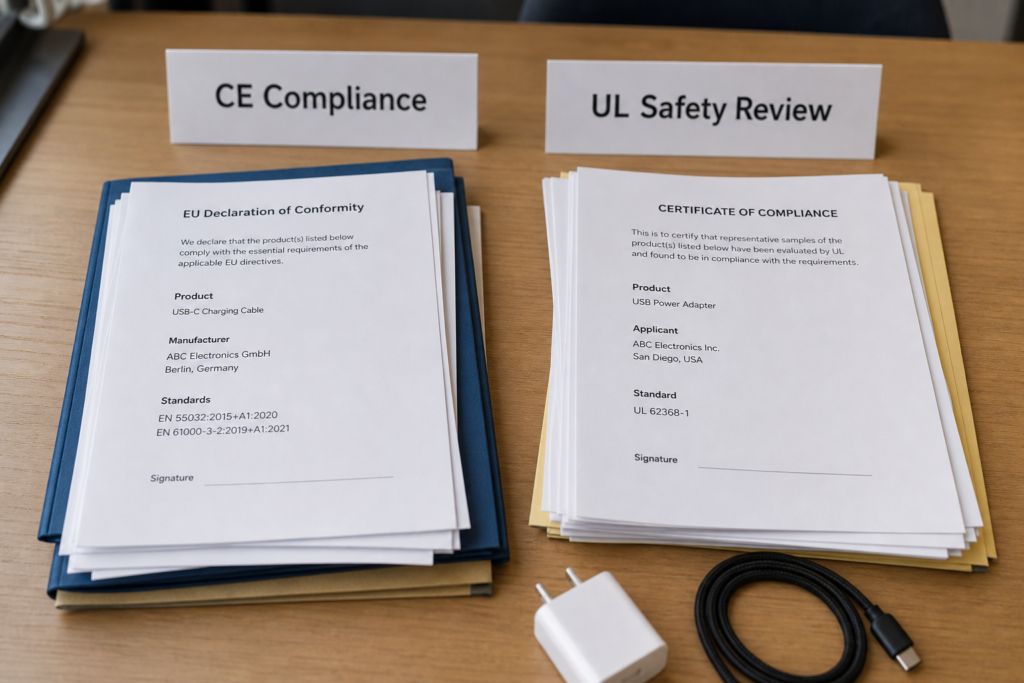
Different Issuing Entities
For ordinary power adapters with CE, conformity assessment may be completed through the manufacturer’s internal production control: enterprises need to prepare technical documents, test and analysis evidence in accordance with applicable regulations, sign the EU DoC, and assume responsibility for continuous compliance. If applicable regulations stipulate that a certain assessment module must involve a Notified Body, the corresponding Notified Body shall execute the specified assessment procedures. A Notified Body does not necessarily just “issue certificates” simply.
UL usually requires testing and evaluation by UL or other certification bodies that meet corresponding qualifications and scope, and complete initial factory assessment and subsequent follow-up services in accordance with project requirements to confirm that products and production processes can continuously meet certification requirements.
Different Factory Inspection Requirements
The CE self-declaration mode usually does not have a unified mandatory annual factory inspection, but manufacturers must retain technical documents, control production consistency, and re-evaluate when products change. If a Notified Body is involved, the inspection and supervision methods are determined by applicable regulations and assessment modules.
UL certification usually includes continuous factory follow-up inspections and product consistency supervision implemented in accordance with project regulations. The frequency and method of inspection may vary, and the specific arrangement depends on the certification agreement and applicable standards. It cannot be generally said that all projects are inspected once a year.
Cost and Cycle Reference
There is no unified fixed value for the cycle, cost of CE and UL projects, and the cost saving ratio that may be generated by dual certification. The actual quotation will be affected by factors such as product structure, applicable standards, number of interfaces, sample rectification, quality of technical documents, number of factories, certification marks and market requirements.
CE self-declaration does not mean a fixed 1-2 weeks; if supplementary testing, rectification or improvement of technical documents is required, the time may be significantly extended. For projects requiring the participation of a Notified Body, the cycle and cost also depend on the specific assessment module and the arrangement of the body.
There is no universally applicable 4-8 week cycle for UL projects. In addition to testing and rectification, it may also involve factory assessment, follow-up services, mark use and subsequent supervision. Dual-market projects can sometimes share part of the technical data or test basis, but how much cost can be saved must be evaluated by specific laboratories or certification bodies, and the 15%-20% ratio cannot be directly applied.
4. Mark Use and Supervision Method: Market Supervision vs. Continuous Oversight
The mark styles, use requirements and supervision logic of the two are not exactly the same.
Mark Styles
The CE mark is the “CE” character with a fixed graphic proportion. In some cases, if regulations require a Notified Body to participate in the conformity assessment, the four-digit identification number of the Notified Body may also appear after the CE mark; ordinary self-declared products do not necessarily have this number.
For UL marks, it is necessary to distinguish between product certification and component recognition. UL Listed is usually used for complete products; UL Recognized is usually used for parts or components, and cannot be directly regarded as whole-machine certification. Many merchants use the UL recognition of components to impersonate the UL certification of the whole machine, and we will specifically talk about how to avoid this pitfall later.
Mark Use Requirements
The CE mark shall be affixed to the product or nameplate in a clear, readable and indelible manner in accordance with applicable regulations. Only when it is impossible or unsuitable to mark on the product due to the nature of the product can it be placed on the packaging or accompanying documents in accordance with regulations. You cannot default to printing the CE mark on the USB-C connector just because the cable is thin; the connector area, readability and permanence all need to meet applicable requirements.
The UL mark must be used in accordance with the mark, additional information and location requirements specified by UL for the product category. Not all products must have the UL file number and certification type printed publicly next to the mark. When verifying, you should check the certification scope, model, production factory and mark type in the official UL directory, instead of just looking at a number or the appearance of the mark.
Supervision Methods
CE mainly relies on the manufacturer’s conformity responsibility and the inspections of market supervision authorities in EU member states. When supervision authorities find that a product has mark, document or safety problems, they may require supplementary information, restrict sales, recall or remove the product from shelves.
UL certification usually includes continuous factory follow-up inspections and product consistency supervision implemented in accordance with project regulations. If the product or production process no longer meets the certification requirements, the use of the mark may be suspended or revoked. Whether market sampling is conducted and how the inspection frequency is arranged depends on the specific certification agreement and service items.
To facilitate a quick review, we have sorted out the core differences in the following table:
| Comparison Dimension | CE | UL |
|---|---|---|
| Applicable Regions | EU and European Economic Area; the Great Britain region of the UK continues to recognize compliant CE for many products, specific confirmation shall be made in accordance with UK rules | Mainly for the United States and Canada; corresponding marks such as UL, cUL or cULus may be used |
| Access Nature | For products falling within the scope of relevant EU harmonized regulations, the CE mark shall be affixed as required after completing conformity assessment | At the US federal level, it is usually not mandatory for all products, but regulations, state and local rules, and channels may require NRTL certification or documents |
| Test Scope | Evaluate applicable requirements such as LVD, EMC, RoHS, and ecodesign separately according to the product, not a unified certificate | Usually centered on product safety, the specific scope is subject to applicable standards, certification plans and project requirements |
| Issuing Entity | For many products, the manufacturer can complete internal conformity assessment; a Notified Body participates when required by regulations | Usually tested, evaluated and supervised by UL or other certification bodies with corresponding qualifications and scope |
| Factory Inspection | No unified annual factory inspection requirement, specifically depends on regulations, assessment modules and manufacturer control | Usually there are continuous factory follow-up inspections implemented in accordance with project regulations, with frequency varying by project |
| Cost and Cycle | No unified fixed cycle or cost, depends on regulations, standards, documents and rectification situation | No unified fixed cycle or cost, depends on standards, factory assessment, follow-up services and certification scope |
Exclusive Certification Requirements for Charging Products (Distinguished by Category)
The above are general differences. For different charging product categories, CE and UL requirements also have their own focuses:
Chargers/Power Adapters
These are the two types of products with the most concentrated compliance requirements.
For CE, it is usually necessary to evaluate applicable requirements such as low voltage safety, EMC, and RoHS according to the product’s input and output, voltage, structure and function; some products may also involve ecodesign energy efficiency requirements. You cannot simply apply exactly the same set of regulations to all chargers.
For UL, the specific safety standards adopted depend on the product category and certification plan, which may involve UL 62368-1, UL 1310, UL 998 or other applicable standards. The evaluation content may include overload protection, insulation performance, operating temperature rise and material flame retardancy, but the final items are subject to applicable standards.
It should be particularly noted that multi-port fast chargers usually need to be evaluated for single-port output, total power distribution, and temperature rise and protection performance when multiple ports are used at the same time, to avoid overload or abnormal heating during actual use.
USB-C/Charging Data Cables
Many people check whether there is CE or UL when buying cables, but in fact, the requirements of the two for cables are different from those for chargers.
Whether a USB-C cable requires an independent CE mark and what tests are required depend on its electrical structure, whether it has an E-Marker or other active electronic components, whether it has data and signal functions, and the sales method of the product. Passive cables cannot be uniformly treated as LVD; for products with E-Marker or other active circuits, corresponding EMC, RoHS and other applicable requirements also need to be evaluated.
The test items of UL cable or connector certification are determined by specific applicable standards and certification categories, which may include flame retardancy, mechanical or plug and unplug, electrical and structural safety. It is impossible to describe a certain test as a unified requirement for all USB-C cables.
Here we want to remind everyone: CE or UL related assessments mainly solve regulatory and safety issues, and do not automatically prove that the cable supports a certain fast charging power or high-speed data transmission. E-Marker, USB Power Delivery, data rate and compatibility shall be verified according to USB Type-C/USB PD specifications and product claims. USB-IF certification can be used as evidence of corresponding USB specification certification, but it is not the legal or only proof of all fast charging functions.
Charging Connectors/Interface Components
These are the interface parts we often refer to, such as USB-C male plugs and female sockets, most of which are sold as accessories or components.
Whether a connector requires an independent CE mark shall be judged according to whether it constitutes a regulated device, operating voltage, function and sales method. You cannot directly assume that it must be separately affixed with CE just because it is ultimately used in a charger.
For UL, connectors may adopt component recognition methods such as UL Recognized. The focus and test items depend on specific standards, which may involve material flame retardancy, mechanical or plug and unplug, electrical and structural safety.
There is a very important note here: UL recognition of a component does not mean that the whole product using this component has UL certification — to obtain UL certification for the whole machine, a separate whole-machine assessment is still required. Many merchants use “uses UL-recognized interfaces” to impersonate “the whole machine has UL certification”, so be very careful about this.
How to Use in Actual Scenarios: Rules for Cross-Border Sales/Purchase
After talking about the differences, what everyone is most concerned about must be: I want to sell/buy charging products, which certification should I use? Let’s talk about it by different markets:
EU Market: CE Is the Basic Access Requirement for Applicable Products
If you want to sell charging products that fall within the scope of CE regulations to the EU, you must complete the corresponding conformity assessment, prepare technical documents, sign the EU DoC, and affix the CE mark as required before placing the products on the market. If customs or market supervision authorities find that the mark is missing, documents are insufficient, or the product has risks, they may take measures such as suspending release, recalling, and removing from shelves.
However, it should be noted that CE is only part of the compliance of product-related regulations, and having a CE mark does not mean everything is fine. In addition to product CE-related regulations, it is also necessary to check REACH restriction or SVHC information obligations, RoHS, packaging producer responsibility, and recycling and registration requirements of each member state according to the product and supply chain situation. REACH does not mean that all finished products must be separately registered for chemicals, and packaging responsibilities may also vary due to the systems of member states.
North American Market: UL Is a Common Safety Certification Option
If you want to enter the North American market, UL is a highly recognized safety certification option, but not all charging products are uniformly required to have the UL mark by US federal law.
US regulations, state or local installation rules, retailers and platforms may require applicable NRTL safety certification or relevant test documents. For NRTLs such as UL and ETL that are recognized by OSHA and carry out certification within the scope of corresponding standards, their marks can usually be used as alternative safety certification when meeting the corresponding US regulatory requirements; whether they are accepted by a certain channel and the specific requirements of the Canadian market still need to be verified separately. CSA also involves the Canadian certification system and cannot be summarized only by the US NRTL identity.
In addition, separate confirmation shall be made according to whether the product is a digital device or radio frequency device under FCC jurisdiction, whether it triggers energy efficiency rules such as US federal DOE or California CEC, and applicable Canadian regulations. Not all products adopt the same “certification” procedure for FCC, and CEC is not a unified certification for all chargers sold in North America. UL itself also cannot represent the completion of all North American compliance.
Global Layout: Optimization Plan for CE+UL Dual Certification
If your products are to be sold in both the EU and North America, you can evaluate CE and UL projects together during the product design stage to reduce repeated rectifications later due to changes in plugs, insulation structures, labels or components.
However, CE and UL marks are not interchangeable on ordinary charging products. Although there are mutual recognition arrangements for conformity assessment in specific fields between the EU and the US, this does not mean that CE and UL marks are mutually recognized for all charging products, nor does it automatically exempt from the regulatory, testing and channel requirements of the target market.
Projects in the two regions can sometimes share part of the technical data or test basis, but whether cost can be saved in the end must be evaluated by specific laboratories or certification bodies according to product structure, applicable standards, number of factories and certification scope, and a fixed saving ratio cannot be directly applied. It is best to consider the plug styles, label requirements and test details of the two regions at the same time during the product design stage, and do not wait until CE is completed to make major modifications for UL, otherwise it may increase the cost of mold modification and retesting.
Intermediate Improvement: Certification Selection, Authenticity Verification and Pitfall Avoidance
If you not only need to understand what they are, but also know how to choose, verify and avoid pitfalls, you must read this part carefully.
3-Step Decision-Making Method for Certification Selection
It’s very simple, just follow along:
- Look at the target sales market — when selling to the EU, first judge whether the product falls within the scope of CE regulations, and complete CE compliance as required; when selling to North America, confirm whether NRTL safety certification such as UL, ETL, CSA is required; if doing both markets, evaluate the requirements of both regions at the same time.
- Look at channel requirements — first ask clearly whether the platform you want to enter, or your customer, has clearly specified certification types and documents. Requirements may vary for different platforms, product categories and policy versions. You cannot just listen to the supplier say “with UL, it will definitely be listed”.
- Look at product positioning — for high-end, high-power products or products with more complex installation scenarios, channels may require more complete third-party assessment; for entry-level products, you should first meet the actual requirements of the target market and sales channels, and do not regard marks unrelated to the product as quality assurance.
Operable Verification Steps for Certification Authenticity
There are many fake certifications now, especially for popular categories such as charging products. Here are a few practical verification methods:
CE Certification Verification
For CE products, there is not necessarily a “CE certificate” in a unified format. For products in self-declaration mode, suppliers should be required to provide the applicable version of the EU DoC, check the manufacturer, product model, applicable regulations and standards, and request access to relevant test and technical evidence when necessary. Technical documents are usually compiled and kept by the manufacturer, and it is not necessary to hand over the complete technical document package to ordinary buyers in all cases.
If applicable regulations require the participation of a Notified Body, the identity and authorization scope of the body shall be verified in the EU NANDO database. NANDO is mainly used to confirm Notified Bodies and their authorized regulations or product scopes, and is not a unified validity period query database for all CE documents or certificates. Most self-declared CE products also do not have a unified CE certificate number.
UL Certification Verification
Verification of UL certification cannot only look at the mark or a string of numbers on the product. It should be checked in the official UL directory:
- Certification type and mark scope, whether it is Listed or Recognized;
- Whether the product model is consistent with the actual product;
- Whether the production factory is consistent with the certification information;
- Whether the standards, restrictions and product scope covered by the certification match.
For charging products, there are two most common pitfalls to be wary of: first, merchants use separate RoHS test reports to impersonate complete CE compliance documents — RoHS reports cannot replace the assessment of other applicable regulations; second, merchants use UL Recognized recognition of components to impersonate UL Listed certification of the whole machine.
Fake certifications generally have several characteristics: there is insufficient product identification and test evidence in the report, the product model does not match the actual product, and the qualification scope of the issuing or assessment body does not match. In these cases, further verification is required.
Common Causes and Judgment of Certification Invalidation
Many people think that once certification is done, it is valid for life, but this is not the correct understanding.
- Situations where CE requires re-evaluation: product modification, such as replacing chips, interfaces or key structures; changes in applicable regulations; technical documents cannot prove that the product continues to meet requirements.
- Situations where UL requires re-evaluation: changes in product structure or materials that are not reported as required; factory inspection or product consistency supervision does not meet requirements; failure to meet follow-up services, fees or other conditions in the specific certification agreement.
Standard updates cannot be simply equated with automatic invalidation of certification. Whether measures need to be taken depends on the citation status of the old and new standards, the revocation date of the old standard, transition arrangements and whether applicable regulations change.
For charging products, the most common risk is still: replacing the power chip of the charger, or replacing the USB-C interface supplier without redoing the certification assessment. Even if the product appearance remains unchanged, changes in key components may affect the original safety and EMC conclusions, so you should first confirm with the responsible assessment body or compliance personnel.
Advanced Cognitive Misconceptions That 90% of People Are Prone to Fall Into
- Misconception 1: CE and UL are interchangeable — No. The two are different in applicable regions, regulatory systems and assessment scopes. Even if there are mutual recognition arrangements for conformity assessment in specific fields between the EU and the US, this does not mean that CE and UL marks are interchangeable for ordinary charging products, and specific assessment must still be made in accordance with target market regulations and channel requirements.
- Misconception 2: UL is the only safety certification in North America — No. For NRTLs such as ETL and UL that are recognized by OSHA and carry out certification within the scope of corresponding standards, their marks can usually be used as alternative safety certification when meeting the corresponding US regulatory requirements. Whether they are accepted by specific channels and the specific requirements of the Canadian market still need to be verified separately.
- Misconception 3: Having CE/UL means the product supports fast charging — To emphasize again, these marks mainly solve safety and regulatory compliance issues, and are not the same thing as fast charging speed and data transmission speed. To confirm fast charging performance, verification shall be carried out according to USB Type-C, USB PD specifications and actual product claims; USB-IF certification can provide certification evidence for corresponding USB specifications, but it is not the legal or only proof of all fast charging functions.
- Misconception 4: Certification is valid for life once done — No. Product modification, regulatory changes, insufficient technical documents, non-compliance of factory follow-up services, or failure to meet the conditions of specific certification agreements may lead to the need for re-evaluation, or even suspension or revocation of mark use.
Summary
We summarize the core difference between the two in one sentence: CE is a compliance declaration and market mark made by the manufacturer for applicable EU regulations. The specific coverage of safety, EMC, environmental protection or energy efficiency requirements shall be judged separately by product; UL is a common third-party certification system in North America centered on product safety assessment, and its specific scope also depends on standards and certification plans, and cannot represent the completion of all North American compliance.
After reading this article, you should be able to do these things independently: you can distinguish the essential difference between CE and UL, and will not be misled by the most basic misconceptions; you can initially judge which compliance items need to be evaluated according to the target sales market, product structure and channel requirements; you can understand the CE and UL marks on products, and know how to verify relevant information through the EU DoC, NANDO and UL official directories; you can judge whether re-evaluation is needed after charging product modification or standard changes, to avoid the risk of invalidation due to insufficient documents, product changes or failure to meet certification conditions; when communicating with suppliers and certification bodies, you can also ask the right questions and will not be easily fooled.